


2 Samuel 20:10
Bible text: King James Version (1769 Blayney text) · Public domain
Bible text: King James Version with Strong's numbers · Public domain
Bible text: Berean Standard Bible · Public domain
Bible text: American Standard Version (1901) · Public domain
Bible text: World English Bible, Messianic edition · Public domain
Bible text: Geneva Bible (1599) · Public domain
Bible text: Young's Literal Translation · Public domain
- וַעֲמָשָׂאva·'a·ma·Sa'and AmasaH6021Conj-w ¦ N-proper-mNoun Proper MasculineוַandעֲמָשָׂאAmasa
- לֹאlo'notH3808NegParticle Negative
- נִשְׁמַרnish·Marhe took heedH8104V-Niphal-Perf-3msVerb Niphal Perfect 3rd Singular Masculine
- בַּחֶרֶבba·Che·revto the swordH2719Prep-b ¦ N-fsNoun Singular Feminine Absoluteבַּto theחֶרֶבsword
- אֲשֶׁר'a·SherwhichH834RelParticle Relative
- בְּיַדbe·yad[was] in [the] hand ofH3027Prep-b ¦ N-cscNoun Singular common gender Constructבְּ[was] inיַד[the] hand of
- יוֹאָבyo·'AvJoabH3097N-proper-mNoun Proper Masculine
- וַיַּכֵּהוּvai·ya·ke·Huand he struck himH5221Conj-w ¦ V-Hiphil-ConsecImperf-3ms ¦ 3msVerb Hiphil Consecutive Imperfect 3rd Singular Masculineוַandיַּכֵּhe struckהוּhim
- בָהּvahwith <the> itPrep-b ¦ 3fsSuffix Personal 3rd Singular Feminineבָwith <the>הּit
- אֶל'elintoH413PrepPreposition
- הַחֹמֶשׁha·Cho·meshthe bellyH2570Art ¦ N-msNoun Singular Masculine Absoluteהַtheחֹמֶשׁbelly
- וַיִּשְׁפֹּךְvai·yish·Pokhand he poured outH8210Conj-w ¦ V-Qal-ConsecImperf-3msVerb Qal Consecutive Imperfect 3rd Singular Masculineוַandיִּשְׁפֹּךְhe poured out
- מֵעָיוme·'Avhis bowelsH4578N-mpc ¦ 3msNoun Plural Masculine Constructמֵעָיbowelsוhis
- אַרְצָה'Ar·tzah[the] ground towardsH776N-fs ¦ SfxNoun Singular Feminine Absoluteאַרְצָ[the] groundהtowards
- וְלֹאve·lo'and notH3808Conj-w ¦ NegParticle Negativeוְandלֹאnot
- שָׁנָהSha·nahhe repeatedH8138V-Qal-Perf-3msVerb Qal Perfect 3rd Singular Masculine
- לוֹloto <the> himPrep-l ¦ 3msSuffix Personal 3rd Singular Masculineלto <the>וֹhim
- וַיָּמֹתvai·ya·Motand he diedH4191Conj-w ¦ V-Qal-ConsecImperf-3msVerb Qal Consecutive Imperfect 3rd Singular Masculineוַandיָּמֹתhe died
- וְיוֹאָבve·yo·'Avand JoabH3097Conj-w ¦ N-proper-mNoun Proper MasculineוְandיוֹאָבJoab
- וַאֲבִישַׁיva·'a·vi·Shaiand AbishaiH52Conj-w ¦ N-proper-mNoun Proper MasculineוַandאֲבִישַׁיAbishai
- אָחִיו'a·Chivhis brotherH251N-msc ¦ 3msNoun Singular Masculine Constructאָחִיbrotherוhis
- רָדַףra·Dafhe pursuedH7291V-Qal-Perf-3msVerb Qal Perfect 3rd Singular Masculine
- אַחֲרֵי'a·cha·ReiafterH310Adj-mpcAdjective Numerical Plural Masculine Construct
- שֶׁבַעShe·va'ShebaH7652N-proper-mNoun Proper Masculine
- בֶּןben[the] son ofH1121N-mscNoun Singular Masculine Construct
- בִּכְרִיbikh·RiBicriH1075N-proper-mNoun Proper Masculine
English is a literal word-by-word gloss of the Hebrew, not the KJV's wording. Why?
This is the original text the KJV's translators worked from — each Hebrew word with its own literal English meaning in this verse, prepared by scholars at Tyndale House, Cambridge. The KJV translates whole sentences, not word by word, so its wording differs: one Hebrew word can become several English words, and the KJV may choose “the LORD” where the gloss reads “Yahweh”. Both are faithful — they answer different questions. For the KJV's own rendering, switch to the KJV text.
Details
See on the biblical-era maps

Study this verse
Public-domain commentary
Matthew Henry
From his Commentary on the Whole Bible. Henry comments on passages, not single verses — this entry covers 2 Samuel 20:4–13. His two-level outline is real structure in the source text, so it is rendered as structure.
We have here Amasa's fall just as he began to rise. He was nephew to David (Sa2 17:25), had been Absalom's general and commander-in-chief of his rebellious army, but, that being routed, he came over into David's interest, upon a promise that he should be general of his forces instead of Joab. Sheba's rebellion gives David an occasion to fulfil his promise sooner than he could wish, but Joab's envy and emulation rendered its fulfillment of ill consequence both to him and David.
I.Amasa has a commission to raise forces for the suppressing of Sheba's rebellion, and is ordered to raise them with all possible expedition, Sa2 20:4. It seems, the men of Judah, though forward to attend the king's triumphs, were backward enough to fight his battles; else, when they were all in a body attending him to Jerusalem, they might immediately have pursued Sheba, and have crushed that cockatrice in the egg. But most love a loyalty, as well as a religion, that is cheap and easy. Many boast of their being akin to Christ that yet are very loth to venture for him. Amasa is sent to assemble the men of Judah within three days; but he finds them so backward and unready that he cannot do it within the time appointed (Sa2 20:5), though the promotion of Amasa, who had been their general under Absalom, was very obliging to them, and a proof of the clemency of David's government.
II.Upon Amasa's delay, Abishai, the brother of Joab, is ordered to take the guards and standing forces, and with them to pursue Sheba (Sa2 20:6, Sa2 20:7), for nothing could be of more dangerous consequence than to give him time. David gives these orders to Abishai, because he resolves to mortify Joab, and degrade him, not so much, I doubt, for the blood of Abner, which he had shed basely, as for the blood of Absalom, which he had shed justly and honourably. "Now (says bishop Hall) Joab smarteth for a loyal disobedience. How slippery are the stations of earthly honours and subject to continual mutability! Happy are those who are in favour with him in whom there is no shadow of change." Joab, without orders, though in disgrace, goes along with his brother, knowing he might be serviceable to the public, or perhaps now meditating the removal of his rival.
III.Joab, near Gibeon, meets with Amasa, and barbarously murders him, Sa2 20:8-10.
It should seem, the great stone in Gibeon was the place appointed for the general rendezvous. There the rivals met; and Amasa, relying upon his commission, went before, as general both of the new-raised forces which he had got together, and of the veteran troops which Abishai had brought in; but Joab there took an opportunity to kill him with his own hand; and,
1.He did it subtilely, and with contrivance, and not upon a sudden provocation. He girded his coat about him, that it might not hang in his way, and girded his belt upon his coat, that his sword might be the readier to his hand; he also put his sword in a sheath too big for it, that, whenever he pleased, it might, upon a little shake, fall out, as if it fell by accident, and so he might take it into his hand, unsuspected, as if he were going to return it into the scabbard, when he designed to sheath it in the bowels of Amasa. The more there is of plot in a sin the worse it is.
2.He did it treacherously, and under pretence of friendship, that Amasa might not be upon his guard. He called him brother, for they were own cousins, enquired of his welfare (Art thou in health?) and took him by the beard, as one he was free with, to kiss him, while with the drawn sword in his other hand he was aiming at his heart. Was this done like a gentleman, like a soldier, like a general? No, but like a villain, like a base coward. Just thus he slew Abner, and went unpunished for it, which encouraged him to do the like again.
3.He did it impudently, not in a corner, but at the head of his troops, and in their sight, as one that was neither ashamed nor afraid to do it, that was so hardened in blood and murders that he could neither blush nor tremble.
4.He did it at one blow, gave the fatal push with a good-will, as we say, so that he needed not strike him again; with such a strong and steady hand he gave this one stroke that it was fatal.
5.He did it in contempt and defiance of David and the commission he had given to Amasa; for that commission was the only ground of his quarrel with him, so that David was struck at through the side of Amasa, and was, in effect, told to his face that Joab would be general, in spite of him.
6.He did it very unseasonably, when they were going against a common enemy and were concerned to be unanimous. This ill-timed quarrel might have scattered their forces, or engaged them one against another, and so have made them all an easy prey to Sheba. So contentedly could Joab sacrifice the interest both of king and kingdom to his personal revenge.
IV.Joab immediately resumes his general's place, and takes care to lead the army on in pursuit of Sheba, that, if possible, he might prevent any prejudice to the common cause by what he had done. 1. He leaves one of his men to make proclamation to the forces that were coming up that they were still engaged in David's cause, but under Joab's command, Sa2 20:11. He knew what an interest he had in the soldiery, and how many favoured him rather than Amasa, who had been a traitor, was now a turn-coat, and had never been successful; on this he boldly relied, and called them all to follow him. What man of Judah would not be for his old king and his old general? But one would wonder with what face a murderer could pursue a traitor; and how, under such a heavy load of guilt, he had courage to enter upon danger. Surely his conscience was seared with a hot iron. 2. care is taken to remove the dead body out of the way, because at that they made a stand (as Sa2 2:23), and to cover it with a cloth, Sa2 20:12, Sa2 20:13. Wicked men think themselves safe in their wickedness if they can but conceal it from the eye of the world: if it be hidden, it is with them as if it were never done. But the covering of blood with a cloth cannot stop its cry in God's ear for vengeance, or make it the less loud. However, since this was no time to arraign Joab for what he had done, and the common safety called for expedition, it was prudent to remove that which retarded the march of the army; and then they all went on after Joab, while David, who no doubt had notice soon brought him of this tragedy, could not but reflect upon it with regret that he had not formerly done justice upon Joab for the death of Abner, and that he now had exposed Amasa by preferring him. And perhaps his conscience reminded him of his employing Joab in the murder of Uriah, which had helped to harden him in cruelty.
Historical interpretation
Two Centuries of Reception
2 surviving comments on this verse. Each one is dated, so this reads as a timeline rather than a list.
Select a marker to jump to its quote. Markers stagger vertically where authors wrote within a few decades of each other.
Would you like that, in another way also, I should make what I say plainer? Let us look into their case, [to those] who avenge themselves even justly. For concerning the wrongdoers, that they are the most worthless of all people, warring against their own soul, is surely plain to every one.But who avenged himself justly yet kindled innumerable ills and pierced himself through with many calamities and sorrows? The captain of David’s host. For Joab both stirred up a grievous war and suffered unnumbered evils; not one of them would have happened had he but known how to exercise self-control. Let us flee therefore from this sin and neither in words nor deeds do our neighbors wrong.
Thus also the wicked, because they have evil not upon the tongue but under the tongue, in the words of their mouth they hold out sweet things, and in the thoughts of their heart are plotting mischief. For it is hence that Joab held the beard of Amasa with his right hand, while secretly putting his left hand to his sword, he spilled out his bowels. For to hold the chin with the right hand is to caress as if in kindness. But he puts his left hand to his sword, who in secret strikes in malice.
Continue studying 2 Samuel 20:10 across the web’s major study libraries — every link below opens this exact verse, chapter, or book on the destination site.
Read & Compare
 BibleGatewayThis verse in more than 200 translations and 70 languages.
 Bible.comThe YouVersion reader — hundreds of translations, reading plans, and highlights.
 ESV.orgCrossway's official English Standard Version reader.
 NET BibleThe NET translation with 60,000+ translators' notes on every rendering decision.
 STEP BibleTyndale House's free study tool — original text, vocabulary, and scholarly resources.
 BibliaLogos Bible Software's free web reader.
 USCCBThe New American Bible (Revised Edition) with the U.S. bishops' study notes.
Commentaries
 BibleHub CommentariesDozens of classic commentaries on this verse, gathered on one page.
 StudyLightMore than 100 commentary sets — the largest collection on the web.
 BibleRefPlain-English commentary on what this verse means, verse by verse.
 Enduring WordDavid Guzik's free commentary on this chapter, widely used by Bible teachers.
 Bible Study ToolsVerse commentary alongside Greek and Hebrew study aids.
Original Language & Research
- BibleHub InterlinearThe verse word by word — original language, transliteration, and English.
- BibleHub LexiconEvery word's original-language definition and Strong's entry.
 Blue Letter BibleDeep-study tools — Strong's numbers, concordance, and word studies.
 SefariaThe Hebrew text with Rashi and centuries of Jewish commentary.
Sermons, Hymns & Audio


TrulyRandomVerse is not affiliated with these sites and doesn’t control their content. They’re linked because they’re genuinely useful.
Summary
2 Samuel 20:10 graphically recounts the treacherous assassination of Amasa by Joab, King David's ruthless nephew and former army commander. Under the guise of a friendly greeting, Joab fatally stabs Amasa, whom David had recently appointed to lead his forces, demonstrating Joab's unyielding ambition and brutal determination to eliminate rivals and maintain his power. This pivotal moment underscores the deep-seated political intrigue and violence that plagued David's reign, even as he sought to restore stability and unity to his kingdom.
Context
ShowHideLiterary Context
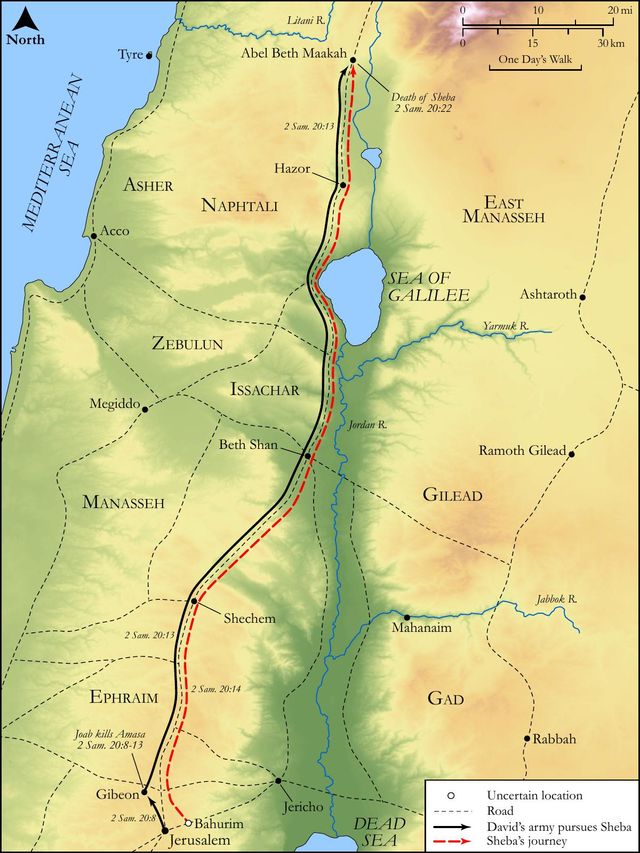
This verse is situated within a turbulent period following Absalom's failed rebellion, where King David is attempting to reassert his authority and unify a fractured Israel. David, seeking to reconcile with Judah and perhaps to curb Joab's immense, often insubordinate, power, had controversially appointed Amasa—who had previously commanded Absalom's rebel army—as his new commander of the army, as detailed in 2 Samuel 19:13. Immediately preceding this, a new rebellion erupted under Sheba, a Benjamite, who rallied discontented Israelites away from David, as recorded in 2 Samuel 20:1-2. David dispatched Amasa to gather Judah's forces, but Amasa's delay prompted David to send Abishai (and by extension, Joab) in pursuit. The encounter at Gibeon, culminating in Amasa's murder, is a calculated move by Joab to eliminate his rival and reclaim his undisputed military leadership, echoing his previous assassination of Abner, another potential rival, in 2 Samuel 3:27. The narrative then swiftly moves to Joab and Abishai continuing their pursuit of Sheba, highlighting the immediate strategic importance of Joab's act.
Historical & Cultural Context
The period of David's reign was characterized by significant political instability, tribal rivalries, and the consolidation of power. Military command was a position of immense influence, often second only to the king. David's appointment of Amasa, a former enemy, was a bold political maneuver intended to heal divisions but also a direct challenge to Joab's entrenched authority. In Israel, a kiss or embrace was a common form of greeting, even between military leaders, making Joab's feigned gesture a profound act of betrayal. The "fifth rib" (or lower abdomen/groin area) was a known vulnerable point for a fatal blow, emphasizing the precision and lethality of Joab's attack. The graphic description of Amasa's bowels being shed to the ground is characteristic of ancient historical narratives that did not shy away from the brutal realities of warfare and assassination, serving both as a factual account and a deterrent to those who might consider similar acts.
Key Themes
ShowHideThis verse powerfully contributes to several overarching themes within 2 Samuel. Treachery and Deception are vividly portrayed through Joab's deceptive greeting, which masks his murderous intent, highlighting the dangerous political landscape where trust is a fatal vulnerability. The narrative also underscores the theme of Ruthless Ambition and Power Struggles, as Joab's actions are clearly driven by a desire to eliminate a rival and reassert his dominance over David's military, illustrating the corrupting influence of unchecked power within the royal court. Furthermore, the immediate and gruesome death of Amasa emphasizes the Consequences of Violence and Bloodshed, a recurring motif in David's family and kingdom, often linked to divine judgment or the unraveling of human plans. Finally, the incident highlights the Challenges of Leadership and Governance, as David's attempts to manage powerful subordinates and unify his kingdom are met with violent resistance and internal strife, demonstrating the immense difficulty of maintaining control and peace amidst such powerful personalities.
Exposition and Analysis
ShowHideKey Word Analysis
ShowHideThe verb shâmar (H8104) fundamentally means "to guard," "to watch," or "to be circumspect." When negated, as here, "took no heed" (literally "did not guard"), it powerfully conveys Amasa's fatal lack of vigilance or suspicion. He failed to observe or protect himself from the imminent danger, whether due to misplaced trust, distraction, or a general unawareness of Joab's true intentions. This oversight is central to the tragedy, highlighting Amasa's vulnerability to Joab's cunning deception.
The term chômesh (H2570) refers to the "fifth (rib)" or, more broadly, the lower abdomen or groin area. While its precise anatomical identification is debated, it consistently denotes a highly vulnerable region of the body containing vital organs. Joab's deliberate targeting of this area underscores the calculated precision and lethal intent of his attack, ensuring a swift and fatal outcome rather than a mere wound.
The word mêʻeh (H4578), translated as "bowels," refers to the intestines or, more generally, the abdomen. When coupled with the verb "shed out" (shâphak, H8210), it creates a stark, visceral image of the fatal wound. This graphic detail is not merely descriptive; it emphasizes the extreme brutality and irreversible nature of Joab's attack, leaving no ambiguity about Amasa's immediate and gruesome death. It serves to shock the reader and underscore the ruthlessness of the act.
Verse Breakdown
ShowHide"But Amasa took no heed to the sword that [was] in Joab's hand:"
This opening clause immediately establishes Amasa's fatal oversight. It highlights his unsuspecting nature or perhaps his trust in Joab, making him utterly vulnerable to the deception. The reader is made aware of the hidden danger that Amasa himself failed to perceive, setting the stage for the tragic outcome.
"so he smote him therewith in the fifth [rib], and shed out his bowels to the ground, and struck him not again; and he died."
This segment details the swift, decisive, and lethal nature of Joab's attack. The single, precise blow to a vital area, followed by the graphic description of Amasa's internal organs spilling out, emphasizes the immediate and irreversible outcome. The phrase "struck him not again" underlines the efficiency and deadliness of the initial strike, confirming that no second blow was needed to ensure death.
"So Joab and Abishai his brother pursued after Sheba the son of Bichri."
This concluding clause reveals the cold, calculated nature of Joab's actions. Without hesitation or remorse, Joab and his brother immediately resume their military objective, demonstrating that Amasa's assassination was a strategic elimination of a rival, not an act of passion, allowing them to continue their primary mission unhindered.
Literary Devices
ShowHideThe passage employs several potent literary devices to convey its dramatic and tragic impact. Irony is prominent in Joab's deceptive greeting, where a gesture of peace (the kiss) conceals a murderous intent, creating a stark contrast between appearance and reality. The narrative uses vivid Graphic Imagery ("shed out his bowels to the ground") to underscore the brutality and finality of Amasa's death, leaving a lasting impression on the reader. This serves to highlight the ruthless nature of the political violence within David's court. Furthermore, the swift transition from the assassination to Joab and Abishai's continued pursuit of Sheba demonstrates Narrative Efficiency and reinforces Joab's cold, calculating character, emphasizing that the murder was a strategic move rather than an emotional outburst. The entire scene also functions as a form of Foreshadowing, hinting at the ongoing violence and power struggles that will plague David's reign and ultimately lead to Joab's own demise under Solomon, as recounted in 1 Kings 2:28-34.
Theological and Thematic Connections
ShowHideThe tragic account of Amasa's murder by Joab serves as a stark reminder of the pervasive nature of sin, even within the chosen people of God and among those who serve His anointed king. It illustrates the destructive power of unchecked ambition, jealousy, and treachery, revealing how personal animosities and the lust for power can override loyalty, justice, and even basic human decency. The incident underscores the fragility of human relationships and political structures in the face of such corruption, highlighting the need for divine justice and a righteous ruler who can truly establish peace and order. It also implicitly points to the fallen state of humanity, where even the most sacred bonds can be broken by self-interest, and where the consequences of such actions reverberate through individuals, families, and nations.
Reflection and Application
ShowHideThis passage compels us to reflect deeply on the dangers of unchecked ambition and the insidious nature of betrayal, even from unexpected sources. It serves as a sober warning against the corrupting influence of power and the destructive path of jealousy. For individuals, it calls for discernment and vigilance, reminding us that not all greetings are genuine and that true character is revealed not in outward show but in underlying motives. For those in leadership, it highlights the immense challenge of managing powerful personalities and the potential for internal strife to undermine even the noblest of intentions. Spiritually, Amasa's vulnerability due to his "taking no heed" can be a metaphor for our own spiritual complacency, urging us to be vigilant against the subtle deceptions of the enemy and the temptations of our own hearts. Ultimately, this narrative invites us to examine our own hearts for any seeds of envy or ambition that might lead to destructive actions, and to pursue integrity, humility, and genuine love in all our interactions.
Questions for Reflection
ShowHideFAQ
ShowHideWhy did Amasa "take no heed" to the sword?
ShowHideAmasa likely "took no heed" for several reasons. Firstly, Joab was his cousin and a prominent figure, making a direct, unprovoked attack seem unlikely. Secondly, Joab's approach was deceptive, feigning a friendly greeting with a kiss, a common gesture of peace and respect. Amasa might have been caught off guard, distracted by the apparent cordiality, or simply trusting that a fellow commander would not act so treacherously in broad daylight. This oversight underscores the cunning nature of Joab's betrayal and Amasa's vulnerability to such a calculated deception.
What was Joab's primary motivation for killing Amasa?
ShowHideJoab's primary motivation was to eliminate a rival and reclaim his undisputed position as the commander of King David's army. David had recently appointed Amasa to this role, as recorded in 2 Samuel 19:13, a move that directly threatened Joab's power and influence, which he had held for many years. Joab was known for his ruthless ambition and willingness to remove anyone who stood in his way, as evidenced by his previous murder of Abner in 2 Samuel 3:27. Amasa's death ensured Joab's return to the top military command, allowing him to continue the pursuit of Sheba's rebellion without interference.
What does this event reveal about King David's reign?
ShowHideThis event reveals the deep-seated challenges and moral compromises within King David's reign. Despite David's desire for justice and unity, his kingdom was plagued by internal strife, treachery, and violence, often perpetrated by those closest to him. It shows David's struggle to control powerful and often insubordinate figures like Joab, highlighting the limits of his authority and his inability or unwillingness to decisively deal with Joab's repeated acts of murder. The incident also underscores the ongoing consequences of sin and the instability that can persist even under a divinely chosen king, demonstrating that human leadership, no matter how anointed, remains flawed and susceptible to corruption.
Christ-Centered Fulfillment
ShowHideThe gruesome treachery of Joab against Amasa, a man appointed by the king, finds a profound and sobering echo in the ultimate betrayal of the King of Kings, Jesus Christ. Just as Amasa was deceived by a feigned greeting, so too was Jesus betrayed by a kiss from Judas Iscariot, one of His own disciples, leading to His arrest and crucifixion, as detailed in Matthew 26:48-49. Joab's ambition led him to shed innocent blood for earthly power, but Christ, though innocent, willingly shed His own blood, not for power, but to secure eternal life and true spiritual authority for all who believe, as He declares in John 10:11. This passage from 2 Samuel starkly illustrates the depth of human depravity and the pervasive nature of sin, which ultimately necessitated the perfect sacrifice of the Lamb of God. In contrast to the flawed and often violent leadership of David's era, Jesus reigns as the righteous King, whose kingdom is not of this world, as He affirmed in John 18:36, established not by treachery and bloodshed, but by self-giving love and ultimate redemption. He is the true commander, whose authority is exercised with perfect justice and unwavering faithfulness, bringing true peace and reconciliation where human ambition and sin bring only chaos and death, as described in Ephesians 2:14-16.