


2 Samuel 20:11
Bible text: King James Version (1769 Blayney text) · Public domain
Bible text: Berean Standard Bible · Public domain
Bible text: American Standard Version (1901) · Public domain
Bible text: World English Bible, Messianic edition · Public domain
Bible text: Geneva Bible (1599) · Public domain
Bible text: Young's Literal Translation · Public domain
- וְאִישׁve·'Ishand a manH376Conj-w ¦ N-msNoun Singular Masculine Absoluteוְandאִישׁa man
- עָמַד'a·Madhe stoodH5975V-Qal-Perf-3msVerb Qal Perfect 3rd Singular Masculine
- עָלָיו'a·Lavover himH5921Prep ¦ 3msPreposition Definiteעָלָיoverוhim
- מִנַּעֲרֵיmi·na·'a·Reione of [the] young men ofH5288Prep-m ¦ N-mpcNoun Plural Masculine Constructמִone ofנַּעֲרֵי[the] young men of
- יוֹאָבyo·'AvJoabH3097N-proper-mNoun Proper Masculine
- וַיֹּאמֶרvai·Yo·merand he saidH559Conj-w ¦ V-Qal-ConsecImperf-3msVerb Qal Consecutive Imperfect 3rd Singular Masculineוַandיֹּאמֶרhe said
- מִיmiwho?H4310InterrogPronoun Interrogative
- אֲשֶׁר'a·Sher[is [the] one] whoH834RelParticle Relative
- חָפֵץcha·Fetzhe delightsH2654V-Qal-Perf-3msVerb Qal Perfect 3rd Singular Masculine
- בְּיוֹאָבbe·yo·'Avin JoabH3097Prep-b ¦ N-proper-mNoun Proper MasculineבְּinיוֹאָבJoab
- וּמִיu·Miand who?H4310Conj-w ¦ InterrogPronoun Interrogativeוּandמִיwho?
- אֲשֶׁר'a·Sher[is [the] one] whoH834RelParticle Relative
- לְדָוִדle·da·Vid[belongs] to DavidH1732Prep-l ¦ N-proper-mNoun Proper Masculineלְ[belongs] toדָוִדDavid
- אַחֲרֵי'a·cha·ReiafterH310Adj-mpcAdjective Numerical Plural Masculine Construct
- יוֹאָבyo·'AvJoabH3097N-proper-mNoun Proper Masculine
English is a literal word-by-word gloss of the Hebrew, not the KJV's wording. Why?
This is the original text the KJV's translators worked from — each Hebrew word with its own literal English meaning in this verse, prepared by scholars at Tyndale House, Cambridge. The KJV translates whole sentences, not word by word, so its wording differs: one Hebrew word can become several English words, and the KJV may choose “the LORD” where the gloss reads “Yahweh”. Both are faithful — they answer different questions. For the KJV's own rendering, switch to the KJV text.
Details
See on the biblical-era maps
Study this verse
Public-domain commentary
Matthew Henry
From his Commentary on the Whole Bible. Henry comments on passages, not single verses — this entry covers 2 Samuel 20:4–13. His two-level outline is real structure in the source text, so it is rendered as structure.
We have here Amasa's fall just as he began to rise. He was nephew to David (Sa2 17:25), had been Absalom's general and commander-in-chief of his rebellious army, but, that being routed, he came over into David's interest, upon a promise that he should be general of his forces instead of Joab. Sheba's rebellion gives David an occasion to fulfil his promise sooner than he could wish, but Joab's envy and emulation rendered its fulfillment of ill consequence both to him and David.
I.Amasa has a commission to raise forces for the suppressing of Sheba's rebellion, and is ordered to raise them with all possible expedition, Sa2 20:4. It seems, the men of Judah, though forward to attend the king's triumphs, were backward enough to fight his battles; else, when they were all in a body attending him to Jerusalem, they might immediately have pursued Sheba, and have crushed that cockatrice in the egg. But most love a loyalty, as well as a religion, that is cheap and easy. Many boast of their being akin to Christ that yet are very loth to venture for him. Amasa is sent to assemble the men of Judah within three days; but he finds them so backward and unready that he cannot do it within the time appointed (Sa2 20:5), though the promotion of Amasa, who had been their general under Absalom, was very obliging to them, and a proof of the clemency of David's government.
II.Upon Amasa's delay, Abishai, the brother of Joab, is ordered to take the guards and standing forces, and with them to pursue Sheba (Sa2 20:6, Sa2 20:7), for nothing could be of more dangerous consequence than to give him time. David gives these orders to Abishai, because he resolves to mortify Joab, and degrade him, not so much, I doubt, for the blood of Abner, which he had shed basely, as for the blood of Absalom, which he had shed justly and honourably. "Now (says bishop Hall) Joab smarteth for a loyal disobedience. How slippery are the stations of earthly honours and subject to continual mutability! Happy are those who are in favour with him in whom there is no shadow of change." Joab, without orders, though in disgrace, goes along with his brother, knowing he might be serviceable to the public, or perhaps now meditating the removal of his rival.
III.Joab, near Gibeon, meets with Amasa, and barbarously murders him, Sa2 20:8-10.
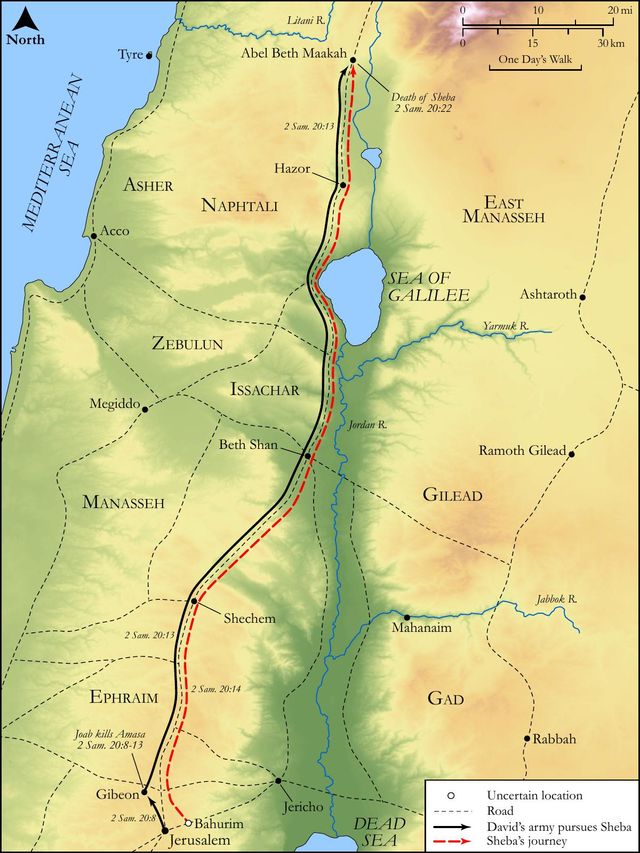
It should seem, the great stone in Gibeon was the place appointed for the general rendezvous. There the rivals met; and Amasa, relying upon his commission, went before, as general both of the new-raised forces which he had got together, and of the veteran troops which Abishai had brought in; but Joab there took an opportunity to kill him with his own hand; and,
1.He did it subtilely, and with contrivance, and not upon a sudden provocation. He girded his coat about him, that it might not hang in his way, and girded his belt upon his coat, that his sword might be the readier to his hand; he also put his sword in a sheath too big for it, that, whenever he pleased, it might, upon a little shake, fall out, as if it fell by accident, and so he might take it into his hand, unsuspected, as if he were going to return it into the scabbard, when he designed to sheath it in the bowels of Amasa. The more there is of plot in a sin the worse it is.
2.He did it treacherously, and under pretence of friendship, that Amasa might not be upon his guard. He called him brother, for they were own cousins, enquired of his welfare (Art thou in health?) and took him by the beard, as one he was free with, to kiss him, while with the drawn sword in his other hand he was aiming at his heart. Was this done like a gentleman, like a soldier, like a general? No, but like a villain, like a base coward. Just thus he slew Abner, and went unpunished for it, which encouraged him to do the like again.
3.He did it impudently, not in a corner, but at the head of his troops, and in their sight, as one that was neither ashamed nor afraid to do it, that was so hardened in blood and murders that he could neither blush nor tremble.
4.He did it at one blow, gave the fatal push with a good-will, as we say, so that he needed not strike him again; with such a strong and steady hand he gave this one stroke that it was fatal.
5.He did it in contempt and defiance of David and the commission he had given to Amasa; for that commission was the only ground of his quarrel with him, so that David was struck at through the side of Amasa, and was, in effect, told to his face that Joab would be general, in spite of him.
6.He did it very unseasonably, when they were going against a common enemy and were concerned to be unanimous. This ill-timed quarrel might have scattered their forces, or engaged them one against another, and so have made them all an easy prey to Sheba. So contentedly could Joab sacrifice the interest both of king and kingdom to his personal revenge.
IV.Joab immediately resumes his general's place, and takes care to lead the army on in pursuit of Sheba, that, if possible, he might prevent any prejudice to the common cause by what he had done. 1. He leaves one of his men to make proclamation to the forces that were coming up that they were still engaged in David's cause, but under Joab's command, Sa2 20:11. He knew what an interest he had in the soldiery, and how many favoured him rather than Amasa, who had been a traitor, was now a turn-coat, and had never been successful; on this he boldly relied, and called them all to follow him. What man of Judah would not be for his old king and his old general? But one would wonder with what face a murderer could pursue a traitor; and how, under such a heavy load of guilt, he had courage to enter upon danger. Surely his conscience was seared with a hot iron. 2. care is taken to remove the dead body out of the way, because at that they made a stand (as Sa2 2:23), and to cover it with a cloth, Sa2 20:12, Sa2 20:13. Wicked men think themselves safe in their wickedness if they can but conceal it from the eye of the world: if it be hidden, it is with them as if it were never done. But the covering of blood with a cloth cannot stop its cry in God's ear for vengeance, or make it the less loud. However, since this was no time to arraign Joab for what he had done, and the common safety called for expedition, it was prudent to remove that which retarded the march of the army; and then they all went on after Joab, while David, who no doubt had notice soon brought him of this tragedy, could not but reflect upon it with regret that he had not formerly done justice upon Joab for the death of Abner, and that he now had exposed Amasa by preferring him. And perhaps his conscience reminded him of his employing Joab in the murder of Uriah, which had helped to harden him in cruelty.
Continue studying 2 Samuel 20:11 across the web’s major study libraries — every link below opens this exact verse, chapter, or book on the destination site.
Read & Compare
 BibleGatewayThis verse in more than 200 translations and 70 languages.
 Bible.comThe YouVersion reader — hundreds of translations, reading plans, and highlights.
 ESV.orgCrossway's official English Standard Version reader.
 NET BibleThe NET translation with 60,000+ translators' notes on every rendering decision.
 STEP BibleTyndale House's free study tool — original text, vocabulary, and scholarly resources.
 BibliaLogos Bible Software's free web reader.
 USCCBThe New American Bible (Revised Edition) with the U.S. bishops' study notes.
Commentaries
 BibleHub CommentariesDozens of classic commentaries on this verse, gathered on one page.
 StudyLightMore than 100 commentary sets — the largest collection on the web.
 BibleRefPlain-English commentary on what this verse means, verse by verse.
 Enduring WordDavid Guzik's free commentary on this chapter, widely used by Bible teachers.
 Bible Study ToolsVerse commentary alongside Greek and Hebrew study aids.
Original Language & Research
- BibleHub InterlinearThe verse word by word — original language, transliteration, and English.
- BibleHub LexiconEvery word's original-language definition and Strong's entry.
 Blue Letter BibleDeep-study tools — Strong's numbers, concordance, and word studies.
 SefariaThe Hebrew text with Rashi and centuries of Jewish commentary.
Sermons, Hymns & Audio


TrulyRandomVerse is not affiliated with these sites and doesn’t control their content. They’re linked because they’re genuinely useful.
Summary
This verse captures a pivotal and highly dramatic moment during Sheba's rebellion against King David, immediately following Joab's ruthless assassination of Amasa. It records the cunning and assertive rallying cry of one of Joab's loyal men, strategically designed to overcome the confusion and paralysis among the Israelite forces caused by Amasa's body blocking the road. This declaration serves as a masterstroke of manipulation, linking allegiance to the controversial Joab directly with loyalty to King David, thereby reasserting Joab's de facto command and redirecting the army's focus toward the urgent pursuit of the rebel Sheba.
Context
ShowHideLiterary Context
This verse is situated at a critical juncture in the narrative of 2 Samuel 20, directly following the shocking and brutal murder of Amasa by Joab in 2 Samuel 20:10. King David had previously appointed Amasa as commander of his army, a move intended to replace Joab and reconcile with elements that had supported Absalom. When Sheba, son of Bichri, initiated a new rebellion, David dispatched Amasa to gather forces. Amasa's delay prompted David to send Abishai (and by extension, Joab) to pursue Sheba. Joab, seizing the opportunity, met Amasa, feigned a friendly greeting, and then treacherously murdered him. With Amasa's body lying in the middle of the road, causing the advancing troops to halt in shock and confusion, one of Joab's loyal followers delivered this powerful and manipulative declaration. The scene is one of chaos, moral ambiguity, and a desperate need for decisive leadership amidst civil unrest.
Historical & Cultural Context
The events of 2 Samuel 20 unfold in the immediate aftermath of Absalom's devastating rebellion, which had deeply fractured David's kingdom and tested his authority (see 2 Samuel 15-19). David's reign was still fragile, marked by internal strife and persistent tribal divisions. Joab, David's nephew and long-standing military commander, possessed immense power and influence, often acting independently of David's direct orders, as seen in his murder of Absalom (2 Samuel 18:14-15). The appointment of Amasa, who had previously commanded Absalom's army, was a strategic move by David to reconcile with the southern tribes and perhaps curb Joab's unchecked power. Joab's murder of Amasa, therefore, was not merely an act of personal vengeance or jealousy but a calculated, ruthless move to eliminate a rival and reassert his indispensable position as the army's true leader in a time of national crisis.
Key Themes
ShowHideThis verse contributes significantly to several key themes within 2 Samuel:
Usurpation of Authority and Unchecked Ambition
Joab, though not officially the commander, effectively reasserts his leadership through a violent act and this rallying cry. It highlights his persistent ambition and willingness to bypass or eliminate rivals to maintain his power and influence within David's army, demonstrating how personal ambition can override legitimate authority. This is a recurring tension throughout David's reign, particularly concerning Joab's actions (e.g., 2 Samuel 3:27).
Loyalty and Manipulation
The statement masterfully links loyalty to Joab with loyalty to King David, making it seem as if following Joab is synonymous with supporting the legitimate king and quelling the rebellion. This was a highly persuasive tactic to rally the hesitant troops who might have been conflicted by Amasa's death and Joab's questionable actions, illustrating the power of rhetoric in shaping allegiance and the ease with which it can be misdirected.
Civil Disorder and Leadership Vacuum
The rebellion of Sheba, following closely on the heels of Absalom's revolt, underscores the fragility of David's reign and the deep-seated divisions within Israel. In this moment of crisis, Joab steps into a leadership vacuum, albeit through violent and morally reprehensible means, to restore order and pursue the enemy, highlighting the desperate need for decisive action in times of national instability and the complex moral landscape of ancient warfare and politics.
Exposition and Analysis
ShowHideKey Word Analysis
ShowHideThis verb (H2654) signifies more than mere agreement; it implies a deep-seated allegiance, a willing support, and a personal affinity for Joab. It means "to delight in," "to desire," or "to be pleased with." By using this word, the speaker appeals to the soldiers' personal inclination and loyalty, framing Joab as someone worthy of their devotion, not just their obedience. It suggests a voluntary, almost affectionate, alignment with Joab's cause.
This proper noun (H1732) refers to King David, the divinely appointed monarch of Israel. Its inclusion in the rallying cry is the rhetorical linchpin, designed to conflate loyalty to Joab with loyalty to the legitimate king. This strategic pairing makes it difficult for any soldier to object to following Joab without appearing disloyal to David himself, thus leveraging the king's authority for Joab's benefit.
This word (H310) indicates following in pursuit or behind someone, denoting active participation under their leadership. It is a direct command for action, urging the troops to move forward under Joab's command to continue the military campaign. It transforms the sentiment of "favoring" into concrete, immediate action, demanding physical movement and compliance.
Verse Breakdown
ShowHide"And one of Joab's men stood by him"
This detail emphasizes the immediate aftermath of Amasa's murder and the presence of Joab's loyal inner circle. The man's proximity to Joab (and Amasa's body) suggests a pre-meditated or at least a highly opportunistic move to capitalize on the chaos and reassert control. It highlights Joab's shrewdness in having loyalists ready to act decisively in moments of crisis.
"and said"
This signifies a public, authoritative declaration, not a whispered suggestion. The man speaks with conviction and a clear purpose, aiming to cut through the confusion and direct the masses. His voice is meant to be heard and obeyed by the assembled troops, indicating a deliberate attempt to seize control of the narrative and the situation.
"He that favoureth Joab"
This clause directly appeals to personal loyalty and support for Joab, who, despite his controversial actions, was still a highly effective and feared military leader. It is a call to those who recognize Joab's prowess and perceive him as the necessary agent for victory, even if his methods are brutal or morally questionable. It targets those who already have an inclination towards Joab.
"and he that [is] for David"
This is the critical rhetorical move. By linking "favoureth Joab" directly with "for David," the speaker masterfully frames Joab as the indispensable agent of the king's will. It creates a false equivalence, implying that supporting Joab is the only way to genuinely support the legitimate king and quell the rebellion. The bracketed "[is]" indicates that the verb "to be" is implied in the Hebrew, making the connection even more direct and forceful.
"[let him go] after Joab"
This is the decisive command, urging immediate action and adherence to Joab's leadership. The bracketed "[let him go]" indicates an implied imperative in the Hebrew, making the statement a direct order to follow Joab into battle. It effectively bypasses any lingering questions about Amasa's death or Joab's authority, demanding immediate military compliance and redirection of focus from the shocking murder to the ongoing mission.
Literary Devices
ShowHideThe verse employs several powerful literary devices to achieve its manipulative effect. The primary device is Rhetorical Manipulation, where the speaker crafts a statement designed to sway opinion and action through clever association rather than pure logic or moral appeal. This is achieved through Juxtaposition, specifically placing "favoureth Joab" directly alongside "for David." This creates a False Equivalence, subtly suggesting that loyalty to Joab is synonymous with loyalty to the king, thereby legitimizing Joab's controversial actions and reasserting his authority. The statement also functions as a form of Obfuscation, diverting attention from the brutal murder of Amasa and framing the pursuit of Sheba under Joab's command as the only righteous and loyal path. Furthermore, there is an element of Dramatic Irony, as the audience (and likely David himself) is aware of Joab's ruthless ambition and the treachery involved, while the soldiers on the ground are presented with a seemingly clear choice of loyalty. The speaker's words serve as a powerful Rallying Cry, designed to cut through confusion and galvanize immediate action, demonstrating the persuasive power of language in times of crisis.
Theological and Thematic Connections
ShowHideThe scene in 2 Samuel 20:11, with Joab's man manipulating loyalty to the king to legitimize Joab's violent reassertion of power, raises profound theological questions about leadership, means and ends, and the nature of true allegiance. While God often uses flawed human instruments to accomplish His purposes, this verse starkly illustrates the dangers of unchecked ambition and the moral compromises that can arise when pragmatism overshadows righteousness. It highlights the tension between divinely appointed authority (David) and the exercise of raw, often violent, human power (Joab). Theologically, it reminds us that God's plan unfolds amidst human sin and political maneuvering, but His character remains untainted by such actions. It also challenges us to discern true loyalty—to God and His righteous ways—from manipulative appeals that conflate personal agendas with divine will or national good, reminding us that God desires obedience more than sacrifice, and righteousness more than ruthless efficiency.
Reflection and Application
ShowHideThe dramatic scene in 2 Samuel 20:11 offers profound insights into the complexities of leadership, loyalty, and the human heart. It serves as a powerful reminder that not all calls to action, even those cloaked in appeals to legitimate authority, are morally sound. Joab's man masterfully exploits the situation, leveraging the public's desire for order and loyalty to the king to advance Joab's personal agenda and secure his position. This challenges us to cultivate discernment, to look beyond the surface rhetoric, and to critically evaluate the motives and methods of those who claim leadership. In our own lives, we are often confronted with situations where "the ends justify the means" is subtly or overtly presented as a viable option. This verse cautions against such pragmatism when it compromises integrity, justice, or righteous principles. True loyalty, whether to a leader, an organization, or a cause, must always be rooted in truth and righteousness, not in manipulation, fear, or self-interest. It compels us to ask: What are we truly loyal to, and what means are we willing to employ to achieve our ends?
Questions for Reflection
ShowHideFAQ
ShowHideWhy did Joab kill Amasa, and how does this verse relate to that event?
ShowHideJoab killed Amasa primarily out of a combination of jealousy, ambition, and a pragmatic desire to reassert his undisputed command of David's army. David had appointed Amasa, who had previously commanded Absalom's army, as the new commander, replacing Joab (see 2 Samuel 19:13). Joab saw Amasa as a direct threat to his long-held position and influence. When Amasa was slow to gather troops to pursue Sheba, Joab seized the opportunity. He met Amasa, feigned a friendly greeting, and then brutally stabbed him (as detailed in 2 Samuel 20:8-10). This verse, 2 Samuel 20:11, immediately follows Amasa's murder. With Amasa's body causing the troops to halt in shock and horror, Joab's man steps in to clear the path and, more importantly, to rally the confused soldiers by cleverly linking loyalty to Joab with loyalty to King David, thereby legitimizing Joab's continued leadership despite his murderous act and ensuring the army's pursuit of Sheba.
What was Sheba's rebellion, and why was it significant?
ShowHideSheba's rebellion (described in 2 Samuel 20:1-2) was a tribal uprising led by Sheba, a Benjamite, who declared, "We have no portion in David, nor any inheritance in the son of Jesse!" This rebellion was significant because it immediately followed Absalom's revolt and highlighted the deep-seated tribal divisions and instability that plagued David's kingdom. It showed that despite David's return to Jerusalem, his authority was still tenuous, particularly among the northern tribes, who felt overlooked. The rebellion underscored the ongoing challenges David faced in unifying all Israel and the constant threat of internal strife. Joab's decisive (though ruthless) action in quelling this rebellion ultimately helped stabilize David's reign, even as it further solidified Joab's own powerful, often problematic, position as the indispensable military commander.
Christ-Centered Fulfillment
ShowHideThe dramatic scene in 2 Samuel 20:11, where a loyalist manipulates allegiance to the king to legitimize a ruthless leader, stands in stark contrast to the true nature of Christ's kingdom and His leadership. Joab's authority was gained and maintained through violence, manipulation, and the elimination of rivals, embodying a worldly power structure that relies on coercion and fear. In contrast, Jesus, the ultimate King and Commander, establishes His reign not through force or cunning, but through humble service and self-sacrificial love (as seen in Philippians 2:5-8). He is the true Lamb of God who takes away the sin of the world, not a lion who devours His rivals. Loyalty to Christ is not coerced by a manipulative rallying cry but is freely given by those who recognize His divine authority and saving grace (John 14:15). He is the one who truly brings peace and order, not through the violent suppression of rebellion, but by reconciling all things to Himself through the cross, making peace through His blood (as beautifully articulated in Colossians 1:19-20). Unlike Joab, whose actions ultimately led to his own judgment (1 Kings 2:5-6), Christ's reign is eternal, righteous, and brings true freedom and life to all who follow Him, calling for a loyalty rooted in love and truth, not fear or deception.