


2 Samuel 20:7
Bible text: King James Version (1769 Blayney text) · Public domain
Bible text: King James Version with Strong's numbers · Public domain
Bible text: Berean Standard Bible · Public domain
Bible text: American Standard Version (1901) · Public domain
Bible text: World English Bible, Messianic edition · Public domain
Bible text: Geneva Bible (1599) · Public domain
Bible text: Young's Literal Translation · Public domain
- וַיֵּצְאוּvai·ye·tze·'Uand they went outH3318Conj-w ¦ V-Qal-ConsecImperf-3mpVerb Qal Consecutive Imperfect 3rd Plural Masculineוַandיֵּצְאוּthey went out
- אַחֲרָיו'a·cha·Ravafter himH310Adj-mpc ¦ 3msAdjective Numerical Plural Masculine Constructאַחֲרָיafterוhim
- אַנְשֵׁי'an·Shei[the] men ofH582N-mpcNoun Plural Masculine Construct
- יוֹאָבyo·'AvJoabH3097N-proper-mNoun Proper Masculine
- וְהַכְּרֵתִיve·ha·ke·re·Tiand the Kerethite[s]H3774Conj-w ¦ Art ¦ N-msNoun Gentilic Singular Masculine AbsoluteוְandהַtheכְּרֵתִיKerethite[s]
- וְהַפְּלֵתִיve·ha·pe·le·Tiand the Pelethite[s]H6432Conj-w ¦ Art ¦ N-msNoun Gentilic Singular Masculine AbsoluteוְandהַtheפְּלֵתִיPelethite[s]
- וְכָלve·kholand allH3605Conj-w ¦ N-mscNoun Singular Masculine Constructוְandכָלall
- הַגִּבֹּרִיםha·gi·bo·Rimthe warriorsH1368Art ¦ N-mpNoun Plural Masculine Absoluteהַtheגִּבֹּרִיםwarriors
- וַיֵּצְאוּvai·ye·tze·'Uand they went outH3318Conj-w ¦ V-Qal-ConsecImperf-3mpVerb Qal Consecutive Imperfect 3rd Plural Masculineוַandיֵּצְאוּthey went out
- מִירוּשָׁלִַםmi·Ru·sha·Limfrom JerusalemH3389Prep-m ¦ N-properNoun Proper LocationמִfromירוּשָׁלִַםJerusalem
- לִרְדֹּףlir·Dofto pursueH7291Prep-l ¦ V-Qal-InfVerb Qal Infinitive Constructלִtoרְדֹּףpursue
- אַחֲרֵי'a·cha·ReiafterH310Adj-mpcAdjective Numerical Plural Masculine Construct
- שֶׁבַעShe·va'ShebaH7652N-proper-mNoun Proper Masculine
- בֶּןben[the] son ofH1121N-mscNoun Singular Masculine Construct
- בִּכְרִיbikh·RiBicriH1075N-proper-mNoun Proper Masculine
English is a literal word-by-word gloss of the Hebrew, not the KJV's wording. Why?
This is the original text the KJV's translators worked from — each Hebrew word with its own literal English meaning in this verse, prepared by scholars at Tyndale House, Cambridge. The KJV translates whole sentences, not word by word, so its wording differs: one Hebrew word can become several English words, and the KJV may choose “the LORD” where the gloss reads “Yahweh”. Both are faithful — they answer different questions. For the KJV's own rendering, switch to the KJV text.
Details
See on the biblical-era maps

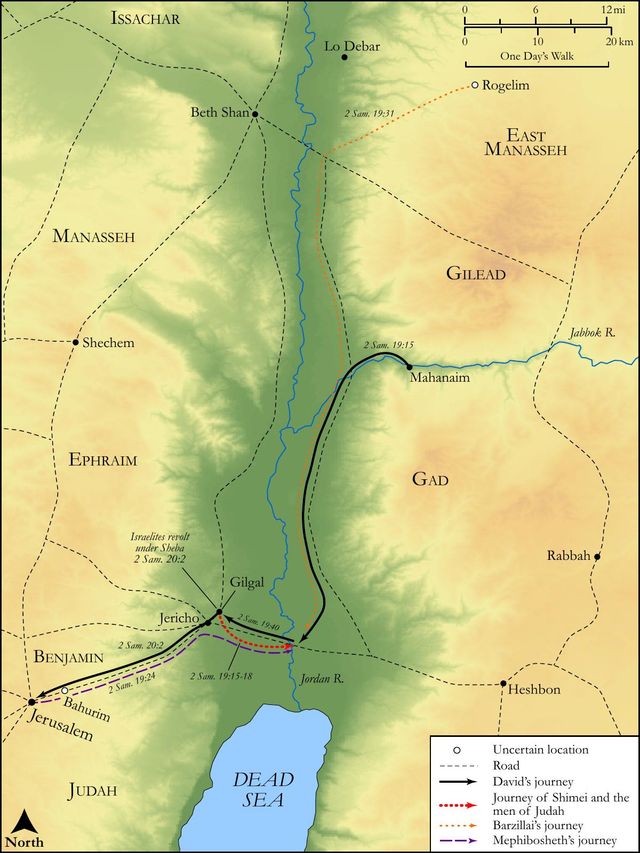
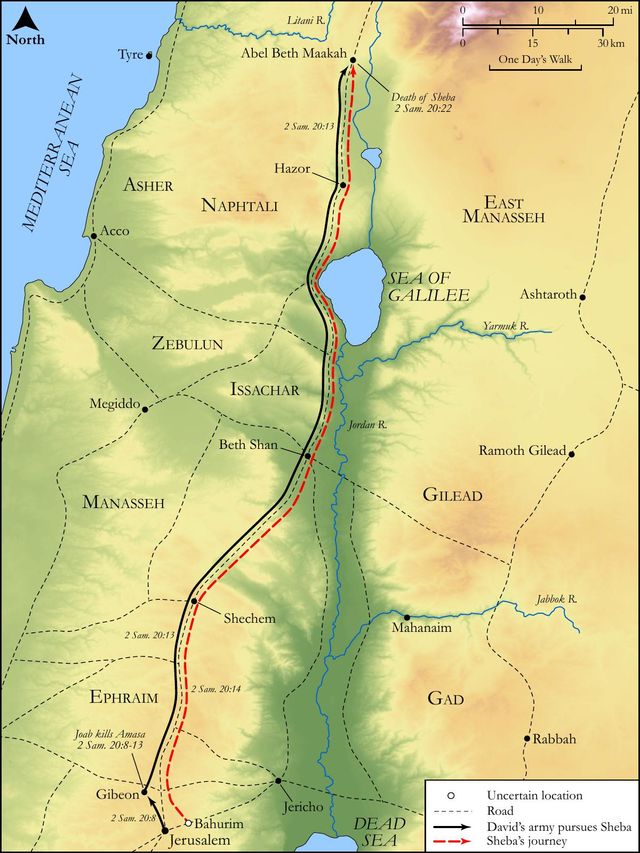
Study this verse
Public-domain commentary
Matthew Henry
From his Commentary on the Whole Bible. Henry comments on passages, not single verses — this entry covers 2 Samuel 20:4–13. His two-level outline is real structure in the source text, so it is rendered as structure.
We have here Amasa's fall just as he began to rise. He was nephew to David (Sa2 17:25), had been Absalom's general and commander-in-chief of his rebellious army, but, that being routed, he came over into David's interest, upon a promise that he should be general of his forces instead of Joab. Sheba's rebellion gives David an occasion to fulfil his promise sooner than he could wish, but Joab's envy and emulation rendered its fulfillment of ill consequence both to him and David.
I.Amasa has a commission to raise forces for the suppressing of Sheba's rebellion, and is ordered to raise them with all possible expedition, Sa2 20:4. It seems, the men of Judah, though forward to attend the king's triumphs, were backward enough to fight his battles; else, when they were all in a body attending him to Jerusalem, they might immediately have pursued Sheba, and have crushed that cockatrice in the egg. But most love a loyalty, as well as a religion, that is cheap and easy. Many boast of their being akin to Christ that yet are very loth to venture for him. Amasa is sent to assemble the men of Judah within three days; but he finds them so backward and unready that he cannot do it within the time appointed (Sa2 20:5), though the promotion of Amasa, who had been their general under Absalom, was very obliging to them, and a proof of the clemency of David's government.
II.Upon Amasa's delay, Abishai, the brother of Joab, is ordered to take the guards and standing forces, and with them to pursue Sheba (Sa2 20:6, Sa2 20:7), for nothing could be of more dangerous consequence than to give him time. David gives these orders to Abishai, because he resolves to mortify Joab, and degrade him, not so much, I doubt, for the blood of Abner, which he had shed basely, as for the blood of Absalom, which he had shed justly and honourably. "Now (says bishop Hall) Joab smarteth for a loyal disobedience. How slippery are the stations of earthly honours and subject to continual mutability! Happy are those who are in favour with him in whom there is no shadow of change." Joab, without orders, though in disgrace, goes along with his brother, knowing he might be serviceable to the public, or perhaps now meditating the removal of his rival.
III.Joab, near Gibeon, meets with Amasa, and barbarously murders him, Sa2 20:8-10.
It should seem, the great stone in Gibeon was the place appointed for the general rendezvous. There the rivals met; and Amasa, relying upon his commission, went before, as general both of the new-raised forces which he had got together, and of the veteran troops which Abishai had brought in; but Joab there took an opportunity to kill him with his own hand; and,
1.He did it subtilely, and with contrivance, and not upon a sudden provocation. He girded his coat about him, that it might not hang in his way, and girded his belt upon his coat, that his sword might be the readier to his hand; he also put his sword in a sheath too big for it, that, whenever he pleased, it might, upon a little shake, fall out, as if it fell by accident, and so he might take it into his hand, unsuspected, as if he were going to return it into the scabbard, when he designed to sheath it in the bowels of Amasa. The more there is of plot in a sin the worse it is.
2.He did it treacherously, and under pretence of friendship, that Amasa might not be upon his guard. He called him brother, for they were own cousins, enquired of his welfare (Art thou in health?) and took him by the beard, as one he was free with, to kiss him, while with the drawn sword in his other hand he was aiming at his heart. Was this done like a gentleman, like a soldier, like a general? No, but like a villain, like a base coward. Just thus he slew Abner, and went unpunished for it, which encouraged him to do the like again.
3.He did it impudently, not in a corner, but at the head of his troops, and in their sight, as one that was neither ashamed nor afraid to do it, that was so hardened in blood and murders that he could neither blush nor tremble.
4.He did it at one blow, gave the fatal push with a good-will, as we say, so that he needed not strike him again; with such a strong and steady hand he gave this one stroke that it was fatal.
5.He did it in contempt and defiance of David and the commission he had given to Amasa; for that commission was the only ground of his quarrel with him, so that David was struck at through the side of Amasa, and was, in effect, told to his face that Joab would be general, in spite of him.
6.He did it very unseasonably, when they were going against a common enemy and were concerned to be unanimous. This ill-timed quarrel might have scattered their forces, or engaged them one against another, and so have made them all an easy prey to Sheba. So contentedly could Joab sacrifice the interest both of king and kingdom to his personal revenge.
IV.Joab immediately resumes his general's place, and takes care to lead the army on in pursuit of Sheba, that, if possible, he might prevent any prejudice to the common cause by what he had done. 1. He leaves one of his men to make proclamation to the forces that were coming up that they were still engaged in David's cause, but under Joab's command, Sa2 20:11. He knew what an interest he had in the soldiery, and how many favoured him rather than Amasa, who had been a traitor, was now a turn-coat, and had never been successful; on this he boldly relied, and called them all to follow him. What man of Judah would not be for his old king and his old general? But one would wonder with what face a murderer could pursue a traitor; and how, under such a heavy load of guilt, he had courage to enter upon danger. Surely his conscience was seared with a hot iron. 2. care is taken to remove the dead body out of the way, because at that they made a stand (as Sa2 2:23), and to cover it with a cloth, Sa2 20:12, Sa2 20:13. Wicked men think themselves safe in their wickedness if they can but conceal it from the eye of the world: if it be hidden, it is with them as if it were never done. But the covering of blood with a cloth cannot stop its cry in God's ear for vengeance, or make it the less loud. However, since this was no time to arraign Joab for what he had done, and the common safety called for expedition, it was prudent to remove that which retarded the march of the army; and then they all went on after Joab, while David, who no doubt had notice soon brought him of this tragedy, could not but reflect upon it with regret that he had not formerly done justice upon Joab for the death of Abner, and that he now had exposed Amasa by preferring him. And perhaps his conscience reminded him of his employing Joab in the murder of Uriah, which had helped to harden him in cruelty.
Continue studying 2 Samuel 20:7 across the web’s major study libraries — every link below opens this exact verse, chapter, or book on the destination site.
Read & Compare
 BibleGatewayThis verse in more than 200 translations and 70 languages.
 Bible.comThe YouVersion reader — hundreds of translations, reading plans, and highlights.
 ESV.orgCrossway's official English Standard Version reader.
 NET BibleThe NET translation with 60,000+ translators' notes on every rendering decision.
 STEP BibleTyndale House's free study tool — original text, vocabulary, and scholarly resources.
 BibliaLogos Bible Software's free web reader.
 USCCBThe New American Bible (Revised Edition) with the U.S. bishops' study notes.
Commentaries
 BibleHub CommentariesDozens of classic commentaries on this verse, gathered on one page.
 StudyLightMore than 100 commentary sets — the largest collection on the web.
 BibleRefPlain-English commentary on what this verse means, verse by verse.
 Enduring WordDavid Guzik's free commentary on this chapter, widely used by Bible teachers.
 Bible Study ToolsVerse commentary alongside Greek and Hebrew study aids.
Original Language & Research
- BibleHub InterlinearThe verse word by word — original language, transliteration, and English.
- BibleHub LexiconEvery word's original-language definition and Strong's entry.
 Blue Letter BibleDeep-study tools — Strong's numbers, concordance, and word studies.
 SefariaThe Hebrew text with Rashi and centuries of Jewish commentary.
Sermons, Hymns & Audio


TrulyRandomVerse is not affiliated with these sites and doesn’t control their content. They’re linked because they’re genuinely useful.
Summary
Second Samuel 20:7 masterfully depicts the immediate and decisive military mobilization initiated by King David to quash the burgeoning rebellion led by Sheba, son of Bichri. This verse meticulously details the composition of David's loyal forces—specifically Joab's personal contingent, the elite Cherethites and Pelethites, and the renowned mighty men—as they swiftly depart Jerusalem. Their urgent mission is to pursue and neutralize this new threat, which jeopardizes the fragile unity of the recently restored kingdom, underscoring both the gravity of the crisis and the strategic importance of their swift action.
Context
ShowHideLiterary Context
This verse is strategically placed at a pivotal moment in David's reign, immediately following the tumultuous and tragic suppression of Absalom's rebellion. The kingdom, still reeling from civil war, is in a precarious state of recovery, marked by lingering tensions and a deep-seated dispute between the tribes of Judah and Israel concerning David's return to Jerusalem (2 Samuel 19:40-43). It is into this volatile and fractured environment that Sheba, a Benjamite, steps forward to exploit the divisions, proclaiming, "We have no part in David, neither have we inheritance in the son of Jesse: every man to his tents, O Israel" (2 Samuel 20:1). Recognizing the immediate and severe danger posed by this separatist movement, David initially commissions Amasa to gather Judah's forces. However, Amasa's unexplained delay prompts David to issue an urgent and direct command to Abishai to pursue Sheba without delay (2 Samuel 20:4-6). Verse 7 then narrates the actual execution of this pursuit, with Joab, despite his recent disfavor and David's attempt to replace him, effectively assuming command, thereby demonstrating his indispensable military prowess and the unwavering loyalty of his core units.
Historical & Cultural Context
The period of David's monarchy was characterized by the ongoing and often challenging process of unifying the disparate Israelite tribes into a cohesive kingdom. This endeavor frequently met with internal resistance, as tribal loyalties often superseded allegiance to a centralized monarchy. Sheba, being a Benjamite and thus from Saul's tribe, likely capitalized on residual resentments against David's ascendancy. The explicit mention of the "Cherethites" and "Pelethites" is historically significant, as these units comprised David's professional, likely foreign, mercenary guard. Their importance lay in their detachment from internal tribal allegiances, rendering them exceptionally loyal directly to the king. Their deployment highlights a common practice among the kings of that day who employed such elite, non-tribal forces as a reliable bodyguard and rapid-response strike team, particularly invaluable when internal loyalties were strained or uncertain. The swiftness of the military response further underscores the political reality of the time: any delay in quelling a rebellion could allow it to gain dangerous momentum, attracting more disaffected individuals and potentially escalating into widespread civil war, as tragically witnessed with Absalom.
Key Themes
ShowHideThis verse profoundly contributes to several overarching themes woven throughout the Book of 2 Samuel:
The Fragility of Unity and the Persistent Threat of Division
Despite David's divine anointing and military successes, the kingdom remains perpetually susceptible to internal strife and tribal fragmentation. Sheba's rebellion serves as a stark reminder of the constant challenge of maintaining national cohesion, a theme that resonates throughout Israel's subsequent history.
The Indispensability of Decisive Leadership
David's immediate and forceful response to Sheba's threat powerfully illustrates the critical importance of swift, firm leadership during times of crisis to prevent the further disintegration of the realm. His urgent command to pursue Sheba without delay, even overriding his prior appointment of Amasa, reveals his acute understanding of the high stakes involved.
The Complex Dynamics of Loyalty and Power within David's Court
The prominent role of "Joab's men," the "Cherethites, and the Pelethites," and "all the mighty men" underscores the enduring loyalty and effectiveness of David's core military apparatus. It also subtly reinforces Joab's indispensable, albeit often problematic and ruthless, influence and control over the army. This dynamic persists even when David attempts to diminish Joab's authority, as evidenced by his appointment of Amasa as commander (2 Samuel 19:13). This power struggle foreshadows future conflicts and highlights Joab's continued, often brutal, effectiveness in securing David's throne.
Exposition and Analysis
ShowHideKey Word Analysis
ShowHideDerived from "Jehovah-fathered," Joab was David's nephew and his long-serving, highly effective, but often ruthless, commander of the army. His name here signifies not just an individual but the powerful military faction directly loyal to him, highlighting his enduring authority and indispensable role in David's military operations, even when David sought to sideline him.
This term refers to a contingent of David's elite personal guard. Likely foreign mercenaries, possibly from Crete (Caphtor) or associated with the Philistines, they were renowned for their fighting prowess and, crucially, their unwavering personal loyalty to King David, independent of Israelite tribal affiliations. Their inclusion here signifies the deployment of the king's most trusted and formidable forces, acting as his direct instruments.
Like the Cherethites, the Pelethites were an integral part of David's personal bodyguard. Their origin is debated, potentially linked to Philistia or a root signifying swiftness ("to run" or "to escape"), suggesting they were elite couriers or rapid-response units. Regardless of precise origin, they functioned as a core component of David's loyal and professional military, distinct from tribal levies, emphasizing the king's direct and absolute command over them.
This refers to David's celebrated corps of elite warriors, individuals of exceptional strength, courage, and skill, often listed with their heroic feats in 2 Samuel 23. Their presence alongside the Cherethites and Pelethites signifies that the full might and most capable elements of David's army were mobilized. This underscores the gravity of Sheba's rebellion and the king's determination to crush it swiftly and decisively with overwhelming force.
Verse Breakdown
ShowHide"And there went out after him Joab's men,"
This initial phrase establishes the immediate commencement of the pursuit, with "him" referring to the general direction of Sheba's flight, as ordered by David. The mention of "Joab's men" highlights Joab's practical and effective assumption of command, despite David's previous appointment of Amasa. This demonstrates Joab's enduring influence and the steadfast loyalty of his personal contingent, a testament to his formidable military leadership.
"and the Cherethites, and the Pelethites, and all the mighty men:"
This clause meticulously enumerates the specific elite units that accompanied Joab's forces. The Cherethites and Pelethites, as David's loyal and professional bodyguard, signify the king's direct involvement and the utmost seriousness with which the mission was regarded. The inclusion of "all the mighty men" indicates that the most formidable, experienced, and renowned warriors of David's army were mobilized, signifying an overwhelming and decisive force intended to swiftly and unequivocally put down the rebellion.
"and they went out of Jerusalem, to pursue after Sheba the son of Bichri."
This final clause explicitly states the objective and origin of the military movement. Their departure from Jerusalem signifies the immediate commencement of the mission from the capital, reinforcing the urgency and the king's resolve. The explicit naming of "Sheba the son of Bichri" as the target underscores that this was a highly focused and targeted operation against a specific individual who represented a clear and present danger to the kingdom's stability and unity.
Literary Devices
ShowHideThe verse employs several effective literary devices to convey its message. Enumeration is prominently featured, as the text meticulously lists the specific military contingents—"Joab's men, and the Cherethites, and the Pelethites, and all the mighty men"—to emphasize the comprehensive and formidable nature of the force dispatched. This detailed listing also functions as a form of Synecdoche, where "Joab's men" represent Joab's pervasive personal influence and effective command, and the named elite units collectively stand for the full might and professional core of David's army. The rapid succession of actions conveyed by the repetition of the verb "went out" ("And there went out... and they went out...") creates a powerful sense of Urgency and rapid Pacing, effectively communicating the immediate and decisive nature of the response to Sheba's rebellion. This swift, organized action stands in stark contrast to Amasa's earlier delay, subtly highlighting the efficiency and determination of the forces now under Joab's de facto command.
Theological and Thematic Connections
ShowHideThis passage profoundly underscores the biblical theme of the constant struggle against forces of division and rebellion, both within the earthly kingdom and, by extension, within the human heart and the spiritual realm. David's swift and resolute action to quell Sheba's uprising reflects a divinely ordained responsibility for leaders to maintain order, preserve unity, and protect the people from chaos and fragmentation. The unwavering loyalty of David's elite forces, even amidst profound internal strife and political maneuvering, points to the profound importance of steadfast commitment to righteous authority. Theologically, the narrative implicitly teaches that God often uses human instruments, even flawed ones like Joab, to accomplish His sovereign purposes in preserving societal order and upholding justice. It serves as a potent reminder that unchecked rebellion, whether against legitimate earthly authority or against divine principles, inevitably leads to destruction and must be confronted decisively for the sake of peace and flourishing.
Reflection and Application
ShowHideThe immediate and resolute response to Sheba's rebellion in 2 Samuel 20:7 offers profound and enduring lessons for contemporary life. Just as King David understood the imperative of swiftly addressing divisive forces to preserve the integrity and unity of his kingdom, so too must individuals and communities recognize and courageously confront sources of disunity, whether they manifest in families, churches, workplaces, or broader society. Unchecked dissent, corrosive gossip, or self-serving agendas can rapidly escalate, tearing apart the very fabric of relationships and collective purpose. This passage calls us to cultivate a profound loyalty, not to fleeting personal ambition or tribalism, but to shared values, divine principles, and righteous leadership. It challenges us to embody the spirit of David's "mighty men and women"—individuals of integrity, courage, and steadfast commitment to peace and unity, willing to stand firmly against anything that seeks to divide or destabilize. Furthermore, it serves as a powerful reminder that effective leadership often necessitates decisive action, even when such decisions are difficult or unpopular, for the ultimate protection of the common good and the maintenance of order.
Questions for Reflection
ShowHideFAQ
ShowHideWhy were the Cherethites and Pelethites so important to David?
ShowHideThe Cherethites and Pelethites were absolutely crucial to David because they constituted his personal, professional, and supremely loyal bodyguard. Unlike the tribal levies, whose allegiance could be fluid and subject to regional or familial ties (as vividly illustrated by the tribal disputes after Absalom's rebellion in 2 Samuel 19:40-43), these elite, likely foreign, mercenaries were bound directly to David by a personal oath. Their loyalty was exclusively to the king himself, not to any internal Israelite faction or tribal interest. This made them an exceptionally reliable and indispensable force for maintaining order, suppressing internal rebellions, and ensuring David's personal safety and the enduring stability of his throne, especially during turbulent times of internal unrest like Sheba's rebellion. They functioned as the direct instruments of the king's will, ensuring his authority was upheld without the complications of tribal bias or shifting loyalties.
Christ-Centered Fulfillment
ShowHideThe swift and decisive action of David's loyal forces in 2 Samuel 20:7 serves as a profound foreshadowing of the ultimate and perfect King, Jesus Christ, who effectively and eternally quells all rebellion against God. Just as David's earthly kingdom faced persistent internal threats from figures like Sheba, so too does humanity experience the pervasive rebellion of sin, the tyranny of death, and the insidious schemes of Satan against the divine order. Jesus, the true Son of David and the Lamb of God who takes away the sin of the world, came not merely to suppress a local uprising but to utterly defeat the powers of rebellion and establish an everlasting kingdom. His "mighty men" are not a mercenary guard, but His redeemed disciples and the Church, empowered by the Holy Spirit to carry out His mission of reconciliation, peace, and truth. Through His crucifixion and glorious resurrection, Christ decisively disarmed the principalities and powers, triumphing over them publicly (Colossians 2:15). He is the one who gathers all things into Himself, breaking down the dividing walls of hostility and establishing a unified kingdom of peace and righteousness (Ephesians 2:14). Ultimately, the pursuit of Sheba points to Christ's ongoing sovereign work to bring all things under His benevolent rule, ensuring that every knee will bow and every tongue confess that He is Lord, thereby establishing an eternal kingdom free from all rebellion, division, and chaos.