


2 Samuel 23:23
Bible text: King James Version (1769 Blayney text) · Public domain
Bible text: Berean Standard Bible · Public domain
Bible text: American Standard Version (1901) · Public domain
Bible text: World English Bible, Messianic edition · Public domain
Bible text: Geneva Bible (1599) · Public domain
Bible text: Young's Literal Translation · Public domain
- מִןminmore thanH4480PrepPreposition
- הַשְּׁלֹשִׁיםha·she·lo·Shimthe thirtyH7970Art ¦ N-mpNoun Plural Masculine Absoluteהַtheשְּׁלֹשִׁיםthirty
- נִכְבָּדnikh·Bad[he was] honoredH3513V-Niphal-Prtcpl-msVerb Niphal Participle Singular Masculine Absolute
- וְאֶלve·'eland toH413Conj-w ¦ PrepPrepositionוְandאֶלto
- הַשְּׁלֹשָׁהha·she·lo·Shahthe threeH7969Art ¦ N-csNoun Singular common gender Absoluteהַtheשְּׁלֹשָׁהthree
- לֹאlo'notH3808NegParticle Negative
- בָאVa'he cameH935V-Qal-Perf-3msVerb Qal Perfect 3rd Singular Masculine
- וַיְשִׂמֵהוּvay·si·Me·huand he appointed himH7760Conj-w ¦ V-Qal-ConsecImperf-3ms ¦ 3msVerb Qal Consecutive Imperfect 3rd Singular Masculineוַandיְשִׂמֵhe appointedהוּhim
- דָוִדda·VidDavidH1732N-proper-mNoun Proper Masculine
- אֶל'eltoH413PrepPreposition
- מִשְׁמַעְתּוֹmish·ma'·Tohis bodyguardH4928N-fsc ¦ 3msNoun Singular Feminine Constructמִשְׁמַעְתּbodyguardוֹhis
English is a literal word-by-word gloss of the Hebrew, not the KJV's wording. Why?
This is the original text the KJV's translators worked from — each Hebrew word with its own literal English meaning in this verse, prepared by scholars at Tyndale House, Cambridge. The KJV translates whole sentences, not word by word, so its wording differs: one Hebrew word can become several English words, and the KJV may choose “the LORD” where the gloss reads “Yahweh”. Both are faithful — they answer different questions. For the KJV's own rendering, switch to the KJV text.
Details
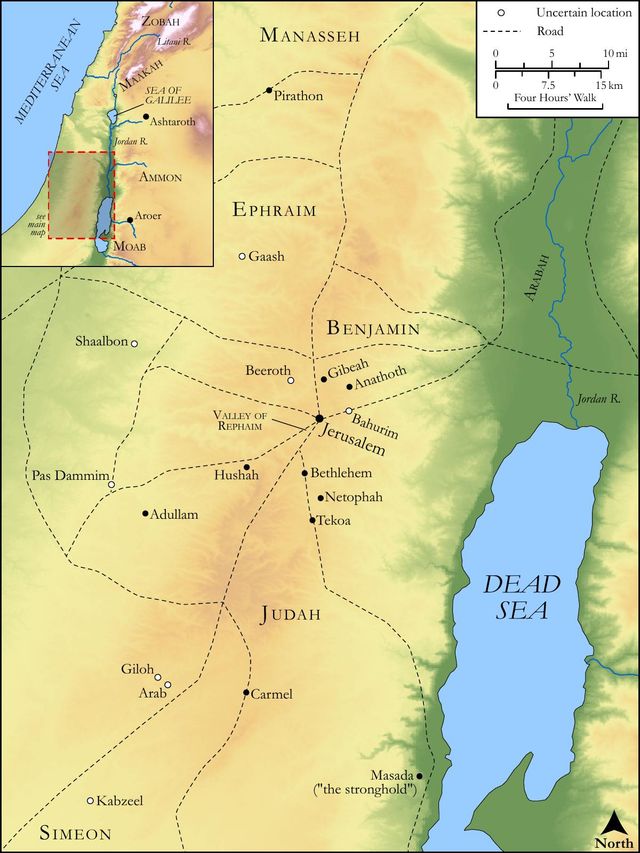
See on the biblical-era maps

Study this verse
Continue studying 2 Samuel 23:23 across the web’s major study libraries — every link below opens this exact verse, chapter, or book on the destination site.
Read & Compare
 BibleGatewayThis verse in more than 200 translations and 70 languages.
 Bible.comThe YouVersion reader — hundreds of translations, reading plans, and highlights.
 ESV.orgCrossway's official English Standard Version reader.
 NET BibleThe NET translation with 60,000+ translators' notes on every rendering decision.
 STEP BibleTyndale House's free study tool — original text, vocabulary, and scholarly resources.
 BibliaLogos Bible Software's free web reader.
 USCCBThe New American Bible (Revised Edition) with the U.S. bishops' study notes.
Commentaries
 BibleHub CommentariesDozens of classic commentaries on this verse, gathered on one page.
 StudyLightMore than 100 commentary sets — the largest collection on the web.
 BibleRefPlain-English commentary on what this verse means, verse by verse.
 Enduring WordDavid Guzik's free commentary on this chapter, widely used by Bible teachers.
 Bible Study ToolsVerse commentary alongside Greek and Hebrew study aids.
Original Language & Research
- BibleHub InterlinearThe verse word by word — original language, transliteration, and English.
- BibleHub LexiconEvery word's original-language definition and Strong's entry.
 Blue Letter BibleDeep-study tools — Strong's numbers, concordance, and word studies.
 SefariaThe Hebrew text with Rashi and centuries of Jewish commentary.
Sermons, Hymns & Audio


TrulyRandomVerse is not affiliated with these sites and doesn’t control their content. They’re linked because they’re genuinely useful.
Summary
2 Samuel 23:23 serves as the culminating statement regarding Benaiah son of Jehoiada, precisely defining his esteemed rank and crucial role within King David's formidable military structure. This verse highlights Benaiah's exceptional valor and honor, positioning him distinctly above the general body of David's "thirty" mighty men while acknowledging that he did not reach the unparalleled status of the supreme "three" champions. The verse concludes by detailing his appointment as the trusted commander of David's personal guard, a role that profoundly underscored David's unwavering confidence in Benaiah's fidelity and formidable capabilities.
Context
ShowHideLiterary Context
This verse provides the definitive conclusion to the account of Benaiah within a meticulously structured literary unit found in 2 Samuel 23. The chapter commences with David's "last words" (verses 1-7), a profound poetic and theological reflection on his reign and God's enduring covenant with him. This spiritual preamble sets the stage for the subsequent detailed list of David's mighty men (verses 8-39), which functions as a powerful testament to the human instruments through whom God established and sustained David's kingdom. The list itself is organized hierarchically, first presenting the extraordinary exploits of "the three" (verses 8-12), followed by a description of "the thirty" (verses 13-17), and then individual heroes such as Abishai (verses 18-19) and Benaiah (verses 20-23). Verse 23 acts as a concise summary and capstone to Benaiah's impressive resume, immediately following specific accounts of his legendary feats, including slaying two lion-like men of Moab, a lion in a pit, and an Egyptian giant, as detailed in 2 Samuel 23:20-22. It marks a transition from his individual acts of valor to his established, permanent, and highly trusted position within the king's inner circle.
Historical & Cultural Context
During the reign of King David, ancient Israel was undergoing a significant transformation from a decentralized tribal confederacy to a centralized monarchy. This transition necessitated the establishment of a strong, loyal, and professional military force. The concept of elite warrior units, often organized into distinct groups based on their prowess, was a common feature among the kings of that day. "The three" and "the thirty" were not merely numerical designations but recognized, named groups of highly skilled and exceptionally valorous soldiers who formed the very backbone of David's army. These units served not only as shock troops in battle but also as the king's personal guard. The role of the king's personal "guard" (often translated as "bodyguard" or "personal escort") was one of immense trust, intimacy, and responsibility. Individuals in this position were privy to the king's most vulnerable moments and were directly accountable for his personal safety and security. Appointing someone to this crucial role signified the king's absolute confidence in their unwavering loyalty, impeccable discretion, and formidable fighting prowess. Thus, Benaiah's placement in this position was a clear and powerful indicator of his esteemed status and his integral, indispensable role in David's royal court, reflecting the hierarchical nature of ancient monarchies and the premium placed on military excellence and unreserved allegiance.
Key Themes
ShowHideThis verse powerfully conveys several profound themes central to the biblical narrative. Firstly, it underscores Hierarchy and Excellence, illustrating a well-defined military system where valor, skill, and distinguished service were explicitly recognized and rewarded with specific ranks and positions. Benaiah's unique placement, being "more honourable than the thirty, but he attained not to the [first] three," speaks to a persistent pursuit of excellence within a structured order. It suggests that while not every individual may reach the absolute pinnacle of achievement, distinction and exceptional performance are still highly valued and acknowledged. Secondly, the verse highlights Trust and Responsibility. David's decisive action to "set him over his guard" demonstrates the profound confidence a leader places in a loyal and supremely capable subordinate, entrusting Benaiah with the king's personal safety and the security of his most intimate space. This theme resonates with the broader biblical concept of stewardship, where individuals are entrusted with specific roles and responsibilities based on their character, faithfulness, and demonstrated abilities, a principle further exemplified when Benaiah later becomes the commander of the entire army under King Solomon in 1 Kings 2:34-35. Finally, Loyalty and Service are central to Benaiah's narrative. His consistent heroic actions and his ultimate appointment reflect an unwavering dedication to King David, a characteristic highly prized in ancient Israel and presented as a compelling model for faithfulness in service to God and His appointed leaders.
Exposition and Analysis
ShowHideKey Word Analysis
ShowHideThis word, derived from the primitive root H3513 (kâbad), literally means "to be heavy." Metaphorically, it extends to convey concepts such as "weighty," "significant," "glorious," or "esteemed." In the context of Benaiah, it implies not merely a superficial recognition but a deep, substantial respect and admiration for his character, prowess, and achievements. His "honor" was profound and tangible, earned through verifiable acts of courage and skill, distinguishing him significantly from others. The term suggests a person whose presence carries weight and importance.
From the primitive root H935 (bôwʼ), meaning "to go or come." In this specific context, the Niphal form (implied by the KJV "attained") signifies "to be brought to," "to reach," or "to arrive at" a specific standard or level. The phrase "attained not to the [first] three" indicates that while Benaiah was exceptionally gifted and accomplished, there was a recognized, perhaps even legendary, tier of warriors whose feats were considered unparalleled and iconic—a benchmark he did not quite reach. This nuance does not diminish Benaiah's own greatness but rather precisely defines the absolute summit of valor and achievement within David's elite forces.
This term (H4928, mishmaʻath) is feminine and derives from a root related to "hearing" or "obedience." It refers to a "watch," "keeping," or "charge," specifically denoting a duty or assignment, particularly one involving protection, vigilance, or attendance at a royal court. In the context of a king's personal guard, it implies an intimate, highly sensitive, and profoundly trusted role. This position required absolute loyalty, discretion, and an immediate readiness to defend the monarch at all costs. Benaiah's appointment to this mishmaʻath underscores the profound and intimate trust David placed in him, extending beyond mere military skill to encompass his unwavering fidelity and reliability.
Verse Breakdown
ShowHide"He was more honourable than the thirty"
This initial clause unequivocally establishes Benaiah's superior standing among the general body of David's elite warriors. "The thirty" refers to a recognized, though larger, group of distinguished fighters who formed a significant tier within David's army. Benaiah's individual exploits, meticulously detailed in the preceding verses (2 Samuel 23:20-22), evidently surpassed the general excellence of this esteemed group, earning him a unique and elevated status that set him apart from and above them.
"but he attained not to the [first] three"
This phrase serves to further refine and precisely delineate Benaiah's rank by placing him just below the absolute pinnacle of David's legendary warriors. "The three" (typically identified as Josheb-basshebeth, Eleazar son of Dodo, and Shammah son of Agee) were renowned for their almost superhuman feats of valor and iconic status. While Benaiah's achievements were indeed extraordinary and exceptional, they did not quite match the unparalleled, almost mythic, status of these three, thereby creating a clear, albeit narrow, distinction at the very apex of David's military hierarchy.
"And David set him over his guard"
This final and crucial clause reveals the practical and highly significant consequence of Benaiah's exceptional honor, proven skill, and unwavering loyalty. King David, recognizing Benaiah's unique blend of prowess, discretion, and fidelity, appointed him to the highly sensitive and critically important position of commanding his personal bodyguard. This was not merely an honorary title but a role of immense trust and profound responsibility, directly ensuring the king's personal safety and serving as a direct extension of his royal authority. This appointment powerfully demonstrates the king's profound and absolute confidence in Benaiah.
Literary Devices
ShowHideThe verse effectively employs several literary devices to convey Benaiah's precise significance and standing within David's elite forces. Categorization and Hierarchy are central to its structure, as the text explicitly ranks Benaiah in relation to two distinct, recognized groups: "the thirty" and "the three." This precise numerical and positional ranking provides a clear organizational structure for David's elite forces and highlights the immense value placed on military distinction and the recognition of varying levels of valor and achievement. Juxtaposition is powerfully evident in the contrast between the phrases "more honourable than the thirty" and "attained not to the [first] three." This contrast precisely defines Benaiah's unique and elevated, yet not supreme, position, creating a nuanced and highly specific understanding of his standing. Furthermore, the verse demonstrates remarkable Conciseness, summarizing Benaiah's entire career trajectory and established standing in a single, impactful statement. This brevity acts as a powerful capstone to the detailed accounts of his individual exploits in the preceding verses (2 Samuel 23:20-22). Finally, the naming of specific groups ("the thirty," "the three") functions as a form of Metonymy, where these numbers stand in for the entire established elite military units they represent, evoking their collective reputation and significance.
Theological and Thematic Connections
ShowHideBenaiah's story, culminating in this verse, offers profound theological insights into the nature of faithful service, the recognition of honor, and the dynamics of leadership within God's kingdom. His exceptional valor, unwavering loyalty to King David, and the trust placed in him reflect a broader biblical principle: God frequently uses individuals of outstanding skill, character, and faithfulness to accomplish His divine purposes. Benaiah's "honor" was not merely human recognition but a testament to his diligent stewardship of his God-given gifts, echoing the idea that those who are faithful in little things will be entrusted with greater responsibilities. His appointment over David's guard signifies the profound trust placed in him, mirroring the trust God places in His servants to carry out specific, often critical, responsibilities within His overarching plan. This narrative reminds us that excellence in our callings, whether prominent or seemingly peripheral, contributes significantly to the larger divine narrative and ultimately brings glory to God, who is the ultimate source of all ability, authority, and true honor.
Reflection and Application
ShowHideBenaiah's story in 2 Samuel 23:23 provides a powerful and enduring example of faithful and excellent service within a defined hierarchy. It challenges us to critically examine our own roles and responsibilities, prompting us to recognize that true honor and fulfillment often come not necessarily from being at the absolute pinnacle of a hierarchy, but from diligently and faithfully executing the tasks and callings God has entrusted to us. Benaiah excelled in his specific assignments, whether confronting formidable foes or safeguarding the king's very life, demonstrating that every position, regardless of its perceived rank, is a profound opportunity for dedicated and impactful service. We are called to cultivate our unique gifts and talents, striving for excellence in our vocations, within our families, and in our communities, understanding that our faithfulness and diligence contribute directly to God's larger, redemptive purposes. Just as King David trusted Benaiah with his personal safety, God trusts each of us with various "guard" roles in His kingdom—whether it's protecting spiritual truth, nurturing vital relationships, stewarding material resources, or upholding justice—and our diligence and integrity in these roles reflect our profound loyalty and devotion to Him.
Questions for Reflection
ShowHideFAQ
ShowHideWho were "the three" and "the thirty" mentioned in this verse?
ShowHide"The three" refers to the absolute top tier of King David's elite warriors, renowned for their unparalleled valor, extraordinary feats, and almost legendary status. These were typically identified as Josheb-basshebeth (also known as Ish-bosheth), Eleazar son of Dodo, and Shammah son of Agee, whose specific exploits are detailed in 2 Samuel 23:8-12. "The thirty" refers to a larger, though still highly elite, group of distinguished warriors who formed the core of David's standing army and personal guard. While their individual exploits were significant and they were formidable fighters, they were generally considered a tier below the almost mythical status of "the three." Benaiah's unique position, as stated in this verse, was that he was superior to all "the thirty," but just shy of the truly legendary status attained by "the three."
What was the significance of being "set over his guard"?
ShowHideBeing "set over his guard" was a position of immense trust, deep intimacy, and critical importance in an ancient monarchy. The king's personal guard was directly responsible for his safety, protecting him from both internal conspiracies and external threats. This role demanded not only exceptional fighting skill and physical prowess but also unwavering loyalty, absolute discretion, and an immediate willingness to lay down one's life for the king. David's appointment of Benaiah to this highly sensitive role signifies his profound and absolute confidence in Benaiah's character, capabilities, and fidelity, placing him in the king's most trusted inner circle. This trust is further evidenced by Benaiah's later pivotal role in securing Solomon's throne and becoming the commander of the entire army, as recorded in 1 Kings 2.
Christ-Centered Fulfillment
ShowHideBenaiah's story, with its emphasis on loyalty, excellence, and trusted service to an earthly king, beautifully foreshadows the ultimate service rendered by the King of Kings, Jesus Christ. While Benaiah was "more honourable than the thirty" and a faithful protector of King David, Christ is infinitely "more honorable" than all creation, being the very image of the invisible God and the radiance of God's glory (see Colossians 1:15 and Hebrews 1:3). He "attained not to the [first] three" in the sense of an earthly hierarchy, but rather, in perfect and divine obedience, He humbled Himself, even to the point of death on a cross, thereby attaining the highest honor and the name that is above every name (see Philippians 2:8-9). Unlike Benaiah, who guarded an earthly king, Jesus, the true Lamb of God who takes away the sin of the world, willingly laid down His own life, not needing a guard but offering Himself as the ultimate, perfect sacrifice for humanity's redemption (see John 10:18). He is the One whom the Father has "set over his guard"—not a guard for Himself, for He is sovereign, but He is the one who perfectly guards and protects His people, leading them with perfect wisdom, power, and love (see John 17:12). All authority in heaven and on earth has been given to Him (see Matthew 28:18), and He now commands His followers, entrusting them with the mission of the Great Commission, just as David entrusted Benaiah with a vital role in his earthly kingdom.