


2 Samuel 23:24
Bible text: King James Version (1769 Blayney text) · Public domain
Bible text: Berean Standard Bible · Public domain
Bible text: American Standard Version (1901) · Public domain
Bible text: World English Bible, Messianic edition · Public domain
Bible text: Geneva Bible (1599) · Public domain
Bible text: Young's Literal Translation · Public domain
- עֲשָׂה'a·sahAsah-H6214N-proper-mNoun Proper Masculine
- אֵל'el-elH6214N-proper-mNoun Proper Masculine
- אֲחִי'a·chi[the] brother ofH251N-mscNoun Singular Masculine Construct
- יוֹאָבyo·'AvJoabH3097N-proper-mNoun Proper Masculine
- בַּשְּׁלֹשִׁיםba·she·lo·Shim[was] among the thirtyH7970Prep-b ¦ N-mpNoun Plural Masculine Absoluteבַּ[was] among theשְּׁלֹשִׁיםthirty
- אֶלְחָנָן'el·cha·NanElhananH445N-proper-mNoun Proper Masculine
- בֶּןben[the] son ofH1121N-mscNoun Singular Masculine Construct
- דֹּדוֹdo·DoDodoH1734N-proper-mNoun Proper Masculine
- בֵּיתbeitBeth-H1035N-properNoun Proper Location
- לָחֶםLa·chem-lehemH1035N-properNoun Proper Location
English is a literal word-by-word gloss of the Hebrew, not the KJV's wording. Why?
This is the original text the KJV's translators worked from — each Hebrew word with its own literal English meaning in this verse, prepared by scholars at Tyndale House, Cambridge. The KJV translates whole sentences, not word by word, so its wording differs: one Hebrew word can become several English words, and the KJV may choose “the LORD” where the gloss reads “Yahweh”. Both are faithful — they answer different questions. For the KJV's own rendering, switch to the KJV text.
Details
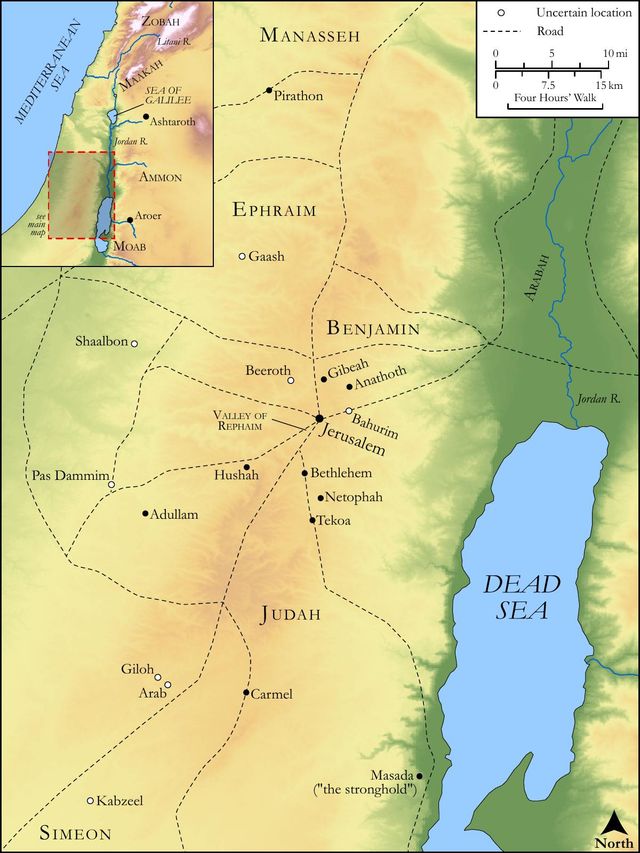
See on the biblical-era maps

Study this verse
Continue studying 2 Samuel 23:24 across the web’s major study libraries — every link below opens this exact verse, chapter, or book on the destination site.
Read & Compare
 BibleGatewayThis verse in more than 200 translations and 70 languages.
 Bible.comThe YouVersion reader — hundreds of translations, reading plans, and highlights.
 ESV.orgCrossway's official English Standard Version reader.
 NET BibleThe NET translation with 60,000+ translators' notes on every rendering decision.
 STEP BibleTyndale House's free study tool — original text, vocabulary, and scholarly resources.
 BibliaLogos Bible Software's free web reader.
 USCCBThe New American Bible (Revised Edition) with the U.S. bishops' study notes.
Commentaries
 BibleHub CommentariesDozens of classic commentaries on this verse, gathered on one page.
 StudyLightMore than 100 commentary sets — the largest collection on the web.
 BibleRefPlain-English commentary on what this verse means, verse by verse.
 Enduring WordDavid Guzik's free commentary on this chapter, widely used by Bible teachers.
 Bible Study ToolsVerse commentary alongside Greek and Hebrew study aids.
Original Language & Research
- BibleHub InterlinearThe verse word by word — original language, transliteration, and English.
- BibleHub LexiconEvery word's original-language definition and Strong's entry.
 Blue Letter BibleDeep-study tools — Strong's numbers, concordance, and word studies.
 SefariaThe Hebrew text with Rashi and centuries of Jewish commentary.
Sermons, Hymns & Audio


TrulyRandomVerse is not affiliated with these sites and doesn’t control their content. They’re linked because they’re genuinely useful.
Summary
2 Samuel 23:24 introduces Asahel, the brother of Joab, and Elhanan, the son of Dodo of Bethlehem, as esteemed members of David's elite fighting force known as "the Thirty." This verse is part of a larger honor roll that meticulously catalogues the king's most distinguished warriors, serving not merely as a historical record but as a profound testament to the valor, loyalty, and diverse contributions of the individuals who helped establish and secure David's kingdom, highlighting the human instruments through whom God worked to fulfill His covenant purposes.
Context
ShowHideLiterary Context
This verse is situated within the concluding chapters of 2 Samuel, specifically following David's "last words" (2 Samuel 23:1-7), a poetic reflection on his reign and God's enduring covenant with him. The transition from David's deeply personal reflections to the catalogue of his mighty men (2 Samuel 23:8-39) is significant, demonstrating that the success and stability of David's kingdom were not solely due to his exceptional leadership but also to the faithful service of his loyal warriors. The list is structured, first presenting the "Three" (2 Samuel 23:8-12), the most elite, followed by "the Thirty," a broader but equally formidable group. The inclusion of Asahel and Elhanan within this esteemed roster underscores their individual significance and the collective strength that underpinned David's reign. The passage functions as a closing testament to the human pillars of David's divinely-ordained kingdom, serving as a vital appendix to the narrative of his reign.
Historical & Cultural Context
David's reign (c. 1010-970 BCE) marked a pivotal era in Israelite history, transitioning from a tribal confederacy to a unified monarchy. The establishment and maintenance of this kingdom required a professional standing army, distinct from the earlier ad-hoc tribal levies. David's "mighty men" represent the pinnacle of this military professionalism, embodying the martial ideals of Israel: courage, skill in combat, and unwavering loyalty to their king. Their service was not merely mercenary; it was deeply intertwined with the political and religious identity of Israel, as David was God's anointed king. The practice of keeping such honor rolls was common in ancient empires, serving to immortalize heroes and inspire future generations. Bethlehem, identified as Elhanan's hometown, held special significance as David's birthplace and the place of his anointing, suggesting a potential early connection or shared heritage among some of these warriors, reinforcing the deep roots of David's support.
Key Themes
ShowHideThe passage, including this verse, powerfully articulates several core themes. Firstly, it emphasizes divine enablement through human agency, illustrating how God uses courageous and loyal individuals to achieve His purposes, as seen in David's triumphs detailed throughout the book of 2 Samuel. Secondly, it highlights the theme of loyalty and faithful service, showcasing men who dedicated their lives to their king and kingdom, often at great personal cost, echoing the unwavering commitment expected of God's people in the covenant relationship. Thirdly, the list serves as a recognition of valor and a legacy of remembrance, ensuring that the deeds of these heroes are not forgotten, much like the "cloud of witnesses" mentioned in Hebrews 11. Finally, it subtly points to the cost of leadership and the necessity of a strong support system, demonstrating that even a king chosen by God relied on the strength and sacrifice of others to fulfill his mandate, a principle seen throughout biblical leadership, from Moses to the apostles.
Exposition and Analysis
ShowHideKey Word Analysis
ShowHideMeaning "God has made" (from the Hebrew roots for 'to make' and 'God'). Asahel was the youngest of Zeruiah's three sons, making him David's nephew and brother to Joab and Abishai. He was renowned for his exceptional speed, described as being "as swift of foot as a wild gazelle" (2 Samuel 2:18). His inclusion in this list, despite his early and tragic death at the hand of Abner (2 Samuel 2:23), underscores his significant reputation and the lasting impact of his valor and swiftness in David's early campaigns. His name itself, "God has made," could subtly point to his divinely endowed speed and skill, recognizing God's hand in his abilities.
Meaning "God (is) gracious" or "God has shown favor" (derived from the Hebrew for 'God' and 'to be gracious'). Elhanan is listed here as "the son of Dodo of Bethlehem." There is some scholarly debate regarding another Elhanan mentioned in 2 Samuel 21:19, who is credited with killing Goliath's brother, Lahmi. While some traditions reconcile these, it is generally understood that this Elhanan is a distinct individual, a mighty warrior from David's hometown. His name, "God has been gracious," reflects a common Israelite naming convention and perhaps subtly acknowledges divine favor in his martial prowess and survival, a testament to God's providence in the lives of His servants.
This numerical term refers to a specific, elite group within David's army, forming the core of his most trusted and capable warriors. While the exact number fluctuates in the full list (sometimes reaching 37, including the "Three"), "the Thirty" denotes a recognized cadre of distinction. Membership in this group was a mark of supreme honor, indicating exceptional military skill, courage, and unwavering loyalty to King David. Their collective strength and individual exploits were instrumental in David's military successes and the consolidation of his kingdom, serving as the backbone of his military might.
Verse Breakdown
ShowHide"Asahel the brother of Joab"
This clause immediately identifies Asahel by his familial relationship to Joab, David's formidable commander-in-chief, and Abishai, another prominent mighty man. This familial connection highlights his lineage within a powerful and influential military family, underscoring his established position and reputation within David's inner circle of warriors. His identity is intrinsically linked to his more famous brothers, yet his own valor, particularly his renowned swiftness, earned him a distinguished place on this esteemed list.
"[was] one of the thirty;"
This phrase directly places Asahel within the elite military unit known as "the Thirty." This designation signifies his status as a top-tier warrior, recognized for his exceptional skill, bravery, and unwavering loyalty. The phrase implies a formal recognition and inclusion in this select group, even posthumously in Asahel's case, testifying to his enduring legacy and the profound impact he had on David's early kingdom, solidifying his place among the most honored.
"Elhanan the son of Dodo of Bethlehem,"
This introduces the second individual in the verse, Elhanan, by his patronymic ("son of Dodo") and his geographical origin ("of Bethlehem"). Identifying warriors by their father's name and hometown was a common practice, providing specific lineage and regional context. The mention of Bethlehem is particularly significant, as it was David's own hometown, suggesting a potential early connection or shared background between Elhanan and the king, perhaps indicating a deep-rooted loyalty from the very beginnings of David's rise to power, linking him to the very heart of David's origins.
Literary Devices
ShowHideThe passage employs several effective literary devices. Cataloging is the most prominent, as the entire section functions as an honor roll, systematically listing names and, in some cases, specific exploits. This creates a sense of historical record and ensures the remembrance of these individuals, preserving their legacy for future generations. The use of Patronymics (e.g., "son of Dodo") and Toponyms (e.g., "of Bethlehem") anchors the individuals in specific lineages and geographical locations, lending authenticity and concreteness to the list, making these ancient figures more tangible. The inclusion of Asahel, who died early, functions as a form of Eulogy or Posthumous Honor, underscoring that his valor was so great it warranted inclusion despite his untimely demise, emphasizing the enduring impact of his service. The very structure of the list, moving from the "Three" to "the Thirty," demonstrates a form of Hierarchy or Gradation, emphasizing levels of distinction and skill within David's fighting force, highlighting the structured excellence of his military.
Theological and Thematic Connections
ShowHideThe inclusion of Asahel and Elhanan in this distinguished list of David's mighty men serves as a profound theological statement on God's method of establishing His kingdom: through the dedicated service of His chosen human instruments. While David was God's anointed, his success was not achieved in isolation but through the collective strength, loyalty, and valor of individuals like Asahel and Elhanan. This highlights the principle that divine purposes are often realized through human faithfulness and cooperation. It underscores the value God places on individual contributions, recognizing that even those who serve in a military capacity are part of His larger plan. The list implicitly teaches that every gift and talent, when consecrated to God's service, contributes to the flourishing of His kingdom on earth, mirroring the diverse roles within the body of Christ, where each member's unique function is vital for the whole.
Reflection and Application
ShowHideThe meticulous recording of David's mighty men, including figures like Asahel and Elhanan, offers a powerful contemporary lesson on the value of recognizing and celebrating faithful service within any community, especially the church. Just as David's kingdom relied on the diverse strengths and unwavering commitment of these warriors, so too does God's work in the world today depend on the dedicated efforts of every believer, whether their contributions are highly visible or quietly foundational. This passage challenges us to consider our own role in God's kingdom: Are we serving with courage, loyalty, and diligence in our spheres of influence? Do we acknowledge and appreciate the "mighty men and women" around us who faithfully contribute their gifts, even if they are not in the spotlight? It encourages us to cultivate a spirit of selfless service, understanding that our individual contributions, however seemingly small, are integral to the larger divine narrative and the advancement of God's purposes. Ultimately, it calls us to live lives that, like these ancient warriors, leave a legacy of faithfulness and devotion to the King of kings, knowing that our service contributes to something far greater than ourselves.
Questions for Reflection
ShowHideFAQ
ShowHideWhy is Asahel included in this list if he died so early in David's reign?
ShowHideAsahel's inclusion, despite his early death at the hands of Abner (as recounted in 2 Samuel 2:23), speaks volumes about his profound reputation and valor. He was renowned for his exceptional speed and courage (see 2 Samuel 2:18), which made him a formidable warrior in David's early campaigns. His posthumous inclusion in "the Thirty" serves as an enduring honor roll, commemorating his significant contribution to David's rise to power and the establishment of his kingdom. It highlights that true valor and impact are not solely measured by longevity but by the quality and dedication of one's service, even if cut short, demonstrating that a life of intense faithfulness, however brief, can leave an indelible mark.
Who was Elhanan, and what is the significance of him being "of Bethlehem"?
ShowHideElhanan, son of Dodo, was one of David's mighty men, an elite warrior whose name is preserved in this esteemed list. His identification as "of Bethlehem" is highly significant because Bethlehem was David's own hometown, the place of his birth and anointing (as seen in 1 Samuel 16:1). This connection suggests a potential long-standing loyalty or shared background with David, possibly even from before David ascended to the throne, indicating a deep-rooted commitment to the king from his earliest days. While there is another Elhanan mentioned in 2 Samuel 21:19, who killed Goliath's brother, scholars generally view the Elhanan in 2 Samuel 23:24 as a distinct individual, a testament to the individual strength and courage of those who rallied around David from his earliest days.
What does "the Thirty" signify in the context of David's army?
ShowHide"The Thirty" refers to a highly select and elite group of warriors within David's army, forming the core of his most trusted and capable fighting force. While the full list in 2 Samuel 23:8-39 and 1 Chronicles 11:10-47 sometimes includes more than thirty names (often reaching 37, including the "Three"), "the Thirty" represents a recognized cadre of distinction and a formal military unit. Membership in this group was a mark of supreme honor, indicating exceptional military skill, unwavering loyalty, and courage in battle. These men were instrumental in David's military campaigns, the consolidation of his kingdom, and the protection of his reign, embodying the pinnacle of Israelite military prowess during that era. Their collective and individual exploits were legendary, ensuring their place in Israel's history as vital pillars of David's divinely established kingdom.
Christ-Centered Fulfillment
ShowHideThe meticulous cataloging of David's mighty men, including Asahel and Elhanan, serves as a profound foreshadowing of the ultimate King, Jesus Christ, and the spiritual army He gathers. Just as David relied on the loyalty and valor of his chosen warriors to establish his earthly kingdom, so too does Christ, the greater Son of David, build His eternal kingdom through the faithful service of His disciples. These Old Testament heroes, with their diverse skills and unwavering commitment, serve as types for the body of Christ, where every member, empowered by the Holy Spirit, has a vital role to play (as articulated in 1 Corinthians 12:4-7). Asahel's posthumous honor, for instance, can be seen as a glimpse of the eternal recognition awaiting those who lay down their lives for Christ, knowing that "whoever loses his life for my sake will find it" (Matthew 10:39). Ultimately, while David's men fought with physical weapons to secure a temporal kingdom, Christ's followers wield spiritual armor (Ephesians 6:10-18) to advance an eternal kingdom, participating in a spiritual warfare that culminates in the triumph of the Lamb of God. The loyalty these men showed David pales in comparison to the unwavering devotion due to the King of kings and Lord of lords, whose kingdom is not of this world (John 18:36) but is established through grace and truth, inviting all to join His eternal reign.