


2 Samuel 23:25
Bible text: King James Version (1769 Blayney text) · Public domain
Bible text: Berean Standard Bible · Public domain
Bible text: American Standard Version (1901) · Public domain
Bible text: World English Bible, Messianic edition · Public domain
Bible text: Geneva Bible (1599) · Public domain
Bible text: Young's Literal Translation · Public domain
- שַׁמָּהsha·MahShammahH8048N-proper-mNoun Proper Masculine
- הַחֲרֹדִיha·cha·ro·Dithe HaroditeH2733Art ¦ N-msNoun Gentilic Singular Masculine AbsoluteהַtheחֲרֹדִיHarodite
- אֱלִיקָא'e·li·Ka'ElikaH470N-proper-mNoun Proper Masculine
- הַחֲרֹדִיha·cha·ro·Dithe HaroditeH2733Art ¦ N-msNoun Gentilic Singular Masculine AbsoluteהַtheחֲרֹדִיHarodite
English is a literal word-by-word gloss of the Hebrew, not the KJV's wording. Why?
This is the original text the KJV's translators worked from — each Hebrew word with its own literal English meaning in this verse, prepared by scholars at Tyndale House, Cambridge. The KJV translates whole sentences, not word by word, so its wording differs: one Hebrew word can become several English words, and the KJV may choose “the LORD” where the gloss reads “Yahweh”. Both are faithful — they answer different questions. For the KJV's own rendering, switch to the KJV text.
Details
See on the biblical-era maps
Study this verse
Continue studying 2 Samuel 23:25 across the web’s major study libraries — every link below opens this exact verse, chapter, or book on the destination site.
Read & Compare
 BibleGatewayThis verse in more than 200 translations and 70 languages.
 Bible.comThe YouVersion reader — hundreds of translations, reading plans, and highlights.
 ESV.orgCrossway's official English Standard Version reader.
 NET BibleThe NET translation with 60,000+ translators' notes on every rendering decision.
 STEP BibleTyndale House's free study tool — original text, vocabulary, and scholarly resources.
 BibliaLogos Bible Software's free web reader.
 USCCBThe New American Bible (Revised Edition) with the U.S. bishops' study notes.
Commentaries
 BibleHub CommentariesDozens of classic commentaries on this verse, gathered on one page.
 StudyLightMore than 100 commentary sets — the largest collection on the web.
 BibleRefPlain-English commentary on what this verse means, verse by verse.
 Enduring WordDavid Guzik's free commentary on this chapter, widely used by Bible teachers.
 Bible Study ToolsVerse commentary alongside Greek and Hebrew study aids.
Original Language & Research
- BibleHub InterlinearThe verse word by word — original language, transliteration, and English.
- BibleHub LexiconEvery word's original-language definition and Strong's entry.
 Blue Letter BibleDeep-study tools — Strong's numbers, concordance, and word studies.
 SefariaThe Hebrew text with Rashi and centuries of Jewish commentary.
Sermons, Hymns & Audio


TrulyRandomVerse is not affiliated with these sites and doesn’t control their content. They’re linked because they’re genuinely useful.
Summary
2 Samuel 23:25 is a concise yet significant entry within the esteemed roster of King David's elite warriors, often referred to as "David's Mighty Men." This verse specifically names "Shammah the Harodite, Elika the Harodite," two individuals whose inclusion underscores their unwavering loyalty, dedicated service, and vital contribution to the establishment and security of David's kingdom. Though their specific deeds are not recounted here, their very presence in this honor roll speaks volumes about their valor and the crucial role played by a broad network of faithful servants in God's redemptive plan through His chosen king.
Context
ShowHideLiterary Context
This verse is situated within a larger literary unit of 2 Samuel 23:8-39, which meticulously lists King David's most valiant and faithful soldiers. This "honor roll" immediately follows David's "last words" (2 Samuel 23:1-7), creating a thematic transition from David's personal reflections on righteous rule to the practical outworking of his kingdom's strength through his loyal warriors. The list is structured, beginning with the "Three Mightiest" (2 Samuel 23:8-12), followed by a group of thirty (2 Samuel 23:13-39), with some overlap and variations. Shammah and Elika are part of this broader list of thirty, signifying their inclusion among the kingdom's most dependable and courageous figures, even if their individual exploits are not detailed like those of the top three. The list serves as a testament to the collective effort that secured David's reign, highlighting the importance of both prominent and lesser-known contributors.
Historical & Cultural Context
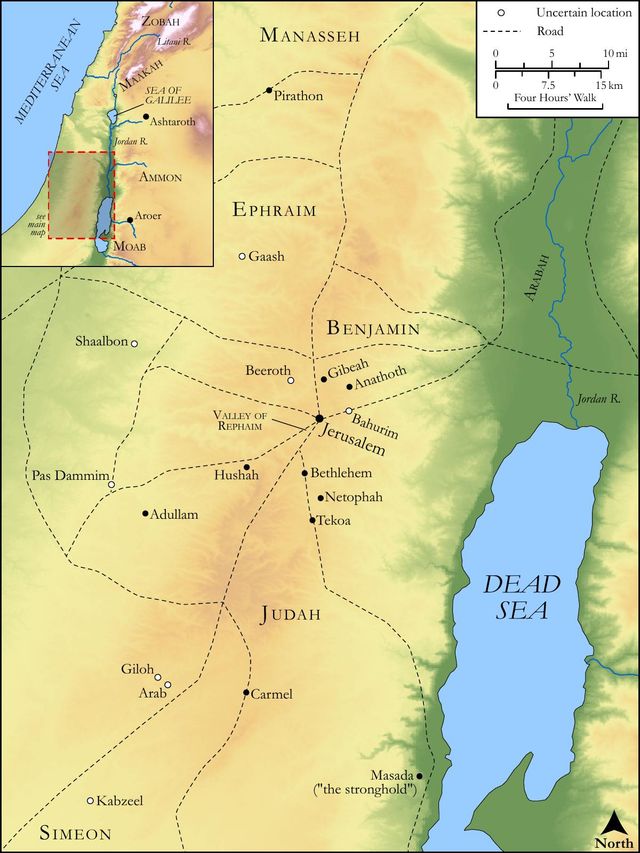
The period of David's reign (c. 1010–970 BCE) was a pivotal time in Israelite history, marked by the consolidation of the twelve tribes into a unified monarchy and significant military expansion. David's success was not solely due to his own prowess but relied heavily on a professional standing army and a core group of elite fighters. These "mighty men" were likely seasoned warriors, perhaps veterans from David's outlaw days in the wilderness or key figures who joined him during his ascent to the throne. Their designation as "Harodite" points to their geographical origin, likely from Harod, a location possibly near the Jezreel Valley or in the vicinity of Mount Gilboa, a region known for its strategic importance and often associated with military encounters. In Israel, lists of heroes and their accomplishments were common, as in the parallel roll of the mighty men in Chronicles, serving to legitimize rulers, inspire future generations, and preserve the memory of those who contributed to national identity and security.
Key Themes
ShowHideThe inclusion of Shammah and Elika, alongside other mighty men, contributes significantly to several overarching themes within 2 Samuel and the broader Deuteronomistic History. Foremost is the theme of divine blessing and human instrumentality. While God establishes David's kingdom (as seen in the Davidic Covenant), He uses human agents—like these warriors—to enact His purposes. Their loyalty and service exemplify the theme of faithful devotion, not just to David, but implicitly to the God who chose David. The list also underscores the theme of unity and strength under a centralized monarchy, as diverse individuals from various regions (like Harod) coalesce around the king. Furthermore, it highlights the value of every contribution, demonstrating that even those without extensive narratives are remembered and honored for their part in the larger story of God's people, echoing the principle found in 1 Corinthians 12:22.
Exposition and Analysis
ShowHideKey Word Analysis
ShowHideThis name (H8048) is a proper noun, referring to a specific individual. As per Strong's, it is the same as another Hebrew word meaning "astonishment" or "desolation," but in this context, it functions simply as a personal name. Shammah is a common name in the Old Testament, appearing for an Edomite and four Israelites, including one of David's "Three Mightiest" (though not this Shammah). Its presence here identifies a unique individual among David's loyalists.
This name (H470) is also a proper noun, identifying the second individual in this verse. Strong's suggests its derivation from "אֵל" (God) and "קוֹא" (to vomit/reject), leading to a potential meaning of "God of rejection." However, as with many ancient names, the precise etymological meaning may not directly reflect the individual's character or the reason for their naming. In this context, it primarily serves to identify this specific Israelite warrior.
This designation (H2733) is a patrial noun, meaning "an inhabitant of Charod" or "from Harod." It serves as a geographical identifier, linking Shammah and Elika to a specific place. Harod is likely associated with En-Harod, a spring at the foot of Mount Gilboa, a significant location in Israelite history, notably where Gideon selected his army (Judges 7:1). This geographical link anchors these men to a known region, suggesting their origin and perhaps the area from which they were recruited into David's forces.
Verse Breakdown
ShowHide"Shammah the Harodite"
This phrase introduces the first of two individuals named in this verse. The structure is simple: a personal name followed by a geographical designation. This format is typical for identifying individuals in ancient Hebrew texts, providing both their given name and their place of origin. The inclusion of "the Harodite" distinguishes this Shammah from others bearing the same name in the list (e.g., Shammah son of Agee in 2 Samuel 23:11).
"Elika the Harodite"
This parallel phrase introduces the second individual. The repetition of "the Harodite" strongly suggests that Shammah and Elika were either brothers, close relatives, or at least from the same immediate family or clan unit from Harod. Their joint mention implies a shared origin and perhaps a shared history of service or recruitment into David's elite forces. The brevity of their mention, like many others in the list, emphasizes their collective contribution rather than individual heroic acts in this specific context.
Literary Devices
ShowHideThe primary literary device at play in 2 Samuel 23:25, and indeed throughout the entire list of David's mighty men, is Enumeration or Cataloging. This involves the systematic listing of names and, in some cases, brief descriptions of their deeds. The purpose of such a list is multifaceted: it serves as an Honor Roll, commemorating those who served the king with distinction; it functions as a Historical Record, preserving the memory of key figures in David's military and administration; and it acts as a Testament to Strength, demonstrating the breadth and depth of loyalty and military prowess that underpinned David's kingdom. The repetition of "the Harodite" for both individuals also creates a subtle form of Parallelism, linking the two men together and emphasizing their shared origin and likely shared service. While not a narrative, the list itself, through its very existence, speaks volumes about the value placed on loyalty and military support in the establishment of the Israelite monarchy.
Theological and Thematic Connections
ShowHideThe inclusion of Shammah and Elika among David's mighty men, despite their lack of detailed exploits, underscores a profound theological principle: the value of every faithful contribution to God's work, no matter how seemingly small or unheralded. Just as a king's strength is built not only on the celebrated heroes but also on the consistent loyalty of many, so too is God's kingdom advanced through the dedicated service of all His people. Their presence in this sacred record reminds us that God sees and remembers every act of faithfulness, even those not accompanied by grand narratives. It highlights the communal nature of God's redemptive plan, where diverse individuals, each with their unique background and calling, contribute to the larger divine purpose. This principle resonates deeply with the New Testament understanding of the body of Christ, where every member, regardless of prominence, is vital and honored.
Reflection and Application
ShowHideThe brief mention of Shammah and Elika serves as a powerful reminder that faithfulness in ordinary, consistent service is deeply valued by God. In a world that often celebrates only the spectacular and the widely recognized, this verse quietly affirms the importance of those who faithfully fulfill their roles without seeking the limelight. It challenges us to consider our own contributions to God's kingdom: Are we serving with loyalty and dedication, even when our efforts might seem small or go unnoticed by others? This passage encourages us to embrace our unique calling within the larger body of believers, knowing that every act of obedience and service, motivated by love for God and His people, contributes to His overarching plan. Our faithfulness, like that of David's mighty men, builds up the community and advances the purposes of God, leaving a legacy of quiet devotion that is remembered in the divine record.
Questions for Reflection
ShowHideFAQ
ShowHideWhy are Shammah and Elika mentioned if no specific deeds are attributed to them?
ShowHideShammah and Elika are mentioned because their inclusion in David's honor roll, alongside other celebrated warriors, signifies their status as trusted and loyal members of David's elite fighting force. Even without specific heroic narratives attached to their names in this particular list, their presence indicates that they were recognized for their consistent service, valor, or significant contribution to the stability and success of David's kingdom. The list itself, found in 2 Samuel 23, is a testament to the collective strength and dedication of the men who supported David, and every name on it represents a vital component of that foundation. Their mention ensures that their faithfulness is remembered in the sacred record, emphasizing that not all valuable contributions are accompanied by grand, detailed accounts.
Christ-Centered Fulfillment
ShowHideWhile 2 Samuel 23:25 speaks of earthly warriors serving an earthly king, it subtly points forward to the ultimate King, Jesus Christ, and His spiritual kingdom. David's mighty men, characterized by loyalty and selfless service, foreshadow the disciples and followers of Christ who, though diverse in background and gifting, are united in their devotion to their Lord. Just as these men formed the bedrock of David's reign, so too are believers called to be the foundation of Christ's church, built upon the cornerstone of Jesus Himself (Ephesians 2:20). The unwavering commitment of Shammah and Elika to David, even unto death, mirrors the call for believers to take up their cross and follow Jesus (Matthew 16:24). Ultimately, Christ's kingdom is not built by human might or power, but by the Spirit of God working through humble, faithful servants who, like the Harodites, are willing to dedicate their lives to the King of kings, knowing that their names are written in the Lamb's book of life, a far greater honor roll than any earthly register.