


1 Chronicles 11:27
Bible text: King James Version (1769 Blayney text) · Public domain
Bible text: Berean Standard Bible · Public domain
Bible text: American Standard Version (1901) · Public domain
Bible text: World English Bible, Messianic edition · Public domain
Bible text: Geneva Bible (1599) · Public domain
Bible text: Young's Literal Translation · Public domain
- שַׁמּוֹתsha·mOtShammothH8054N-proper-mNoun Proper Masculine
- הַהֲרוֹרִיha·ha·ro·Rithe HaroriteH2033Art ¦ N-msNoun Gentilic Singular Masculine AbsoluteהַtheהֲרוֹרִיHarorite
- חֶלֶץChe·letzHelezH2503N-proper-mNoun Proper Masculine
- הַפְּלוֹנִיha·pe·lo·Nithe PeloniteH6397Art ¦ N-msNoun Gentilic Singular Masculine AbsoluteהַtheפְּלוֹנִיPelonite
English is a literal word-by-word gloss of the Hebrew, not the KJV's wording. Why?
This is the original text the KJV's translators worked from — each Hebrew word with its own literal English meaning in this verse, prepared by scholars at Tyndale House, Cambridge. The KJV translates whole sentences, not word by word, so its wording differs: one Hebrew word can become several English words, and the KJV may choose “the LORD” where the gloss reads “Yahweh”. Both are faithful — they answer different questions. For the KJV's own rendering, switch to the KJV text.
Details
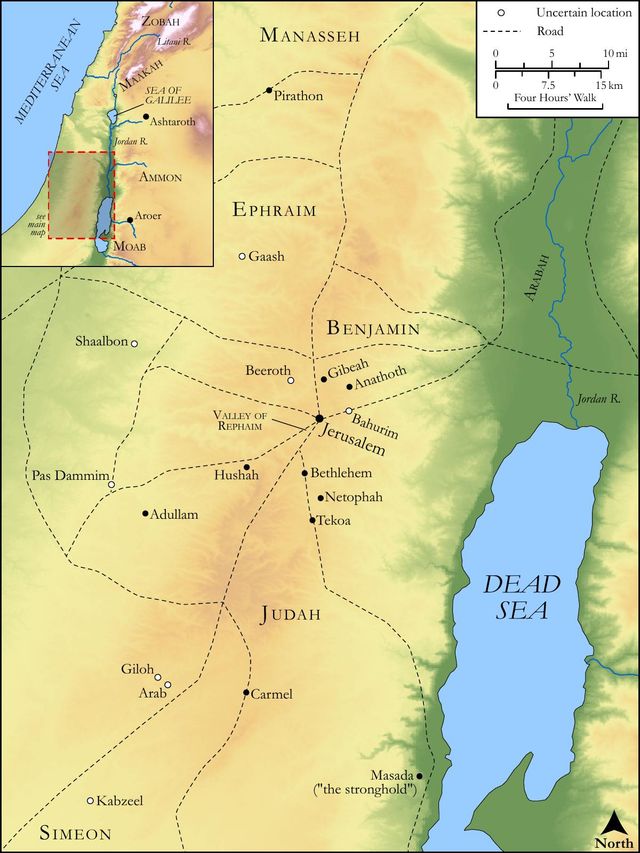
See on the biblical-era map
Study this verse
Public-domain commentary
Matthew Henry
From his Commentary on the Whole Bible. Henry comments on passages, not single verses — this entry covers 1 Chronicles 11:10–47. His two-level outline is real structure in the source text, so it is rendered as structure.
We have here an account of David's worthies, the great men of his time that served him and were preferred by him. The first edition of this catalogue we had, Sa2 23:8, etc. This is much the same, only that those named here from Ch1 11:41 to the end are added. Observe,
I.The connexion of this catalogue with that which is said concerning David, Ch1 11:9.
1.David waxed greater and greater, and these were his mighty men. Much of the strength and honour of great men is borrowed from their servants and depends upon them, which cannot but somewhat diminish pomp and power in the opinion of those that are wise. David is great because he has great men about him; take these away, and he is where he was.
2.The Lord of hosts was with him, and these were the mighty men which he had. God was with him and wrought for him, but by men and means and the use of second causes. By this it appeared that God was with him, that he inclined the hearts of those to come over to him that were able to serve his interest. As, if God be for us none can be against us, so, if God be for us, all shall be for us that we have occasion for. Yet David ascribed his success and increase, not to the hosts he had, but to the Lord of hosts, not to the mighty men that were with him, but to the mighty God whose presence with us is all in all.
II.The title of this catalogue (Ch1 11:10):
These are the men who strengthened themselves with him. In strengthening him they strengthened themselves and their own interest; for his advancement was theirs. What we do in our places for the support of the kingdom of the Son of David we shall be gainers by. In strengthening it we strengthen ourselves. It may be read, They held strongly with him and with all Israel. Note, When God has work to do he will not want fit instruments to do it with. If it be work that requires mighty men, mighty men shall either be found or made to effect it, according to the word of the Lord.
III.That which made all these men honourable was the good service that they did to their king and country; they helped to make David king (Ch1 11:10) - a good work. They slew the Philistines, and other public enemies, and were instrumental to save Israel. Note, The way to be great is to do good. Nor did they gain this honour without labour and the hazard of their lives. The honours of Christ's kingdom are prepared for those that fight the good fight of faith, that labour and suffer, and are willing to venture all, even life itself, for Christ and a good conscience. It is by a patient continuance in well-doing that we must seek for glory, and honour, and immortality; and those that are faithful to the Son of David shall find their names registered and enrolled much more to their honour than these are in the records of fame.
IV.Among all the great exploits of David's mighty men, here is nothing great mentioned concerning David himself but his pouring out water before the Lord which he had longed for, Ch1 11:18, Ch1 11:19. Four very honourable dispositions of David appeared in that action, which, for aught I know, made it as great as any of the achievements of those worthies.
1.Repentance for his own weakness. It is really an honour to a man, when he is made sensible that he has said or done any thing unadvisedly, to unsay it and undo it again by repentance, as it is a shame to a man when he has said or done amiss to stand to it.
2.Denial of his own appetite. He longed for the water of the well of Bethlehem; but, when he had it, he would not drink it, because he would not so far humour himself and gratify a foolish fancy. He that has such a rule as this over his own spirit is better than the mighty. It is an honour to a man to have the command of himself; but he that will command himself must sometimes cross himself.
3.Devotion towards God. That water which he thought too good, too precious, for his own drinking, he poured out to the Lord for a drink offering. If we have any thing better than another, let God be honoured with it, who is the best, and should have the best.
4.Tenderness of his servants. It put him into the greatest confusion imaginable to think that three brave men should hazard their lives to fetch water for him. In his account it turns the water into blood. It is the honour of great men not to be prodigal of the blood of those they employ, but, in all the commands they give them, to put their own souls into their souls' stead.
V.In the wonderful achievements of these heroes the power of God must be acknowledged.
How could one slay 300 and another the same number (Ch1 11:11, Ch1 11:20), another two lion-like men (Ch1 11:22), and another an Egyptian giant (Ch1 11:23), if they had not had the extraordinary presence of God with them, according to that promise, Jos 23:10, One man of you shall chase a thousand, for the Lord your God fighteth for you?
VI.One of these worthies is said to be an Ammonite (Ch1 11:39), another a Moabite (Ch1 11:46), and yet the law was that an Ammonite and a Moabite should not enter into the congregation of the Lord, Deu 23:3. These, it is likely, had approved themselves so hearty for the interest of Israel that in their case it was thought fit to dispense with that law, and the rather because it was an indication that the Son of David would have worthies among the Gentiles: with him there is neither Greek nor Jew.
Continue studying 1 Chronicles 11:27 across the web’s major study libraries — every link below opens this exact verse, chapter, or book on the destination site.
Read & Compare
 BibleGatewayThis verse in more than 200 translations and 70 languages.
 Bible.comThe YouVersion reader — hundreds of translations, reading plans, and highlights.
 ESV.orgCrossway's official English Standard Version reader.
 NET BibleThe NET translation with 60,000+ translators' notes on every rendering decision.
 STEP BibleTyndale House's free study tool — original text, vocabulary, and scholarly resources.
 BibliaLogos Bible Software's free web reader.
 USCCBThe New American Bible (Revised Edition) with the U.S. bishops' study notes.
Commentaries
 BibleHub CommentariesDozens of classic commentaries on this verse, gathered on one page.
 StudyLightMore than 100 commentary sets — the largest collection on the web.
 BibleRefPlain-English commentary on what this verse means, verse by verse.
 Enduring WordDavid Guzik's free commentary on this chapter, widely used by Bible teachers.
 Bible Study ToolsVerse commentary alongside Greek and Hebrew study aids.
Original Language & Research
- BibleHub InterlinearThe verse word by word — original language, transliteration, and English.
- BibleHub LexiconEvery word's original-language definition and Strong's entry.
 Blue Letter BibleDeep-study tools — Strong's numbers, concordance, and word studies.
 SefariaThe Hebrew text with Rashi and centuries of Jewish commentary.
Sermons, Hymns & Audio


TrulyRandomVerse is not affiliated with these sites and doesn’t control their content. They’re linked because they’re genuinely useful.
Summary
1 Chronicles 11:27 meticulously names Shammoth the Harorite and Helez the Pelonite, two distinguished individuals within King David's elite corps of "mighty men." This verse, embedded in a comprehensive roster in 1 Chronicles 11, profoundly underscores the Chronicler's commitment to detailed historical record-keeping, highlighting the diverse origins, unwavering loyalty, and specific contributions of the warriors who faithfully served King David, thereby illustrating the divine backing and formidable strength that characterized his reign.
Context
ShowHideLiterary Context
1 Chronicles 11:27 is an integral part of the extensive and detailed catalogue of King David's most valiant warriors, commonly known as "David's mighty men." This significant list commences in 1 Chronicles 11:10 and extends through 1 Chronicles 12:40. The inclusion of this roster immediately follows the pivotal narrative of David's anointing as king over all Israel at Hebron (1 Chronicles 11:1-3) and his strategic capture of Jerusalem, which he established as his capital city (1 Chronicles 11:4-9). The Chronicler's deliberate decision to include such a comprehensive and specific enumeration serves not merely as a historical archive but as a profound theological affirmation. It underscores the widespread and diverse support David garnered, emphasizing the divine favor that enabled him to assemble such a formidable and loyal fighting force, which was absolutely critical for the secure establishment and enduring stability of his divinely appointed kingdom. A parallel, though slightly varied, account of these valiant figures can also be found in 2 Samuel 23:8-39, further affirming their historical significance.
Historical & Cultural Context
Among the kings of that day, the stability, power, and prestige of a monarch's reign were inextricably linked to the loyalty, skill, and sheer prowess of his military elite. David's "mighty men" were far more than mere soldiers; they constituted a highly professional fighting force, a dedicated personal guard, and crucial strategic advisors who had stood by David through the arduous years of his wilderness exile from Saul and throughout his remarkable ascent to power. Their unwavering allegiance was a hallmark of their character. Descriptive titles such as "the Harorite" and "the Pelonite" were common cultural markers in this period, serving to indicate an individual's geographical origin, tribal affiliation, or even a specific family lineage. Such identifiers were vital for distinguishing individuals in a society where personal names might be common. While the precise locations of "Haror" and "Pelon" remain somewhat ambiguous to modern scholarship, these suffixes emphatically underscore the diverse geographical and tribal origins of David's loyalists. His forces drew strength from various regions of Israel and, in some cases (as seen with certain Gittites elsewhere), even from non-Israelite backgrounds, reflecting David's expansive influence and the unifying nature of his leadership. This meticulous detailing of individuals highlights Israel's profound emphasis on lineage, place, and the personal contribution of each individual to collective endeavors and national identity.
Key Themes
ShowHideThe meticulous inclusion of individuals like Shammoth and Helez within this detailed roster in 1 Chronicles 11 powerfully contributes to several overarching theological and narrative themes central to the book of Chronicles. Firstly, it vividly illustrates the theme of Divine Providence and Human Agency, demonstrating how God sovereignly works through specific, dedicated individuals to accomplish His overarching plan for His chosen king and nation. The success of David's reign was not accidental but a result of God's hand working through faithful men. Secondly, this list profoundly emphasizes Loyalty and Faithful Service, portraying these men as exemplary models of unwavering dedication to God's anointed leader, a quality held in exceptionally high regard within the Chronicler's theological framework. Their steadfast commitment was absolutely instrumental in securing and consolidating David's kingdom, a kingdom ultimately blessed and established by God Himself. Thirdly, the sheer number and precise identification of these warriors powerfully underscore the Strength and Legitimacy of David's Kingdom, demonstrating that his rule was not only divinely appointed but also robustly supported by a highly capable and profoundly devoted military force. This detailed record also reinforces the Chronicler's deep concern for Historical Accuracy and Continuity, providing a meticulous and authentic account of the foundational figures who contributed significantly to the establishment of the Davidic dynasty, which was central to Israel's identity, national hope, and future messianic expectations. These themes collectively reinforce the Chronicler's enduring message, particularly relevant to the post-exilic community for whom the book was written, that faithfulness to God and His chosen leaders leads directly to national stability, prosperity, and divine blessing, a truth echoed throughout the entire book of 1 Chronicles.
Exposition and Analysis
ShowHideKey Word Analysis
ShowHideThis proper noun identifies one of David's mighty men. While its primary function here is as an identifier, the name itself is derived from a root meaning "ruins" (plural of שַׁמָּה). This etymological background, though not directly descriptive of Shammoth's character in the text, highlights the ancient practice of naming and the diverse origins of names. Its inclusion in this precise list emphasizes the Chronicler's meticulous record-keeping and his desire to attribute credit to every individual who contributed to David's success, regardless of the potential connotations of their name.
This descriptive title indicates Shammoth's place of origin or tribal affiliation. The suffix "-ite" is a common geographical or ethnic indicator in Hebrew. According to the Strong's data, it is "another form for הֲרָרִי; a Harorite or mountaineer." This suggests an association with a mountainous region or a people known for inhabiting such terrain. Its mention serves to ground the individual in a specific geographical context, suggesting that David's support network extended beyond a single region, drawing strength from various parts of Israel or its environs, and highlighting the diverse composition of David's elite forces.
This is a proper noun identifying another of David's valiant warriors. The name itself, derived from חָלַץ, carries the meaning "perhaps, strength" or "deliverance." This etymological connection is highly fitting for a "mighty man," suggesting a quality of robust capability or a role in bringing about victory. His inclusion further illustrates the Chronicler's commitment to documenting the specific individuals who formed the backbone of David's military and administrative success, underscoring the collective effort behind the establishment of the kingdom.
This designation, like "Harorite," indicates Helez's geographical or tribal origin. It is patronymically derived from an unused name (from פָּלָה) meaning "separate." This suggests an inhabitant of an "unknown Palon" or a place that was distinct or set apart. The precise location of "Pelon" is uncertain, but its presence signifies the diverse origins of David's loyalists. The specificity of these designations, even for seemingly minor figures within a long list, speaks to the Chronicler's historical rigor and his desire to present a comprehensive and authentic account of the foundational figures of the Davidic monarchy.
Verse Breakdown
ShowHide"Shammoth the Harorite"
This clause introduces the first of two individuals specifically named in this verse. Shammoth is identified not only by his personal name but also by his geographical or tribal affiliation, "the Harorite." This dual identification was a crucial practice in Israel for distinguishing individuals, particularly within military rosters or genealogical records. It signifies his specific background, perhaps hinting at his origin from a mountainous region, and underscores his unique contribution to David's diverse and formidable forces.
"Helez the Pelonite"
Following a parallel pattern, this clause introduces the second individual, Helez, who is likewise identified by his personal name and his place of origin or tribal connection, "the Pelonite." The consistent use of these geographical or tribal identifiers throughout the extensive list of mighty men underscores the diverse origins of David's loyal supporters and the meticulous way in which the Chronicler documented these key figures, affirming their unique identities and invaluable contributions to the strength and stability of the kingdom.
Literary Devices
ShowHideThe Chronicler's presentation of 1 Chronicles 11:27, situated within the broader and extensive list of David's mighty men, primarily employs the literary device of Catalogue or Roster. This systematic and exhaustive listing of names, often accompanied by their identifying epithets (e.g., "the Harorite," "the Pelonite"), serves to provide a comprehensive, authoritative, and historically grounded account of David's elite warriors. The deliberate Repetition of the "Name the Place/Tribe" pattern throughout the entire list creates a rhythmic and almost litany-like effect, effectively emphasizing the vast breadth and profound depth of support that David commanded across various regions and peoples. This detailed enumeration also functions as a powerful form of Emphasis, underscoring the formidable strength and divinely blessed nature of David's kingdom, which was built upon the unwavering loyalty, exceptional prowess, and collective dedication of these individually recognized heroes. By meticulously naming each man, the Chronicler implicitly conveys the profound idea that every individual contribution, no matter how seemingly small or obscure within the grand narrative, was profoundly valued, remembered, and instrumental in securing David's throne and establishing the enduring Davidic dynasty.
Theological and Thematic Connections
ShowHide1 Chronicles 11:27, though a concise entry within a lengthy list, carries significant theological weight by affirming the profound divine principle that every individual's contribution, however seemingly minor or behind-the-scenes, is recognized, valued, and intricately woven into God's grand design. Just as King David's monumental success was not solely his own achievement but a collective effort of numerous loyal and diverse individuals, so too is God's eternal kingdom advanced and built through the varied gifts, faithful service, and unique contributions of many. The Chronicler's meticulous record-keeping here reflects a divine perspective that overlooks no one, reminding us that God sees, remembers, and honors all who faithfully serve His purposes, whether they occupy prominent leadership roles or serve diligently in more background capacities. This verse implicitly teaches a vital lesson: faithfulness in one's specific calling, even if it means being a "Harorite" or a "Pelonite" in a vast spiritual army, contributes meaningfully and indispensably to the greater, overarching work of God.
Reflection and Application
ShowHideThe seemingly mundane list of names in 1 Chronicles 11:27 offers surprisingly profound and practical insights for contemporary believers. It challenges us to deeply consider our own unique place and vital role within God's unfolding redemptive story, powerfully reminding us that every act of faithful service, no matter how obscure, small, or behind-the-scenes, contributes meaningfully and indispensably to the advancement of His eternal kingdom. Just as Shammoth and Helez were absolutely vital to the stability and success of King David's earthly reign, so too are we, as believers, called to be loyal, dedicated, and active participants in the ongoing work of Christ, our true and sovereign King. This verse profoundly encourages us to embrace our unique gifts, our specific callings, and our individual backgrounds, understanding that our particular "Harorite" or "Pelonite" identity—our specific skills, experiences, and heritage—are precisely what God can and will powerfully use for His glory. It fosters a deep sense of belonging, purpose, and mutual interdependence within the body of Christ, where the diversity of roles and gifts strengthens the entire whole. Ultimately, we are reminded that true significance and lasting impact are found not in worldly recognition or fleeting accolades, but in faithful obedience to God's divine call, knowing with absolute certainty that He sees, values, and remembers every heart devoted to His will and every contribution made in His name.
Questions for Reflection
ShowHideFAQ
ShowHideWhy does the Bible include such long lists of names, like the one in 1 Chronicles 11?
ShowHideThe inclusion of detailed lists of names, such as the one featuring Shammoth the Harorite and Helez the Pelonite in 1 Chronicles 11, serves multiple crucial and interconnected purposes. Firstly, it profoundly underscores the historical veracity and authenticity of the biblical narrative, demonstrating a meticulous concern for documenting real people, places, and events, thereby grounding the sacred story in tangible, verifiable reality. Secondly, these lists highlight the profound importance of individuals in God's overarching plan, showing that even seemingly minor or briefly mentioned figures play vital and indispensable roles in His grand purposes. They serve as a powerful reminder that every person's contribution, no matter how small, is seen, known, and valued by God. Thirdly, they often function as a compelling testimony to divine blessing and support, showcasing the breadth and depth of human resources God providentially provided to His chosen leaders, like King David, enabling them to achieve great things for His kingdom. For the post-exilic community, the primary audience of the Chronicler, these lists also served to establish lineage, identity, and continuity, powerfully connecting them to their glorious past and reinforcing their national, tribal, and spiritual heritage, providing hope for the future.
Are Shammoth the Harorite and Helez the Pelonite mentioned elsewhere in the Bible, or are they only in 1 Chronicles?
ShowHideShammoth the Harorite and Helez the Pelonite are primarily known from the extensive list of David's mighty men, which is a central feature of the Chronicler's account. Shammoth the Harorite is specifically mentioned in 1 Chronicles 11:27. His name appears with a slight variation as "Shammah the Harodite" in the parallel account found in 2 Samuel 23:25. This minor variation in spelling or geographical designation is common in ancient texts and does not diminish the historical reality or significance of the individual. Helez the Pelonite is also prominently mentioned in 1 Chronicles 11:27 and is further noted in 1 Chronicles 27:10, where he is listed among the monthly commanders of David's army, specifically serving in the seventh month. This additional mention in 1 Chronicles 27 indicates that Helez was not merely a valiant warrior but also held a significant and ongoing leadership position within David's administrative and military structure, further underscoring the profound importance of these "mighty men" beyond their roles in mere combat.
Christ-Centered Fulfillment
ShowHideThe meticulous enumeration of David's mighty men, including figures like Shammoth the Harorite and Helez the Pelonite, finds its ultimate and most profound Christ-centered fulfillment in the spiritual army of believers who faithfully serve Jesus Christ, the true, eternal, and sovereign King of kings. Just as these ancient warriors pledged their unwavering loyalty, strength, and lives to an earthly king to establish and secure his kingdom, so too are believers called to dedicate their lives, unique gifts, and all their resources to the advancement of Christ's heavenly and everlasting kingdom. David's mighty men engaged in physical battles against earthly foes; Christ's followers, by contrast, are called to engage in spiritual warfare, equipped not with swords and shields of this world, but with the divine "armor of God" (Ephesians 6:10-18). The Chronicler's powerful emphasis on every individual's contribution, no matter how seemingly small, profoundly foreshadows the New Testament teaching that every single member of the body of Christ, no matter how seemingly obscure or behind-the-scenes, is absolutely vital, uniquely gifted by the Holy Spirit, and indispensable for the common good and effective functioning of the whole (1 Corinthians 12:4-11). The unwavering loyalty these men demonstrated to King David powerfully prefigures the supreme and ultimate allegiance owed to Jesus, who is majestically proclaimed as "King of kings and Lord of lords" (Revelation 19:16). Ultimately, the strength, security, and earthly triumphs of David's kingdom, built upon the shoulders of these mighty men, serve as a powerful type and shadow pointing to the eternal, unshakable, and ever-expanding kingdom of God, which was definitively established by Christ's sacrificial death and glorious resurrection, and is continually sustained by the faithful, Spirit-empowered service of His redeemed people, who are, in Him, "more than conquerors through Him who loved us" (Romans 8:37).