


2 Samuel 23:26
Bible text: King James Version (1769 Blayney text) · Public domain
Bible text: Berean Standard Bible · Public domain
Bible text: American Standard Version (1901) · Public domain
Bible text: World English Bible, Messianic edition · Public domain
Bible text: Geneva Bible (1599) · Public domain
Bible text: Young's Literal Translation · Public domain
- חֶלֶץChe·letzHelezH2503N-proper-mNoun Proper Masculine
- הַפַּלְטִיha·pal·Tithe PaltiteH6407Art ¦ N-msNoun Gentilic Singular Masculine AbsoluteהַtheפַּלְטִיPaltite
- עִירָא'i·Ra'IraH5896N-proper-mNoun Proper Masculine
- בֶןven[the] son ofH1121N-mscNoun Singular Masculine Construct
- עִקֵּשׁ'i·KeshIkkeshH6142N-proper-mNoun Proper Masculine
- הַתְּקוֹעִיha·te·ko·'Ithe TekoiteH8621Art ¦ N-msNoun Gentilic Singular Masculine AbsoluteהַtheתְּקוֹעִיTekoite
English is a literal word-by-word gloss of the Hebrew, not the KJV's wording. Why?
This is the original text the KJV's translators worked from — each Hebrew word with its own literal English meaning in this verse, prepared by scholars at Tyndale House, Cambridge. The KJV translates whole sentences, not word by word, so its wording differs: one Hebrew word can become several English words, and the KJV may choose “the LORD” where the gloss reads “Yahweh”. Both are faithful — they answer different questions. For the KJV's own rendering, switch to the KJV text.
Details
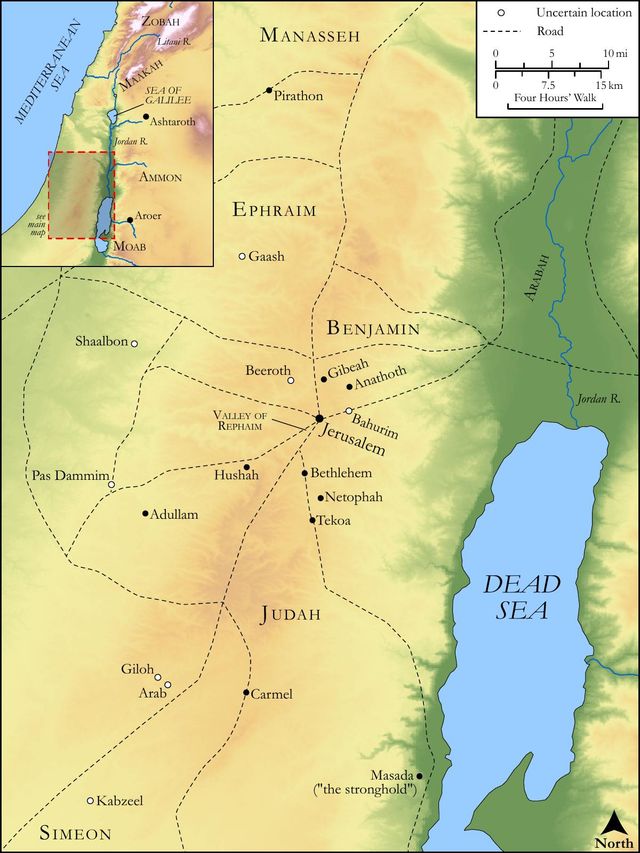
See on the biblical-era maps

Study this verse
Continue studying 2 Samuel 23:26 across the web’s major study libraries — every link below opens this exact verse, chapter, or book on the destination site.
Read & Compare
 BibleGatewayThis verse in more than 200 translations and 70 languages.
 Bible.comThe YouVersion reader — hundreds of translations, reading plans, and highlights.
 ESV.orgCrossway's official English Standard Version reader.
 NET BibleThe NET translation with 60,000+ translators' notes on every rendering decision.
 STEP BibleTyndale House's free study tool — original text, vocabulary, and scholarly resources.
 BibliaLogos Bible Software's free web reader.
 USCCBThe New American Bible (Revised Edition) with the U.S. bishops' study notes.
Commentaries
 BibleHub CommentariesDozens of classic commentaries on this verse, gathered on one page.
 StudyLightMore than 100 commentary sets — the largest collection on the web.
 BibleRefPlain-English commentary on what this verse means, verse by verse.
 Enduring WordDavid Guzik's free commentary on this chapter, widely used by Bible teachers.
 Bible Study ToolsVerse commentary alongside Greek and Hebrew study aids.
Original Language & Research
- BibleHub InterlinearThe verse word by word — original language, transliteration, and English.
- BibleHub LexiconEvery word's original-language definition and Strong's entry.
 Blue Letter BibleDeep-study tools — Strong's numbers, concordance, and word studies.
 SefariaThe Hebrew text with Rashi and centuries of Jewish commentary.
Sermons, Hymns & Audio


TrulyRandomVerse is not affiliated with these sites and doesn’t control their content. They’re linked because they’re genuinely useful.
Summary
2 Samuel 23:26 meticulously records the names of Helez the Paltite and Ira the son of Ikkesh the Tekoite, two distinguished members of King David's elite corps of "mighty men." This concise entry, embedded within a larger appendix celebrating David's most valiant warriors, serves as a testament to the individual contributions and unwavering loyalty of these formidable soldiers. Their inclusion underscores the providential strength and stability God granted David's kingdom, manifested through the dedication of these faithful servants who were instrumental in establishing and securing the throne.
Context
ShowHideLiterary Context
This verse is strategically placed within a pivotal appendix to the book of 2 Samuel, specifically spanning from 2 Samuel 23:8 to the chapter's conclusion. It directly follows David's profound "last words" (found in 2 Samuel 23:1-7), which offer a theological summation of his reign and God's enduring covenant with him. Consequently, the ensuing list of mighty men functions as a tangible illustration of the divine strength and stability bestowed upon David's kingdom through dedicated individuals. Far from being a mere historical roster, it stands as an inspired testament to the human instruments God employed to fulfill His promises, often paralleled with the detailed account in 1 Chronicles 11.
Historical & Cultural Context
David's reign (approximately 1010-970 BC) was a transformative era characterized by the unification of the Israelite tribes, the significant expansion of national borders, and numerous military campaigns against formidable adversaries such as the Philistines, Ammonites, and Arameans. David's remarkable success was inextricably linked to his military acumen and the unyielding loyalty of his fighting forces. The "mighty men" represented the apex of his army, a cadre of seasoned warriors whose valor, skill, and strategic importance were legendary. Their inclusion in this sacred record follows Israel's own practice of preserving the names of its heroes and documenting the foundational figures instrumental in a kingdom's establishment. This practice emphasized individual identity through lineage ("son of Ikkesh") and geographical origin ("Paltite," "Tekoite"). Tekoa, for instance, was a strategically important town in the rugged hill country of Judah, south of Jerusalem, later renowned as the hometown of the prophet Amos (Amos 1:1).
Key Themes
ShowHideThe overarching themes permeating 2 Samuel 23 encompass God's unwavering faithfulness to His covenant with David, the profound importance of loyal service, and the divine recognition of individual contributions to a greater, divinely ordained purpose. The meticulous listing of these warriors, including Helez and Ira, prominently highlights the theme of valor and unwavering dedication in service to God's chosen king. It also subtly underscores the diversity of origins within David's unified kingdom, as these men hailed from various regions, demonstrating a broad base of support. Furthermore, the very act of their names being preserved within sacred scripture speaks powerfully to the theme of legacy and divine remembrance, affirming that faithful service, even in roles that might seem less prominent to human eyes, is profoundly valued and eternally recorded by God. This passage profoundly reinforces the theological truth that God actively works through human agents, empowering them to achieve His sovereign purposes, a truth vividly illustrated throughout the narrative of David's rise to power and the consolidation of his kingdom in 2 Samuel.
Exposition and Analysis
ShowHideKey Word Analysis
ShowHideFrom the root H2503 (חָלַץ), meaning "to draw out" or "to be strong," this name perhaps signifies "strength." Helez is identified as one of David's mighty men, and his name itself might reflect the inherent strength or valor expected of such a warrior. His inclusion in this elite list, alongside the meaning of his name, subtly emphasizes the quality of the individuals who served David's kingdom.
Derived from the root H5896 (עוּר), meaning "to rouse oneself" or "to be awake," this name suggests "wakefulness" or "vigilance." Ira, as one of David's mighty men, embodies the alertness and readiness required of a warrior. The name's connotation of wakefulness could metaphorically point to his constant readiness for battle or his watchful loyalty to King David.
From the root H1121 (בָּנָה), meaning "to build," this common term refers to a son, signifying not only literal offspring but also one who "builds" the family name or lineage. In biblical contexts, it often denotes a deep connection to family identity and heritage, underscoring the importance of lineage in ancient Israelite society and providing a clear identifier for individuals within their tribal and familial structures.
Verse Breakdown
ShowHide"Helez the Paltite"
This clause introduces the first of the two mighty men named in this verse. Helez is identified not only by his personal name but also by his geographical or clan designation, "the Paltite." This epithet indicates his origin from "Palti" or "Beth-Pelet," grounding him in a specific community. His presence on this elite list unequivocally signifies his exceptional valor and unwavering loyalty to King David, even though specific heroic deeds are not detailed here. He is also recognized in 1 Chronicles 27:10 as a commander of a monthly division of David's army, attesting to his significant role.
"Ira the son of Ikkesh the Tekoite"
This second clause introduces Ira, providing a more detailed identification through both his patronymic ("the son of Ikkesh") and his geographical origin ("the Tekoite"). The mention of his father's name, Ikkesh (H6142, meaning "perverse"), further roots him in his lineage, a crucial practice in biblical genealogies and lists of prominent individuals. His association with Tekoa (H8621), a town in the hill country of Judah, highlights the diverse geographical representation among David's elite warriors. Like Helez, Ira's inclusion in this roster is a clear testament to his significant military contributions and unwavering dedication to David's reign. He is also listed among David's thirty mighty men in 1 Chronicles 11:28.
Literary Devices
ShowHideThe primary literary device at play in 2 Samuel 23:26, and indeed throughout the entire list of David's mighty men, is Cataloging or Listing. This technique involves presenting a systematic sequence of names, places, or events, serving to document, honor, and provide a comprehensive historical or commemorative record. In this specific context, the cataloging of warriors emphasizes the sheer breadth and depth of David's loyal support base, highlighting the collective strength and diverse origins of his kingdom. Another prominent device is Epithet, where individuals are identified by descriptive phrases (e.g., "the Paltite," "the Tekoite") rather than solely by their given names. These epithets provide crucial geographical, tribal, or familial context, firmly anchoring the individuals within the broader Israelite society and its historical narrative. The entire list can also be understood as a form of Encomium, a formal expression of high praise, celebrating the valor, achievements, and unwavering loyalty of these men and, by extension, affirming the strength and divine favor bestowed upon David's reign.
Theological and Thematic Connections
ShowHideThe inclusion of figures like Helez and Ira, who might appear less prominent than others in David's inner circle, within the inspired text of 2 Samuel carries profound theological weight. It powerfully underscores the biblical principle that God values and remembers every act of faithful service, regardless of its perceived prominence in human eyes. While these men may not have performed the dramatic, single-handed feats of the "Three" or the "Thirty," their consistent loyalty, steadfast dedication, and reliable presence were foundational to the stability and success of David's kingdom, which itself served as a type and shadow of God's eternal kingdom. Their presence on this list serves as a divine affirmation that every member of God's people, contributing their unique gifts and strengths, is essential to the collective flourishing of His purposes. It teaches us that faithfulness in "smaller" or less celebrated roles is just as vital in God's economy as the more widely recognized and applauded acts. God sees and honors the quiet, persistent dedication.
Reflection and Application
ShowHideThe brief yet significant mention of Helez and Ira in this esteemed list invites us to deeply reflect on the nature of faithful service within God's kingdom today. Just as these men were indispensable to the earthly reign of King David, every believer is a vital and irreplaceable member of the body of Christ, uniquely equipped with spiritual gifts and called to specific, God-ordained roles. This passage serves as a poignant reminder that not everyone is called to be a public "star" or to perform widely celebrated deeds, but every act of loyalty, perseverance, and dedicated service, however seemingly small or unheralded by human standards, profoundly contributes to the greater, eternal work of God. It challenges us to embrace our individual callings with humility, unwavering commitment, and a deep trust that our service, when rendered faithfully to the Lord, is always seen, profoundly valued, and eternally recorded in God's perfect memory. Our ultimate reward is not fleeting human recognition, but the enduring affirmation and commendation of our Heavenly King.
Questions for Reflection
ShowHideFAQ
ShowHideWho were Helez the Paltite and Ira the son of Ikkesh the Tekoite?
ShowHideHelez and Ira were two distinguished warriors listed among King David's elite "mighty men" in 2 Samuel 23. While specific heroic deeds are not detailed for them in this particular passage, their inclusion in this esteemed roster unequivocally signifies their exceptional valor, military skill, and unwavering loyalty to David's kingdom. Helez is further identified as "the Paltite," indicating his origin from a place or clan called Palti or Beth-Pelet. Ira is identified by his father, Ikkesh, and as "the Tekoite," meaning he hailed from the town of Tekoa in Judah. Both men are also mentioned in the parallel account in 1 Chronicles 11 and 1 Chronicles 27, where Helez is notably listed as a captain over one of the monthly divisions of David's army, underscoring his significant leadership role.
Christ-Centered Fulfillment
ShowHideThe faithful service and unwavering loyalty of David's mighty men, including Helez and Ira, serve as a profound Old Testament type pointing to the ultimate service and absolute allegiance due to King Jesus. David's earthly kingdom, established and secured through the valor and dedication of these warriors, powerfully foreshadowed the eternal, spiritual kingdom of Christ. Just as these men pledged their very lives to David, believers are called to pledge their lives in absolute, unreserved allegiance to the Lamb of God, who takes away the sin of the world!. Their dedication to an earthly king, who was himself a messianic type, prefigures the far greater and eternal devotion required for the true and everlasting King. In Christ, the concept of "mighty men" transcends mere physical prowess, expanding to encompass spiritual strength, unwavering faithfulness, and courageous obedience, as believers are empowered by the Holy Spirit to serve in His kingdom. Our service, whether prominent or unseen by human eyes, contributes vitally to the building of His church, which is His mystical body (Ephesians 4:16), and is ultimately recognized, valued, and eternally rewarded by Him who sits on the throne and declares, "Behold, I am coming soon, bringing my recompense with me, to repay each one for what he has done" (Revelation 22:12). The steadfast loyalty of Helez and Ira to David thus finds its ultimate and perfect fulfillment in the unwavering commitment of every believer to Christ, the King of kings and Lord of lords.