


1 Chronicles 11:10
- וְאֵלֶּהve·'E·lehand theseH428Conj-w ¦ PrtParticle Demonstrativeוְandאֵלֶּהthese
- רָאשֵׁיra·Shei[were] [the] chiefs ofH7218N-mpcNoun Plural Masculine Construct
- הַגִּבּוֹרִיםha·gi·bo·Rimthe mighty [men]H1368Art ¦ N-mpNoun Plural Masculine Absoluteהַtheגִּבּוֹרִיםmighty [men]
- אֲשֶׁר'a·SherwhoH834RelParticle Relative
- לְדָוִידle·da·Vid[belonged] to DavidH1732Prep-l ¦ N-proper-mNoun Proper Masculineלְ[belonged] toדָוִידDavid
- הַמִּתְחַזְּקִיםha·mit·cha·ze·Kimwho held stronglyH2388Art ¦ V-Hithpael-Prtcpl-mpVerb Hithpael Participle Plural Masculine Absoluteהַwhoמִּתְחַזְּקִיםheld strongly
- עִמּוֹi·Mowith himH5973Prep ¦ 3msPrepositionעִמּwithוֹhim
- בְמַלְכוּתוֹve·mal·khu·Toin his kingdomH4438Prep-b ¦ N-fsc ¦ 3msNoun Singular Feminine Constructבְinמַלְכוּתkingdomוֹhis
- עִם'imwithH5973PrepPreposition
- כָּלkolallH3605N-mscNoun Singular Masculine Construct
- יִשְׂרָאֵלYis·ra·'ElIsraelH3478N-properNoun Proper Location
- לְהַמְלִיכוֹle·ham·li·Khoto make king himH4427Prep-l ¦ V-Hiphil-Inf ¦ 3msVerb Hiphil Infinitive Constructלְtoהַמְלִיכmake kingוֹhim
- כִּדְבַרkid·Varaccording to [the] word ofH1697Prep-k ¦ N-mscNoun Singular Masculine Constructכִּaccording toדְבַר[the] word of
- יְהוָהYah·wehYahwehH3068N-properNoun Proper Title
- עַל'alonH5921PrepPreposition
- יִשְׂרָאֵלYis·ra·'ElIsraelH3478N-properNoun Proper Location
English is a literal word-by-word gloss of the Hebrew, not the KJV's wording. Why?
This is the original text the KJV's translators worked from — each Hebrew word with its own literal English meaning in this verse, prepared by scholars at Tyndale House, Cambridge. The KJV translates whole sentences, not word by word, so its wording differs: one Hebrew word can become several English words, and the KJV may choose “the LORD” where the gloss reads “Yahweh”. Both are faithful — they answer different questions. For the KJV's own rendering, switch to the KJV text.
Details
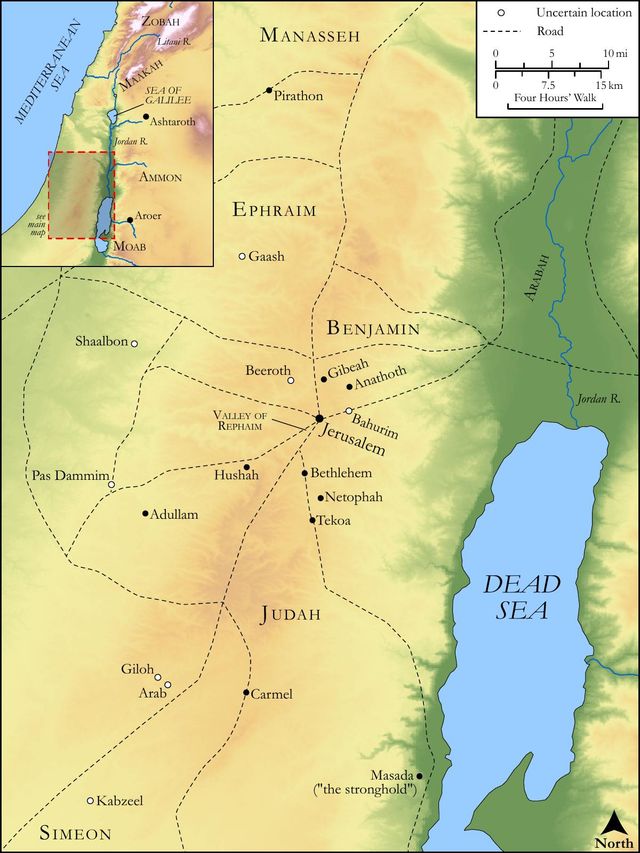
See on the biblical-era map
Study this verse
Public-domain commentary
Matthew Henry
From his Commentary on the Whole Bible. Henry comments on passages, not single verses — this entry covers 1 Chronicles 11:10–47. His two-level outline is real structure in the source text, so it is rendered as structure.
We have here an account of David's worthies, the great men of his time that served him and were preferred by him. The first edition of this catalogue we had, Sa2 23:8, etc. This is much the same, only that those named here from Ch1 11:41 to the end are added. Observe,
I.The connexion of this catalogue with that which is said concerning David, Ch1 11:9.
1.David waxed greater and greater, and these were his mighty men. Much of the strength and honour of great men is borrowed from their servants and depends upon them, which cannot but somewhat diminish pomp and power in the opinion of those that are wise. David is great because he has great men about him; take these away, and he is where he was.
2.The Lord of hosts was with him, and these were the mighty men which he had. God was with him and wrought for him, but by men and means and the use of second causes. By this it appeared that God was with him, that he inclined the hearts of those to come over to him that were able to serve his interest. As, if God be for us none can be against us, so, if God be for us, all shall be for us that we have occasion for. Yet David ascribed his success and increase, not to the hosts he had, but to the Lord of hosts, not to the mighty men that were with him, but to the mighty God whose presence with us is all in all.
II.The title of this catalogue (Ch1 11:10):
These are the men who strengthened themselves with him. In strengthening him they strengthened themselves and their own interest; for his advancement was theirs. What we do in our places for the support of the kingdom of the Son of David we shall be gainers by. In strengthening it we strengthen ourselves. It may be read, They held strongly with him and with all Israel. Note, When God has work to do he will not want fit instruments to do it with. If it be work that requires mighty men, mighty men shall either be found or made to effect it, according to the word of the Lord.
III.That which made all these men honourable was the good service that they did to their king and country; they helped to make David king (Ch1 11:10) - a good work. They slew the Philistines, and other public enemies, and were instrumental to save Israel. Note, The way to be great is to do good. Nor did they gain this honour without labour and the hazard of their lives. The honours of Christ's kingdom are prepared for those that fight the good fight of faith, that labour and suffer, and are willing to venture all, even life itself, for Christ and a good conscience. It is by a patient continuance in well-doing that we must seek for glory, and honour, and immortality; and those that are faithful to the Son of David shall find their names registered and enrolled much more to their honour than these are in the records of fame.
IV.Among all the great exploits of David's mighty men, here is nothing great mentioned concerning David himself but his pouring out water before the Lord which he had longed for, Ch1 11:18, Ch1 11:19. Four very honourable dispositions of David appeared in that action, which, for aught I know, made it as great as any of the achievements of those worthies.
1.Repentance for his own weakness. It is really an honour to a man, when he is made sensible that he has said or done any thing unadvisedly, to unsay it and undo it again by repentance, as it is a shame to a man when he has said or done amiss to stand to it.
2.Denial of his own appetite. He longed for the water of the well of Bethlehem; but, when he had it, he would not drink it, because he would not so far humour himself and gratify a foolish fancy. He that has such a rule as this over his own spirit is better than the mighty. It is an honour to a man to have the command of himself; but he that will command himself must sometimes cross himself.
3.Devotion towards God. That water which he thought too good, too precious, for his own drinking, he poured out to the Lord for a drink offering. If we have any thing better than another, let God be honoured with it, who is the best, and should have the best.
4.Tenderness of his servants. It put him into the greatest confusion imaginable to think that three brave men should hazard their lives to fetch water for him. In his account it turns the water into blood. It is the honour of great men not to be prodigal of the blood of those they employ, but, in all the commands they give them, to put their own souls into their souls' stead.
V.In the wonderful achievements of these heroes the power of God must be acknowledged.
How could one slay 300 and another the same number (Ch1 11:11, Ch1 11:20), another two lion-like men (Ch1 11:22), and another an Egyptian giant (Ch1 11:23), if they had not had the extraordinary presence of God with them, according to that promise, Jos 23:10, One man of you shall chase a thousand, for the Lord your God fighteth for you?
VI.One of these worthies is said to be an Ammonite (Ch1 11:39), another a Moabite (Ch1 11:46), and yet the law was that an Ammonite and a Moabite should not enter into the congregation of the Lord, Deu 23:3. These, it is likely, had approved themselves so hearty for the interest of Israel that in their case it was thought fit to dispense with that law, and the rather because it was an indication that the Son of David would have worthies among the Gentiles: with him there is neither Greek nor Jew.
Continue studying 1 Chronicles 11:10 across the web’s major study libraries — every link below opens this exact verse, chapter, or book on the destination site.
Read & Compare
 BibleGatewayThis verse in more than 200 translations and 70 languages.
 Bible.comThe YouVersion reader — hundreds of translations, reading plans, and highlights.
 ESV.orgCrossway's official English Standard Version reader.
 NET BibleThe NET translation with 60,000+ translators' notes on every rendering decision.
 STEP BibleTyndale House's free study tool — original text, vocabulary, and scholarly resources.
 BibliaLogos Bible Software's free web reader.
 USCCBThe New American Bible (Revised Edition) with the U.S. bishops' study notes.
Commentaries
 BibleHub CommentariesDozens of classic commentaries on this verse, gathered on one page.
 StudyLightMore than 100 commentary sets — the largest collection on the web.
 BibleRefPlain-English commentary on what this verse means, verse by verse.
 Enduring WordDavid Guzik's free commentary on this chapter, widely used by Bible teachers.
 Bible Study ToolsVerse commentary alongside Greek and Hebrew study aids.
Original Language & Research
- BibleHub InterlinearThe verse word by word — original language, transliteration, and English.
- BibleHub LexiconEvery word's original-language definition and Strong's entry.
 Blue Letter BibleDeep-study tools — Strong's numbers, concordance, and word studies.
 SefariaThe Hebrew text with Rashi and centuries of Jewish commentary.
Sermons, Hymns & Audio


TrulyRandomVerse is not affiliated with these sites and doesn’t control their content. They’re linked because they’re genuinely useful.
Summary
1 Chronicles 11:10 serves as a foundational introduction to the illustrious catalog of David's most formidable warriors, often referred to as his "mighty men." This verse critically highlights their active and unwavering commitment to David, emphasizing their integral role in consolidating his nascent kingdom and securing his position as king. Beyond mere human effort, the verse profoundly asserts that this entire process—encompassing the strength of these elite warriors and the unified consent of all Israel—was a direct and deliberate fulfillment of God's divine promise and sovereign plan for His people.
Context
ShowHideLiterary Context
This verse is strategically positioned by the Chronicler immediately following the pivotal account of David's anointing as king by all the tribes of Israel at Hebron, a momentous event detailed in 1 Chronicles 11:1-3. It functions as a crucial thematic preamble to the extensive and detailed roster of David's individual "mighty men" and their heroic exploits, which commences in 1 Chronicles 11:11. By first presenting this overarching statement about the collective purpose and divine legitimacy behind these warriors' actions, the Chronicler masterfully sets the interpretive framework. Their individual feats, though remarkable, are thus understood not as isolated acts of valor but as integral components of a larger, divinely ordained plan for the establishment and security of David's reign. The verse effectively bridges the narrative of David's formal enthronement with the subsequent demonstration of his military strength and the loyal support that underpinned his kingdom.
Historical & Cultural Context
David's ascension to the throne marked a profound epoch in Israel's history, transitioning the nation from the fragmented, often tumultuous period of the Judges and Saul's unstable monarchy to a unified, centralized kingdom. The concept of "mighty men" (Hebrew: גִּבֹּרִים, gibborim) was a recognized and vital institution in ancient Near Eastern societies, denoting an elite corps of warriors—often personal bodyguards or special forces—whose unparalleled skill, unwavering loyalty, and military prowess were indispensable to a king's authority, defense, and expansion. In Israel, this elite group, drawn from various tribes, symbolized the burgeoning national unity under David's leadership. The collective act of "making him king" by "all Israel" underscores the prevalent tribal structure of the era, where broad consensus from tribal elders and representatives was paramount for legitimizing a ruler, especially one whose claim to the throne was rooted in divine election rather than conventional hereditary succession. This period also witnessed the strategic establishment of Jerusalem as the new capital, a central religious and political hub, which these mighty men would be instrumental in defending and expanding.
Key Themes
ShowHide1 Chronicles 11:10 powerfully encapsulates several overarching themes that are central to the Chronicler's theological agenda. Firstly, it underscores the theme of Divine Kingship, explicitly stating that David's rule was not merely a human political achievement but occurred "according to the word of the LORD." This foundational theological truth aligns perfectly with the Chronicler's emphasis on God's sovereign choice and His covenant faithfulness, particularly as articulated in the Davidic Covenant, where God promises an enduring dynasty. Secondly, the theme of Unity and National Consensus is prominently displayed, as "all Israel" participated in making David king, starkly contrasting with the earlier tribal divisions and the fragmented kingdom under Saul. This highlights the ideal of a unified people under God's chosen leader. Thirdly, the verse brilliantly illustrates the Interplay of Divine Sovereignty and Human Agency, acknowledging that while God ordains, He sovereignly chooses to work through dedicated and loyal individuals. The "mighty men" who "strengthened themselves with him" exemplify this crucial dynamic, demonstrating that human responsibility and effort are vital components in the realization of God's purposes, a recurring motif throughout the historical books, as seen in the call for obedience and its consequences in Deuteronomy 28.
Exposition and Analysis
ShowHideKey Word Analysis
ShowHideThe Hebrew verb חָזַק (châzaq) is a primitive root meaning "to fasten upon," "to seize," "to be strong," "to prevail," or "to hold fast." In this context, the Hithpael stem (hitpa'el, reflexive-intensive) of the verb, rendered "strengthened themselves," denotes a proactive, deliberate, and intensive action. It implies that David's mighty men did not merely offer passive allegiance but actively and intentionally exerted their strength, influence, and unwavering loyalty to support, consolidate, and empower David's kingdom. This was a profound personal investment and a concerted effort to solidify his rule and ensure the stability and success of his reign.
The term גִּבֹּר (gibbôwr), or גִּבֹּר, is an intensive form meaning "powerful," and by implication, "warrior," "champion," or "valiant man." It refers to an elite class of soldiers, distinguished not only by their physical strength but also by their exceptional skill, courage, and prowess in battle. In the biblical narrative, gibbôwr are often depicted as individuals of extraordinary valor, indispensable for military success and national defense. Their designation as David's "mighty men" underscores the high caliber and formidable capabilities of his inner circle of warriors, whose physical and strategic contributions were instrumental in establishing and maintaining his kingdom.
The Hebrew noun דָבָר (dâbâr) derives from a root meaning "to speak," and refers to "a word," but also by implication, "a matter," "a thing," "a decree," or "a promise." In the phrase "according to the word of the LORD," dâbâr signifies God's authoritative decree, divine promise, and sovereign plan. It is not merely a spoken utterance but carries the weight of divine will and covenantal faithfulness. This emphasizes that David's kingship, and the human efforts that facilitated it, were not accidental or solely human-driven, but were directly aligned with and the fulfillment of God's pre-ordained purposes for Israel.
Verse Breakdown
ShowHide"These also [are] the chief of the mighty men whom David had"
This opening clause immediately introduces the subject of the ensuing detailed list. It identifies the most prominent, preeminent, and skilled warriors who were in David's service, establishing their elite status and their direct, personal association with the king. The term "chief" (Hebrew: ro'sh) indicates their leadership, superior rank, and preeminence among David's military forces, setting the stage for the enumeration of their heroic deeds.
"who strengthened themselves with him in his kingdom"
This phrase illuminates the active, collaborative, and deeply committed role of these elite warriors. They did not merely serve David passively but proactively exerted their strength, influence, and unwavering loyalty alongside him. This signifies a partnership and shared objective, indicating that their efforts were specifically directed towards solidifying David's rule, ensuring the stability, security, and prosperity of his royal domain. It highlights their profound personal investment and dedication to the success of his reign.
"[and] with all Israel, to make him king"
This segment broadens the scope of the support for David, emphasizing that the mighty men's efforts were part of a larger, national consensus. "All Israel" united to affirm David's kingship, signifying a collective acceptance, participation, and legitimization of his enthronement. This underscores the unity achieved under David's leadership, moving beyond previous tribal divisions to establish a unified kingdom with a national mandate.
"according to the word of the LORD concerning Israel"
This concluding phrase serves as the theological linchpin of the entire verse, providing the ultimate interpretive lens. It unequivocally asserts that David's kingship, and the combined efforts of his mighty men and all Israel, were not random occurrences, political maneuvers, or mere human achievements. Instead, they were the direct fulfillment of God's divine promise, sovereign plan, and covenantal faithfulness concerning the leadership and destiny of His people. This validates David's reign as divinely ordained and legitimate, rooting it firmly in God's overarching redemptive narrative for Israel.
Literary Devices
ShowHideThe Chronicler masterfully employs several literary devices in 1 Chronicles 11:10 to convey its profound theological and historical message. Emphasis is achieved through the strategic placement of this verse as a preamble to the detailed list of David's mighty men, thereby highlighting their collective significance and, more importantly, the divine mandate that undergirded David's kingship. The phrase "according to the word of the LORD" functions as a powerful Theological Affirmation, framing all subsequent human actions and military successes within the context of God's overarching sovereign plan. There is an element of Foreshadowing present, as this verse sets the stage for David's future successful military campaigns, the expansion of his territory, and the secure establishment of his kingdom, all of which are detailed later in the book. The mention of "all Israel" participating "to make him king" suggests Synecdoche, where a part (the mighty men, as a leading example) represents the whole (the unified nation), working together under divine guidance. This verse also effectively functions as a thematic Inclusio with other Chronicler passages that consistently emphasize God's direct role in establishing and sustaining the Davidic throne, thereby reinforcing the divine legitimacy and enduring nature of the Davidic line.
Theological and Thematic Connections
ShowHide1 Chronicles 11:10 profoundly illustrates the intricate interplay between divine sovereignty and human agency in the unfolding of God's redemptive purposes. While God's "word" is explicitly stated as the ultimate authority and the foundational source of David's kingship, He chooses to accomplish His will through the active participation, strength, and unified support of human agents—specifically, the "mighty men" and "all Israel." This verse underscores that God's plans are not abstract or detached from human history; rather, they are realized through the dedicated efforts of those who align themselves with His divine will. It highlights the profound theological truth that true leadership, particularly in God's kingdom, is both divinely appointed and sustained, yet it simultaneously requires and greatly benefits from loyal, strong, and unified support from its people. This dynamic relationship between divine decree and human responsibility is a consistent and powerful theme woven throughout biblical history, teaching believers that their actions, when consecrated to and aligned with God's word, contribute meaningfully to His greater redemptive narrative.
Reflection and Application
ShowHideThis verse offers a powerful and enduring reminder that God, in His infinite wisdom, frequently chooses to work through human instruments to accomplish His divine purposes on earth. David's kingship, though unequivocally divinely ordained, necessitated the tangible strength, active participation, and unified support of his "mighty men" and "all Israel." For believers today, this passage imparts a profound lesson on the importance of active participation and loyal commitment within our various communities—be it the local church, our families, or our professional spheres. It challenges us to introspectively consider how we are "strengthening ourselves with" those God has placed in positions of leadership, or how we are contributing to the collective good of a shared vision that is aligned with God's overarching will. Recognizing God's sovereign hand in the larger narrative should inspire us to faithfully and diligently play our part, trusting that our efforts, however seemingly small, contribute significantly to His grand and unfolding design. Furthermore, it encourages us to consistently seek and acknowledge divine guidance in all our endeavors, understanding that true and lasting success is ultimately realized when human effort is consecrated to and flows from God's "word."
Questions for Reflection
ShowHideFAQ
ShowHideWhat is the significance of "strengthened themselves with him"?
ShowHideThe phrase "strengthened themselves with him" (Hebrew: חָזַק, châzaq, in the Hithpael stem) carries significant weight. It signifies a proactive, deliberate, and intense commitment from David's mighty men. This goes far beyond mere passive loyalty; it indicates that they actively exerted their power, influence, and military prowess to support David, consolidate his kingdom, and ensure its stability. This highlights their deep personal investment and partnership in establishing David's reign, demonstrating that while God ordained David's kingship, He chose to use human agents who were fully dedicated and actively engaged in realizing His plan. This active strengthening was crucial for transforming a divine promise into a tangible reality on earth, as seen in David's eventual secure rule over all Israel.
How does this verse emphasize God's sovereignty alongside human responsibility?
ShowHideThis verse beautifully encapsulates the biblical tension and harmony between God's sovereignty and human responsibility. It explicitly states that David's kingship was established "according to the word of the LORD," thereby affirming God's ultimate authority, overarching plan, and faithfulness to His promises. Simultaneously, it highlights the active and indispensable role of "the chief of the mighty men" and "all Israel" who "strengthened themselves with him...to make him king." This demonstrates that God's divine decree does not negate human action but rather empowers, directs, and works through it. It teaches a profound theological truth: our obedience, dedicated effort, and active participation are vital components in the unfolding of God's redemptive purposes, much like the Israelites' journey to possess the Promised Land.
Christ-Centered Fulfillment
ShowHide1 Chronicles 11:10, with its profound emphasis on a divinely appointed king supported by loyal, mighty warriors and a unified nation, serves as a powerful and rich foreshadowing of the kingship of Jesus Christ. Just as David's reign was established "according to the word of the LORD," so too was Christ's coming and the establishment of His eternal kingdom prophesied, ordained, and brought to fruition by God's sovereign will (e.g., Isaiah 9:6-7). Jesus is the ultimate King, the true Son of David, whose kingdom is not of this world yet extends in spiritual authority and dominion over all creation (John 18:36; Colossians 1:16-17). His "mighty men" are not physical warriors but rather believers, empowered by the Holy Spirit, who "strengthen themselves with Him" by faithfully serving His purposes and actively advancing His spiritual kingdom through evangelism, discipleship, and righteous living in the world (Ephesians 6:10-18; Matthew 28:18-20). The unity of "all Israel" in making David king finds its ultimate spiritual fulfillment in the Church, the global body of Christ, composed of believers from every tribe, tongue, people, and nation, all united under Christ the Head (Ephesians 4:4-6). Thus, David's earthly kingdom, established by divine word and human cooperation, powerfully points to the eternal, spiritual reign of Christ, which is likewise established by God's unchangeable decree and continually advanced by the faithful, Spirit-empowered participation of His redeemed people.