


1 Chronicles 11:11
Bible text: King James Version (1769 Blayney text) · Public domain
Bible text: King James Version with Strong's numbers · Public domain
Bible text: Berean Standard Bible · Public domain
Bible text: American Standard Version (1901) · Public domain
Bible text: World English Bible, Messianic edition · Public domain
Bible text: Geneva Bible (1599) · Public domain
Bible text: Young's Literal Translation · Public domain
- וְאֵלֶּהve·'E·lehand theseH428Conj-w ¦ PrtParticle Demonstrativeוְandאֵלֶּהthese
- מִסְפַּרmis·Par[are] [the] number ofH4557N-mscNoun Singular Masculine Construct
- הַגִּבֹּרִיםha·gi·bo·Rimthe mighty [men]H1368Art ¦ N-mpNoun Plural Masculine Absoluteהַtheגִּבֹּרִיםmighty [men]
- אֲשֶׁר'a·SherwhoH834RelParticle Relative
- לְדָוִידle·da·Vid[belonged] to DavidH1732Prep-l ¦ N-proper-mNoun Proper Masculineלְ[belonged] toדָוִידDavid
- יָשָׁבְעָםya·sha·ve·'AmJashobeamH3434N-proper-mNoun Proper Masculine
- בֶּןbena son ofH1121N-mscNoun Singular Masculine Construct
- חַכְמוֹנִיchakh·mo·Nia HacmoniteH2453N-proper-mNoun Proper Masculine
- רֹאשׁrosh[was] [the] chief ofH7218N-mscNoun Singular Masculine Construct
- הַשָּׁלִישִׁיםha·she·lo·shimthe officersH7991Art ¦ N-mpNoun Plural Masculine Absoluteהַtheשָּׁלִישִׁיםofficers
- הוּאhu'heH1931Pro-3msPronoun Personal 3rd Singular Masculine
- עוֹרֵרo·Rerhe wieldedH5782V-Piel-Perf-3msVerb Piel Perfect 3rd Singular Masculine
- אֶת'et<obj.>H853DirObjMParticle Object Indicator
- חֲנִיתוֹcha·ni·Tohis spearH2595N-fsc ¦ 3msNoun Singular Feminine Constructחֲנִיתspearוֹhis
- עַל'alonH5921PrepPreposition
- שְׁלֹשׁshe·loshthreeH7969N-cscNoun Singular common gender Construct
- מֵאוֹתme·'othundred<s>H3967N-fpNoun Plural Feminine Absolute
- חָלָלcha·Lal[one] slainH2491Adj-msAdjective Singular Masculine Absolute
- בְּפַעַםbe·Fa·'amat a timeH6471Prep-b ¦ N-fsNoun Singular Feminine Absoluteבְּatפַעַםa time
- אֶחָת'e·ChatoneH259N-fsNoun Singular Feminine Absolute
English is a literal word-by-word gloss of the Hebrew, not the KJV's wording. Why?
This is the original text the KJV's translators worked from — each Hebrew word with its own literal English meaning in this verse, prepared by scholars at Tyndale House, Cambridge. The KJV translates whole sentences, not word by word, so its wording differs: one Hebrew word can become several English words, and the KJV may choose “the LORD” where the gloss reads “Yahweh”. Both are faithful — they answer different questions. For the KJV's own rendering, switch to the KJV text.
Details
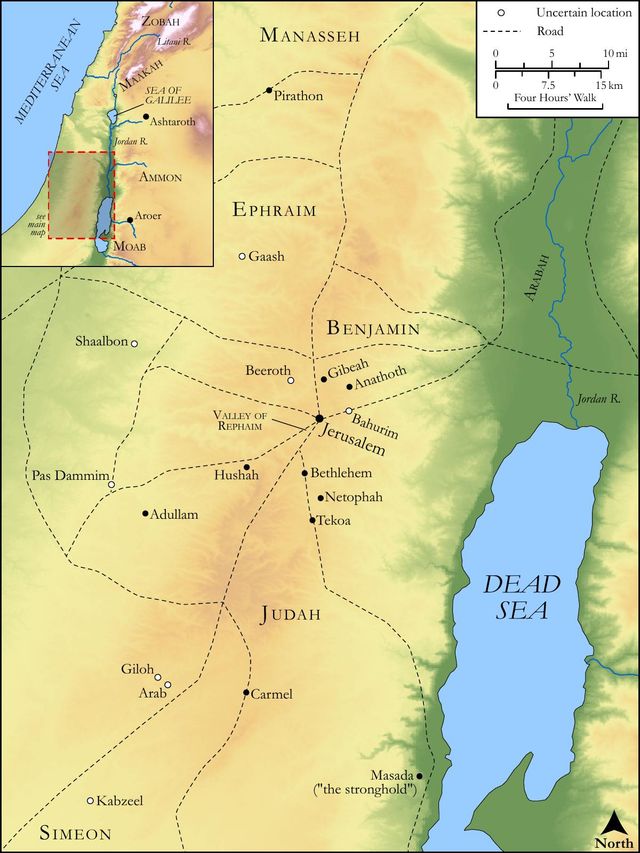
See on the biblical-era map
Study this verse
Public-domain commentary
Matthew Henry
From his Commentary on the Whole Bible. Henry comments on passages, not single verses — this entry covers 1 Chronicles 11:10–47. His two-level outline is real structure in the source text, so it is rendered as structure.
We have here an account of David's worthies, the great men of his time that served him and were preferred by him. The first edition of this catalogue we had, Sa2 23:8, etc. This is much the same, only that those named here from Ch1 11:41 to the end are added. Observe,
I.The connexion of this catalogue with that which is said concerning David, Ch1 11:9.
1.David waxed greater and greater, and these were his mighty men. Much of the strength and honour of great men is borrowed from their servants and depends upon them, which cannot but somewhat diminish pomp and power in the opinion of those that are wise. David is great because he has great men about him; take these away, and he is where he was.
2.The Lord of hosts was with him, and these were the mighty men which he had. God was with him and wrought for him, but by men and means and the use of second causes. By this it appeared that God was with him, that he inclined the hearts of those to come over to him that were able to serve his interest. As, if God be for us none can be against us, so, if God be for us, all shall be for us that we have occasion for. Yet David ascribed his success and increase, not to the hosts he had, but to the Lord of hosts, not to the mighty men that were with him, but to the mighty God whose presence with us is all in all.
II.The title of this catalogue (Ch1 11:10):
These are the men who strengthened themselves with him. In strengthening him they strengthened themselves and their own interest; for his advancement was theirs. What we do in our places for the support of the kingdom of the Son of David we shall be gainers by. In strengthening it we strengthen ourselves. It may be read, They held strongly with him and with all Israel. Note, When God has work to do he will not want fit instruments to do it with. If it be work that requires mighty men, mighty men shall either be found or made to effect it, according to the word of the Lord.
III.That which made all these men honourable was the good service that they did to their king and country; they helped to make David king (Ch1 11:10) - a good work. They slew the Philistines, and other public enemies, and were instrumental to save Israel. Note, The way to be great is to do good. Nor did they gain this honour without labour and the hazard of their lives. The honours of Christ's kingdom are prepared for those that fight the good fight of faith, that labour and suffer, and are willing to venture all, even life itself, for Christ and a good conscience. It is by a patient continuance in well-doing that we must seek for glory, and honour, and immortality; and those that are faithful to the Son of David shall find their names registered and enrolled much more to their honour than these are in the records of fame.
IV.Among all the great exploits of David's mighty men, here is nothing great mentioned concerning David himself but his pouring out water before the Lord which he had longed for, Ch1 11:18, Ch1 11:19. Four very honourable dispositions of David appeared in that action, which, for aught I know, made it as great as any of the achievements of those worthies.
1.Repentance for his own weakness. It is really an honour to a man, when he is made sensible that he has said or done any thing unadvisedly, to unsay it and undo it again by repentance, as it is a shame to a man when he has said or done amiss to stand to it.
2.Denial of his own appetite. He longed for the water of the well of Bethlehem; but, when he had it, he would not drink it, because he would not so far humour himself and gratify a foolish fancy. He that has such a rule as this over his own spirit is better than the mighty. It is an honour to a man to have the command of himself; but he that will command himself must sometimes cross himself.
3.Devotion towards God. That water which he thought too good, too precious, for his own drinking, he poured out to the Lord for a drink offering. If we have any thing better than another, let God be honoured with it, who is the best, and should have the best.
4.Tenderness of his servants. It put him into the greatest confusion imaginable to think that three brave men should hazard their lives to fetch water for him. In his account it turns the water into blood. It is the honour of great men not to be prodigal of the blood of those they employ, but, in all the commands they give them, to put their own souls into their souls' stead.
V.In the wonderful achievements of these heroes the power of God must be acknowledged.
How could one slay 300 and another the same number (Ch1 11:11, Ch1 11:20), another two lion-like men (Ch1 11:22), and another an Egyptian giant (Ch1 11:23), if they had not had the extraordinary presence of God with them, according to that promise, Jos 23:10, One man of you shall chase a thousand, for the Lord your God fighteth for you?
VI.One of these worthies is said to be an Ammonite (Ch1 11:39), another a Moabite (Ch1 11:46), and yet the law was that an Ammonite and a Moabite should not enter into the congregation of the Lord, Deu 23:3. These, it is likely, had approved themselves so hearty for the interest of Israel that in their case it was thought fit to dispense with that law, and the rather because it was an indication that the Son of David would have worthies among the Gentiles: with him there is neither Greek nor Jew.
Continue studying 1 Chronicles 11:11 across the web’s major study libraries — every link below opens this exact verse, chapter, or book on the destination site.
Read & Compare
 BibleGatewayThis verse in more than 200 translations and 70 languages.
 Bible.comThe YouVersion reader — hundreds of translations, reading plans, and highlights.
 ESV.orgCrossway's official English Standard Version reader.
 NET BibleThe NET translation with 60,000+ translators' notes on every rendering decision.
 STEP BibleTyndale House's free study tool — original text, vocabulary, and scholarly resources.
 BibliaLogos Bible Software's free web reader.
 USCCBThe New American Bible (Revised Edition) with the U.S. bishops' study notes.
Commentaries
 BibleHub CommentariesDozens of classic commentaries on this verse, gathered on one page.
 StudyLightMore than 100 commentary sets — the largest collection on the web.
 BibleRefPlain-English commentary on what this verse means, verse by verse.
 Enduring WordDavid Guzik's free commentary on this chapter, widely used by Bible teachers.
 Bible Study ToolsVerse commentary alongside Greek and Hebrew study aids.
Original Language & Research
- BibleHub InterlinearThe verse word by word — original language, transliteration, and English.
- BibleHub LexiconEvery word's original-language definition and Strong's entry.
 Blue Letter BibleDeep-study tools — Strong's numbers, concordance, and word studies.
 SefariaThe Hebrew text with Rashi and centuries of Jewish commentary.
Sermons, Hymns & Audio


TrulyRandomVerse is not affiliated with these sites and doesn’t control their content. They’re linked because they’re genuinely useful.
Summary
1 Chronicles 11:11 introduces Jashobeam, an Hachmonite, as the preeminent warrior among King David's elite "mighty men." This verse records his astonishing feat of valor: single-handedly slaying three hundred adversaries with his spear in a single encounter. This extraordinary deed highlights not only Jashobeam's exceptional strength and skill but also the divine empowerment that characterized David's most trusted and loyal champions, underscoring the formidable foundation of David's newly established kingdom.
Context
ShowHideLiterary Context
This verse is strategically placed within 1 Chronicles 11, a pivotal chapter that chronicles David's anointing as king over all Israel in Hebron, his capture of Jerusalem, and its establishment as the City of David. Following these foundational events, the Chronicler immediately shifts focus to introduce David's "mighty men." This detailed roster, which extends into chapter 12, serves a crucial purpose: it underscores the divine backing and foundational strength of David's reign by showcasing the caliber of individuals God raised up to serve His chosen king. While a parallel account of David's elite warriors is found in the book of 2 Samuel, the Chronicler's version often provides unique details or emphasizes different aspects, aligning with his overarching theological agenda of highlighting God's faithfulness to the Davidic covenant and the unity of Israel under David's rule. The inclusion of Jashobeam's exceptional deed at the very beginning of this list establishes a benchmark of valor for the subsequent heroes.
Historical & Cultural Context
Among the kings of that day, the military prowess of a king and the strength of his personal guard were direct indicators of his power, legitimacy, and the security of his kingdom. The "mighty men" (Hebrew: gibborim) were not ordinary soldiers; they constituted an elite fighting force, celebrated for their unparalleled skill, bravery, and unwavering loyalty to the monarch. Their legendary exploits, such as Jashobeam's, were more than individual acts of heroism; they served to validate David's divinely appointed authority and to secure the nascent kingdom of Israel against its numerous adversaries. The designation "an Hachmonite" likely refers to Jashobeam's clan or family origin, emphasizing his identity within the intricate tribal structure of Israel. While ancient heroic narratives often employed a degree of hyperbole to convey extraordinary capabilities, the accounts of slaying large numbers of enemies in a single engagement were understood to signify a warrior's almost superhuman strength and, more importantly, a clear sign of divine favor and empowerment.
Key Themes
ShowHideThe account of Jashobeam and the other mighty men significantly contributes to several core themes within the book of 1 Chronicles. Firstly, it powerfully illustrates Divine Empowerment and Providence, demonstrating that God not only chose David as king but also meticulously provided him with exceptionally gifted individuals to fulfill His redemptive purposes for Israel. The extraordinary valor displayed by these men is implicitly attributed to God's enabling hand, allowing them to achieve feats that would otherwise be humanly impossible. Secondly, it highlights the theme of Loyalty and Dedicated Service to God's anointed leader. These warriors were not merely fighting for David's personal glory; they were integral to the establishment and expansion of God's kingdom on earth through David's reign, exhibiting unwavering commitment even in the face of overwhelming odds. Their actions directly contribute to the Establishment and Security of David's Kingdom, a central focus of the Chronicler, emphasizing the strength and stability that God granted to David's throne, as seen in David's initial conquest of Jerusalem and the subsequent support from all Israel, as recorded in 1 Chronicles 11:4-9. Finally, the meticulous enumeration and celebration of these heroes serve to Honor and Preserve the Legacy of those who faithfully served God's unfolding plan, providing a historical record of the human instruments through whom God worked to establish His covenant people.
Exposition and Analysis
ShowHideKey Word Analysis
ShowHideThis term (גִּבֹּרִים, H1368) is a plural form of gibbôwr, consistently used throughout the Old Testament to describe individuals of exceptional strength, valor, or influence. It denotes not merely physical power but often a heroic quality, implying courage, skill, and leadership. In the context of David's court, the gibborim were his elite personal guard and military commanders, distinguished by their extraordinary feats and unwavering loyalty, serving as the backbone of his military strength and the enforcers of his kingdom's security.
The word (רֹאשׁ, H7218) literally means "head" but is used figuratively to denote the highest position, leader, or chief. In this context, it signifies Jashobeam's preeminent status and authority within David's elite forces. He was not just one of the mighty men, but the foremost among them, likely holding the highest military command or leading the most elite unit directly under David. This highlights his unparalleled rank and distinction within this celebrated group of warriors.
This term (חֲנִית, H2595) refers to a lance or javelin, a primary weapon in ancient warfare used for thrusting and throwing. The specific mention of Jashobeam's "spear" emphasizes his personal combat skill and the direct, hands-on nature of his incredible feat. It highlights the instrument through which he achieved his astonishing victory, underscoring his individual prowess in close-quarters combat.
Verse Breakdown
ShowHide"And this [is] the number of the mighty men whom David had;"
This introductory clause functions as a heading, signaling the Chronicler's intention to enumerate and honor David's most distinguished warriors. It emphasizes that these men were specifically "David's," highlighting their personal allegiance and their integral role in his rise to power and the establishment of his kingdom. This sets the stage for the subsequent list of heroic deeds.
"Jashobeam, an Hachmonite, the chief of the captains:"
This clause identifies the first and most prominent of David's mighty men. "Jashobeam" is his personal name, and "an Hachmonite" identifies his family or clan, providing a specific lineage and grounding his identity within Israel's tribal structure. His title, "the chief of the captains," immediately establishes his supreme rank and authority within this elite military corps, setting him apart even from other valiant warriors and signifying his leadership among them.
"he lifted up his spear against three hundred slain [by him] at one time."
This clause describes Jashobeam's most celebrated and astonishing feat. The phrase "lifted up his spear against" indicates a direct, aggressive, and decisive engagement. The number "three hundred" slain "at one time" signifies an extraordinary, almost unbelievable, act of valor and military prowess. While scholars often interpret the precise number as a form of hyperbole, the clear intent is to convey Jashobeam's unparalleled strength, skill, and the overwhelming victory he achieved, marking him as a truly formidable and legendary warrior.
Literary Devices
ShowHideThe Chronicler masterfully employs several literary devices to underscore Jashobeam's extraordinary valor and establish his legendary status. Hyperbole is prominently featured in the claim of slaying three hundred men at one time. This deliberate exaggeration is not intended as a precise literal count but rather serves to convey the overwhelming scale of Jashobeam's victory and his almost superhuman strength, elevating him to an iconic figure of martial prowess. The specific mention of the spear can be interpreted as a form of Synecdoche, where the weapon stands in for the warrior's entire martial skill, might, and personal combat effectiveness, symbolizing his direct and devastating impact. Furthermore, the narrative employs Emphasis through Enumeration, as Jashobeam's feat is listed first and described with specific, awe-inspiring detail. This strategic placement highlights his preeminence among the mighty men and establishes a benchmark of valor against which the deeds of the other warriors will be measured, thereby underscoring the foundational strength and divine favor bestowed upon David's kingdom.
Theological and Thematic Connections
ShowHideThe account of Jashobeam's extraordinary valor in 1 Chronicles 11:11 transcends a mere historical record of military might; it serves as a profound theological statement about divine enablement and human faithfulness. It illustrates how God, in His sovereign providence, not only chooses His leaders but also equips them with faithful and exceptionally gifted individuals to fulfill His grand purposes. Jashobeam's strength, while human, is implicitly presented as a manifestation of divine favor, enabling him to achieve what seems humanly impossible. This highlights the enduring biblical principle that when human ability is consecrated to God's will, it can be empowered to accomplish great things for His kingdom. The "mighty men" embody the ideal of dedicated service and unwavering loyalty, not just to a king, but to the divine plan unfolding through that king. Their valor secures the earthly kingdom, foreshadowing the spiritual victories achieved through God's people empowered by His Spirit.
Reflection and Application
ShowHideJashobeam's incredible feat serves as a powerful metaphor for the strength, courage, and dedication required in our spiritual walk and daily lives. While we are not called to wield spears in physical battle, we are called to exhibit conviction, resilience, and unwavering dedication in our spiritual struggles and responsibilities. Just as Jashobeam used his unique strength and skill for the advancement of David's kingdom, we are called to employ our God-given gifts, talents, and resources with excellence in service to God and others. This verse encourages us to face challenges with boldness, knowing that God empowers those who are committed to His purposes. It reminds us that even in seemingly overwhelming circumstances, extraordinary outcomes are possible when we act with faith and resolve, leveraging the strength God provides. Our "battles" may be against sin, injustice, societal brokenness, or personal weaknesses, but the call to be "mighty" in our sphere of influence, standing firm and making a significant impact for God's kingdom, remains timeless and urgent.
Questions for Reflection
ShowHideFAQ
ShowHideWas the slaying of 300 men by Jashobeam a literal event, or is it hyperbole?
ShowHideWhile it is conceivable for an exceptionally skilled warrior in ancient combat to achieve a high number of kills, the figure of 300 slain "at one time" by a single individual is widely interpreted by scholars as a form of hyperbole—a deliberate exaggeration for rhetorical effect. This literary device was common in ancient heroic narratives to emphasize the extraordinary valor, skill, and divine favor upon the warrior. The primary intent is not to provide a precise casualty count but to convey Jashobeam's unparalleled prowess and his preeminent status among David's mighty men, demonstrating the formidable strength upon which David's kingdom was built. The number highlights the impact and legendary status of his feat rather than its exact literalness, serving to inspire awe and reverence for his capabilities.
Who were "the Hachmonites" mentioned in connection with Jashobeam?
ShowHideThe term "Hachmonite" (or "son of Hachmoni" in some translations) likely refers to Jashobeam's family or clan lineage. Beyond this verse and a similar reference to "Jehiel the son of Hachmoni" as a companion to the king's sons in the administrative lists of David's reign, little specific information is known about the Hachmonite clan itself. It appears to be a family or ancestral designation, similar to other tribal or regional identifiers used in the biblical lists of David's men. Its inclusion here serves to ground Jashobeam's identity within the broader Israelite tribal structure, even as his individual feat elevates him to national prominence and legendary status.
How does Jashobeam's feat reflect on David's leadership?
ShowHideJashobeam's extraordinary valor, and indeed the existence of David's entire corps of "mighty men," speaks volumes about David's leadership. First, it demonstrates David's remarkable ability to attract and inspire exceptional individuals. His reputation, divine anointing, and compelling vision for Israel drew men of incredible skill and unwavering loyalty to his side. Second, it highlights the divine favor upon David; God not only chose David as king but also graciously provided him with the necessary human resources—such as these formidable warriors—to establish and secure his kingdom. These mighty men were instrumental in David's military successes, which in turn solidified his reign and fulfilled God's promises for a stable monarchy. Their dedication reflects a profound trust and commitment to David's cause, which was perceived as God's cause for Israel, as evidenced by the unified declaration of all Israel to make David king in 1 Chronicles 11:3.
Christ-Centered Fulfillment
ShowHideJashobeam's unparalleled valor and his preeminent position as "chief of the captains" among David's mighty men serve as a profound Old Testament foreshadowing of Jesus Christ. While Jashobeam achieved an extraordinary physical victory through human strength and skill, Christ accomplished the ultimate spiritual victory through divine power and self-sacrificial love. Jesus is the true "Chief of the Captains," not of an earthly army, but of God's spiritual host, leading His church in triumph over sin, death, and the powers of darkness. His single, decisive act of ultimate valor on the cross, where He metaphorically "lifted up his spear" by enduring the full wrath of God and the physical agony of the cross, resulted in the decisive defeat of spiritual enemies far greater than 300 men. Through His death and glorious resurrection, Christ disarmed principalities and powers, making a public spectacle of them, triumphing over them in it, as declared in Colossians 2:15. Just as Jashobeam's feat secured David's earthly kingdom, Christ's supreme sacrifice established an eternal, unshakable kingdom, inviting all who believe to become His "mighty men and women," empowered by the Holy Spirit to fight spiritual battles and live lives of courageous dedication under His perfect leadership. We are called to put on the full armor of God and stand firm against the schemes of the devil, for our struggle is not against flesh and blood, but against spiritual forces of evil, as powerfully articulated in Ephesians 6:10-12. He is the ultimate hero, whose victory secures our eternal salvation and empowers us for faithful service.