


1 Chronicles 11:9
Bible text: King James Version (1769 Blayney text) · Public domain
Bible text: Berean Standard Bible · Public domain
Bible text: American Standard Version (1901) · Public domain
Bible text: World English Bible, Messianic edition · Public domain
Bible text: Geneva Bible (1599) · Public domain
Bible text: Young's Literal Translation · Public domain
- וַיֵּלֶךְvai·Ye·lekhand he wentH1980Conj-w ¦ V-Qal-ConsecImperf-3msVerb Qal Consecutive Imperfect 3rd Singular Masculineוַandיֵּלֶךְhe went
- דָּוִידda·VidDavidH1732N-proper-mNoun Proper Masculine
- הָלוֹךְha·Lokhcontinuously <to go>H1980V-Qal-InfAbsVerb Qal Infinitive Absolute
- וְגָדוֹלve·ga·Doland becoming greatH1431Conj-w ¦ V-Qal-InfAbsVerb Qal Infinitive Absoluteוְandגָדוֹלbecoming great
- וַיהוָהva·Yah·wehand YahwehH3068Conj-w ¦ N-properNoun Proper TitleוַandיהוָהYahweh
- צְבָאוֹתtze·va·'otof hostsH6635N-fpNoun Plural Feminine Absolute
- עִמּוֹi·Mo[was] with himH5973Prep ¦ 3msPrepositionעִמּ[was] withוֹhim
English is a literal word-by-word gloss of the Hebrew, not the KJV's wording. Why?
This is the original text the KJV's translators worked from — each Hebrew word with its own literal English meaning in this verse, prepared by scholars at Tyndale House, Cambridge. The KJV translates whole sentences, not word by word, so its wording differs: one Hebrew word can become several English words, and the KJV may choose “the LORD” where the gloss reads “Yahweh”. Both are faithful — they answer different questions. For the KJV's own rendering, switch to the KJV text.
Details
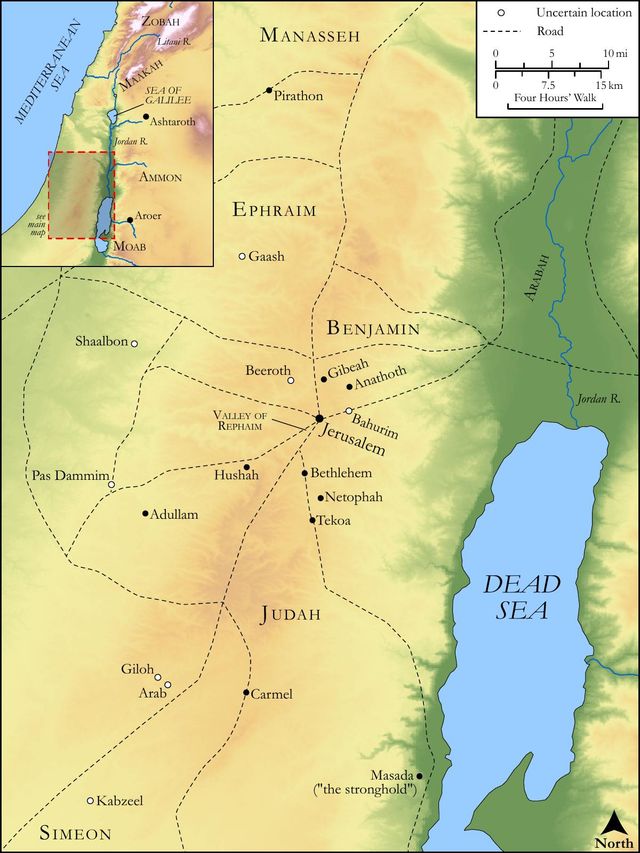
See on the biblical-era map
Study this verse
Public-domain commentary
Matthew Henry
From his Commentary on the Whole Bible. Henry comments on passages, not single verses — this entry covers 1 Chronicles 11:1–9. His two-level outline is real structure in the source text, so it is rendered as structure.
David is here brought to the possession.
I.Of the throne of Israel, after he had reigned seven years in Hebron, over Judah only.
In consideration of his relation to them (Ch1 11:1), his former good services, and especially the divine designation (Ch1 11:2), they anointed him their king: he covenanted to protect them, and they to bear faith and true allegiance to him, Ch1 11:3. Observe,
1.God's counsels will be fulfilled at last, whatever difficulties lie in the way. If God had said, David shall rule, it is in vain to oppose it.
2.Men that have long stood in their own light, when they have long wearied themselves with their lying vanities, it is to be hoped, will understand the things that belong to their peace and return to their own mercies.
3.Between prince and people there is an original contract, which both ought religiously to observe. If ever any prince might have claimed an absolute despotic power, David might, and might as safely as any have been entrusted with it; and yet he made a covenant with the people, took the coronation-oath, to rule by law.
II.Of the strong-hold of Zion, which was held by the Jebusites till David's time.
Whether David had a particular eye upon it as a place fit to make a royal city, or whether he had a promise of it from God, it seems that one of his first exploits was to make himself master of that fort; and, when he had it, he called it the city of David, Ch1 11:7. To this reference is had, Psa 2:6. I have set my king upon my holy hill of Zion. See here what quickens and engages resolution in great undertakings.
1.Opposition. When the Jebusites set David at defiance, and said, Thou shalt not come hither. he resolved to force it, whatever it cost him.
2.Prospect of preferment. When David proposed to give the general's place to him that would lead the attack upon the castle of Zion, Joab was fired with the proposal, and he went up first, and was chief. It has been said, "Take away honour out of the soldier's eye and you cut off the spurs from his heels."
Historical interpretation
Historical reception
2 surviving comments on this verse. Each one is dated, so this reads as a timeline rather than a list.
In vain also do they object that what we have established from Scripture in the books of Kings and Chronicles—that when God wills the accomplishment of something which ought not to be done except by people who will it, their hearts will be inclined to will this, with God producing this inclination, who in a marvelous and ineffable way works also in us that we will—is not pertinent to the subject with which we are dealing.
There is no doubt that human wills cannot resist the will of God, “who has done whatsoever he pleased in heaven and on earth” and who has even “done the things that are to come.” Nor can the human will prevent him from doing what he wills, seeing that even with human wills he does what he wills, when he wills to do it.… There is the case of David, whom God with happier outcome set up over the kingdom. We read of him: “And David went on growing and increasing, and the Lord of hosts was with him.” Then, shortly thereafter, it is said, “But the spirit came on Amasai, the chief among thirty, and he said, We are yours, O David, and for you, O son of Isay; peace, peace be to you, and peace to your helpers; for your God helped you.” Could Amasai have opposed the will of God, instead of doing his will, since God, through his spirit, with which Amasai was clothed, wrought in his heart that he should so will and speak and act? In like fashion, a little later on, Scripture says, “And all these men of war, well appointed to fight, came with a perfect heart to Hebron, to make David king over all Israel.” Obviously, it was of their own will that these men made David king; the fact is clear and undeniable. Nevertheless, it was God, who effects in human hearts whatsoever he wills, who wrought this will in them. This is why Scripture first says, “And David went on growing and increasing, and the Lord of hosts was with him.” The Lord God, therefore, who was with David, brought these men to make him king. And how did he bring them to this? Surely it was not by binding them with any material chains. Rather, he worked within them; he seized their hearts; he drew them on by means of their own wills, which he had himself created within them. When, therefore, God wills to set up kings on earth, he holds the wills of people more in his own power than they are in the power of people themselves. And if this is so, it is surely he, and no other, who makes admonitions salutary and effects amendment in the heart of one who is admonished, with the result that he is established in the heavenly kingdom.
Continue studying 1 Chronicles 11:9 across the web’s major study libraries — every link below opens this exact verse, chapter, or book on the destination site.
Read & Compare
 BibleGatewayThis verse in more than 200 translations and 70 languages.
 Bible.comThe YouVersion reader — hundreds of translations, reading plans, and highlights.
 ESV.orgCrossway's official English Standard Version reader.
 NET BibleThe NET translation with 60,000+ translators' notes on every rendering decision.
 STEP BibleTyndale House's free study tool — original text, vocabulary, and scholarly resources.
 BibliaLogos Bible Software's free web reader.
 USCCBThe New American Bible (Revised Edition) with the U.S. bishops' study notes.
Commentaries
 BibleHub CommentariesDozens of classic commentaries on this verse, gathered on one page.
 StudyLightMore than 100 commentary sets — the largest collection on the web.
 BibleRefPlain-English commentary on what this verse means, verse by verse.
 Enduring WordDavid Guzik's free commentary on this chapter, widely used by Bible teachers.
 Bible Study ToolsVerse commentary alongside Greek and Hebrew study aids.
Original Language & Research
- BibleHub InterlinearThe verse word by word — original language, transliteration, and English.
- BibleHub LexiconEvery word's original-language definition and Strong's entry.
 Blue Letter BibleDeep-study tools — Strong's numbers, concordance, and word studies.
 SefariaThe Hebrew text with Rashi and centuries of Jewish commentary.
Sermons, Hymns & Audio


TrulyRandomVerse is not affiliated with these sites and doesn’t control their content. They’re linked because they’re genuinely useful.
Summary
1 Chronicles 11:9 serves as a pivotal statement summarizing the early, progressive, and divinely ordained success of King David, attributing his escalating power, influence, and dominion directly to the active and sovereign presence of "the LORD of hosts." This verse encapsulates the Chronicler's theological conviction that David's reign was not merely a human achievement but a clear manifestation of God's unwavering faithfulness to His chosen king and His covenant purposes for Israel, establishing the divine source of his unparalleled ascent.
Context
ShowHideLiterary Context
This verse is strategically placed within 1 Chronicles 11, a chapter dedicated to validating David's kingship and establishing Jerusalem as his capital. Immediately preceding this verse, David has been anointed king over all Israel by unanimous consent, a crucial act that legitimizes his rule (1 Chronicles 11:1-3). Following his anointing, David successfully captures the formidable stronghold of Zion from the Jebusites, a strategically vital city, and renames it the City of David (1 Chronicles 11:4-8). This military and political triumph solidifies his position and provides a neutral capital for a unified Israel. Verse 9 acts as a theological summation of these initial triumphs, providing the underlying reason for David's rapid consolidation of power and the establishment of his kingdom. It sets the stage for the subsequent accounts of David's mighty men and his military victories (1 Chronicles 11:10-47), all understood as flowing from this fundamental truth: God was with him, ensuring his continuous growth and success.
Historical & Cultural Context
Among the nations, the success of a king was often attributed to the favor of his gods, but for Israel, the relationship was covenantal and unique, centered on the one true God, Yahweh. David's rise occurred during a critical period of transition from a decentralized tribal confederacy to a centralized monarchy. His capture of Jerusalem, a neutral city, was a brilliant strategic and political move, uniting the northern and southern tribes under his rule. The phrase "waxed greater and greater" reflects the geopolitical reality of David's expanding influence over surrounding nations, transforming Israel from a vulnerable collection of tribes into a regional power. The Chronicler, writing centuries later, likely in the post-exilic period (c. 450-400 BC), emphasizes David's legitimacy and the divine hand in his success. This emphasis served to encourage a community that had experienced exile and national weakness, reminding them of God's enduring faithfulness to the Davidic line and His ability to restore His people. The historical context underscores that David's achievements were not merely the product of military prowess or political acumen but were supernaturally empowered by the God of Israel.
Key Themes
ShowHideThe verse powerfully articulates several core themes central to 1 Chronicles and the broader Old Testament narrative. Firstly, it highlights Divine Presence as the Catalyst for Success. David's increasing greatness is explicitly attributed to the fact that "the LORD of hosts was with him," underscoring that true and lasting prosperity for God's people originates from His active favor and empowering presence, not solely from human effort or strategic brilliance. This echoes themes seen in the lives of figures like Joseph, where God's "being with" someone guarantees success and prosperity even in adversity (see Genesis 39:2-3), and Moses, who was assured of God's presence for his mission (see Exodus 3:12). Secondly, it emphasizes Progressive Growth and Influence. The phrase "waxed greater and greater" (Hebrew: halak we-gadel) signifies a continuous and expanding trajectory of strength, prominence, and dominion, portraying David's reign as one of consistent expansion and consolidation of power, a testament to God's sustained blessing and faithfulness to His chosen king. Thirdly, the title "LORD of hosts" (Hebrew: Yahweh Sabaoth) underscores God's Sovereignty and Power. This powerful designation for God emphasizes His role as the sovereign commander of heavenly armies and all creation, highlighting His omnipotence and His ability to ensure victory and prosperity for those He supports, as famously declared by David himself before facing Goliath, trusting in the name of the LORD of hosts.
Exposition and Analysis
ShowHideKey Word Analysis
ShowHideThis idiomatic phrase, literally "went and became great" or "walked and grew," denotes a continuous, progressive, and sustained increase in power, influence, and stature. The verb hâlak (H1980) signifies a continuous movement or progression, often translated as "walk" or "go," but here conveying the idea of an ongoing process. The adjective gâdôwl (H1419) means "great" in any sense, referring to magnitude, importance, or influence. The repetition of the idea of "greatness" or the continuous nature of "waxing" emphasizes the remarkable and undeniable trajectory of David's ascent, portraying it as an ever-increasing success rather than a series of isolated achievements. It signifies a divinely orchestrated and unstoppable momentum in his reign, a constant expansion of his kingdom and authority.
This is one of the most majestic and powerful titles for God in the Old Testament. Yᵉhôvâh (H3068) is the personal, covenantal name of God, revealing His self-existence and faithfulness, often translated as "the LORD." tsâbâʼ (H6635), meaning "armies" or "hosts," refers to both the celestial armies (angels) and the earthly armies of Israel. The full title, "Yahweh Sabaoth," conveys God's supreme authority and omnipotence as the commander of all forces, both spiritual and physical. It highlights His ability to intervene decisively in human affairs, to fight on behalf of His people, and to ensure the fulfillment of His purposes. In the context of David's military and political expansion, this title emphasizes that his success was not merely human might but the direct result of the Almighty God, the General of all creation, being on his side, orchestrating his victories and establishing his kingdom.
Verse Breakdown
ShowHide"So David waxed greater and greater"
This clause describes the observable reality of David's reign. It speaks to his increasing military strength, political authority, territorial control, and personal renown. The introductory "So" (וַיֵּלֶךְ, wayyeleḵ) indicates a direct consequence of what precedes it – his anointing and the capture of Jerusalem – but also sets up the divine explanation that follows. It paints a picture of a king whose influence was not diminishing but constantly expanding, a clear sign of divine favor and blessing that set him apart from previous leaders.
"for the LORD of hosts [was] with him"
This is the explanatory clause, providing the theological rationale for David's extraordinary success. The conjunction "for" (כִּי, ki) establishes a direct causal link. David's greatness was not due to his own inherent abilities alone, nor to chance, but because the omnipotent, covenant-keeping God, the "LORD of hosts," actively accompanied, empowered, and favored him. This phrase encapsulates the core theological message of the Chronicler: God's active presence is the ultimate source of true prosperity, success, and legitimacy for His chosen servants and people. It underscores that David's reign was fundamentally a divine enterprise.
Literary Devices
ShowHideThe verse employs several potent literary devices to convey its profound message. Causality is central, explicitly linking David's increasing greatness to the direct presence of the LORD. The structure "A: for B" clearly establishes B as the reason for A, emphasizing divine agency over human effort. The phrase "waxed greater and greater" employs a form of Repetition or Intensification, using a verbal idiom to convey continuous, escalating growth, which borders on Hyperbole to underscore the extraordinary and divinely-enabled nature of David's ascent beyond typical human achievement. The use of the Divine Epithet "LORD of hosts" is a powerful form of Theological Naming, invoking God's supreme authority, military might, and sovereign control over all creation. This specific title, often associated with warfare and divine intervention, underscores the supernatural backing behind David's military and political victories. The verse also functions as a Theological Summary, condensing complex historical and political developments into a concise statement about divine agency and human flourishing.
Theological and Thematic Connections
ShowHideThis verse profoundly illustrates the foundational biblical principle that true and lasting success, particularly in the service of God's kingdom, is not merely a product of human effort, talent, or strategic planning, but primarily a result of God's active presence and favor. David's escalating greatness serves as a powerful testament to God's faithfulness to His covenant promises, demonstrating that when God is "with" His chosen instruments, their endeavors are supernaturally empowered and prosper. This divine partnership elevates human leadership from mere political maneuvering to a sacred calling, where God's omnipotence ensures the fulfillment of His purposes through obedient vessels. It underscores the sovereignty of God over all earthly affairs, including the rise and fall of nations and kings, and highlights that His presence is the ultimate source of authority, protection, and victory, making human success ultimately a reflection of divine blessing.
Reflection and Application
ShowHide1 Chronicles 11:9 offers a timeless and profoundly encouraging principle for believers today: our true and enduring success in life, ministry, and all our endeavors is ultimately rooted in the active, empowering presence of God. This verse challenges us to shift our focus from relying solely on our own abilities, resources, or strategic plans, to cultivating a deep and abiding relationship with the "LORD of hosts." When we acknowledge His sovereignty and seek His presence above all else, we invite His supernatural favor to empower our efforts, overcome our obstacles, and lead us into a trajectory of spiritual and practical fruitfulness that extends beyond our natural capacities. It calls us to live with a confident dependence on God, trusting that His "being with us" is the ultimate guarantee of purpose, protection, and progressive impact, transforming our lives into living testimonies of His faithfulness and power, much like David's. This divine partnership frees us from the anxiety of self-reliance and invites us into a collaborative journey with the Almighty, where His strength is made perfect in our weakness.
Questions for Reflection
ShowHideFAQ
ShowHideWhy does the Chronicler emphasize "the LORD of hosts was with him" so strongly in relation to David's greatness?
ShowHideThe Chronicler's primary purpose in writing was not merely to recount history, but to provide a theological interpretation of Israel's past, particularly for the post-exilic community. By repeatedly emphasizing that David's success stemmed directly from "the LORD of hosts [being] with him," the Chronicler achieves several crucial objectives. Firstly, it legitimizes David's kingship as divinely ordained, not merely a political coup, thereby reinforcing the legitimacy of the Davidic line. Secondly, it highlights God's unwavering faithfulness to His covenant promises, especially the Davidic covenant, offering hope and reassurance to a community that had experienced exile and loss, reminding them that God's promises endure. Thirdly, it establishes a foundational theological principle: true prosperity and national strength for Israel (and by extension, for God's people in any era) are always contingent upon God's active presence and favor, not human might or political alliances. This emphasis serves as both an encouragement and a challenge, reminding the audience that their future well-being depends on their relationship with the sovereign God, the "LORD of hosts," who controls all things and fights for His people, just as He did for David (see 2 Chronicles 15:2).
Christ-Centered Fulfillment
ShowHideWhile 1 Chronicles 11:9 celebrates the earthly reign of King David, its profound truth finds its ultimate and most glorious fulfillment in Jesus Christ. David's "waxing greater and greater" due to the LORD's presence foreshadows the unparalleled and eternal reign of the Messiah, the true Son of David. Jesus, the incarnate God, perfectly embodies the truth that "the LORD of hosts [is] with him," for He is God with us, Emmanuel, fully divine and fully human. His entire ministry, from His miraculous birth to His triumphant resurrection, was empowered by the perfect union of the Father and the Spirit, demonstrating a divine presence far exceeding that experienced by David. Christ's kingdom, unlike David's, is not limited by geography or time; it is an ever-increasing kingdom that will have no end, over which He has been given all authority in heaven and on earth. David's greatness was a shadow of Christ's supreme dominion and universal Lordship, for in Christ, all the fullness of God dwells bodily, and through Him, God is actively working to reconcile all things to Himself. Thus, David's success, rooted in God's presence, points to the ultimate King whose reign is eternal, whose power is absolute, and whose presence guarantees the ultimate triumph of God's kingdom and the full establishment of His redemptive purposes.