


2 Samuel 5:7
Bible text: King James Version (1769 Blayney text) · Public domain
Bible text: Berean Standard Bible · Public domain
Bible text: American Standard Version (1901) · Public domain
Bible text: World English Bible, Messianic edition · Public domain
Bible text: Geneva Bible (1599) · Public domain
Bible text: Young's Literal Translation · Public domain
- וַיִּלְכֹּדvai·yil·Kodand he capturedH3920Conj-w ¦ V-Qal-ConsecImperf-3msVerb Qal Consecutive Imperfect 3rd Singular Masculineוַandיִּלְכֹּדhe captured
- דָּוִדda·VidDavidH1732N-proper-mNoun Proper Masculine
- אֵת'et<obj.>H853DirObjMParticle Object Indicator
- מְצֻדַתme·tzu·Dat[the] stronghold ofH4686N-fscNoun Singular Feminine Construct
- צִיּוֹןtzi·YonZionH6726N-properNoun Proper Location
- הִיאhi'itH1931Pro-3fsPronoun Personal 3rd Singular Feminine
- עִיר'ir[is] [the] city ofH5892N-fscNoun Singular Feminine Construct
- דָּוִדda·VidDavidH1732N-proper-mNoun Proper Masculine
English is a literal word-by-word gloss of the Hebrew, not the KJV's wording. Why?
This is the original text the KJV's translators worked from — each Hebrew word with its own literal English meaning in this verse, prepared by scholars at Tyndale House, Cambridge. The KJV translates whole sentences, not word by word, so its wording differs: one Hebrew word can become several English words, and the KJV may choose “the LORD” where the gloss reads “Yahweh”. Both are faithful — they answer different questions. For the KJV's own rendering, switch to the KJV text.
Details
See on the biblical-era maps
Study this verse
Public-domain commentary
Matthew Henry
From his Commentary on the Whole Bible. Henry comments on passages, not single verses — this entry covers 2 Samuel 5:6–10. His two-level outline is real structure in the source text, so it is rendered as structure.
If Salem, the place of which Melchizedec was king, was Jerusalem (as seems probable from Psa 76:2), it was famous in Abraham's time. Joshua, in his time, found it the chief city of the south part of Canaan, Jos 10:1-3. It fell to Benjamin's lot (Jos 18:28), but joined close to Judah's, Jos 15:8. The children of Judah had taken it (Jdg 1:8), but the children of Benjamin suffered the Jebusites to dwell among them (Jdg 1:21), and they grew so upon them that it became a city of Jebusites, Jdg 19:11. Now the very first exploit David did, after he was anointed king over all Israel, was to gain Jerusalem out of the hand of the Jebusites, which, because it belonged to Benjamin, he could not well attempt till that tribe, which long adhered to Saul's house (Ch1 12:29), submitted to him. Here we have,
I.The Jebusites' defiance of David and his forces.
They said, Except thou take away the blind and the lame, thou shalt not come in hither, Sa2 5:6. They sent David this provoking message, because, as it is said afterwards, on another occasion, they could not believe that ever an enemy would enter into the gates of Jerusalem, Lam 4:12. They confided either,
1.In the protection of their gods, which David, in contempt, had called the blind and the lame, for they have eyes and see not, feet and walk not. "But," say they, "these are the guardians of our city, and except thou take these away (which thou canst never do) thou canst not come in hither." Some think they were constellated images of brass set up in the recess of the fort, and entrusted with the custody of the place. They called their idols their Mauzzim, or strong-holds (Dan 11:38) and as such relied on them. The name of the Lord is our strong tower, and his arm is strong, his eyes are piercing. Or,
2.In the strength of their fortifications, which they thought were made so impregnable by nature or art, or both, that the blind and the lame were sufficient to defend them against the most powerful assailant. The strong-hold of Zion they especially depended on, as that which could not be forced. Probably they set blind and lame people, invalids or maimed soldiers, to make their appearance upon the walls, in scorn of David and his men, judging them an equal match for him. Though there remain but wounded men among them, yet they should serve to beat back the besiegers. Compare Jer 37:10. Note, The enemies of God's people are often very confident of their own strength and most secure when their day to fall draws nigh.
II.David's success against the Jebusites.
Their pride and insolence, instead of daunting him, animated him, and when he made a general assault he gave this order to his men: "He that smiteth the Jebusites, let him also throw down into the ditch, or gutter, the lame and the blind, which are set upon the wall to affront us and our God." It is probable they had themselves spoken blasphemous things, and were therefore hated of David's soul. Thus Sa2 5:8 may be read; we fetch our reading of it from Ch1 11:6, which speaks only of smiting the Jebusites, but nothing of the blind and the lame. The Jebusites had said that if these images of theirs did not protect them the blind and the lame should not come into the house, that is, they would never again trust their palladium (so Mr. Gregory understands it) nor pay the respect they had paid to their images; and David, having gained the fort, said so too, that these images, which could not protect their worshippers, should never have any place there more.
III.His fixing his royal seat in Sion.
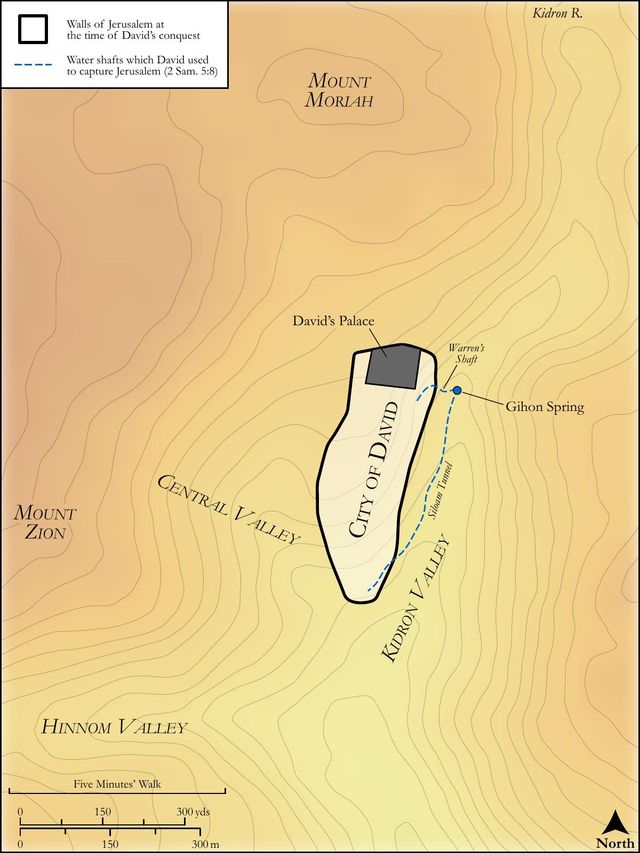
He himself dwelt in the fort (the strength whereof, which had given him opposition, and was a terror to him, now contributed to his safety), and he built houses round about for his attendants and guards (Sa2 5:9) from Millo (the town-hall, or state-house) and inward. He proceeded and prospered in all he set his hand to, grew great in honour, strength, and wealth, more and more honourable in the eyes of his subjects and formidable in the eyes of his enemies; for the Lord God of hosts was with him. God has all creatures at his command, makes what use he pleases of them, and serves his own purposes by them; and he was with him, to direct, preserve, and prosper him, Those that have the Lord of hosts for them need not fear what hosts of men or devils can do against them. Those who grow great must ascribe their advancement to the presence of God with them, and give him the glory of it. The church is called Sion, and the city of the living God. The Jebusites, Christ's enemies, must first be conquered and dispossessed, the blind and the lame taken away, and then Christ divides the spoil, sets up his throne there, and makes it his residence by the Spirit.
Continue studying 2 Samuel 5:7 across the web’s major study libraries — every link below opens this exact verse, chapter, or book on the destination site.
Read & Compare
 BibleGatewayThis verse in more than 200 translations and 70 languages.
 Bible.comThe YouVersion reader — hundreds of translations, reading plans, and highlights.
 ESV.orgCrossway's official English Standard Version reader.
 NET BibleThe NET translation with 60,000+ translators' notes on every rendering decision.
 STEP BibleTyndale House's free study tool — original text, vocabulary, and scholarly resources.
 BibliaLogos Bible Software's free web reader.
 USCCBThe New American Bible (Revised Edition) with the U.S. bishops' study notes.
Commentaries
 BibleHub CommentariesDozens of classic commentaries on this verse, gathered on one page.
 StudyLightMore than 100 commentary sets — the largest collection on the web.
 BibleRefPlain-English commentary on what this verse means, verse by verse.
 Enduring WordDavid Guzik's free commentary on this chapter, widely used by Bible teachers.
 Bible Study ToolsVerse commentary alongside Greek and Hebrew study aids.
Original Language & Research
- BibleHub InterlinearThe verse word by word — original language, transliteration, and English.
- BibleHub LexiconEvery word's original-language definition and Strong's entry.
 Blue Letter BibleDeep-study tools — Strong's numbers, concordance, and word studies.
 SefariaThe Hebrew text with Rashi and centuries of Jewish commentary.
Sermons, Hymns & Audio


TrulyRandomVerse is not affiliated with these sites and doesn’t control their content. They’re linked because they’re genuinely useful.
Summary
Second Samuel 5:7 records the pivotal moment when David decisively captured the formidable Jebusite stronghold of Zion, subsequently renaming it "the city of David." This strategic conquest transformed a pagan fortress into the burgeoning political and spiritual capital of Israel, solidifying David's reign over a unified kingdom and laying the foundational stone for Jerusalem's enduring significance as the chosen dwelling place of God's presence and the epicenter of Israelite identity and worship.
Context
ShowHideLiterary Context
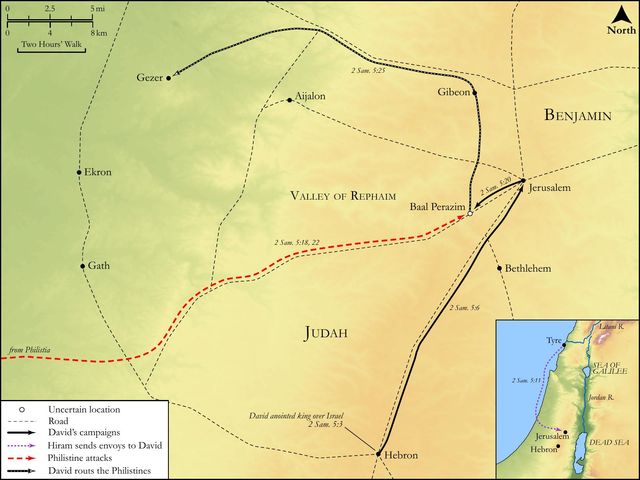
This verse immediately follows David's anointing as king over all twelve tribes of Israel in Hebron, signifying the unification of the kingdom after his seven-and-a-half-year reign over Judah alone (2 Samuel 5:5). The narrative deliberately highlights the Jebusites' arrogant confidence in their city's impregnability, famously taunting David that even "the blind and the lame" could defend it (2 Samuel 5:6). David's swift and successful capture of Zion, therefore, serves as a powerful demonstration of his military prowess and, more importantly, divine favor, establishing his authority over the newly unified nation. This strategic move sets the stage for the subsequent transfer of the Ark of the Covenant to Jerusalem (2 Samuel 6:12) and the eventual building of the Temple by his son Solomon 1 Kings 6:1.
Historical & Cultural Context
At the time of David's conquest, Jerusalem, then known as Jebus, was an independent Canaanite city-state that had successfully resisted Israelite occupation since the time of Joshua (Joshua 15:63). Its strategic location, situated on a defensible ridge between the territories of Judah and Benjamin, made it an ideal neutral capital for a kingdom seeking to bridge tribal divisions. The city's natural defenses, including steep valleys on three sides (Kidron, Hinnom, and Tyropoeon), contributed to the Jebusites' belief in its invincibility. The act of capturing such a formidable stronghold was a monumental military and political achievement for David, demonstrating his capacity to lead and unite a diverse people under a single, strong central authority—a common and necessary practice for newly established kings of that day to consolidate power and legitimacy.
Key Themes
ShowHideThe capture of Zion underscores several key themes within the broader narrative of 2 Samuel and the unfolding history of Israel. Firstly, it highlights the consolidation of David's kingship and the establishment of a unified national identity for Israel, moving beyond fragmented tribal allegiances to a centralized monarchy under God's chosen leader. Secondly, it emphasizes divine enablement; while David's military strategy and leadership are evident, the biblical account implicitly portrays God's sovereign hand guiding David to fulfill His purposes for Israel, including the selection of a permanent dwelling place for His presence. Thirdly, the renaming of Zion as "the city of David" profoundly establishes Jerusalem's unparalleled significance as the future spiritual and political heart of Israel, intrinsically linking it to the Davidic Covenant and its enduring legacy. This event also foreshadows Jerusalem's future role as the location of the Temple and the ultimate prophetic destination for all nations seeking divine instruction (Isaiah 2:2-3).
Exposition and Analysis
ShowHideKey Word Analysis
ShowHideThis primitive root signifies "to catch," "to capture," or "to occupy." In this context, it emphasizes David's decisive military action in seizing the stronghold. It conveys the idea of a successful and complete conquest, transforming the ownership and control of Zion from the Jebusites to David and, by extension, to Israel. The word suggests not merely an entry, but a firm and lasting occupation.
This term denotes a fortress, citadel, or mountain fastness, emphasizing the formidable and seemingly impregnable nature of the Jebusite stronghold. Its use highlights the significant military challenge David faced and the strategic importance of his success in overcoming such a well-defended position. The word conveys a sense of security and inaccessibility, making David's conquest all the more remarkable and a testament to his prowess.
Originally the name of the Jebusite fortress itself, "Zion" came to refer to the specific hill on which the stronghold stood. Over time, its meaning expanded to encompass the entire city of Jerusalem and, eventually, became a poetic and theological synonym for Jerusalem, representing God's holy city, the spiritual home of His people, and the place of His dwelling. Its transformation from a pagan fortress to a sacred site is central to its biblical significance and prophetic trajectory.
This word refers to a city in the widest sense, often implying a guarded place or a watch. When combined with "David," it signifies a place that is not merely a collection of dwellings but a seat of power and authority. Its use here underscores the establishment of Jerusalem as the administrative and political center of David's unified kingdom, a place guarded and governed under his direct rule.
Verse Breakdown
ShowHide"Nevertheless David took the strong hold of Zion:"
This opening clause emphasizes David's decisive and successful military action, standing in stark contrast to the perceived impregnability of the Jebusite fortress, as highlighted in the preceding verse. The word "nevertheless" (or "however") serves as a powerful rhetorical device, showcasing David's strategic brilliance and the divine favor that enabled his conquest despite the Jebusites' taunts. It marks the definitive transition of Zion from an independent, pagan stronghold to a territory under Israelite control.
"the same [is] the city of David."
This declarative statement immediately renames and redefines the conquered stronghold. It signifies its transformation into David's personal possession, his royal seat, and the capital of his kingdom. This renaming is crucial, as it establishes Jerusalem's new identity not merely as a captured city but as the administrative and spiritual center of Israel, a place intimately connected to David's kingship, his legacy, and the future of the unified nation. It highlights the profound shift in ownership and purpose, making it the focal point for all the Israelite tribes.
Literary Devices
ShowHideThe verse employs several potent literary devices that amplify its significance. Conciseness is paramount; in a mere ten words (in the KJV), it encapsulates a monumental historical and theological event, underscoring its pivotal importance without unnecessary elaboration. There is a clear Contrast between the Jebusites' overconfidence in their "strong hold" (implied from the previous verse) and David's swift, decisive action in "taking" it, highlighting the efficacy of David's leadership and the implied divine backing. The renaming of Zion as "the city of David" serves as powerful Symbolism, transforming a geographical location into a representation of David's reign, the unified kingdom, and ultimately, the chosen dwelling place of God. This act of renaming also functions as a Metonymy, where "the city of David" stands for the entire political and spiritual authority centered there, embodying the new era of Israelite national identity.
Theological and Thematic Connections
ShowHideThe capture of Zion and its establishment as the "city of David" is deeply significant for Israel's theological trajectory and understanding of God's covenantal faithfulness. It represents God's sovereign choice and provision of a central, unified place for His people and, ultimately, for His enduring presence. This act laid the groundwork for the Davidic Covenant, where God promised David an eternal dynasty and a perpetual kingdom, with Jerusalem as its enduring capital. The city's unique status as God's chosen dwelling place, later confirmed by the building of the Temple, transformed it into a sacred space, a symbol of divine election, protection, and the outworking of God's redemptive plan. It became the destination for pilgrimage, the fount of divine instruction, and the prophetic hope for the nations, embodying the intersection of God's sovereign will and human history.
Reflection and Application
ShowHideDavid's conquest of Zion serves as a compelling narrative of overcoming seemingly insurmountable obstacles through strategic action and divine enablement. For believers today, this act can be seen as an illustration of the spiritual warfare we are called to engage in, where we are to "demolish arguments and every pretension that sets itself up against the knowledge of God, and we take captive every thought to make it obedient to Christ" (2 Corinthians 10:4-5). Just as David secured a physical stronghold to establish his kingdom, we are called to identify and dismantle spiritual "strongholds" in our lives and communities that hinder God's reign and the flourishing of His truth. Furthermore, the establishment of Jerusalem as a central place for God's presence reminds us of the importance of cultivating a "center" in our own lives—a place where God's presence is prioritized, where His Word is honored, and from which our lives are ordered and directed for His glory and the advancement of His kingdom.
Questions for Reflection
ShowHideFAQ
ShowHideWhy was Jerusalem chosen as the capital over Hebron, where David had previously reigned?
ShowHideJerusalem was chosen for several compelling reasons. Firstly, its strategic location on the border between the territories of Judah and Benjamin made it a neutral territory, preventing favoritism towards either tribe and fostering unity in the newly consolidated kingdom. Secondly, its formidable natural defenses offered a secure and easily defensible capital. Thirdly, by conquering an independent, non-Israelite city rather than moving into an existing Israelite tribal city, David established a new, unifying center that was uniquely "his" and not previously associated with any particular tribal identity, thus solidifying his authority over all Israel. Finally, and most profoundly, it is evident that this choice was also part of God's divine plan for the future of Israel and the establishment of a permanent dwelling place for His presence.
What is the significance of "Zion" becoming "the city of David"?
ShowHideThe renaming of Zion as "the city of David" carries immense significance. It transformed a pagan Jebusite stronghold into the personal royal seat of God's chosen king, symbolizing David's complete conquest and authority over a unified Israel. More profoundly, it marked the beginning of Jerusalem's sacred identity and its elevation to a unique status. It became the administrative, political, and spiritual heart of Israel, intrinsically linked to the Davidic Covenant and the future location of the Temple. This designation set the stage for Jerusalem's enduring role as the center of Israelite worship, pilgrimage, and the prophetic hope for the nations.
Did David conquer Jerusalem alone, or was it a joint effort?
ShowHideThe biblical account in 2 Samuel 5:6-7 indicates that David led his forces in the conquest of Jerusalem. While the text briefly describes David's personal involvement, particularly in challenging the Jebusites, it clearly implies a military campaign involving his army. The formidable challenge posed by the Jebusites, who believed their city to be impregnable, suggests a concerted effort was required. The narrative focuses on David as the leader and orchestrator of the victory, but it was undoubtedly a joint military endeavor under his command, empowered by divine favor, that secured the "strong hold of Zion."
Christ-Centered Fulfillment
ShowHideThe capture of Zion by David, establishing it as "the city of David," profoundly foreshadows the redemptive work of Jesus Christ, the greater Son of David. Just as David conquered a physical stronghold to establish his earthly kingdom, Christ, through His sacrificial death and glorious resurrection, conquered the spiritual strongholds of sin, death, and the devil, thereby establishing His eternal, spiritual kingdom. The earthly Zion, chosen by God as the dwelling place for His presence among His people, points forward to the New Testament reality where God's presence dwells not in a physical temple or city, but in His people, the church, which is built on the foundation of the apostles and prophets, with Christ Jesus Himself as the cornerstone (Ephesians 2:19-22). Jesus is the true King, whose reign extends far beyond the boundaries of an earthly city, establishing a spiritual Mount Zion to which believers come. His ultimate fulfillment is seen in the New Jerusalem, a heavenly city where God will dwell eternally with His redeemed people, a reality secured by the Lamb of God who takes away the sin of the world (John 1:29), fulfilling the ancient prophecies concerning Zion's ultimate glory and making all things new (Revelation 21:5).