


2 Samuel 5:6
Bible text: King James Version (1769 Blayney text) · Public domain
Bible text: King James Version with Strong's numbers · Public domain
Bible text: Berean Standard Bible · Public domain
Bible text: American Standard Version (1901) · Public domain
Bible text: World English Bible, Messianic edition · Public domain
Bible text: Geneva Bible (1599) · Public domain
Bible text: Young's Literal Translation · Public domain
- וַיֵּלֶךְvai·Ye·lekhand he wentH1980Conj-w ¦ V-Qal-ConsecImperf-3msVerb Qal Consecutive Imperfect 3rd Singular Masculineוַandיֵּלֶךְhe went
- הַמֶּלֶךְha·Me·lekhthe kingH4428Art ¦ N-msNoun Singular Masculine Absoluteהַtheמֶּלֶךְking
- וַאֲנָשָׁיוva·'a·na·Shavand his menH582Conj-w ¦ N-mpc ¦ 3msNoun Plural Masculine Constructוַandאֲנָשָׁיmenוhis
- יְרוּשָׁלִַםye·Ru·sha·LimJerusalemH3389N-properNoun Proper Location
- אֶל'elagainstH413PrepPreposition
- הַיְבֻסִיhay·vu·Sithe Jebusite[s]H2983Art ¦ N-msNoun Gentilic Singular Masculine AbsoluteהַtheיְבֻסִיJebusite[s]
- יוֹשֵׁבyo·Shev[the] inhabitant[s] ofH3427V-Qal-Prtcpl-msVerb Qal Participle Singular Masculine Construct
- הָאָרֶץha·'A·retzthe landH776Art ¦ N-fsNoun Singular Feminine Absoluteהָtheאָרֶץland
- וַיֹּאמֶרvai·Yo·merand it saidH559Conj-w ¦ V-Qal-ConsecImperf-3msVerb Qal Consecutive Imperfect 3rd Singular Masculineוַandיֹּאמֶרit said
- לְדָוִדle·da·Vidto DavidH1732Prep-l ¦ N-proper-mNoun Proper MasculineלְtoדָוִדDavid
- לֵאמֹרle·Mor<to> sayingH559Prep-l ¦ V-Qal-InfVerb Qal Infinitive Constructלֵ<to>אמֹרsaying
- לֹאlo'notH3808NegParticle Negative
- תָבוֹאta·Vo'you will comeH935V-Qal-Imperf-2msVerb Qal Imperfect 2nd Singular Masculine
- הֵנָּהHe·nahhereH2008AdvAdverb
- כִּיkithatH3588PrtParticle Conditional
- אִם'imexceptH518PrtParticle Conditional
- הֱסִירְךָhe·si·re·Khahe will turn aside youH5493V-Hiphil-Perf-3ms ¦ 2msVerb Hiphil Perfect 3rd Singular Masculineהֱסִירְhe will turn asideךָyou
- הַעִוְרִיםha·'iv·Rimthe blind [people]H5787Art ¦ Adj-mpAdjective Plural Masculine Absoluteהַtheעִוְרִיםblind [people]
- וְהַפִּסְחִיםve·ha·pis·Chimand the lame [people]H6455Conj-w ¦ Art ¦ Adj-mpAdjective Plural Masculine Absoluteוְandהַtheפִּסְחִיםlame [people]
- לֵאמֹרle·Mor<to> sayingH559Prep-l ¦ V-Qal-InfVerb Qal Infinitive Constructלֵ<to>אמֹרsaying
- לֹאlo'notH3808NegParticle Negative
- יָבוֹאya·Vo'he will comeH935V-Qal-Imperf-3msVerb Qal Imperfect 3rd Singular Masculine
- דָוִדda·VidDavidH1732N-proper-mNoun Proper Masculine
- הֵנָּהHe·nahhereH2008AdvAdverb
English is a literal word-by-word gloss of the Hebrew, not the KJV's wording. Why?
This is the original text the KJV's translators worked from — each Hebrew word with its own literal English meaning in this verse, prepared by scholars at Tyndale House, Cambridge. The KJV translates whole sentences, not word by word, so its wording differs: one Hebrew word can become several English words, and the KJV may choose “the LORD” where the gloss reads “Yahweh”. Both are faithful — they answer different questions. For the KJV's own rendering, switch to the KJV text.
Details
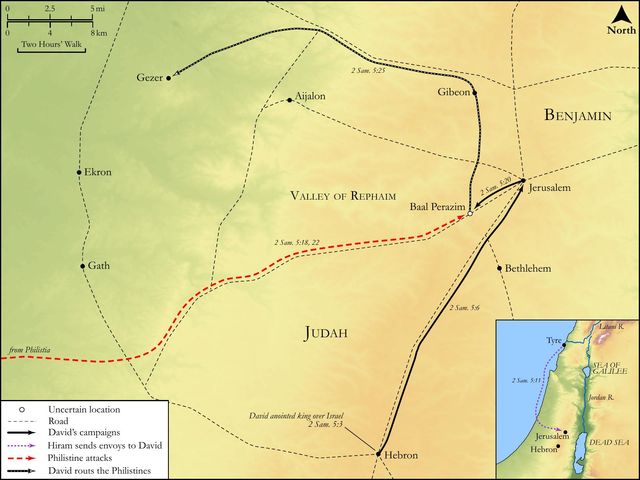
See on the biblical-era maps

Study this verse
Public-domain commentary
Matthew Henry
From his Commentary on the Whole Bible. Henry comments on passages, not single verses — this entry covers 2 Samuel 5:6–10. His two-level outline is real structure in the source text, so it is rendered as structure.
If Salem, the place of which Melchizedec was king, was Jerusalem (as seems probable from Psa 76:2), it was famous in Abraham's time. Joshua, in his time, found it the chief city of the south part of Canaan, Jos 10:1-3. It fell to Benjamin's lot (Jos 18:28), but joined close to Judah's, Jos 15:8. The children of Judah had taken it (Jdg 1:8), but the children of Benjamin suffered the Jebusites to dwell among them (Jdg 1:21), and they grew so upon them that it became a city of Jebusites, Jdg 19:11. Now the very first exploit David did, after he was anointed king over all Israel, was to gain Jerusalem out of the hand of the Jebusites, which, because it belonged to Benjamin, he could not well attempt till that tribe, which long adhered to Saul's house (Ch1 12:29), submitted to him. Here we have,
I.The Jebusites' defiance of David and his forces.
They said, Except thou take away the blind and the lame, thou shalt not come in hither, Sa2 5:6. They sent David this provoking message, because, as it is said afterwards, on another occasion, they could not believe that ever an enemy would enter into the gates of Jerusalem, Lam 4:12. They confided either,
1.In the protection of their gods, which David, in contempt, had called the blind and the lame, for they have eyes and see not, feet and walk not. "But," say they, "these are the guardians of our city, and except thou take these away (which thou canst never do) thou canst not come in hither." Some think they were constellated images of brass set up in the recess of the fort, and entrusted with the custody of the place. They called their idols their Mauzzim, or strong-holds (Dan 11:38) and as such relied on them. The name of the Lord is our strong tower, and his arm is strong, his eyes are piercing. Or,
2.In the strength of their fortifications, which they thought were made so impregnable by nature or art, or both, that the blind and the lame were sufficient to defend them against the most powerful assailant. The strong-hold of Zion they especially depended on, as that which could not be forced. Probably they set blind and lame people, invalids or maimed soldiers, to make their appearance upon the walls, in scorn of David and his men, judging them an equal match for him. Though there remain but wounded men among them, yet they should serve to beat back the besiegers. Compare Jer 37:10. Note, The enemies of God's people are often very confident of their own strength and most secure when their day to fall draws nigh.
II.David's success against the Jebusites.
Their pride and insolence, instead of daunting him, animated him, and when he made a general assault he gave this order to his men: "He that smiteth the Jebusites, let him also throw down into the ditch, or gutter, the lame and the blind, which are set upon the wall to affront us and our God." It is probable they had themselves spoken blasphemous things, and were therefore hated of David's soul. Thus Sa2 5:8 may be read; we fetch our reading of it from Ch1 11:6, which speaks only of smiting the Jebusites, but nothing of the blind and the lame. The Jebusites had said that if these images of theirs did not protect them the blind and the lame should not come into the house, that is, they would never again trust their palladium (so Mr. Gregory understands it) nor pay the respect they had paid to their images; and David, having gained the fort, said so too, that these images, which could not protect their worshippers, should never have any place there more.
III.His fixing his royal seat in Sion.
He himself dwelt in the fort (the strength whereof, which had given him opposition, and was a terror to him, now contributed to his safety), and he built houses round about for his attendants and guards (Sa2 5:9) from Millo (the town-hall, or state-house) and inward. He proceeded and prospered in all he set his hand to, grew great in honour, strength, and wealth, more and more honourable in the eyes of his subjects and formidable in the eyes of his enemies; for the Lord God of hosts was with him. God has all creatures at his command, makes what use he pleases of them, and serves his own purposes by them; and he was with him, to direct, preserve, and prosper him, Those that have the Lord of hosts for them need not fear what hosts of men or devils can do against them. Those who grow great must ascribe their advancement to the presence of God with them, and give him the glory of it. The church is called Sion, and the city of the living God. The Jebusites, Christ's enemies, must first be conquered and dispossessed, the blind and the lame taken away, and then Christ divides the spoil, sets up his throne there, and makes it his residence by the Spirit.
Continue studying 2 Samuel 5:6 across the web’s major study libraries — every link below opens this exact verse, chapter, or book on the destination site.
Read & Compare
 BibleGatewayThis verse in more than 200 translations and 70 languages.
 Bible.comThe YouVersion reader — hundreds of translations, reading plans, and highlights.
 ESV.orgCrossway's official English Standard Version reader.
 NET BibleThe NET translation with 60,000+ translators' notes on every rendering decision.
 STEP BibleTyndale House's free study tool — original text, vocabulary, and scholarly resources.
 BibliaLogos Bible Software's free web reader.
 USCCBThe New American Bible (Revised Edition) with the U.S. bishops' study notes.
Commentaries
 BibleHub CommentariesDozens of classic commentaries on this verse, gathered on one page.
 StudyLightMore than 100 commentary sets — the largest collection on the web.
 BibleRefPlain-English commentary on what this verse means, verse by verse.
 Enduring WordDavid Guzik's free commentary on this chapter, widely used by Bible teachers.
 Bible Study ToolsVerse commentary alongside Greek and Hebrew study aids.
Original Language & Research
- BibleHub InterlinearThe verse word by word — original language, transliteration, and English.
- BibleHub LexiconEvery word's original-language definition and Strong's entry.
 Blue Letter BibleDeep-study tools — Strong's numbers, concordance, and word studies.
 SefariaThe Hebrew text with Rashi and centuries of Jewish commentary.
Sermons, Hymns & Audio


TrulyRandomVerse is not affiliated with these sites and doesn’t control their content. They’re linked because they’re genuinely useful.
Summary
Upon his anointing as king over all Israel, David strategically moved to conquer Jerusalem, a formidable Jebusite stronghold. The inhabitants, confident in their city's impregnability, defiantly mocked David, asserting that even the blind and the lame could defend it against his forces. This verse captures their profound overconfidence and disdain, setting the stage for David's decisive conquest and the establishment of Jerusalem as the capital of the united monarchy.
Context
ShowHideLiterary Context
This verse immediately follows David's anointing as king over all Israel at Hebron, uniting the northern and southern tribes (2 Samuel 5:1-5). With his kingdom now consolidated, David's next strategic move is to establish a central capital. Jerusalem, then known as Jebus, was a Canaanite enclave situated between the tribal territories of Benjamin and Judah, making it an ideal, neutral location for the new united monarchy. The narrative here sets up the dramatic conquest of this seemingly unconquerable city, which becomes the "City of David" and the future spiritual heart of Israel, as detailed in the subsequent verses describing the capture of the stronghold of Zion (2 Samuel 5:7-9). This act solidifies David's reign and marks a pivotal moment in the nation's history.
Historical & Cultural Context
Jerusalem, or Jebus, was one of the few remaining Canaanite strongholds that had resisted Israelite conquest since the days of Joshua (Joshua 15:63). Its natural defenses, including steep valleys on three sides (Kidron, Hinnom, and Tyropoeon), made it a formidable fortress, often considered impregnable. The Jebusites' taunt, "Except thou take away the blind and the lame," reflects a common practice of psychological warfare, as the Rabshakeh's speech before Jerusalem would later show, designed to demoralize the enemy and boast of their city's invulnerability. It also likely alludes to a cultural belief that the blind and lame were ritually impure or weak, making their inclusion in defense a profound insult to David's military might and a hyperbolic claim of their city's absolute security. Their confidence was rooted in centuries of successful resistance and the perceived invulnerability of their citadel.
Key Themes
ShowHideThis verse powerfully introduces several key themes that resonate throughout the Davidic narrative. First, it highlights the arrogance of human self-reliance in the face of divine purpose; the Jebusites' overconfidence and defiant mockery directly precede their downfall, illustrating the biblical principle that pride precedes destruction (Proverbs 16:18). Second, it underscores David's strategic genius and divine favor; his decision to target Jerusalem demonstrates foresight, and his subsequent conquest illustrates God's enablement of the impossible, as seen in the declaration that the Lord God of Hosts was with David (2 Samuel 5:10). Third, it marks the establishment of Jerusalem as the political and spiritual center of Israel, a pivotal moment in the nation's history that foreshadows its future role as the City of God and the site of the Temple, fulfilling God's covenant promises to David.
Exposition and Analysis
ShowHideKey Word Analysis
ShowHideThe indigenous inhabitants of Jerusalem (ancient Jebus) prior to its conquest by David. Their continued presence in the land, despite the Israelite conquest under Joshua, highlights their resilience and the strategic strength of their city. Their defiance here underscores their perceived invincibility, posing a direct challenge to the newly unified Israelite kingdom under David. Their name is derived from "Jebus," the ancient name for Jerusalem.
Literally refers to those without sight. In this context, the Jebusites use this term, along with "lame," metaphorically to represent the weakest, most vulnerable, or ritually impure members of society. By claiming that even the blind could defend their city, the Jebusites intended to convey the absolute impregnability of their fortress and their utter contempt for David's military prowess. It was a profound insult, suggesting David's forces were so inept that even the incapacitated would be sufficient to repel them.
Refers to those who are crippled or unable to walk properly. Like "blind," it functions as a metaphor for the most defenseless and useless individuals. The combination of "blind and lame" creates a powerful image of extreme weakness and vulnerability, amplifying the Jebusites' boast of invincibility. This taunt was designed to demoralize David's army by implying their efforts would be futile against even the most negligible opposition, highlighting the perceived impregnability of their stronghold.
Verse Breakdown
ShowHide"And the king and his men went to Jerusalem unto the Jebusites, the inhabitants of the land:"
This clause sets the scene, indicating David's deliberate and strategic movement towards Jerusalem. Having been anointed king over all Israel, David understood the necessity of a central, neutral capital to solidify his reign and unite the disparate tribes. His advance on Jerusalem, a city still held by its original Canaanite inhabitants, signifies a decisive step in establishing his kingdom and consolidating Israelite territory.
"which spake unto David, saying,"
This introduces the direct speech of the Jebusites, highlighting their immediate and vocal response to David's approach. Their words are not merely a statement but a defiant challenge, demonstrating their awareness of David's intentions and their absolute confidence in their defenses. It sets up the dramatic confrontation between David's ambition and their entrenched security.
"Except thou take away the blind and the lame, thou shalt not come in hither:"
This is the core of the Jebusite taunt, a hyperbolic statement designed to mock David. They imply their fortress is so strong that even the most helpless individuals (the blind and the lame) could successfully defend it against David's army. The phrase functions as a psychological weapon, aiming to deter David by emphasizing the futility of his efforts and the perceived invincibility of their stronghold, thereby challenging his authority and military capability.
"thinking, David cannot come in hither."
This final clause reveals the internal conviction and arrogant mindset of the Jebusites. It clarifies that their taunt was not merely bravado but stemmed from a deep-seated belief in their city's impregnability and David's inability to conquer it. This hubris sets the stage for their dramatic downfall, as the narrative immediately proceeds to describe David's successful capture of the city, demonstrating the fallacy of their human-centered security.
Literary Devices
ShowHideThe primary literary devices at play in 2 Samuel 5:6 are Hyperbole and Irony. The Jebusites' statement, "Except thou take away the blind and the lame, thou shalt not come in hither," is a clear example of Hyperbole, an exaggeration used for emphasis. They do not literally mean that the blind and lame are their active defenders, but rather that their fortress is so impregnable that even the weakest members of society could symbolically hold it against David. This exaggerated boast serves to underscore their extreme confidence and contempt for David's forces, aiming to psychologically deter him. The profound Irony of the situation is revealed in the subsequent verses, where David swiftly conquers the city, demonstrating the emptiness of the Jebusites' boast and the fallibility of their human-centered security. Their arrogant declaration, "thinking, David cannot come in hither," directly precedes the very event they deemed impossible, highlighting the dramatic reversal of fortune and the ultimate sovereignty of God in establishing David's kingdom.
Theological and Thematic Connections
ShowHide2 Samuel 5:6 serves as a powerful illustration of the contrast between human arrogance and divine enablement. The Jebusites' defiant taunt, rooted in their perceived impregnability and centuries of successful resistance, represents humanity's tendency to rely on its own strength and dismiss God's chosen instruments. Their overconfidence sets the stage for a dramatic display of God's power working through David. This episode underscores the theological principle that what seems impossible to human effort or wisdom is readily achievable with God's favor and strategic guidance. It's a reminder that God often chooses to work through seemingly insurmountable obstacles to demonstrate His sovereignty and to humble those who boast in their own might. The conquest of Jerusalem, despite the Jebusites' taunt, is a testament to God's faithfulness in fulfilling His promises to David and establishing his kingdom, transforming a pagan stronghold into the future City of God.
Reflection and Application
ShowHideThe narrative of David's encounter with the Jebusites in 2 Samuel 5:6 offers profound lessons for contemporary believers. We often face "Jebusite strongholds" in our lives – challenges, obstacles, or even the voices of critics that seem insurmountable and mock our aspirations. These might be personal struggles, professional barriers, or spiritual battles that appear to defy all odds. The Jebusites' taunt, "Except thou take away the blind and the lame, thou shalt not come in hither," resonates with the dismissive voices that tell us our goals are impossible or that we are inadequate. Yet, like David, who did not shrink from the challenge but relied on God's strategic wisdom and strength, we are called to approach our "Jebusite strongholds" with faith and determination. This passage reminds us that God delights in using the seemingly weak or impossible situations to display His power. It encourages us to confront our fears and perceived limitations, trusting that with God, what seems impregnable to human effort can be overcome, leading to victory and the establishment of His purposes in our lives and in the world.
Questions for Reflection
ShowHideFAQ
ShowHideWhat was the significance of the Jebusites' taunt about "the blind and the lame"?
ShowHideThe Jebusites' taunt was a profound expression of their overconfidence and disdain for David's forces. By claiming that even the blind and the lame could defend their city, they were using hyperbole to convey that their fortress was so impregnable that it required no capable defenders. It was a psychological tactic designed to demoralize David's army, suggesting that their efforts would be futile against even the weakest opposition. Culturally, the blind and lame were often seen as ritually impure or weak, making the taunt an even deeper insult to David's military might and a boast of their city's absolute invincibility. This boast, however, proved to be an act of profound irony, as David quickly captured the city, turning their arrogance into their downfall and demonstrating that human pride often precedes a fall (Proverbs 16:18).
Why was Jerusalem so strategically important for David?
ShowHideJerusalem (Jebus) held immense strategic importance for David for several reasons. Firstly, its geographical location was ideal: situated on a high ridge, it was naturally fortified by steep valleys on three sides, making it easily defensible. Secondly, it was located precisely on the border between the northern and southern tribes (Benjamin and Judah), making it a neutral territory. This neutrality was crucial for David, who had just united a kingdom previously divided by tribal loyalties. Establishing his capital in a neutral city helped to prevent accusations of favoritism towards either Judah or the northern tribes, fostering unity. Thirdly, capturing Jerusalem completed the consolidation of Israelite territory, removing a lingering Canaanite enclave and solidifying David's control over the entire land. This strategic move allowed Jerusalem to become not only the political capital but also the spiritual heart of the nation, eventually housing the Ark of the Covenant and the Temple, fulfilling God's plan for a central place of worship (Psalm 132:13-14).
Christ-Centered Fulfillment
ShowHideThe conquest of Jerusalem in 2 Samuel 5:6-10, initiated by the Jebusites' arrogant taunt, finds profound Christ-centered fulfillment in the person and work of Jesus. Just as David conquered a seemingly impregnable stronghold, Jesus came to conquer the ultimate stronghold of sin and death, which held humanity captive. The Jebusites' boast about the "blind and the lame" is ironically fulfilled in Christ, who came not for the strong and self-sufficient, but specifically for the spiritually blind and lame—those who are helpless in their sin and in need of a physician (Mark 2:17). He is the true King who establishes a spiritual kingdom, not by human might or power, but by His sacrificial death and resurrection, overcoming the powers that mocked and defied God's rule (Colossians 2:15). Furthermore, Jerusalem, which became the "City of David," later became the focal point of God's redemptive plan, where Jesus was crucified, resurrected, and from where the gospel message of repentance and forgiveness was to be proclaimed to all nations, beginning from Jerusalem (Luke 24:47). Thus, David's victory over the Jebusites foreshadows Christ's ultimate triumph over all spiritual adversaries, establishing a kingdom that is eternal and accessible to all who were once spiritually "blind and lame" but are now made whole and brought near through His blood (Ephesians 2:1-5).