


1 Chronicles 11:4
- וַיֵּלֶךְvai·Ye·lekhand he wentH1980Conj-w ¦ V-Qal-ConsecImperf-3msVerb Qal Consecutive Imperfect 3rd Singular Masculineוַandיֵּלֶךְhe went
- דָּוִידda·VidDavidH1732N-proper-mNoun Proper Masculine
- וְכָלve·kholand allH3605Conj-w ¦ N-mscNoun Singular Masculine Constructוְandכָלall
- יִשְׂרָאֵלYis·ra·'ElIsraelH3478N-properNoun Proper Location
- יְרוּשָׁלִַםye·ru·sha·LimJerusalemH3389N-properNoun Proper Location
- הִיאhi'itH1931Pro-3fsPronoun Personal 3rd Singular Feminine
- יְבוּסye·Vus[was] JebusH2982N-properNoun Proper Location
- וְשָׁםve·Shamand [were] thereH8033Conj-w ¦ AdvAdverbוְandשָׁם[were] there
- הַיְבוּסִיhay·vu·Sithe Jebusite[s]H2983Art ¦ N-msNoun Gentilic Singular Masculine AbsoluteהַtheיְבוּסִיJebusite[s]
- יֹשְׁבֵיyo·she·Vei[the] inhabitants ofH3427V-Qal-Prtcpl-mpVerb Qal Participle Plural Masculine Construct
- הָאָרֶץha·'A·retzthe landH776Art ¦ N-fsNoun Singular Feminine Absoluteהָtheאָרֶץland
English is a literal word-by-word gloss of the Hebrew, not the KJV's wording. Why?
This is the original text the KJV's translators worked from — each Hebrew word with its own literal English meaning in this verse, prepared by scholars at Tyndale House, Cambridge. The KJV translates whole sentences, not word by word, so its wording differs: one Hebrew word can become several English words, and the KJV may choose “the LORD” where the gloss reads “Yahweh”. Both are faithful — they answer different questions. For the KJV's own rendering, switch to the KJV text.
Details
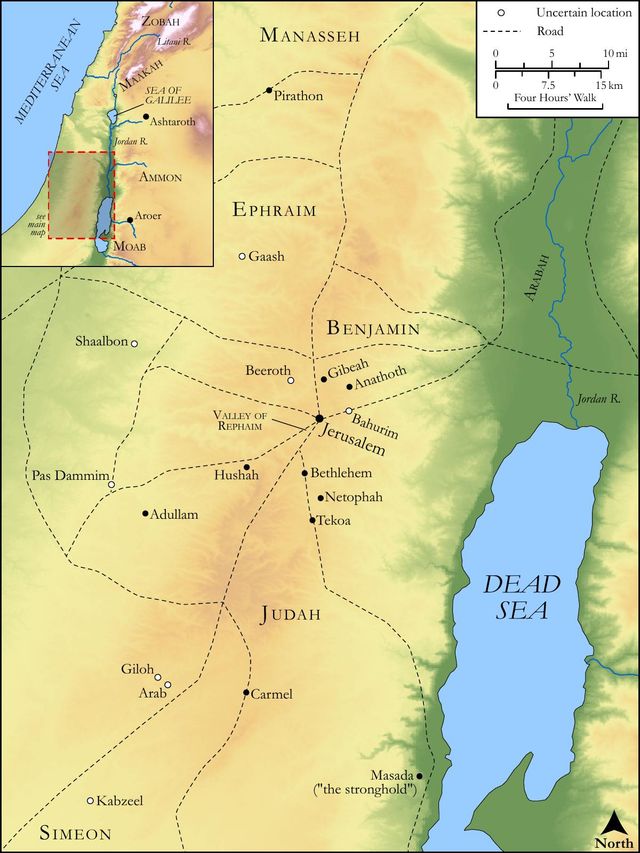
See on the biblical-era map
Study this verse
Public-domain commentary
Matthew Henry
From his Commentary on the Whole Bible. Henry comments on passages, not single verses — this entry covers 1 Chronicles 11:1–9. His two-level outline is real structure in the source text, so it is rendered as structure.
David is here brought to the possession.
I.Of the throne of Israel, after he had reigned seven years in Hebron, over Judah only.
In consideration of his relation to them (Ch1 11:1), his former good services, and especially the divine designation (Ch1 11:2), they anointed him their king: he covenanted to protect them, and they to bear faith and true allegiance to him, Ch1 11:3. Observe,
1.God's counsels will be fulfilled at last, whatever difficulties lie in the way. If God had said, David shall rule, it is in vain to oppose it.
2.Men that have long stood in their own light, when they have long wearied themselves with their lying vanities, it is to be hoped, will understand the things that belong to their peace and return to their own mercies.
3.Between prince and people there is an original contract, which both ought religiously to observe. If ever any prince might have claimed an absolute despotic power, David might, and might as safely as any have been entrusted with it; and yet he made a covenant with the people, took the coronation-oath, to rule by law.
II.Of the strong-hold of Zion, which was held by the Jebusites till David's time.
Whether David had a particular eye upon it as a place fit to make a royal city, or whether he had a promise of it from God, it seems that one of his first exploits was to make himself master of that fort; and, when he had it, he called it the city of David, Ch1 11:7. To this reference is had, Psa 2:6. I have set my king upon my holy hill of Zion. See here what quickens and engages resolution in great undertakings.
1.Opposition. When the Jebusites set David at defiance, and said, Thou shalt not come hither. he resolved to force it, whatever it cost him.
2.Prospect of preferment. When David proposed to give the general's place to him that would lead the attack upon the castle of Zion, Joab was fired with the proposal, and he went up first, and was chief. It has been said, "Take away honour out of the soldier's eye and you cut off the spurs from his heels."
Historical interpretation
Historical reception
1 surviving comment on this verse from the historical church.
Farewell likewise, grand and renowned temple, our new inheritance, whose greatness is now due to the Word, which once was a Jebus and has now been made by us a Jerusalem.
Continue studying 1 Chronicles 11:4 across the web’s major study libraries — every link below opens this exact verse, chapter, or book on the destination site.
Read & Compare
 BibleGatewayThis verse in more than 200 translations and 70 languages.
 Bible.comThe YouVersion reader — hundreds of translations, reading plans, and highlights.
 ESV.orgCrossway's official English Standard Version reader.
 NET BibleThe NET translation with 60,000+ translators' notes on every rendering decision.
 STEP BibleTyndale House's free study tool — original text, vocabulary, and scholarly resources.
 BibliaLogos Bible Software's free web reader.
 USCCBThe New American Bible (Revised Edition) with the U.S. bishops' study notes.
Commentaries
 BibleHub CommentariesDozens of classic commentaries on this verse, gathered on one page.
 StudyLightMore than 100 commentary sets — the largest collection on the web.
 BibleRefPlain-English commentary on what this verse means, verse by verse.
 Enduring WordDavid Guzik's free commentary on this chapter, widely used by Bible teachers.
 Bible Study ToolsVerse commentary alongside Greek and Hebrew study aids.
Original Language & Research
- BibleHub InterlinearThe verse word by word — original language, transliteration, and English.
- BibleHub LexiconEvery word's original-language definition and Strong's entry.
 Blue Letter BibleDeep-study tools — Strong's numbers, concordance, and word studies.
 SefariaThe Hebrew text with Rashi and centuries of Jewish commentary.
Sermons, Hymns & Audio


TrulyRandomVerse is not affiliated with these sites and doesn’t control their content. They’re linked because they’re genuinely useful.
Summary
1 Chronicles 11:4 records the pivotal moment when David, newly anointed as king over all Israel, led a unified nation to conquer Jerusalem, then known as Jebus, which was inhabited by the Jebusites. This strategic move marked the beginning of Jerusalem's transformation from a Canaanite stronghold into the political and spiritual capital of Israel, symbolizing the consolidation of David's reign and a significant step in the fulfillment of God's covenant promises for His people and the land.
Context
ShowHideLiterary Context
This verse immediately follows the account of David's anointing as king over all Israel by all the tribes at Hebron, as detailed in 1 Chronicles 11:1-3. Having secured the allegiance of a unified nation, David's next logical and strategic move is to establish a central capital that can serve as the administrative and spiritual heart of his nascent kingdom. The narrative in 1 Chronicles 11:4-9 then proceeds to describe the conquest of Jerusalem from the Jebusites, a crucial event that solidifies David's authority and sets the stage for the city's future theological significance. The Chronicler's emphasis on "all Israel" going with David highlights the unprecedented unity achieved under his leadership, a recurring theme in Chronicles that contrasts with the earlier tribal disunity. This account closely parallels the narrative found in 2 Samuel 5:6-10, underscoring the historical weight and importance of this event in both historical traditions.
Historical & Cultural Context
At the time of David's ascent to the throne, Jerusalem, or Jebus as it was known, was a formidable Canaanite city-state that had remained unconquered by the Israelites since the time of Joshua (Joshua 15:63 and Judges 1:21). Its strategic location on a high ridge, surrounded by deep valleys, provided strong natural defenses, making it a challenging target. For David, capturing Jebus was not merely a military endeavor but a profound political and symbolic act. By selecting a city not associated with any particular Israelite tribe, David could establish a neutral capital, thereby mitigating potential tribal rivalries and fostering a sense of national unity. Furthermore, its central geographical position within the land made it an ideal administrative hub, accessible to all parts of the newly unified kingdom. This move was essential for consolidating his reign and transforming a loose confederacy of tribes into a cohesive monarchy.
Key Themes
ShowHideThe primary themes emerging from 1 Chronicles 11:4 are the Establishment of a Unified Capital and the Consolidation of David's Reign. David's strategic choice of Jerusalem, a neutral territory, was instrumental in forging a cohesive national identity, moving beyond the tribal confederacy to a unified monarchy under his leadership. This act demonstrates his wise and decisive leadership, crucial for a newly formed kingdom. Furthermore, the verse subtly introduces the theme of Divine Sovereignty and Fulfillment of Promise. While not explicitly stated here, the capture of Jerusalem, often referred to as Zion, sets the stage for its future role as the chosen city where God's presence would dwell, where the Temple would eventually be built by Solomon (2 Chronicles 3:1), and from which God's law and word would go forth to the nations (Isaiah 2:3). This strategic victory was a crucial step in God's overarching plan for Israel and His covenant people, aligning with the divine promise of a lasting dynasty for David (2 Samuel 7:12-16).
Exposition and Analysis
ShowHideKey Word Analysis
ShowHideFrom the same root as "loving," this name signifies the central figure of the narrative. David, the youngest son of Jesse, is presented here not just as an individual but as the divinely chosen king, whose actions are instrumental in shaping the destiny of Israel. His leadership in this conquest underscores his role as the unifying force for "all Israel."
This name, meaning "founded peaceful" or "city of peace," carries profound prophetic significance. Though still known as "Jebus" at this moment, the Chronicler's immediate identification of it as "Jerusalem" foreshadows its destiny as the spiritual and political heart of Israel, the city where God would choose to place His name and where the Davidic dynasty would be established.
This term refers to the Canaanite inhabitants of Jebus. Their presence in the land, despite earlier Israelite conquests, represented a persistent challenge to Israel's full inheritance of the Promised Land. Their defeat by David marked a significant step in establishing Israel's complete sovereignty and demonstrated David's military prowess and divine favor in overcoming entrenched opposition.
Verse Breakdown
ShowHide"And David and all Israel went to Jerusalem"
This opening clause highlights the unified and collective action under David's leadership. The phrase "all Israel" emphasizes the national consensus and support for their newly anointed king, signifying a deliberate and strategic national undertaking to establish a central capital. This movement is portrayed as a decisive step in consolidating the kingdom.
"which [is] Jebus;"
This parenthetical clarification, with the implied "is" in the KJV, identifies Jerusalem by its contemporary name, "Jebus." This detail serves to ground the narrative in its historical context, emphasizing that the city was, at this specific juncture, an unconquered, non-Israelite stronghold, setting the stage for the narrative of conquest that immediately follows.
"where the Jebusites [were], the inhabitants of the land."
This final clause explicitly names the occupants of Jebus, underscoring the challenge David and Israel faced. By identifying them as "inhabitants of the land," the text emphasizes their established presence and control over this strategically vital location, which Israel now sought to claim as its own, thereby completing the possession of the Promised Land.
Literary Devices
ShowHideThe verse employs several literary techniques to convey its significance and thematic depth. Juxtaposition is evident in the immediate naming of "Jerusalem" alongside its former name "Jebus," which subtly highlights the impending transition from a pagan stronghold to the future capital of God's people. This also functions as a form of foreshadowing, as the capture of Jebus is presented as a foundational event for Jerusalem's later, greater role as the holy city and the center of the Temple. The phrase "all Israel" can be seen as a form of synecdoche, where a part (the unified tribes) represents the whole (the entire nation under David's leadership), emphasizing the unprecedented unity achieved under David. The concise, declarative statement also lends a sense of historical gravitas and inevitability to David's strategic move, portraying it as a divinely ordained progression in Israel's history.
Theological and Thematic Connections
ShowHideThe establishment of Jerusalem as Israel's capital by David is a profound theological statement, signifying the culmination of centuries of Israel's journey to possess the land promised by God to Abraham. By choosing a neutral city and conquering it, David not only secured a strategic political center but also laid the groundwork for a spiritual hub where God would choose to dwell among His people. This act reflects God's faithfulness to His covenant promises, guiding His chosen king to establish a kingdom that would foreshadow the ultimate, eternal kingdom. The centrality of Jerusalem, therefore, becomes a symbol of God's presence, His desire for a unified people centered on Him, and the unfolding of His redemptive plan through the Davidic line.
Reflection and Application
ShowHide1 Chronicles 11:4 offers timeless lessons on leadership, unity, and the pursuit of God's purposes. David's strategic vision in selecting a neutral capital and his ability to unite "all Israel" for this common goal underscore the importance of wise, Spirit-led leadership and collaborative effort in achieving significant objectives. Spiritually, this passage reminds us that God often calls us to confront and transform "strongholds" in our lives—whether they be personal habits, societal injustices, or spiritual resistances—just as David confronted the Jebusite stronghold. The establishment of Jerusalem as a central place for a unified people also challenges believers today to seek and maintain unity within the body of Christ, striving for a common purpose centered on God's will and truth. Our lives, like Jerusalem, are meant to be places where God's presence is established, where His kingdom principles are lived out, and where His light shines forth.
Questions for Reflection
ShowHideFAQ
ShowHideWhy was Jerusalem so important for David to capture?
ShowHideJerusalem's capture was crucial for several strategic, political, and symbolic reasons. Strategically, it was a naturally fortified city, making it an ideal and defensible capital for a burgeoning kingdom. Politically, its neutrality—not belonging to any of the twelve tribes—allowed David to establish a capital free from tribal rivalries, fostering unity among the newly consolidated kingdom. Symbolically, its capture was a significant step in Israel's complete possession of the Promised Land, fulfilling centuries of divine promise. It also set the stage for its future role as the spiritual center of Israel, where the Temple would eventually be built by Solomon (2 Chronicles 3:1) and where God's presence would dwell among His people.
Were the Jebusites completely removed from Jerusalem after David's conquest?
ShowHideWhile David conquered the city and established it as his capital, the Jebusites were not entirely eradicated. Scripture indicates that some Jebusites remained in the land and were eventually subjugated rather than annihilated. For example, Joshua 15:63 and Judges 1:21 mention their continued presence in Jerusalem and Benjamin. Later, we see David purchasing the threshing floor of Araunah the Jebusite to build an altar (2 Samuel 24:16-25), indicating that Jebusites were still living in the area and even owned property. They became a subjugated people, serving as forced laborers for Solomon's extensive building projects (1 Kings 9:20-21).
Christ-Centered Fulfillment
ShowHideThe historical account of David's capture of Jebus and establishment of Jerusalem as the capital of Israel finds profound Christ-centered fulfillment. Just as David, the shepherd-king and a type of Christ, united "all Israel" and led them to establish a central dwelling place for God's presence, so too does Jesus Christ, the ultimate Davidic King, unite His people from every tribe, tongue, and nation under His sovereign rule (Revelation 7:9-10). The conquest of Jebus, a formidable stronghold that had long resisted Israelite dominion, powerfully foreshadows Christ's decisive victory over the spiritual strongholds of sin, death, and the devil, disarming the powers and authorities (Colossians 2:15). Jerusalem's transformation from Jebus to the city of God, the seat of the Davidic throne, points to the New Jerusalem, the heavenly city where God's ultimate dwelling is with humanity, and where Christ reigns eternally as King of kings (Revelation 21:2-3). Our true spiritual center is not a physical city, but Christ Himself, who is the head of the church, His body (Ephesians 1:22-23), and the unifying force for all believers, drawing us into a kingdom that cannot be shaken, a kingdom of righteousness, peace, and joy in the Holy Spirit (Hebrews 12:28 and Romans 14:17).