


1 Chronicles 11:3
- וַיָּבֹאוּVai·ya·vo·'uand they cameH935Conj-w ¦ V-Qal-ConsecImperf-3mpVerb Qal Consecutive Imperfect 3rd Plural Masculineוַandיָּבֹאוּthey came
- כָּלkolallH3605N-mscNoun Singular Masculine Construct
- זִקְנֵיzik·Nei[the] elders ofH2205Adj-mpcAdjective Plural Masculine Construct
- יִשְׂרָאֵלYis·ra·'ElIsraelH3478N-properNoun Proper Location
- אֶל'eltoH413PrepPreposition
- הַמֶּלֶךְha·Me·lekhthe kingH4428Art ¦ N-msNoun Singular Masculine Absoluteהַtheמֶּלֶךְking
- חֶבְרוֹנָהchev·Ro·nahHebron towardsH2275N-proper ¦ SfxNoun Proper LocationחֶבְרוֹנָHebronהtowards
- וַיִּכְרֹתvai·yikh·Rotand he madeH3772Conj-w ¦ V-Qal-ConsecImperf-3msVerb Qal Consecutive Imperfect 3rd Singular Masculineוַandיִּכְרֹתhe made
- לָהֶםla·Hemto themPrep-l ¦ 3mpSuffix Personal 3rd Plural Masculineלָtoהֶםthem
- דָּוִידda·VidDavidH1732N-proper-mNoun Proper Masculine
- בְּרִיתbe·Rita covenantH1285N-fsNoun Singular Feminine Absolute
- בְּחֶבְרוֹןbe·chev·Ronat HebronH2275Prep-b ¦ N-properNoun Proper LocationבְּatחֶבְרוֹןHebron
- לִפְנֵיlif·Nei<to> beforeH6440Prep-l ¦ N-mpcNoun Plural Masculine Constructלִ<to>פְנֵיbefore
- יְהוָהYah·wehYahwehH3068N-properNoun Proper Title
- וַיִּמְשְׁחוּvai·yim·she·Chuand they anointedH4886Conj-w ¦ V-Qal-ConsecImperf-3mpVerb Qal Consecutive Imperfect 3rd Plural Masculineוַandיִּמְשְׁחוּthey anointed
- אֶת'et<obj.>H853DirObjMParticle Object Indicator
- דָּוִידda·VidDavidH1732N-proper-mNoun Proper Masculine
- לְמֶלֶךְle·Me·lekhto kingH4428Prep-l ¦ N-msNoun Singular Masculine Absoluteלְtoמֶלֶךְking
- עַל'aloverH5921PrepPreposition
- יִשְׂרָאֵלYis·ra·'ElIsraelH3478N-properNoun Proper Location
- כִּדְבַרkid·Varaccording to [the] word ofH1697Prep-k ¦ N-mscNoun Singular Masculine Constructכִּaccording toדְבַר[the] word of
- יְהוָהYah·wehYahwehH3068N-properNoun Proper Title
- בְּיַדbe·yadby [the] hand ofH3027Prep-b ¦ N-cscNoun Singular common gender Constructבְּbyיַד[the] hand of
- שְׁמוּאֵלshe·mu·'ElSamuelH8050N-proper-mNoun Proper Masculine
English is a literal word-by-word gloss of the Hebrew, not the KJV's wording. Why?
This is the original text the KJV's translators worked from — each Hebrew word with its own literal English meaning in this verse, prepared by scholars at Tyndale House, Cambridge. The KJV translates whole sentences, not word by word, so its wording differs: one Hebrew word can become several English words, and the KJV may choose “the LORD” where the gloss reads “Yahweh”. Both are faithful — they answer different questions. For the KJV's own rendering, switch to the KJV text.
Details
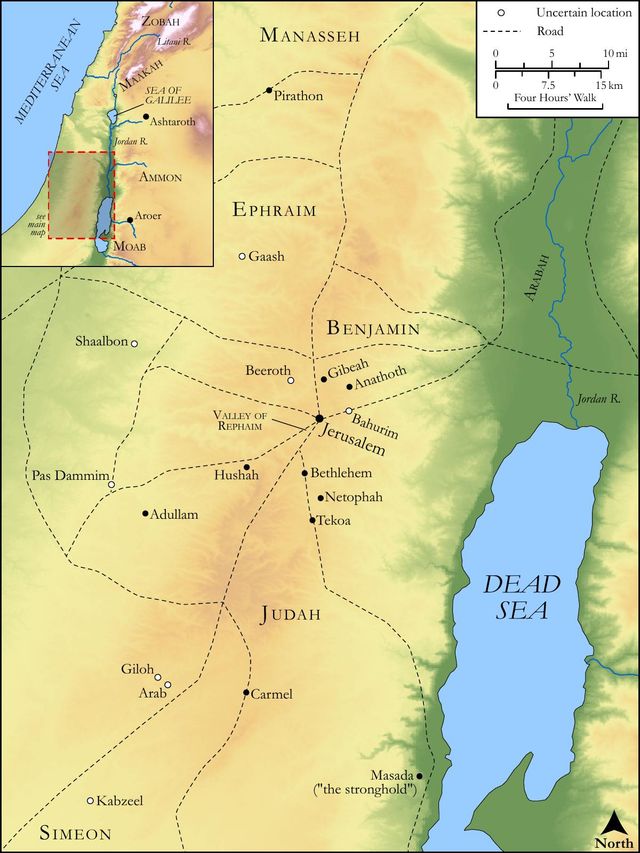
See on the biblical-era map
Study this verse
Public-domain commentary
Matthew Henry
From his Commentary on the Whole Bible. Henry comments on passages, not single verses — this entry covers 1 Chronicles 11:1–9. His two-level outline is real structure in the source text, so it is rendered as structure.
David is here brought to the possession.
I.Of the throne of Israel, after he had reigned seven years in Hebron, over Judah only.
In consideration of his relation to them (Ch1 11:1), his former good services, and especially the divine designation (Ch1 11:2), they anointed him their king: he covenanted to protect them, and they to bear faith and true allegiance to him, Ch1 11:3. Observe,
1.God's counsels will be fulfilled at last, whatever difficulties lie in the way. If God had said, David shall rule, it is in vain to oppose it.
2.Men that have long stood in their own light, when they have long wearied themselves with their lying vanities, it is to be hoped, will understand the things that belong to their peace and return to their own mercies.
3.Between prince and people there is an original contract, which both ought religiously to observe. If ever any prince might have claimed an absolute despotic power, David might, and might as safely as any have been entrusted with it; and yet he made a covenant with the people, took the coronation-oath, to rule by law.
II.Of the strong-hold of Zion, which was held by the Jebusites till David's time.
Whether David had a particular eye upon it as a place fit to make a royal city, or whether he had a promise of it from God, it seems that one of his first exploits was to make himself master of that fort; and, when he had it, he called it the city of David, Ch1 11:7. To this reference is had, Psa 2:6. I have set my king upon my holy hill of Zion. See here what quickens and engages resolution in great undertakings.
1.Opposition. When the Jebusites set David at defiance, and said, Thou shalt not come hither. he resolved to force it, whatever it cost him.
2.Prospect of preferment. When David proposed to give the general's place to him that would lead the attack upon the castle of Zion, Joab was fired with the proposal, and he went up first, and was chief. It has been said, "Take away honour out of the soldier's eye and you cut off the spurs from his heels."
Continue studying 1 Chronicles 11:3 across the web’s major study libraries — every link below opens this exact verse, chapter, or book on the destination site.
Read & Compare
 BibleGatewayThis verse in more than 200 translations and 70 languages.
 Bible.comThe YouVersion reader — hundreds of translations, reading plans, and highlights.
 ESV.orgCrossway's official English Standard Version reader.
 NET BibleThe NET translation with 60,000+ translators' notes on every rendering decision.
 STEP BibleTyndale House's free study tool — original text, vocabulary, and scholarly resources.
 BibliaLogos Bible Software's free web reader.
 USCCBThe New American Bible (Revised Edition) with the U.S. bishops' study notes.
Commentaries
 BibleHub CommentariesDozens of classic commentaries on this verse, gathered on one page.
 StudyLightMore than 100 commentary sets — the largest collection on the web.
 BibleRefPlain-English commentary on what this verse means, verse by verse.
 Enduring WordDavid Guzik's free commentary on this chapter, widely used by Bible teachers.
 Bible Study ToolsVerse commentary alongside Greek and Hebrew study aids.
Original Language & Research
- BibleHub InterlinearThe verse word by word — original language, transliteration, and English.
- BibleHub LexiconEvery word's original-language definition and Strong's entry.
 Blue Letter BibleDeep-study tools — Strong's numbers, concordance, and word studies.
 SefariaThe Hebrew text with Rashi and centuries of Jewish commentary.
Sermons, Hymns & Audio


TrulyRandomVerse is not affiliated with these sites and doesn’t control their content. They’re linked because they’re genuinely useful.
Summary
1 Chronicles 11:3 records the pivotal moment when David, having reigned over Judah for seven and a half years, is formally recognized and anointed king over all twelve tribes of Israel by their assembled elders in Hebron. This solemn covenant ceremony, conducted in the presence of the LORD, signifies the divine ratification and human acknowledgment of God's long-standing promise, bringing an end to a period of national division and establishing David as the unified kingdom's divinely appointed and legitimate leader.
Context
ShowHideLiterary Context
1 Chronicles 11:3 serves as the narrative climax of David's ascent to the throne, following immediately after the Chronicler's concise account of David's military prowess and the unanimous desire of all Israel to make him king (1 Chronicles 11:1-2). This verse marks the culmination of the divine plan for David's kingship, transitioning the narrative from the period of civil strife and fragmented rule to the establishment of a unified monarchy under God's chosen leader. The Chronicler, writing for a post-exilic audience, intentionally streamlines or omits details found in 2 Samuel that might complicate David's ideal portrayal, emphasizing instead the divine legitimacy, unity, and covenantal foundation of his reign. This foundational act sets the stage for the subsequent detailed accounts of David's military victories, the capture of Jerusalem, and his preparations for the Temple, all presented within a framework of divine favor and fulfillment.
Historical & Cultural Context
The gathering in Hebron was a profoundly significant event in ancient Israelite history. Hebron, a prominent city in the Judean hills, possessed deep historical and religious importance, serving as a burial place for the patriarchs (e.g., Genesis 23:19) and a key stronghold. It had already served as David's capital for Judah for seven and a half years (as noted in 2 Samuel 5:5), lending a sense of continuity and established authority. The "elders of Israel" represented the tribal leadership, signifying a national consensus and a crucial step towards unity after the fragmented rule following Saul's death. The act of making a "covenant" (Hebrew: berît) was a common and binding practice in the ancient Near East, establishing formal relationships with mutual obligations. Performing it "before the LORD" underscored its sacred nature, invoking divine witness and sanction, transforming it from a mere political agreement into a divinely ordained compact with spiritual implications.
Key Themes
ShowHideThis verse powerfully encapsulates several overarching themes central to the Books of Samuel and Chronicles. Foremost is the theme of Divine Appointment and Fulfillment, as David's kingship is explicitly stated to be "according to the word of the LORD by Samuel," echoing the initial anointing in 1 Samuel 16:13. This highlights God's sovereign plan unfolding in history, demonstrating His faithfulness to His promises. Secondly, the gathering of "all the elders of Israel" underscores the theme of National Unity, bringing together the disparate tribes under a single, divinely chosen leader, a crucial step after years of division and civil conflict. Thirdly, the Legitimacy and Authority of David's rule are firmly established through this public covenant and anointing, validating his position not just by conquest but by popular consent and, critically, by divine decree. Finally, the Covenant Relationship between king and people, witnessed by God, establishes a foundational model for righteous governance and mutual fidelity within the kingdom, setting the stage for the Davidic covenant.
Exposition and Analysis
ShowHideKey Word Analysis
ShowHideFrom בָּרָה (in the sense of cutting), this term refers to a compact, confederacy, or league, often established by a ritual involving the cutting of flesh and passing between the pieces. In 1 Chronicles 11:3, David "made a covenant" with the elders, signifying a solemn, binding agreement that formally established the relationship between the king and the united nation of Israel. The phrase "before the LORD" elevates this political agreement to a sacred, divinely sanctioned compact, emphasizing its permanence and the mutual responsibilities it entailed for both king and people under God's watchful eye.
A primitive root meaning "to rub with oil" or "to smear," this verb signifies consecration or setting apart for a sacred office or task. From this root comes the noun māšîaḥ (Messiah), meaning "anointed one." David's anointing by the elders, following his initial anointing by Samuel (1 Samuel 16:13) and later by the men of Judah (2 Samuel 2:4), publicly confirmed his divine selection and empowerment for the kingship over all Israel. It was a visible sign of God's Spirit resting upon him, granting him the authority and capability to lead the entire nation.
This phrase emphasizes divine revelation and prophetic fulfillment. The Hebrew word dâbâr means "a word," but by implication, it can also refer to a matter, thing, or decree. When combined with Yᵉhôvâh (the self-Existent or Eternal, Jehovah, the LORD), it signifies that David's kingship was not merely a human political maneuver but the direct execution of God's predetermined plan, communicated through His prophet Samuel. This divine decree provides the ultimate legitimacy for David's rule, rooting his authority not in human strength or popular acclaim alone, but in the sovereign, faithful will of God.
Verse Breakdown
ShowHide"Therefore came all the elders of Israel to the king to Hebron;"
This opening clause establishes the culmination of a long process of national recognition and unification. "All the elders of Israel" signifies comprehensive representation from every tribe, underscoring the unanimous consent and legitimacy of the decision. Their journey to Hebron, David's existing capital for Judah, demonstrates their recognition of his established authority and the symbolic importance of the city as a historical, religious, and strategic center for the unified kingdom.
"and David made a covenant with them in Hebron before the LORD;"
This describes the formal, binding agreement that solidified the relationship between David and the representatives of the nation. The "covenant" established mutual obligations: the elders pledged loyalty and submission to David's rule, while David committed to righteous governance, protection, and leadership according to God's will. The crucial phrase "before the LORD" transforms this political act into a sacred one, implying divine witness and sanction, making God a party to the agreement and guaranteeing its solemnity and permanence.
"and they anointed David king over Israel,"
This act was the public, ritualistic confirmation of David's kingship over the entire unified nation. This was David's third anointing, solidifying his role as the legitimate monarch. The anointing with oil symbolized the impartation of divine authority and the presence of God's Spirit, setting David apart as God's chosen leader for all Israel, not just Judah. It was a visible and tangible sign of his divinely sanctioned and popularly accepted rule.
"according to the word of the LORD by Samuel."
This concluding phrase provides the ultimate theological justification and validation for David's kingship. It explicitly links this historical event to God's prior prophetic revelation through Samuel (e.g., 1 Samuel 16:1-13). This emphasizes God's sovereignty and faithfulness in fulfilling His promises, portraying David's reign as the divinely ordained outcome of a long-unfolding plan, rather than a mere human political achievement or a result of human ambition.
Literary Devices
ShowHideThe Chronicler masterfully employs several literary devices to underscore the profound significance of David's anointing. The Repetition of "Hebron" emphasizes the geographical and historical locus of this pivotal event, grounding it in a place of deep significance for Israel's past and future. The narrative structure itself demonstrates Fulfillment, as the long-prophesied kingship of David, first announced by Samuel, finally comes to pass, creating a powerful sense of divine purpose and an unfolding Narrative Arc that moves from fragmentation to unity under God's chosen leader. Furthermore, the act of anointing, especially for a king chosen by God, serves as profound Foreshadowing. It points beyond David to the ultimate "Anointed One," the Messiah, who would establish an everlasting kingdom. The Chronicler's selective presentation, focusing on the ideal aspects of David's reign and omitting less favorable details, also highlights Idealization, portraying David as the perfect king, chosen and sanctioned by God, thereby serving as a model for future leadership and a symbol of God's faithfulness to His covenant promises.
Theological and Thematic Connections
ShowHide1 Chronicles 11:3 stands as a pivotal theological statement, affirming God's unwavering faithfulness to His promises and His sovereign control over human history. David's ascent to the throne of all Israel, explicitly stated as being "according to the word of the LORD by Samuel," underscores the divine initiative behind human leadership and the certainty of God's prophetic word. This event solidifies the Davidic covenant, a foundational theological concept in Israel's history, establishing a perpetual dynasty through which God would bless His people and ultimately bring forth the Messiah. It demonstrates that true, lasting authority is derived from God, not merely from human consent, military might, or political maneuvering. The unity achieved under David, bringing together disparate tribes into a cohesive nation, also prefigures the eschatological unity of God's people under the ultimate King, Jesus Christ.
Reflection and Application
ShowHideThe establishment of David's kingship in 1 Chronicles 11:3 offers profound and enduring lessons for contemporary believers. It reminds us that God's promises, though sometimes long in coming and requiring patient endurance, are always fulfilled in His perfect timing and according to His sovereign plan. David endured years of waiting, fleeing from Saul, and reigning over only a portion of Israel, yet he remained faithful to God's call and trusted in His timing. This narrative teaches us the virtue of patient endurance and unwavering trust in divine sovereignty, even when circumstances seem contrary to God's declared will. Furthermore, the covenant made "before the LORD" highlights the sacred nature of all agreements, whether personal, professional, or communal, urging us to uphold our commitments with integrity, honesty, and a profound awareness of God's watchful presence. The unity of "all the elders of Israel" under one king serves as a powerful call for unity within the body of Christ, emphasizing the importance of diverse members coming together under the headship of Christ for the common good, the advancement of God's kingdom, and a powerful witness to the world.
Questions for Reflection
ShowHideFAQ
ShowHideWhy was Hebron chosen as the location for David's anointing as king over all Israel?
ShowHideHebron was chosen for several significant reasons that underscore its strategic and symbolic importance. Firstly, it had already served as David's capital for Judah for seven and a half years prior to this event (2 Samuel 5:5), establishing his presence and authority there. This provided a stable and recognized base for the transition to national kingship. Secondly, Hebron held deep historical and religious significance for Israel, being associated with Abraham and the patriarchs as a burial place and a site of covenant (Genesis 23:2). Its strategic location in the Judean hills also made it a suitable central meeting point for representatives from all the tribes, offering a neutral and respected ground for the unification of the northern and southern tribes under David's rule. The choice of Hebron underscored the continuity of God's covenant promises and provided a powerful symbolic setting for this momentous event.
What is the significance of the "covenant" David made with the elders "before the LORD"?
ShowHideThe covenant (Hebrew: bᵉrîyth) was a solemn and binding agreement that established mutual obligations between David and the elders representing all Israel. For the elders, it signified their loyalty, submission, and commitment to David's rule. For David, it implied a commitment to rule justly, protect the people, and uphold God's law and the principles of the Mosaic covenant. Performing this covenant "before the LORD" elevated it beyond a mere political treaty to a sacred, divinely witnessed compact. This invoked God's immediate presence and sanction, ensuring the agreement's solemnity, permanence, and accountability. It meant that both parties were accountable to God for upholding their respective parts of the agreement, underscoring the theological foundation of David's kingship and establishing a divine precedent for the future of the monarchy in Israel.
Christ-Centered Fulfillment
ShowHide1 Chronicles 11:3, detailing David's anointing as king over all Israel, finds its ultimate and perfect fulfillment in Jesus Christ, the true and everlasting King. David, the "anointed one" (Messiah), serves as a profound type of Christ, foreshadowing His greater reign. Just as David was chosen by God and anointed to unite a divided Israel, so Jesus, the Lamb of God who takes away the sin of the world, is the divinely appointed King who unites all peoples—Jew and Gentile—into one new humanity, the Church, under His headship. The covenant made with David in Hebron, establishing an earthly dynasty, foreshadows the new covenant established through Christ's blood, a covenant of grace and eternal life that is superior, unbreakable, and everlasting. While David's kingdom was earthly, temporary, and flawed, Jesus' kingdom is spiritual, eternal, and perfect, encompassing all who believe (John 18:36). The "word of the LORD by Samuel" that legitimized David's rule points to the ultimate divine affirmation of Jesus as the beloved Son of God and the rightful heir to David's throne, whose reign will have no end (Luke 1:32-33). Thus, David's anointing in Hebron is a powerful prelude to the universal and eternal reign of Christ, the Messiah, who perfectly fulfills all the promises and hopes associated with the Davidic monarchy, bringing true unity and everlasting peace.