


Genesis 10:16
Bible text: King James Version (1769 Blayney text) · Public domain
Bible text: Berean Standard Bible · Public domain
Bible text: American Standard Version (1901) · Public domain
Bible text: World English Bible, Messianic edition · Public domain
Bible text: Geneva Bible (1599) · Public domain
Bible text: Young's Literal Translation · Public domain
- וְאֶתve·'Etand <obj.>H853Conj-w ¦ DirObjMParticle Object Indicatorוְandאֶת<obj.>
- הַיְבוּסִיhay·vu·Sithe Jebusite[s]H2983Art ¦ N-msNoun Gentilic Singular Masculine AbsoluteהַtheיְבוּסִיJebusite[s]
- וְאֶתve·'Etand <obj.>H853Conj-w ¦ DirObjMParticle Object Indicatorוְandאֶת<obj.>
- הָאֱמֹרִיha·'e·mo·Rithe Amorite[s]H567Art ¦ N-msNoun Gentilic Singular Masculine AbsoluteהָtheאֱמֹרִיAmorite[s]
- וְאֵתve·'Etand <obj.>H853Conj-w ¦ DirObjMParticle Object Indicatorוְandאֵת<obj.>
- הַגִּרְגָּשִׁיha·gir·ga·Shithe Girgashite[s]H1622Art ¦ N-msNoun Gentilic Singular Masculine AbsoluteהַtheגִּרְגָּשִׁיGirgashite[s]
English is a literal word-by-word gloss of the Hebrew, not the KJV's wording. Why?
This is the original text the KJV's translators worked from — each Hebrew word with its own literal English meaning in this verse, prepared by scholars at Tyndale House, Cambridge. The KJV translates whole sentences, not word by word, so its wording differs: one Hebrew word can become several English words, and the KJV may choose “the LORD” where the gloss reads “Yahweh”. Both are faithful — they answer different questions. For the KJV's own rendering, switch to the KJV text.
Details
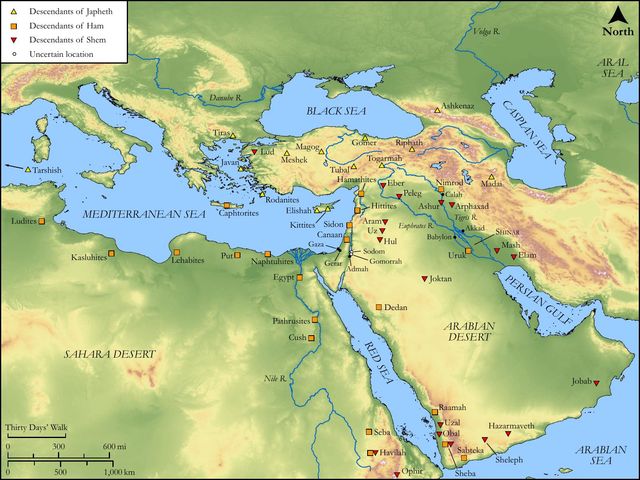
See on the biblical-era maps


Study this verse
Public-domain commentary
Matthew Henry
From his Commentary on the Whole Bible. Henry comments on passages, not single verses — this entry covers Genesis 10:15–20.
Observe here, 1. The account of the posterity of Canaan, of the families and nations that descended from him, and of the land they possessed, is more particular than of any other in this chapter, because these were the nations that were to be subdued before Israel, and their land was in process of time to become the holy land, Immanuel's land; and this God had an eye to when, in the mean time, he cast the lot of that accursed devoted race in that spot of ground which he had selected for his own people; this Moses takes notice of, Deu 32:8, When the Most High divided to the nations their inheritance, he set the bounds of the people according to the number of the children of Israel. 2. By this account it appears that the posterity of Canaan were numerous, and rich, and very pleasantly situated; and yet Canaan was under a curse, a divine curse, and not a curse causeless. Note, Those that are under the curse of God may yet perhaps thrive and prosper greatly in this world; for we cannot know love or hatred, the blessing or the curse, by what is before us, but by what is within us, Ecc 9:1. The curse of God always works really and always terribly: but perhaps it is a secret curse, a curse to the soul, and does not work visibly, or a slow curse, and does not work immediately; but sinners are by it reserved for, and bound over to, a day of wrath. Canaan here has a better land than either Shem or Japheth, and yet they have a better lot, for they inherit the blessing.
Historical interpretation
Historical reception
1 surviving comment on this verse from the historical church.
Canaan became the father of Sidon, his firstborn, Heth, and the Jebusite, the Amorite, the Girgashite, the Hivite, the Arkite, the Sinite, the Arvadite, the Zemarite, and the Hamathite. "From Sidon, the firstborn of Canaan, comes the city in Phoenicia called Sidon, formerly the northern boundary of the Canaanites. The Arkite founded Arca, a town situated against Tripoli at the foot of Mount Lebanon, near which was another city named Sim, which was later destroyed by various wars but retained its original name for the site. The Arvadites possessed Aradus Island, separated by a narrow strait from the Phoenician coast. This island, situated near Tyre, is today seen as a safe city and across from it lies the town of Antaradus. Samara is the noble city of Emesa in Syria. Emath, up to our time, is called by both the Assyrians and Hebrews as it was of old. The Macedonians, who ruled the East after Alexander, named it Epiphania, and some think it was called Antioch. Indeed, there were two cities named Emath: one was Great Emath, now called Antioch, and it was called great to distinguish it from Lesser Emath, which is called Epiphania, where the eyes of Zedekiah were blinded by Nebuchadnezzar.
Continue studying Genesis 10:16 across the web’s major study libraries — every link below opens this exact verse, chapter, or book on the destination site.
Read & Compare
 BibleGatewayThis verse in more than 200 translations and 70 languages.
 Bible.comThe YouVersion reader — hundreds of translations, reading plans, and highlights.
 ESV.orgCrossway's official English Standard Version reader.
 NET BibleThe NET translation with 60,000+ translators' notes on every rendering decision.
 STEP BibleTyndale House's free study tool — original text, vocabulary, and scholarly resources.
 BibliaLogos Bible Software's free web reader.
 USCCBThe New American Bible (Revised Edition) with the U.S. bishops' study notes.
Commentaries
 BibleHub CommentariesDozens of classic commentaries on this verse, gathered on one page.
 StudyLightMore than 100 commentary sets — the largest collection on the web.
 BibleRefPlain-English commentary on what this verse means, verse by verse.
 Enduring WordDavid Guzik's free commentary on this chapter, widely used by Bible teachers.
 Bible Study ToolsVerse commentary alongside Greek and Hebrew study aids.
Original Language & Research
- BibleHub InterlinearThe verse word by word — original language, transliteration, and English.
- BibleHub LexiconEvery word's original-language definition and Strong's entry.
 Blue Letter BibleDeep-study tools — Strong's numbers, concordance, and word studies.
 SefariaThe Hebrew text with Rashi and centuries of Jewish commentary.
Sermons, Hymns & Audio


TrulyRandomVerse is not affiliated with these sites and doesn’t control their content. They’re linked because they’re genuinely useful.
Summary
Genesis 10:16, a vital component of the "Table of Nations," meticulously enumerates three significant Canaanite tribes—the Jebusites, Amorites, and Girgasites—tracing their lineage back to Noah's son Ham through Canaan. This verse is indispensable for establishing the precise historical and geographical coordinates of the land divinely promised to Israel, thereby laying a crucial foundation for understanding God's unfolding redemptive plan and the future interactions between His chosen people and these indigenous nations.
Context
ShowHideLiterary Context
Genesis 10:16 is deeply embedded within the "Table of Nations," a comprehensive genealogical record spanning Genesis 10:1-32 that details the post-Flood dispersion of humanity through Noah's three sons: Shem, Ham, and Japheth. Specifically, this verse continues the enumeration of Canaan's descendants, following the Sidonians and Hethites mentioned in Genesis 10:15. These named tribes represent significant pre-Israelite inhabitants of the geographical region that would later be known as Canaan, the very land explicitly promised by God to Abraham and his descendants as their eternal inheritance in Genesis 12:7. The detailed listing underscores the biblical narrative's commitment to historical and geographical precision, setting the stage for the unfolding drama of Israel's national identity and destiny.
Historical & Cultural Context
The tribes listed in Genesis 10:16—the Jebusites, Amorites, and Girgasites—were integral to the complex tapestry of peoples inhabiting the land of Canaan in the days of the patriarchs. The region of Canaan, a land bridge connecting Mesopotamia and Egypt, was a melting pot of diverse Semitic and Hamitic peoples, often organized into city-states or tribal confederations. The Amorites, for instance, were a particularly prominent and widespread group, known for their martial prowess and significant presence in both the Transjordan and the central highlands of Canaan. The Jebusites controlled the strategically vital city of Jebus (later Jerusalem), a formidable natural fortress. Understanding these groups' presence and general characteristics is vital for appreciating the challenges and divine directives Israel would later face in their conquest and settlement of the land, as detailed in books like Joshua and Judges.
Key Themes
ShowHideGenesis 10:16 contributes significantly to several overarching themes within the chapter and the broader book. Firstly, it reinforces the theme of Divine Sovereignty over Nations, demonstrating God's meticulous hand in orchestrating the dispersion and settlement of all peoples, even those who would later stand in opposition to His chosen people. Secondly, it establishes a crucial Historical and Geographical Foundation for Redemptive History, providing the specific "who" and "where" for the subsequent narratives of the Abrahamic covenant and the Israelite conquest. The detailed genealogy underscores the reality of the promised land's existing inhabitants, setting the stage for the command to dispossess them, as seen in Deuteronomy 7:1. Lastly, the inclusion of these specific tribes subtly introduces the theme of Foreshadowing of Conflict and Judgment, hinting at the future struggles Israel would endure to inherit their promised territory and the divine judgment that would eventually fall upon these nations due to their iniquity, as God reveals to Abraham in Genesis 15:16.
Exposition and Analysis
ShowHideKey Word Analysis
ShowHideThis term refers to an inhabitant of Jebus, the ancient name for Jerusalem. The Jebusites were a Canaanite tribe who maintained control over this strategically important city until its eventual conquest by King David, transforming it into the capital of the united Israelite kingdom. Their enduring presence in such a key location highlights the significant challenge they posed to Israel's full inheritance of the land.
Derived from a root suggesting "prominence" or "mountaineer," the Amorites were a powerful and widespread group among the Canaanitish tribes. They are frequently mentioned in the Old Testament as formidable adversaries, dominating significant territories in both Canaan and Transjordan. Their name often functions as a general term for the pre-Israelite inhabitants of the land, underscoring their pervasive influence and strength.
A patrial term indicating a member of one of the native tribes of Canaan. While less prominent in specific biblical narratives than the Jebusites or Amorites, the Girgasites are consistently included in the lists of the seven nations God commanded Israel to dispossess from the land. Their consistent mention, despite limited individual narratives, emphasizes the comprehensive nature of the biblical record concerning the original inhabitants of the promised land.
Verse Breakdown
ShowHide"And the Jebusite"
This phrase introduces the first of three specific Canaanite tribes. The Jebusites were a distinct people group primarily associated with the city of Jebus, which would later become Jerusalem. Their inclusion here establishes their ancestral claim to a territory that would become central to Israel's national and religious identity, setting the stage for the future conflict over this pivotal city.
"and the Amorite"
Following the Jebusite, this clause names the Amorite, a widely recognized and powerful group in ancient Canaan. The conjunction "and" links them as another significant branch of Canaan's descendants, emphasizing their co-existence and shared heritage within the broader Canaanite population. Their mention here anticipates their formidable presence throughout the narratives of the conquest and early Israelite history.
"and the Girgasite"
The final tribe listed in this verse, the Girgasite, completes the enumeration of these specific Canaanite groups. Their inclusion, alongside the more prominent Jebusites and Amorites, underscores the meticulous detail of the "Table of Nations" in accounting for the diverse peoples inhabiting the promised land. This comprehensive listing serves to fully identify the indigenous populations that would later interact with the Israelites.
Literary Devices
ShowHideGenesis 10:16 primarily employs Enumeration and Genealogy. The verse is part of a larger genealogical record, meticulously listing descendants and their tribal affiliations. This serves to establish the historical and geographical framework for the biblical narrative. The specific naming of these three tribes, in particular, functions as a form of Foreshadowing, subtly hinting at the future conflicts and divine commands related to the dispossession of these very nations from the land God promised to Abraham. The precise cataloging also exemplifies the biblical author's commitment to Verisimilitude, lending an air of historical accuracy and grounded reality to the unfolding divine plan.
Theological and Thematic Connections
ShowHideGenesis 10:16, though a simple list of names, is profoundly significant in the tapestry of biblical theology. It underscores God's meticulous providential oversight of human history, demonstrating His sovereign hand in the formation and dispersion of all nations, even those destined to stand in opposition to His chosen people. By precisely identifying these inhabitants of Canaan, the verse lays the essential groundwork for understanding God's covenant promises to Abraham and the subsequent history of Israel's inheritance of the land. It highlights that God's plan is not abstract but deeply rooted in specific geographical and historical realities, preparing the reader for the unfolding drama of redemption that will involve these very territories and their inhabitants.
Reflection and Application
ShowHideGenesis 10:16, seemingly a dry list of names, serves as a powerful reminder of God's intricate and purposeful design in human history. It teaches us that even the most seemingly minor details in Scripture contribute to a grand, overarching narrative of God's redemptive work. The meticulous naming of these ancient tribes, who would later become central to Israel's story, reinforces the truth that God is sovereign over all nations and all generations. For us today, this instills confidence that God is actively working out His purposes in our world, guiding history toward His ultimate, glorious conclusion. It encourages us to trust in His perfect timing and to recognize His hand in the seemingly chaotic events of our own lives and times, knowing that He is meticulously weaving every thread into His divine tapestry.
Questions for Reflection
ShowHideFAQ
ShowHideWhy are these specific tribes mentioned in Genesis 10:16?
ShowHideGenesis 10:16 names the Jebusite, Amorite, and Girgasite as descendants of Canaan to precisely identify key inhabitants of the land that would later become Israel. Their inclusion is crucial for establishing the historical and geographical context of the promised land and foreshadowing the future interactions and conflicts between these nations and the Israelites, as detailed in passages like Numbers 21 and Joshua 10.
How do these tribes relate to the later history of Israel?
ShowHideThese tribes were among the primary inhabitants of Canaan whom the Israelites were commanded to dispossess upon entering the promised land. The Jebusites held Jerusalem until David's time (2 Samuel 5:6-9), the Amorites were a dominant force throughout the land, and the Girgasites were consistently listed among the nations to be removed (Deuteronomy 20:17). Their presence sets the stage for the narratives of conquest, settlement, and ongoing spiritual struggle in books like Joshua and Judges.
Does the "Table of Nations" imply a literal, exhaustive list of all peoples?
ShowHideThe "Table of Nations" (Genesis 10) is understood as a comprehensive, though not necessarily exhaustive in modern anthropological terms, genealogical record of the major peoples and their geographical dispersion known to the ancient Israelites. It focuses on the primary lines of descent from Noah's sons that were relevant to the biblical narrative, particularly those nations that would interact with Israel. It emphasizes the common origin of all humanity from Noah's family after the Flood, laying the foundation for the universal scope of God's redemptive plan.
Christ-Centered Fulfillment
ShowHideWhile Genesis 10:16 directly lists ancient peoples, it profoundly points to Christ by establishing the very geographical and historical stage upon which God's redemptive plan would unfold. These nations inhabited the land of Canaan, which would become Israel, the birthplace of the Messiah. The eventual dispossession of these nations, and the establishment of Israel in their place, was a necessary step in God's sovereign plan to preserve the lineage through which Christ would come. Ultimately, Christ's kingdom transcends all earthly nations and genealogies, fulfilling God's promise of a universal blessing that originated with Abraham (Genesis 12:3). Jesus, the ultimate Seed of Abraham, would establish an eternal kingdom not bound by physical borders or specific tribes, welcoming people from every tribe, tongue, and nation mentioned in this very table, as prophesied in Revelation 7:9-10. He is the true inheritor of the earth, bringing salvation to all who believe, regardless of their earthly lineage or origin, as declared in John 3:16.