


1 Chronicles 11:5
- וַיֹּאמְרוּvai·Yo·me·Ruand they saidH559Conj-w ¦ V-Qal-ConsecImperf-3mpVerb Qal Consecutive Imperfect 3rd Plural Masculineוַandיֹּאמְרוּthey said
- יֹשְׁבֵיyo·she·Vei[the] inhabitants ofH3427V-Qal-Prtcpl-mpVerb Qal Participle Plural Masculine Construct
- יְבוּסye·VusJebusH2982N-properNoun Proper Location
- לְדָוִידle·da·Vidto DavidH1732Prep-l ¦ N-proper-mNoun Proper MasculineלְtoדָוִידDavid
- לֹאlo'notH3808NegParticle Negative
- תָבוֹאta·Vo'you will enterH935V-Qal-Imperf-2msVerb Qal Imperfect 2nd Singular Masculine
- הֵנָּהHe·nahhereH2008AdvAdverb
- וַיִּלְכֹּדvai·yil·Kodand he capturedH3920Conj-w ¦ V-Qal-ConsecImperf-3msVerb Qal Consecutive Imperfect 3rd Singular Masculineוַandיִּלְכֹּדhe captured
- דָּוִידda·VidDavidH1732N-proper-mNoun Proper Masculine
- אֶת'et<obj.>H853DirObjMParticle Object Indicator
- מְצֻדַתme·tzu·Dat[the] stronghold ofH4686N-fscNoun Singular Feminine Construct
- צִיּוֹןtzi·YonZionH6726N-properNoun Proper Location
- הִיאhi'itH1931Pro-3fsPronoun Personal 3rd Singular Feminine
- עִיר'ir[was] [the] city ofH5892N-fscNoun Singular Feminine Construct
- דָּוִידda·VidDavidH1732N-proper-mNoun Proper Masculine
English is a literal word-by-word gloss of the Hebrew, not the KJV's wording. Why?
This is the original text the KJV's translators worked from — each Hebrew word with its own literal English meaning in this verse, prepared by scholars at Tyndale House, Cambridge. The KJV translates whole sentences, not word by word, so its wording differs: one Hebrew word can become several English words, and the KJV may choose “the LORD” where the gloss reads “Yahweh”. Both are faithful — they answer different questions. For the KJV's own rendering, switch to the KJV text.
Details
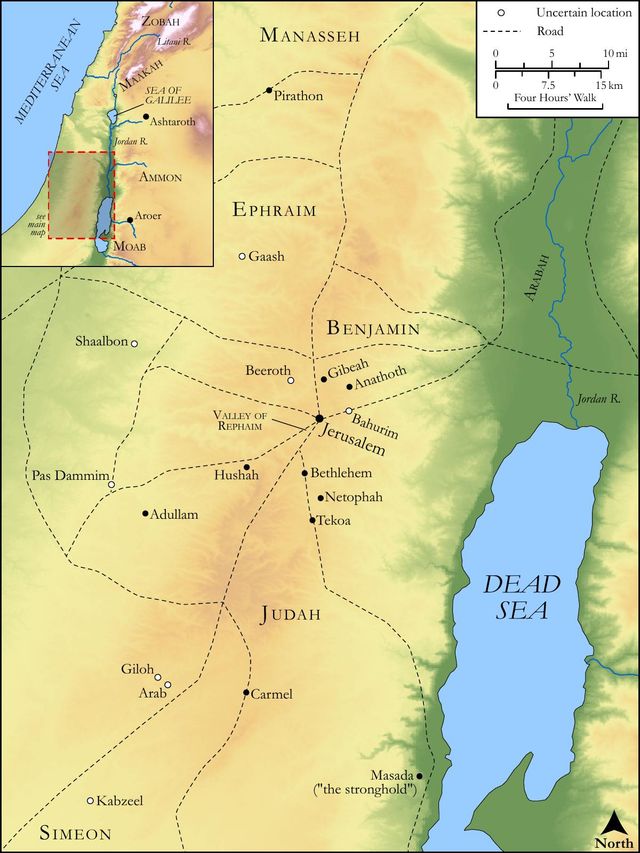
See on the biblical-era map
Study this verse
Public-domain commentary
Matthew Henry
From his Commentary on the Whole Bible. Henry comments on passages, not single verses — this entry covers 1 Chronicles 11:1–9. His two-level outline is real structure in the source text, so it is rendered as structure.
David is here brought to the possession.
I.Of the throne of Israel, after he had reigned seven years in Hebron, over Judah only.
In consideration of his relation to them (Ch1 11:1), his former good services, and especially the divine designation (Ch1 11:2), they anointed him their king: he covenanted to protect them, and they to bear faith and true allegiance to him, Ch1 11:3. Observe,
1.God's counsels will be fulfilled at last, whatever difficulties lie in the way. If God had said, David shall rule, it is in vain to oppose it.
2.Men that have long stood in their own light, when they have long wearied themselves with their lying vanities, it is to be hoped, will understand the things that belong to their peace and return to their own mercies.
3.Between prince and people there is an original contract, which both ought religiously to observe. If ever any prince might have claimed an absolute despotic power, David might, and might as safely as any have been entrusted with it; and yet he made a covenant with the people, took the coronation-oath, to rule by law.
II.Of the strong-hold of Zion, which was held by the Jebusites till David's time.
Whether David had a particular eye upon it as a place fit to make a royal city, or whether he had a promise of it from God, it seems that one of his first exploits was to make himself master of that fort; and, when he had it, he called it the city of David, Ch1 11:7. To this reference is had, Psa 2:6. I have set my king upon my holy hill of Zion. See here what quickens and engages resolution in great undertakings.
1.Opposition. When the Jebusites set David at defiance, and said, Thou shalt not come hither. he resolved to force it, whatever it cost him.
2.Prospect of preferment. When David proposed to give the general's place to him that would lead the attack upon the castle of Zion, Joab was fired with the proposal, and he went up first, and was chief. It has been said, "Take away honour out of the soldier's eye and you cut off the spurs from his heels."
Historical interpretation
Historical reception
1 surviving comment on this verse from the historical church.
You have a great intellect and an inexhaustible store of language, your diction is fluent and pure, your fluency and purity are mingled with wisdom. Your head is clear and all your senses keen. Were you to add to this wisdom and eloquence a careful study and knowledge of Scripture, I should soon see you holding our citadel against all comers; you would go up with Joab on the roof of Zion and sing on the housetops what you had learned in the secret chambers.
Continue studying 1 Chronicles 11:5 across the web’s major study libraries — every link below opens this exact verse, chapter, or book on the destination site.
Read & Compare
 BibleGatewayThis verse in more than 200 translations and 70 languages.
 Bible.comThe YouVersion reader — hundreds of translations, reading plans, and highlights.
 ESV.orgCrossway's official English Standard Version reader.
 NET BibleThe NET translation with 60,000+ translators' notes on every rendering decision.
 STEP BibleTyndale House's free study tool — original text, vocabulary, and scholarly resources.
 BibliaLogos Bible Software's free web reader.
 USCCBThe New American Bible (Revised Edition) with the U.S. bishops' study notes.
Commentaries
 BibleHub CommentariesDozens of classic commentaries on this verse, gathered on one page.
 StudyLightMore than 100 commentary sets — the largest collection on the web.
 BibleRefPlain-English commentary on what this verse means, verse by verse.
 Enduring WordDavid Guzik's free commentary on this chapter, widely used by Bible teachers.
 Bible Study ToolsVerse commentary alongside Greek and Hebrew study aids.
Original Language & Research
- BibleHub InterlinearThe verse word by word — original language, transliteration, and English.
- BibleHub LexiconEvery word's original-language definition and Strong's entry.
 Blue Letter BibleDeep-study tools — Strong's numbers, concordance, and word studies.
 SefariaThe Hebrew text with Rashi and centuries of Jewish commentary.
Sermons, Hymns & Audio


TrulyRandomVerse is not affiliated with these sites and doesn’t control their content. They’re linked because they’re genuinely useful.
Summary
1 Chronicles 11:5 records a pivotal moment in David's early reign: his decisive conquest of Jebus, the ancient city that would become Jerusalem. Despite the defiant challenge from its inhabitants, David successfully captured the heavily fortified "castle of Zion," thereby establishing it as his capital and renaming it "the city of David." This strategic act not only secured a neutral and centrally located hub for a newly united Israel but also laid the foundational stone for what would become the spiritual and political heart of the nation under God's chosen king.
Context
ShowHideLiterary Context
This verse immediately follows the account of David's anointing as king over all Israel by all the tribes at Hebron, signifying the full consolidation of his rule (1 Chronicles 11:3). Having secured the allegiance of the nation, David's first strategic move is to establish a central, neutral capital. The Chronicler's narrative, while concise, emphasizes David's immediate and effective leadership in unifying his kingdom. It serves as a foundational event for his reign, preceding the detailed listing of David's mighty men and their heroic exploits (1 Chronicles 11:10-47). Unlike the parallel account in 2 Samuel 5:6-8, the Chronicler focuses less on the tactical details or the Jebusites' taunts and more on the successful outcome, highlighting God's favor and David's divinely appointed authority.
Historical & Cultural Context
Jebus, the ancient name for Jerusalem, was a formidable Canaanite city, strategically situated on a defensible hilltop. Its location between the territories of Judah and Benjamin made it an ideal neutral capital, avoiding tribal favoritism. The Jebusites, its inhabitants, had remarkably maintained control of this stronghold even after the Israelites had largely conquered the surrounding land during the time of Joshua and the Judges (Joshua 15:63). Their defiant statement, "Thou shalt not come hither," reflects their supreme confidence in the city's seemingly impregnable defenses, which included steep valleys on three sides. The capture of such a city was a monumental military feat, demonstrating not only David's exceptional prowess but also the undeniable hand of the Lord with him, enabling him to achieve what previous generations could not.
Key Themes
ShowHideThe conquest of Jebus encapsulates several profound themes central to the book of Chronicles and David's reign. Firstly, it underscores Divine Appointment and Favor, as David's success in taking a seemingly unconquerable city is ultimately attributed to God's enabling hand. Secondly, it highlights Strategic Leadership, demonstrating David's wisdom in choosing a central, defensible capital that could effectively unite the often-fractious tribes of Israel. This act of establishing a new capital, distinct from existing tribal territories, was crucial for fostering the Unity of Israel. Thirdly, the verse introduces the profound significance of Zion, which initially refers to the specific fortress but quickly expands to encompass the entire city of Jerusalem, becoming a theological symbol for God's dwelling place and the spiritual heart of His people, as celebrated throughout the Psalms (e.g., Psalm 48:1-3). David's conquest of this stronghold also exemplifies the theme of Overcoming Obstacles through faith and divine assistance.
Exposition and Analysis
ShowHideKey Word Analysis
ShowHideThis term refers to the pre-Israelite city of Jerusalem, inhabited by the Jebusites. Derived from a root meaning "trodden" or "threshing-place," its mention emphasizes the foreign, unconquered nature of the city prior to David's arrival. The act of taking Jebus signifies the completion of Israel's territorial claims in this vital region and the establishment of a truly national capital, free from previous tribal affiliations.
This primitive root means "to catch (in a net, trap or pit); generally, to capture or occupy." In this context, it powerfully conveys David's decisive and successful military action against the fortified city. It highlights not merely an attempt but a complete and effective seizure, demonstrating his military acumen and the divine enablement that allowed him to overcome the formidable defenses of Jebus.
This term, initially referring to the specific fortified hill or "castle" within Jebus, is a mountain of Jerusalem. Its capture was the key to controlling the entire city. Over time, "Zion" transitioned from denoting this specific stronghold to encompassing the entire city of Jerusalem, and eventually, to a profound theological concept representing God's holy mountain, His chosen dwelling place, and the spiritual center of His people.
Verse Breakdown
ShowHide"And the inhabitants of Jebus said to David, Thou shalt not come hither."
This opening clause vividly portrays the Jebusites' defiant posture and their supreme confidence in the impregnability of their fortress. Their declaration is a direct challenge to David's authority and military might, implying that their defenses were so strong that even the "blind and the lame" could repel an attack (as detailed in the parallel account in 2 Samuel 5:6). It sets up the formidable obstacle David faced, highlighting the human impossibility of the task without divine intervention.
"Nevertheless David took the castle of Zion"
The word "Nevertheless" acts as a powerful adversative, emphatically highlighting David's determination and ultimate success in overcoming the seemingly insurmountable challenge posed by the Jebusites. This clause emphasizes David's decisive action, military acumen, and the divine favor that enabled him to conquer the stronghold that had resisted Israel for centuries. It is a testament to his leadership and an affirmation of his God-given authority, demonstrating that human defiance cannot thwart God's sovereign plan.
"which [is] the city of David."
This concluding phrase identifies the captured "castle of Zion" with the newly established capital, "the city of David." It signifies the immediate and profound consequence of David's conquest: the transformation of a foreign stronghold into the political and spiritual center of Israel. This renaming solidifies David's legacy, inextricably linking the city's identity to his reign, and foreshadows its future importance in God's redemptive plan as the chosen dwelling place of the Ark of the Covenant and later, the Temple.
Literary Devices
ShowHideThe verse employs several effective literary devices that enhance its impact and meaning. Contrast is prominently featured, setting the defiant declaration of the Jebusites ("Thou shalt not come hither") against David's decisive and successful action ("Nevertheless David took..."). This highlights the perceived impossibility of the task versus the reality of its accomplishment, thereby emphasizing David's prowess and divine backing. The phrase "castle of Zion" functions as a form of Synecdoche, where a part (the citadel) represents the whole (the entire city of Jerusalem), underscoring the strategic importance of this specific stronghold for controlling the entire area. The renaming of the city to "the city of David" is a powerful act of Symbolism, signifying a new era of Israelite sovereignty, the establishment of a unified kingdom under God's chosen king, and the city's transformation from a pagan stronghold to the heart of God's people. This also serves as Foreshadowing, hinting at the city's future theological significance as the dwelling place of God and the center of His worship.
Theological and Thematic Connections
ShowHideThe conquest of Jerusalem by David is far more than a mere military victory; it is a foundational theological event in Israel's history. It signifies God's faithfulness to His covenant promises, establishing David's kingdom and providing a central dwelling place for His presence among His people. The city of Zion, once a pagan stronghold, is transformed into the "City of God," a place of divine election and blessing. This act solidifies David's role as God's chosen king, through whom the divine kingdom would be established on earth. The defiance of the Jebusites and David's ultimate success underscore the theme that no earthly power or seemingly impregnable obstacle can ultimately thwart God's sovereign plan for His people and His anointed.
Reflection and Application
ShowHideThe narrative of David's conquest of Jebus offers profound and timeless lessons for the believer today. We often encounter "Jebusites" in our lives—seemingly impregnable obstacles, deeply entrenched habits, or defiant spiritual strongholds that declare, "Thou shalt not come hither." These challenges can appear insurmountable, mocking our efforts and confidence, leading to discouragement. Yet, like David, we are called to perseverance and faith, trusting that with God's guidance and strategic effort, what seems impossible can indeed be overcome. This passage reminds us that God often works through our determined obedience and courageous action to achieve His purposes, transforming places of resistance into centers of His presence and blessing. It encourages us to identify the "strongholds" in our lives—whether personal struggles, communal challenges, or spiritual battles—and, empowered by God's Spirit, to take decisive action to establish His reign in those areas, transforming them into "cities of God" where His will is done and His glory is revealed.
Questions for Reflection
ShowHideFAQ
ShowHideWhy was Jerusalem so important for David to capture and make his capital?
ShowHideJerusalem (Jebus) was strategically vital for several reasons. Geographically, its central location between the northern and southern tribes made it a neutral territory that could unite a kingdom often divided by tribal loyalties. Militarily, its hilltop location and natural defenses made it nearly impregnable, providing a secure and easily defensible capital. Spiritually, by conquering it, David fulfilled God's implicit promise of a secure dwelling place for His people, and it later became the chosen site for the Temple, the central place of Israel's worship and God's presence among them.
What is the significance of "Zion" becoming "the city of David"?
ShowHideThe transformation of "Zion" into "the city of David" signifies a profound shift from a pagan stronghold to the spiritual and political heart of God's chosen nation. It marks the establishment of David's dynasty and the physical embodiment of God's covenant with him, making Jerusalem synonymous with the kingdom of God on earth, representing His rule through His anointed king. This renaming also laid the groundwork for Zion's future theological significance as the holy mountain of God and the ultimate destination for His people, a place of pilgrimage and divine blessing.
How does the account in 1 Chronicles 11:5 compare to the parallel in 2 Samuel 5:6-8?
ShowHideWhile both accounts describe David's conquest of Jerusalem, the Chronicler's version in 1 Chronicles 11:5 is more concise and focuses primarily on the successful outcome and the establishment of the capital. It omits the detailed taunts of the Jebusites about the "blind and the lame" defending the city, and David's specific strategy of attacking through the water shaft (2 Samuel 5:8). The Chronicler's emphasis is on David's divinely appointed role and the positive, unifying impact of his reign, aligning with the book's overall purpose of encouraging the post-exilic community by highlighting God's faithfulness to His covenant with David and the enduring significance of Jerusalem.
Christ-Centered Fulfillment
ShowHideThe conquest of Zion by David, establishing it as the "city of David," profoundly foreshadows the ultimate conquest and kingship of Jesus Christ. Just as David, the shepherd-king, overcame the seemingly impregnable stronghold of Jebus, Christ, the greater Son of David, conquered the ultimate strongholds of sin, death, and the devil (Colossians 2:15). The Jebusites' defiant declaration, "Thou shalt not come hither," echoes the spiritual resistance humanity offers to God's reign, yet Christ, through His sacrificial death and glorious resurrection, decisively took the "castle of Zion" of our hearts, establishing His kingdom there. The earthly Jerusalem, the city of David, points to the heavenly Jerusalem, the true and eternal "city of the living God" (Hebrews 12:22), where Christ reigns supreme. He is the true King who, having overcome all opposition, now builds His spiritual temple, the Church, upon Himself as the cornerstone (Ephesians 2:20-22). Ultimately, the establishment of David's earthly capital anticipates the glorious, eternal reign of Christ from His heavenly throne, bringing ultimate peace, unity, and salvation to all who acknowledge Him as Lord (Revelation 21:2-3).