


1 Chronicles 11:7
Bible text: King James Version (1769 Blayney text) · Public domain
Bible text: Berean Standard Bible · Public domain
Bible text: American Standard Version (1901) · Public domain
Bible text: World English Bible, Messianic edition · Public domain
Bible text: Geneva Bible (1599) · Public domain
Bible text: Young's Literal Translation · Public domain
- וַיֵּשֶׁבvai·Ye·shevand he dweltH3427Conj-w ¦ V-Qal-ConsecImperf-3msVerb Qal Consecutive Imperfect 3rd Singular Masculineוַandיֵּשֶׁבhe dwelt
- דָּוִידda·VidDavidH1732N-proper-mNoun Proper Masculine
- בַּמְצָדbam·Tzadin the fortressH4679Prep-b ¦ N-fsNoun Singular Feminine Absoluteבַּin theמְצָדfortress
- עַל'althere-H5921PrepPreposition
- כֵּןken-foreH3651AdvAdverb
- קָרְאוּka·re·'upeople calledH7121V-Qal-Perf-3cpVerb Qal Perfect 3rd Plural common gender
- לוֹlo<to> itPrep-l ¦ 3msSuffix Personal 3rd Singular Masculineל<to>וֹit
- עִיר'ir[the] city ofH5892N-fscNoun Singular Feminine Construct
- דָּוִידda·VidDavidH1732N-proper-mNoun Proper Masculine
English is a literal word-by-word gloss of the Hebrew, not the KJV's wording. Why?
This is the original text the KJV's translators worked from — each Hebrew word with its own literal English meaning in this verse, prepared by scholars at Tyndale House, Cambridge. The KJV translates whole sentences, not word by word, so its wording differs: one Hebrew word can become several English words, and the KJV may choose “the LORD” where the gloss reads “Yahweh”. Both are faithful — they answer different questions. For the KJV's own rendering, switch to the KJV text.
Details
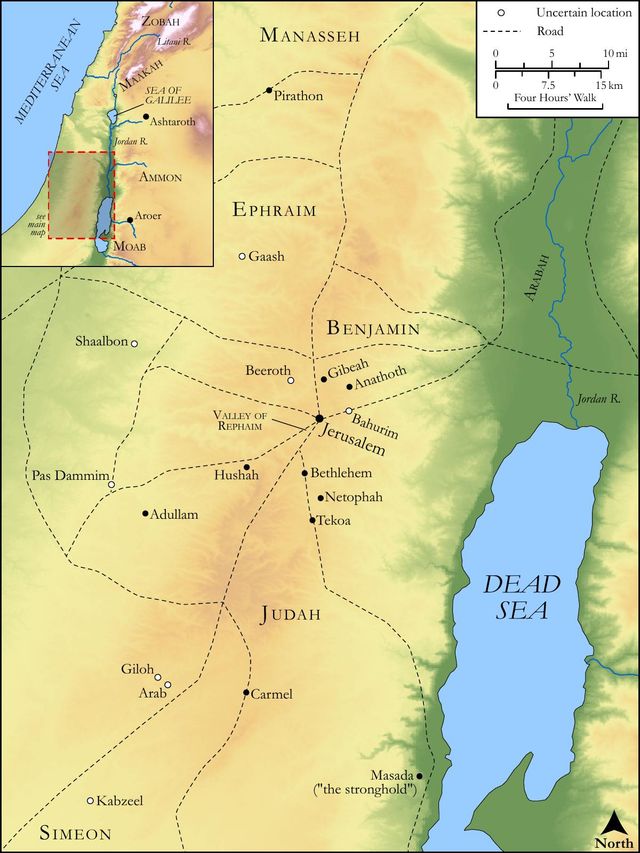
See on the biblical-era map
Study this verse
Public-domain commentary
Matthew Henry
From his Commentary on the Whole Bible. Henry comments on passages, not single verses — this entry covers 1 Chronicles 11:1–9. His two-level outline is real structure in the source text, so it is rendered as structure.
David is here brought to the possession.
I.Of the throne of Israel, after he had reigned seven years in Hebron, over Judah only.
In consideration of his relation to them (Ch1 11:1), his former good services, and especially the divine designation (Ch1 11:2), they anointed him their king: he covenanted to protect them, and they to bear faith and true allegiance to him, Ch1 11:3. Observe,
1.God's counsels will be fulfilled at last, whatever difficulties lie in the way. If God had said, David shall rule, it is in vain to oppose it.
2.Men that have long stood in their own light, when they have long wearied themselves with their lying vanities, it is to be hoped, will understand the things that belong to their peace and return to their own mercies.
3.Between prince and people there is an original contract, which both ought religiously to observe. If ever any prince might have claimed an absolute despotic power, David might, and might as safely as any have been entrusted with it; and yet he made a covenant with the people, took the coronation-oath, to rule by law.
II.Of the strong-hold of Zion, which was held by the Jebusites till David's time.
Whether David had a particular eye upon it as a place fit to make a royal city, or whether he had a promise of it from God, it seems that one of his first exploits was to make himself master of that fort; and, when he had it, he called it the city of David, Ch1 11:7. To this reference is had, Psa 2:6. I have set my king upon my holy hill of Zion. See here what quickens and engages resolution in great undertakings.
1.Opposition. When the Jebusites set David at defiance, and said, Thou shalt not come hither. he resolved to force it, whatever it cost him.
2.Prospect of preferment. When David proposed to give the general's place to him that would lead the attack upon the castle of Zion, Joab was fired with the proposal, and he went up first, and was chief. It has been said, "Take away honour out of the soldier's eye and you cut off the spurs from his heels."
Continue studying 1 Chronicles 11:7 across the web’s major study libraries — every link below opens this exact verse, chapter, or book on the destination site.
Read & Compare
 BibleGatewayThis verse in more than 200 translations and 70 languages.
 Bible.comThe YouVersion reader — hundreds of translations, reading plans, and highlights.
 ESV.orgCrossway's official English Standard Version reader.
 NET BibleThe NET translation with 60,000+ translators' notes on every rendering decision.
 STEP BibleTyndale House's free study tool — original text, vocabulary, and scholarly resources.
 BibliaLogos Bible Software's free web reader.
 USCCBThe New American Bible (Revised Edition) with the U.S. bishops' study notes.
Commentaries
 BibleHub CommentariesDozens of classic commentaries on this verse, gathered on one page.
 StudyLightMore than 100 commentary sets — the largest collection on the web.
 BibleRefPlain-English commentary on what this verse means, verse by verse.
 Enduring WordDavid Guzik's free commentary on this chapter, widely used by Bible teachers.
 Bible Study ToolsVerse commentary alongside Greek and Hebrew study aids.
Original Language & Research
- BibleHub InterlinearThe verse word by word — original language, transliteration, and English.
- BibleHub LexiconEvery word's original-language definition and Strong's entry.
 Blue Letter BibleDeep-study tools — Strong's numbers, concordance, and word studies.
 SefariaThe Hebrew text with Rashi and centuries of Jewish commentary.
Sermons, Hymns & Audio


TrulyRandomVerse is not affiliated with these sites and doesn’t control their content. They’re linked because they’re genuinely useful.
Summary
1 Chronicles 11:7 records the pivotal moment when King David took up residence in the recently captured stronghold of Jerusalem, formerly Jebus. This strategic act not only solidified Jerusalem's status as the capital of the newly unified kingdom of Israel but also led to its immediate and lasting designation as "the city of David," a name imbued with profound historical, political, and theological significance throughout the biblical narrative.
Context
ShowHideLiterary Context
This verse is strategically positioned within the Chronicler's narrative emphasizing David's legitimate and divinely appointed kingship over all Israel. Immediately preceding 1 Chronicles 11:7, the preceding verses, specifically 1 Chronicles 11:4-6, recount David's audacious and successful capture of "the stronghold of Zion" from the Jebusites, a feat achieved through Joab's valor. This conquest was the essential prerequisite for David's subsequent dwelling there, highlighting the direct link between military victory and the establishment of royal authority. The broader context of 1 Chronicles 11 begins with David's anointing by all the tribes of Israel at Hebron (1 Chronicles 11:1-3), setting the stage for his consolidation of power and the imperative need for a central, neutral capital to unite the disparate tribes.
Historical & Cultural Context
Jerusalem, known as Jebus prior to David's conquest, was a formidable natural fortress, strategically situated on a defensible ridge between the Kidron and Tyropoeon valleys. It had remained an unconquered Canaanite enclave during the Israelite conquest, serving as a neutral territory. For David, establishing his capital in Jerusalem was a stroke of political genius. Unlike Hebron, which was strongly associated with the tribe of Judah, Jerusalem was not tied to any single tribe, making it an ideal neutral ground to foster unity among the often-fractious tribes of Israel. Culturally, a king's residence was synonymous with the seat of power and authority. By dwelling in the "castle" or stronghold, David physically manifested his reign, asserted his dominion over the entire land, and symbolically transformed a foreign stronghold into the very heart of the Israelite kingdom.
Key Themes
ShowHide1 Chronicles 11:7 contributes significantly to several overarching themes within the book of Chronicles. Firstly, it underscores The Establishment of Jerusalem as the Chosen Capital. This act marks Jerusalem's definitive transition from a Jebusite stronghold to the political and spiritual epicenter of Israel, a theme extensively developed throughout Chronicles, particularly with the subsequent planning and building of the Temple. Secondly, it highlights David's Consolidating Authority and Righteous Reign. David's successful conquest and subsequent dwelling in the fortress signify his divinely appointed leadership and the stability and security of his kingdom, fulfilling the promises made to him by God. Finally, the verse introduces the enduring theme of The Significance of "City of David". This naming is far more than a geographical designation; it imbues the city with David's identity, legacy, and covenantal significance, foreshadowing its future role in God's redemptive plan. This name would later become intrinsically linked to the birthplace of the Messiah, Jesus Christ, as prophesied and recorded in passages like Luke 2:11.
Exposition and Analysis
ShowHideKey Word Analysis
ShowHideThe Hebrew verb יָשַׁב (yâshab) signifies not merely a temporary stay but a permanent settlement, to "sit down" or "abide." In this context, David's act of dwelling in the castle denotes the establishment of his permanent residence and the seat of his government. It conveys the idea of stability, authority, and the consolidation of his reign, transforming the conquered fortress into the fixed center of his kingdom.
The Hebrew word מְצָדָה (mᵉtsadah) refers to a "fortress," "stronghold," or "citadel." This term emphasizes the impregnable and highly defensible nature of the location David chose for his dwelling. It was not just a royal palace but a militarily significant and secure position, underscoring the strategic importance of Jerusalem as the new capital and the security David brought to his reign. The choice of this word highlights the physical strength and strategic advantage of the site, making it a fitting symbol of David's secure rule.
The Hebrew verb קָרָא (qârâʼ) means "to call," "to name," or "to proclaim." In this context, it signifies an act of naming that establishes identity and ownership. The people's collective act of "calling it the city of David" was not a casual designation but a formal recognition of the city's new status and its intrinsic connection to their king. It implies a communal acknowledgment and proclamation, solidifying Jerusalem's identity as the royal city, personally identified with David's leadership and legacy.
Verse Breakdown
ShowHide"And David dwelt in the castle"
This clause describes David's decisive action of physically occupying and establishing his royal residence within the captured stronghold of Zion. His dwelling there was not a temporary encampment but a foundational act, symbolizing the transfer of power from the Jebusites to the Israelite monarchy and the permanent establishment of his royal court. It underscores his successful leadership in securing a central, strategic location for his kingdom, transforming a foreign enclave into the heart of Israelite governance and a tangible expression of his kingship and the consolidation of his authority.
"therefore they called it the city of David"
This second clause directly presents the consequence of David's action, highlighting a clear cause-and-effect relationship. The people, recognizing David's pivotal role in conquering and occupying the formidable stronghold, immediately associated the place with him. The naming "city of David" (עִיר דָּוִד, ‘ir Dawid) was more than a mere label; it was an act of communal acknowledgment, honor, and allegiance, solidifying its new identity as the royal capital. This name would become a lasting testament to David's enduring legacy and the city's profound significance in Israelite history and theology, echoing through generations.
Literary Devices
ShowHideThe verse employs several significant literary devices to convey its profound meaning. Cause-and-Effect is prominently featured, as David's act of dwelling in the stronghold directly precipitates its renaming as "the city of David." This highlights the immediate and transformative impact of David's actions on the national identity and geography of Israel. Symbolism is also powerfully at play, with the "castle" or stronghold symbolizing David's secure, divinely appointed, and consolidated reign. His strategic presence transforms a mere military fortress into the national capital, a potent symbol of unity, stability, and legitimate authority. Furthermore, the act of Naming itself is a powerful performative device. The immediate renaming of the stronghold to "the city of David" is not just descriptive but prescriptive, establishing a new identity, ownership, and destiny for the city. This naming imbues the city with David's personal legacy and foreshadows its future significance as the spiritual and political heart of Israel, and ultimately, as the birthplace of the Messiah.
Theological and Thematic Connections
ShowHideThe establishment of Jerusalem as the "City of David" is a profoundly theological event, signifying God's providential hand in raising David to kingship and choosing a specific place for His dwelling among His people. This act laid the groundwork for the foundational Davidic covenant, promising an enduring dynasty and a perpetual kingdom, and setting the stage for the construction of the Temple, where God's presence would uniquely reside. Jerusalem, chosen by David and later explicitly affirmed by God Himself (Psalm 78:68), became the focal point of Israel's worship, governance, and national identity, embodying the intersection of divine promise and human action. It became the sacred place where God's faithfulness to His covenant with David would be continually demonstrated and celebrated.
Reflection and Application
ShowHideThe narrative of David making Jerusalem his dwelling place and establishing it as the "City of David" offers profound and enduring lessons for believers today. Just as King David strategically chose a central, secure location to consolidate his earthly kingdom, we are called to center our lives entirely on Christ, allowing Him to establish His sovereign reign within the innermost chambers of our hearts. This spiritual act involves surrendering our personal "strongholds" – those areas of resistance, self-reliance, or unyielded control – to His divine authority, permitting Him to transform them into sacred spaces where His presence dwells and His redemptive purposes are fully realized. The renaming of the city signifies a profound change in identity, powerfully reminding us that in Christ, we receive a new, spiritual identity as citizens of His eternal kingdom, called to live in unwavering alignment with His perfect will. Our lives, much like the ancient City of David, are meant to be vibrant, living testimonies where God's truth is boldly proclaimed, His kingdom is actively advanced, and His glory is radiantly displayed, becoming a beacon of hope and a powerful witness to His enduring faithfulness to all generations.
Questions for Reflection
ShowHideFAQ
ShowHideWhy was Jerusalem so significant for David to choose as his capital?
ShowHideJerusalem (then Jebus) was strategically significant for several reasons that made it an ideal choice for David's capital. First, its natural topography made it an almost impregnable fortress, providing unparalleled security for the king and the nascent nation. Second, it was a neutral city, not belonging to any of the twelve Israelite tribes. This neutrality was absolutely crucial for David, who sought to unite a kingdom often fractured by deep-seated tribal loyalties. By choosing Jerusalem, he skillfully avoided showing favoritism to any single tribe, thereby fostering a much-needed sense of national unity. Furthermore, David's personal conquest of the city, as detailed in 1 Chronicles 11:4-6, made it uniquely "his," solidifying his authority and legitimacy over all Israel.
Christ-Centered Fulfillment
ShowHide1 Chronicles 11:7, with its foundational declaration of Jerusalem as "the city of David," profoundly foreshadows the coming and reign of Jesus Christ. David, as an earthly king, established his dwelling in a conquered stronghold, making it the political and spiritual center of his earthly kingdom. This pivotal act points forward to Jesus, the greater Son of David (Matthew 1:1), who not only reigns from a spiritual "City of David" but is Himself the true King who decisively conquers the ultimate strongholds of sin and death. Just as Jerusalem became the chosen earthly city, Jesus is the chosen one, the very dwelling place of God among humanity, the Word made flesh (John 1:14). His humble birth in Bethlehem, also prophetically known as "the city of David" (Luke 2:11), physically and symbolically links Him to this ancient prophecy. Ultimately, Jesus establishes a spiritual kingdom, a new Jerusalem, where believers are living stones built into a spiritual house (1 Peter 2:5), and He dwells intimately in the hearts of His people by faith (Ephesians 3:17). The earthly City of David thus finds its ultimate and eternal fulfillment in the glorious reign of Christ and the heavenly Jerusalem (Revelation 21:2-3), where God truly dwells among His redeemed people forevermore.