


1 Chronicles 12:29
Bible text: King James Version (1769 Blayney text) · Public domain
Bible text: King James Version with Strong's numbers · Public domain
Bible text: Berean Standard Bible · Public domain
Bible text: American Standard Version (1901) · Public domain
Bible text: World English Bible, Messianic edition · Public domain
Bible text: Geneva Bible (1599) · Public domain
Bible text: Young's Literal Translation · Public domain
- וּמִןu·minand ofH4480Conj-w ¦ PrepPrepositionוּandמִןof
- בְּנֵיbe·Nei[the] descendants ofH1121N-mpcNoun Plural Masculine Construct
- בִנְיָמִןvin·ya·MinBenjaminH1144N-proper-mNoun Proper Masculine
- אֲחֵי'a·Chei[the] relatives ofH251N-mpcNoun Plural Masculine Construct
- שָׁאוּלsha·'UlSaulH7586N-proper-mNoun Proper Masculine
- שְׁלֹשֶׁתshe·Lo·shetthreeH7969N-cscNoun Singular common gender Construct
- אֲלָפִים'a·la·Fimthousand<s>H505N-cpNoun Plural common gender Absolute
- וְעַדve·'adand untilH5704Conj-w ¦ PrepPrepositionוְandעַדuntil
- הֵנָּהhe·nahnowH2008AdvAdverb
- מַרְבִּיתָםmar·bi·Tamtheir greater partH4768N-fsc ¦ 3mpNoun Singular Feminine Constructמַרְבִּיתָgreater partםtheir
- שֹׁמְרִיםsho·me·Rim[were] keepingH8104V-Qal-Prtcpl-mpVerb Qal Participle Plural Masculine Absolute
- מִשְׁמֶרֶתmish·Me·ret[the] duty ofH4931N-fscNoun Singular Feminine Construct
- בֵּיתbeit[the] house ofH1004N-mscNoun Singular Masculine Construct
- שָׁאוּלsha·'UlSaulH7586N-proper-mNoun Proper Masculine
English is a literal word-by-word gloss of the Hebrew, not the KJV's wording. Why?
This is the original text the KJV's translators worked from — each Hebrew word with its own literal English meaning in this verse, prepared by scholars at Tyndale House, Cambridge. The KJV translates whole sentences, not word by word, so its wording differs: one Hebrew word can become several English words, and the KJV may choose “the LORD” where the gloss reads “Yahweh”. Both are faithful — they answer different questions. For the KJV's own rendering, switch to the KJV text.
Details
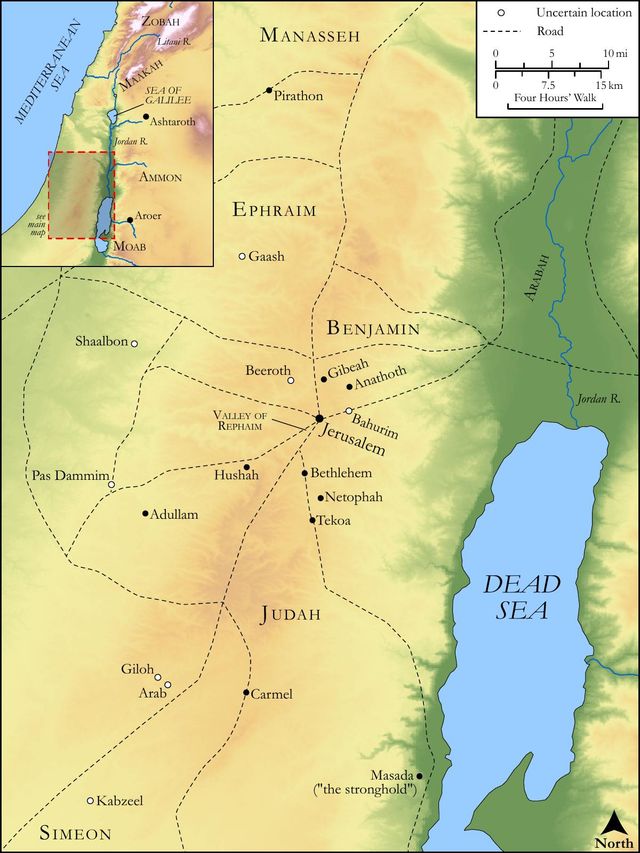
See on the biblical-era maps
Study this verse
Public-domain commentary
Matthew Henry
From his Commentary on the Whole Bible. Henry comments on passages, not single verses — this entry covers 1 Chronicles 12:23–40.
We have here an account of those who were active in perfecting the settlement of David upon the throne, after the death of Ishbosheth. We read (Ch1 11:1, and before Sa2 5:1) that all the tribes of Israel came, either themselves or by their representatives, to Hebron, to make David king; now here we have an account of the quota which every tribe brought in ready armed to the war, in case there should be any opposition, Ch1 12:23. We may observe here,
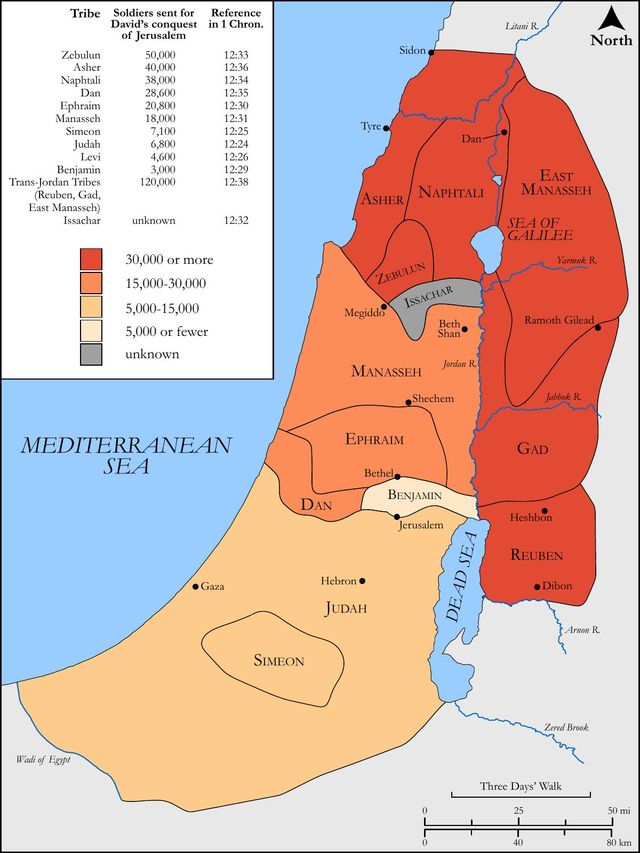
I.That those tribes that lived nearest brought the fewest - Judah but 6800 (Ch1 12:24), Simeon but 7100 (Ch1 12:25); whereas Zebulun, that lay remote, brought 50,000, Asher 40,000, and the two tribes and a half on the other side Jordan 120,000. Not as if the next adjacent tribes were cold in the cause; but they showed as much of their prudence in bringing few, since all the rest lay so near within call, as the others did of their zeal in bringing so many. The men of Judah had enough to do to entertain those that came from afar.
II.The Levites themselves, and the priests (called here the Aaronites), appeared very hearty in this cause, and were ready, if there were occasion, to fight for David, as well as pray for him, because they knew he was called of God to the government, Ch1 12:26-28.
III.Even some of the kindred of Saul came over to David (Ch1 12:29), not so many as of the other tribes, because a foolish affection for their own tribe, and a jealousy for the honour of it, kept many of them long in the sinking interest of Saul's family. Kindred should never over-rule conscience. Call no man Father to this extent, but God only.
IV.It is said of most of these that they were mighty men of valour (Ch1 12:25, Ch1 12:28, Ch1 12:30), of others that they were expert in war (Ch1 12:35, Ch1 12:36), and of them all that they could keep rank, Ch1 12:38. They had a great deal of martial fire, and yet were governable and subject to the rules of order - warm hearts but cool heads.
V.Some were so considerate as to bring with them arms, and all instruments for war (Ch1 12:24, Ch1 12:33, Ch1 12:37), for how could they think that David should be able to furnish them?
VI.The men of Issachar were the fewest af all, only 200, and yet as serviceable to David's interest as those that brought in the greatest numbers, these few being in effect the whole tribe. For, 1. They were men of great skill above any of their neighbours, men that had understanding of the times, to know what Israel ought to do. They understood the natural times, could discern the face of the sky, were weather-wise, could advise their neighbours in the proper times for ploughing, sowing reaping, etc. Or the ceremonial times, the times appointed for the solemn feasts; therefore they are said to call the people to the mountain (Deu 33:19), for almanacs were not then so common as now. Or, rather, the political times; they understood public affairs, the temper of the nation, and the tendencies of the present events. It is the periphrasis of statesmen that they know the times, Esth. 1. 13. Those of that tribe were greatly intent on public affairs, had good intelligence from abroad and made a good use of it. They knew what Israel ought to do: from their observation and experience they learned both their own and others' duty and interest. In this critical juncture they knew Israel ought to make David king. It was not only expedient, but necessary; the present posture of affairs called for it. The men of Issachar dealt mostly in country business, and did not much intermeddle in public affairs, which gave them an opportunity of observing others and conversing with themselves. A stander-by sees sometimes more than a gamester. 2. They were men of great interests; for all their brethren were at their commandment. The commonality of that tribe having bowed their shoulder to bear (Gen 49:15), the great men had them at their beck. Hence we read of the princes of Issachar, Jdg 5:15. They knew how to rule, and the rest knew how to obey. It is happy indeed when those that should lead are intelligent and judicious, and those who are to follow are modest and obsequious.
VII.It is said of them all that they engaged in this enterprise with a perfect heart (Ch1 12:38), and particularly of the men of Zebulun that they were not of double heart, Ch1 12:33. They were, in this matter, Israelites indeed, in whom was no guile. And this was their perfection, that they were of one heart, Ch1 12:38. None had any separate interests, but all for the public good.
VIII.The men of Judah, and others of the adjacent tribes, prepared for the victualling of their respective camps when they came to Hebron, Ch1 12:39, Ch1 12:40. Those that were at the least pains in travelling to this convention, or congress of states, thought themselves obliged to be at so much the more charge in entertaining the rest, that there might be something of an equality. A noble feast was made (was made for laughter, Ecc 10:19) upon this occasion, for there was joy in Israel, Ch1 12:40. And good reason; for when the righteous bear rule the city rejoices. Thus, when the throne of Christ is set up in a soul, there is, or ought to be, great joy in that soul: and provision is made for the feasting of it, not as here for two or three days, but for the whole life, nay, for eternity.
Continue studying 1 Chronicles 12:29 across the web’s major study libraries — every link below opens this exact verse, chapter, or book on the destination site.
Read & Compare
 BibleGatewayThis verse in more than 200 translations and 70 languages.
 Bible.comThe YouVersion reader — hundreds of translations, reading plans, and highlights.
 ESV.orgCrossway's official English Standard Version reader.
 NET BibleThe NET translation with 60,000+ translators' notes on every rendering decision.
 STEP BibleTyndale House's free study tool — original text, vocabulary, and scholarly resources.
 BibliaLogos Bible Software's free web reader.
 USCCBThe New American Bible (Revised Edition) with the U.S. bishops' study notes.
Commentaries
 BibleHub CommentariesDozens of classic commentaries on this verse, gathered on one page.
 StudyLightMore than 100 commentary sets — the largest collection on the web.
 BibleRefPlain-English commentary on what this verse means, verse by verse.
 Enduring WordDavid Guzik's free commentary on this chapter, widely used by Bible teachers.
 Bible Study ToolsVerse commentary alongside Greek and Hebrew study aids.
Original Language & Research
- BibleHub InterlinearThe verse word by word — original language, transliteration, and English.
- BibleHub LexiconEvery word's original-language definition and Strong's entry.
 Blue Letter BibleDeep-study tools — Strong's numbers, concordance, and word studies.
 SefariaThe Hebrew text with Rashi and centuries of Jewish commentary.
Sermons, Hymns & Audio


TrulyRandomVerse is not affiliated with these sites and doesn’t control their content. They’re linked because they’re genuinely useful.
Summary
This verse, situated within a comprehensive enumeration of those who joined David, marks a pivotal moment in Israel's history: the allegiance of three thousand warriors from the tribe of Benjamin. Notably, these men were from Saul's own kindred and had previously maintained steadfast loyalty to his house. Their decision to join David at Hebron signifies a definitive and divinely orchestrated shift in loyalty, underscoring the unification of Israel under David's rightful kingship and the conclusive end of Saul's dynasty.
Context
ShowHideLiterary Context
1 Chronicles 12 meticulously catalogs the diverse contingents of warriors, leaders, and skilled individuals who rallied to David's cause. The chapter opens by detailing those who joined David at Ziklag during his period as a fugitive, highlighting their martial prowess and unwavering commitment. It then transitions to the much larger assembly at Hebron, where David was formally anointed king over all Israel. Verse 29 specifically identifies a significant contingent from the tribe of Benjamin, a tribe historically and politically entwined with the fallen King Saul. This inclusion is strategically positioned within the broader list to demonstrate the extensive and profound support David garnered, even from unexpected origins, thereby solidifying his legitimate claim to the throne. The verse serves as a crucial narrative point, indicating the erosion of the final vestiges of Saulide loyalty and the complete consolidation of national allegiance under David.
Historical & Cultural Context
The period immediately following the deaths of King Saul and his son Ish-bosheth was characterized by immense political instability and transition in Israel. While David had been anointed king over Judah at Hebron, a rival kingdom under Ish-bosheth (Saul's surviving son) persisted in the northern tribes for seven and a half years, primarily supported by the tribe of Benjamin and led by Saul's general, Abner. The phrase "kept the ward of the house of Saul" refers to this sustained allegiance and military backing for Saul's lineage. Culturally, tribal loyalties were exceptionally strong, deeply rooted in kinship, shared heritage, and ancestral land. For members of Benjamin, aligning with David represented a profound abandonment of deeply ingrained tribal and familial ties to Saul's house. Their decision reflects a pragmatic recognition of David's increasing strength, divine favor, and the inevitable shift in power, likely influenced by the assassinations of both Abner and Ish-bosheth, which left Saul's house without effective leadership.
Key Themes
ShowHideThis verse powerfully contributes to several overarching themes within 1 Chronicles and the broader biblical narrative. Firstly, it highlights the theme of divine sovereignty and the transfer of kingship. The Chronicler consistently emphasizes God's active hand in establishing David's throne, and the defection of the Benjaminites demonstrates the irresistible nature of God's plan, even overcoming deeply entrenched human loyalties. This aligns with the narrative in 2 Samuel 5:1-5 where all the tribes eventually come to David. Secondly, it underscores the theme of national unity. The gathering of diverse tribes, including those previously opposed, under David's leadership is a crucial step towards the unified kingdom God intended for Israel, foreshadowing the peace and prosperity of David's reign. This unity is a recurring motif, also seen in the call for all Israel to worship God together in Jerusalem, as described in passages like 1 Chronicles 13. Finally, it speaks to the theme of shifting allegiances in response to God's appointed leader. The Benjaminites' decision to abandon their long-held "ward" signifies a recognition of God's new work and a willingness to align with His chosen vessel, even if it meant breaking with tradition.
Exposition and Analysis
ShowHideKey Word Analysis
ShowHideDerived from a primitive root, this word properly means "to hedge about (as with thorns)," and more generally, "to guard," "to protect," or "to attend to." In this context, it signifies the active and diligent maintenance of allegiance, service, and protection. The Benjaminites were not merely passive observers but active participants in preserving Saul's legacy, making their shift to David all the more significant as it represented a conscious cessation of this guarding.
This feminine noun, stemming from the root shâmar, refers to a "watch," "custody," "sentry," or "post." More broadly, it denotes an act of preservation, a duty, an observance, or a charge. Here, it specifically indicates the faithful maintenance of allegiance, responsibility, and protective service towards the house of Saul. It implies a long-standing commitment and an active role in upholding the remnants of Saul's dynasty.
This word, probably from the root meaning "to build," refers to a "house" in its broadest applications, including a literal dwelling, a family, a household, a palace, or a temple. In the phrase "house of Saul," it refers to Saul's royal lineage, his dynasty, and all those associated with upholding his claim to the throne. The Benjaminites' "keeping the ward" of this "house" signifies their loyalty to Saul's family and the remnants of his kingdom.
Verse Breakdown
ShowHide"And of the children of Benjamin, the kindred of Saul, three thousand:"
This opening clause identifies the specific group of warriors who joined David: a substantial contingent of three thousand men from the tribe of Benjamin. The parenthetical phrase "the kindred of Saul" is a crucial explanatory detail, immediately highlighting the profound significance of their defection. Benjamin was Saul's ancestral tribe, and many of its members would have felt a strong, inherent loyalty to his lineage. The sheer number, "three thousand," indicates a substantial and impactful contingent, demonstrating a significant erosion of support for Saul's house and a robust endorsement of David's kingship.
"for hitherto the greatest part of them had kept the ward of the house of Saul."
This explanatory clause provides the vital context for why their allegiance is so noteworthy. It clarifies that up until this point ("hitherto"), the majority ("the greatest part") of these Benjaminites had faithfully maintained their duty, service, and allegiance to Saul's royal family. The phrase "kept the ward" emphasizes their active role in upholding Saul's dynasty, whether through military support, political backing, or general loyalty. Their decision to join David, therefore, represents a profound and intentional shift, signaling the final collapse of Saulide power and the full recognition of David as God's chosen king over all Israel.
Literary Devices
ShowHideThe verse employs several literary devices to convey its profound message of shifting allegiance and divine orchestration. Numerical Detail ("three thousand") provides a concrete and impactful measure of the shift in allegiance, emphasizing the substantial nature of this defection from Saul's house. The explicit mention of "the kindred of Saul" creates a powerful Contrast between past loyalties and the present reality, highlighting the dramatic nature of the Benjaminites' change of heart. This also functions as Irony, as the very tribe that produced the first king and remained steadfastly loyal to his lineage is now abandoning it for David. Furthermore, the entire verse serves as a form of Symbolism, where the joining of these Benjaminites with David represents the ultimate unification of Israel under God's chosen king, signifying the divine transfer of authority and the end of a divided kingdom. The phrase "hitherto the greatest part of them had kept the ward" provides a clear Temporal Marker, emphasizing the definitive break from the past and the inauguration of a new era.
Theological and Thematic Connections
ShowHideThe defection of the Benjaminites to David's side in 1 Chronicles 12:29 is a powerful testament to God's sovereign hand in establishing and consolidating His chosen king. It illustrates that no human loyalty or political resistance can ultimately thwart God's divine plan. This passage underscores the theme of unity, showing how God orchestrates the coming together of disparate groups, even those with historical grievances or opposing loyalties, to fulfill His purposes for His people. It also highlights the importance of discerning and aligning with God's unfolding will, even when it requires abandoning long-held traditions or allegiances. The Benjaminites' shift signifies the end of a flawed, human-initiated kingship and the full embrace of God's divinely appointed leader, paving the way for the Davidic covenant and the establishment of a unified kingdom that would prefigure the eternal reign of Christ.
Reflection and Application
ShowHideThe story of the Benjaminites' shift in allegiance to David offers profound lessons for contemporary believers. Just as these warriors recognized the divine hand upon David and chose to align with God's new work, we are called to continually assess our loyalties and ensure they are primarily directed towards Christ and His kingdom. This may involve releasing old habits, outdated perspectives, or even comfortable traditions that hinder our full embrace of God's present truth and calling. The unity achieved through their joining David reminds us of the power of reconciliation and the imperative for the body of Christ to overcome divisions, whether theological, social, or personal, in pursuit of a greater, God-given purpose. It challenges us to actively seek harmony and collaboration within the church, recognizing that our ultimate allegiance is to the one true King. Furthermore, this passage reassures us of God's patient and sovereign work; even when change seems slow or resistance is strong, God is faithfully working to bring about His purposes, calling His people into greater unity and alignment with His will.
Questions for Reflection
ShowHideFAQ
ShowHideWhy was it significant that these Benjaminites joined David, given their tribal affiliation?
ShowHideIt was profoundly significant because Benjamin was the tribe of King Saul, David's predecessor and adversary. For a long period after Saul's death, a significant portion of Benjamin remained loyal to Saul's surviving son, Ish-bosheth, creating a divided kingdom (as seen in 2 Samuel 2:8-11). The defection of three thousand Benjaminites to David at Hebron signaled a decisive shift in national allegiance. It demonstrated that even those with the strongest historical and familial ties to the old regime were now recognizing David as God's chosen king, effectively marking the end of Saul's dynasty and the full consolidation of Israel under David's unified rule. This was a critical step in fulfilling God's promise to establish David's throne.
What does "kept the ward of the house of Saul" mean in this context?
ShowHideThe phrase "kept the ward of the house of Saul" (Hebrew: mishmereth) signifies that these Benjaminites had maintained their duty, allegiance, and protective service to Saul's royal family. It doesn't imply a literal prison ward, but rather a commitment to their lineage, perhaps serving as guards, soldiers, or political supporters of Saul's dwindling dynasty. Their long-standing loyalty meant they had actively guarded or preserved the interests of Saul's house. Their decision to join David therefore represents a conscious and significant abandonment of this deep-seated loyalty and a recognition of the new divine order under David's kingship. It highlights the profound nature of their change of allegiance.
Christ-Centered Fulfillment
ShowHideThe historical transition of the Benjaminites from their loyalty to the house of Saul to allegiance with David serves as a powerful foreshadowing of the ultimate shift in humanity's allegiance to Jesus Christ. Just as David was God's chosen king to unite Israel, Jesus is the true and eternal King, appointed by God to gather all nations under His reign. The Benjaminites' decision to abandon their "ward" of the old order for David mirrors the call for all people to turn from their former allegiances to sin, self, or worldly systems, and to embrace the liberating reign of Christ. The unity achieved under David, bringing together previously divided tribes, points to the profound spiritual unity found in the Church, where Jew and Gentile, slave and free, male and female are all one in Christ Jesus (as articulated in Galatians 3:28). Jesus, the Lamb of God who takes away the sin of the world, establishes a new covenant, replacing the old order and inviting all who believe to join His eternal kingdom, where He reigns supreme, bringing true peace and reconciliation (as promised in Colossians 1:19-20). The Benjaminites' move from a fading dynasty to a divinely established kingdom beautifully illustrates the believer's journey from spiritual death to new life in Christ, the King of kings and Lord of lords.