


Genesis 31:23
Bible text: King James Version (1769 Blayney text) · Public domain
Bible text: Berean Standard Bible · Public domain
Bible text: American Standard Version (1901) · Public domain
Bible text: World English Bible, Messianic edition · Public domain
Bible text: Geneva Bible (1599) · Public domain
Bible text: Young's Literal Translation · Public domain
- וַיִּקַּחvai·yi·Kachand he tookH3947Conj-w ¦ V-Qal-ConsecImperf-3msVerb Qal Consecutive Imperfect 3rd Singular Masculineוַandיִּקַּחhe took
- אֶת'et<obj.>H853DirObjMParticle Object Indicator
- אֶחָיו'e·Chavhis relativesH251N-mpc ¦ 3msNoun Plural Masculine Constructאֶחָיrelativesוhis
- עִמּוֹi·Mowith himH5973Prep ¦ 3msPreposition Definiteעִמּwithוֹhim
- וַיִּרְדֹּףvai·yir·Dofand he pursuedH7291Conj-w ¦ V-Qal-ConsecImperf-3msVerb Qal Consecutive Imperfect 3rd Singular Masculineוַandיִּרְדֹּףhe pursued
- אַחֲרָיו'a·cha·Ravafter himH310Adj-mpc ¦ 3msAdjective Numerical Plural Masculine Constructאַחֲרָיafterוhim
- דֶּרֶךְDe·rekha journey ofH1870N-cscNoun Singular common gender Construct
- שִׁבְעַתshiv·'AtsevenH7651Adj-cscAdjective Numerical Singular common gender Construct
- יָמִיםya·MimdaysH3117N-mpNoun Plural Masculine Absolute
- וַיַּדְבֵּקvai·yad·Bekand he overtookH1692Conj-w ¦ V-Hiphil-ConsecImperf-3msVerb Hiphil Consecutive Imperfect 3rd Singular Masculineוַandיַּדְבֵּקhe overtook
- אֹתוֹ'o·To<obj.> himH853DirObjM ¦ 3msParticle Object Indicatorאֹת<obj.>וֹhim
- בְּהַרbe·Harin [the] hill country ofH2022Prep-b ¦ N-mscNoun Singular Masculine Constructבְּinהַר[the] hill country of
- הַגִּלְעָדha·gil·'Ad<the> GileadH1568Art ¦ N-properNoun Proper Locationהַ<the>גִּלְעָדGilead
English is a literal word-by-word gloss of the Hebrew, not the KJV's wording. Why?
This is the original text the KJV's translators worked from — each Hebrew word with its own literal English meaning in this verse, prepared by scholars at Tyndale House, Cambridge. The KJV translates whole sentences, not word by word, so its wording differs: one Hebrew word can become several English words, and the KJV may choose “the LORD” where the gloss reads “Yahweh”. Both are faithful — they answer different questions. For the KJV's own rendering, switch to the KJV text.
Details
See on the biblical-era maps


Study this verse
Public-domain commentary
Matthew Henry
From his Commentary on the Whole Bible. Henry comments on passages, not single verses — this entry covers Genesis 31:17–24. His two-level outline is real structure in the source text, so it is rendered as structure.
Here is, I. Jacob's flight from Laban. We may suppose he had been long considering of it, and casting about in his mind respecting it; but when now, at last, God had given him positive orders to go, he made no delay, nor was he disobedient to the heavenly vision. The first opportunity that offered itself he laid hold of, when Laban was shearing his sheep (Gen 31:19), that part of his flock which was in the hands of his sons three days' journey off. Now, 1. It is certain that it was lawful for Jacob to leave his service suddenly, without giving a quarter's warning. It was not only justified by the particular instructions God gave him, but warranted by the fundamental law of self-preservation, which directs us, when we are in danger, to shift for our own safety, as far as we can do it without wronging our consciences. 2. It was his prudence to steal away unawares to Laban, lest, if Laban had known, he should have hindered him or plundered him. 3. It was honestly done to take no more than his own with him, the cattle of his getting, Gen 31:18. He took what Providence gave him, and was content with that, and would not take the repair of his damages into his own hands. Yet Rachel was not so honest as her husband; she stole her father's images (Gen 31:19) and carried them away with her. The Hebrew calls them teraphiam. Some think they were only little representations of the ancestors of the family, in statues or pictures, which Rachel had a particular fondness for, and was desirous to have with her, now that she was going into another country. It should rather seem that they were images for a religious use, penates, household-gods, either worshipped or consulted as oracles; and we are willing to hope (with bishop Patrick) that she took them away not out of covetousness of the rich metal they were made of, much less for her own use, or out of any superstitious fear lest Laban, by consulting his teraphim, might know which way they had gone (Jacob, no doubt, dwelt with his wives as a man of knowledge, and they were better taught than so), but out of a design hereby to convince her father of the folly of his regard to those as gods which could not secure themselves, Isa 46:1, Isa 46:2.
II.Laban's pursuit of Jacob.
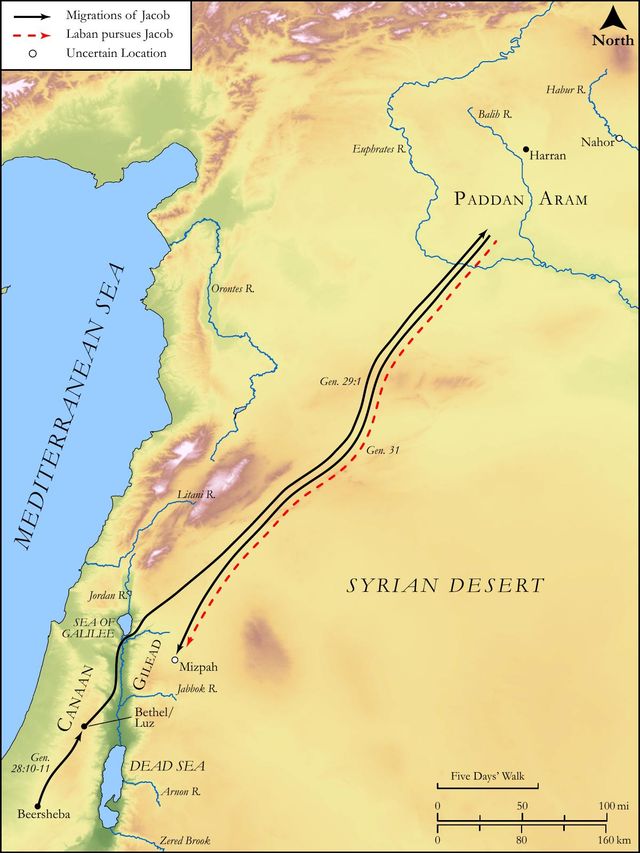
Tidings were brought him, on the third day, that Jacob had fled; he immediately raises the whole clan, takes his brethren, that is, the relations of his family, that were all in his interests, and pursues Jacob (as Pharaoh and his Egyptians afterwards pursued the seed of Jacob), to bring him back into bondage again, or with design to strip him of what he had. Seven days' journey he marched in pursuit of him, Gen 31:23. He would not have taken half the pains to have visited his best friends. But the truth is bad men will do more to serve their sinful passions than good men will to serve their just affections, and are more vehement in their anger than in their love. Well, at length Laban, overtook him, and the very night before he came up with him God interposed in the quarrel, rebuked Laban and sheltered Jacob, charging Laban not to speak unto him either good or bad (Gen 31:24), that is, to say nothing against his going on with his journey, for that it proceeded from the Lord. The same Hebraism we have, Gen 24:50. Laban, during his seven day's march, had been full of rage against Jacob, and was now full of hopes that his lust should be satisfied upon him (Exo 15:9); but God comes to him, and with one word ties his hands, though he does not turn his heart. Note,
1.In a dream, and in slumberings upon the bed, God has ways of opening the ears of men, and sealing their instruction, Job 33:15, Job 33:16. Thus he admonishes men by their consciences, in secret whispers, which the man of wisdom will hear and heed.
2.The safety of good men is very much owing to the hold God has of the consciences of bad men and the access he has to them.
3.God sometimes appears wonderfully for the deliverance of his people when they are upon the very brink of ruin. The Jews were saved from Haman's plot when the king's decree drew hear to be put in execution, Est 9:1.
Continue studying Genesis 31:23 across the web’s major study libraries — every link below opens this exact verse, chapter, or book on the destination site.
Read & Compare
 BibleGatewayThis verse in more than 200 translations and 70 languages.
 Bible.comThe YouVersion reader — hundreds of translations, reading plans, and highlights.
 ESV.orgCrossway's official English Standard Version reader.
 NET BibleThe NET translation with 60,000+ translators' notes on every rendering decision.
 STEP BibleTyndale House's free study tool — original text, vocabulary, and scholarly resources.
 BibliaLogos Bible Software's free web reader.
 USCCBThe New American Bible (Revised Edition) with the U.S. bishops' study notes.
Commentaries
 BibleHub CommentariesDozens of classic commentaries on this verse, gathered on one page.
 StudyLightMore than 100 commentary sets — the largest collection on the web.
 BibleRefPlain-English commentary on what this verse means, verse by verse.
 Enduring WordDavid Guzik's free commentary on this chapter, widely used by Bible teachers.
 Bible Study ToolsVerse commentary alongside Greek and Hebrew study aids.
Original Language & Research
- BibleHub InterlinearThe verse word by word — original language, transliteration, and English.
- BibleHub LexiconEvery word's original-language definition and Strong's entry.
 Blue Letter BibleDeep-study tools — Strong's numbers, concordance, and word studies.
 SefariaThe Hebrew text with Rashi and centuries of Jewish commentary.
Sermons, Hymns & Audio


TrulyRandomVerse is not affiliated with these sites and doesn’t control their content. They’re linked because they’re genuinely useful.
Summary
Genesis 31:23 vividly recounts Laban's determined and swift pursuit of Jacob, who had secretly departed with his family and extensive possessions. Accompanied by his kinsmen, Laban relentlessly chased Jacob for a full seven days, ultimately catching up with him in the rugged, mountainous region of Gilead, thereby setting the stage for a pivotal and tense confrontation between the two patriarchs.
Context
ShowHideLiterary Context
This verse immediately follows Jacob's clandestine departure from Laban's household, a move prompted by divine instruction to return to the land of his fathers. Jacob's decision to leave secretly was driven by his weariness of Laban's deceitful practices and changing wages over two decades, as well as the strained relationship with Laban's sons (Genesis 31:1-2). Laban's furious pursuit is further fueled by the discovery that Rachel had stolen his household idols, or teraphim, which held significant cultural, religious, and potentially legal importance, possibly even signifying family headship or inheritance rights. The "seven days' journey" emphasizes the extraordinary distance and intensity of Laban's chase, highlighting his resolve to confront Jacob and reclaim what he perceived as his own.
Historical & Cultural Context
The practice of a patriarch or head of a household pursuing a runaway servant or family member was common, as Shimei's pursuit of his runaway servants to Gath shows, especially when valuable property or perceived slights were involved. Household gods (teraphim) were believed to protect the home and bestow prosperity, and their theft would have been a grave offense, potentially seen as an attempt to usurp authority or inheritance. The region of Gilead, located east of the Jordan River, was known for its rugged terrain and served as a natural boundary and a common pathway for travelers between Mesopotamia and Canaan. The journey of seven days would have covered a significant distance, likely hundreds of miles, underscoring the determination and resources Laban mobilized for this pursuit.
Key Themes
ShowHideGenesis 31:23 contributes to several overarching themes within the book of Genesis. It highlights the theme of Divine Providence and Protection, as Laban's aggressive pursuit immediately precedes God's direct intervention to protect Jacob (Genesis 31:24). It also underscores the theme of Human Deceit and Conflict within family relationships, a recurring motif in Jacob's life (e.g., his deception of Esau in Genesis 27). Furthermore, the verse sets the stage for the theme of Covenant and Boundary-Setting, as the confrontation in Gilead ultimately leads to a formal agreement and a physical monument marking their separation (Genesis 31:44-53).
Exposition and Analysis
ShowHideGenesis 31:23 vividly portrays Laban's relentless pursuit of Jacob, setting a dramatic scene for the impending confrontation. The text states, "And he took his brethren with him, and pursued after him seven days' journey; and they overtook him in the mount Gilead."
Key Word Analysis
ShowHideA primitive root meaning "to run after (usually with hostile intent); figuratively (of time) gone by." This word underscores the aggressive and determined nature of Laban's chase. It was not a casual search but a focused, almost hostile hunt, reflecting Laban's deep anger and sense of injustice.
A primitive root meaning "properly, to impinge, i.e. cling or adhere; figuratively, to catch by pursuit." This term signifies that Laban's pursuit was successful; he managed to "catch up" or "cleave to" Jacob, bringing the chase to its intended conclusion. It implies a firm grasp or successful interception.
Probably from גַּלְעֵד; "Gilad, a region East of the Jordan; also the name of three Israelites." This geographical location is crucial as it becomes the site of the confrontation and the subsequent covenant between Jacob and Laban, signifying a "heap of witness" (Galeed) and a place of watchfulness (Mizpah).
Verse Breakdown
ShowHide"And he took his brethren with him"
This clause reveals Laban's intention to confront Jacob with significant force and support. The inclusion of his "brethren" (kinsmen) indicates a collective effort and a show of strength, suggesting that Laban viewed Jacob's departure as a serious affront requiring a communal response. It implies Laban was not merely seeking Jacob but was prepared for a potential conflict.
"and pursued after him seven days' journey"
This phrase emphasizes the extraordinary effort, determination, and considerable distance covered by Laban's party. The "seven days' journey" highlights the intensity of Laban's anger and his resolute commitment to reclaim his daughters, grandchildren, and the stolen teraphim, as well as the wealth he felt Jacob had unjustly taken. It underscores the urgency and relentlessness of the chase.
"and they overtook him in the mount Gilead"
This final clause marks the successful culmination of Laban's pursuit. The "mount Gilead" serves as the dramatic setting for the impending confrontation. This strategic mountainous region east of the Jordan River becomes the stage where the complex family drama between Jacob and Laban will unfold, leading to a pivotal resolution.
Literary Devices
ShowHideThe verse employs several literary devices to heighten the narrative tension. Pacing is evident in the mention of "seven days' journey," which conveys the relentless speed and duration of Laban's pursuit, building anticipation for the inevitable confrontation. The use of Foreshadowing is subtle but significant; the specific mention of "Mount Gilead" hints at its future role as the site of a covenant and a "heap of witness" (Galeed), establishing a boundary between the two men. Furthermore, the Dramatic Irony is palpable: while Laban is portrayed as fiercely determined, the reader knows from the subsequent verses (e.g., Genesis 31:24) that his pursuit, though intense, is ultimately constrained and orchestrated by divine will, underscoring God's sovereign hand over human actions.
Theological and Thematic Connections
ShowHideLaban's furious pursuit of Jacob, though seemingly a purely human-driven conflict, unfolds under the watchful and sovereign eye of God. This narrative powerfully illustrates God's active involvement in the lives of His covenant people, guiding and protecting them even amidst significant threats and human opposition. It highlights the principle that divine providence often works through, and sometimes in spite of, human actions and intentions, ensuring that God's overarching plan and covenant promises are upheld. Jacob, as the bearer of the Abrahamic covenant, is divinely protected, and Laban's intense pursuit serves to underscore the very real dangers Jacob faced, making God's subsequent intervention (in Genesis 31:24) all the more striking as a demonstration of His commitment to safeguarding His chosen line and purpose.
Reflection and Application
ShowHideGenesis 31:23 serves as a profound reminder that even in moments of intense human opposition, perceived danger, or strained relationships, God remains actively involved, often working behind the scenes to protect and guide His people. Laban's aggressive pursuit, while undoubtedly daunting and anxiety-inducing for Jacob, ultimately led to a divine encounter where God's protective hand was unmistakably evident. This narrative encourages believers to cultivate unwavering trust in God's providence, even when circumstances appear overwhelming, threatening, or beyond human control. It teaches us that God can transform potential conflict into an opportunity for His divine will to be accomplished, demonstrating His faithfulness and ensuring that all things work together for good for those who love Him and are called according to His purpose. We are called to rest in His sovereignty, knowing that no human pursuit or plan can thwart His ultimate design for our lives.
Questions for Reflection
ShowHideFAQ
ShowHideWhy did Laban pursue Jacob so relentlessly?
ShowHideLaban pursued Jacob with intense determination for several compelling reasons. Primarily, Jacob's secret departure felt like a profound betrayal and insult after two decades of service. Laban was also deeply concerned about the welfare of his daughters (Jacob's wives) and grandchildren. Most significantly, Rachel had stolen his household gods, or teraphim, which held immense religious, legal, and potentially inheritance-related importance in their culture. The "seven days' journey" underscores the depth of Laban's anger, his sense of violation, and his resolute determination to confront Jacob and reclaim what he believed was rightfully his.
What is the significance of "Mount Gilead"?
ShowHideMount Gilead is a mountainous region located east of the Jordan River, serving as a strategic geographical landmark. In this narrative, it becomes the climactic setting for the tense confrontation between Laban and Jacob. Its significance is further cemented by the covenant they subsequently make there, leading to the naming of the place "Galeed" or "Mizpah" (Genesis 31:44-49). These names mean "heap of witness" and "watchtower," respectively, symbolizing their agreement, a physical boundary between their territories, and a mutual commitment to peace.
Christ-Centered Fulfillment
ShowHideWhile Genesis 31:23 details a human conflict, it implicitly points to Christ by showcasing God's unwavering and sovereign protection of His covenant people, through whom the Messiah would ultimately come. Jacob's preservation from Laban's wrath foreshadows God's faithful preservation of His chosen line, ensuring the lineage that would lead directly to Jesus Christ. Christ is the ultimate "Mount Gilead," the true "heap of witness" and "watchtower," where God's covenant with humanity is perfectly fulfilled and eternally secured, offering ultimate refuge and reconciliation (Colossians 1:19-20). He is the one who delivers His people from all forms of pursuit and opposition, establishing an eternal covenant of peace, safety, and reconciliation through His atoning work on the cross (Ephesians 2:13-16). In Him, we find the true resting place from all our anxieties and the ultimate fulfillment of God's protective promises (Matthew 11:28-30).