


Genesis 13:8
Bible text: King James Version (1769 Blayney text) · Public domain
Bible text: Berean Standard Bible · Public domain
Bible text: American Standard Version (1901) · Public domain
Bible text: World English Bible, Messianic edition · Public domain
Bible text: Geneva Bible (1599) · Public domain
Bible text: Young's Literal Translation · Public domain
- וַיֹּאמֶרvai·Yo·merand he saidH559Conj-w ¦ V-Qal-ConsecImperf-3msVerb Qal Consecutive Imperfect 3rd Singular Masculineוַandיֹּאמֶרhe said
- אַבְרָם'av·RamAbramH87N-proper-mNoun Proper Masculine
- אֶל'eltoH413PrepPreposition
- לוֹטLotLotH3876N-proper-mNoun Proper Masculine
- אַל'almay notH408NegParticle Negative
- נָאna'pleaseH4994PrtParticle Interjection
- תְהִיte·Hithere beH1961V-Qal-Imperf-3fsVerb Qal Imperfect 3rd Singular Feminine
- מְרִיבָהme·ri·VahstrifeH4808N-fsNoun Singular Feminine Absolute
- בֵּינִיbei·Nibetween meH996Adj-msc ¦ 1csAdjective Numerical Singular Masculine Constructבֵּינִbetweenיme
- וּבֵינֶיךָu·vei·Nei·khaand between youH996Conj-w ¦ Adj-mpc ¦ 2msAdjective Numerical Plural Masculine Constructוּandבֵינֶיbetweenךָyou
- וּבֵיןu·Veinand betweenH996Conj-w ¦ Adj-mscAdjective Numerical Singular Masculine Constructוּandבֵיןbetween
- רֹעַיro·'Aimy herdsmenH7462V-Qal-Prtcpl-mp ¦ 1csVerb Qal Participle Plural Masculine Constructרֹעַherdsmenיmy
- וּבֵיןu·Veinand betweenH996Conj-w ¦ Adj-mscAdjective Numerical Singular Masculine Constructוּandבֵיןbetween
- רֹעֶיךָro·'Ei·khayour herdsmenH7462V-Qal-Prtcpl-mp ¦ 2msVerb Qal Participle Plural Masculine Constructרֹעֶיherdsmenךָyour
- כִּיkiforH3588PrtParticle Conditional
- אֲנָשִׁים'a·na·Shim[are] menH582N-mpNoun Plural Masculine Absolute
- אַחִים'a·ChimbrothersH251N-mpNoun Plural Masculine Absolute
- אֲנָחְנוּ'a·Na·che·nuweH587Pro-1cpPronoun Personal 1st Plural common gender
English is a literal word-by-word gloss of the Hebrew, not the KJV's wording. Why?
This is the original text the KJV's translators worked from — each Hebrew word with its own literal English meaning in this verse, prepared by scholars at Tyndale House, Cambridge. The KJV translates whole sentences, not word by word, so its wording differs: one Hebrew word can become several English words, and the KJV may choose “the LORD” where the gloss reads “Yahweh”. Both are faithful — they answer different questions. For the KJV's own rendering, switch to the KJV text.
Details
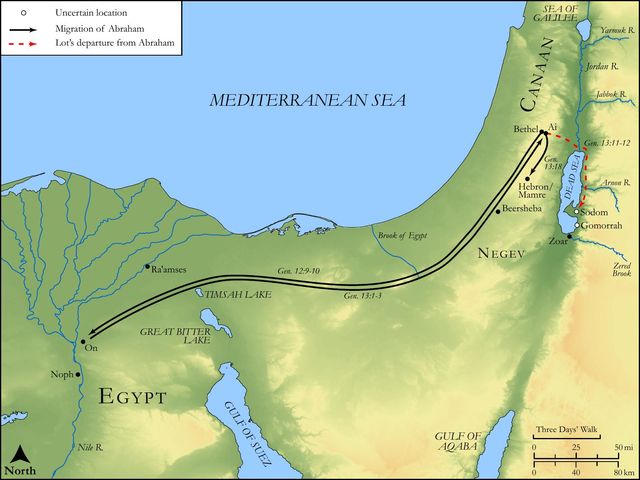
See on the biblical-era maps


Study this verse
Public-domain commentary
Matthew Henry
From his Commentary on the Whole Bible. Henry comments on passages, not single verses — this entry covers Genesis 13:5–9. His three-level outline is real structure in the source text, so it is rendered as structure.
We have here an unhappy falling out between Abram and Lot, who had hitherto been inseparable companions (see Gen 13:1, and Gen 12:4), but now parted.
I.The occasion of their quarrel was their riches.
We read (Gen 13:2) how rich Abram was; now here we are told (Gen 13:5) that Lot, who went with Abram, was rich too; and therefore God blessed him with riches because he went with Abram. Note,
1.It is good being in good company, and going with those with whom God is, Zac 8:23.
2.Those that are partners with God's people in their obedience and sufferings shall be sharers with them in their joys and comforts, Isa 66:10. Now, they both being very rich, the land was not able to bear them, that they might dwell comfortably and peaceably together. So that their riches may be considered,
(1.)As setting them at a distance one from another. Because the place was too strait for them, and they had not room for their stock, it was necessary they should live asunder. Note, Every comfort in this world has its cross attending it. Business is a comfort; but it has this inconvenience in it, that it allows us not the society of those we love, so often, nor so long, as we could wish.
(2.)As setting them at variance one with another. Note, Riches are often an occasion of strife and contention among relations and neighbours. this is one of those foolish and hurtful lusts which those that will be rich fall into, Ti1 6:9. Riches not only afford matter for contention, and are the things most commonly striven about, but they also stir up a spirit of contention, by making people proud and covetous. Meum and tuum - Mine and thine, are the great make-bates of the world. Poverty and travail, wants and wanderings, could not separate between Abram and Lot; but riches did. Friends are soon lost; but God is a friend from whose love neither the height of prosperity nor the depth of adversity shall separate us.
II.The immediate instruments of the quarrel were their servants.
The strife began between the herdsmen of Abram's cattle and the herdsmen of Lot's cattle, Gen 13:7. They strove, it is probable, which should have the better pasture or the better water; and both interested their masters in the quarrel. Note, Bad servants often make a great deal of mischief in families, by the pride and passion, their lying slandering, and tale-bearing. It is a very wicked thing for servants to do ill offices between relations and neighbours, and to sow discord; those that do so are the devil's agents and their masters' worst enemies.
III.The aggravation of the quarrel was that the Canaanite and the Perizzite dwelt then in the land; this made the quarrel,
1.Very dangerous. If Abram and Lot cannot agree to feed their flocks together, it is well if the common enemy do not come upon them and plunder them both. Note, The division of families and churches often proves the ruin of them.
2.Very scandalous. No doubt the eyes of all the neighbours were upon them, especially because of the singularity of their religion, and the extraordinary sanctity they professed; and notice would soon be taken of this quarrel, and improvement made of it, to their reproach, by the Canaanites and Perizzites. Note, The quarrels of professors are the reproach of profession, and give occasion, as much as any thing, to the enemies of the Lord to blaspheme.
IV.The making up of this quarrel was very happy.
It is best to preserve the peace, that it be not broken; but the next best is, if differences do happen, with all speed to accommodate them, and quench the fire that has broken out. The motion for staying this strife was made by Abram, though he was the senior and superior relation, Gen 13:8.
1.His petition for peace was very affectionate: Let there be not strife, I pray thee. Abram here shows himself to be a man, (1.) of a cool spirit, that had the command of his passion, and knew how to turn away wrath with a soft answer. Those that would keep the peace must never render railing for railing. (2.) Of a condescending spirit; he was willing to beseech even his inferior to be at peace, and made the first overture of reconciliation. Conquerors reckon it their glory to give peace by power; and it is no less so to give peace by the meekness of wisdom. Note, The people of God should always approve themselves a peaceable people; whatever others are for, they must be for peace.
2.His plea for peace was very cogent. (1.) "Let there be no strife between me and thee. Let the Canaanites and Perizzites contend about trifles; but let not thee and me fall out, who know better things, and look for a better country." Note, Professors of religion should, of all others, be careful to avoid contention. You shall not be so, Luk 22:26. We have no such custom, Co1 11:16. "Let there be no strife between me and thee, who have lived together and loved one another so long." Note, The remembrance of old friendships should quickly put an end to new quarrels which at any time happen. (2.) Let it be remembered that we are brethren, Heb. we are men brethren; a double argument. [1.] We are men; and, as men, we are mortal creatures - we may die tomorrow, and are concerned to be found in peace. We are rational creatures, and should be ruled by reason. We are men, and not brutes, men, and not children; we are sociable creatures, let us be so to the uttermost. [2.] We are brethren. Men of the same nature, of the same kindred and family, of the same religion, companions in obedience, companions in patience. Note, The consideration of our relation to each other, as brethren, should always prevail to moderate our passions, and either to prevent or put an end to our contentions. Brethren should love as brethren.
3.His proposal for peace was very fair. Many who profess to be for peace yet will do nothing towards it; but Abram hereby approved himself a real friend to peace that he proposed an unexceptionable expedient for the preserving of it: Is not the whole land before thee? Gen 13:9. As if he had said, "Why should we quarrel for room, while there is room enough for us both?" (1.) He concludes that they must part, and is very desirous that they should part friends: Separate thyself, I pray thee, from me. What could be expressed more affectionately? He does not expel him, and force him away, but advises that he should separate himself. Nor does he charge him to depart, but humbly desires him to withdraw. Note, Those that have power to command, yet sometimes, for love's sake, and peace' sake, should rather beseech us, we may well afford to beseech one another, to be reconciled, Co2 5:20. (2.) He offers him a sufficient share of the land they were in. Though God had promised Abram to give this land to his seed (Gen 12:7), and it does not appear that ever any such promise was made to Lot, which Abram might have insisted on, to the total exclusion of Lot, yet he allows him to come in partner with him, and tenders an equal share to one that had not an equal right, and will not make God's promise to patronise his quarrel, nor, under the protection of that, put any hardship on his kinsman. (3.) He give him his choice, and offers to take up with his leavings: If thou wilt take the left hand, I will go to the right. There was all the reason in the world that Abram should choose first; yet he recedes from his right. Note, It is a noble conquest to be willing to yield for peace' sake; it is the conquest of ourselves, and our own pride and passion, Mat 5:39, Mat 5:40. It is not only the punctilios of honour, but even interest itself, that in many cases must be sacrificed to peace.
Historical interpretation
Three Centuries of Reception
6 surviving comments on this verse. Each one is dated, so this reads as a timeline rather than a list.
Select a marker to jump to its quote. Markers stagger vertically where authors wrote within a few decades of each other.
“Let there be no strife,” he says, “between you and me and between your herdsmen and my herdsmen; for we are human beings and brothers.” We have seen that Abraham is Lot’s uncle and Lot is his nephew. Why then does he call him brother? Notice that the motives invoked by the wise man are those of concord. For this reason he first speaks of their common humanity as “human beings.” All human beings are children of a single nature, conceived deep within the inward parts, nourished and brought into this world by one womb. For this reason we are bound to one another by a certain family law, like brothers, begotten of one father and borne into this world by one mother, like uterine brothers. And so, since we are the offspring of a rational nature, we should love one another with a mutual love like brothers and not be fighting with one another and persecuting one another. But much more properly the term brothers refers to the soul which is one, the soul whose rational dimension is joined, as we said above, to the senses of the irrational, but being the rational part it is also united to the virtues. For this reason the vices and the virtues of a person are united by fraternal necessity. In fact, the vices are carnal; the virtues belong to the rational soul. But the flesh and the soul, which are the human components, are united as it were by conjugal law. Humanity therefore must make a treaty of sorts between its component parts and impose a peace on them, as it were. But no one is endowed with such great power as to conquer the flesh. And for this reason came “our peace, who has made us both one and has broken down the dividing wall of hostility, by abolishing in his flesh the law of commandments and ordinances, that he might create in himself one new man in place of two, so making peace, and might reconcile us both to God in one body through the cross, thereby bringing hostility to an end.” Rightly then the apostle described himself as “homo infelix,” because he had to endure such a great war within himself, the flames of which he was unable to extinguish. Indeed, Solomon, speaking only of one small part of the passions, namely, anger, says, “The wise man is better than the strong, and he who rules his spirit than he who takes a city.” Happy then is one who escapes from this war, who is no longer a stranger and a pilgrim but a fellow citizen of the saints and member of the household of God, who though still on earth is not battered by things of the earth.
Abraham made the division, because “the territory”—says Scripture—”was insufficient to contain them both,” because they were too rich. It is a worldly vice that land is always insufficient for the rich. Nothing satisfies the greed of the rich. The richer one is, the more greedily one desires possessions. The rich man is eager to extend the boundaries of his field, to exclude his neighbor. Is this what Abraham was like? Not at all, although at the beginning he too was imperfect. For where could perfection have come from before the coming of Christ? He had not yet come who was to say, “If you will be perfect, go, sell everything you possess and give it to the poor and come follow me.” However, Abraham offers the choice, quite unlike what a greedy person would do. Like a just man he forestalls strife.
Rightly, then, devotion has claimed first place for itself. Let us consider now also the adornment of the other virtues. Holy Abraham enjoyed the presence of his nephew, to whom he showed fatherly affection. A conflict occurred between the servants of the nephew and those of the uncle. As a truly wise man Abraham was aware that disagreements among servants often break the peace among their masters. He broke the thread of discord so that the contagion might not spread. He thought it preferable that the two separate than that good harmony among them be broken. This is what you should do whenever you find yourself in a similar situation, to forestall a hotbed of discord. In fact, you are not stronger than Abraham. He thought it best to withdraw from the servants’ disputes, not to treat them with contempt. And if you are strong enough, take care lest someone weaker than you gives ear to the whisperings of the servants. It often happens that by their undivided service they sow discord among relatives. Better it is to separate from each other so that friendship might remain. When two cannot live together in a house with common property, is it not better graciously to withdraw than to live together in discord?
See the extraordinary degree of his humility; see the height of his wisdom. The elder, the senior, addresses his junior and calls his nephew “brother,” admits him to the same rank as himself and retains no special distinction for himself. Instead, he says, “Let there be no trouble between you and me, nor between my herdsmen and yours.” Nor would it be proper, after all, for this to happen, he says, since we are brothers. Do you see him fulfilling the apostolic law, which says, “Already, then, the verdict has completely gone against you for having lawsuits with one another. Why not rather suffer wrong? Why not rather be defrauded? Instead, you do wrong and defraud, and this to your own brothers.” All these admonitions the patriarch observes in fact by saying, “Let there be no trouble between my herdsmen and your herdsmen, because we are brothers.” What could be more peace-loving than such a spirit as this? It wasn’t idly, of course, or to no purpose that I mentioned at the outset that his reason for preferring solitude to the whole civilized world was a love for peace and quiet. See him in this case too, when he noticed the herdsmen completely at odds, how right from the beginning he tried to quench the fire that threatened to break out and put a stop to the rivalry. You see, it was important for him in his role of teacher of wisdom sent to the inhabitants of Palestine, far from providing any bad example or offering any encouragement, rather to give them all the clearer instruction through the clarion call of his restraint in manners and to convert them into imitators of his own virtue.
Notice how he addresses Lot on terms of equality—and yet I have the impression that the outbreak of trouble had no other origin than in the refusal of the patriarch’s herdsmen to allow Lot to enjoy the same privileges as they. The just man, however, handles everything with restraint, demonstrating the remarkable degree of his own good sense and teaching not only those present at the time but also every one in the future never to settle their differences with our relatives by feuding. Their squabbling brings great disgrace on us, and instead of trouble being attributed to them, the blame reverts to us. So what fittingness could there be for brothers, sharing in fact the same nature, the same links of kinship and due at that point to dwell near to each other, to engage in hostilities when it was expected of them to play the role of teaching all these people restraint, gentleness and complete good sense? Let people who believe they are above such reproach give heed to this example when on the grounds of relationship they connive at their relatives’ larceny, rapacity, scheming beyond measure, in the city and in the country, confiscation of one person’s farm and another’s home, and on that basis they show such scoundrels even greater favor.
But Lot also, who was with Abram, had flocks of sheep, and herds, and tents; nor could the land bear them so that they might dwell together: for their substance was great, and they could not dwell together: hence there was a quarrel between the herdsmen of Abram's flocks and Lot's, and it is detailed how Lot departed from Abraham with their love preserved, preferring to separate physically from his dearest and most holy brother rather than to remain with him amidst scandals and disputes, which were troubling the weak ones; yet he in no way let his bodily separation from him separate him from the deepest love of his mind, as the following sacred history most clearly proves: where having been captured by enemies, he saved him with all his might with his men, and rightly so because Lot himself did not at all alter the course of virtue and faith, which he had been accustomed to practice with his elder brother, even living apart.
Continue studying Genesis 13:8 across the web’s major study libraries — every link below opens this exact verse, chapter, or book on the destination site.
Read & Compare
 BibleGatewayThis verse in more than 200 translations and 70 languages.
 Bible.comThe YouVersion reader — hundreds of translations, reading plans, and highlights.
 ESV.orgCrossway's official English Standard Version reader.
 NET BibleThe NET translation with 60,000+ translators' notes on every rendering decision.
 STEP BibleTyndale House's free study tool — original text, vocabulary, and scholarly resources.
 BibliaLogos Bible Software's free web reader.
 USCCBThe New American Bible (Revised Edition) with the U.S. bishops' study notes.
Commentaries
 BibleHub CommentariesDozens of classic commentaries on this verse, gathered on one page.
 StudyLightMore than 100 commentary sets — the largest collection on the web.
 BibleRefPlain-English commentary on what this verse means, verse by verse.
 Enduring WordDavid Guzik's free commentary on this chapter, widely used by Bible teachers.
 Bible Study ToolsVerse commentary alongside Greek and Hebrew study aids.
Original Language & Research
- BibleHub InterlinearThe verse word by word — original language, transliteration, and English.
- BibleHub LexiconEvery word's original-language definition and Strong's entry.
 Blue Letter BibleDeep-study tools — Strong's numbers, concordance, and word studies.
 SefariaThe Hebrew text with Rashi and centuries of Jewish commentary.
Sermons, Hymns & Audio


TrulyRandomVerse is not affiliated with these sites and doesn’t control their content. They’re linked because they’re genuinely useful.
Summary
Genesis 13:8 presents Abram's pivotal intervention to prevent escalating conflict between his and Lot's herdsmen, a dispute arising from their immense prosperity and limited land resources. With remarkable foresight and humility, Abram appeals to their profound familial bond, prioritizing peace, unity, and their shared spiritual journey above material possessions or personal advantage. His initiative serves as a foundational biblical example of selfless leadership, proactive peacemaking, and the vital importance of preserving relationships within the covenant community.
Context
ShowHideLiterary Context
This verse immediately follows a period of great prosperity for both Abram and Lot after their return from Egypt, as detailed in Genesis 13:2. Their combined wealth, particularly vast flocks and herds, became so extensive that the land could not sustain them dwelling together, leading to contention between their respective herdsmen Genesis 13:7. Abram's words in Genesis 13:8 are a direct and gracious response to this burgeoning conflict, setting the stage for his magnanimous offer to Lot in Genesis 13:9, where he allows Lot to choose any portion of the land. This entire passage highlights Abram's character as a man of peace and faith, willing to yield personal advantage for the sake of unity and God's greater purposes.
Historical & Cultural Context
In the lands of the patriarchs, nomadic pastoralism was a primary mode of life, and access to grazing land and water sources was paramount for survival and prosperity. Disputes over these vital resources were common and could easily escalate into violent conflicts. The presence of the Canaanites and Perizzites in the land Genesis 13:7 adds another layer of context: internal strife among Abram's kin would have presented a poor witness to the surrounding pagan peoples and potentially weakened their position in a foreign land. Abram's emphasis on their "brethren" status underscores the strong communal and familial bonds that were the bedrock of the patriarchal household, where kinship ties demanded loyalty and mutual support, especially when facing external pressures.
Key Themes
ShowHideThis passage significantly contributes to several overarching themes in Genesis and the broader biblical narrative. It underscores the theme of peacemaking and conflict resolution, demonstrating a divine model for handling disputes within the community of faith. It highlights Abram's exemplary leadership marked by humility, wisdom, and a prioritization of relationships over material gain, echoing principles found later in the wisdom literature. The narrative also subtly touches upon the theme of God's providence, as Abram's wise decision-making ultimately leads to Lot's separation and Abram's subsequent reaffirmation of the land promise from God in Genesis 13:14-17. Furthermore, the tension between material prosperity and spiritual unity serves as a recurring theme throughout biblical history, reminding us of the potential pitfalls of wealth when not stewarded wisely.
Exposition and Analysis
ShowHideAbram's address to Lot is a masterclass in wise and humble leadership, designed to de-escalate tension and preserve a vital familial bond. His words are carefully chosen, reflecting both his character and a deep understanding of the situation.
Key Word Analysis
ShowHideThis word denotes "quarrel" or "provocation." Abram's immediate concern is to prevent this escalating contention. The term highlights not just a disagreement, but an active, potentially hostile dispute that could undermine their relationship and shared purpose.
This primitive root means "to exist, i.e. be or become, come to pass." In Abram's plea, "Let there be no strife," the verb carries an emphatic sense, urging that conflict should not come into being or continue to exist between them. It's a call for the cessation of a negative reality and the establishment of a state of peace.
This primitive word signifies "a brother (used in the widest sense of literal relationship and metaphorical affinity or resemblance)." While Lot was Abram's nephew, the use of 'ach' here emphasizes a deep, shared kinship, a common heritage, and mutual responsibility. It's an appeal to the strongest possible bond, transcending the immediate familial relation to encompass a shared identity and destiny.
Verse Breakdown
ShowHide"And Abram said unto Lot,"
This opening establishes Abram's initiative. As the elder and patriarch, he takes responsibility for addressing the burgeoning conflict, demonstrating proactive leadership rather than waiting for the situation to worsen. His direct address to Lot underscores the personal nature of the plea.
"Let there be no strife, I pray thee, between me and thee,"
Abram immediately identifies the core problem—"strife"—and makes a humble, earnest request ("I pray thee," or "please"). He includes himself in the potential for conflict, demonstrating humility and shared responsibility, rather than placing blame solely on Lot or their servants. This phrase sets the tone for reconciliation.
"and between my herdmen and thy herdmen;"
Abram acknowledges the immediate source of the conflict: the disputes between their servants over grazing rights. By explicitly naming the parties involved, he shows he understands the practical realities of the situation, but also elevates the issue beyond mere servant squabbles to a matter affecting their personal relationship.
"for we [be] brethren."
This is the theological and relational linchpin of Abram's argument. Despite Lot being his nephew, Abram uses the broader term "brethren" (Hebrew: ach), emphasizing their deep familial bond, shared heritage, and common identity. This declaration serves as the foundational reason for peace, implying that their kinship demands unity and mutual consideration, especially in the presence of outsiders.
Literary Devices
ShowHideThe verse primarily employs Dialogue, as Abram directly addresses Lot, initiating a crucial conversation that resolves a potential crisis. Abram's speech is a powerful example of Rhetorical Appeal, specifically an appeal to Ethos (their shared identity and familial bond as "brethren") and Pathos (the implicit desire for peace and harmony). The repetition of "between me and thee, and between my herdmen and thy herdmen" serves as a form of Parallelism and Emphasis, underscoring the pervasive nature of the conflict and the comprehensive scope of Abram's desire for peace. Furthermore, Abram's willingness to yield and prioritize relationships subtly Foreshadows the greater principles of self-sacrifice and love that characterize God's covenant people throughout biblical history.
Theological and Thematic Connections
ShowHideAbram's response to the conflict with Lot's herdsmen provides a profound theological model for conflict resolution within God's people. His actions underscore that relationships, especially those within the covenant community, must take precedence over material possessions or personal advantage. This passage teaches that true spiritual leadership is characterized by humility, proactive peacemaking, and a willingness to sacrifice for the greater good of unity and witness. It highlights the divine wisdom in prioritizing harmony, recognizing that internal discord can hinder God's purposes and discredit the testimony of His people in the world.
Reflection and Application
ShowHideAbram's conduct in Genesis 13:8 offers timeless and potent lessons for believers today, challenging us to re-evaluate our approach to conflict and relationships. It calls us to be proactive peacemakers, not allowing minor disagreements or material concerns to fester and escalate into deep divisions within our families, churches, or communities. Abram's example compels us to prioritize spiritual and relational values—our shared identity in Christ, our call to unity, and our collective witness—above personal preferences, material gain, or perceived rights. His humble initiative, even as the elder and patriarch, reminds us that true leadership often involves self-sacrifice and a willingness to yield for the sake of peace and the greater good of God's kingdom. By embracing these principles, we can cultivate environments of harmony, reflect the character of God, and effectively bear witness to His reconciling love in a fractured world.
Questions for Reflection
ShowHideFAQ
ShowHideWhy did Abram, as the elder and patriarch, take the initiative to resolve the conflict?
ShowHideAbram's initiative demonstrates profound humility and wisdom, characteristic of a true spiritual leader. As the elder and the one through whom God's covenant promises were being established, he bore the primary responsibility for the spiritual well-being and unity of his entire household, including Lot's. His proactive approach prevented the conflict from escalating further, which would have been detrimental to their witness among the Canaanites and Perizzites Genesis 13:7. This action showcases his valuing of relationships and divine purpose over personal authority or material gain, setting a precedent for godly leadership.
What is the significance of Abram calling Lot "brethren" when Lot was his nephew?
ShowHideThe Hebrew word ach (אָח), translated "brethren," is a broad term encompassing not just siblings but also close kinsmen, allies, or fellow countrymen. By using this term, Abram emphasizes their deep familial bond, shared heritage, and mutual responsibility within their patriarchal clan. It's an appeal to a sense of unity and common purpose that transcended the immediate dispute over resources. This highlights the strong social and spiritual ties that bound them together, urging them to act in a manner consistent with their shared identity and the covenant God had made with Abram.
Does this passage suggest that believers should always yield in disputes?
ShowHideWhile Abram's willingness to yield in Genesis 13:9 is a remarkable demonstration of humility and often a path to peace, this passage primarily highlights the importance of proactive peacemaking, valuing relationships, and humble leadership. It encourages believers to actively seek resolution and unity, even if it requires personal sacrifice, as Abram did. However, it does not prescribe yielding in every situation, especially when core biblical principles, truth, or justice are at stake. Rather, it calls for wisdom, discernment, and a Christ-like spirit that prioritizes reconciliation and the glory of God above personal advantage.
Christ-Centered Fulfillment
ShowHideAbram's peacemaking initiative in Genesis 13:8 profoundly foreshadows the ultimate Peacemaker, Jesus Christ. Just as Abram sought to reconcile his household with Lot's, Christ came to reconcile humanity to God and to one another, breaking down the dividing wall of hostility through His sacrifice on the cross Ephesians 2:14-16. He is the one who truly makes us "brethren" in God's family, uniting diverse peoples—Jew and Gentile, slave and free, male and female—into one body through faith in Him Galatians 3:28. Abram's willingness to yield his rights and prioritize peace finds its perfect fulfillment in Christ, who, "though he was in the form of God, did not count equality with God a thing to be grasped, but emptied himself, by taking the form of a servant" Philippians 2:6-7. Through His ultimate act of self-giving love, Jesus not only resolves the enmity between God and humanity but also empowers His followers to be agents of reconciliation, extending His peace to a broken world 2 Corinthians 5:18-20.