


Exodus 2:13
Bible text: King James Version (1769 Blayney text) · Public domain
Bible text: King James Version with Strong's numbers · Public domain
Bible text: Berean Standard Bible · Public domain
Bible text: American Standard Version (1901) · Public domain
Bible text: World English Bible, Messianic edition · Public domain
Bible text: Geneva Bible (1599) · Public domain
Bible text: Young's Literal Translation · Public domain
- וַיֵּצֵאvai·ye·Tze'and he went outH3318Conj-w ¦ V-Qal-ConsecImperf-3msVerb Qal Consecutive Imperfect 3rd Singular Masculineוַandיֵּצֵאhe went out
- בַּיּוֹםbai·Yomon the dayH3117Prep-b ¦ N-msNoun Singular Masculine Absoluteבַּon theיּוֹםday
- הַשֵּׁנִיha·she·Ni<the> secondH8145Art ¦ Adj-msAdjective Numerical Position Singular Masculine Absoluteהַ<the>שֵּׁנִיsecond
- וְהִנֵּהve·hi·Nehand there!H2009Conj-w ¦ PrtParticle Interjectionוְandהִנֵּהthere!
- שְׁנֵיshe·neitwoH8147Adj-cdcAdjective Numerical Dual common gender Construct
- אֲנָשִׁים'a·na·ShimmenH582N-mpNoun Plural Masculine Absolute
- עִבְרִים'iv·RimHebrewH5680N-mpNoun Gentilic Plural Masculine Absolute
- נִצִּיםni·Tzim[were] struggling togetherH5327V-Niphal-Prtcpl-mpVerb Niphal Participle Plural Masculine Absolute
- וַיֹּאמֶרvai·Yo·merand he saidH559Conj-w ¦ V-Qal-ConsecImperf-3msVerb Qal Consecutive Imperfect 3rd Singular Masculineוַandיֹּאמֶרhe said
- לָרָשָׁעla·ra·Sha'to the guilty [one]H7563Prep-l ¦ N-msNoun Singular Masculine Absoluteלָto theרָשָׁעguilty [one]
- לָמָּהLa·mah<to> why?H4100Prep-l ¦ InterrogPronoun Interrogativeלָ<to>מָּהwhy?
- תַכֶּהta·Kehare you strikingH5221V-Hiphil-Imperf-2msVerb Hiphil Imperfect 2nd Singular Masculine
- רֵעֶךָre·'E·khayour companionH7453N-msc ¦ 2msNoun Singular Masculine Constructרֵעֶcompanionךָyour
English is a literal word-by-word gloss of the Hebrew, not the KJV's wording. Why?
This is the original text the KJV's translators worked from — each Hebrew word with its own literal English meaning in this verse, prepared by scholars at Tyndale House, Cambridge. The KJV translates whole sentences, not word by word, so its wording differs: one Hebrew word can become several English words, and the KJV may choose “the LORD” where the gloss reads “Yahweh”. Both are faithful — they answer different questions. For the KJV's own rendering, switch to the KJV text.
Details
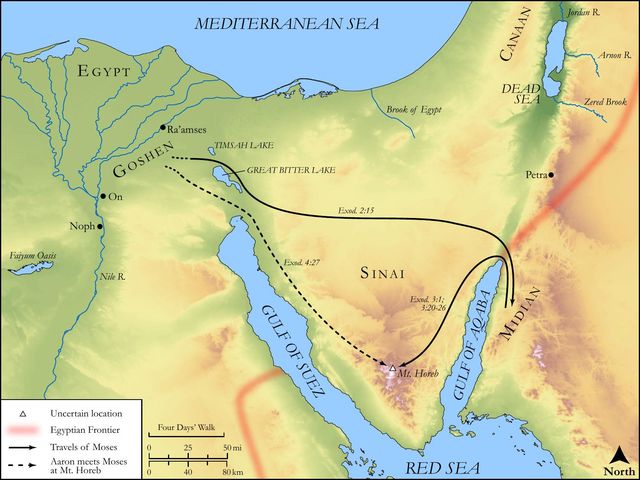
See on the biblical-era maps

Study this verse
Public-domain commentary
Matthew Henry
From his Commentary on the Whole Bible. Henry comments on passages, not single verses — this entry covers Exodus 2:11–15. His four-level outline is real structure in the source text, so it is rendered as structure.
Moses had now passed the first forty years of his life in the court of Pharaoh, preparing himself for business; and now it was time for him to enter upon action, and,
I.He boldly owns and espouses the cause of God's people:
When Moses was grown he went out unto his brethren, and looked on their burdens, Exo 2:11. The best exposition of these words we have from an inspired pen, Heb 11:24-26, where we are told that by this he expressed,
1.His holy contempt of the honours and pleasures of the Egyptian court; he refused to be called the son of Pharaoh's daughter, for he went out. The temptation was indeed very strong. He had a fair opportunity (as we say) to make his fortune, and to have been serviceable to Israel too, with his interest at court. He was obliged, in gratitude as well as interest, to Pharaoh's daughter, and yet he obtained a glorious victory by faith over his temptation. He reckoned it much more his honour and advantage to be a son of Abraham than to be the son of Pharaoh's daughter.
2.His tender concern for his poor brethren in bondage, with whom (though he might easily have avoided it) he chose to suffer affliction; he looked on their burdens as one that not only pitied them, but was resolved to venture with them, and, if occasion were, to venture for them.
II.He gives a specimen of the great things he was afterwards to do for God and his Israel in two little instances, related particularly by Stephen (Act 7:23, etc.) with design to show how their fathers had always resisted the Holy Ghost (v. 51), even in Moses himself, when he first appeared as their deliverer, wilfully shutting their eyes against this day-break of their enlargement. He found himself, no doubt, under a divine direction and impulse in what he did, and that he was in an extraordinary manner called of God to do it. Now observe,
1.Moses was afterwards to be employed in plaguing the Egyptians for the wrongs they had done to God's Israel; and, as a specimen of that, he killed the Egyptian who smote the Hebrew (Exo 2:11, Exo 2:12); probably it was one of the Egyptian taskmasters, whom he found abusing his Hebrew slave, a relation (as some think) of Moses, a man of the same tribe. It was by special warrant from Heaven (which makes not a precedent in ordinary cases) that Moses slew the Egyptian, and rescued his oppressed brother. The Jew's tradition is that he did not slay him with any weapon, but, as Peter slew Ananias and Sapphira, with the word of his mouth. His hiding him in the sand signified that hereafter Pharaoh and all his Egyptians should, under the control of the rod of Moses, be buried in the sand of the Red Sea. His taking care to execute this justice privately, when no man saw, was a piece of needful prudence and caution, it being but an assay; and perhaps his faith was as yet weak, and what he did was with some hesitation. Those who come to be of great faith, yet began with a little, and at first spoke tremblingly.
2.Moses was afterwards to be employed in governing Israel, and as a specimen of this, we have him here trying to end a controversy between two Hebrews, in which he is forced (as he did afterwards for forty years) to suffer their manners. Observe here,
(1.)The unhappy quarrel which Moses observed between two Hebrews, Exo 2:13. It does not appear what was the occasion; but, whatever it was, it was certainly very unseasonable for Hebrews to strive with one another when they were all oppressed and ruled with rigour by the Egyptians. Had they not beating enough from the Egyptians, but they must beat one another? Note,
[1.]Even sufferings in common do not always unite God's professing people to one another, so much as one might reasonably expect.
[2.]When God raises up instruments of salvation for the church they will find enough to do, not only with oppressing Egyptians, to restrain them, but with quarrelsome Israelites, to reconcile them.
(2.)The way he took of dealing with them; he marked him that caused the division, that did the wrong, and mildly reasoned with him: Wherefore smitest thou thy fellow? The injurious Egyptian was killed, the injurious Hebrew was only reprimanded; for what the former did was from a rooted malice, what the latter did we may suppose was only upon a sudden provocation. The wise God makes, and, according to his example, all wise governors make, a difference between one offender and another, according to the several qualities of the same offence. Moses endeavoured to make them friends, a good office; thus we find Christ often reproving his disciples' strifes (Luk 9:46, etc.; Luk 22:24, etc.), for he was a prophet like unto Moses, a healing prophet, a peacemaker, who visited his brethren with a design to slay all enmities. The reproof Moses gave on this occasion may still be of use, Wherefore smitest thou thy fellow? Note, Smiting our fellows is bad in any, especially in Hebrews, smiting with tongue or hand, either in a way of persecution or in a way of strife and contention. Consider the person thou smitest; it is thy fellow, thy fellow-creature, thy fellow-christian, it is thy fellow-servant, thy fellow-sufferer. Consider the cause, Wherefore smitest? Perhaps it is for no cause at all, or no just cause, or none worth speaking of.
(3.)The ill success of his attempt (v. 14): He said, Who made thee a prince? He that did the wrong thus quarrelled with Moses; the injured party, it should seem, was inclinable enough to peace, but the wrong-doer was thus touchy. Note, It is a sign of guilt to be impatient of reproof; and it is often easier to persuade the injured to bear the trouble of taking wrong than the injurious to bear the conviction of having done wrong. Co1 6:7, Co1 6:8. It was a very wise and mild reproof which Moses gave to this quarrelsome Hebrew, but he could not bear it, he kicked against the pricks (Act 9:5), and crossed questions with his reprover.
[1.]He challenges his authority: Who made thee a prince? A man needs no great authority for the giving of a friendly reproof, it is an act of kindness; yet this man needs will interpret it an act of dominion, and represents his reprover as imperious and assuming. Thus when people dislike good discourse, or a seasonable admonition, they will call it preaching, as if a man could not speak a work for God and against sin but he took too much upon him. Yet Moses was indeed a prince and a judge, and knew it, and thought the Hebrews would have understood it, and struck in with him; but they stood in their own light, and thrust him away, Act 7:25, Act 7:27.
[2.]He upbraids him with what he had done in killing the Egyptian: Intendest thou to kill me? See what base constructions malice puts upon the best words and actions. Moses, for reproving him is immediately charged with a design to kill him. An attempt upon his sin was interpreted an attempt upon his life; and his having killed the Egyptian was thought sufficient to justify the suspicion; as if Moses made no difference between an Egyptian and a Hebrew. If Moses, to right an injured Hebrew, had put his life in his hand, and slain an Egyptian, he ought therefore to have submitted to him, not only as a friend to the Hebrews, but as a friend that had more than ordinary power and zeal. But he throws that in his teeth as a crime which was bravely done, and was intended as a specimen of the promised deliverance; if the Hebrews had taken the hint, and come in to Moses as their head and captain, it is probable that they would have been delivered now; but, despising their deliverer, their deliverance was justly deferred, and their bondage prolonged forty years, as afterwards their despising Canaan kept them out of it forty years more. I would, and you would not. Note, Men know not what they do, nor what enemies they are to their own interest, when they resist and despise faithful reproofs and reprovers. When the Hebrews strove with Moses, God sent him away into Midian, and they never heard of him for forty years; thus the things that belonged to their peace were hidden from their eyes, because they knew not the day of their visitation. As to Moses, we may look on it as a great damp and discouragement to him. He was now choosing to suffer affliction with the people of God, and embracing the reproach of Christ; and now, at his first setting out, to meet with this affliction and reproach from them was a very sore trial of his resolution. He might have said, "If this be the spirit of the Hebrews, I will go to court again, and be the son of Pharaoh's daughter." Note, First, We must take heed of being prejudiced against the ways and people of God by the follies and peevishness of some particular persons that profess religion. Secondly, It is no new thing for the church's best friends to meet with a great deal of opposition and discouragement in their healing, saving attempts, even from their own mother's children; Christ himself was set at nought by the builders, and is still rejected by those he would save.
(4.)The flight of Moses to Midian, in consequence. The affront given him thus far proved a kindness to him; it gave him to understand that his killing the Egyptian was discovered, and so he had time to make his escape, otherwise the wrath of Pharaoh might have surprised him and taken him off. Note, God can overrule even the strife of tongues, so as, one way or other, to bring good to his people out of it. Information was brought to Pharaoh (and it is well if it was not brought by the Hebrew himself whom Moses reproved) of his killing the Egyptian; warrants are presently out for the apprehending of Moses, which obliged him to shift for his own safety, by flying into the land of Midian, Exo 2:15.
[1.]Moses did this out of a prudent care of his own life. If this be his forsaking of Egypt which the apostle refers to as done by faith (Heb 11:27), it teaches us that when we are at any time in trouble and danger for doing our duty the grace of faith will be of good use to us in taking proper methods for our own preservation. Yet there it is said, He feared not the wrath of the king; here it is said he feared, Exo 2:14. He did not fear with a fear of diffidence and amazement, which weakens and has torment, but with a fear of diligence, which quickened him to take that way which Providence opened to him for his own preservation.
[2.]God ordered it for wise and holy ends. Things were not yet ripe for Israel's deliverance: the measure of Egypt's iniquity was not yet full; the Hebrews were not sufficiently humbled, nor were they yet increased to such a multitude as God designed; Moses is to be further fitted for the service, and therefore is directed to withdraw for the present, till the time to favour Israel, even the set time, should come. God guided Moses to Midian because the Midianites were of the seed of Abraham, and retained the worship of the true God among them, so that he might have not only a safe but a comfortable settlement among them. And through this country he was afterwards to lead Israel, with which (that he might do it the better) he now had opportunity of making himself acquainted. Hither he came, and sat down by a well, tired and thoughtful, at a loss, and waiting to see which way Providence would direct him. It was a great change with him, since he was but the other day at ease in Pharaoh's court: thus God tried his faith, and it was found to praise and honour.
Continue studying Exodus 2:13 across the web’s major study libraries — every link below opens this exact verse, chapter, or book on the destination site.
Read & Compare
 BibleGatewayThis verse in more than 200 translations and 70 languages.
 Bible.comThe YouVersion reader — hundreds of translations, reading plans, and highlights.
 ESV.orgCrossway's official English Standard Version reader.
 NET BibleThe NET translation with 60,000+ translators' notes on every rendering decision.
 STEP BibleTyndale House's free study tool — original text, vocabulary, and scholarly resources.
 BibliaLogos Bible Software's free web reader.
 USCCBThe New American Bible (Revised Edition) with the U.S. bishops' study notes.
Commentaries
 BibleHub CommentariesDozens of classic commentaries on this verse, gathered on one page.
 StudyLightMore than 100 commentary sets — the largest collection on the web.
 BibleRefPlain-English commentary on what this verse means, verse by verse.
 Enduring WordDavid Guzik's free commentary on this chapter, widely used by Bible teachers.
 Bible Study ToolsVerse commentary alongside Greek and Hebrew study aids.
Original Language & Research
- BibleHub InterlinearThe verse word by word — original language, transliteration, and English.
- BibleHub LexiconEvery word's original-language definition and Strong's entry.
 Blue Letter BibleDeep-study tools — Strong's numbers, concordance, and word studies.
 SefariaThe Hebrew text with Rashi and centuries of Jewish commentary.
Sermons, Hymns & Audio


TrulyRandomVerse is not affiliated with these sites and doesn’t control their content. They’re linked because they’re genuinely useful.
Summary
Exodus 2:13 presents Moses' second day of engagement with his Hebrew kinsmen, where he encounters two men in violent conflict. His direct confrontation with the aggressor, questioning the reason for striking his "fellow," serves as a pivotal moment, revealing Moses' burgeoning sense of justice and his identification with his oppressed people, while simultaneously exposing the internal strife and disunity within the Hebrew community itself. This incident further shapes Moses' character, preparing him for his future, divinely appointed role as a mediator and judge for Israel.
Context
ShowHideLiterary Context
This verse immediately follows Moses' decisive and violent intervention on behalf of a Hebrew slave against an Egyptian taskmaster in Exodus 2:12. The narrative shifts from an external conflict with an oppressor to an internal conflict within the oppressed community. This transition is crucial, as it broadens the scope of Moses' emerging leadership, demonstrating that his concern for justice extends beyond the master-slave dynamic to encompass interpersonal relations among his own people. The subsequent verses (Exodus 2:14-15) reveal the immediate consequences of Moses' intervention, as the aggressor's retort exposes Moses' previous act, forcing him to flee Pharaoh's wrath. This sequence highlights the swift and often complex repercussions of seeking justice, both externally and internally.
Historical & Cultural Context
The Hebrews were enslaved in Egypt, subjected to harsh labor and oppression, a situation detailed in Exodus 1. Despite their shared suffering and ethnic identity, this verse reveals that their plight did not automatically foster perfect unity. Internal disputes and violence were likely exacerbated by the dehumanizing conditions of slavery, where frustration and desperation could easily boil over. Moses, having been raised in Pharaoh's court (Exodus 2:10), would have been acutely aware of Egyptian law and justice, but his intervention here is rooted in a deeper, emerging identification with his Hebrew heritage and a nascent understanding of divine justice that transcends imperial decrees. His questioning of the aggressor also subtly foreshadows the need for a divinely ordained law and judicial system to govern the community, which would later be established at Sinai.
Key Themes
ShowHideExodus 2:13 contributes to several key themes within the broader narrative of Exodus. It underscores the theme of Divine Providence in Leadership Development, showing how seemingly spontaneous acts by Moses are part of God's preparation for his role as deliverer. The incident also highlights the Pervasiveness of Sin and Injustice, demonstrating that even an oppressed people can harbor internal strife and wrongdoing, necessitating a mediator. Furthermore, it introduces the theme of Internal Strife as an Obstacle to Liberation, foreshadowing the challenges Moses would face in leading a fractious and often rebellious people through the wilderness, as seen in numerous accounts of their complaining and disobedience (e.g., Exodus 16). Moses' question also implicitly raises the theme of Brotherhood and Accountability, emphasizing the moral obligation to treat one's kinsman justly.
Exposition and Analysis
ShowHideKey Word Analysis
ShowHideThis primitive root signifies "to go out" or "to bring out" in a wide variety of applications, both literal and figurative. In this context, it literally describes Moses' physical departure from his dwelling or the palace, but it also carries a figurative sense of his stepping out into the public sphere, actively engaging with the plight of his people. His "going out" is not merely a casual stroll but an intentional act of observation and involvement, indicative of his growing sense of mission.
This root primarily means "to go forth" or "to be expelled," but specifically in this context, it means "to quarrel" or "to strive together." It denotes a physical altercation, a violent dispute, rather than a mere verbal disagreement. The use of this word emphasizes the severity of the internal conflict among the Hebrews, highlighting a breakdown in communal harmony and the presence of physical aggression within the oppressed group.
A primitive root meaning "to strike," whether lightly or severely, literally or figuratively. This is the same verb used in Exodus 2:12 to describe Moses' action against the Egyptian. Its repetition here creates a powerful parallelism, drawing a moral equivalence between the Egyptian's violence against a Hebrew and a Hebrew's violence against his own "fellow." Moses' challenge implicitly questions the legitimacy of such violence, regardless of the perpetrator's identity, emphasizing the inherent wrongness of striking another.
This term denotes an "associate," "companion," "friend," or "neighbor." It emphasizes the close bond of kinship and shared identity among the Hebrews. Moses' use of "thy fellow" appeals to this shared relationship, underscoring the impropriety and betrayal inherent in one Hebrew striking another. It highlights the moral expectation of solidarity and mutual support within the community, especially in the face of external oppression.
Verse Breakdown
ShowHide"And when he went out the second day"
This clause establishes the temporal setting, indicating that Moses' intervention among his kinsmen is not a one-off event but a continued pattern of engagement. The "second day" connects this incident directly to the previous day's confrontation with the Egyptian, suggesting a deliberate and sustained interest in the welfare of his people. It marks a continued outward movement, signifying his active observation and involvement.
"behold, two men of the Hebrews strove together"
This phrase introduces the immediate scene Moses encounters. The word "behold" (Hebrew: hinnēh) draws attention to the unexpected or significant nature of the discovery. The fact that "two men of the Hebrews" are "striving together" (a violent quarrel) is deeply significant, revealing that the oppression from without has not forged perfect unity within. This internal conflict presents a new, perhaps more complex, challenge to Moses' burgeoning sense of justice.
"and he said to him that did the wrong, Wherefore smitest thou thy fellow?"
This is the climax of the verse, showcasing Moses' direct and authoritative intervention. He identifies and confronts "him that did the wrong" (Hebrew: râshâʻ, H7563, meaning "wicked" or "guilty"), demonstrating his nascent role as a judge. His rhetorical question, "Wherefore smitest thou thy fellow?", is a powerful challenge to the aggressor's actions, appealing to a higher moral standard and the bond of kinship. It underscores the injustice of internal violence and the responsibility each person has towards their community.
Literary Devices
ShowHideExodus 2:13 employs several significant literary devices. Parallelism is evident in the use of the verb "smitest" (nâkâh) for both Moses' action against the Egyptian in Exodus 2:12 and the Hebrew's action against his kinsman here. This parallel implicitly draws a connection between external and internal violence, highlighting Moses' consistent stance against injustice regardless of the perpetrator. The incident also serves as Foreshadowing, hinting at Moses' future role as a judge and lawgiver for Israel, a function he would formally assume later (Exodus 18:13). Furthermore, there is a subtle Irony in the fact that the very people Moses seeks to deliver are themselves engaged in conflict, underscoring the pervasive nature of sin and the challenges of leadership even within a chosen community. The direct, rhetorical question "Wherefore smitest thou thy fellow?" functions as a form of Direct Address and Moral Interrogation, immediately establishing Moses' authority and moral conviction.
Theological and Thematic Connections
ShowHideMoses' intervention in this internal conflict is a crucial step in his divine preparation, revealing that God's chosen leaders are often forged in the crucible of both external oppression and internal strife. This incident underscores the biblical truth that sin's corrupting influence extends beyond external enemies, manifesting even within the covenant community. It highlights the deep need for divine law and righteous judgment to bring order and justice, not just to the world, but to God's own people. Moses' question, "Wherefore smitest thou thy fellow?", echoes the foundational principle of brotherly love and accountability that would later be codified in the Mosaic Law, emphasizing the sanctity of human relationships within the community of faith.
Reflection and Application
ShowHideExodus 2:13 serves as a profound call for believers to actively engage with and address injustice, not solely when it originates from external forces or societal structures, but perhaps even more critically, when it manifests within our own spiritual families, churches, and personal relationships. Moses' courage to confront wrongdoing, even among his own "fellows," challenges us to cultivate a similar moral fortitude. We are called to be peacemakers and agents of reconciliation, speaking truth in love and upholding the dignity of every individual, especially those within the body of Christ. This passage reminds us that internal strife can be a significant hindrance to the collective witness and mission of God's people, urging us to prioritize unity, pursue genuine reconciliation, and actively work to resolve conflicts in a manner that honors God and strengthens our communal bonds. It compels us to ask ourselves: Where are the "strivings" within our own communities, and how are we, like Moses, called to intervene for justice and peace?
Questions for Reflection
ShowHideFAQ
ShowHideWhy did Moses intervene in this specific conflict?
ShowHideMoses intervened because he was developing a deep, divinely-instilled sense of justice and a profound identification with his Hebrew people. Having already acted against external oppression by an Egyptian taskmaster the day before (Exodus 2:12), he now confronted internal violence among his own kinsmen. This demonstrated his burgeoning role as a mediator and judge, seeking to establish righteousness and order within his community, recognizing that injustice was wrong regardless of who perpetrated it. His intervention was a natural outflow of his growing compassion and moral conviction.
What does "Wherefore smitest thou thy fellow?" reveal about Moses?
ShowHideThis direct and challenging question reveals several key aspects of Moses' character. Firstly, it showcases his moral courage and conviction; he was not afraid to confront wrongdoing directly, even when it involved his own people, who might resent his intervention. Secondly, it highlights his nascent leadership qualities and his commitment to justice, indicating his readiness to assume a role of authority and judgment. Thirdly, it underscores his understanding of the bond of kinship ("thy fellow") and the inherent impropriety of violence within that sacred bond. Moses' question is not merely an inquiry but a moral condemnation, demonstrating his deep concern for the well-being and unity of his people.
Does this incident suggest disunity among the Hebrews?
ShowHideYes, the incident unequivocally suggests a significant degree of disunity and internal strife among the Hebrews, despite their shared oppression under Egyptian bondage. Their "striving together" indicates that even under extreme hardship, human sin, conflict, and aggression persisted within the community. This internal discord foreshadows the numerous challenges Moses would face in leading a people often prone to complaining, rebellion, and infighting throughout their wilderness journey (Numbers 14:1-4). It highlights that liberation from external tyranny does not automatically resolve internal moral and relational brokenness.
Christ-Centered Fulfillment
ShowHideMoses' intervention in Exodus 2:13, acting as a mediator and judge among his quarreling brethren, profoundly foreshadows the ultimate work of Jesus Christ. While Moses' authority was questioned and his attempts at deliverance were initially rejected by his own people (Exodus 2:14), Christ, the greater Moses prophesied in Deuteronomy 18:15, came not only as a judge but primarily as the rejected Messiah who would reconcile humanity to God and to one another. Jesus confronts the root of all "striving" and "smiting"—sin itself—by offering Himself as the atoning sacrifice, thereby bringing true peace and unity. He is the one who truly heals the internal divisions of humanity, breaking down the "dividing wall of hostility" (Ephesians 2:14) and uniting all who believe into one body, the Church, where there is no longer "Jew nor Gentile, slave nor free, male nor female, for you are all one in Christ Jesus" (Galatians 3:28). Through Christ, we become true "fellow" heirs with Him, bound by a spiritual kinship far deeper than any earthly tie, called to live in harmony and mutual love (Romans 12:5).