


Exodus 2:12
- וַיִּפֶןvai·Yi·fenand he turnedH6437Conj-w ¦ V-Qal-ConsecImperf-3msVerb Qal Consecutive Imperfect 3rd Singular Masculineוַandיִּפֶןhe turned
- כֹּהkohthusH3541AdvAdverb
- וָכֹהva·Khohand thusH3541Conj-w ¦ AdvAdverbוָandכֹהthus
- וַיַּרְאvai·Yar'and he sawH7200Conj-w ¦ V-Qal-ConsecImperf-3msVerb Qal Consecutive Imperfect 3rd Singular Masculineוַandיַּרְאhe saw
- כִּיkithatH3588PrtParticle Conditional
- אֵין'einthere notH369N-mscNoun Singular Masculine Construct
- אִישׁ'Ish[was] a personH376N-msNoun Singular Masculine Absolute
- וַיַּךְvai·yaKhand he struck downH5221Conj-w ¦ V-Hiphil-ConsecImperf-3msVerb Hiphil Consecutive Imperfect 3rd Singular Masculineוַandיַּךְhe struck down
- אֶת'et<obj.>H853DirObjMParticle Object Indicator
- הַמִּצְרִיha·mitz·Rithe EgyptianH4713Art ¦ N-msNoun Gentilic Singular Masculine AbsoluteהַtheמִּצְרִיEgyptian
- וַיִּטְמְנֵהוּvai·yit·me·Ne·huand he hid himH2934Conj-w ¦ V-Qal-ConsecImperf-3ms ¦ 3msVerb Qal Consecutive Imperfect 3rd Singular Masculineוַandיִּטְמְנֵhe hidהוּhim
- בַּחוֹלba·Cholin the sandH2344Prep-b ¦ N-msNoun Singular Masculine Absoluteבַּin theחוֹלsand
English is a literal word-by-word gloss of the Hebrew, not the KJV's wording. Why?
This is the original text the KJV's translators worked from — each Hebrew word with its own literal English meaning in this verse, prepared by scholars at Tyndale House, Cambridge. The KJV translates whole sentences, not word by word, so its wording differs: one Hebrew word can become several English words, and the KJV may choose “the LORD” where the gloss reads “Yahweh”. Both are faithful — they answer different questions. For the KJV's own rendering, switch to the KJV text.
Details
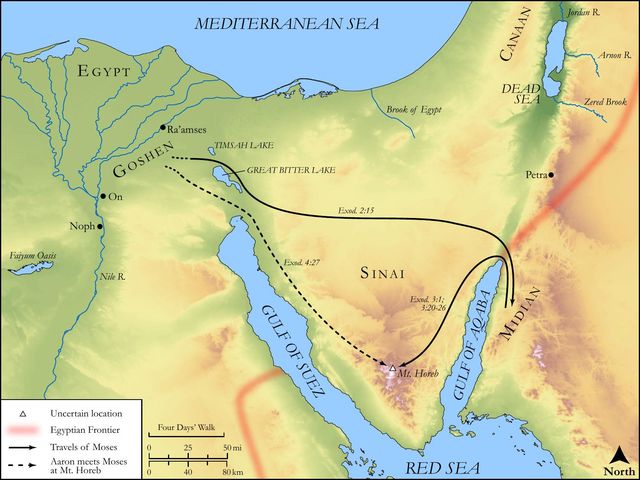
See on the biblical-era maps

Study this verse
Public-domain commentary
Matthew Henry
From his Commentary on the Whole Bible. Henry comments on passages, not single verses — this entry covers Exodus 2:11–15. His four-level outline is real structure in the source text, so it is rendered as structure.
Moses had now passed the first forty years of his life in the court of Pharaoh, preparing himself for business; and now it was time for him to enter upon action, and,
I.He boldly owns and espouses the cause of God's people:
When Moses was grown he went out unto his brethren, and looked on their burdens, Exo 2:11. The best exposition of these words we have from an inspired pen, Heb 11:24-26, where we are told that by this he expressed,
1.His holy contempt of the honours and pleasures of the Egyptian court; he refused to be called the son of Pharaoh's daughter, for he went out. The temptation was indeed very strong. He had a fair opportunity (as we say) to make his fortune, and to have been serviceable to Israel too, with his interest at court. He was obliged, in gratitude as well as interest, to Pharaoh's daughter, and yet he obtained a glorious victory by faith over his temptation. He reckoned it much more his honour and advantage to be a son of Abraham than to be the son of Pharaoh's daughter.
2.His tender concern for his poor brethren in bondage, with whom (though he might easily have avoided it) he chose to suffer affliction; he looked on their burdens as one that not only pitied them, but was resolved to venture with them, and, if occasion were, to venture for them.
II.He gives a specimen of the great things he was afterwards to do for God and his Israel in two little instances, related particularly by Stephen (Act 7:23, etc.) with design to show how their fathers had always resisted the Holy Ghost (v. 51), even in Moses himself, when he first appeared as their deliverer, wilfully shutting their eyes against this day-break of their enlargement. He found himself, no doubt, under a divine direction and impulse in what he did, and that he was in an extraordinary manner called of God to do it. Now observe,
1.Moses was afterwards to be employed in plaguing the Egyptians for the wrongs they had done to God's Israel; and, as a specimen of that, he killed the Egyptian who smote the Hebrew (Exo 2:11, Exo 2:12); probably it was one of the Egyptian taskmasters, whom he found abusing his Hebrew slave, a relation (as some think) of Moses, a man of the same tribe. It was by special warrant from Heaven (which makes not a precedent in ordinary cases) that Moses slew the Egyptian, and rescued his oppressed brother. The Jew's tradition is that he did not slay him with any weapon, but, as Peter slew Ananias and Sapphira, with the word of his mouth. His hiding him in the sand signified that hereafter Pharaoh and all his Egyptians should, under the control of the rod of Moses, be buried in the sand of the Red Sea. His taking care to execute this justice privately, when no man saw, was a piece of needful prudence and caution, it being but an assay; and perhaps his faith was as yet weak, and what he did was with some hesitation. Those who come to be of great faith, yet began with a little, and at first spoke tremblingly.
2.Moses was afterwards to be employed in governing Israel, and as a specimen of this, we have him here trying to end a controversy between two Hebrews, in which he is forced (as he did afterwards for forty years) to suffer their manners. Observe here,
(1.)The unhappy quarrel which Moses observed between two Hebrews, Exo 2:13. It does not appear what was the occasion; but, whatever it was, it was certainly very unseasonable for Hebrews to strive with one another when they were all oppressed and ruled with rigour by the Egyptians. Had they not beating enough from the Egyptians, but they must beat one another? Note,
[1.]Even sufferings in common do not always unite God's professing people to one another, so much as one might reasonably expect.
[2.]When God raises up instruments of salvation for the church they will find enough to do, not only with oppressing Egyptians, to restrain them, but with quarrelsome Israelites, to reconcile them.
(2.)The way he took of dealing with them; he marked him that caused the division, that did the wrong, and mildly reasoned with him: Wherefore smitest thou thy fellow? The injurious Egyptian was killed, the injurious Hebrew was only reprimanded; for what the former did was from a rooted malice, what the latter did we may suppose was only upon a sudden provocation. The wise God makes, and, according to his example, all wise governors make, a difference between one offender and another, according to the several qualities of the same offence. Moses endeavoured to make them friends, a good office; thus we find Christ often reproving his disciples' strifes (Luk 9:46, etc.; Luk 22:24, etc.), for he was a prophet like unto Moses, a healing prophet, a peacemaker, who visited his brethren with a design to slay all enmities. The reproof Moses gave on this occasion may still be of use, Wherefore smitest thou thy fellow? Note, Smiting our fellows is bad in any, especially in Hebrews, smiting with tongue or hand, either in a way of persecution or in a way of strife and contention. Consider the person thou smitest; it is thy fellow, thy fellow-creature, thy fellow-christian, it is thy fellow-servant, thy fellow-sufferer. Consider the cause, Wherefore smitest? Perhaps it is for no cause at all, or no just cause, or none worth speaking of.
(3.)The ill success of his attempt (v. 14): He said, Who made thee a prince? He that did the wrong thus quarrelled with Moses; the injured party, it should seem, was inclinable enough to peace, but the wrong-doer was thus touchy. Note, It is a sign of guilt to be impatient of reproof; and it is often easier to persuade the injured to bear the trouble of taking wrong than the injurious to bear the conviction of having done wrong. Co1 6:7, Co1 6:8. It was a very wise and mild reproof which Moses gave to this quarrelsome Hebrew, but he could not bear it, he kicked against the pricks (Act 9:5), and crossed questions with his reprover.
[1.]He challenges his authority: Who made thee a prince? A man needs no great authority for the giving of a friendly reproof, it is an act of kindness; yet this man needs will interpret it an act of dominion, and represents his reprover as imperious and assuming. Thus when people dislike good discourse, or a seasonable admonition, they will call it preaching, as if a man could not speak a work for God and against sin but he took too much upon him. Yet Moses was indeed a prince and a judge, and knew it, and thought the Hebrews would have understood it, and struck in with him; but they stood in their own light, and thrust him away, Act 7:25, Act 7:27.
[2.]He upbraids him with what he had done in killing the Egyptian: Intendest thou to kill me? See what base constructions malice puts upon the best words and actions. Moses, for reproving him is immediately charged with a design to kill him. An attempt upon his sin was interpreted an attempt upon his life; and his having killed the Egyptian was thought sufficient to justify the suspicion; as if Moses made no difference between an Egyptian and a Hebrew. If Moses, to right an injured Hebrew, had put his life in his hand, and slain an Egyptian, he ought therefore to have submitted to him, not only as a friend to the Hebrews, but as a friend that had more than ordinary power and zeal. But he throws that in his teeth as a crime which was bravely done, and was intended as a specimen of the promised deliverance; if the Hebrews had taken the hint, and come in to Moses as their head and captain, it is probable that they would have been delivered now; but, despising their deliverer, their deliverance was justly deferred, and their bondage prolonged forty years, as afterwards their despising Canaan kept them out of it forty years more. I would, and you would not. Note, Men know not what they do, nor what enemies they are to their own interest, when they resist and despise faithful reproofs and reprovers. When the Hebrews strove with Moses, God sent him away into Midian, and they never heard of him for forty years; thus the things that belonged to their peace were hidden from their eyes, because they knew not the day of their visitation. As to Moses, we may look on it as a great damp and discouragement to him. He was now choosing to suffer affliction with the people of God, and embracing the reproach of Christ; and now, at his first setting out, to meet with this affliction and reproach from them was a very sore trial of his resolution. He might have said, "If this be the spirit of the Hebrews, I will go to court again, and be the son of Pharaoh's daughter." Note, First, We must take heed of being prejudiced against the ways and people of God by the follies and peevishness of some particular persons that profess religion. Secondly, It is no new thing for the church's best friends to meet with a great deal of opposition and discouragement in their healing, saving attempts, even from their own mother's children; Christ himself was set at nought by the builders, and is still rejected by those he would save.
(4.)The flight of Moses to Midian, in consequence. The affront given him thus far proved a kindness to him; it gave him to understand that his killing the Egyptian was discovered, and so he had time to make his escape, otherwise the wrath of Pharaoh might have surprised him and taken him off. Note, God can overrule even the strife of tongues, so as, one way or other, to bring good to his people out of it. Information was brought to Pharaoh (and it is well if it was not brought by the Hebrew himself whom Moses reproved) of his killing the Egyptian; warrants are presently out for the apprehending of Moses, which obliged him to shift for his own safety, by flying into the land of Midian, Exo 2:15.
[1.]Moses did this out of a prudent care of his own life. If this be his forsaking of Egypt which the apostle refers to as done by faith (Heb 11:27), it teaches us that when we are at any time in trouble and danger for doing our duty the grace of faith will be of good use to us in taking proper methods for our own preservation. Yet there it is said, He feared not the wrath of the king; here it is said he feared, Exo 2:14. He did not fear with a fear of diffidence and amazement, which weakens and has torment, but with a fear of diligence, which quickened him to take that way which Providence opened to him for his own preservation.
[2.]God ordered it for wise and holy ends. Things were not yet ripe for Israel's deliverance: the measure of Egypt's iniquity was not yet full; the Hebrews were not sufficiently humbled, nor were they yet increased to such a multitude as God designed; Moses is to be further fitted for the service, and therefore is directed to withdraw for the present, till the time to favour Israel, even the set time, should come. God guided Moses to Midian because the Midianites were of the seed of Abraham, and retained the worship of the true God among them, so that he might have not only a safe but a comfortable settlement among them. And through this country he was afterwards to lead Israel, with which (that he might do it the better) he now had opportunity of making himself acquainted. Hither he came, and sat down by a well, tired and thoughtful, at a loss, and waiting to see which way Providence would direct him. It was a great change with him, since he was but the other day at ease in Pharaoh's court: thus God tried his faith, and it was found to praise and honour.
Historical interpretation
Sixteen Centuries of Reception
5 surviving comments on this verse. Each one is dated, so this reads as a timeline rather than a list.
Select a marker to jump to its quote. Markers stagger vertically where authors wrote within a few decades of each other.
Eupolemus in his work On the Kings of Judea says that Moses was the first sage and the first person to transmit to the Jews the science of writing, which passed from the Jews to the Phoenicians and from the Phoenicians to the Greeks. When he reached the age of manhood he developed his practical wisdom, being zealous for his national, ancestral educational traditions, to the point of striking down and killing an Egyptian who was unjustly attacking a Hebrew. The mystics say that he eliminated the Egyptian simply by speaking, as later in Acts Peter is said to have killed by his words those who had kept for themselves part of the price of the land and had told lies.
He who hated the pomp of royalty returned to the lowly state of his own race. He preferred to suffer affliction with the people of God rather than to have the fleeting enjoyment of sin. He who, possessing naturally a love for justice, on one occasion even before the government of the people was entrusted to him was seen inflicting on the wicked punishment to the extent of death because of his natural hatred of villainy. He was banished by those to whom he had been a benefactor. He gladly left the uproar of the Egyptians and went to Ethiopia and, spending there all his time apart from others, devoted himself for forty entire years to the contemplation of creation.
Moses indeed killed the Egyptian and became a fugitive from the land of Egypt, in order to avoid the tyrant of that land. But he would not have killed that Egyptian man before he had first killed the Egyptian man of spiritual wickedness within himself, and had renounced the luxury of regal honors, considering the reproach of Christ a greater inheritance than the treasures of Egypt.
Concerning Moses’ deed, when he killed the Egyptian to defend his brethren, we have treated the point adequately in the book that we wrote against Faustus on the lives of the patriarchs. The question was whether his role in that deed was praiseworthy, insofar as he admitted his sin, just as the richness of the earth, even before useful seeds are planted, is often praised for a growth of plants, even if they are useless. Or perhaps the deed itself should be justified. But to do so does not seem right, for up to that point Moses had no legitimate authority—neither authority that he received from God nor authority ordained by human society. But still, as Stephen says in the Acts of the Apostles, Moses thought that his brethren understood that God would bring them salvation through him, so that by this testimony it appeared that Moses could dare to do this because he was already called by God to act. (But Scripture is silent on this point).
He slew the Egyptian: This he did by a particular inspiration of God; as a prelude to his delivering the people from their oppression and bondage. He thought, says St. Stephen, Acts 7. 25, that his brethren understood that God by his hand would save them. But such particular and extraordinary examples are not to be imitated.
Continue studying Exodus 2:12 across the web’s major study libraries — every link below opens this exact verse, chapter, or book on the destination site.
Read & Compare
 BibleGatewayThis verse in more than 200 translations and 70 languages.
 Bible.comThe YouVersion reader — hundreds of translations, reading plans, and highlights.
 ESV.orgCrossway's official English Standard Version reader.
 NET BibleThe NET translation with 60,000+ translators' notes on every rendering decision.
 STEP BibleTyndale House's free study tool — original text, vocabulary, and scholarly resources.
 BibliaLogos Bible Software's free web reader.
 USCCBThe New American Bible (Revised Edition) with the U.S. bishops' study notes.
Commentaries
 BibleHub CommentariesDozens of classic commentaries on this verse, gathered on one page.
 StudyLightMore than 100 commentary sets — the largest collection on the web.
 BibleRefPlain-English commentary on what this verse means, verse by verse.
 Enduring WordDavid Guzik's free commentary on this chapter, widely used by Bible teachers.
 Bible Study ToolsVerse commentary alongside Greek and Hebrew study aids.
Original Language & Research
- BibleHub InterlinearThe verse word by word — original language, transliteration, and English.
- BibleHub LexiconEvery word's original-language definition and Strong's entry.
 Blue Letter BibleDeep-study tools — Strong's numbers, concordance, and word studies.
 SefariaThe Hebrew text with Rashi and centuries of Jewish commentary.
Sermons, Hymns & Audio


TrulyRandomVerse is not affiliated with these sites and doesn’t control their content. They’re linked because they’re genuinely useful.
Summary
Exodus 2:12 records a pivotal yet flawed moment in Moses' early life, where his deep identification with his oppressed Hebrew people led him to an impulsive act of violence. Witnessing an Egyptian taskmaster brutalizing a Hebrew slave, Moses took matters into his own hands, slaying the Egyptian and attempting to conceal the act, an event that marked a significant, albeit problematic, turning point in his journey toward becoming Israel's divinely appointed deliverer.
Context
ShowHideLiterary Context
This verse is deeply embedded within the narrative of Moses' formative years, immediately following his miraculous preservation from Pharaoh's decree and his unique upbringing in the Egyptian royal court. The preceding verse, Exodus 2:11, establishes Moses' conscious decision to "go out unto his brethren" and "look on their burdens," indicating a growing awareness and empathy for his true heritage and their suffering. This act of "looking" culminates in the violent intervention described in Exodus 2:12, which then directly precipitates his flight from Egypt in Exodus 2:15, setting the stage for his forty years of preparation in Midian. The immediate narrative flow highlights Moses' burgeoning sense of justice and his premature attempt to deliver his people through human strength rather than divine timing.
Historical & Cultural Context
The historical backdrop is the severe oppression of the Israelites under Egyptian bondage, characterized by forced labor and brutal taskmasters, as detailed in Exodus 1. Egyptians held a superior social and national status, viewing the enslaved Hebrews as expendable. The act of an Egyptian beating a Hebrew was a common, yet deeply unjust, occurrence. For Moses, an adopted Egyptian prince, to intervene on behalf of a slave was an extraordinary act of defiance against the established order and a profound identification with the oppressed. Hiding a body in the sand was a practical attempt to conceal a crime in a desert environment where such a deed might remain undiscovered for a time, reflecting the legal consequences he would face if caught.
Key Themes
ShowHideThis verse contributes significantly to several key themes in Exodus and the broader Pentateuch. It introduces the theme of deliverance, albeit through flawed human means, foreshadowing God's ultimate, perfect deliverance. It highlights the theme of divine calling and preparation, showing that God often uses imperfect individuals and even their mistakes as part of a longer process of shaping them for His purposes. Furthermore, it touches upon the theme of justice versus self-justice, where Moses' righteous indignation leads to an act outside of God's timing and method, contrasting with God's perfect justice. Finally, it subtly introduces the theme of human sin and its consequences, as Moses' action leads to his flight and a forty-year delay in his divine assignment, echoing the consequences of sin seen throughout Genesis and Exodus.
Exposition and Analysis
ShowHideKey Word Analysis
ShowHideMeaning "to turn; by implication, to face, i.e. appear, look, etc." In this context, it emphasizes Moses' deliberate and cautious act of surveying his surroundings, indicating a conscious awareness of the illegality and secrecy of his impending action. His "looking this way and that way" is an act of reconnaissance, a search for witnesses, underscoring the premeditated nature of his intervention.
Meaning "to strike (lightly or severely, literally or figuratively); beat, cast forth, ... kill, ... slay." This verb is potent, denoting a decisive and often fatal blow. While it can imply a non-fatal strike in other contexts, here, coupled with the immediate act of concealment, it unequivocally signifies a killing. It highlights the severity of Moses' action and the finality of the Egyptian's fate at his hand.
Meaning "to hide (by covering over); hide, lay privily, in secret." This word reveals Moses' immediate attempt to conceal his crime, emphasizing his awareness of wrongdoing and his desire to avoid detection and accountability. The act of hiding the body "in the sand" speaks to the desperate and secretive nature of his deed, attempting to bury the evidence and the consequences of his impulsive act.
Verse Breakdown
ShowHide"And he looked this way and that way"
This opening clause immediately sets a tone of stealth and premeditation. Moses is not acting blindly or in a fit of uncontrolled rage, but with a calculated assessment of his environment. His gaze is searching, indicating a desire to ensure privacy for the act he is about to commit, revealing his awareness that his actions are illicit and require concealment.
"and when he saw that [there was] no man"
This phrase confirms Moses' deliberate search for witnesses. The absence of "man" (Hebrew, ʼîysh' - H376, referring to a male individual or person) signifies that Moses perceived himself to be unobserved by any human eye. This perceived solitude emboldened him to proceed, highlighting his reliance on human secrecy rather than divine sanction.
"he slew the Egyptian"
This is the central, decisive action of the verse. Driven by a powerful sense of injustice and perhaps a nascent, yet misdirected, calling to deliver his people, Moses takes a life. This act, while stemming from a righteous indignation against oppression, is an unauthorized and violent intervention, demonstrating Moses' reliance on his own strength and timing rather than waiting for God's clear instruction. It is a moment of human impulsivity overriding divine wisdom.
"and hid him in the sand"
This concluding clause underscores the illegality and secrecy of Moses' act. The immediate attempt to conceal the body in the sand (Hebrew, chôwl' - H2344, referring to loose, whirling particles) reveals his guilt and his desperate effort to escape the consequences of his deed. This act of concealment is a stark reminder of the human tendency to hide sin, believing that what is unseen by man is unknown to God.
Literary Devices
ShowHideExodus 2:12 is rich in Irony, as Moses, destined to be Israel's great deliverer, attempts to initiate that deliverance through a flawed, violent act that ultimately leads to his flight rather than liberation. There is also significant Foreshadowing in this verse; while Moses' method is wrong, his deep identification with his suffering people and his passionate response hint at the future role he will play, albeit under divine guidance. The act of "looking this way and that way" before acting introduces an element of Suspense, building tension before the decisive, violent act. Furthermore, Moses' attempt to hide the body in the sand can be seen as Symbolism, representing the human desire to bury mistakes and consequences, a futile effort against the all-seeing eye of God.
Theological and Thematic Connections
ShowHideThis pivotal moment in Moses' life profoundly illustrates the tension between human agency and divine sovereignty. While Moses' act was impulsive and sinful, stemming from a premature attempt to fulfill a perceived calling through his own strength, God sovereignly weaves this flawed action into His overarching redemptive plan. Rather than disqualifying Moses, this event marks the beginning of a forty-year period of wilderness preparation, during which God would strip away Moses' self-reliance and equip him for true, Spirit-led leadership. This demonstrates God's incredible patience and grace, using even human failures to shape His chosen instruments for His perfect will.
Reflection and Application
ShowHideExodus 2:12 offers profound lessons for believers today, particularly regarding the dangers of acting impulsively, even when driven by righteous indignation or a sincere desire to serve God. Moses' reliance on his own strength and his attempt to "fix" a problem through human means, rather than waiting for God's timing and method, resulted in significant personal consequences and a delay in God's plan. This passage challenges us to examine our own motivations and methods. Are we quick to act in our own strength, or do we patiently wait upon the Lord for His guidance and empowerment? It reminds us that God's ways are higher than our ways, and His timing is perfect (Isaiah 55:8-9). Furthermore, Moses' subsequent flight and forty years of obscurity serve as a powerful testament to God's refining process. He uses our wilderness experiences, even those stemming from our failures, to humble us, teach us dependence, and prepare us for the tasks He has ordained. We are called to trust in God's sovereign hand, knowing that He can redeem our mistakes and use our imperfections for His glory, shaping us into vessels fit for His service.
Questions for Reflection
ShowHideFAQ
ShowHideWas Moses justified in killing the Egyptian?
ShowHideFrom a divine and moral perspective, Moses' act was not justified. While he undoubtedly felt a righteous indignation against the oppression he witnessed, his action was an impulsive act of violence, not a divinely commanded execution or an act of self-defense for himself. It was a sin, as evidenced by his immediate attempt to conceal the body and his subsequent flight from Pharaoh's wrath (Exodus 2:15). His method was outside of God's will and timing, leading to personal consequences and a delay in God's plan for Israel's deliverance. Stephen's account in Acts 7:25 indicates Moses' expectation that his brethren would understand his intention to deliver them, but this expectation was rooted in his own human understanding rather not a clear divine mandate at that moment.
Why did Moses look "this way and that way" before acting?
ShowHideMoses looked "this way and that way" to ensure no human witnesses were present. This action highlights his awareness that what he was about to do was illegal under Egyptian law and morally questionable, even if driven by a sense of justice. It demonstrates his attempt to conceal his crime and avoid accountability, indicative of the human tendency to hide sin and its consequences. This detail underscores the secretive and premeditated nature of his act, not a spontaneous outburst of rage, but a calculated, albeit flawed, decision.
Christ-Centered Fulfillment
ShowHideMoses, as a deliverer and lawgiver, serves as a significant type of Christ, yet this particular event in Exodus 2:12 highlights the profound contrast between the two. Moses attempted to deliver his people through human strength, an impulsive act of violence that ultimately failed and led to his flight and forty years of exile. He was a flawed deliverer, whose sin underscored the need for a perfect one. In stark contrast, Christ, the true and greater Moses (Deuteronomy 18:15), accomplished salvation not through violence against His enemies, but through perfect obedience, self-sacrifice, and divine power. He did not come to slay the oppressor but to lay down His life for the oppressed, offering a perfect and complete redemption from the bondage of sin and death (John 1:29). While Moses' act was driven by a desire for justice, Christ perfectly embodied justice and mercy, becoming the propitiation for our sins (Romans 3:25). Moses' failure here underscores the necessity of the sinless Lamb of God, whose atoning sacrifice perfectly fulfills the ultimate deliverance that Moses could only imperfectly foreshadow.