


2 Samuel 2:8
Bible text: King James Version (1769 Blayney text) · Public domain
Bible text: Berean Standard Bible · Public domain
Bible text: American Standard Version (1901) · Public domain
Bible text: World English Bible, Messianic edition · Public domain
Bible text: Geneva Bible (1599) · Public domain
Bible text: Young's Literal Translation · Public domain
- וְאַבְנֵרve·'av·Nerand AbnerH74Conj-w ¦ N-proper-mNoun Proper MasculineוְandאַבְנֵרAbner
- בֶּןben[the] son ofH1121N-mscNoun Singular Masculine Construct
- נֵרNerNerH5369N-proper-mNoun Proper Masculine
- שַׂרsar[the] commander ofH8269N-mscNoun Singular Masculine Construct
- צָבָאtza·Va'[the] armyH6635N-msNoun Singular Masculine Absolute
- אֲשֶׁר'a·SherwhichH834RelParticle Relative
- לְשָׁאוּלle·sha·'Ul[belonged] to SaulH7586Prep-l ¦ N-proper-mNoun Proper Masculineלְ[belonged] toשָׁאוּלSaul
- לָקַחla·Kachhe had takenH3947V-Qal-Perf-3msVerb Qal Perfect 3rd Singular Masculine
- אֶת'et<obj.>H853DirObjMParticle Object Indicator
- אִישׁ'ishIsh-H378N-proper-mNoun Proper Masculine
- בֹּשֶׁתbo·shetboshethH378N-proper-mNoun Proper Masculine
- בֶּןben[the] son ofH1121N-mscNoun Singular Masculine Construct
- שָׁאוּלsha·'UlSaulH7586N-proper-mNoun Proper Masculine
- וַיַּעֲבִרֵהוּvai·ya·'a·vi·Re·huand he had brought over himH5674Conj-w ¦ V-Hiphil-ConsecImperf-3ms ¦ 3msVerb Hiphil Consecutive Imperfect 3rd Singular Masculineוַandיַּעֲבִרֵhe had brought overהוּhim
- מַחֲנָיִםma·cha·Na·yimMahanaimH4266N-properNoun Proper Location
English is a literal word-by-word gloss of the Hebrew, not the KJV's wording. Why?
This is the original text the KJV's translators worked from — each Hebrew word with its own literal English meaning in this verse, prepared by scholars at Tyndale House, Cambridge. The KJV translates whole sentences, not word by word, so its wording differs: one Hebrew word can become several English words, and the KJV may choose “the LORD” where the gloss reads “Yahweh”. Both are faithful — they answer different questions. For the KJV's own rendering, switch to the KJV text.
Details
See on the biblical-era maps
Study this verse
Public-domain commentary
Matthew Henry
From his Commentary on the Whole Bible. Henry comments on passages, not single verses — this entry covers 2 Samuel 2:8–17. His three-level outline is real structure in the source text, so it is rendered as structure.
Here is, I. A rivalship between two kings - David, whom God made king, and Ishbosheth, whom Abner made king. One would have thought, when Saul was slain, and all his sons that had sense and spirit enough to take the field with him, David would come to the throne without any opposition, since all Israel knew, not only how he had signalized himself, but how manifestly God had designated him to it; but such a spirit of contradiction is there, in the devices of men, to the counsels of God, that such a weak and silly thing as Ishbosheth, who was not thought fit to go with his father to the battle, shall yet be thought fit to succeed him in the government, rather than David shall come peaceably to it. Herein David's kingdom was typical of the Messiah's, against which the heathens rage and the rulers take counsel, Psa 2:1, Psa 2:2. 1. Abner was the person who set up Ishbosheth in competition with David, perhaps in his zeal for the lineal succession (since they must have a king like the nations, in this they must be like them, that the crown must descend from father to son), or rather in his affection to his own family and relations (for he was Saul's uncle), and because he had no other way to secure to himself the post of honour he was in, as captain of the host. See how much mischief the pride and ambition of one man may be the occasion of. Ishbosheth would never have set up himself if Abner had not set him up, and made a tool of him to serve his own purposes. 2. Mahanaim, the place where he first made his claim, was on the other side Jordan, where it was thought David had the least interest, and being at a distance from his forces they might have time to strengthen themselves. But having set up his standard there, the unthinking people of all the tribes of Israel (that is, the generality of them) submitted to him (Sa2 2:9), and Judah only was entirely for David. This was a further trial of the faith of David in the promise of God, and of his patience, whether he could wait God's time for the performance of that promise. 3. Some difficulty there is about the time of the continuance of this competition. David reigned about seven years over Judah only (Sa2 2:11), and yet (Sa2 2:10) Ishbosheth reigned over Israel but two years: before those two years, or after, or both, it was in general for the house of Saul (Sa2 3:6), and not any particular person of that house, that Abner declared. Or these two years he reigned before the war broke out (Sa2 2:12), which continued long, even the remaining five years, Sa2 3:1.
II.An encounter between their two armies.
1.It does not appear that either side brought their whole force into the field, for the slaughter was but small, Sa2 2:30, Sa2 2:31. We may wonder,
(1.)That the men of Judah did not appear and act more vigorously for David, to reduce all the nation into obedience to him; but, it is likely, David would not suffer them to act offensively, choosing rather to wait till the thing would do itself or rather till God would do it for him, without the effusion of Israelitish blood; for to him, as a type of Christ, that was very precious, Psa 72:14. Even those that were his adversaries he looked upon as his subjects, and would treat them accordingly.
(2.)That the men of Israel could in a manner stand neuter, and sit down tamely under Ishbosheth, for so many years, especially considering what characters many of the tribes displayed at this time (as we find, Ch1 12:23, etc.): Wise men, mighty men, men of valour, expert in war, and not of double heart, and yet for seven years together, for aught that appears, most of them seemed indifferent in whose hand the public administration was. Divine Providence serves its own purposes by the stupidity of men at some times and the activity of the same persons at other times; they are unlike themselves, and yet the motions of Providence are uniform.
2.In this battle Abner was the aggressor. David sat still to see how the matter would fall, but the house of Saul, and Abner at the head of it, gave the challenge, and they went by the worst. Therefore go not forth hastily to strive, nor be forward to begin quarrels, lest thou know not what to do in the end thereof, Pro 25:8. A fool's lips and hands enter into contention.
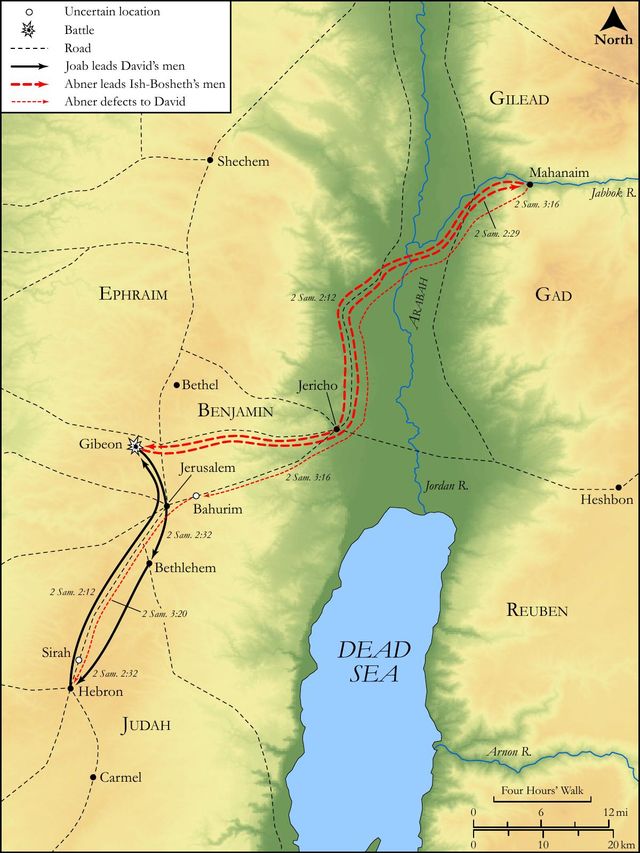
3.The seat of the war was Gibeon. Abner chose it because it was in the lot of Benjamin, where Saul had the most friends; yet, since he offered battle, Joab, David's general, would not decline it, but there joined issue with him, and met him by the pool of Gibeon, Sa2 2:13. David's cause, being built upon God's promise, feared not the disadvantages of the ground. The pool between them gave both sides time to deliberate.
4.The engagement was at first proposed by Abner, and accepted by Joab, to be between twelve and twelve of a side.
(1.)It should seem this trial of skill began in sport. Abner made the motion (Sa2 2:14): Let the young men arise and play before us, as gladiators. Perhaps Saul had used his men to these barbarous pastimes, like a tyrant indeed, and Abner had learnt of him to make a jest of wounds and death and divert himself with the scenes of blood and horror. He meant, "Let them fight before us," when he said, "Let them play before us." Fools thus make a mock at sin. but he is unworthy the name of a man that can be thus prodigal of human blood, that can thus throw about firebrands, arrows, and death, and say, Am not I in sport? Pro 26:18, Pro 26:19. Joab, having been bred up under David, had so much wisdom as not to make such a proposal, yet had not resolution enough to resist and gainsay it when another made it; for he stood upon a point of honour, and thought it a blemish to his reputation to refuse a challenge, and therefore said, Let them arise; not that he was fond of the sport, or expected that the duels would be decisive, but he would not be hectored by his antagonist. How many precious lives have thus been sacrificed to the caprices of proud men! Twelve of each side were accordingly called out as champions to enter the lists, a double jury of life and death, not of others', but their own; and the champions on Abner's side seem to have been most forward, for they took the field first (Sa2 2:15), having perhaps been bred up in a foolish ambition thus to serve the humour of their commander-in-chief. But,
(2.)However it began, it ended in blood (Sa2 2:16): They thrust every man his sword into his fellow's side (spurred on by honour, not by enmity); so they fell down together, that is, all the twenty-four were slain, such an equal match were they for one another, and so resolute, that neither side would either beg or give quarter; they did as it were by agreement (says Josephus) dispatch one another with mutual wounds. Those that strike at other men's lives often throw away their own and death only conquers and rides in triumph. The wonderful obstinacy of both sides was remembered in the name given to the place: Heldath-hazzurim - the field of rocky men, men that were not only strong in body, but of firm and unshaken constancy, that stirred not at the sight of death. Yet the stout-hearted were spoiled, and slept their sleep, Psa 76:5. Poor honour for men to purchase at so vast an expense! Those that lose their lives for Christ shall find them.
5.The whole army at length engaged, and Abner's forces were routed, Sa2 2:17. The former was a drawn battle, in which all were killed on both sides, and therefore they must put it upon another trial, in which (as it often happens) those that gave the challenge went away with loss. David had God on his side; his side therefore was victorious.
Continue studying 2 Samuel 2:8 across the web’s major study libraries — every link below opens this exact verse, chapter, or book on the destination site.
Read & Compare
 BibleGatewayThis verse in more than 200 translations and 70 languages.
 Bible.comThe YouVersion reader — hundreds of translations, reading plans, and highlights.
 ESV.orgCrossway's official English Standard Version reader.
 NET BibleThe NET translation with 60,000+ translators' notes on every rendering decision.
 STEP BibleTyndale House's free study tool — original text, vocabulary, and scholarly resources.
 BibliaLogos Bible Software's free web reader.
 USCCBThe New American Bible (Revised Edition) with the U.S. bishops' study notes.
Commentaries
 BibleHub CommentariesDozens of classic commentaries on this verse, gathered on one page.
 StudyLightMore than 100 commentary sets — the largest collection on the web.
 BibleRefPlain-English commentary on what this verse means, verse by verse.
 Enduring WordDavid Guzik's free commentary on this chapter, widely used by Bible teachers.
 Bible Study ToolsVerse commentary alongside Greek and Hebrew study aids.
Original Language & Research
- BibleHub InterlinearThe verse word by word — original language, transliteration, and English.
- BibleHub LexiconEvery word's original-language definition and Strong's entry.
 Blue Letter BibleDeep-study tools — Strong's numbers, concordance, and word studies.
 SefariaThe Hebrew text with Rashi and centuries of Jewish commentary.
Sermons, Hymns & Audio


TrulyRandomVerse is not affiliated with these sites and doesn’t control their content. They’re linked because they’re genuinely useful.
Summary
Following the devastating defeat at Gilboa and the tragic deaths of King Saul and his sons, 2 Samuel 2:8 marks a critical turning point, detailing Abner, Saul's influential cousin and army commander, actively seeking to preserve the fallen dynasty. In a strategic move of political defiance against God's anointed, David, Abner took Ishbosheth, Saul's surviving son, and transported him across the Jordan River to Mahanaim, thereby establishing a rival kingdom and setting the stage for a prolonged and bloody civil war within Israel. This act of human ambition and resistance highlights the immediate fragmentation of the nation and the complexities of leadership transition in the wake of divine decree.
Context
ShowHideLiterary Context
This verse immediately follows David's anointing as king over Judah in Hebron after Saul's death on Mount Gilboa, as recounted in 1 Samuel 31 and 2 Samuel 1. While David has been divinely chosen and recognized by his own tribe, the broader nation of Israel remains in flux. Abner's actions here directly oppose the trajectory of God's plan for David's kingship, initiating the conflict that will dominate the early chapters of 2 Samuel. The subsequent verses in 2 Samuel 2 detail the beginning of skirmishes between the forces of David and Ishbosheth, culminating in the declaration of a "long war" between the two houses in 2 Samuel 3:1.
Historical & Cultural Context
The period immediately after a king's death was often one of instability and power struggles among the kingdoms of that day. Saul's death left a vacuum, and while David had been privately anointed by Samuel years prior (1 Samuel 16:13), his public recognition was fragmented. Abner, as the commander of Saul's army and his cousin, held significant military and political power. His loyalty to the house of Saul, whether out of genuine devotion or self-preservation, was a powerful force. By moving Ishbosheth to Mahanaim, east of the Jordan, Abner strategically placed him in territory less directly influenced by Judah and David, providing a defensible base from which to consolidate support among the northern tribes who had been loyal to Saul. This geographical separation underscored the political division.
Key Themes
ShowHideThis verse powerfully contributes to several overarching themes in the narrative. It starkly illustrates the theme of human resistance to divine will, as Abner actively works against God's clear choice of David as king, setting up a rival claimant. This resistance leads directly to the theme of division and civil strife within Israel, contrasting with the eventual unity under God's chosen king. Furthermore, it highlights the theme of political maneuvering and ambition, as Abner's actions are driven by a desire to maintain power and perpetuate the Saulide dynasty, even with a weak figurehead like Ishbosheth. The verse also subtly introduces the theme of God's sovereignty prevailing despite human obstacles, as the narrative will ultimately show David's kingdom expanding and Ishbosheth's falling, fulfilling the divine promise found in passages like 1 Samuel 15:28.
Exposition and Analysis
ShowHideKey Word Analysis
ShowHideFrom אָב and נִיר, meaning "father of light (i.e. enlightening)." Abner was a formidable figure, Saul's cousin and the commander of his army. He was a man of considerable influence and military prowess, whose loyalty to the house of Saul was unwavering, at least initially. His actions in this verse demonstrate his executive power and his determination to maintain the existing dynastic line, even in the face of God's clear anointing of David.
From אִישׁ and בֹּשֶׁת, meaning "man of shame." This name is likely a scribal alteration of "Ish-baal" (meaning "man of Baal"), as found in 1 Chronicles 8:33. The change reflects a later religious aversion to associating an Israelite king with the Canaanite deity Baal. Ishbosheth appears to have been a weak and perhaps even cowardly figure, a mere puppet in Abner's hands, lacking the charisma or leadership qualities of his father or David. His very name, "man of shame," ironically foreshadows his inglorious end and the ultimate failure of his reign.
Dual of מַחֲנֶה, meaning "double camp." This city east of the Jordan River held significant biblical history, notably as the place where Jacob encountered angels (Genesis 32:2). Its strategic location, relatively isolated from David's power base in Judah and offering natural defenses, made it an ideal stronghold for Abner to establish a rival kingdom. The name "double camp" or "two camps" is profoundly symbolic, foreshadowing the division of Israel into two warring factions.
Verse Breakdown
ShowHide"But Abner the son of Ner, captain of Saul's host"
This phrase immediately identifies the key antagonist to David's immediate kingship. Abner's lineage ("the son of Ner") establishes his close familial tie to Saul (Ner was Saul's uncle, making Abner Saul's cousin), and his title ("captain of Saul's host," from H6635 tsâbâʼ meaning "mass of persons... organized for war," and H8269 sar meaning "a head person... captain") underscores his immense military and political authority. The "But" signals a counter-action, a deliberate move against the prevailing narrative of David's ascent.
"took Ishbosheth the son of Saul"
This clause describes Abner's decisive action. He did not merely support Ishbosheth; he "took" him (H3947 lâqach, meaning "to take in the widest variety of applications"), implying a proactive and perhaps even forceful removal from a vulnerable position, to elevate him. The identification "the son of Saul" (H1121 bên, meaning "son, builder of the family name") emphasizes Ishbosheth's claim to legitimacy through his father's lineage, despite being one of the weaker and perhaps less prominent of Saul's sons.
"and brought him over to Mahanaim;"
This final clause reveals the strategic location chosen for the rival kingdom. Abner "brought him over" (H5674 ʻâbar, meaning "to cross over," used widely of any transition) to Mahanaim, situated across the Jordan, providing a safe distance from David's stronghold in Hebron and a base from which Abner could rally support from the northern tribes who had remained loyal to Saul's house. This geographical relocation was a deliberate act of establishing a separate, competing center of power, directly setting the stage for the civil war.
Literary Devices
ShowHideThe verse employs several significant literary devices. Contrast is evident in the immediate juxtaposition of David's anointing in Hebron with Abner's establishment of a rival king. This creates a tension between divine appointment and human manipulation. The name Ishbosheth itself functions as Irony and Foreshadowing; "man of shame" not only reflects a later theological discomfort with "Baal" but also ironically prefigures his weak and ultimately shameful reign and death. The choice of Mahanaim, meaning "two camps," serves as potent Symbolism, directly foreshadowing the division of the kingdom into two warring factions—the house of David and the house of Saul. The entire verse also functions as Foreshadowing for the "long war" that will ensue, setting up the primary conflict of the subsequent chapters.
Theological and Thematic Connections
ShowHide2 Samuel 2:8 is a powerful illustration of human resistance to God's sovereign plan, a recurring theme throughout biblical history. Despite God's clear anointing of David as king over all Israel, Abner's actions represent a political attempt to thwart divine will and establish an alternative, human-devised kingdom. This highlights the tension between divine decree and human agency, demonstrating that while God's ultimate purposes will prevail, human choices can introduce significant delays, conflict, and suffering. The verse underscores the theological truth that true authority and legitimate kingship derive from divine appointment, not human maneuvering or dynastic claims alone. It sets the stage for a narrative that will ultimately affirm God's faithfulness to His promises, even amidst the chaos of civil war.
Reflection and Application
ShowHideThis verse serves as a profound reminder that even when God's will is clear and His chosen leader is evident, human ambition, loyalty, and political maneuvering can create significant obstacles and prolonged conflict. Abner's attempt to establish Ishbosheth as king, though perhaps rooted in a sense of duty to Saul's house, ultimately prolonged a period of instability and civil strife within Israel. For us, this underscores the truth that God's ultimate plan will prevail, but our choices can profoundly influence the path and duration of its unfolding. It challenges us to examine our own loyalties: are they primarily to human institutions, traditions, or personal interests, or are they first and foremost to God's revealed will and His chosen purposes? When we resist God's clear direction, whether individually or corporately, we often invite unnecessary hardship and delay the full realization of His blessings. It also highlights the complexities of leadership transitions and the challenges of unity, even within a community called by God. Our call is to discern God's will and align ourselves with it, trusting in His sovereignty even when the path seems difficult or counter-intuitive to human logic.
Questions for Reflection
ShowHideFAQ
ShowHideWhy did Abner choose Ishbosheth, and not another of Saul's sons?
ShowHideWhile the text doesn't explicitly state why Ishbosheth was chosen over other potential surviving sons of Saul, it's implied that he was the most viable candidate for Abner's purposes. Some scholars suggest he may have been the only surviving son of Saul who was of age and not killed at Gilboa, or perhaps he was simply the most pliable and least threatening figurehead for Abner to control. The narrative portrays Ishbosheth as a weak leader, effectively a puppet king under Abner's strong hand, which would have suited Abner's desire to maintain his own power and influence while upholding the semblance of Saulide legitimacy. The other sons of Saul, including Jonathan, had perished with their father at the Battle of Gilboa (1 Samuel 31:6).
What was the significance of Mahanaim as the location for Ishbosheth's kingdom?
ShowHideMahanaim, meaning "two camps," was a strategically important city located east of the Jordan River in Gilead. Its significance was multi-faceted. Firstly, its geographical location provided a natural barrier (the Jordan River) between Ishbosheth's nascent kingdom and David's stronghold in Hebron, Judah. This offered a measure of security and distance from David's immediate influence. Secondly, the region east of the Jordan had strong ties to the northern tribes, many of whom had remained loyal to Saul's house. By establishing the capital there, Abner could more easily rally support from these tribes. Thirdly, Mahanaim had historical and spiritual significance as the place where Jacob encountered angels (Genesis 32:2), lending a degree of historical legitimacy to the location, even if its current use was for a rival kingdom. The name "two camps" also ironically foreshadowed the division of Israel into two warring factions.
Christ-Centered Fulfillment
ShowHideThe political maneuvering and civil strife depicted in 2 Samuel 2:8, where a human agent attempts to establish a rival kingdom against God's anointed, finds its ultimate resolution and fulfillment in the person and work of Jesus Christ. Just as Abner sought to maintain a human dynasty in defiance of God's chosen king, so too does humanity often resist the reign of God's true Anointed One. However, unlike Ishbosheth, who was a weak and ultimately failed king, Jesus is the divine King, whose authority is not derived from human lineage or political schemes but from God Himself (Matthew 28:18). The division and conflict that characterized Israel under two kings foreshadow the spiritual battle between the kingdom of God and the kingdoms of this world, which are ultimately under the sway of the "prince of the power of the air" (Ephesians 2:2). Yet, Jesus, the true Son of David, does not merely unite a divided nation but brings spiritual unity to all who believe, breaking down the dividing wall of hostility (Ephesians 2:14). His kingdom is not of this world (John 18:36), yet it will ultimately prevail over all earthly powers and resistance, culminating in His undisputed reign where every knee will bow and every tongue confess that He is Lord (Philippians 2:10-11). The temporary triumph of Ishbosheth's kingdom, orchestrated by human will, serves as a stark contrast to the eternal and unshakeable kingdom of Christ, established by divine power and grace.