


Genesis 32:2
Bible text: King James Version (1769 Blayney text) · Public domain
Bible text: Berean Standard Bible · Public domain
Bible text: American Standard Version (1901) · Public domain
Bible text: World English Bible, Messianic edition · Public domain
Bible text: Geneva Bible (1599) · Public domain
Bible text: Young's Literal Translation · Public domain
- וַיֹּאמֶרvai·Yo·merand he saidH559Conj-w ¦ V-Qal-ConsecImperf-3msVerb Qal Consecutive Imperfect 3rd Singular Masculineוַandיֹּאמֶרhe said
- יַעֲקֹבya·'a·KoJacobH3290N-proper-mNoun Proper Masculine
- כַּאֲשֶׁרka·'a·Sherjust whenH834Prep-k ¦ RelParticle Relativeכַּjustאֲשֶׁרwhen
- רָאָםra·'Amhe saw themH7200V-Qal-Perf-3ms ¦ 3mpVerb Qal Perfect 3rd Singular Masculineרָאָhe sawםthem
- מַחֲנֵהma·cha·Neh[is] [the] camp ofH4264N-fscNoun Singular Feminine Construct
- אֱלֹהִים'E·lo·HimGodH430N-mpNoun Plural Masculine Absolute
- זֶהZehthisH2088PrtParticle Demonstrative
- וַיִּקְרָאvai·yik·Ra'and he calledH7121Conj-w ¦ V-Qal-ConsecImperf-3msVerb Qal Consecutive Imperfect 3rd Singular Masculineוַandיִּקְרָאhe called
- שֵׁםshem[the] name ofH8034N-mscNoun Singular Masculine Construct
- הַמָּקוֹםha·ma·Komthe placeH4725Art ¦ N-msNoun Singular Masculine Absoluteהַtheמָּקוֹםplace
- הַהוּאha·Hu'<the> thatH1931Art ¦ Pro-3msPronoun Personal 3rd Singular Masculineהַ<the>הוּאthat
- מַחֲנָיִםMa·cha·Na·yimMahanaimH4266N-properNoun Proper Location
English is a literal word-by-word gloss of the Hebrew, not the KJV's wording. Why?
This is the original text the KJV's translators worked from — each Hebrew word with its own literal English meaning in this verse, prepared by scholars at Tyndale House, Cambridge. The KJV translates whole sentences, not word by word, so its wording differs: one Hebrew word can become several English words, and the KJV may choose “the LORD” where the gloss reads “Yahweh”. Both are faithful — they answer different questions. For the KJV's own rendering, switch to the KJV text.
Details
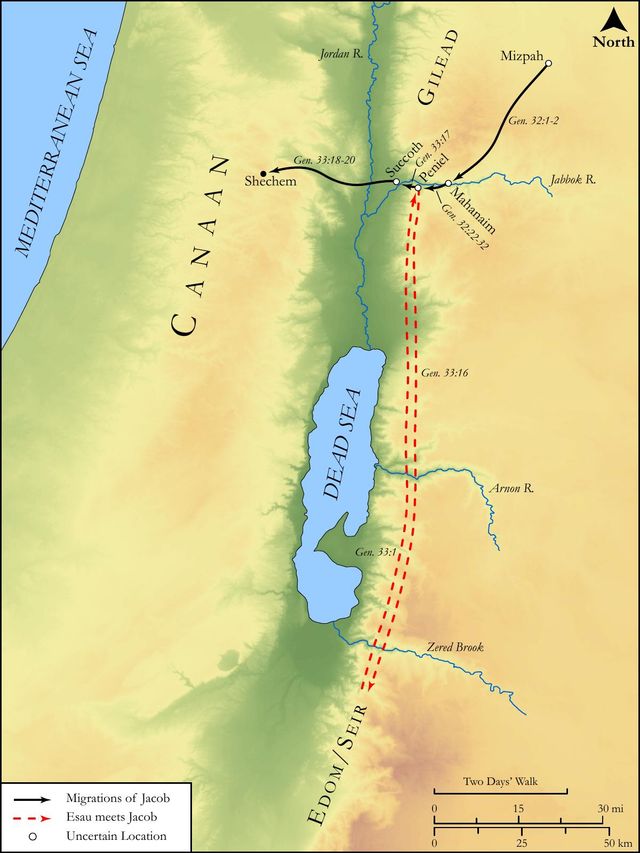
See on the biblical-era maps


Study this verse
Public-domain commentary
Matthew Henry
From his Commentary on the Whole Bible. Henry comments on passages, not single verses — this entry covers Genesis 32:1–2.
Jacob, having got clear of Laban, pursues his journey homewards towards Canaan: when God has helped us through difficulties we should go on our way heaven-ward with so much the more cheerfulness and resolution. Now, 1. Here is Jacob's convoy in his journey (Gen 32:1): The angels of God met him, in a visible appearance, whether in a vision by da or in a dream by night, as when he saw them upon the ladder (Gen 28:12), is uncertain. Note, Those that keep in a good way have always a good guard; angels themselves are ministering spirits for their safety, Heb 1:14. Where Jacob pitched his tents, they pitched theirs about him, Psa 34:7. They met him, to bid him welcome to Canaan again; a more honourable reception this was than ever any prince had, that was met by the magistrates of a city in their formalities. They met him to congratulate him on his arrival, as well as on his escape from Laban; for they have pleasure in the prosperity of God's servants. They had invisibly attended him all along, but now they appeared to him, because he had greater dangers before him than those he had hitherto encountered. Note, When God designs his people for extraordinary trials, he prepares them by extraordinary comforts. We should think it had been more seasonable for these angels to have appeared to him amidst the perplexity and agitation occasioned first by Laban, and afterwards by Esau, than in this calm and quiet interval, when he saw not himself in any imminent peril; but God will have us, when we are in peace, to provide for trouble, and, when trouble comes, to live upon former observations and experiences; for we walk by faith, not by sight. God's people, at death, are returning to Canaan, to their Father's house; and then the angels of God will meet them, to congratulate them on the happy finishing of their servitude, and to carry them to their rest. 2. The comfortable notice he took of this convoy, Gen 32:2. This is God's host, and therefore, (1.) It is a powerful host; very great is he that is thus attended, and very safe that is thus guarded. (2.) God must have the praise of this protection: "This I may thank God for, for it is his host." A good man may with an eye of faith see the same that Jacob saw with his bodily eyes, by believing that promise (Psa 91:11), He shall give his angels charge over thee. What need have we to dispute whether every particular saint has a guardian angel, when we are sure he has a guard of angels about him? To preserve the remembrance of this favour, Jacob gave a name to the place from it, Mahanaim, two hosts, or two camps. That is, say some of the rabbin, one host of the guardian angels of Mesopotamia, who conducted Jacob thence, and delivered him safely to the other host of the angels of Canaan, who met him upon the borders where he now was. Rather, they appeared to him in two hosts, one on either side, or one in the front and the other in the rear, to protect him from Laban behind and Esau before, that they might be a complete guard. Thus he is compassed with God's favour. Perhaps in allusion to this the church is called Mahanaim, two armies, Sol 6:13. Here were Jacob's family, which made one army, representing the church militant and itinerant on earth; and the angels, another army, representing the church triumphant and at rest in heaven.
Historical interpretation
Historical reception
2 surviving comments on this verse. Each one is dated, so this reads as a timeline rather than a list.
(Chapter XXXII.—Verse 1 and 2.) And the angels of God met him, and when Jacob saw them, he said: These are the camps of God, and he called the name of that place Mahanaim. Where these camps were placed, in Hebrew it means Mahanaim (); so that we may know, if it is ever mentioned in another place without interpretation, what place it signifies. And beautifully, as he goes to meet his enemy brother, he is received by choirs of accompanying angels.
(Chapter XXXII, Verse 2) And Sara died in the city of Arboc, which is in the valley: this is Chebron, in the land of Canaan. This that is placed here, which is in the valley, is not found in authentic codices. The name of the city Arboc has also gradually been corrupted by scribes and readers. For it should not be assumed that the Seventy Interpreters translated the name of the Hebrew city in a barbaric and corrupted manner, differently than it is said in its own language. Indeed, 'Arboc' signifies nothing at all. But it is said to be 'Arbee' (that is, four) because there Abraham, Isaac, and Jacob were buried, and also the first of the human race, Adam, as will be more clearly demonstrated in the book of Jesus.
Continue studying Genesis 32:2 across the web’s major study libraries — every link below opens this exact verse, chapter, or book on the destination site.
Read & Compare
 BibleGatewayThis verse in more than 200 translations and 70 languages.
 Bible.comThe YouVersion reader — hundreds of translations, reading plans, and highlights.
 ESV.orgCrossway's official English Standard Version reader.
 NET BibleThe NET translation with 60,000+ translators' notes on every rendering decision.
 STEP BibleTyndale House's free study tool — original text, vocabulary, and scholarly resources.
 BibliaLogos Bible Software's free web reader.
 USCCBThe New American Bible (Revised Edition) with the U.S. bishops' study notes.
Commentaries
 BibleHub CommentariesDozens of classic commentaries on this verse, gathered on one page.
 StudyLightMore than 100 commentary sets — the largest collection on the web.
 BibleRefPlain-English commentary on what this verse means, verse by verse.
 Enduring WordDavid Guzik's free commentary on this chapter, widely used by Bible teachers.
 Bible Study ToolsVerse commentary alongside Greek and Hebrew study aids.
Original Language & Research
- BibleHub InterlinearThe verse word by word — original language, transliteration, and English.
- BibleHub LexiconEvery word's original-language definition and Strong's entry.
 Blue Letter BibleDeep-study tools — Strong's numbers, concordance, and word studies.
 SefariaThe Hebrew text with Rashi and centuries of Jewish commentary.
Sermons, Hymns & Audio


TrulyRandomVerse is not affiliated with these sites and doesn’t control their content. They’re linked because they’re genuinely useful.
Summary
Genesis 32:2 records a pivotal moment in Jacob's journey home, where he encounters a company of angels, recognizing them as "God's host." This divine manifestation provides profound reassurance and prompts Jacob to name the location Mahanaim, meaning "two camps," signifying the visible presence of both his human entourage and the unseen, protective angelic army of God, bolstering his faith before the daunting reunion with his estranged brother Esau.
Context
ShowHideLiterary Context
This verse immediately follows Jacob's departure from Laban's household, marking a significant transition in his life. After twenty years of service and the dramatic reconciliation with Laban in Genesis 31, Jacob is now heading back to Canaan, the land of his birth and God's covenant promises. The narrative builds tension as Jacob anticipates confronting Esau, from whom he fled years earlier after deceitfully obtaining the birthright and blessing. The angelic encounter in Genesis 32:1-2 serves as a divine prelude and source of encouragement, strategically placed just before Jacob's intense fear and wrestling match at Peniel in Genesis 32:22-32, underscoring God's active involvement in his journey and His preparedness to meet Jacob's deepest needs.
Historical & Cultural Context
In the days of the patriarchs, journeys were perilous, fraught with dangers from bandits, wild animals, and hostile tribes. Jacob's return was particularly fraught due to his past actions against Esau, making the threat of a violent confrontation very real. The concept of divine "hosts" or armies was common in the nations' notions of the heavens, often associated with celestial beings or divine warriors who intervened in human affairs. For a patriarch like Jacob, who lived by divine promises, a visible manifestation of God's protective forces would have been a profound affirmation of his covenant relationship and a powerful antidote to his very real anxieties about his brother. The naming of places was also a significant cultural practice, often commemorating a specific event, a divine encounter, or a personal experience that shaped identity or destiny.
Key Themes
ShowHideGenesis 32:2 contributes significantly to several overarching themes within the book of Genesis and the broader patriarchal narrative. It highlights God's Covenant Faithfulness, demonstrating His unwavering commitment to protect and guide Jacob, the heir of the Abrahamic covenant, even in moments of great vulnerability and fear, as promised in Genesis 28:15. The theme of Divine Providence and Protection is powerfully underscored, showing God's active orchestration of events and His provision of unseen, supernatural aid. Furthermore, the verse emphasizes the Significance of Divine Encounters in shaping the lives and faith of the patriarchs, serving as turning points that reaffirm God's presence and purpose, much like Abraham's encounter with Melchizedek in Genesis 14:18-20 or Isaac's reaffirmation of the covenant in Genesis 26:23-25.
Exposition and Analysis
ShowHideKey Word Analysis
ShowHideFrom עָקַב; heel-catcher (i.e. supplanter); Jaakob, the Israelitish patriarch. This name, given at birth, reflects Jacob's nature and early life, marked by cunning and striving (e.g., Genesis 25:26). His encounter at Mahanaim, and later Peniel, are part of God's process of transforming this "supplanter" into "Israel," a prince with God.
From חָנָה; an encampment (of travellers or troops); hence, an army, whether literal (of soldiers) or figurative (of dancers, angels, cattle, locusts, stars; or even the sacred courts). Here, it denotes an organized company, specifically of angels, suggesting a divine army or protective encampment surrounding Jacob.
Dual of מַחֲנֶה; double camp; Machanajim, a place in Palestine. The dual form emphasizes "two camps," signifying both Jacob's physical camp and the divine, angelic camp, highlighting the dual presence and protection.
Verse Breakdown
ShowHide"And when Jacob saw them"
This phrase immediately follows the previous verse, which states that "the angels of God met him." Jacob's "seeing" is not merely physical sight but a recognition of a supernatural reality. This visual encounter is a direct, tangible manifestation of God's presence and active involvement in Jacob's life, occurring at a crucial juncture as he prepares to face his brother Esau.
"he said, This [is] God's host"
Upon seeing this angelic company, Jacob articulates his understanding of what he is witnessing. The term "God's host" (Hebrew: machaneh Elohim) signifies an encampment or army belonging to God. This declaration reveals Jacob's spiritual discernment, recognizing the divine origin and protective nature of this heavenly company, which serves as a powerful reassurance against his fears.
"and he called the name of that place Mahanaim"
Jacob's immediate response to this profound encounter is to name the location. "Mahanaim" (מַחֲנַיִם), meaning "two camps," directly reflects the dual reality he perceives: his own camp and the camp of God's angels. This act of naming commemorates the divine intervention, marking the place as sacred and a perpetual reminder of God's protective presence and faithfulness.
Literary Devices
ShowHideThe verse employs several significant literary devices. The most prominent is Nomenclature (place-naming), where Jacob names the location "Mahanaim" to commemorate a profound spiritual experience. This act of naming is common in Genesis, marking significant encounters with God and imbuing geographical locations with theological meaning. The appearance of "God's host" constitutes an Angelophany, a visible manifestation of angels, which serves as a form of Divine Intervention. This intervention is rich in Symbolism, with the "host" symbolizing God's protective power and His readiness to defend His covenant people. The dual nature of "Mahanaim" also presents a subtle Juxtaposition between the human and divine realms, highlighting their proximity and interaction in Jacob's journey.
Theological and Thematic Connections
ShowHideGenesis 32:2 profoundly illustrates God's active and personal involvement in the lives of His covenant people. It underscores the truth that God is not a distant deity but one who draws near, providing tangible reassurance and protection, especially during moments of anxiety and transition. The appearance of "God's host" serves as a visible affirmation of God's unwavering covenant faithfulness to Jacob, demonstrating that His promises of presence and protection are not abstract but powerfully real. This encounter also highlights the active ministry of angels as agents of God's will, serving and guarding those who are heirs of salvation.
Reflection and Application
ShowHideThe encounter at Mahanaim offers profound spiritual lessons for believers today. Like Jacob, we often find ourselves at critical junctures, facing daunting transitions, past regrets, or uncertain futures. This narrative reminds us that even when our fears are overwhelming and our circumstances seem precarious, God's presence and protection are real and active. The "host" may not always be visible, but the spiritual reality of God's encompassing care, whether through His Spirit, His providential hand, or even unseen angelic ministry, remains constant. We are called to cultivate a spiritual awareness that discerns God's hand in our lives, trusting that He is with us, preparing the way, and providing strength for the challenges ahead. This passage encourages us to lean into God's sovereignty, finding peace in His protective embrace, and to remember that our journey is always accompanied by His faithful presence.
Questions for Reflection
ShowHideFAQ
ShowHideWhat is the significance of the name Mahanaim?
ShowHideMahanaim, a Hebrew dual form, translates to "two camps" or "two companies." Its significance lies in commemorating Jacob's profound encounter with "God's host." The name symbolizes the dual presence of Jacob's own human camp and the divine, angelic camp, emphasizing the visible manifestation of God's protective presence and escort alongside him as he journeyed. It serves as a lasting reminder of God's active involvement and reassurance in a moment of great anxiety for Jacob.
Does "God's host" imply a military force?
ShowHideThe Hebrew term machaneh Elohim (מַחֲנֵה אֱלֹהִים) literally means "camp of God." While "host" can indeed carry military connotations in biblical contexts (e.g., "the host of heaven" often refers to angelic armies or celestial bodies organized like an army, as seen in Joshua 5:14), in this context, it primarily suggests an organized, powerful, and protective angelic company. It underscores God's might and readiness to defend His servant, providing a sense of security rather than implying an imminent physical battle for Jacob at this specific moment.
Christ-Centered Fulfillment
ShowHideWhile Jacob's encounter at Mahanaim offered a powerful, albeit temporary, visible manifestation of God's protective presence through an angelic host, the ultimate and enduring fulfillment of divine companionship and security is found in Jesus Christ. He is the true "God with us" (Immanuel), the one in whom the fullness of God dwells bodily (Colossians 2:9). Unlike a fleeting angelic appearance, Christ's incarnation means that God Himself has tabernacled among humanity, providing a permanent and intimate presence. Through Christ's atoning work, believers are not merely protected by angels but are indwelt by the Holy Spirit, receiving constant divine companionship and an eternal covenant of grace that far surpasses any temporary angelic escort. Furthermore, all angelic hosts are subject to Christ's supreme authority (1 Peter 3:22), ensuring that His people are eternally secure under His sovereign care and that the promise of God's enduring presence is realized in a far more profound and personal way than Jacob could have imagined at Mahanaim.