


Genesis 32:1
Bible text: King James Version (1769 Blayney text) · Public domain
Bible text: Berean Standard Bible · Public domain
Bible text: American Standard Version (1901) · Public domain
Bible text: World English Bible, Messianic edition · Public domain
Bible text: Geneva Bible (1599) · Public domain
Bible text: Young's Literal Translation · Public domain
- וְיַעֲקֹבve·ya·'a·Koand JacobH3290Conj-w ¦ N-proper-mNoun Proper MasculineוְandיַעֲקֹבJacob
- הָלַךְha·Lakhhe wentH1980V-Qal-Perf-3msVerb Qal Perfect 3rd Singular Masculine
- לְדַרְכּוֹle·dar·Koto his wayH1870Prep-l ¦ N-csc ¦ 3msNoun Singular common gender Constructלְtoדַרְכּwayוֹhis
- וַיִּפְגְּעוּvai·yif·ge·'uand they metH6293Conj-w ¦ V-Qal-ConsecImperf-3mpVerb Qal Consecutive Imperfect 3rd Plural Masculineוַandיִּפְגְּעוּthey met
- בוֹvo<in> <the> himPrep-b ¦ 3msSuffix Personal 3rd Singular Masculineב<in> <the>וֹhim
- מַלְאֲכֵיmal·'a·Khei[the] angels ofH4397N-mpcNoun Plural Masculine Construct
- אֱלֹהִים'E·lo·HimGodH430N-mpNoun Plural Masculine Absolute
English is a literal word-by-word gloss of the Hebrew, not the KJV's wording. Why?
This is the original text the KJV's translators worked from — each Hebrew word with its own literal English meaning in this verse, prepared by scholars at Tyndale House, Cambridge. The KJV translates whole sentences, not word by word, so its wording differs: one Hebrew word can become several English words, and the KJV may choose “the LORD” where the gloss reads “Yahweh”. Both are faithful — they answer different questions. For the KJV's own rendering, switch to the KJV text.
Details
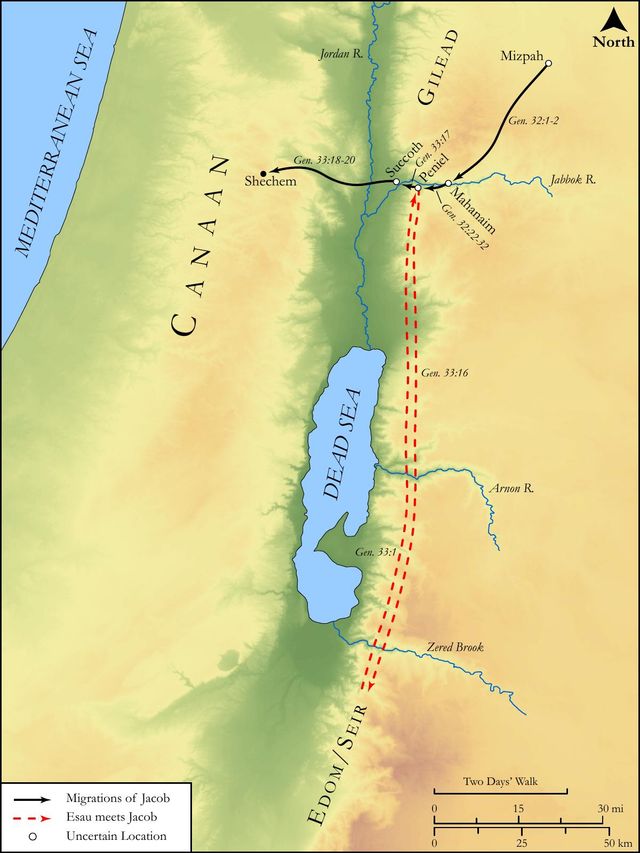
See on the biblical-era maps


Study this verse
Public-domain commentary
Matthew Henry
From his Commentary on the Whole Bible. Henry comments on passages, not single verses — this entry covers Genesis 32:1–2.
Jacob, having got clear of Laban, pursues his journey homewards towards Canaan: when God has helped us through difficulties we should go on our way heaven-ward with so much the more cheerfulness and resolution. Now, 1. Here is Jacob's convoy in his journey (Gen 32:1): The angels of God met him, in a visible appearance, whether in a vision by da or in a dream by night, as when he saw them upon the ladder (Gen 28:12), is uncertain. Note, Those that keep in a good way have always a good guard; angels themselves are ministering spirits for their safety, Heb 1:14. Where Jacob pitched his tents, they pitched theirs about him, Psa 34:7. They met him, to bid him welcome to Canaan again; a more honourable reception this was than ever any prince had, that was met by the magistrates of a city in their formalities. They met him to congratulate him on his arrival, as well as on his escape from Laban; for they have pleasure in the prosperity of God's servants. They had invisibly attended him all along, but now they appeared to him, because he had greater dangers before him than those he had hitherto encountered. Note, When God designs his people for extraordinary trials, he prepares them by extraordinary comforts. We should think it had been more seasonable for these angels to have appeared to him amidst the perplexity and agitation occasioned first by Laban, and afterwards by Esau, than in this calm and quiet interval, when he saw not himself in any imminent peril; but God will have us, when we are in peace, to provide for trouble, and, when trouble comes, to live upon former observations and experiences; for we walk by faith, not by sight. God's people, at death, are returning to Canaan, to their Father's house; and then the angels of God will meet them, to congratulate them on the happy finishing of their servitude, and to carry them to their rest. 2. The comfortable notice he took of this convoy, Gen 32:2. This is God's host, and therefore, (1.) It is a powerful host; very great is he that is thus attended, and very safe that is thus guarded. (2.) God must have the praise of this protection: "This I may thank God for, for it is his host." A good man may with an eye of faith see the same that Jacob saw with his bodily eyes, by believing that promise (Psa 91:11), He shall give his angels charge over thee. What need have we to dispute whether every particular saint has a guardian angel, when we are sure he has a guard of angels about him? To preserve the remembrance of this favour, Jacob gave a name to the place from it, Mahanaim, two hosts, or two camps. That is, say some of the rabbin, one host of the guardian angels of Mesopotamia, who conducted Jacob thence, and delivered him safely to the other host of the angels of Canaan, who met him upon the borders where he now was. Rather, they appeared to him in two hosts, one on either side, or one in the front and the other in the rear, to protect him from Laban behind and Esau before, that they might be a complete guard. Thus he is compassed with God's favour. Perhaps in allusion to this the church is called Mahanaim, two armies, Sol 6:13. Here were Jacob's family, which made one army, representing the church militant and itinerant on earth; and the angels, another army, representing the church triumphant and at rest in heaven.
Historical interpretation
Historical reception
3 surviving comments on this verse. Each one is dated, so this reads as a timeline rather than a list.
Select a marker to jump to its quote. Markers stagger vertically where authors wrote within a few decades of each other.
After Jacob and Laban had parted from each other, “angels of God met Jacob” to make known to him that if Laban did not obey God, who had appeared to him in the evening, he and those with him would be destroyed at dawn by the hands of those angels who protect Jacob. Just as God had shown Jacob the angels that accompanied him when he went down, he also showed him angels when he was going up to make him know that the word was true which God had spoken to him: “I will go down with you, and I will bring you up from there.” The army of angels that God had shown Jacob was so that he would not fear Esau, for there were many more [angels] with Jacob than were with Esau.
You see, once fear of Laban faded and was no more, then fear of his brother took hold of Jacob; so the loving Lord wanted to give the good man heart and drive out all his apprehension. Thus he caused Jacob to see the angels’ camp. “God’s angels accosted him,” the text says, remember. “Jacob said, ‘This is God’s camp,’ and he called that place Camps,” with the result that from the name there was a constant reminder of the vision that occurred to him there.
(Chapter XXXII.—Verse 1 and 2.) And the angels of God met him, and when Jacob saw them, he said: These are the camps of God, and he called the name of that place Mahanaim. Where these camps were placed, in Hebrew it means Mahanaim (); so that we may know, if it is ever mentioned in another place without interpretation, what place it signifies. And beautifully, as he goes to meet his enemy brother, he is received by choirs of accompanying angels.
Continue studying Genesis 32:1 across the web’s major study libraries — every link below opens this exact verse, chapter, or book on the destination site.
Read & Compare
 BibleGatewayThis verse in more than 200 translations and 70 languages.
 Bible.comThe YouVersion reader — hundreds of translations, reading plans, and highlights.
 ESV.orgCrossway's official English Standard Version reader.
 NET BibleThe NET translation with 60,000+ translators' notes on every rendering decision.
 STEP BibleTyndale House's free study tool — original text, vocabulary, and scholarly resources.
 BibliaLogos Bible Software's free web reader.
 USCCBThe New American Bible (Revised Edition) with the U.S. bishops' study notes.
Commentaries
 BibleHub CommentariesDozens of classic commentaries on this verse, gathered on one page.
 StudyLightMore than 100 commentary sets — the largest collection on the web.
 BibleRefPlain-English commentary on what this verse means, verse by verse.
 Enduring WordDavid Guzik's free commentary on this chapter, widely used by Bible teachers.
 Bible Study ToolsVerse commentary alongside Greek and Hebrew study aids.
Original Language & Research
- BibleHub InterlinearThe verse word by word — original language, transliteration, and English.
- BibleHub LexiconEvery word's original-language definition and Strong's entry.
 Blue Letter BibleDeep-study tools — Strong's numbers, concordance, and word studies.
 SefariaThe Hebrew text with Rashi and centuries of Jewish commentary.
Sermons, Hymns & Audio


TrulyRandomVerse is not affiliated with these sites and doesn’t control their content. They’re linked because they’re genuinely useful.
Summary
Genesis 32:1 marks a pivotal transition in Jacob's life, immediately following his departure from Laban and preceding his momentous reconciliation with Esau. As Jacob journeys homeward, facing the daunting prospect of confronting his estranged brother, the sudden and tangible appearance of the angels of God serves as a profound divine affirmation and preparation. This encounter signals God's unwavering presence, providential care, and active involvement in Jacob's life, strengthening him for the trials and transformations that lie ahead.
Context
ShowHideLiterary Context
This verse serves as a crucial bridge between two major narrative arcs in Jacob's story: his contentious departure from Laban's household in Genesis 31 and his impending, fear-filled reunion with Esau, which culminates in the transformative encounter at Peniel in Genesis 32. Having successfully, though contentiously, negotiated his separation from Laban and secured his family and possessions, Jacob is now fully committed to returning to the land of Canaan, the promised inheritance. The appearance of the angels here is strategically placed, occurring just before Jacob sends messengers ahead to Esau, setting the stage for the intense psychological and spiritual preparation Jacob undergoes before facing his brother, and underscoring the divine orchestration of his journey.
Historical & Cultural Context
In the days of the patriarchs, travel was inherently perilous, fraught with dangers from bandits, wild animals, and hostile tribes. Jacob's journey was particularly precarious, as he was returning to a land where his brother Esau, whom he had wronged, held significant power and harbored a long-standing grudge (Genesis 27:41). The concept of divine messengers or angels was well-established in Scripture, often serving as intermediaries between God and humanity, delivering messages, providing protection, or executing divine judgments. For Jacob, a patriarch whose life was often marked by human cunning and struggle, a direct angelic encounter would have carried immense weight, signifying a tangible manifestation of divine oversight and intervention in a world where such spiritual realities were deeply integrated into daily life and understanding.
Key Themes
ShowHideGenesis 32:1 contributes significantly to several overarching themes in the book of Genesis. It powerfully reinforces the theme of Divine Faithfulness and Providence, demonstrating God's unwavering commitment to His covenant promises made to Abraham and Isaac, and reiterated to Jacob at Bethel (Genesis 28:15). The verse also highlights the theme of Divine Protection and Guidance, assuring Jacob (and the reader) that despite the dangers and uncertainties of his journey, he is under the direct watch and care of God. Furthermore, it subtly introduces the theme of Preparation for Transformation, as this angelic encounter precedes Jacob's spiritual wrestling at the Jabbok, suggesting that God actively prepares His servants for significant moments of growth and encounter.
Exposition and Analysis
ShowHideKey Word Analysis
ShowHideThis primitive root signifies "to walk" in a great variety of applications, both literally and figuratively. Here, it denotes Jacob's purposeful continuation of his journey, a deliberate movement towards his homeland. It implies not merely physical locomotion but a progression in his life's trajectory, fulfilling God's command to return.
Derived from a root meaning "to dispatch as a deputy," this word literally means "messenger." When applied to God, as here ("angels of God"), it specifically refers to divine emissaries, celestial beings sent by God to carry out His will, deliver messages, or provide assistance. Their appearance signifies a direct, purposeful manifestation of divine presence.
This primitive root means "to impinge, by accident or violence, or (figuratively) by importunity." In this context, it suggests a direct, purposeful encounter rather than a chance meeting. It implies that the angels actively intercepted or encountered Jacob, emphasizing the divine initiative in this significant interaction.
Verse Breakdown
ShowHide"And Jacob went on his way"
This phrase establishes the immediate context of Jacob's journey. Having concluded his twenty-year sojourn with Laban, Jacob is now purposefully heading towards Canaan, the land of his inheritance and the place where he must confront his past. This "way" (Hebrew: derek) is not just a physical path but also symbolizes the divinely guided trajectory of his life, leading him toward the fulfillment of God's promises.
"and the angels of God met him"
This is the climactic moment of the verse. The sudden and unannounced appearance of "the angels of God" (Hebrew: mal'akhim Elohim) signifies a direct, tangible divine intervention. Unlike his dream at Bethel (Genesis 28:12), this encounter is presented as a physical meeting, providing Jacob with a visible and undeniable sign of God's active presence, protection, and reassurance precisely when he is most vulnerable and apprehensive about facing Esau. It underscores that God is actively involved in his journey and is preparing him for the trials ahead.
Literary Devices
ShowHideThe verse effectively employs Divine Intervention as a central literary device, where God directly intercedes in human affairs through His angelic messengers. This supernatural appearance serves as powerful Foreshadowing, hinting at the significant divine encounters and spiritual struggles Jacob will face shortly, particularly his wrestling match at the Jabbok (Genesis 32:22-32). The narrative also utilizes Juxtaposition, placing Jacob's human apprehension and physical journey immediately alongside a visible manifestation of divine power, thereby highlighting the contrast between human weakness and divine strength. This encounter functions as a crucial Narrative Transition, bridging the story of Jacob's departure from Laban with the dramatic events surrounding his reunion with Esau, and setting a tone of divine oversight for the unfolding drama.
Theological and Thematic Connections
ShowHideGenesis 32:1 powerfully articulates God's unwavering commitment to His covenant people, even amidst their flaws and fears. The appearance of the angels serves as a tangible demonstration of divine faithfulness and providential care, assuring Jacob that he is not alone as he faces the daunting challenges of returning home. This encounter reinforces the truth that God actively watches over and prepares His servants for the trials ahead, providing supernatural reassurance and strength precisely when human resources and courage falter. It underscores the continuity of God's redemptive plan, reminding us that His purposes will prevail, often through means beyond human comprehension or control.
Reflection and Application
ShowHideGenesis 32:1 offers profound encouragement for believers navigating life's transitions and confronting daunting challenges. Just as Jacob faced an uncertain future and the apprehension of meeting Esau, we too encounter moments of fear, anxiety, and doubt when stepping into the unknown or confronting past hurts. This verse serves as a powerful reminder that God's presence is constant, and He often provides tangible signs of His protection, guidance, and reassurance, especially when we are on the verge of significant, difficult situations. It encourages us to trust implicitly in God's unwavering faithfulness, knowing that He goes before us, preparing the way and strengthening us for what lies ahead. When feeling alone or overwhelmed by life's demands, we can draw comfort from the truth that the "angels of God"—His divine messengers and providential care—are actively at work in our lives, providing strength, comfort, and direction for every step of our journey. Our faith is not in the absence of trials, but in the presence of a faithful God who accompanies us through them.
Questions for Reflection
ShowHideFAQ
ShowHideWhy did angels appear to Jacob at this specific point in his journey?
ShowHideThe appearance of angels in Genesis 32:1 is strategically timed to occur just as Jacob is about to face his estranged brother Esau, a deeply feared confrontation. This moment of divine intervention serves as a profound reassurance and preparation, affirming God's continued presence and protection over Jacob. It strengthens his faith and courage for the impending trial, reminding him of the promise God made to him at Bethel to be with him and bring him back to his land (Genesis 28:15). The encounter provides a visible sign of God's active involvement in Jacob's journey precisely when his human anxieties are at their peak.
What is the significance of the phrase "angels of God" compared to just "angels"?
ShowHideThe Hebrew phrase mal'akhim Elohim (מַלְאָכֵי אֱלֹהִים), translated as "angels of God," emphasizes that these are not merely spiritual beings but divine messengers directly sent by God to carry out His specific will. The use of "Elohim" (God) underscores their divine commission, authority, and the fact that their appearance is a direct manifestation of God's active involvement and presence in Jacob's life. It signifies that this is a purposeful, divinely orchestrated encounter rather than a random spiritual sighting.
Was this angelic encounter a physical meeting or a vision?
ShowHideThe text states that the angels "met him," suggesting a tangible, physical encounter rather than a dream or vision. Unlike Jacob's previous encounter with angels in a dream at Bethel (Genesis 28:12), the narrative in Genesis 32:1 presents this as a real-world event. This physical meeting provided concrete, immediate reassurance to Jacob as he physically journeyed towards the potentially dangerous confrontation with Esau, underscoring the reality of God's protective presence.
Christ-Centered Fulfillment
ShowHideWhile Genesis 32:1 describes an Old Testament encounter with angels, it profoundly points forward to Christ as the ultimate fulfillment of God's presence and protection for His people. The divine presence and angelic ministry afforded to Jacob, a key patriarch in the lineage of the Messiah, foreshadows God's perfect and complete care for His people through Jesus Christ. Christ Himself is the ultimate "Messenger of God," the very Word made flesh (John 1:14), through whom God fully reveals Himself and provides salvation. He is superior to all angels (Hebrews 1:4-5) and the One through whom all divine promises find their "Yes" and "Amen" (2 Corinthians 1:20). Just as angels ministered to Jacob to strengthen him for his trials, Christ, our faithful High Priest, continually intercedes for and strengthens believers, assuring them of God's unwavering presence, guidance, and protection through every challenge (Hebrews 7:25). The promise of God's faithfulness to Jacob, ensuring his return and the continuation of his line, ultimately finds its unshakable fulfillment in the new covenant established through Christ, securing an eternal inheritance for all who believe in Him (Ephesians 1:11-14).