


Genesis 31:55
Bible text: King James Version (1769 Blayney text) · Public domain
Bible text: King James Version with Strong's numbers · Public domain
Bible text: Berean Standard Bible · Public domain
Bible text: American Standard Version (1901) · Public domain
Bible text: World English Bible, Messianic edition · Public domain
Bible text: Geneva Bible (1599) · Public domain
Bible text: Young's Literal Translation · Public domain
- וַיַּשְׁכֵּםvai·yash·Kemand he rose earlyH7925Conj-w ¦ V-Hiphil-ConsecImperf-3msVerb Hiphil Consecutive Imperfect 3rd Singular Masculineוַandיַּשְׁכֵּםhe rose early
- לָבָןla·VanLabanH3837N-proper-mNoun Proper Masculine
- בַּבֹּקֶרba·Bo·kerin the morningH1242Prep-b ¦ N-msNoun Singular Masculine Absoluteבַּin theבֹּקֶרmorning
- וַיְנַשֵּׁקvay·na·Shekand he kissedH5401Conj-w ¦ V-Piel-ConsecImperf-3msVerb Piel Consecutive Imperfect 3rd Singular Masculineוַandיְנַשֵּׁקhe kissed
- לְבָנָיוle·va·Nav<to> his sonsH1121Prep-l ¦ N-mpc ¦ 3msNoun Plural Masculine Constructלְ<to>בָנָיsonsוhis
- וְלִבְנוֹתָיוve·liv·no·Tavand <to> his daughtersH1323Conj-w ¦ Prep-l ¦ N-fpc ¦ 3msNoun Plural Feminine Constructוְandלִ<to>בְנוֹתָיdaughtersוhis
- וַיְבָרֶךְvay·Va·rekhand he blessedH1288Conj-w ¦ V-Piel-ConsecImperf-3msVerb Piel Consecutive Imperfect 3rd Singular Masculineוַandיְבָרֶךְhe blessed
- אֶתְהֶם'et·Hem<obj.> themH853DirObjM ¦ 3mpParticle Object Indicatorאֶתְ<obj.>הֶםthem
- וַיֵּלֶךְvai·Ye·lekhand he wentH1980Conj-w ¦ V-Qal-ConsecImperf-3msVerb Qal Consecutive Imperfect 3rd Singular Masculineוַandיֵּלֶךְhe went
- וַיָּשָׁבvai·Ya·shovand he returnedH7725Conj-w ¦ V-Qal-ConsecImperf-3msVerb Qal Consecutive Imperfect 3rd Singular Masculineוַandיָּשָׁבhe returned
- לָבָןla·VanLabanH3837N-proper-mNoun Proper Masculine
- לִמְקֹמוֹlim·ko·Moto his own placeH4725Prep-l ¦ N-msc ¦ 3msNoun Singular Masculine Constructלִtoמְקֹמown placeוֹhis
English is a literal word-by-word gloss of the Hebrew, not the KJV's wording. Why?
This is the original text the KJV's translators worked from — each Hebrew word with its own literal English meaning in this verse, prepared by scholars at Tyndale House, Cambridge. The KJV translates whole sentences, not word by word, so its wording differs: one Hebrew word can become several English words, and the KJV may choose “the LORD” where the gloss reads “Yahweh”. Both are faithful — they answer different questions. For the KJV's own rendering, switch to the KJV text.
Details
See on the biblical-era maps


Study this verse
Public-domain commentary
Matthew Henry
From his Commentary on the Whole Bible. Henry comments on passages, not single verses — this entry covers Genesis 31:43–55. His four-level outline is real structure in the source text, so it is rendered as structure.
We have here the compromising of the matter between Laban and Jacob. Laban had nothing to say in reply to Jacob's remonstrance: he could neither justify himself nor condemn Jacob, but was convicted by his own conscience of the wrong he had done him; and therefore desires to hear no more of the matter He is not willing to own himself in a fault, nor to ask Jacob's forgiveness, and make him satisfaction, as he ought to have done. But,
I.He turns it off with a profession of kindness for Jacob's wives and children (Gen 31:43):
These daughters are my daughters. When he cannot excuse what he has done, he does, in effect, own what he should have done; he should have treated them as his own, but he had counted them as strangers, Gen 31:15. Note, It si common for those who are without natural affection to pretend much to it when it will serve a turn. Or perhaps Laban said this in a vain-glorious say, as one that loved to talk big, and use great swelling words of vanity: "All that thou seest is mine." It was not so, it was all Jacob's, and he had paid dearly for it; yet Jacob let him have his saying, perceiving him coming into a better humour. Note, Property lies near the hearts of worldly people. They love to boast of it, "This is mine, and the other is mine," as Nabal, Sa1 25:11, my bread and my water.
II.He proposes a covenant of friendship between them, to which Jacob readily agrees, without insisting upon Laban's submission, much less his restitution. Note, When quarrels happen, we should be willing to be friends again upon any terms: peace and love are such valuable jewels that we can scarcely buy them too dearly. Better sit down losers than go on in strife. Now observe here,
1.The substance of this covenant. Jacob left it wholly to Laban to settle it. The tenour of it was,
(1.)That Jacob should be a good husband to his wives, that he should not afflict them, nor marry other wives besides them, Gen 31:50. Jacob had never given him any cause to suspect that he would be any other than a kind husband; yet, as if he had, he was willing to come under this engagement. Though Laban had afflicted them himself, yet he will bind Jacob that he shall not afflict them. Note, Those that are injurious themselves are commonly most jealous of others, and those that do not do their own duty are most peremptory in demanding duty from others.
(2.)That he should never be a bad neighbour to Laban, Gen 31:52. It was agreed that no act of hostility should ever pass between them, that Jacob should forgive and forget all the wrongs he had received and not remember them against Laban or his family in after-times. Note, We may resent an injury which yet we may not revenge.
2.The ceremony of this covenant. It was made and ratified with great solemnity, according to the usages of those times.
(1.)A pillar was erected (Gen 31:45), and a heap of stones raised (Gen 31:46), to perpetuate the memory or the ting, the way of recording agreements by writing being then either not known or not used.
(2.)A sacrifice was offered (Gen 31:54), a sacrifice of peace-offerings. Note, Our peace with God is that which puts true comfort into our peace with our friends. If parties contend, the reconciliation of both to him will facilitate their reconciliation one to another.
(3.)They did eat bread together (Gen 31:46), jointly partaking of the feast upon the sacrifice, Gen 31:54. This was in token of a hearty reconciliation. Covenants of friendship were anciently ratified by the parties eating and drinking together. It was in the nature of a love-feast.
(4.)They solemnly appealed to God concerning their sincerity herein,
[1.]As a witness (Gen 31:49): The Lord watch between me and thee, that is, "The Lord take cognizance of every thing that shall be done on either side in violation of this league. When we are out of one another's sight, let his be a restraint upon us, that wherever we are we are under God's eye." This appeal is convertible into a prayer. Friends at a distance from each other may take the comfort of this, that when they cannot know or succour one another God watches between them, and has his eye on them both.
[2.]As a Judge, Gen 31:53. The God of Abraham (from whom Jacob descended), and the God of Nahor (from whom Laban descended), the God of their father (the common ancestor, form whom they both descended), judge betwixt us. God's relation to them is thus expressed to intimate that they worshipped one and the same God, upon which consideration there ought to be no enmity between them. Note, Those that have one God should have one heart: those that agree in religion should strive to agree in every thing else. God is Judge between contending parties, and he will judge righteously; whoever does wrong, it is at his peril.
(5.)They gave a new name to the place, Gen 31:47, Gen 31:48. Laban called it in Syriac, and Jacob in Hebrew, the heap of witness; and (Gen 31:49) it was called Mizpah, a watch-tower. Posterity being included in the league, care was taken that thus the memory of it should be preserved. These names are applicable to the seals of the gospel covenant, which are witnesses to us if we be faithful, but witnesses to us if we be faithful, but witnesses against us if we be false. The name Jacob gave this heap (Galeed) stuck by it, not the name Laban gave it. In all this rencounter, Laban was noisy and full of words, affecting to say much; Jacob was silent, and said little. When Laban appealed to God under many titles, Jacob only swore by the fear of his father Isaac, that is, the God whom his father Isaac feared, who had never served other gods, as Abraham and Nahor had done. Two words of Jacob's were more memorable than all Laban's speeches and vain repetitions: for the words of wise men are heard in quiet, more than the cry of him that ruleth among fools, Ecc 9:17.
Lastly, After all this angry parley, they part friends, Gen 31:55. Laban very affectionately kissed his sons and his daughters, and blessed them, and then went back in peace. Note, God is often better to us than our fears, and strangely overrules the spirits of men in our favour, beyond what we could have expected; for it is not in vain to trust in him.
Historical interpretation
Historical reception
1 surviving comment on this verse from the historical church.
Do you see, dearly beloved, God’s great wisdom in demonstrating his care for the good man, as well as at the same time deterring the other from his injustice and, by forbidding him from speaking evil against Jacob, conducting him gradually to the path of knowledge of God? Though Laban had been pacing about like a wild beast intent on snaring and destroying him, he made his excuses, kissed his daughters and their sons good-bye and returned home.
Continue studying Genesis 31:55 across the web’s major study libraries — every link below opens this exact verse, chapter, or book on the destination site.
Read & Compare
 BibleGatewayThis verse in more than 200 translations and 70 languages.
 Bible.comThe YouVersion reader — hundreds of translations, reading plans, and highlights.
 ESV.orgCrossway's official English Standard Version reader.
 NET BibleThe NET translation with 60,000+ translators' notes on every rendering decision.
 STEP BibleTyndale House's free study tool — original text, vocabulary, and scholarly resources.
 BibliaLogos Bible Software's free web reader.
 USCCBThe New American Bible (Revised Edition) with the U.S. bishops' study notes.
Commentaries
 BibleHub CommentariesDozens of classic commentaries on this verse, gathered on one page.
 StudyLightMore than 100 commentary sets — the largest collection on the web.
 BibleRefPlain-English commentary on what this verse means, verse by verse.
 Enduring WordDavid Guzik's free commentary on this chapter, widely used by Bible teachers.
 Bible Study ToolsVerse commentary alongside Greek and Hebrew study aids.
Original Language & Research
- BibleHub InterlinearThe verse word by word — original language, transliteration, and English.
- BibleHub LexiconEvery word's original-language definition and Strong's entry.
 Blue Letter BibleDeep-study tools — Strong's numbers, concordance, and word studies.
 SefariaThe Hebrew text with Rashi and centuries of Jewish commentary.
Sermons, Hymns & Audio


TrulyRandomVerse is not affiliated with these sites and doesn’t control their content. They’re linked because they’re genuinely useful.
Summary
Genesis 31:55 marks the definitive conclusion of Laban's long and often tumultuous relationship with Jacob, portraying Laban's final, poignant acts of farewell as he kisses and blesses his daughters and grandchildren before departing for his homeland. This verse serves as a critical narrative pivot, signifying the peaceful resolution of their protracted conflict and enabling Jacob to resume his divinely directed journey back to Canaan, unhindered by his father-in-law's influence. It encapsulates a moment of familial closure, despite the underlying history of tension and manipulation.
Context
ShowHideLiterary Context
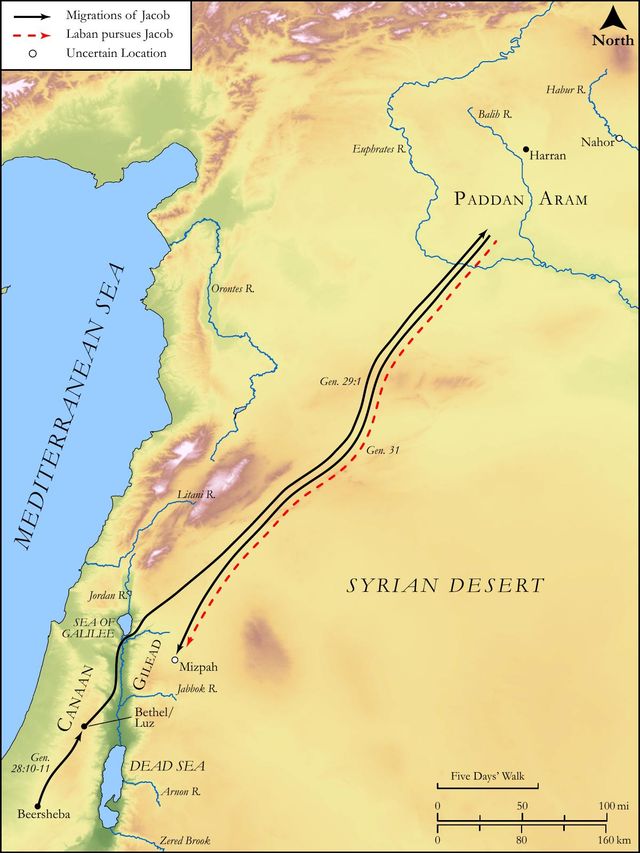
This verse provides the narrative climax and resolution to the extended conflict between Jacob and Laban, which has dominated the preceding chapters. Following Jacob's clandestine departure from Laban's household after two decades of service, as recounted in Genesis 31:17-21, Laban pursued him with hostile intent. However, divine intervention, powerfully described in Genesis 31:24, prevented Laban from harming Jacob. Their subsequent tense confrontation culminated in a covenant of peace and mutual non-aggression established at Mizpah, marked by a pillar and a heap of stones (Genesis 31:44-54). Genesis 31:55, therefore, serves as the final, decisive act of this reconciliation, providing a clear narrative boundary and setting the stage for Jacob's next significant encounters on his homeward journey, particularly with Esau.
Historical & Cultural Context
Among the patriarchs, familial bonds, particularly between a father and his daughters and grandchildren, were profoundly significant, even amidst disputes. The act of "kissing" (H5401, nâshaq) was a common gesture of greeting, farewell, or reconciliation, signifying deep emotion or affection, and often accompanied by a "blessing" (H1288, bârak). Laban's actions reflect these cultural norms for a patriarchal farewell, even if his past behavior had been less than honorable. The concept of "returning unto his place" (H4725, mâqôwm) underscores the importance of one's ancestral land and tribal affiliation in this period, signifying a permanent separation of households and a return to established territories. This formal departure was crucial for ensuring that the covenant made at Mizpah would be honored, preventing future claims or interference.
Key Themes
ShowHideGenesis 31:55 contributes to several overarching themes within the book of Genesis. Foremost is the theme of Divine Providence and Protection, as God's direct intervention in Genesis 31:24 ensures Jacob's safety and the peaceful resolution of the conflict, allowing him to continue his journey toward the promised land. This highlights God's faithfulness to His covenant promises, particularly those made to Jacob at Bethel (Genesis 28:15). The verse also underscores the theme of Reconciliation and Closure, demonstrating that even deeply strained relationships can find a measure of peace and definitive separation, enabling all parties to move forward. Finally, it marks a significant step in Jacob's personal journey of Maturation and Identity Formation, as he is now fully released from Laban's influence, prepared to assume his role as a patriarch and to confront the challenges and blessings awaiting him in Canaan, as promised throughout Genesis.
Exposition and Analysis
ShowHideGenesis 31:55 meticulously records Laban's final actions before his departure, providing a definitive closure to his involvement in Jacob's life.
Key Word Analysis
ShowHideFrom בָּקַר; properly, dawn (as the break of day); generally, morning; ([phrase]) day, early, morning, morrow. This word emphasizes the early hour of Laban's departure, suggesting a decisive and perhaps eager movement to conclude the farewell and return home. It signifies the beginning of a new day, symbolically marking a new chapter for both Laban and Jacob.
A primitive root (identical with נָשַׂק, through the idea of fastening up; compare חָזָק, חָשַׁק); to kiss, literally or figuratively (touch); also (as a mode of attachment), to equip with weapons; armed (men), rule, kiss, that touched. In this context, nâshaq denotes a physical act of affection and farewell. Its inclusion here highlights a complex mix of genuine familial emotion, despite the history of deception and conflict, and adherence to customary farewell rituals.
A primitive root; to kneel; by implication to bless God (as an act of adoration), and (vice-versa) man (as a benefit); also (by euphemism) to curse (God or the king, as treason); [idiom] abundantly, [idiom] altogether, [idiom] at all, blaspheme, bless, congratulate, curse, [idiom] greatly, [idiom] indeed, kneel (down), praise, salute, [idiom] still, thank. Here, bârak signifies a paternal good wish or benediction, conveying a desire for the well-being and prosperity of his daughters and grandchildren. It is a final act of paternal favor and acknowledgment of their departure, implicitly releasing them to their new life with Jacob.
Verse Breakdown
ShowHide"And early in the morning Laban rose up,"
This phrase emphasizes the swift and decisive nature of Laban's departure. The early hour suggests an eagerness to conclude the farewell and return to his own land, signaling the definitive end of his direct involvement in Jacob's life. It underscores the finality of the separation.
"and kissed his sons and his daughters, and blessed them:"
This pivotal clause reveals Laban's final, complex acts of familial affection. "His sons" refers to his grandchildren (Jacob's children), and "his daughters" are Leah and Rachel, Jacob's wives. The act of kissing (H5401, nâshaq) is a customary, intimate gesture of farewell, while "blessed them" (H1288, bârak) signifies a paternal good wish for their well-being. Despite his manipulative past, these actions convey a genuine, albeit complicated, expression of familial love and a formal release.
"and Laban departed, and returned unto his place."
This concluding clause provides the definitive closure to the narrative arc involving Laban. "Departed" (H3212, yâlak) and "returned" (H7725, shûwb) emphasize the physical separation. Laban's return "unto his place" (H4725, mâqôwm), his homeland in Paddan-Aram, marks the complete and permanent separation of the two households. This peaceful parting, orchestrated by divine providence, allows Jacob to continue his journey to Canaan, the land of promise, without further hindrance or obligation to his father-in-law.
Literary Devices
ShowHideThe verse effectively employs Closure and Symbolism. The narrative achieves a profound sense of Closure by meticulously detailing Laban's final actions and his definitive departure. This provides a clear and satisfying end to the long-standing conflict between Jacob and Laban, resolving a major narrative tension that has spanned several chapters. The acts of kissing and blessing, followed by Laban's return "unto his place," are highly Symbolic. They symbolize not just a physical separation but also the severing of Laban's patriarchal influence over Jacob's household. This symbolic act of release is crucial for Jacob to fully embrace his own destiny and leadership as he returns to the land of promise, free from the entanglements and deceptions that characterized his time with Laban.
Theological and Thematic Connections
ShowHideGenesis 31:55, while seemingly a simple narrative conclusion, is rich with theological implications. It powerfully illustrates God's unwavering faithfulness to His covenant promises, particularly His commitment to protect and guide Jacob back to the promised land. Despite the human complexities, deceit, and conflict that characterized Jacob's relationship with Laban, God's sovereign hand is evident in orchestrating a peaceful resolution and ensuring Jacob's safe passage. This verse underscores that God's purposes will prevail, even through challenging human relationships, and that He is capable of bringing forth good and fulfilling His plans regardless of obstacles. The final, albeit imperfect, reconciliation and departure highlight the divine desire for peace and order, even if it means separating paths for the sake of greater spiritual progression.
Reflection and Application
ShowHideGenesis 31:55 offers profound insights into the nature of human relationships, the necessity of closure, and the overarching faithfulness of God. It teaches us that even in relationships marked by deep conflict, manipulation, or strained dynamics, there is a time for definitive farewells and the establishment of boundaries. Laban's final acts of kissing and blessing, despite his history, serve as a powerful reminder of the potential for grace, a measure of reconciliation, and the importance of allowing for proper goodbyes, especially within familial contexts. This passage encourages us to trust in God's faithful guidance through difficult transitions and strained relationships, knowing that He orchestrates events to bring about His purposes and lead us to our intended destinations. It challenges us to consider how we navigate endings in our own lives, whether personal or professional, and to seek God's wisdom in finding peace and moving forward, even when past hurts linger.
Questions for Reflection
ShowHideFAQ
ShowHideWhy did Laban bless his daughters and grandchildren despite his conflict with Jacob?
ShowHideLaban's actions, while seemingly contradictory to his previous anger and pursuit, reflect a complex mix of genuine familial affection and the customary expectations of a patriarchal household. Despite his manipulative nature and conflict with Jacob, these were still his daughters and grandchildren, and the bond was significant. The act of kissing (H5401, nâshaq) and blessing (H1288, bârak) was a customary, formal farewell, conveying good wishes and a paternal benediction. It allowed for a degree of closure and a public acknowledgment of their departure. Furthermore, it aligns with the divine intervention that prevented him from harming Jacob (Genesis 31:24), suggesting a softened heart or at least an acknowledgment of God's hand in the situation, compelling him to act honorably in this final interaction.
What is the significance of Laban "returning unto his place"?
ShowHideLaban "returning unto his place" (H4725, mâqôwm) signifies a definitive and permanent separation. His "place" refers to his homeland in Paddan-Aram, distinct from Canaan, where Jacob was headed. This phrase emphasizes that the chapter of Laban's direct involvement in Jacob's life is irrevocably closed. It allows Jacob to continue his journey unhindered, fulfilling God's command to return to the land of his fathers (Genesis 31:3), and reinforces the idea that each man was to go his own way, respecting the covenant they had just made at Mizpah (Genesis 31:44-54). This geographical and relational separation is crucial for Jacob's future, enabling him to fully embrace his destiny as the patriarch of Israel.
Christ-Centered Fulfillment
ShowHideGenesis 31:55, though depicting a mundane human farewell, subtly points to Christ through its underlying themes of divine guidance, the fulfillment of promises, and ultimate reconciliation. Just as God faithfully led Jacob through years of servitude and conflict, ensuring his safe return to the promised land despite Laban's schemes, so too does Christ, our Good Shepherd, guide His people through the trials and complexities of life, guaranteeing their safe passage to the heavenly inheritance. Laban's final blessing, imperfect and born of complex motives, foreshadows the perfect and eternal blessing found in Jesus Christ, through whom believers are reconciled to God and receive the ultimate inheritance of salvation and eternal life (Ephesians 1:3-7). In Christ, all of God's covenant promises find their "Yes" and "Amen" (2 Corinthians 1:20), far surpassing any earthly blessing or reconciliation. His departure for His "place" (heavenly home) after accomplishing salvation on the cross ensures that His followers can proceed on their journey toward their true, eternal home, free from the bondage of sin and the interference of the adversary (John 14:2-3).