


Old Testament · The Law · Book 1 of 66
Genesis
God creates the world and man falls; after the flood, God calls Abraham, and the promise follows his family through Isaac and Jacob to Joseph in Egypt.
- 50 chapters
- 1,533 verses
- About 2.9 hours to read
- Creation & The Fall, Creation Era
- The Great Flood, Creation Era
- The Tower of Babel, Creation Era
- Abraham: The Covenant, c. 2100–1900 BC
- Jacob, Joseph & Egypt, c. 1900–1700 BC
Genesis begins, “In the beginning God created the heaven and the earth” (1:1), and is built on one word, generations, which heads each part that follows: of the heavens and the earth (2:4), of Adam (5:1), of Noah (6:9), and on to Jacob (37:2). God makes the world good, and the man and woman made in his image break the one command they were given. Judgment follows, in the curse, the flood and the scattering at Babel. Yet the first judgment already holds the first promise: the woman’s seed will bruise the serpent’s head (3:15).
From chapter 12 the book follows one family. God calls Abram out of his country and promises, “in thee shall all families of the earth be blessed” (12:3). The promise passes to Isaac, not Ishmael, and to Jacob, not Esau, and it outlasts the sins of the men who carry it. The book closes with Jacob’s house in Egypt, and Joseph’s last words look past it: “God will surely visit you, and bring you out of this land” (50:24).
And I will bless them that bless thee, and curse him that curseth thee: and in thee shall all families of the earth be blessed.
Genesis 12:3 KJV
Before you read
- Who wrote it
- Not named in the book; traditionally Moses, with the rest of the law. Christ said of Moses, “he wrote of me” (John 5:46). Chrysostom held that Moses,
being born many generations after the event, was guided by the deity on high
to tell of the creation.
How Genesis is laid out
8 movements · 219 passages · 1,533 verses
Six days and the seventh
1:1–2:3 · 34 verses
God creates the heaven and the earth. Over six days his word brings light, the firmament, dry land and plants, the sun, moon and stars, fish and birds, beasts, and last of all man, male and female, made in his image and given dominion. God sees all he has made to be “very good.” On the seventh day he rests, and blesses and sanctifies it.
8 passages
- 1:1–2 The Initial Act of Creation
- 1:3–5 Day One: Light and Darkness
- 1:6–8 Day Two: The Firmament
- 1:9–13 Day Three: Land and Vegetation
- 1:14–19 Day Four: The Celestial Lights
- 1:20–23 Day Five: Birds and Sea Creatures
- 1:24–31 Day Six: Animals and Humanity Created
- 2:1–3 The Seventh Day: God's Rest and Blessing
The garden and the fall
2:4–4:26 · 72 verses
The LORD God forms man of the dust, places him in Eden under one command, and makes the woman from his rib. The serpent deceives the woman; she and Adam eat and are judged, and the curse on the serpent carries the promise of her seed. Driven out, they have sons: Cain kills Abel, and in Seth’s line men call upon the name of the LORD.
13 passages
- 2:4–7 The Account of Man's Creation
- 2:8–14 The Garden of Eden and Its Rivers
- 2:15–17 Man's Mandate and the Prohibition
- 2:18–25 The Creation of Woman and Marriage
- 3:1–5 The Serpent Tempts the Woman
- 3:6–7 The Disobedience and The Fall
- 3:8–13 The Lord God Seeks Out Adam
- 3:14–20 Consequences and Divine Judgment
- 3:21–24 Expulsion from the Garden
- 4:1–7 Cain and Abel Are Born
- 4:8–16 Cain Murders Abel
- 4:17–24 The Line of Cain
- 4:25–26 The Birth of Seth
The flood and the nations
5:1–11:26 · 187 verses
From Adam to Noah each generation closes “and he died,” save Enoch, whom God took. The earth fills with violence; Noah finds grace, builds the ark, and is saved. God covenants never again to flood the earth and sets his bow in the cloud. Noah’s sons spread into nations; at Babel the LORD confounds their one language. Shem’s line runs to Terah.
The call and the covenant
11:27–17:27 · 132 verses
Terah’s household leaves Ur, and at the LORD’s word Abram goes on from Haran to Canaan, promised a great nation and a blessing for all families of the earth. Lot parts from him; Melchizedek blesses him. Abram believes the promise of a son, and it is counted for righteousness. Hagar bears Ishmael. God renames him Abraham and gives circumcision as the sign of the covenant.
The son of promise
18:1–25:18 · 252 verses
The LORD visits Abraham at Mamre and promises Sarah a son. Abraham intercedes for Sodom, which is destroyed; Lot escapes. Isaac is born, and Ishmael is sent away. God tests Abraham, who binds Isaac on the altar, and a ram is offered in his stead. Abraham buries Sarah at Machpelah, sends his servant to find Isaac a wife, and dies full of years.
Jacob, named Israel
25:19–36:43 · 407 verses
Rebekah bears twins, and “the elder shall serve the younger.” Jacob buys Esau’s birthright, takes Isaac’s blessing by deceit, and flees. At Bethel the LORD renews Abraham’s promise to him. In Haran he serves Laban twenty years for Leah, Rachel and flocks, and eleven sons are born. Returning, he wrestles at Peniel and is named Israel, meets Esau in peace, and goes up to Bethel.
12 chapters
- 25 Abraham's Later Descendants
- 26 Isaac and God’s Covenant Reaffirmed
- 27 Isaac Plans to Bless Esau
- 28 Isaac Blesses Jacob and Sends Him Away
- 29 Jacob Arrives in Haran and Meets Rachel
- 30 The Birth Contest Continues: Rachel’s Desperation
- 31 Jacob Prepares to Leave Laban
- 32 Jacob Encounters God's Host at Mahanaim
- 33 Jacob Prepares for the Encounter
- 34 Dinah is Defiled by Shechem
- 35 Jacob Returns to Bethel and Purifies His Household
- 36 Esau’s Family and Relocation
Sold into Egypt
Chapters 37–41 · 169 verses
Israel loves Joseph best, and his brothers hate him for it and for his dreams. They sell him to merchants bound for Egypt, and Jacob mourns him as dead. Judah fathers Pharez and Zarah by Tamar. In Egypt the LORD is with Joseph in Potiphar’s house and in prison. He interprets dreams for Pharaoh’s officers, then for Pharaoh, and is made ruler over all Egypt.
Much people saved alive
Chapters 42–50 · 280 verses
Joseph’s brothers come to buy corn. He knows them, but they know not him, and he tests them until Judah offers himself in Benjamin’s place. Joseph makes himself known, and Jacob’s house of seventy souls settles in Goshen. Jacob blesses Joseph’s sons and his own, and is buried at Machpelah. Joseph forgives his brothers and dies, charging them to carry his bones up when God visits them.
9 chapters
- 42 Jacob Sends Sons to Egypt
- 43 Judah Becomes Surety for Benjamin
- 44 Joseph Plants the Silver Cup
- 45 Joseph Reveals His Identity
- 46 God Assures Jacob at Beersheba
- 47 Joseph Presents His Family to Pharaoh
- 48 Joseph Visits Jacob; The Adoption Declared
- 49 Jacob Gathers His Sons for Prophecy
- 50 Jacob's Embalming and Burial Preparation
The words Genesis turns on
Generations heads each part; seed carries the promise through them. Bless and covenant are God’s gifts; brother runs from Cain to Joseph, good from 1:4 to 50:20.
What Genesis teaches
zeraʻ · seed
The promised seed
The first promise is a promise of seed. God tells the serpent that the woman’s seed “shall bruise thy head” (3:15), and from then on the book follows a line. Eve names Seth, for God “hath appointed me another seed instead of Abel” (4:25). To Abram the LORD says, “Unto thy seed will I give this land” (12:7), and under the stars, “So shall thy seed be” (15:5). God’s word, not birth order, chooses the line: “in Isaac shall thy seed be called” (21:12). After Moriah the oath reaches the nations: “in thy seed shall all the nations of the earth be blessed” (22:18). The same promise is spoken to Isaac (26:4) and to Jacob (28:14).
bᵉrîyth · covenant
Covenant, received by faith
God binds himself by covenant. After the flood he says, “I will establish my covenant with you” (9:11), and sets his bow in the cloud as its token. With Abram the covenant is made over divided animals while a deep sleep is on him (15:12), and only “a smoking furnace, and a burning lamp” pass “between those pieces” (15:17). The promise rests on the LORD alone. Before that covenant, and years before circumcision, Abram “believed in the LORD; and he counted it to him for righteousness” (15:6). Circumcision comes later, as the sign of “an everlasting covenant, to be a God unto thee, and to thy seed after thee” (17:7). Paul builds on that order: Abraham received “the sign of circumcision, a seal of the righteousness of the faith which he had yet being uncircumcised” (Romans 4:11).
ʼâch · brother
My brother’s keeper
Cain answers the LORD with a question: “Am I my brother’s keeper?” (4:9). Brothers in this book seldom keep each other. Esau resolves, “then will I slay my brother Jacob” (27:41). Joseph’s brothers “hated him, and could not speak peaceably unto him” (37:4), and it was Judah who said, “Come, and let us sell him” (37:27). Years later Judah stands surety for Benjamin, and when the cup is found he asks to take the lad’s place: “let thy servant abide instead of the lad a bondman to my lord” (44:33). Then Joseph makes himself known, and “kissed all his brethren, and wept upon them” (45:15). Cain’s question is answered by a brother who offers himself for another.
ṭôwb · good
Evening and morning
Each day of the making closes the same way: “And the evening and the morning were the first day” (1:5), and over the works God saw “that it was good” (1:10), until “behold, it was very good” (1:31). Faithful readers have counted those days differently. Basil read them as days as we count them: Scripture sets a day and a night together, for twenty-four hours fill up the space of one day
, and the law rests the sabbath on them, “in six days the LORD made heaven and earth” (Exodus 20:11). Augustine noted that the first three days passed before the sun was made (1:14–19), and read evening as the completion of the work that was done
and morning as the beginning of the work to come
. Both read the days as the order of God’s own making, by his word.
Christ in Genesis
The New Testament reads Genesis as the opening of Christ’s story. Paul calls Adam “the figure of him that was to come” (Romans 5:14). The woman’s seed who bruises the serpent’s head (3:15) is the Son whom God sent forth, “made of a woman” (Galatians 4:4), manifested “that he might destroy the works of the devil” (1 John 3:8). The promise to Abraham narrows the seed to one: “He saith not, And to seeds, as of many; but as of one, And to thy seed, which is Christ” (Galatians 3:16).
Melchizedek, king of Salem and priest of the most high God, is “made like unto the Son of God” (Hebrews 7:3). Abraham offered Isaac, “accounting that God was able to raise him up, even from the dead; from whence also he received him in a figure” (Hebrews 11:19). Abraham’s son was spared, and a ram was offered “in the stead of his son” (22:13); God “spared not his own Son, but delivered him up for us all” (Romans 8:32). Jacob leaves the sceptre with Judah “until Shiloh come” (49:10), and “our Lord sprang out of Juda” (Hebrews 7:14).
People
By how many verses name them
- JacobSon of Isaac and Rebekah; a brother of Esau187
- AbrahamSon of Terah; a brother of Nahor, Haran and Sarah165
- JosephSon of Israel and Rachel; a brother of Benjamin138
- IsaacA son of Abraham and Sarah74
- EsauSon of Isaac and Rebekah; a brother of Israel67
- Pharaoh61
- LabanSon of Bethuel; a brother of Rebekah; father of Rachel and Leah46
- SarahDaughter of Terah; a sister of Abraham, Nahor and Haran; wife of Abraham; mother of Isaac43
343 more are named.
Places
108 named
- EgyptWhere Abram sojourns in famine, and Joseph rules under Pharaoh76
- CanaanThe land promised to Abraham’s seed, where the fathers live as strangers35
- SodomLot’s city, overthrown with brimstone and fire from the LORD20
- BeershebaWhere Abraham swears with Abimelech, and Isaac builds an altar10
- BethelWhere Jacob dreams of the ladder, and returns to build an altar10
- Paddan-aramLaban’s country, where Jacob serves for his wives10
- Gomorrah9
- GoshenThe land in Egypt where Jacob’s house settles9
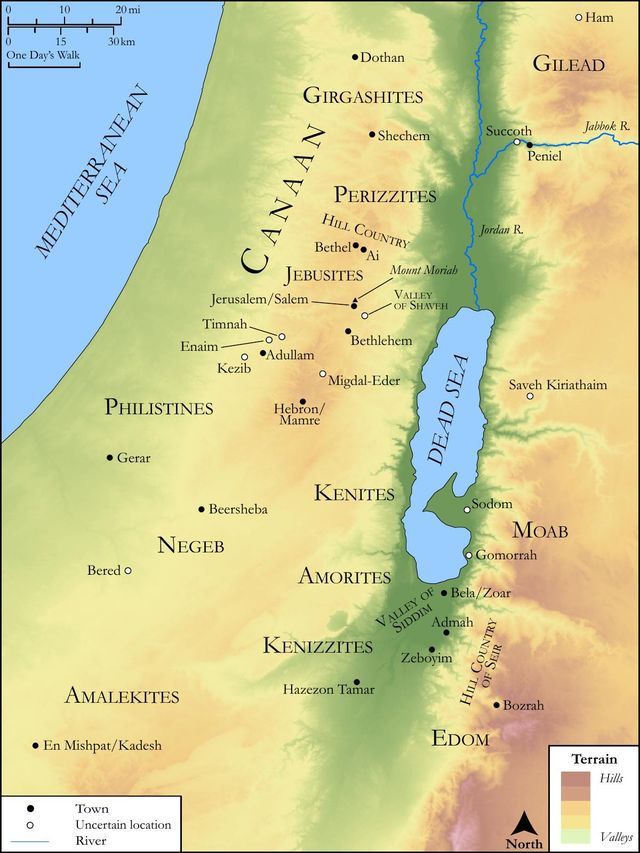
Where Genesis reaches
The passages it leans on, and the ones that lean on it
“In the beginning”: John opens on the first words of Genesis, and names the Word by whom all things were made.
The serpent’s head bruised: the God of peace shall bruise Satan under the feet of his people.
Genesis 15:6 Galatians 3:6 James 2:23
Abraham’s faith counted for righteousness, cited by Paul for justification by faith, and by James beside the offering of Isaac.
Jacob’s ladder: Christ says the angels of God shall ascend and descend upon the Son of man.
What the brothers meant for evil, God meant for good; Paul says all things work together for good to them that love God.
Books Genesis links to most
The Church Fathers on Genesis
2,146 quotations from 66 writers before AD 800 · the ten most quoted, in date order
- Hippolytus235
- Origen253
- Ephrem373
- Basil379
- Ambrose397
- Chrysostom407
- Jerome420
- Augustine430
- Caesarius542
- Bede735
Origen read the first words of Genesis with the first words of John: the beginning is the Word.
What is the beginning of all things except our Lord and “Savior of all,” Jesus Christ “the firstborn of every creature?” In this beginning, therefore, that is, in his Word, “God made heaven and earth” as the evangelist John also says in the beginning of his Gospel: “In the beginning was the Word, and the Word was with God, and the Word was God. The same was in the beginning with God. All things were made by him, and without him nothing was made.”
Clement of Alexandria saw Isaac as a type of the Lord, offered but not slain.
Isaac is another type too … this time of the Lord. He was a son, just as is the Son (he is the son of Abraham; Christ, of God). He was a victim, as was the Lord, but his sacrifice was not consummated, while the Lord’s was. All he did was to carry the wood of his sacrifice, just as the Lord bore the wood of the cross.
Chromatius of Aquileia read Joseph’s rejection and sale as a figure of Christ’s.
Joseph was rejected by his brothers and was received by the Ishmaelites; in the same manner our Lord and Savior was rejected by the Jews and received by the pagans.
Rufinus on the sceptre of Judah, held until the one came to whom the kingdom was reserved.
This passage clearly refers to Judah. It appears that until the birth of Christ there was no lack of princes from the family of Judah or of heads from its sides, until Herod came, who according to the history written by Josephus was a foreigner and usurped the throne of Judea through his plots. As soon as this happened and a head from the sides of Judah was lacking, the one to whom the kingdom had been reserved immediately came.
Keep studying
Articles