


Genesis 37:4
Bible text: King James Version (1769 Blayney text) · Public domain
Bible text: Berean Standard Bible · Public domain
Bible text: American Standard Version (1901) · Public domain
Bible text: World English Bible, Messianic edition · Public domain
Bible text: Geneva Bible (1599) · Public domain
Bible text: Young's Literal Translation · Public domain
- וַיִּרְאוּvai·yir·'Uand they sawH7200Conj-w ¦ V-Qal-ConsecImperf-3mpVerb Qal Consecutive Imperfect 3rd Plural Masculineוַandיִּרְאוּthey saw
- אֶחָיו'e·Chavhis brothersH251N-mpc ¦ 3msNoun Plural Masculine Constructאֶחָיbrothersוhis
- כִּיkithatH3588PrtParticle Conditional
- אֹתוֹ'o·To<obj.> himH853DirObjM ¦ 3msParticle Object Indicatorאֹת<obj.>וֹhim
- אָהַב'a·Havhe lovedH157V-Qal-Perf-3msVerb Qal Perfect 3rd Singular Masculine
- אֲבִיהֶם'a·vi·Hemtheir fatherH1N-msc ¦ 3mpNoun Singular Masculine Constructאֲבִיfatherהֶםtheir
- מִכָּלmi·kolmore than allH3605Prep-m ¦ N-mscNoun Singular Masculine Constructמִmore thanכָּלall
- אֶחָיו'e·Chavhis brothersH251N-mpc ¦ 3msNoun Plural Masculine Constructאֶחָיbrothersוhis
- וַיִּשְׂנְאוּvai·yis·ne·'Uand they hatedH8130Conj-w ¦ V-Qal-ConsecImperf-3mpVerb Qal Consecutive Imperfect 3rd Plural Masculineוַandיִּשְׂנְאוּthey hated
- אֹתוֹ'o·To<obj.> himH853DirObjM ¦ 3msParticle Object Indicatorאֹת<obj.>וֹhim
- וְלֹאve·Lo'and notH3808Conj-w ¦ NegParticle Negativeוְandלֹאnot
- יָכְלוּya·khe·Luthey were ableH3201V-Qal-Perf-3cpVerb Qal Perfect 3rd Plural common gender
- דַּבְּרוֹda·be·Roto speak to himH1696V-Piel-Inf ¦ 3msVerb Piel Infinitive Constructדַּבְּרto speak toוֹhim
- לְשָׁלֹםle·sha·Lomto welfareH7965Prep-l ¦ N-msNoun Singular Masculine Absoluteלְtoשָׁלֹםwelfare
English is a literal word-by-word gloss of the Hebrew, not the KJV's wording. Why?
This is the original text the KJV's translators worked from — each Hebrew word with its own literal English meaning in this verse, prepared by scholars at Tyndale House, Cambridge. The KJV translates whole sentences, not word by word, so its wording differs: one Hebrew word can become several English words, and the KJV may choose “the LORD” where the gloss reads “Yahweh”. Both are faithful — they answer different questions. For the KJV's own rendering, switch to the KJV text.
Details
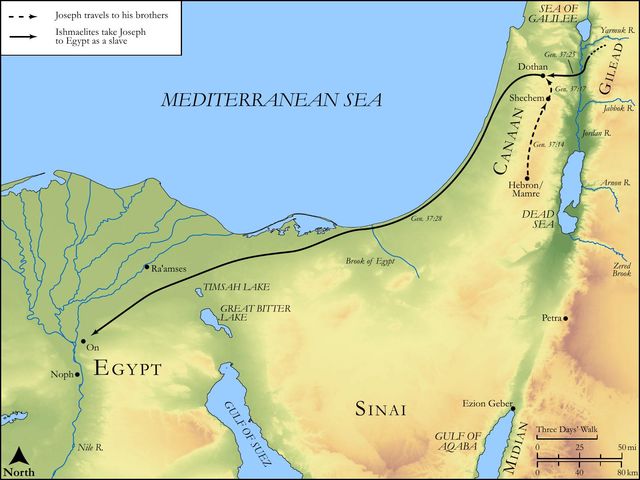
See on the biblical-era maps


Study this verse
Public-domain commentary
Matthew Henry
From his Commentary on the Whole Bible. Henry comments on passages, not single verses — this entry covers Genesis 37:1–4.
Moses has no more to say of the Edomites, unless as they happen to fall in Israel's way; but now applies himself closely to the story of Jacob's family: These are the generations of Jacob. His is not a bare barren genealogy as that of Esau (Gen 36:1), but a memorable useful history. Here is, 1. Jacob a sojourner with his father Isaac, who has yet living, Gen 37:1. We shall never be at home, till we come to heaven. 2. Joseph, a shepherd, feeding the flock with his brethren, Gen 37:2. Though he was his father's darling, yet he was not brought up in idleness or delicacy. Those do not truly love their children that do not inure them to business, and labour, and mortification. The fondling of children is with good reason commonly called the spoiling of them. Those that are trained up to do nothing are likely to be good for nothing. 3. Joseph beloved by his father (Gen 37:3), partly for his dear mother's sake that was dead, and partly for his own sake, because he was the greatest comfort of his old age; probably he waited on him, and was more observant of him than the rest of his sons; he was the son of the ancient so some; that is, when he was a child, he was as grave and discreet as if he had been an old man, a child, but not childish. Jacob proclaimed his affection to him by dressing him finer than the rest of his children: He made him a coat of divers colours, which probably was significant of further honors intended him. Note, Though those children are happy that have that in them which justly recommends them to their parents' particular love, yet it is the prudence of parents not to make a difference between one child and another, unless there be a great and manifest cause given for it by the children's dutifulness or undutifulness; paternal government must be impartial, and managed with a steady hand. 4. Joseph hated by his brethren, (1.) Because his father loved him; when parents make a difference, children soon take notice of it, and it often occasions feuds and quarrels in families. (2.) Because he brought to his father their evil report. Jacob's sons did that, when they were from under his eye, which they durst not have done if they had been at home with him; but Joseph gave his father an account of their bad carriage, that he might reprove and restrain them; not as a malicious tale-bearer, to sow discord, but as a faithful brother, who, when he durst not admonish them himself, represented their faults to one that had authority to admonish them. Note, [1.] It is common for friendly monitors to be looked upon as enemies. Those that hate to be reformed hate those that would reform them, Pro 9:8. [2.] It is common for those that are beloved of God to be hated by the world; whom Heaven blesses, hell curses. To those to whom God speaks comfortably wicked men will not speak peaceably. It is said here of Joseph, the lad was with the sons of Bilhah; some read it, and he was servant to them, they made him their drudge.
Historical interpretation
Historical reception
3 surviving comments on this verse. Each one is dated, so this reads as a timeline rather than a list.
Select a marker to jump to its quote. Markers stagger vertically where authors wrote within a few decades of each other.
Envy is a terrible passion, you see, and when it affects the soul, it does not leave it before bringing it to an extremely sorry state. [It damages] the soul that gives it birth and affect[s] the object of its envy in the opposite way to that intended, rendering him more conspicuous, more esteemed, more famous—which in turn proves another severe blow to the envious person. Notice at any rate in this instance how this remarkable man is depicted as ignorant of what was going on and conversing cheerfully in great simplicity with them as his brothers who had caused the same birth pangs as he.… They for their part were in the grip of the passion of envy and were thus brought to hate him.
And Joseph was loved by his father a great deal. And he gave him a multicolored garment as an excellent gift and a proof of the love with which he accompanied him. And this was an incentive to envy for his brothers and a cause of hatred, as the following events will demonstrate. In fact, the Pharisees were inflamed with anger against the beloved, that is, Christ, because he had been clothed by God the Father with a multiform glory. He was admirable in different forms, partly as a vivifying God, partly as a light that was able to illuminate those who were in the darkness, and to purify the lepers, and to raise from the dead those who were already decomposing, and to reprove the seas and to be carried on the waves through his power. And the Jews being in difficulty and burning with the flames of envy, said to each other, “What are we to do? This man is performing many signs.” The multicolored garment is the symbol of the multiform glory with which God the Father clothed the Son made similar to us through his human nature. However, with regard to his own nature, he himself is the Lord of glory, even though, because of the likeness he has with us, he says, “Father, glorify your Son.” Therefore for the reasons that I have examined, the sons of the concubines were induced to anger and envy and became suspicious after the dream was related. Since they knew in advance that in time they would have become subjects to their brother and would have adored him, and he would have been superior to them by far and would have been brought to such a glory to be adored by their own parents, they gnashed their teeth and planned to kill him. And so the Jews were angered too, and not less afflicted, since they understood that the Immanuel would have been superior to the holy patriarchs themselves and would have been necessarily adored by all the people and indeed by the whole world. And being aware of this, they said, “This is the heir; come, let us kill him, and the inheritance will be ours.”
It is written concerning blessed Joseph, dearly beloved, that his brothers envied him and therefore “could not even greet him.” It is true, beloved brothers, that so dangerous is the disease of envy that it cannot even spare brothers, not to mention strangers. Indeed, at the very beginning of the world Cain, a wicked brother, killed the just Abel through envy. Holy and faithful Joseph then was shown to be a more just servant of the Lord because of his tribulations. Through envy he was first sold by his brothers to the Ishmaelites as a slave, and after having been sold by the very people by whom he had seen himself worshiped, he was later handed over to an Egyptian master.
Continue studying Genesis 37:4 across the web’s major study libraries — every link below opens this exact verse, chapter, or book on the destination site.
Read & Compare
 BibleGatewayThis verse in more than 200 translations and 70 languages.
 Bible.comThe YouVersion reader — hundreds of translations, reading plans, and highlights.
 ESV.orgCrossway's official English Standard Version reader.
 NET BibleThe NET translation with 60,000+ translators' notes on every rendering decision.
 STEP BibleTyndale House's free study tool — original text, vocabulary, and scholarly resources.
 BibliaLogos Bible Software's free web reader.
 USCCBThe New American Bible (Revised Edition) with the U.S. bishops' study notes.
Commentaries
 BibleHub CommentariesDozens of classic commentaries on this verse, gathered on one page.
 StudyLightMore than 100 commentary sets — the largest collection on the web.
 BibleRefPlain-English commentary on what this verse means, verse by verse.
 Enduring WordDavid Guzik's free commentary on this chapter, widely used by Bible teachers.
 Bible Study ToolsVerse commentary alongside Greek and Hebrew study aids.
Original Language & Research
- BibleHub InterlinearThe verse word by word — original language, transliteration, and English.
- BibleHub LexiconEvery word's original-language definition and Strong's entry.
 Blue Letter BibleDeep-study tools — Strong's numbers, concordance, and word studies.
 SefariaThe Hebrew text with Rashi and centuries of Jewish commentary.
Sermons, Hymns & Audio


TrulyRandomVerse is not affiliated with these sites and doesn’t control their content. They’re linked because they’re genuinely useful.
Summary
Genesis 37:4 vividly portrays the immediate and destructive consequences of Jacob's overt favoritism towards his son Joseph. This verse reveals the profound animosity that festered among Joseph's brothers, culminating in an intense hatred that rendered them utterly incapable of civil or peaceful communication with him, setting the stage for the dramatic events that follow in the Joseph narrative.
Context
ShowHideLiterary Context
This verse serves as the critical turning point in the early chapters of the Joseph narrative (Genesis 37-50). Immediately preceding it, Genesis 37:3 establishes Jacob's preferential love for Joseph, expressed through the gift of a special "coat of many colours." This act of favoritism, coupled with Joseph's role as a "reporter" of his brothers' misdeeds to Jacob (Genesis 37:2), creates a volatile familial environment. Verse 4 then directly articulates the brothers' visceral reaction to this favoritism, explaining their hatred and inability to interact peaceably, which directly precipitates Joseph's dreams in Genesis 37:5-11, further intensifying their animosity and leading to the plot to kill him in Genesis 37:18-20.
Historical & Cultural Context
Among the patriarchs, the concept of primogeniture (the right of the firstborn son to inherit the family headship and a double portion of the inheritance) was generally paramount. Jacob's blatant favoritism towards Joseph, the firstborn of his beloved wife Rachel (who had died in childbirth with Benjamin, as recounted in Genesis 35:16-19), over his elder sons, particularly Reuben, Simeon, and Levi, was a significant deviation from established norms. The special tunic (often translated "coat of many colours" or "long robe with sleeves") symbolized status, authority, and perhaps even an intention to grant Joseph the rights of the firstborn, further fueling the brothers' resentment and perceived injustice within the family hierarchy. This context highlights the profound cultural offense and threat to their standing that the brothers experienced.
Key Themes
ShowHideGenesis 37:4 introduces several pivotal themes that resonate throughout the Joseph narrative and the broader book of Genesis. It underscores the destructive power of familial discord and favoritism, a recurring motif in Genesis, seen also in the stories of Cain and Abel (Genesis 4) and Isaac and Ishmael (Genesis 21:8-21). The verse also highlights the corrosive nature of jealousy and hatred, demonstrating how these unchecked emotions can lead to profound brokenness in relationships. Furthermore, it subtly introduces the theme of divine sovereignty working through human sin and brokenness, as the brothers' sinful actions, born of this hatred, will ultimately become the means through which God's redemptive plan for Jacob's family and the nascent nation of Israel will unfold, a theme explicitly articulated later in Genesis 50:20.
Exposition and Analysis
ShowHideKey Word Analysis
ShowHideA primitive root meaning "to have affection for (sexually or otherwise)." Here, it denotes Jacob's deep, preferential affection for Joseph, which was openly displayed and perceived by his brothers. This "love" was not merely a feeling but manifested in actions (like the special coat), creating visible partiality that incited resentment.
A primitive root meaning "to hate (personally)." This term signifies a profound, active, and personal animosity. It is a strong verb indicating not just dislike but a deep-seated, consuming abhorrence that motivated their subsequent actions against Joseph.
Meaning "safe, i.e. (figuratively) well, happy, friendly; also (abstractly) welfare, i.e. health, prosperity, peace." In this context, "speak peaceably" (literally "speak to peace" or "speak with shalom") implies the inability to engage in any form of civil, respectful, or well-wishing communication. Their hatred was so absolute that they could not even offer a perfunctory greeting that conveyed goodwill or acknowledged Joseph's well-being.
Verse Breakdown
ShowHide"And when his brethren saw that their father loved him more than all his brethren"
This clause establishes the direct cause of the brothers' animosity. Their hatred was not arbitrary but a direct, observable response to Jacob's blatant favoritism. The phrase "more than all his brethren" emphasizes the extreme nature of this partiality, making it impossible for the brothers to ignore or rationalize. Their "seeing" implies not just observation but a deep, resentful awareness of their father's unequal affection.
"they hated him"
This is the immediate and powerful consequence of the perceived favoritism. The verb "hated" (Hebrew: vayyisne'u) signifies a deep, personal, and active animosity. This hatred was not a fleeting emotion but a consuming passion that would drive their future actions, including the plot to get rid of Joseph.
"and could not speak peaceably unto him"
This concluding phrase underscores the depth and totality of their hatred. The inability to "speak peaceably" (Hebrew: velo yakhelu dabbero leshalom) means they were incapable of even basic civil discourse or offering a greeting of goodwill. Their animosity had completely severed any possibility of healthy familial interaction, signifying a profound breakdown in relationship and a refusal to acknowledge Joseph's well-being or standing.
Literary Devices
ShowHideThe verse effectively employs several literary devices to convey its powerful message. Contrast is central, highlighting the stark opposition between Jacob's overwhelming love for Joseph and the brothers' intense hatred. This emotional polarity sets the stage for the narrative's conflict. Foreshadowing is also evident, as the brothers' deep animosity and inability to communicate peaceably hint at the violent actions they will soon take against Joseph, such as plotting his death and selling him into slavery. Furthermore, the phrase "could not speak peaceably unto him" functions as a form of hyperbole, emphasizing the extreme and all-consuming nature of their hatred, suggesting that their animosity was so profound it literally rendered them incapable of even the most basic civil interaction, thereby stressing the complete breakdown of familial harmony.
Theological and Thematic Connections
ShowHideGenesis 37:4 serves as a stark reminder of the destructive power of human sin, particularly as it manifests in familial relationships. It illustrates how parental favoritism, though seemingly an act of love, can sow seeds of deep resentment, jealousy, and hatred among siblings, leading to profound relational brokenness. The brothers' inability to "speak peaceably" to Joseph highlights how unchecked animosity can completely sever communication, a vital component of healthy relationships, and prevent any possibility of reconciliation or harmony. This verse, therefore, underscores the pervasive nature of sin's effects on human interaction, setting the stage for God's sovereign plan to work through these very human failings to bring about His redemptive purposes, ultimately demonstrating His ability to transform even the deepest betrayals into instruments of salvation and blessing.
Reflection and Application
ShowHideGenesis 37:4 offers profound insights for contemporary reflection and application, particularly concerning family dynamics and the corrosive nature of unchecked emotions. It serves as a potent warning against the perils of favoritism, whether within families, workplaces, or communities, demonstrating how it can breed deep-seated resentment and division. The brothers' intense hatred and their subsequent inability to communicate peaceably with Joseph powerfully illustrate how jealousy and animosity, when left unaddressed, can consume individuals and destroy relationships, leading to a complete breakdown of compassion and civility. This verse challenges us to examine our own hearts for any seeds of envy or hatred, urging us to confront these destructive emotions before they fester and lead to irreparable harm. Furthermore, it underscores the critical importance of fostering open, honest, and respectful communication, even in the face of conflict, recognizing that the breakdown of dialogue is often a symptom of deeper relational brokenness that must be addressed for true healing and reconciliation to occur.
Questions for Reflection
ShowHideFAQ
ShowHideWhat does 'could not speak peaceably unto him' truly imply beyond a lack of friendly conversation?
ShowHideThe phrase "could not speak peaceably unto him" (Hebrew: velo yakhelu dabbero leshalom) implies a profound and active refusal to engage with Joseph in any manner that conveyed goodwill, respect, or acknowledgment of his well-being. The Hebrew word shalom (H7965) is far richer than just "peace"; it encompasses wholeness, well-being, prosperity, and harmony. Therefore, the brothers' hatred was so deep that they were literally incapable of addressing Joseph with any measure of positive regard, civility, or even a basic greeting that wished him well. It signifies a complete and intentional severance of familial harmony, demonstrating the depth of their animosity and their active rejection of Joseph's presence and person.
Christ-Centered Fulfillment
ShowHideThe narrative of Joseph, initiated by the profound rejection and hatred expressed in Genesis 37:4, serves as a compelling and multifaceted foreshadowing of Jesus Christ. Just as Joseph was hated and rejected by his own brethren, sold for a price, and seemingly abandoned to a life of suffering, so too was Christ rejected by His own people, the Jewish nation, who "received him not" (John 1:11). He was betrayed by a close associate for silver (Matthew 26:14-16), and suffered unjustly at the hands of those He came to save. Yet, in a remarkable parallel, just as Joseph's suffering and eventual exaltation in Egypt led to the salvation and reconciliation of his family from famine, so too did Christ's suffering, crucifixion, and resurrection lead to the ultimate salvation and reconciliation of all humanity to God (Romans 5:8). Through His sacrifice, Christ, like Joseph, demonstrated God's sovereign ability to work through the darkest human sin and betrayal to accomplish His redemptive purposes, ultimately offering forgiveness and restoration, echoing Joseph's eventual reconciliation with his brothers in Genesis 45:15 and Genesis 50:20.