


Genesis 37:2
Bible text: King James Version (1769 Blayney text) · Public domain
Bible text: King James Version with Strong's numbers · Public domain
Bible text: Berean Standard Bible · Public domain
Bible text: American Standard Version (1901) · Public domain
Bible text: World English Bible, Messianic edition · Public domain
Bible text: Geneva Bible (1599) · Public domain
Bible text: Young's Literal Translation · Public domain
- אֵלֶּה'E·lehtheseH428PrtParticle Demonstrative
- תֹּלְדוֹתto·le·Dot[are] [the] accounts ofH8435N-fpcNoun Plural Feminine Construct
- יַעֲקֹבya·'a·KoJacobH3290N-proper-mNoun Proper Masculine
- יוֹסֵףyo·SefJosephH3130N-proper-mNoun Proper Masculine
- בֶּןben[was] a son ofH1121N-mscNoun Singular Masculine Construct
- שְׁבַעshe·va'seven-H7651Adj-cscAdjective Numerical Singular common gender Construct
- עֶשְׂרֵה'es·RehteenH6240Adj-csAdjective Numerical Singular common gender Absolute
- שָׁנָהsha·Nahyear[s]H8141N-fsNoun Singular Feminine Absolute
- הָיָהha·Yahhe wasH1961V-Qal-Perf-3msVerb Qal Perfect 3rd Singular Masculine
- רֹעֶהro·'EhshepherdingH7462V-Qal-Prtcpl-msVerb Qal Participle Singular Masculine Absolute
- אֶת'etwithH854PrepPreposition
- אֶחָיו'e·Chavhis brothersH251N-mpc ¦ 3msNoun Plural Masculine Constructאֶחָיbrothersוhis
- בַּצֹּאןba·Tzon<in> the flockH6629Prep-b ¦ N-csNoun Singular common gender Absoluteבַּ<in> theצֹּאןflock
- וְהוּאve·Hu'and heH1931Conj-w ¦ Pro-3msPronoun Personal 3rd Singular Masculineוְandהוּאhe
- נַעַרNa·'ar[was] a youthH5288N-msNoun Singular Masculine Absolute
- אֶת'etwithH854PrepPreposition
- בְּנֵיbe·Nei[the] sons ofH1121N-mpcNoun Plural Masculine Construct
- בִלְהָהvil·HahBilhahH1090N-proper-fNoun Proper Feminine
- וְאֶתve·'Etand withH854Conj-w ¦ PrepPrepositionוְandאֶתwith
- בְּנֵיbe·Nei[the] sons ofH1121N-mpcNoun Plural Masculine Construct
- זִלְפָּהzil·PahZilpahH2153N-proper-fNoun Proper Feminine
- נְשֵׁיne·Shei[the] wives ofH802N-mpcNoun Plural Masculine Construct
- אָבִיו'a·Vivhis fatherH1N-msc ¦ 3msNoun Singular Masculine Constructאָבִיfatherוhis
- וַיָּבֵאvai·ya·Ve'and he broughtH935Conj-w ¦ V-Hiphil-ConsecImperf-3msVerb Hiphil Consecutive Imperfect 3rd Singular Masculineוַandיָּבֵאhe brought
- יוֹסֵףyo·SefJosephH3130N-proper-mNoun Proper Masculine
- אֶת'et<obj.>H853DirObjMParticle Object Indicator
- דִּבָּתָםdi·ba·Tamtheir reportH1681N-fsc ¦ 3mpNoun Singular Feminine Constructדִּבָּתָreportםtheir
- רָעָהra·'AhbadH7451Adj-fsAdjective Singular Feminine Absolute
- אֶל'eltoH413PrepPreposition
- אֲבִיהֶם'a·vi·Hemtheir fatherH1N-msc ¦ 3mpNoun Singular Masculine Constructאֲבִיfatherהֶםtheir
English is a literal word-by-word gloss of the Hebrew, not the KJV's wording. Why?
This is the original text the KJV's translators worked from — each Hebrew word with its own literal English meaning in this verse, prepared by scholars at Tyndale House, Cambridge. The KJV translates whole sentences, not word by word, so its wording differs: one Hebrew word can become several English words, and the KJV may choose “the LORD” where the gloss reads “Yahweh”. Both are faithful — they answer different questions. For the KJV's own rendering, switch to the KJV text.
Details
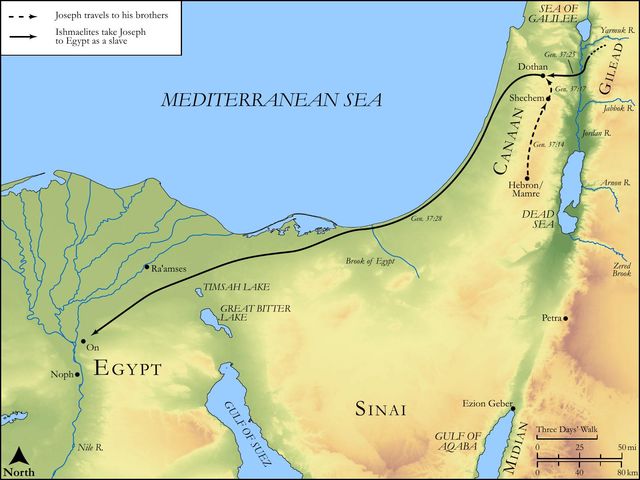
See on the biblical-era maps


Study this verse
Public-domain commentary
Matthew Henry
From his Commentary on the Whole Bible. Henry comments on passages, not single verses — this entry covers Genesis 37:1–4.
Moses has no more to say of the Edomites, unless as they happen to fall in Israel's way; but now applies himself closely to the story of Jacob's family: These are the generations of Jacob. His is not a bare barren genealogy as that of Esau (Gen 36:1), but a memorable useful history. Here is, 1. Jacob a sojourner with his father Isaac, who has yet living, Gen 37:1. We shall never be at home, till we come to heaven. 2. Joseph, a shepherd, feeding the flock with his brethren, Gen 37:2. Though he was his father's darling, yet he was not brought up in idleness or delicacy. Those do not truly love their children that do not inure them to business, and labour, and mortification. The fondling of children is with good reason commonly called the spoiling of them. Those that are trained up to do nothing are likely to be good for nothing. 3. Joseph beloved by his father (Gen 37:3), partly for his dear mother's sake that was dead, and partly for his own sake, because he was the greatest comfort of his old age; probably he waited on him, and was more observant of him than the rest of his sons; he was the son of the ancient so some; that is, when he was a child, he was as grave and discreet as if he had been an old man, a child, but not childish. Jacob proclaimed his affection to him by dressing him finer than the rest of his children: He made him a coat of divers colours, which probably was significant of further honors intended him. Note, Though those children are happy that have that in them which justly recommends them to their parents' particular love, yet it is the prudence of parents not to make a difference between one child and another, unless there be a great and manifest cause given for it by the children's dutifulness or undutifulness; paternal government must be impartial, and managed with a steady hand. 4. Joseph hated by his brethren, (1.) Because his father loved him; when parents make a difference, children soon take notice of it, and it often occasions feuds and quarrels in families. (2.) Because he brought to his father their evil report. Jacob's sons did that, when they were from under his eye, which they durst not have done if they had been at home with him; but Joseph gave his father an account of their bad carriage, that he might reprove and restrain them; not as a malicious tale-bearer, to sow discord, but as a faithful brother, who, when he durst not admonish them himself, represented their faults to one that had authority to admonish them. Note, [1.] It is common for friendly monitors to be looked upon as enemies. Those that hate to be reformed hate those that would reform them, Pro 9:8. [2.] It is common for those that are beloved of God to be hated by the world; whom Heaven blesses, hell curses. To those to whom God speaks comfortably wicked men will not speak peaceably. It is said here of Joseph, the lad was with the sons of Bilhah; some read it, and he was servant to them, they made him their drudge.
Historical interpretation
Historical reception
1 surviving comment on this verse from the historical church.
Why does he also indicate to us Joseph’s age? For you to learn that his youth constituted no obstacle to virtue and for you to have a complete awareness of the young man’s obedience to his father and his sympathy for his brothers despite their savagery. Despite his being so well disposed to them, Joseph was unable to win them over to concord with him on the grounds of his youth so as to be willing to maintain the bond of love. Instead, they saw from the outset the youth’s inclination to virtue and the father’s favor for him and were prompted to envy him. You see, “they brought false reports about Joseph to their father Israel.”
Continue studying Genesis 37:2 across the web’s major study libraries — every link below opens this exact verse, chapter, or book on the destination site.
Read & Compare
 BibleGatewayThis verse in more than 200 translations and 70 languages.
 Bible.comThe YouVersion reader — hundreds of translations, reading plans, and highlights.
 ESV.orgCrossway's official English Standard Version reader.
 NET BibleThe NET translation with 60,000+ translators' notes on every rendering decision.
 STEP BibleTyndale House's free study tool — original text, vocabulary, and scholarly resources.
 BibliaLogos Bible Software's free web reader.
 USCCBThe New American Bible (Revised Edition) with the U.S. bishops' study notes.
Commentaries
 BibleHub CommentariesDozens of classic commentaries on this verse, gathered on one page.
 StudyLightMore than 100 commentary sets — the largest collection on the web.
 BibleRefPlain-English commentary on what this verse means, verse by verse.
 Enduring WordDavid Guzik's free commentary on this chapter, widely used by Bible teachers.
 Bible Study ToolsVerse commentary alongside Greek and Hebrew study aids.
Original Language & Research
- BibleHub InterlinearThe verse word by word — original language, transliteration, and English.
- BibleHub LexiconEvery word's original-language definition and Strong's entry.
 Blue Letter BibleDeep-study tools — Strong's numbers, concordance, and word studies.
 SefariaThe Hebrew text with Rashi and centuries of Jewish commentary.
Sermons, Hymns & Audio


TrulyRandomVerse is not affiliated with these sites and doesn’t control their content. They’re linked because they’re genuinely useful.
Summary
Genesis 37:2 serves as the narrative's pivot, introducing Joseph, a seventeen-year-old, tending his father's flocks alongside his half-brothers, the sons of Bilhah and Zilpah. This verse immediately establishes the complex and fractious family dynamics within Jacob's household, highlighting Joseph's youth and his controversial act of bringing an "evil report" about his brothers to their father, Jacob. This seemingly minor incident is a crucial catalyst, setting the stage for the intense sibling rivalry, profound betrayal, and subsequent dramatic events that will shape Joseph's life and the destiny of the nascent nation of Israel.
Context
ShowHideLiterary Context
Genesis 37:2 initiates a new narrative section marked by the crucial toledot (generations) formula: "These are the generations of Jacob." This recurring structural device throughout Genesis (e.g., Genesis 2:4, Genesis 5:1) signals a shift in focus to a new genealogical line and its unfolding history. While the heading names Jacob, the narrative immediately centers on Joseph, indicating that Joseph's story is the primary vehicle for the continuation of Jacob's legacy and God's covenant purposes through him. This abrupt shift from the preceding account of Esau's descendants underscores the divine election of Jacob's line and sets the stage for the dramatic events that will lead to the formation of the twelve tribes and their descent into Egypt.
Historical & Cultural Context
The setting is the patriarchal age, where pastoralism was the primary livelihood, and family units were the fundamental social and economic structures. Jacob's family, as depicted here, is a complex, polygamous household, a common, though often problematic, reality in patriarchal households. Joseph's brothers are distinguished by their mothers: Leah, Rachel, and the handmaids Bilhah and Zilpah. The sons of the handmaids (Dan, Naphtali, Gad, Asher) might have occupied a distinct, potentially lower, social standing within the family hierarchy compared to the sons of the primary wives, especially Rachel's sons. Jacob's overt favoritism towards Joseph, Rachel's firstborn, was culturally understood as a source of deep resentment and jealousy among the other sons, exacerbating existing tensions inherent in a polygamous family structure.
Key Themes
ShowHideThis verse immediately introduces several pivotal themes that will dominate the Joseph narrative and resonate throughout the book of Genesis. The theme of family dysfunction is paramount, evident in the complex sibling relationships and the "evil report" that ignites conflict. Favoritism and its destructive consequences are subtly introduced, as Joseph's youth and his association with the sons of Bilhah and Zilpah hint at the divisions within the family that will be explicitly revealed in Genesis 37:3-4. The underlying theme of divine sovereignty is also present, as even seemingly negative human actions, like the brothers' future betrayal, will ultimately serve God's larger redemptive plan, a truth powerfully articulated later in Genesis 50:20. Joseph's early experiences also foreshadow the theme of suffering leading to exaltation and preparation for leadership, as his trials will forge him into the man capable of saving his family and a nation.
Exposition and Analysis
ShowHideKey Word Analysis
ShowHideThis plural noun signifies "descent," "family," or "history." In Genesis, toledot serves as a crucial literary device, functioning as a heading that introduces a new genealogical and historical section. Here, "the generations of Jacob" signals the unfolding story of Jacob's family line, which immediately focuses on Joseph, indicating his central role in the continuation of the patriarchal narrative and God's covenant promises.
This term refers to a "boy" from infancy to adolescence, often implying a servant. Joseph, at seventeen, is still considered a naʻar, highlighting his relative youth and perhaps a degree of naiveté. This designation sets him apart from his older brothers, emphasizing his vulnerability and potentially contributing to their perception of him as immature or a "tattletale," further fueling their animosity.
Composed of H1681 (dibbâh), meaning "slander," "defaming," or "infamy," and H7451 (raʻ), meaning "bad" or "evil." This phrase denotes a serious, damaging report, not mere gossip. The nature of the "evil" is unspecified, but it implies significant misconduct on the part of the brothers. Joseph's act of bringing this report to Jacob is the immediate catalyst for the narrative's conflict, revealing the deep-seated tensions and moral failings within the family that will lead to Joseph's suffering.
Verse Breakdown
ShowHideThis opening clause functions as a literary heading, marking a new major section in the book of Genesis. The Hebrew word toledot (generations/accounts) signifies a shift in narrative focus from the preceding chapters detailing Esau's lineage to the unfolding history of Jacob's family. While Jacob is named, the subsequent narrative immediately pivots to Joseph, underscoring his pivotal role as the primary figure through whom God's covenant promises will continue to be realized.
This clause introduces Joseph and his age, seventeen, placing him on the cusp of adulthood but still young. His occupation, "feeding the flock," connects him to the traditional pastoral livelihood of his patriarchal family, a common and significant role. The phrase "with his brethren" is crucial, as it sets the scene for the interactions that will lead to conflict, highlighting the immediate proximity of Joseph to those who will soon become his adversaries.
This detail specifies which brothers Joseph was with: Dan, Naphtali (sons of Bilhah, Rachel's handmaid), and Gad, Asher (sons of Zilpah, Leah's handmaid). This particular grouping is significant because Joseph, as the favored son of Rachel, Jacob's beloved wife, is noted to be with these half-brothers rather than with the older sons of Leah. This distinction subtly emphasizes the complex, stratified family structure and hints at the existing divisions and potential for rivalry, as the sons of the handmaids might have felt a lesser status or greater resentment towards Joseph due to Jacob's overt favoritism.
This is the pivotal and most charged clause of the verse, immediately introducing the central conflict. The "evil report" (Hebrew: dibbah ra'ah) implies serious misconduct on the part of the brothers, not mere gossip. Joseph's act of reporting this to Jacob is open to various interpretations: it could be a righteous concern for his father's property or the family's moral integrity, or it could be a naive or imprudent act by a favored son. Regardless of Joseph's intent, this action would have been perceived by his brothers as betrayal or an attempt to curry further favor, serving as a direct catalyst for their escalating hatred and setting the entire Joseph narrative in motion, leading to his eventual sale into slavery.
Literary Devices
ShowHideGenesis 37:2 employs several literary devices to establish the narrative's trajectory. The most prominent is the Toledot Formula, "These are the generations of Jacob," which functions as a structural marker, signaling a new genealogical and historical section and immediately shifting the narrative's focus to Joseph. This formula also serves as Foreshadowing, indicating that the events detailed in this section, though centered on Joseph, are integral to the unfolding of God's plan for Jacob's descendants. The verse also utilizes Juxtaposition by placing the favored young Joseph alongside the sons of the handmaids, subtly highlighting the inherent divisions and potential for conflict within Jacob's polygamous family. Furthermore, Joseph's act of bringing an "evil report" functions as a crucial Inciting Incident, immediately introducing conflict and setting in motion the chain of events that will lead to Joseph's suffering and eventual exaltation, thus foreshadowing the theme of divine providence working through human dysfunction.
Theological and Thematic Connections
ShowHideGenesis 37:2, though brief, is pregnant with theological and thematic significance, laying the groundwork for the profound narrative that follows. It immediately introduces the destructive power of familial discord and the consequences of parental favoritism, which breed resentment and jealousy, ultimately leading to betrayal. Yet, beneath the surface of human sin and dysfunction, the verse subtly hints at divine sovereignty. Joseph's early experiences, marked by rejection and suffering, are not random but are part of God's intricate plan to preserve His covenant people and prepare Joseph for a pivotal role in salvation. This narrative arc, beginning with the "evil report," underscores that God can orchestrate even human malice and imprudence to accomplish His redemptive purposes, transforming evil intentions into instruments of good.
Reflection and Application
ShowHideGenesis 37:2 offers profound insights into the complexities of family life and the seeds of conflict. It reminds us that unchecked favoritism can breed deep-seated resentment, and seemingly minor actions, like Joseph's "evil report," can ignite pre-existing tensions into destructive fires. For us today, this verse underscores the critical importance of fostering equitable relationships within families and communities, recognizing that every member has dignity and worth. It challenges us to reflect on how we handle information, especially concerning others' faults, emphasizing the need for wisdom, discretion, and a spirit of reconciliation rather than exacerbating division. Joseph's youthful act, though perhaps well-intentioned, highlights that even actions perceived as righteous can have unintended and far-reaching consequences if not tempered with prudence and an understanding of human dynamics. We are called to strive for unity, understanding, and forgiveness, seeking to build bridges rather than walls, and always considering the potential impact of our words and actions on those around us.
Questions for Reflection
ShowHideFAQ
ShowHideWhat is the significance of the "generations of Jacob" phrase?
ShowHideThe phrase "These are the generations of Jacob" (toledot Ya'aqov) is a key structural marker in the book of Genesis. The Hebrew word toledot signifies an "account of," "history," or "descendants." In Genesis, it acts as a heading, introducing a new section that details the lineage and history stemming from the named patriarch. While it names Jacob, the subsequent narrative immediately focuses on Joseph, indicating that Joseph's story is the primary fulfillment and continuation of Jacob's line and God's covenant purposes through him. It signals a shift in narrative focus and the unfolding of God's redemptive plan through a specific family line, ultimately leading to the formation of the nation of Israel. This formula underscores the divine election and the purposeful progression of biblical history.
What was the "evil report" Joseph brought to his father, and why is it important?
ShowHideThe Bible does not specify the exact nature of the "evil report" (dibbah ra'ah) that Joseph brought to Jacob about his brothers. It implies a serious moral or behavioral transgression, not mere gossip or a trivial complaint. Its importance lies in its immediate and profound impact on the narrative: it serves as a direct catalyst for the brothers' animosity and hatred towards Joseph. Whether Joseph reported out of genuine concern for his father's interests, the welfare of the flock, or due to youthful imprudence, this act, combined with Jacob's overt favoritism towards Joseph (as seen in Genesis 37:3), significantly escalated the existing family tensions. This "evil report" directly contributed to the brothers' eventual plot to harm Joseph, setting the entire Joseph narrative in motion and leading to his sale into slavery, thus initiating the long chain of events that would ultimately bring Jacob's family to Egypt.
Christ-Centered Fulfillment
ShowHideJoseph's life, beginning with the familial rejection and suffering subtly hinted at in this verse, serves as a profound and compelling type of Christ. Just as Joseph, the favored son of Jacob, was despised and rejected by his own brothers, sold into slavery, and suffered unjustly in a foreign land, only to be exalted to a position of immense power that ultimately saved his family and many others from famine, so too was Jesus, the Beloved Son of God, rejected by His own people, betrayed by those close to Him, suffered a humiliating crucifixion, and was raised to the right hand of God. Through His suffering and exaltation, Christ became the means of salvation not only for His spiritual family, the Church, but for all who believe, demonstrating God's sovereign plan to bring redemption and life through the one who was despised and rejected (as prophesied in Isaiah 53:3). The narrative of Joseph, initiated by the "evil report" and subsequent betrayal, powerfully illustrates God's ability to turn human evil and the machinations of sin into instruments for His ultimate good and the fulfillment of His redemptive purposes, a truth echoed in Romans 8:28 and exemplified in the cross of Christ.