


Genesis 35:26
- וּבְנֵיu·ve·Neiand [the] sons ofH1121Conj-w ¦ N-mpcNoun Plural Masculine Constructוּandבְנֵי[the] sons of
- זִלְפָּהzil·PahZilpahH2153N-proper-fNoun Proper Feminine
- שִׁפְחַתshif·Chat[the] maidservant ofH8198N-fscNoun Singular Feminine Construct
- לֵאָהle·'AhLeahH3812N-proper-fNoun Proper Feminine
- גָּדgadGadH1410N-proper-mNoun Proper Masculine
- וְאָשֵׁרve·'a·Sherand AsherH836Conj-w ¦ N-proper-mNoun Proper MasculineוְandאָשֵׁרAsher
- אֵלֶּה'E·lehtheseH428PrtParticle Demonstrative
- בְּנֵיbe·Nei[were] [the] sons ofH1121N-mpcNoun Plural Masculine Construct
- יַעֲקֹבya·'a·KoJacobH3290N-proper-mNoun Proper Masculine
- אֲשֶׁר'a·SherwhoH834RelParticle Relative
- יֻלַּדyu·ladit was bornH3205V-Pual-Perf-3msVerb Pual Perfect 3rd Singular Masculine
- לוֹloto <the> himPrep-l ¦ 3msSuffix Personal 3rd Singular Masculineלto <the>וֹhim
- בְּפַדַּןbe·fa·Danin PaddanH6307Prep-b ¦ N-properNoun Proper LocationבְּinפַדַּןPaddan
- אֲרָם'a·RamAramH758N-properNoun Proper Location
English is a literal word-by-word gloss of the Hebrew, not the KJV's wording. Why?
This is the original text the KJV's translators worked from — each Hebrew word with its own literal English meaning in this verse, prepared by scholars at Tyndale House, Cambridge. The KJV translates whole sentences, not word by word, so its wording differs: one Hebrew word can become several English words, and the KJV may choose “the LORD” where the gloss reads “Yahweh”. Both are faithful — they answer different questions. For the KJV's own rendering, switch to the KJV text.
Details
See on the biblical-era maps


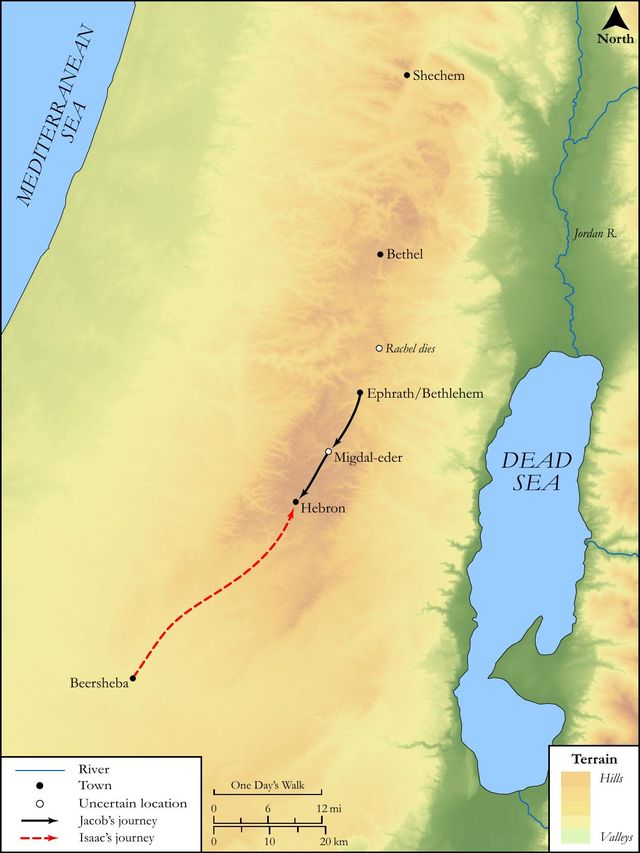
Study this verse
Public-domain commentary
Matthew Henry
From his Commentary on the Whole Bible. Henry comments on passages, not single verses — this entry covers Genesis 35:21–29.
Here is, 1. Jacob's removal, Gen 35:21. He also, as his fathers, sojourned in the land of promise as in a strange country, and was not long in a place. Immediately after the story of Rachel's death he is here called Israel (Gen 35:21, Gen 35:22), and not often so afterwards: the Jews say, "The historian does him this honour here because he bore that affliction with such admirable patience and submission to Providence." Note, Those are Israel's indeed, princes with God, that support the government of their own passions. He that has this rule over his own spirit is better than the mighty. Israel, a prince with God, yet dwells in tents; the city is reserved for him in the other world. 2. The sin of Reuben. A piece of abominable wickedness it was that he was guilty of (Gen 35:22), that very sin which the apostle says (Co1 5:1) is not so much as named among the Gentiles, that one should have his father's wife. It is said to have been when Israel dwelt in that land; as if he were then absent from his family, which might be the unhappy occasion of these disorders. Though perhaps Bilhah was the greater criminal, and it is probable was abandoned by Jacob for it, yet Reuben's crime was so provoking that, for it, he lost his birthright and blessing, Gen 49:4. The first-born is not always the best, nor the most promising. This was Reuben's sin, but it was Jacob's affliction; and what a sore affliction it was is intimated in a little compass, and Israel heard it. No more is said - that is enough; he heard it with the utmost grief and shame, horror and displeasure. Reuben thought to conceal it, that his father should never hear of it; but those that promise themselves secresy in sin are generally disappointed; a bird of the air carries the voice. 3. A complete list of the sons of Jacob, now that Benjamin the youngest was born. This is the first time we have the names of these heads of the twelve tribes together; afterwards we find them very often spoken of and enumerated, even to the end of the Bible, Rev 7:4; Rev 21:12. 4. The visit which Jacob made to his father Isaac at Hebron. We may suppose he had visited him before since his return, for he sorely longed after his father's house; but never, till now, brought his family to settle with him, or near him, Gen 35:27. Probably he did this now upon the death of Rebekah, by which Isaac was left solitary, and not disposed to marry again. 5. The age and death of Isaac are here recorded, though it appears, by computation, that he died not till many years after Joseph was sold into Egypt, and much about the time that he was preferred there. Isaac, a mild quiet man, lived the longest of all the patriarches, for he was 180 years old; Abraham was but 175. Isaac lived about forty years after he had made his will, Gen 27:2. We shall not die an hour the sooner, but abundantly the better, for our timely setting our heart and house in order. Particular notice is taken of the amicable agreement of Esau and Jacob, in solemnizing their father's funeral (Gen 35:29), to show how wonderfully God had changed Esau's mind since he vowed his brother's murder immediately after his father's death, Gen 27:41. Note, God has many ways of preventing bad men from doing the mischief they intended; he can either tie their hands or turn their hearts.
Continue studying Genesis 35:26 across the web’s major study libraries — every link below opens this exact verse, chapter, or book on the destination site.
Read & Compare
 BibleGatewayThis verse in more than 200 translations and 70 languages.
 Bible.comThe YouVersion reader — hundreds of translations, reading plans, and highlights.
 ESV.orgCrossway's official English Standard Version reader.
 NET BibleThe NET translation with 60,000+ translators' notes on every rendering decision.
 STEP BibleTyndale House's free study tool — original text, vocabulary, and scholarly resources.
 BibliaLogos Bible Software's free web reader.
 USCCBThe New American Bible (Revised Edition) with the U.S. bishops' study notes.
Commentaries
 BibleHub CommentariesDozens of classic commentaries on this verse, gathered on one page.
 StudyLightMore than 100 commentary sets — the largest collection on the web.
 BibleRefPlain-English commentary on what this verse means, verse by verse.
 Enduring WordDavid Guzik's free commentary on this chapter, widely used by Bible teachers.
 Bible Study ToolsVerse commentary alongside Greek and Hebrew study aids.
Original Language & Research
- BibleHub InterlinearThe verse word by word — original language, transliteration, and English.
- BibleHub LexiconEvery word's original-language definition and Strong's entry.
 Blue Letter BibleDeep-study tools — Strong's numbers, concordance, and word studies.
 SefariaThe Hebrew text with Rashi and centuries of Jewish commentary.
Sermons, Hymns & Audio


TrulyRandomVerse is not affiliated with these sites and doesn’t control their content. They’re linked because they’re genuinely useful.
Summary
Genesis 35:26 serves as the concluding entry in the comprehensive enumeration of Jacob's twelve sons, specifically identifying Gad and Asher as those born to him through Zilpah, Leah's handmaid. This verse definitively completes the roster of Jacob's children conceived and born during his twenty-year sojourn in Padanaram, thereby establishing the full complement of progenitors for the nascent nation of Israel.
Context
ShowHideLiterary Context
This verse appears at a pivotal juncture in the narrative of Jacob's life. Immediately prior, Jacob has returned to the land of Canaan, had his transformative encounter at Peniel, and received the new name Israel. Genesis 35 details his journey to Bethel, the burial of Deborah, and the tragic death of Rachel during the birth of Benjamin. The enumeration of Jacob's sons in verses 23-26 is a crucial genealogical record, establishing the twelve patriarchs from whom the future tribes of Israel would descend. Genesis 35:26 specifically concludes this list by accounting for Gad and Asher, ensuring all sons born in Padanaram are recorded before the narrative shifts to Jacob's full settlement and the subsequent history of his family.
Historical & Cultural Context
The practice of a barren wife giving her handmaid to her husband to bear children on her behalf was a recognized custom in the ancient Near East, as evidenced by the Code of Hammurabi and other ancient texts. This practice, seen also with Sarah and Hagar and Rachel and Bilhah, ensured the continuation of the family line and the production of heirs, which was paramount in patriarchal societies. The children born of such unions were considered legitimate offspring of the husband and were often legally recognized as the children of the primary wife. Zilpah, as Leah's handmaid, bore Gad and Asher, who were fully integrated into Jacob's family and later became progenitors of two of the twelve tribes, underscoring their full legitimacy within the patriarchal structure. The mention of "Padanaram" highlights the region of Mesopotamia where Jacob spent twenty years in Laban's household, a significant period of family formation outside the Promised Land.
Key Themes
ShowHideGenesis 35:26 contributes to several overarching themes within the book of Genesis and the broader biblical narrative. Firstly, it underscores the theme of Covenant Fulfillment, as the growing family of Jacob, now complete with twelve sons, is a tangible sign of God's faithfulness to His promises made to Abraham and Isaac regarding numerous descendants who would become a great nation. Secondly, it highlights Nation-Building, as these twelve sons are the foundational progenitors of what would become the twelve tribes of Israel, God's chosen people. Thirdly, the verse subtly points to Divine Sovereignty, demonstrating God's ability to work through complex and often imperfect human family dynamics—involving multiple wives and handmaids—to achieve His redemptive purposes. Finally, it emphasizes the importance of Patriarchal Lineage as the means through which God's plan for salvation would unfold, culminating in the Messiah.
Exposition and Analysis
ShowHideKey Word Analysis
ShowHideFrom the root meaning "to build," this word signifies a son as a builder or continuator of the family name and lineage. In its widest sense, it refers to a descendant, often implying a foundational role in the family or community. Here, it emphasizes Gad and Asher's integral position as legitimate heirs who contribute to the formation of Jacob's household and, ultimately, the nation of Israel.
Derived from an unused root possibly meaning "to trickle," suggesting "fragrant dropping" or "anointed." Zilpah was Leah's handmaid, given to Jacob as a secondary wife. Her inclusion here underscores the complex family structure of Jacob and the divine providence that worked through these arrangements to produce the twelve foundational patriarchs, regardless of their mother's status.
A primitive root meaning "to bear young" or "to beget." This term emphasizes the physical act of birth and the establishment of lineage. Its use here confirms the biological relationship of Gad and Asher to Jacob, solidifying their place within the family tree and their legitimacy as progenitors of the future tribes.
Verse Breakdown
ShowHide"And the sons of Zilpah, Leah's handmaid; Gad, and Asher:"
This clause precisely identifies the two sons born to Jacob through Zilpah, who served as Leah's handmaid. In ancient Near Eastern custom, a handmaid could bear children on behalf of her mistress, and these children were legally considered the offspring of the husband and the mistress. Thus, Gad and Asher are fully recognized as Jacob's legitimate sons, integral to the family's lineage. Gad's name (גָּד) means "troop" or "fortune," reflecting Leah's exclamation upon his birth (Genesis 30:11). Asher's name (אָשֵׁר) means "happy" or "blessed," reflecting Leah's joy at his birth (Genesis 30:13).
"these [are] the sons of Jacob, which were born to him in Padanaram."
This concluding statement serves as a definitive summary, affirming that the preceding enumeration (from Genesis 35:23) encompasses all twelve sons born to Jacob during his twenty-year sojourn in Padanaram. Padanaram (פַּדַּן אֲרָם), meaning "the plain of Aram," refers to the region in Mesopotamia where Jacob lived with Laban. This emphasis on their birthplace highlights the foreign origin of the initial family unit before their full establishment in the Promised Land of Canaan. The inclusion of all twelve sons here underscores their equal standing as patriarchs, despite their different mothers, forming the complete ancestral line of the nation of Israel.
Literary Devices
ShowHideThe primary literary device at play in Genesis 35:26 is Genealogy, specifically Enumeration. This verse completes a meticulously detailed list of Jacob's twelve sons, a common feature in biblical narratives used to establish lineage, legitimacy, and the foundation of a people group. The careful listing of each son by his mother, culminating here with Zilpah's sons, emphasizes the Universal Reach of all twelve as full members of Jacob's family, regardless of the complex circumstances of their birth. This structured enumeration serves not merely as a historical record but as a theological statement about the formation of God's chosen nation through diverse origins, all ordained by divine providence.
Theological and Thematic Connections
ShowHideGenesis 35:26, while a simple genealogical entry, carries profound theological weight as it completes the foundational roster of the patriarchs of Israel. It underscores God's meticulous and sovereign plan for the formation of His covenant people. Even amidst the complex and often messy family dynamics of Jacob's household, involving multiple wives and handmaids, God faithfully works to bring forth the twelve sons who will become the progenitors of a great nation. This demonstrates that God's purposes are not thwarted by human imperfections but rather woven into the fabric of real-life circumstances, ensuring the continuity of the covenant line established with Abraham and Isaac. The completion of this list signifies the tangible fulfillment of God's promise to multiply Jacob's descendants, laying the essential groundwork for the identity and future destiny of Israel as a unique people set apart for God's redemptive plan.
Reflection and Application
ShowHideGenesis 35:26, though a seemingly straightforward genealogical entry, offers significant insights for reflection and application in our lives. It reminds us that God's grand design unfolds through real, often complicated, human families and circumstances. The twelve sons, born in diverse situations and to different mothers, collectively formed the foundational unit of God's chosen people. This reinforces the enduring truth that every individual, regardless of their background, birth circumstances, or the complexities of their family history, has a place in God's overarching plan. God works through imperfect people and imperfect situations to accomplish His perfect will. We are called to recognize God's hand in the details of our lives and the lives of others, trusting that He is sovereignly building His kingdom through diverse individuals. This verse encourages us to embrace the unity found in diversity within the body of Christ, recognizing that each member, with their unique story, contributes uniquely to the larger narrative of God's redemptive work in the world.
Questions for Reflection
ShowHideFAQ
ShowHideWhy is the birthplace "Padanaram" emphasized?
ShowHideThe emphasis on "Padanaram" (meaning "the plain of Aram," a region in Mesopotamia) signifies the foreign land where Jacob's family began to grow into a multitude, before their full establishment in the Promised Land of Canaan. It highlights the initial stage of the family's development and their eventual return, underscoring God's faithfulness in bringing His people into the land He promised. This detail serves as a reminder of God's providence guiding His chosen family even in a land not their own, preparing them for their destiny in Canaan, as promised to Abraham.
What is the significance of listing the sons by their mothers?
ShowHideListing the sons by their mothers (Leah, Rachel, Bilhah, Zilpah) acknowledges the complex family dynamics and the distinct roles each woman played in the formation of Jacob's household. It provides a clear genealogical record, essential for tracing the lineage of the future tribes and understanding their historical origins within the family structure. This detailed enumeration also subtly highlights the rivalries and blessings associated with each birth, as seen in Genesis 29, Genesis 30, yet ultimately affirms that all offspring were part of God's plan for the nation.
How do Zilpah's sons, Gad and Asher, fit into the twelve tribes of Israel?
ShowHideGad and Asher, though born to Zilpah (Leah's handmaid), are fully legitimate sons of Jacob and are counted among the twelve patriarchs. Their descendants formed distinct tribes within Israel, receiving their own inheritances in the Promised Land, as detailed in Joshua 13, Joshua 14, Joshua 15, Joshua 16, Joshua 17, Joshua 18, Joshua 19. This demonstrates that all of Jacob's sons, regardless of their mother's status, were equally foundational to the nation, fulfilling God's promise of a numerous progeny to Jacob, who was renamed Israel.
Christ-Centered Fulfillment
ShowHideWhile Genesis 35:26 primarily serves as a genealogical record, it lays crucial groundwork for the lineage through which the Messiah would eventually come. The enumeration of Jacob's twelve sons establishes the foundational family unit of the nation of Israel, from whom the tribe of Judah would emerge, leading ultimately to Jesus Christ. This verse, by completing the roster of the patriarchs, points to God's meticulous and sovereign plan for human history, ensuring the continuity of the covenant line that would culminate in the birth of the Savior. Jesus, as the ultimate Son of David and Son of Abraham (Matthew 1:1), fulfills all the promises made to Abraham, Isaac, and Jacob. Through His atoning work, He establishes a new, spiritual Israel, composed of all believers from every tribe and nation (Galatians 3:29), bringing to fruition the divine purpose that began with the formation of Jacob's family and culminating in the new covenant in His blood.