


Genesis 31:18
Bible text: King James Version (1769 Blayney text) · Public domain
Bible text: King James Version with Strong's numbers · Public domain
Bible text: Berean Standard Bible · Public domain
Bible text: American Standard Version (1901) · Public domain
Bible text: World English Bible, Messianic edition · Public domain
Bible text: Geneva Bible (1599) · Public domain
Bible text: Young's Literal Translation · Public domain
- וַיִּנְהַגvai·yin·Hagand he droveH5090Conj-w ¦ V-Qal-ConsecImperf-3msVerb Qal Consecutive Imperfect 3rd Singular Masculineוַandיִּנְהַגhe drove
- אֶת'et<obj.>H853DirObjMParticle Object Indicator
- כָּלkolallH3605N-mscNoun Singular Masculine Construct
- מִקְנֵהוּmik·Ne·huhis livestockH4735N-msc ¦ 3msNoun Singular Masculine Constructמִקְנֵlivestockהוּhis
- וְאֶתve·'Etand <obj.>H853Conj-w ¦ DirObjMParticle Object Indicatorוְandאֶת<obj.>
- כָּלkolallH3605N-mscNoun Singular Masculine Construct
- רְכֻשׁוֹre·khu·Shohis possession[s]H7399N-msc ¦ 3msNoun Singular Masculine Constructרְכֻשׁpossession[s]וֹhis
- אֲשֶׁר'a·SherwhichH834RelParticle Relative
- רָכָשׁra·Khashhe had accumulatedH7408V-Qal-Perf-3msVerb Qal Perfect 3rd Singular Masculine
- מִקְנֵהmik·Neh[the] livestock ofH4735N-mscNoun Singular Masculine Construct
- קִנְיָנוֹkin·ya·Nohis acquisitionH7075N-msc ¦ 3msNoun Singular Masculine Constructקִנְיָנacquisitionוֹhis
- אֲשֶׁר'a·SherwhichH834RelParticle Relative
- רָכַשׁra·Khashhe had accumulatedH7408V-Qal-Perf-3msVerb Qal Perfect 3rd Singular Masculine
- בְּפַדַּןbe·fa·Danin PaddanH6307Prep-b ¦ N-properNoun Proper LocationבְּinפַדַּןPaddan
- אֲרָם'a·RamAramH758N-properNoun Proper Location
- לָבוֹאla·Vo'to goH935Prep-l ¦ V-Qal-InfVerb Qal Infinitive Constructלָtoבוֹאgo
- אֶל'eltoH413PrepPreposition
- יִצְחָקyitz·ChakIsaacH3327N-proper-mNoun Proper Masculine
- אָבִיו'a·Vivhis fatherH1N-msc ¦ 3msNoun Singular Masculine Constructאָבִיfatherוhis
- אַרְצָה'Ar·tzah[the] land of towardsH776N-fsc ¦ SfxNoun Singular Feminine Constructאַרְצָ[the] land ofהtowards
- כְּנָעַןke·Na·'anCanaanH3667N-properNoun Proper Location
English is a literal word-by-word gloss of the Hebrew, not the KJV's wording. Why?
This is the original text the KJV's translators worked from — each Hebrew word with its own literal English meaning in this verse, prepared by scholars at Tyndale House, Cambridge. The KJV translates whole sentences, not word by word, so its wording differs: one Hebrew word can become several English words, and the KJV may choose “the LORD” where the gloss reads “Yahweh”. Both are faithful — they answer different questions. For the KJV's own rendering, switch to the KJV text.
Details
See on the biblical-era maps


Study this verse
Public-domain commentary
Matthew Henry
From his Commentary on the Whole Bible. Henry comments on passages, not single verses — this entry covers Genesis 31:17–24. His two-level outline is real structure in the source text, so it is rendered as structure.
Here is, I. Jacob's flight from Laban. We may suppose he had been long considering of it, and casting about in his mind respecting it; but when now, at last, God had given him positive orders to go, he made no delay, nor was he disobedient to the heavenly vision. The first opportunity that offered itself he laid hold of, when Laban was shearing his sheep (Gen 31:19), that part of his flock which was in the hands of his sons three days' journey off. Now, 1. It is certain that it was lawful for Jacob to leave his service suddenly, without giving a quarter's warning. It was not only justified by the particular instructions God gave him, but warranted by the fundamental law of self-preservation, which directs us, when we are in danger, to shift for our own safety, as far as we can do it without wronging our consciences. 2. It was his prudence to steal away unawares to Laban, lest, if Laban had known, he should have hindered him or plundered him. 3. It was honestly done to take no more than his own with him, the cattle of his getting, Gen 31:18. He took what Providence gave him, and was content with that, and would not take the repair of his damages into his own hands. Yet Rachel was not so honest as her husband; she stole her father's images (Gen 31:19) and carried them away with her. The Hebrew calls them teraphiam. Some think they were only little representations of the ancestors of the family, in statues or pictures, which Rachel had a particular fondness for, and was desirous to have with her, now that she was going into another country. It should rather seem that they were images for a religious use, penates, household-gods, either worshipped or consulted as oracles; and we are willing to hope (with bishop Patrick) that she took them away not out of covetousness of the rich metal they were made of, much less for her own use, or out of any superstitious fear lest Laban, by consulting his teraphim, might know which way they had gone (Jacob, no doubt, dwelt with his wives as a man of knowledge, and they were better taught than so), but out of a design hereby to convince her father of the folly of his regard to those as gods which could not secure themselves, Isa 46:1, Isa 46:2.
II.Laban's pursuit of Jacob.
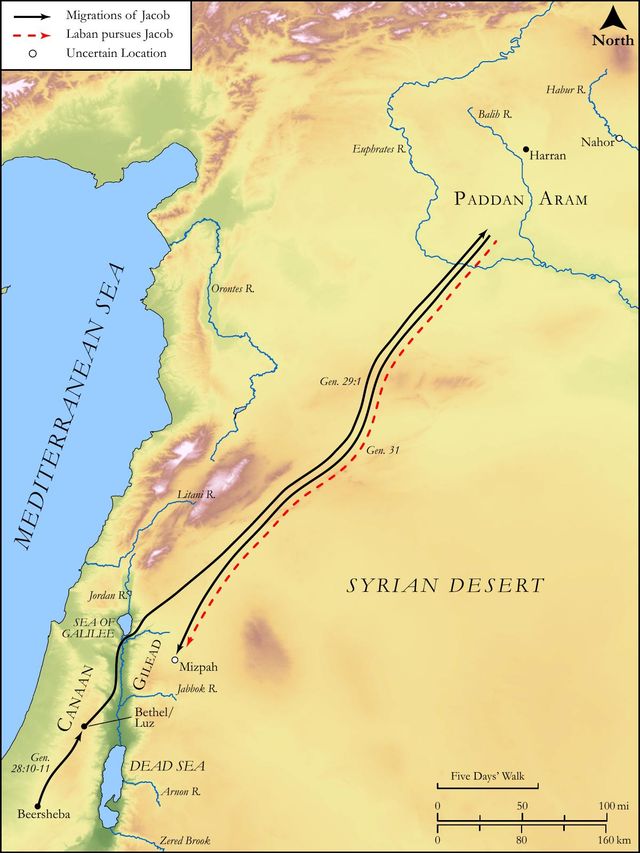
Tidings were brought him, on the third day, that Jacob had fled; he immediately raises the whole clan, takes his brethren, that is, the relations of his family, that were all in his interests, and pursues Jacob (as Pharaoh and his Egyptians afterwards pursued the seed of Jacob), to bring him back into bondage again, or with design to strip him of what he had. Seven days' journey he marched in pursuit of him, Gen 31:23. He would not have taken half the pains to have visited his best friends. But the truth is bad men will do more to serve their sinful passions than good men will to serve their just affections, and are more vehement in their anger than in their love. Well, at length Laban, overtook him, and the very night before he came up with him God interposed in the quarrel, rebuked Laban and sheltered Jacob, charging Laban not to speak unto him either good or bad (Gen 31:24), that is, to say nothing against his going on with his journey, for that it proceeded from the Lord. The same Hebraism we have, Gen 24:50. Laban, during his seven day's march, had been full of rage against Jacob, and was now full of hopes that his lust should be satisfied upon him (Exo 15:9); but God comes to him, and with one word ties his hands, though he does not turn his heart. Note,
1.In a dream, and in slumberings upon the bed, God has ways of opening the ears of men, and sealing their instruction, Job 33:15, Job 33:16. Thus he admonishes men by their consciences, in secret whispers, which the man of wisdom will hear and heed.
2.The safety of good men is very much owing to the hold God has of the consciences of bad men and the access he has to them.
3.God sometimes appears wonderfully for the deliverance of his people when they are upon the very brink of ruin. The Jews were saved from Haman's plot when the king's decree drew hear to be put in execution, Est 9:1.
Continue studying Genesis 31:18 across the web’s major study libraries — every link below opens this exact verse, chapter, or book on the destination site.
Read & Compare
 BibleGatewayThis verse in more than 200 translations and 70 languages.
 Bible.comThe YouVersion reader — hundreds of translations, reading plans, and highlights.
 ESV.orgCrossway's official English Standard Version reader.
 NET BibleThe NET translation with 60,000+ translators' notes on every rendering decision.
 STEP BibleTyndale House's free study tool — original text, vocabulary, and scholarly resources.
 BibliaLogos Bible Software's free web reader.
 USCCBThe New American Bible (Revised Edition) with the U.S. bishops' study notes.
Commentaries
 BibleHub CommentariesDozens of classic commentaries on this verse, gathered on one page.
 StudyLightMore than 100 commentary sets — the largest collection on the web.
 BibleRefPlain-English commentary on what this verse means, verse by verse.
 Enduring WordDavid Guzik's free commentary on this chapter, widely used by Bible teachers.
 Bible Study ToolsVerse commentary alongside Greek and Hebrew study aids.
Original Language & Research
- BibleHub InterlinearThe verse word by word — original language, transliteration, and English.
- BibleHub LexiconEvery word's original-language definition and Strong's entry.
 Blue Letter BibleDeep-study tools — Strong's numbers, concordance, and word studies.
 SefariaThe Hebrew text with Rashi and centuries of Jewish commentary.
Sermons, Hymns & Audio


TrulyRandomVerse is not affiliated with these sites and doesn’t control their content. They’re linked because they’re genuinely useful.
Summary
Genesis 31:18 meticulously details Jacob's strategic and divinely sanctioned exodus from Padanaram. After two decades of service to Laban, Jacob, obedient to God's command, gathered his extensive livestock and all his accumulated possessions—wealth miraculously multiplied by divine favor—and set forth on the arduous journey to reunite with his father Isaac in the promised land of Canaan, marking a pivotal moment in the unfolding covenant narrative.
Context
ShowHideLiterary Context
This verse is a crucial turning point, immediately following God's explicit command for Jacob to return to the land of his fathers and kindred. The preceding chapters, particularly Genesis 29, Genesis 30 and Genesis 30:25-43, detail Jacob's twenty years of service under Laban, characterized by Laban's repeated deceit and Jacob's shrewd, yet ultimately divinely blessed, accumulation of immense wealth in flocks and servants. The narrative builds tension as Jacob perceives Laban's changing countenance and hears the complaints of Laban's sons, signaling that his time in Padanaram must end. Jacob's secret departure, described in this verse, is a direct response to both divine instruction and the increasingly hostile environment, setting the stage for the dramatic confrontation with Laban that follows in Genesis 31:22-42.
Historical & Cultural Context
In the days of the patriarchs, livestock (miqneh) represented the primary form of wealth and capital. A man's standing and prosperity were largely measured by the size of his flocks and herds. The practice of a son-in-law serving a father-in-law for a wife was common, but Laban's repeated manipulation of Jacob's wages (changing them ten times, as mentioned in Genesis 31:7) was an extreme abuse of this custom. Padanaram, or Paddan-Aram, refers to the "plain of Aram" in northwestern Mesopotamia, a significant distance from Canaan. Jacob's journey back to Canaan was not merely a geographical relocation but a return to his ancestral homeland and the sphere of God's covenant promises. The secrecy of his departure was a pragmatic necessity, given Laban's possessive and manipulative character, who would undoubtedly have tried to retain Jacob's wealth and family.
Key Themes
ShowHideThis verse encapsulates several major themes central to the book of Genesis. It highlights Divine Providence and Blessing, as Jacob's vast wealth, despite Laban's schemes, is attributed to God's direct intervention and blessing (Genesis 30:27-43). It underscores Obedience to God's Call, as Jacob's departure is a direct response to the Lord's command to return to his homeland (Genesis 31:3). The journey's destination, "the land of Canaan," reinforces the theme of Covenant Fulfillment and the continuity of God's promises made to Abraham and Isaac regarding the land and their numerous descendants. Finally, it subtly introduces the theme of God's Protection and Guidance as Jacob embarks on a perilous journey with his entire household and possessions, foreshadowing God's continued oversight.
Exposition and Analysis
ShowHideKey Word Analysis
ShowHideThis verb signifies the act of driving forth or leading away, often with a sense of urgency or force. In this context, it highlights Jacob's decisive and comprehensive action in moving his entire household and possessions. It conveys the physical effort and the strategic, perhaps hurried, nature of his exodus from Laban's domain, implying a calculated departure to avoid confrontation.
This term specifically refers to acquired property, primarily livestock (sheep, goats, camels, donkeys), which was the principal form of wealth in the patriarchal age. Its inclusion emphasizes the immense material prosperity Jacob had accumulated. This "cattle" represents the tangible evidence of God's faithfulness and blessing upon Jacob, despite Laban's deceitful practices, as it was the means by which Jacob's wealth was measured and multiplied.
Derived from a root meaning "to acquire" or "to create," this noun denotes acquisition, purchase, or wealth. Its repetition in the verse ("cattle of his getting," "which he had gotten") powerfully underscores that the vast wealth Jacob possessed was not inherited but was obtained through his labor and, more importantly, through God's miraculous intervention and blessing. It validates Jacob's legitimate claim over these possessions against any potential dispute from Laban, emphasizing divine enablement.
Verse Breakdown
ShowHide"And he carried away all his cattle"
This opening phrase immediately establishes Jacob's primary action—the physical removal of his vast livestock, which constituted the foundational element of his wealth. The verb "carried away" (nâhag) implies a deliberate, comprehensive, and perhaps swift movement, emphasizing the sheer scale of his departure and the urgency behind it.
"and all his goods which he had gotten, the cattle of his getting, which he had gotten in Padanaram"
This highly repetitive and emphatic clause powerfully underscores both the sheer volume and the legitimate source of Jacob's accumulated wealth. "Goods" (rekûwsh) refers to general property, while the repeated "cattle of his getting" and "which he had gotten" (qinyân, rākash) highlight that this vast fortune was not inherited but acquired through his diligent labor and, crucially, through God's miraculous intervention and blessing during his two decades in Padanaram. It serves to validate his claim to these possessions despite Laban's attempts to defraud him.
"for to go to Isaac his father in the land of Canaan"
This final clause clarifies the ultimate purpose and destination of Jacob's arduous journey. His return to "Isaac his father" signifies a familial reunion and, more significantly, a return to the patriarchal lineage and the divinely promised land of Canaan. This destination is not arbitrary but is the direct fulfillment of God's command and the continuation of the covenant narrative, establishing the next stage of God's plan for the nascent nation of Israel.
Literary Devices
ShowHideThe verse employs several effective literary devices. Repetition is prominent with the phrase "which he had gotten," emphasizing the vastness of Jacob's acquired wealth and underscoring its legitimate, divinely-blessed origin despite Laban's deceit. This repetition creates a strong sense of Emphasis, highlighting that Jacob's prosperity was not accidental but a testament to God's faithfulness. The meticulous enumeration of "all his cattle, and all his goods" also serves as Hyperbole to convey the immense scale of Jacob's departure, signifying a complete and comprehensive relocation. Furthermore, the verse functions as a narrative Transition, marking the end of Jacob's sojourn in Padanaram and the beginning of his return to the promised land, a critical step in the unfolding of God's covenant plan for Israel.
Theological and Thematic Connections
ShowHideGenesis 31:18 powerfully illustrates God's unwavering faithfulness and sovereign provision for His chosen servant. Jacob's immense wealth, explicitly stated as "cattle of his getting," was not merely the result of his shrewdness or labor, but a direct manifestation of God's blessing, fulfilling His promise to prosper Jacob despite Laban's repeated deceptions. This highlights a profound theological truth: God's covenant promises are upheld even in challenging circumstances, demonstrating His active involvement in the lives of His people. Jacob's journey back to Canaan, the land promised to Abraham and Isaac, signifies his obedience to God's command and marks a crucial step in the unfolding of God's redemptive plan, bringing the patriarch closer to the realization of the covenant and the formation of the nation of Israel.
Reflection and Application
ShowHideGenesis 31:18 offers profound lessons on trusting God's provision and guidance, especially during significant life transitions. Jacob's journey, laden with all the wealth he had acquired through two decades of labor and divine blessing, serves as a powerful testament to God's unwavering faithfulness in equipping and prospering His people, even in foreign or oppressive environments. For believers today, this narrative encourages a posture of obedience when God calls us to new seasons or locations, confident that He orchestrates our circumstances, provides for our needs, and protects our journey. Just as God promised Jacob at Bethel, "I am with thee, and will keep thee in all places whither thou goest" (Genesis 28:15), we can rest assured in His presence and provision. This passage reminds us that our "getting"—our resources, talents, and opportunities—are ultimately from God, enabling us to fulfill His divine purposes and contribute to His kingdom.
Questions for Reflection
ShowHideFAQ
ShowHideWhy did Jacob depart from Laban secretly?
ShowHideJacob's secret departure was a strategic and necessary move born out of a well-founded fear of Laban's reaction. Laban had repeatedly cheated Jacob, manipulated his wages, and demonstrated a possessive nature, making it highly probable he would attempt to prevent Jacob from leaving with the substantial wealth God had blessed him with. Jacob waited for Laban to be away shearing sheep, a common and time-consuming activity, indicating a calculated decision to avoid confrontation and ensure the safe passage of his entire family and extensive possessions, as God had instructed him to return to Canaan (Genesis 31:3).
What is the significance of the repeated phrase "which he had gotten" or "cattle of his getting"?
ShowHideThe repetition of "which he had gotten" (from the Hebrew roots rākash and qinyân) and "cattle of his getting" serves a crucial dual purpose. Firstly, it emphasizes the sheer vastness of Jacob's accumulated wealth, highlighting the immense scale of his departure. Secondly, and more importantly, it underscores the divine source of his prosperity. While Jacob worked diligently, the text consistently attributes his success and the multiplication of his flocks to God's blessing and direct intervention, particularly in how his flocks multiplied despite Laban's attempts to defraud him (Genesis 30:27-43). It asserts that his "getting" was not solely by human effort but by divine enablement, fulfilling God's covenant promises and validating Jacob's legitimate claim over these possessions.
Christ-Centered Fulfillment
ShowHideGenesis 31:18, depicting Jacob's obedient return to the promised land with all his divinely provided possessions, profoundly foreshadows Christ's ultimate work of redemption and His role as the true inheritor and provider. Just as Jacob was led by God back to the physical inheritance of Canaan, Christ, the greater Jacob, leads His people to the spiritual inheritance of eternal life and the heavenly Canaan (Hebrews 4:9-11). He is the ultimate Provider who gathers His elect from every nation, equipping them with spiritual blessings "in heavenly places" (Ephesians 1:3) for their journey of faith. Moreover, Christ's perfect obedience to the Father's will, even unto death on the cross, ensures the fulfillment of all God's covenant promises, making Him the ultimate "heir of all things" (Hebrews 1:2) and the one through whom believers receive their true, lasting inheritance—not of earthly cattle and goods, but of eternal life and co-heirship with Him (Romans 8:17).