


Genesis 35:27
- וַיָּבֹאvai·ya·Vo'and he cameH935Conj-w ¦ V-Qal-ConsecImperf-3msVerb Qal Consecutive Imperfect 3rd Singular Masculineוַandיָּבֹאhe came
- יַעֲקֹבya·'a·KoJacobH3290N-proper-mNoun Proper Masculine
- אֶל'eltoH413PrepPreposition
- יִצְחָקyitz·ChakIsaacH3327N-proper-mNoun Proper Masculine
- אָבִיו'a·Vivhis fatherH1N-msc ¦ 3msNoun Singular Masculine Constructאָבִיfatherוhis
- מַמְרֵאmam·Re'MamreH4471N-properNoun Proper Location
- קִרְיַתkir·YatKiriathH7153N-properNoun Proper Location
- הָאַרְבַּעha·'ar·Ba'<the> ArbaH7153N-properNoun Proper Location
- הִואhi'thatH1931Pro-3fsPronoun Personal 3rd Singular Feminine
- חֶבְרוֹןchev·Ron[is] HebronH2275N-properNoun Proper Location
- אֲשֶׁר'a·SherwhereH834RelParticle Relative
- גָּרgarhe had sojournedH1481V-Qal-Perf-3msVerb Qal Perfect 3rd Singular Masculine
- שָׁםshamthereH8033AdvAdverb
- אַבְרָהָם'av·ra·HamAbrahamH85N-proper-mNoun Proper Masculine
- וְיִצְחָקve·yitz·Chakand IsaacH3327Conj-w ¦ N-proper-mNoun Proper MasculineוְandיִצְחָקIsaac
English is a literal word-by-word gloss of the Hebrew, not the KJV's wording. Why?
This is the original text the KJV's translators worked from — each Hebrew word with its own literal English meaning in this verse, prepared by scholars at Tyndale House, Cambridge. The KJV translates whole sentences, not word by word, so its wording differs: one Hebrew word can become several English words, and the KJV may choose “the LORD” where the gloss reads “Yahweh”. Both are faithful — they answer different questions. For the KJV's own rendering, switch to the KJV text.
Details
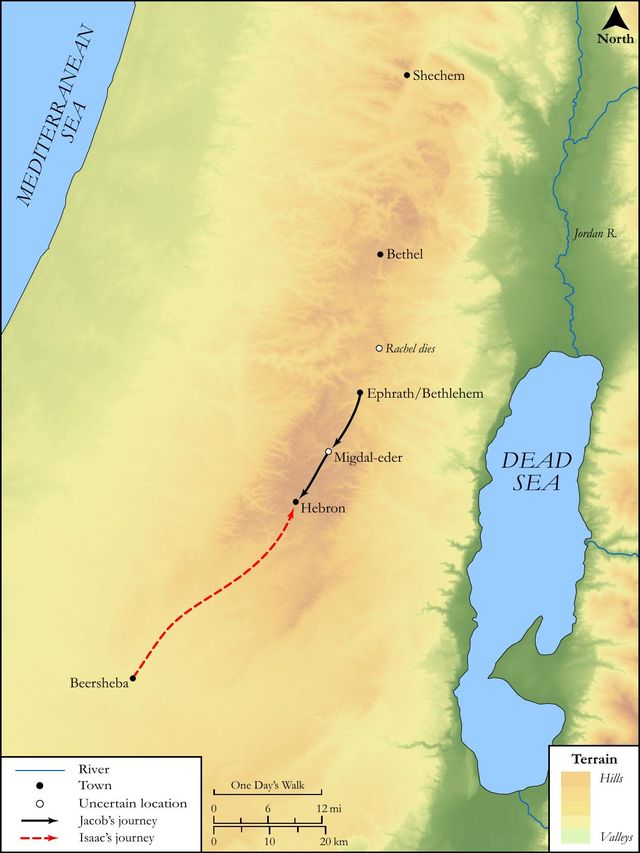
See on the biblical-era maps


Study this verse
Public-domain commentary
Matthew Henry
From his Commentary on the Whole Bible. Henry comments on passages, not single verses — this entry covers Genesis 35:21–29.
Here is, 1. Jacob's removal, Gen 35:21. He also, as his fathers, sojourned in the land of promise as in a strange country, and was not long in a place. Immediately after the story of Rachel's death he is here called Israel (Gen 35:21, Gen 35:22), and not often so afterwards: the Jews say, "The historian does him this honour here because he bore that affliction with such admirable patience and submission to Providence." Note, Those are Israel's indeed, princes with God, that support the government of their own passions. He that has this rule over his own spirit is better than the mighty. Israel, a prince with God, yet dwells in tents; the city is reserved for him in the other world. 2. The sin of Reuben. A piece of abominable wickedness it was that he was guilty of (Gen 35:22), that very sin which the apostle says (Co1 5:1) is not so much as named among the Gentiles, that one should have his father's wife. It is said to have been when Israel dwelt in that land; as if he were then absent from his family, which might be the unhappy occasion of these disorders. Though perhaps Bilhah was the greater criminal, and it is probable was abandoned by Jacob for it, yet Reuben's crime was so provoking that, for it, he lost his birthright and blessing, Gen 49:4. The first-born is not always the best, nor the most promising. This was Reuben's sin, but it was Jacob's affliction; and what a sore affliction it was is intimated in a little compass, and Israel heard it. No more is said - that is enough; he heard it with the utmost grief and shame, horror and displeasure. Reuben thought to conceal it, that his father should never hear of it; but those that promise themselves secresy in sin are generally disappointed; a bird of the air carries the voice. 3. A complete list of the sons of Jacob, now that Benjamin the youngest was born. This is the first time we have the names of these heads of the twelve tribes together; afterwards we find them very often spoken of and enumerated, even to the end of the Bible, Rev 7:4; Rev 21:12. 4. The visit which Jacob made to his father Isaac at Hebron. We may suppose he had visited him before since his return, for he sorely longed after his father's house; but never, till now, brought his family to settle with him, or near him, Gen 35:27. Probably he did this now upon the death of Rebekah, by which Isaac was left solitary, and not disposed to marry again. 5. The age and death of Isaac are here recorded, though it appears, by computation, that he died not till many years after Joseph was sold into Egypt, and much about the time that he was preferred there. Isaac, a mild quiet man, lived the longest of all the patriarches, for he was 180 years old; Abraham was but 175. Isaac lived about forty years after he had made his will, Gen 27:2. We shall not die an hour the sooner, but abundantly the better, for our timely setting our heart and house in order. Particular notice is taken of the amicable agreement of Esau and Jacob, in solemnizing their father's funeral (Gen 35:29), to show how wonderfully God had changed Esau's mind since he vowed his brother's murder immediately after his father's death, Gen 27:41. Note, God has many ways of preventing bad men from doing the mischief they intended; he can either tie their hands or turn their hearts.
Continue studying Genesis 35:27 across the web’s major study libraries — every link below opens this exact verse, chapter, or book on the destination site.
Read & Compare
 BibleGatewayThis verse in more than 200 translations and 70 languages.
 Bible.comThe YouVersion reader — hundreds of translations, reading plans, and highlights.
 ESV.orgCrossway's official English Standard Version reader.
 NET BibleThe NET translation with 60,000+ translators' notes on every rendering decision.
 STEP BibleTyndale House's free study tool — original text, vocabulary, and scholarly resources.
 BibliaLogos Bible Software's free web reader.
 USCCBThe New American Bible (Revised Edition) with the U.S. bishops' study notes.
Commentaries
 BibleHub CommentariesDozens of classic commentaries on this verse, gathered on one page.
 StudyLightMore than 100 commentary sets — the largest collection on the web.
 BibleRefPlain-English commentary on what this verse means, verse by verse.
 Enduring WordDavid Guzik's free commentary on this chapter, widely used by Bible teachers.
 Bible Study ToolsVerse commentary alongside Greek and Hebrew study aids.
Original Language & Research
- BibleHub InterlinearThe verse word by word — original language, transliteration, and English.
- BibleHub LexiconEvery word's original-language definition and Strong's entry.
 Blue Letter BibleDeep-study tools — Strong's numbers, concordance, and word studies.
 SefariaThe Hebrew text with Rashi and centuries of Jewish commentary.
Sermons, Hymns & Audio


TrulyRandomVerse is not affiliated with these sites and doesn’t control their content. They’re linked because they’re genuinely useful.
Summary
Genesis 35:27 chronicles Jacob's poignant return to his aged father Isaac at Mamre, a location intrinsically linked to the patriarchal heritage near Hebron. This verse signifies a crucial moment of familial reunion and underscores the enduring continuity of God's covenantal promises, as Jacob, the third patriarch, settles in the very land where Abraham and Isaac had long sojourned, thereby reinforcing the divine faithfulness to His chosen lineage and the promised inheritance.
Context
ShowHideLiterary Context
This verse serves as a significant narrative culmination within the broader story of Jacob's life, marking the end of his long and arduous journey back to Canaan from Padan-Aram. The preceding chapters detail a series of transformative and often tumultuous events: his reconciliation with Esau (Genesis 33), the tragic events at Shechem involving Dinah (Genesis 34), and the profound sorrow of Rachel's death while giving birth to Benjamin (Genesis 35:16-20). Following God's explicit instruction to return to Bethel (Genesis 35:1), where Jacob renewed his covenant vows, his southward journey continues until he reaches Mamre. This arrival at his ancestral home brings a sense of closure and stability to Jacob's narrative, signifying the fulfillment of God's promise to bring him back to the land and his family.
Historical & Cultural Context
Mamre, specifically "the oaks of Mamre," was a well-known landmark near Hebron, a prominent and ancient city in the hill country of Judah. This region held immense historical and cultural significance for the early Israelites, serving as a primary dwelling place for Abraham and Isaac. Culturally, the act of "sojourning" (living as a temporary resident or foreigner) was common for semi-nomadic peoples like the patriarchs, who did not yet fully possess the land promised to them. Hebron itself was a pivotal center, not only for dwelling but also for worship and burial. It was here that Abraham purchased the Cave of Machpelah as a family burial plot (Genesis 23:19), establishing a physical claim and a lasting presence in the land before its full inheritance. Jacob's return to this specific location re-establishes the family's presence in their historical and spiritual heartland.
Key Themes
ShowHideGenesis 35:27 contributes significantly to several overarching themes in the book of Genesis and the broader biblical narrative. Firstly, it highlights Divine Faithfulness and Guidance, demonstrating God's unwavering commitment to His promises, particularly His pledge to Jacob to bring him safely back to the land of his fathers, as declared in Genesis 28:15. Secondly, the verse underscores Covenantal Continuity and Lineage, as Jacob's reunion with Isaac reinforces the unbroken chain of the Abrahamic covenant, ensuring the transmission of divine promises through the chosen descendants. Finally, the mention of Abraham and Isaac having "sojourned" in Hebron emphasizes the theme of The Land Promise and Sojourning. This paradox of being promised an entire land yet living as temporary residents highlights the patriarchs' faith-filled existence, relying on God's future fulfillment rather than present possession, a theme echoed in the New Testament's portrayal of believers as pilgrims awaiting a heavenly inheritance (Hebrews 11:13).
Exposition and Analysis
ShowHideKey Word Analysis
ShowHideFrom the root meaning "heel-catcher" or "supplanter," this name encapsulates the patriarch's early life marked by cunning and struggle. His journey back to Isaac at Mamre signifies a maturation and a return to his spiritual roots, having wrestled with God and received the new name "Israel" (Genesis 32:28), yet still identified by his birth name, emphasizing the continuity of his personal history and God's work in his life.
Derived from a word meaning "seat of association," Hebron was a profoundly significant city for the patriarchs. Its name itself suggests a place of fellowship, connection, and covenant. For Abraham, Isaac, and now Jacob, Hebron was not merely a geographical location but a spiritual anchor, a place where they associated with God's promises and where their family's legacy was deeply rooted through dwelling and burial.
This primitive root means "to turn aside from the road (for a lodging or any other purpose)," implying a temporary residence, to live as a guest, or a stranger. Its use here for Abraham and Isaac highlights their transient existence in the Promised Land. They were not permanent possessors but lived by faith, trusting in God's future fulfillment of the land promise, a concept that underscores their pilgrim status and reliance on divine provision.
Verse Breakdown
ShowHide"And Jacob came unto Isaac his father"
This clause marks the long-awaited reunion between Jacob and his aged father, Isaac. After decades of separation, including Jacob's flight to Padan-Aram and his subsequent return, this meeting signifies the re-establishment of familial bonds and the continuity of the patriarchal line. It carries deep emotional and spiritual weight, as Jacob, now a mature patriarch himself, returns to the living source of his covenantal heritage.
"unto Mamre, unto the city of Arbah, which [is] Hebron"
This precise geographical designation underscores the significance of the location. Mamre, specifically "the oaks of Mamre," was a familiar and sacred place for Abraham and Isaac, where they had dwelt and interacted with God. The clarification that "the city of Arbah" is "Hebron" emphasizes the antiquity and prominence of this city, which served as a central hub for the patriarchs' activities, including their encampments, altars, and the pivotal burial site of the Cave of Machpelah.
"where Abraham and Isaac sojourned"
This final clause provides crucial context for the nature of the patriarchs' presence in the Promised Land. The term "sojourned" (Hebrew gûwr) indicates that they lived as temporary residents, foreigners, or guests, rather than as permanent, undisputed owners. This highlights their faith-filled existence, living in the land promised to them but not yet fully possessing it, trusting in God's future fulfillment of His covenant. It also foreshadows the transient nature of God's people in the world, looking forward to a permanent, eternal inheritance.
Literary Devices
ShowHideThe verse employs several literary devices to convey its profound meaning. Repetition of key names (Abraham, Isaac, Jacob) and locations (Mamre, Hebron) serves to emphasize the continuity of the patriarchal line and the sacredness of the ancestral land. The specific mention of "the city of Arbah, which is Hebron" acts as an Apposition, providing clarification and reinforcing the historical depth of the place. Furthermore, the use of the verb "sojourned" carries significant Symbolism, representing the transient nature of the patriarchs' lives and, by extension, the life of faith for all believers. It symbolizes a pilgrimage, a journey through a temporary earthly existence while awaiting a greater, eternal inheritance. This choice of word underscores a theological truth: even in the Promised Land, the patriarchs lived by faith, not by full possession, looking forward to God's ultimate fulfillment.
Theological and Thematic Connections
ShowHideGenesis 35:27 profoundly reinforces the unwavering faithfulness of God to His covenant promises, showcasing His meticulous guidance of Jacob back to the ancestral land and family. This reunion at Mamre, a place steeped in patriarchal history, signifies the unbroken continuity of the divine plan, flowing from Abraham to Isaac and now securely into the hands of Jacob, the father of the twelve tribes. It highlights that despite Jacob's many trials and wanderings, God remained true to His word, ensuring the preservation of the chosen lineage and the eventual inheritance of the Promised Land. The patriarchs' experience of "sojourning" in the land, never fully possessing it, serves as a powerful theological metaphor for living by faith, trusting in God's future fulfillment rather than present circumstances, and looking forward to an ultimate, eternal dwelling.
Reflection and Application
ShowHideGenesis 35:27 offers enduring lessons for believers today, reminding us of the profound importance of family connections and the spiritual legacy passed down through generations. Jacob's long-awaited reunion with Isaac, though briefly stated, underscores the value of honoring our elders and maintaining vital bonds within our families and spiritual communities. His journey, marked by both divine guidance and personal struggles, serves as a powerful testament to God's unwavering faithfulness; even through life's unexpected turns, severe challenges, and periods of separation, we can trust that God will fulfill His promises and guide us to our ultimate spiritual destination. Furthermore, the patriarchs' experience as "sojourners" in the Promised Land provides a compelling metaphor for our own lives, calling us to cultivate an eternal perspective. It encourages us to recognize that our true and ultimate home is not found in this transient world, but in God's eternal presence, thereby prompting us to prioritize spiritual values and eternal rewards over fleeting earthly possessions and temporary comforts.
Questions for Reflection
ShowHideFAQ
ShowHideWhy is the location Mamre/Hebron so significant in this verse?
ShowHideMamre, near Hebron, holds immense significance because it was a primary dwelling place for Abraham and Isaac, and the site where Abraham purchased the cave of Machpelah as a family burial plot (Genesis 23:19). Jacob's return there signifies a deep connection to his ancestral roots, the land promised by God, and the physical continuity of the covenant lineage. It represents coming home to the very heart of the patriarchal heritage, a place where foundational covenantal interactions occurred and where the family's claim to the land was physically established.
What does the term "sojourned" imply about the patriarchs' lives?
ShowHideThe term "sojourned" (Hebrew gûwr) means to dwell as a temporary resident or foreigner. It implies that Abraham, Isaac, and Jacob lived in the Promised Land without fully possessing it, relying on God's future fulfillment of His promises. This highlights their faith-filled existence, their transient earthly status, and their ultimate hope in a future, eternal inheritance. It underscores that their true security was not in land ownership but in God's faithfulness, a concept powerfully echoed in the New Testament where believers are described as "strangers and pilgrims on the earth," looking for a "better, that is, a heavenly country" (Hebrews 11:13).
Christ-Centered Fulfillment
ShowHideGenesis 35:27, depicting Jacob's return to the ancestral land and his father, finds its ultimate and profound fulfillment in Christ. The patriarchs' experience of "sojourning" in the Promised Land, living as temporary residents and awaiting a full inheritance, powerfully prefigures the believer's journey as a "sojourner" in this present world, awaiting the heavenly city and the true, eternal rest found exclusively in Christ. Jesus, as the ultimate heir of the promises made to Abraham, Isaac, and Jacob, is the one who brings His people into their eternal inheritance, not merely a physical land, but a "better country—a heavenly one" (Hebrews 11:16). Through His atoning work on the cross, Christ accomplishes the ultimate reunion, reconciling humanity with God, our true Father, thereby bringing us "home" to the ultimate spiritual dwelling place. He is the true "seed" promised to Abraham (Galatians 3:16), through whom all the families of the earth are blessed, establishing an eternal covenant and an everlasting kingdom that far surpasses the temporary dwelling in Canaan. Just as Jacob's return signified a restoration of family and a step towards the fulfillment of the covenant, so Christ's coming ushers in the full and final realization of God's redemptive plan, providing eternal belonging and rest for all who believe.