


Genesis 35:28
Bible text: King James Version (1769 Blayney text) · Public domain
Bible text: Berean Standard Bible · Public domain
Bible text: American Standard Version (1901) · Public domain
Bible text: World English Bible, Messianic edition · Public domain
Bible text: Geneva Bible (1599) · Public domain
Bible text: Young's Literal Translation · Public domain
- וַיִּהְיוּvai·yih·Yuand they wereH1961Conj-w ¦ V-Qal-ConsecImperf-3mpVerb Qal Consecutive Imperfect 3rd Plural Masculineוַandיִּהְיוּthey were
- יְמֵיye·Mei[the] days ofH3117N-mpcNoun Plural Masculine Construct
- יִצְחָקyitz·ChakIsaacH3327N-proper-mNoun Proper Masculine
- מְאַתme·'Atone hundredH3967Adj-fscAdjective Numerical Singular Feminine Construct
- שָׁנָהsha·Nahyear[s]H8141N-fsNoun Singular Feminine Absolute
- וּשְׁמֹנִיםu·she·mo·Nimand eightyH8084Conj-w ¦ Adj-mpAdjective Numerical Plural Masculine Absoluteוּandשְׁמֹנִיםeighty
- שָׁנָהsha·Nahyear[s]H8141N-fsNoun Singular Feminine Absolute
English is a literal word-by-word gloss of the Hebrew, not the KJV's wording. Why?
This is the original text the KJV's translators worked from — each Hebrew word with its own literal English meaning in this verse, prepared by scholars at Tyndale House, Cambridge. The KJV translates whole sentences, not word by word, so its wording differs: one Hebrew word can become several English words, and the KJV may choose “the LORD” where the gloss reads “Yahweh”. Both are faithful — they answer different questions. For the KJV's own rendering, switch to the KJV text.
Details
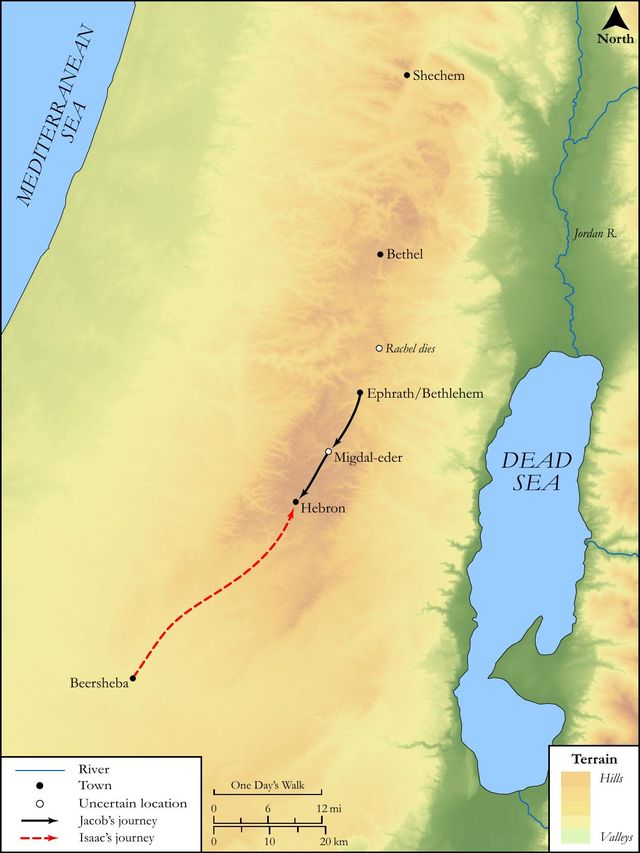
See on the biblical-era maps


Study this verse
Public-domain commentary
Matthew Henry
From his Commentary on the Whole Bible. Henry comments on passages, not single verses — this entry covers Genesis 35:21–29.
Here is, 1. Jacob's removal, Gen 35:21. He also, as his fathers, sojourned in the land of promise as in a strange country, and was not long in a place. Immediately after the story of Rachel's death he is here called Israel (Gen 35:21, Gen 35:22), and not often so afterwards: the Jews say, "The historian does him this honour here because he bore that affliction with such admirable patience and submission to Providence." Note, Those are Israel's indeed, princes with God, that support the government of their own passions. He that has this rule over his own spirit is better than the mighty. Israel, a prince with God, yet dwells in tents; the city is reserved for him in the other world. 2. The sin of Reuben. A piece of abominable wickedness it was that he was guilty of (Gen 35:22), that very sin which the apostle says (Co1 5:1) is not so much as named among the Gentiles, that one should have his father's wife. It is said to have been when Israel dwelt in that land; as if he were then absent from his family, which might be the unhappy occasion of these disorders. Though perhaps Bilhah was the greater criminal, and it is probable was abandoned by Jacob for it, yet Reuben's crime was so provoking that, for it, he lost his birthright and blessing, Gen 49:4. The first-born is not always the best, nor the most promising. This was Reuben's sin, but it was Jacob's affliction; and what a sore affliction it was is intimated in a little compass, and Israel heard it. No more is said - that is enough; he heard it with the utmost grief and shame, horror and displeasure. Reuben thought to conceal it, that his father should never hear of it; but those that promise themselves secresy in sin are generally disappointed; a bird of the air carries the voice. 3. A complete list of the sons of Jacob, now that Benjamin the youngest was born. This is the first time we have the names of these heads of the twelve tribes together; afterwards we find them very often spoken of and enumerated, even to the end of the Bible, Rev 7:4; Rev 21:12. 4. The visit which Jacob made to his father Isaac at Hebron. We may suppose he had visited him before since his return, for he sorely longed after his father's house; but never, till now, brought his family to settle with him, or near him, Gen 35:27. Probably he did this now upon the death of Rebekah, by which Isaac was left solitary, and not disposed to marry again. 5. The age and death of Isaac are here recorded, though it appears, by computation, that he died not till many years after Joseph was sold into Egypt, and much about the time that he was preferred there. Isaac, a mild quiet man, lived the longest of all the patriarches, for he was 180 years old; Abraham was but 175. Isaac lived about forty years after he had made his will, Gen 27:2. We shall not die an hour the sooner, but abundantly the better, for our timely setting our heart and house in order. Particular notice is taken of the amicable agreement of Esau and Jacob, in solemnizing their father's funeral (Gen 35:29), to show how wonderfully God had changed Esau's mind since he vowed his brother's murder immediately after his father's death, Gen 27:41. Note, God has many ways of preventing bad men from doing the mischief they intended; he can either tie their hands or turn their hearts.
Continue studying Genesis 35:28 across the web’s major study libraries — every link below opens this exact verse, chapter, or book on the destination site.
Read & Compare
 BibleGatewayThis verse in more than 200 translations and 70 languages.
 Bible.comThe YouVersion reader — hundreds of translations, reading plans, and highlights.
 ESV.orgCrossway's official English Standard Version reader.
 NET BibleThe NET translation with 60,000+ translators' notes on every rendering decision.
 STEP BibleTyndale House's free study tool — original text, vocabulary, and scholarly resources.
 BibliaLogos Bible Software's free web reader.
 USCCBThe New American Bible (Revised Edition) with the U.S. bishops' study notes.
Commentaries
 BibleHub CommentariesDozens of classic commentaries on this verse, gathered on one page.
 StudyLightMore than 100 commentary sets — the largest collection on the web.
 BibleRefPlain-English commentary on what this verse means, verse by verse.
 Enduring WordDavid Guzik's free commentary on this chapter, widely used by Bible teachers.
 Bible Study ToolsVerse commentary alongside Greek and Hebrew study aids.
Original Language & Research
- BibleHub InterlinearThe verse word by word — original language, transliteration, and English.
- BibleHub LexiconEvery word's original-language definition and Strong's entry.
 Blue Letter BibleDeep-study tools — Strong's numbers, concordance, and word studies.
 SefariaThe Hebrew text with Rashi and centuries of Jewish commentary.
Sermons, Hymns & Audio


TrulyRandomVerse is not affiliated with these sites and doesn’t control their content. They’re linked because they’re genuinely useful.
Summary
Genesis 35:28 serves as a concise, yet profound, obituary for Isaac, the second of the great patriarchs, marking the completion of his earthly pilgrimage at the venerable age of 180 years. This brief declaration signifies the orderly transition of patriarchal leadership within the covenant line from Isaac to his son, Jacob (Israel), underscoring the unwavering continuity of God's redemptive plan through successive generations.
Context
ShowHideLiterary Context
Genesis 35:28 is strategically placed within the broader narrative of Jacob's return to Canaan and the consolidation of his family. Prior to this verse, Genesis 35 details Jacob's obedience to God's command to return to Bethel, where he builds an altar and God reaffirms the Abrahamic covenant with him, renaming him Israel (Genesis 35:9-12). The chapter also records the tragic death of Rachel during the birth of Benjamin (Genesis 35:16-19), and the listing of Jacob's twelve sons, who will become the progenitors of the tribes of Israel (Genesis 35:22-26). Although Isaac's death is recorded here, it is widely understood to have occurred chronologically later than some events in the following chapters, specifically after Joseph had been sold into slavery (Genesis 37) but before Jacob's descent into Egypt. Its placement here serves a theological and narrative purpose: to formally conclude Isaac's role as the living patriarch and solidify Jacob's position as the undisputed head of the covenant family before the narrative shifts entirely to the complex story of Joseph and the formation of the nation.
Historical & Cultural Context
In Scripture, longevity was generally perceived as a sign of divine blessing and favor, indicative of a life lived in accordance with divine will and under divine protection. The patriarchal narratives frequently record the ages of key figures at their death, emphasizing the fulfillment of their life's span and the continuity of their lineage. Isaac's lifespan of 180 years was exceptional, even among the patriarchs, surpassing his father Abraham's 175 years (Genesis 25:7) and his son Jacob's 147 years (Genesis 47:28). This extended life allowed Isaac to witness the growth of his family, including the birth of all his grandsons (Jacob's sons), and to see Jacob's return to Canaan, thus providing a quiet but significant close to his narrative arc. The recording of ages also served as a vital part of genealogical records, crucial for establishing tribal identity and land claims within the covenant community.
Key Themes
ShowHideThis verse contributes to several overarching themes in Genesis. Foremost is the Continuity of the Covenant, demonstrating that God's promises to Abraham are faithfully passed down through Isaac to Jacob, ensuring the lineage through which the Messiah would eventually come. It highlights the theme of Patriarchal Succession, as Isaac's death formally transitions leadership to Jacob, who has already received a divine renaming to Israel (Genesis 35:10) and a reaffirmation of the covenant promises. The Divine Faithfulness to His word is evident in Isaac's long and full life, which is often seen as a blessing for those who walk in obedience, as God promised Isaac prosperity and protection (Genesis 26:3-5). Finally, it subtly underscores the theme of God's Sovereign Plan, which unfolds across generations, not dependent on any single individual but progressing through a chosen line, even amidst human frailties and family conflicts.
Exposition and Analysis
ShowHideKey Word Analysis
ShowHideThis word, derived from a root meaning "to be hot," refers to a day, whether literal (sunrise to sunset) or figurative (a space of time). In this context, it denotes the full span of Isaac's life, emphasizing the completion of his allotted time on earth. It signifies the entirety of his existence, from birth to death, under God's sovereign hand.
Meaning "laughter" or "mockery," Isaac's name was given by God before his birth, reflecting the initial incredulity of his parents, Abraham and Sarah, at the prospect of having a child in their old age (Genesis 17:17 and Genesis 18:12). His name serves as a perpetual reminder of the miraculous nature of his birth and God's power to fulfill seemingly impossible promises.
This term denotes a year, understood as a revolution of time. In conjunction with "days," it precisely quantifies Isaac's lifespan, indicating a complete cycle of seasons and events. The use of "years" here, along with "days," provides a definitive and formal statement of his age at the time of his passing.
Verse Breakdown
ShowHide"And the days of Isaac"
This phrase introduces the subject of the verse—Isaac's lifespan. It signals the conclusion of his earthly journey, a common biblical idiom for marking the end of a significant figure's life. The focus is not merely on his existence but on the full duration of his life as a completed period.
"were an hundred and fourscore years"
This clause precisely states Isaac's age at death. "An hundred" refers to 100, and "fourscore" is an archaic English term meaning four times twenty, or 80. Thus, Isaac lived to be 180 years old. This direct, factual declaration is characteristic of biblical obituaries, providing a definitive end to his personal narrative within the broader patriarchal history. The longevity itself is a testament to divine blessing.
Literary Devices
ShowHideThe verse employs several literary devices to convey its profound message. Conciseness is paramount; the statement is remarkably brief and unadorned, characteristic of biblical obituaries for significant figures, which often prioritize factual information over elaborate eulogy. This brevity, however, highlights the significance of the event by isolating it as a pivotal moment. The verse also functions as an Obituary Formula, a recurring literary pattern in Genesis (e.g., Genesis 25:7-8 for Abraham, Genesis 47:28 for Jacob), which formally concludes the narrative arc of a patriarch and facilitates the transition to the next generation. Finally, there is an element of Symbolism in the stated longevity. In the biblical worldview, a long life, particularly for a covenant figure, often symbolized divine favor, faithfulness, and the fulfillment of God's promises, underscoring Isaac's blessed status within the lineage.
Theological and Thematic Connections
ShowHideIsaac's death, though briefly recorded, is theologically significant as it marks a crucial juncture in the unfolding of God's covenant plan. His long life and peaceful passing affirm God's enduring faithfulness to the promises made to Abraham and renewed to Isaac, ensuring the continuity of the chosen lineage through whom the promised Seed would come. This transition underscores that God's redemptive purposes are not dependent on any single individual but are sovereignly carried forward through successive generations, demonstrating His unwavering commitment to His people and His ultimate goal of salvation.
Reflection and Application
ShowHideGenesis 35:28, while a simple record of a patriarch's death, offers profound lessons for contemporary believers. It reminds us of the natural progression of life and death, and the unwavering constancy of God's overarching plan that transcends individual lifespans. Isaac's life, characterized by quiet faith and obedience, was foundational in preserving the covenant line. For us, this verse prompts reflection on the spiritual legacy we inherit from those who have gone before us in faith, and the responsibility we bear to steward that heritage for future generations. It encourages us to live lives of faithfulness, trusting that God's promises endure even as individuals complete their earthly journey. We are called to consider our place in the grand narrative of God's redemptive work, ensuring that the torch of faith is passed on, confident in God's faithfulness across all time.
Questions for Reflection
ShowHideFAQ
ShowHideWhy is Isaac's death recorded here, rather than earlier or later in Genesis?
ShowHideWhile the precise chronology of events in Genesis suggests Isaac likely died some years after the events immediately following this verse (e.g., Joseph being sold into slavery in Genesis 37), its placement in Genesis 35 serves a crucial narrative and theological purpose. It formally concludes Isaac's narrative arc as a living patriarch, allowing the biblical narrative to shift its primary focus fully to Jacob and his sons. This strategic placement underscores the transition of patriarchal leadership, preparing the reader for the detailed accounts of Joseph's life and the eventual descent of the family into Egypt, with Jacob now firmly established as the head of the covenant family.
What is the significance of Isaac's longevity compared to Abraham's?
ShowHideIsaac's lifespan of 180 years, surpassing Abraham's 175 years (Genesis 25:7), is often interpreted as a further sign of God's abundant blessing and faithfulness to His covenant promises. In Israel, a long and full life was considered a mark of divine favor, as the promise attached to the fifth commandment shows. Isaac, as the "son of promise," lived a complete and favored life, witnessing the birth of all his grandsons (Jacob's twelve sons) and seeing the beginnings of the fulfillment of God's promise to make his descendants a great nation. His extended years allowed him to be a living bridge between Abraham's foundational faith and Jacob's burgeoning family, solidifying the generational continuity of the covenant.
Christ-Centered Fulfillment
ShowHideIsaac's life, culminating in the record of his death in Genesis 35:28, is profoundly significant in the unfolding of God's redemptive history and points forward to Christ in several compelling ways. As the "son of promise," born miraculously to Abraham and Sarah in their old age, Isaac foreshadows the ultimate, supernatural birth of Jesus Christ, the true Seed of Abraham, born of the virgin Mary by the power of the Holy Spirit (Luke 1:34-35). Isaac's quiet obedience, particularly in the harrowing near-sacrifice on Mount Moriah (Genesis 22), serves as a powerful type of Christ's ultimate, voluntary sacrifice on the cross, where God provided the true Lamb for atonement (John 1:29). Furthermore, Isaac's role as the faithful link in the covenant line, ensuring the continuation of the lineage from Abraham to Jacob, underscores the unbroken divine plan that culminates in the birth of Jesus, through whom all the families of the earth are indeed blessed (Galatians 3:16). Isaac's peaceful end, after seeing the beginnings of the promised nation, points to the ultimate fulfillment and eternal rest found in Christ, who perfectly embodies and fulfills all God's covenant promises, ushering in the new covenant for all who believe (Hebrews 9:15).