


Revelation 7:4
Bible text: King James Version (1769 Blayney text) · Public domain
Bible text: King James Version with Strong's numbers · Public domain
Bible text: Berean Standard Bible · Public domain
Bible text: American Standard Version (1901) · Public domain
Bible text: World English Bible, Messianic edition · Public domain
Bible text: Geneva Bible (1599) · Public domain
Bible text: Young's Literal Translation · Public domain
- ΚαὶKaiAndG2532CONJConjunction
- ἤκουσαēkousaI heardG191V-AAI-1SVerb Aorist Active Indicative 1st Singular
- τὸνtontheG3588T-ASMDefinite article Accusative Singular Masculine
- ἀριθμὸνarithmonnumberG706N-ASMNoun Accusative Singular Masculine
- τῶνtōnof thoseG3588T-GPMDefinite article Genitive Plural Masculine
- ἐσφραγισμένων·esphragismenōnsealedG4972V-RPP-GPMVerb Perfect Passive Participle Genitive Plural Masculine
- ἑκατὸνhekatonone hundredG1540A-NUIAdjective
- τεσσεράκονταtesserakontafortyG5062A-NUIAdjective
- τέσσαρεςtessaresfourG5064A-NPFAdjective Nominative Plural Feminine
- χιλιάδεςchiliadesthousandG5505N-NPFNoun Nominative Plural Feminine
- ἐσφραγισμένοιesphragismenoisealedG4972V-RPP-NPMVerb Perfect Passive Participle Nominative Plural Masculine
- ἐκekout ofG1537PREPPreposition
- πάσηςpasēseveryG3956A-GSFAdjective Genitive Singular Feminine
- φυλῆςphulēstribeG5443N-GSFNoun Genitive Singular Feminine
- υἱῶνhuiōnof [the] sonsG5207N-GPMNoun Genitive Plural Masculine
- Ἰσραήλ·Israēlof IsraelG2474N-GSM-LNoun Genitive Singular Masculine Location
English is a literal word-by-word gloss of the Greek, not the KJV's wording. Why?
This is the original text the KJV's translators worked from — each Greek word with its own literal English meaning in this verse, prepared by scholars at Tyndale House, Cambridge. The KJV translates whole sentences, not word by word, so its wording differs: one Greek word can become several English words, and the KJV may choose “charity” where the gloss reads “love”. Both are faithful — they answer different questions. For the KJV's own rendering, switch to the KJV text.
Details
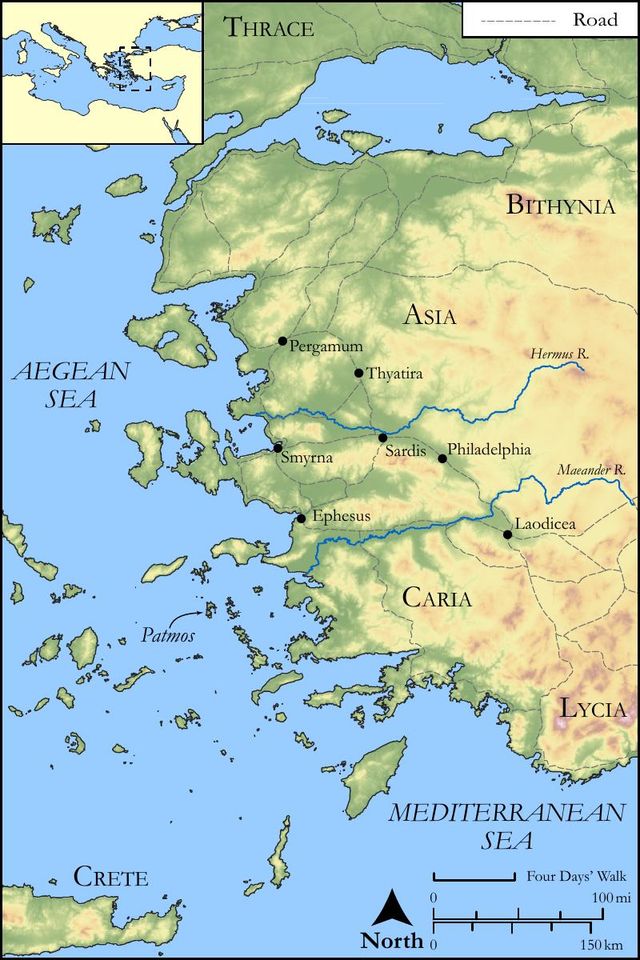
See on the biblical-era maps

Study this verse
Public-domain commentary
Matthew Henry
From his Commentary on the Whole Bible. Henry comments on passages, not single verses — this entry covers Revelation 7:1–12. His four-level outline is real structure in the source text, so it is rendered as structure.
Here we have, I. An account of the restraint laid upon the winds. By these winds we suppose are meant those errors and corruptions in religion which would occasion a great deal of trouble and mischief to the church of God. Sometimes the Holy Spirit is compared to the wind: here the spirits of error are compared to the four winds, contrary one to another, but doing much hurt to the church, the garden and vineyard of God, breaking the branches and blasting the fruits of his plantation. The devil is called the prince of the power of the air; he, by a great wind, overthrew the house of Job's eldest son. Errors are as wind, by which those who are unstable are shaken, and carried to and fro, Eph 4:14. Observe, 1. These are called the winds of the earth, because they blow only in these lower regions near the earth; heaven is always clear and free from them. 2. They are restrained by the ministry of angels, standing on the four corners of the earth, intimating that the spirit of error cannot go forth till God permits it, and that the angels minister to the good of the church by restraining its enemies. 3. Their restraint was only for a season, and that was till the servants of God were sealed in their foreheads. God has a particular care and concern for his own servants in times of temptation and corruption, and he has a way to secure them from the common infection; he first establishes them, and then he tries them; he has the timing of their trials in his own hand.
II.An account of the sealing of the servants of God, where observe,
1.To whom this work was committed - to an angel, another angel. While some of the angels were employed to restrain Satan and his agents, another angel was employed to mark out and distinguish the faithful servants of God.
2.How they were distinguished - the seal of God was set upon their foreheads, a seal known to him, and as plain as if it appeared in their foreheads; by this mark they were set apart for mercy and safety in the worst of times.
3.The number of those that were sealed, where observe,
(1.)A particular account of those that were sealed of the twelve tribes of Israel - twelve thousand out of every tribe, the whole sum amounting to a hundred and forty-four thousand. In this list the tribe of Dan is omitted, perhaps because they were greatly addicted to idolatry; and the order of the tribes is altered, perhaps according as they had been more or less faithful to God. Some take these to be a select number of the Jews who were reserved for mercy at the destruction of Jerusalem; others think that time was past, and therefore it is to be more generally applied to God's chosen remnant in the world; but, if the destruction of Jerusalem was not yet over (and I think it is hard to prove that it was), it seems more proper to understand this of the remnant of that people which God had reserved according to the election of grace, only here we have a definite number for an indefinite.
(2.)A general account of those who were saved out of other nations (Rev 7:9): A great multitude, which no man could number, of all nations, and kindreds, and people, and tongues. Though these are not said to be sealed, yet they were selected by God out of all nations, and brought into his church, and there stood before the throne. Observe,
[1.]God will have a greater harvest of souls among the Gentiles than he had among the Jews. More are the children of the desolate than of the married woman.
[2.]The Lord knows who are his, and he will keep them safe in times of dangerous temptation.
[3.]Though the church of God is but a little flock, in comparison of the wicked world, yet it is no contemptible society, but really large and to be still more enlarged.
III.We have the songs of saints and angels on this occasion, Rev 7:9-12, where observe,
1.The praises offered up by the saints (and, as it seems to me, by the Gentile believers) for the care of God in reserving so large a remnant of the Jews, and saving them from infidelity and destruction. The Jewish church prayed for the Gentiles before their conversion, and the Gentile churches have reason to bless God for his distinguishing mercy to so many of the Jews, when the rest were cut off. Here observe,
(1.)The posture of these praising saints: they stood before the throne, and before the Lamb, before the Creator and the Mediator. In acts of religious worship we come nigh to God, and are to conceive ourselves as in his special presence; and we must come to God by Christ. The throne of God would be inaccessible to sinners were it not for a Mediator.
(2.)Their habit: they were clothed with white robes, and had palms in their hands; they were invested with the robes of justification, holiness, and victory, and had palms in their hands, as conquerors used to appear in their triumphs: such a glorious appearance will the faithful servants of God make at last, when they have fought the good fight of faith and finished their course.
(3.)Their employment: they cried with a loud voice, saying, Salvation to our God who sitteth upon the throne, and to the Lamb. This may be understood either as a hosannah, wishing well to the interest of God and Christ in the church and in the world, or as a hallelujah, giving to God and the Lamb the praise of the great salvation; both the Father and the Son are joined together in these praises; the Father contrived this salvation, the Son purchased it, and those who enjoy it must and will bless the Lord and the Lamb, and they will do it publicly, and with becoming fervour.
2.Here is the song of the angels (Rev 7:11, Rev 7:12), where observe,
(1.)Their station - before the throne of God, attending on him, and about the saints, ready to serve them.
(2.)Their posture, which is very humble, and expressive of the greatest reverence: They fell before the throne on their faces, and worshipped God. Behold the most excellent of all the creatures, who never sinned, who are before him continually, not only covering their faces, but falling down on their faces before the Lord! What humility then, and what profound reverence, become us vile frail creatures, when we come into the presence of God! We should fall down before him; there should be both a reverential frame of spirit and a humble behaviour in all our addresses to God (3.) Their praises. They consented to the praises of the saints, said their Amen thereto; there is in heaven a perfect harmony between the angels and saints; and then they added more of their own, saying, Blessing, and glory, and wisdom, and thanksgiving, and honour, and power, and might, be unto our God for ever and ever. Amen. Here,
[1.]They acknowledge the glorious attributes of God - his wisdom, his power, and his might.
[2.]They declare that for these his divine perfections he ought to be blessed, and praised, and glorified, to all eternity; and they confirm it by their Amen. We see what is the work of heaven, and we ought to begin it now, to get our hearts tuned for it, to be much in it, and to long for that world where our praises, as well as happiness, will be perfected.
Historical interpretation
Eight Centuries of Reception
7 surviving comments on this verse. Each one is dated, so this reads as a timeline rather than a list.
Select a marker to jump to its quote. Markers stagger vertically where authors wrote within a few decades of each other.
"Now, sir," I continued, "explain to me, with respect to the mountains, why their forms are various and diverse." "Listen," he said: "these mountains are the twelve tribes, which inhabit the whole world. The Son of God, accordingly, was preached unto them by the apostles."
"And I saw another angel ascending from the east, having the seal of the living God" He speaks of Elias the prophet, who is the precursor of the times of Antichrist, for the restoration and establishment of the churches from the great and intolerable persecution. We read that these things are predicted in the opening of the Old and New Testament; for He says by Malachi: "Lo, I will send to you Elias the Tishbite, to turn the hearts of the fathers to the children, according to the time of calling, to recall the Jews to the faith of the people that succeed them." And to that end He shows, as we have said, that the number of those that shall believe, of the Jews and of the nations, is a great multitude which no man was able to number. Moreover, we read in the Gospel that the prayers of the Church are sent from heaven by an angel, and that they are received against wrath, and that the kingdom of Antichrist is cast out and extinguished by holy angels; for He says: "Pray that ye enter not into temptation: for there shall be a great affliction, such as has not been from the beginning of the world; and except the Lord had shortened those days, no flesh should be saved." Therefore He shall send these seven great archangels to smite the kingdom of Antichrist; for He Himself also thus said: "Then the Son of man shall send His messengers; and they shall gather together His elect from the four corners of the wind, from the one end of heaven even to the other end thereof." For, moreover, He previously says by the prophet: "Then shall there be peace for our land, when there shall arise in it seven shepherds and eight attacks of men; and they shall encircle Assur," that is, Antichrist, "in the trench of Nimrod," that is, in the nation of the devil, by the spirit of the Church. Similarly when the keepers of the house shall be moved. Moreover, the Lord Himself, in the parable to the apostles, when the labourers had come to Him and said, "Lord, did not we sow good seed in Thy field? whence, then, hath it tares? answered them, An enemy hath done this. And they said to Him, Lord, wilt Thou, then, that we go and root them up? And He said, Nay, but let both grow together until the harvest; and in the time of the harvest I will say to the reapers, that they gather the tares and make bundles of them, and burn them with fire everlasting, but that they gather the wheat into my barns." The Apocalypse here shows, therefore, that these reapers, and shepherds, and labourers, are the angels. And the trumpet is the word of power. And although the same thing recurs in the phials, still it is not said as if it occurred twice, but because what is decreed by the Lord to happen shall be once for all; for this cause it is said twice. What, therefore, He said too little in the trumpets, is here found in the phials. We must not regard the order of what is said, because frequently the Holy Spirit, when He has traversed even to the end of the last times, returns again to the same times, and fills up what He had before failed to say. Nor must we look for order in the Apocalypse; but we must follow the meaning of those things which are prophesied. Therefore in the trumpets and phials is signified either the desolation of the plagues that are sent upon the earth, or the madness of Antichrist himself, or the cutting off of the peoples, or the diversity of the plagues, or the hope in the kingdom of the saints, or the ruin of states, or the great overthrow of Babylon, that is, the Roman state.
And I join with their company in the new song of the archangels, showing forth the new grace of the Church; for the Word says that the company of virgins always follow the Lord, and have fellowship with Him wherever He is. And this is what John signifies in the commemoration of the hundred and forty-four thousand.
And I heard the number of those who were sealed, etc. This finite number signifies the innumerable multitude of the whole Church, which is generated from the patriarchs, either by descent of flesh or by imitation of faith. For if you are Christ's, then you are Abraham's seed (Gal. 3). For the increase of perfection, it pertains that twelve is multiplied twelve times, and to the total is perfected as a thousand, which is a solid squared number, signifying the stable life of the Church. Therefore, it is often figured by the number twelve because it stands firm in the faith of the Holy Trinity in a fourfold world. For thrice four is the perfect number, a double portion. Finally, the apostles, who were chosen to preach the same faith to the world, were twelve, indicating by their number the mystery of their work.
QUESTION: What is meant by And I heard the number of them that were signed, an hundred forty-four thousand were signed, of every tribe of the children of Israel? ANSWER: By this finite number is signified the innumerable multitude of the whole Church, which was born of the patriarchs through imitation, whether by lineage of the flesh or by lineage of faith — for, he says, If you be Christ's, then are you the seed of Abraham. [Gal. 3:29] It conduces to an increase in perfection that the number twelve itself is multiplied by twelve, and completed, to form the entire sum, by the number thousand, which is the cube number of ten, signifying the stable life of the Church. The reason why the Church is often symbolized by the number twelve is that it is present throughout the world, which is divided into four parts, and it is based on faith in the holy Trinity; for three times four make twelve. Finally, the apostles chosen to preach the same faith to the world were also twelve in number, symbolizing by their number the mystery of their work. So, of the tribe of Juda were twelve thousand signed. It is fitting for him to start with Juda, which is the tribe that our Lord was born of, and to omit Dan, which it is said that the Antichrist will be born of (as it is written: Let Dan be a snake in the way, a serpent in the path, that biteth the horse's heels that his rider may fall); [Gen. 49:17] for it is not the order of earthly generation that he decided to present here, but the virtues of the Church, according to the interpretations of the names — the Church, which, with its present confession and praise, hastens to the right hand which is eternal life: this is indeed what the names Juda, who is put first, and Benjamin, who is put last, mean. So Juda, which translates to “confession” or “laudation,” is put first because no one lays hold of the summit of goods before the beginning of confession, and if we do not renounce bad actions through confession, we cannot be instructed for right actions. Second comes Ruben, which translates to “he who sees the child.” The Psalmist testifies that what is indicated by children is works, as he says in the blessings of the blessed man, Thy children as young plants of olive-trees, [Ps. 127:3] and also, And mayest thou see thy children's children; [Ibid. 6] for it is not because someone who fears the Lord has not begotten children and had grandchildren that he cannot be blessed, since a greater reward awaits the virgin faithful; but by children, the Psalmist means works, and by one's children's children, the fruits of one's works, that is the eternal reward. Therefore after Juda comes Ruben, that is, after the beginnings of divine confession and praise comes perfection of action. Yet, since through many tribulations we must enter into the kingdom of God, [Acts 14:21] after Ruben follows Gad, which translates to “temptation” or “girded.” After the beginning of good work, a person must be tested with greater temptations and gird themselves for harder battles, so that the strength of their faith may be tested. As Solomon says, Son, when thou comest to the service of God, stand in justice and in fear; prepare thy soul for temptation. [Sir. 2:1] Then, since we consider blessed those who have endured suffering, after Gad comes Aser, which means “blessed.” This order is fitting enough, for blessed is the man that endureth temptation; for when he hath been proved, he shall receive a crown of life. [James 1:12] Now, since, feeling secure because of the faithful promise of this blessedness, they do not feel afflicted, but, rejoicing in hope and patient in tribulation, they sing together with the Psalmist, I have run the way of thy commandments, when thou didst enlarge my heart, [Ps. 118:32] and say, rejoicing with the mother of blessed Samuel, My mouth is enlarged over my enemies: because I have joyed in thy salvation, [1 Sam. 2:1] for this reason, next comes Nephthali, which means “wideness.” Nephthali himself is followed by Manasses, which translates to “having forgotten” or “necessity.” By the mystery of this name, we are told, taught by the torments of present temptations, to forget the things that are behind and to stretch forth, like the Apostle, to those that are before, [Phil. 3:13] without making provision for the flesh in its concupiscences, [Rom. 13:14] but only when we are forced to by the necessity of human condition, which the Psalmist was talking about when he prayed, sighing for better things, Deliver me from my necessities. [Ps. 24:17] After this one comes Simeon, which means “He has heard sorrow” or “the name of the dwelling,” so that by the nature of this word too he may inculcate in us the more evidently both what we must get here and what we must expect to good effect; for the joy of the heavenly dwelling will be given to those whose minds are here saddened with a fruitful penitence. It is also said to these people, Your sorrow shall be turned into joy. [John 16:20] Then follows Levi, which means “added,” in whom we understand either those who buy eternal things at the cost of temporal ones (as Solomon says, The ransom of a man's life are his riches) [Prov. 13:8] or those who, because they follow God's counsel, receive a hundredfold in this world with tribulations, and in the world to come life everlasting. [Mark 10:30] These people are also being referred to in what is written: He that addeth knowledge, addeth labour. [Eccles. 1:18] Indeed the reason why tribulations were heaped on saint Job was in order for a bigger reward to be rendered to him once he had been successfully tested. Whence it is not without reason that Issachar, which translates to “reward,” comes directly after this one; because, as the apostle teaches us, The sufferings of this time are not worthy to be compared with the glory to come, that shall be revealed in us. [Rom. 8:18] Indeed battle is fought more effectively when a sure reward is expected. God works and completes all this in the dwelling of strength, which is what Zabulon means, when power is made perfect in infirmity [2 Cor. 12:9] so that a body that is thought weak by one's enemies, and through whose matter they try to inflict death on the soul as well, turns out to be invincible when God strengthens it. There follows a happy increase, which is what the name Joseph means, denoting more gifts of graces to be given, whether you understand by this the spiritual interests gained from the twofold return of the talents, [Ref. to Matt. 25:14-30] or whether you take it to mean those rendered to God the Redeemer by the faithful's votive piety. Then, so that you may understand that all these people, whose order and names' interpretations both show that they have been placed here in a way that signifies something, will be on the right hand of Christ the eternal King in the future judgment, in last position, as we said earlier, comes Benjamin, which means “son of the right hand,” as if he were the end of the sequence, when the last enemy, death, has been destroyed, [Cf. 1 Cor. 15:26] and the elect are given the eternal happiness of their inheritance — whether it is every one of the faithful that is entitled to be called “son of the right hand,” or the whole assembly of the Church, about which we sing, The queen stood on thy right hand, in gilded clothing; surrounded with variety. [Ps. 44:10] So, there are twelve thousand signed out of each tribe because whatever virtues every one of the faithful has succeeded in, they must necessarily always be strengthened by the faith of the ancient fathers and instructed by their examples. It is indeed absolutely certain that the number twelve often represents either the teachers or the whole Church, because of the total number of the apostles or of the patriarchs; for whether the individual faithful are praiseworthy in confession, like in Juda; outstanding in offspring of works in Ruben; strong in the trial of temptations in Gad; successful by their victory in battles in Aser; enlarged by bountiful works of compassion in Nephthali; forgetting the things that are behind in Manasses; or as though sad thus far in the valley of tears, but always rejoicing in the name of the dwelling, and sighing for the heavenly Jerusalem in Simeon; whether those in Levi, who rejoice in the promises both of the present life and of the future one, as they receive temporal goods in addition, while having the eternal good as their foundation; those in Issachar, who are strengthened by the contemplation of the future reward; those in Zabulon, who lay down their lives for Christ; those in Joseph, who also strive after an increase in spiritual substance, and offer something more in addition to God's commandments, whether in virginity or from their resources; or those in Benjamin, who seek with tireless wishes after the right hand which is eternal happiness, it is fitting that each of these, in their own calling, be marked by the rule of the preceding fathers as though by the number twelve, and that from the merits of all individuals there be reckoned the most perfect beauty of the Church, as the sum of a hundred forty-four thousand.
And I heard the number of them that were signed, an hundred forty-four thousand were signed, of every tribe of the children of Israel. It is a definite number put for an indefinite one, and it does not refer only to the twelve tribes of Israel, but all the Church, in the elect, is represented by it. Indeed the number three is a perfect number in the sacred Scripture, especially because it represents the Trinity; same for the number four because of the four parts of the world, the four Gospels, or the four cardinal virtues: if we multiply these by each other, we reach the number twelve, which also is hallowed because of the twelve tribes or the twelve apostles. As for the number thousand, it represents totality, according to this: unto a thousand generations. [Deut. 7:9, 1 Chron. 16:15, Ps. 104:8] Therefore, since the Church is brought together from all nations by knowledge of the Trinity and nourished by the four books of the Gospels, it is appropriate for it to be symbolized by twelve thousand; but in order for it to be perfected in what it has believed in, the number twelve thousand needs to be joined together by the solidity of the cube: therefore, let twelve thousand be multiplied by four, and it makes forty-eight thousand; then, in order for it to reach what it has believed in, that is the contemplation of the Trinity, let forty-eight thousand be multiplied by three, and it gives a hundred forty-four thousand.
And he says that one hundred and forty thousand were sealed; for many were those who believed in Christ from among the Jews, who owed their salvation from the common destruction to this number. And those who spoke with Paul in Jerusalem bear witness: "Look, brother, how many myriads of Jews have believed." (Acts 21:20)
It was not only reasonable to spare the faithful but also those who, in ignorance and deception, cooperated with the crucifixion of the Lord, concerning whom He said: "Father, forgive them; for they do not know what they are doing." (Luke 23:34) Cyril, in his thirteenth book Against Julian, states that this prayer of the Lord is not found in the Gospels according to the pagans, but it is indeed present among us. And not only these individuals but also those who were not present at that time, or who were residing in Jerusalem, and therefore did not partake in the impious counsel of the accursed chief priests regarding the crucifixion, or even those who were present but did not share in the guilt of the pollution, for He blessed all under heaven, having opposed or rejected the godless council of the lawless; all of whom it was reasonable to be later sealed by the faith of Christ. For the angel would not have otherwise called them servants of God; of whom, when some were preserved, the rest, being evil, defected even to the Romans and were thoroughly corrupted, "becoming a spectacle to the world and to angels and men" (1 Cor. 4:9) in a different manner, and not as Paul spoke concerning the divine apostles. Of these, again Josephus is a witness, enumerating the greatest number, tens of thousands, due to the famine.
Continue studying Revelation 7:4 across the web’s major study libraries — every link below opens this exact verse, chapter, or book on the destination site.
Read & Compare
 BibleGatewayThis verse in more than 200 translations and 70 languages.
 Bible.comThe YouVersion reader — hundreds of translations, reading plans, and highlights.
 ESV.orgCrossway's official English Standard Version reader.
 NET BibleThe NET translation with 60,000+ translators' notes on every rendering decision.
 STEP BibleTyndale House's free study tool — original text, vocabulary, and scholarly resources.
 BibliaLogos Bible Software's free web reader.
 USCCBThe New American Bible (Revised Edition) with the U.S. bishops' study notes.
Commentaries
 BibleHub CommentariesDozens of classic commentaries on this verse, gathered on one page.
 StudyLightMore than 100 commentary sets — the largest collection on the web.
 BibleRefPlain-English commentary on what this verse means, verse by verse.
 Enduring WordDavid Guzik's free commentary on this chapter, widely used by Bible teachers.
 Bible Study ToolsVerse commentary alongside Greek and Hebrew study aids.
Original Language & Research
- BibleHub InterlinearThe verse word by word — original language, transliteration, and English.
- BibleHub LexiconEvery word's original-language definition and Strong's entry.
 Blue Letter BibleDeep-study tools — Strong's numbers, concordance, and word studies.
 CNTR CollationThe earliest Greek manuscripts of this verse, collated letter by letter.
Sermons, Hymns & Audio


TrulyRandomVerse is not affiliated with these sites and doesn’t control their content. They’re linked because they’re genuinely useful.
Summary
Revelation 7:4 unveils a crucial detail within John's apocalyptic vision: the precise enumeration of a divinely protected group. This verse, situated as an interlude of hope amidst escalating judgments, reveals that 144,000 individuals, identified as originating "of all the tribes of the children of Israel," are marked with a divine seal, signifying God's ownership and preservation in the face of impending global tribulation.
Context
ShowHideLiterary Context
Revelation 7:4 forms a significant part of an interlude (Revelation 7:1-17) that pauses the unfolding of the seven seals. Immediately preceding this, the opening of the sixth seal (Revelation 6:12-17) describes cataclysmic disturbances in the heavens, widespread terror, and humanity's desperate attempt to hide from the wrath of God and the Lamb. This terrifying display of judgment sets a stark backdrop for the comforting assurance found in Chapter 7, where God's protective hand is revealed. Before the seventh seal is opened and further judgments are unleashed, John sees four angels holding back destructive winds, emphasizing God's sovereign control over the timing and extent of judgment. It is within this divine pause that the sealing of the 144,000 is announced, providing a counterpoint of preservation to the preceding devastation.
Historical & Cultural Context
The concept of "sealing" was deeply significant in that day. Seals, often signet rings, were used to authenticate documents, secure property, indicate ownership, or protect contents from tampering. For instance, a king's seal on a decree made it unalterable, or a seal on a tomb ensured its undisturbed state. In a religious context, the mark could signify divine protection, echoing the Passover account where the blood on the doorposts marked Israelite homes for protection from the angel of death (Exodus 12:13). The mention of "tribes of Israel" immediately invokes the historical covenant people of God, whose lineage and tribal divisions were meticulously maintained in Jewish tradition. The number 12, foundational to the tribes of Israel and later the apostles, symbolized completeness and divine order in Jewish thought, making the number 144,000 (12x12x1000) highly symbolic of a divinely ordered and complete multitude.
Key Themes
ShowHideThis verse contributes to several overarching themes within Revelation and the broader biblical narrative. The primary theme is Divine Protection and Preservation, demonstrating God's unwavering commitment to safeguard His chosen people amidst tribulation. The act of "sealing" signifies God's ownership and active intervention to protect His elect from the destructive forces unleashed upon the earth, assuring believers that they are not abandoned. Closely related is the theme of the Remnant, a consistent biblical motif seen from Noah to Elijah (1 Kings 19:18) and Paul (Romans 11:5), where God always preserves a faithful portion of His people. The mention of "all the tribes of the children of Israel" introduces the crucial theme of Identity of God's People, prompting questions about whether "Israel" refers to ethnic Jews or the spiritual Israel (the Church), a debate central to understanding the scope of God's covenant promises throughout the New Testament, as explored in passages like Galatians 6:16.
Exposition and Analysis
ShowHideKey Word Analysis
ShowHideThis primary verb signifies John's reception of auditory information, emphasizing that the revelation of the number was not a visual perception but a divine communication. It underscores the authoritative nature of the information being conveyed, as John is not merely seeing a multitude but is explicitly told their number and identity by a divine source.
Derived from the word for "seal," this verb means to stamp with a signet or private mark for security, preservation, or authentication. In this context, it denotes a divine act of marking for ownership and protection. Those who are "sealed" are set apart by God, indicating their security from the judgments that will fall upon the unsealed world, akin to a divine "do not harm" sign.
Of Hebrew origin, this term refers to Jacob's adopted name and, by extension, his descendants. In Revelation 7:4, its use is pivotal and highly debated. It can be interpreted literally as the twelve historical tribes of ethnic Israel, or symbolically as the spiritual Israel, encompassing all believers in Christ, both Jew and Gentile, who are now part of God's covenant people. The context of an apocalyptic vision often lends itself to symbolic interpretation.
Verse Breakdown
ShowHide"And I heard the number of them which were sealed:"
John, the visionary, is not merely observing a scene but is given specific, quantifiable information through an auditory revelation. This emphasizes the precision and divine intentionality behind the identification of this group. The focus is immediately placed on a distinct, marked group.
"and there were sealed an hundred and forty and four thousand"
This clause provides the exact, divinely determined quantity of those who are sealed. The number 144,000 is highly symbolic (12 x 12 x 1,000), representing completeness, divine order, and a vast, innumerable multitude (1,000 often signifies a very large, complete number). It signifies a full and perfect number of God's protected people.
"of all the tribes of the children of Israel."
This final phrase identifies the origin or composition of the sealed group. The mention of "all the tribes" (even though the subsequent list in Revelation 7:5-8 omits Dan and includes Levi and Joseph/Manasseh in different ways) points to a comprehensive representation of God's covenant people. The critical interpretive question revolves around whether "Israel" here refers to ethnic Jews or to the Church, which is often understood as the spiritual Israel, encompassing believers from all nations.
Literary Devices
ShowHideRevelation 7:4 employs several significant literary devices. Numerology is prominent, with the number 144,000 being highly symbolic rather than strictly literal. Derived from 12 (representing the tribes of Israel and the apostles, thus divine completeness) multiplied by 12 and then by 1,000 (a number signifying vastness and totality), it conveys the idea of a complete, divinely ordered, and immense multitude of God's people. This is not merely a census count but a theological statement about the full number of the elect. Symbolism is also central, particularly with the "sealing." The seal is a symbolic mark of divine ownership, protection, and authentication, distinguishing God's people from those destined for judgment. Furthermore, the identity of "Israel" itself is often interpreted symbolically in apocalyptic literature, representing the redeemed community of God, rather than exclusively ethnic Israel. The entire passage functions as an Apocalyptic Vision, where spiritual truths are conveyed through vivid, often symbolic, imagery and numbers, inviting deeper theological reflection rather than purely literal interpretation.
Theological and Thematic Connections
ShowHideRevelation 7:4 profoundly underscores God's unwavering faithfulness and His sovereign power to preserve His people amidst global chaos. It assures believers that even when the world is engulfed in judgment, God maintains a distinct, identified, and protected remnant. This divine safeguarding is not arbitrary but is a deliberate act of God's covenant love, ensuring that His purposes for humanity will be fulfilled through those who bear His mark. The sealing signifies not only protection from wrath but also an affirmation of ownership, marking them as God's peculiar treasure.
Reflection and Application
ShowHideRevelation 7:4 offers profound comfort and a powerful call to assurance for believers in every generation. In a world often marked by uncertainty, fear, and the pervasive sense of impending doom, this verse reminds us that God is sovereign over all events, even the most terrifying judgments. We are assured that God knows His own, and He actively preserves them. The "seal" is a spiritual reality for every believer, a mark of the Holy Spirit, signifying our adoption, redemption, and future inheritance. This should instill in us a deep sense of security and belonging, knowing that our ultimate protection rests not in worldly defenses but in the divine hand of God. It encourages us to live with courage and hope, confident that no matter the tribulation, God's purposes for His people will prevail, and we are eternally marked as His.
Questions for Reflection
ShowHideFAQ
ShowHideWho are the 144,000 mentioned in Revelation 7:4?
ShowHideThe identity of the 144,000 is one of the most debated topics in Revelation. There are two primary interpretations. The literal interpretation holds that they are 144,000 ethnic Jewish evangelists—12,000 from each of the twelve tribes of Israel (though the list in Revelation 7:5-8 varies from standard Old Testament lists)—who will be supernaturally preserved and empowered to proclaim the gospel during the Great Tribulation. The symbolic interpretation views the number 144,000 (12x12x1,000) as a symbolic representation of the complete number of God's redeemed people throughout history, the "spiritual Israel" or the Church. In this view, "tribes of Israel" symbolizes the entirety of God's covenant people, both Jew and Gentile, who have been brought into the new covenant through Christ, echoing themes found in Romans 2:29 and Galatians 3:29. Regardless of the interpretation, the core message is that God has a specific, divinely appointed group whom He protects and uses for His purposes.
Christ-Centered Fulfillment
ShowHideRevelation 7:4, with its vision of a sealed remnant from the tribes of Israel, finds its ultimate and richer fulfillment in Christ and His Church. While the Old Testament concept of Israel was tied to a specific ethnic lineage and covenant, Christ Himself is the true Israel, the perfect Son of God who perfectly fulfilled God's covenant promises. Through His atoning work on the cross, He established a new covenant, creating a new "Israel" not defined by physical descent but by faith in Him. The "sealing" mentioned in Revelation 7:4 foreshadows the spiritual sealing of believers with the Holy Spirit, which is a reality for all who are in Christ (as seen in Ephesians 4:30). This Spirit is the "guarantee of our inheritance" (Ephesians 1:14), marking us as God's own and securing us for the day of redemption. Thus, the 144,000, whether literally ethnic Israel or symbolically the Church, ultimately point to the vast, innumerable multitude of redeemed people from "every tribe and language and people and nation" (Revelation 5:9) who are united in Christ and protected by His finished work, serving as His witnesses in the world.