


Revelation 7:1
Bible text: King James Version (1769 Blayney text) · Public domain
Bible text: King James Version with Strong's numbers · Public domain
Bible text: Berean Standard Bible · Public domain
Bible text: American Standard Version (1901) · Public domain
Bible text: World English Bible, Messianic edition · Public domain
Bible text: Geneva Bible (1599) · Public domain
Bible text: Young's Literal Translation · Public domain
- ΚαὶKaiandG2532CONJConjunction
- μετὰmetaAfterG3326PREPPreposition
- τοῦτοtoutothis thingG3778D-ASNDemonstrative pronoun Accusative Singular Neuter
- εἶδονeidonI sawG1492V-2AAI-1SVerb 2nd Aorist Active Indicative 1st Singular
- τέσσαραςtessarasfourG5064A-APMAdjective Accusative Plural Masculine
- ἀγγέλουςangelousangelsG32N-APMNoun Accusative Plural Masculine
- ἑστῶταςhestōtasstandingG2476V-RAP-APMVerb Perfect Active Participle Accusative Plural Masculine
- ἐπὶepiuponG1909PREPPreposition
- τὰςtastheG3588T-APFDefinite article Accusative Plural Feminine
- τέσσαραςtessarasfourG5064A-APFAdjective Accusative Plural Feminine
- γωνίαςgōniascornersG1137N-APFNoun Accusative Plural Feminine
- τῆςtēsof theG3588T-GSFDefinite article Genitive Singular Feminine
- γῆςgēsearthG1093N-GSFNoun Genitive Singular Feminine
- κρατοῦνταςkratountasholdingG2902V-PAP-APMVerb Present Active Participle Accusative Plural Masculine
- τοὺςtoustheG3588T-APMDefinite article Accusative Plural Masculine
- τέσσαραςtessarasfourG5064A-APMAdjective Accusative Plural Masculine
- ἀνέμουςanemouswindsG417N-APMNoun Accusative Plural Masculine
- τῆςtēsof theG3588T-GSFDefinite article Genitive Singular Feminine
- γῆςgēsearthG1093N-GSFNoun Genitive Singular Feminine
- ἵναinaso thatG2443CONJConjunction
- μὴmēnoG3361PRT-NNegative Particle Negative
- πνέῃpneēmay blowG4154V-PAS-3SVerb Present Active Subjunctive 3rd Singular
- ἄνεμοςanemoswindG417N-NSMNoun Nominative Singular Masculine
- ἐπὶepionG1909PREPPreposition
- τῆςtēstheG3588T-GSFDefinite article Genitive Singular Feminine
- γῆςgēsearthG1093N-GSFNoun Genitive Singular Feminine
- μήτεmētenorG3383CONJ-NConjunction Negative
- ἐπὶepionG1909PREPPreposition
- τῆςtēstheG3588T-GSFDefinite article Genitive Singular Feminine
- θαλάσσηςthalassēsseaG2281N-GSFNoun Genitive Singular Feminine
- μήτεmētenorG3383CONJ-NConjunction Negative
- ἐπὶepionG1909PREPPreposition
- πᾶνpanallG3956A-ASNAdjective Accusative Singular Neuter
- δένδρονdendrontreeG1186N-ASNNoun Accusative Singular Neuter
English is a literal word-by-word gloss of the Greek, not the KJV's wording. Why?
This is the original text the KJV's translators worked from — each Greek word with its own literal English meaning in this verse, prepared by scholars at Tyndale House, Cambridge. The KJV translates whole sentences, not word by word, so its wording differs: one Greek word can become several English words, and the KJV may choose “charity” where the gloss reads “love”. Both are faithful — they answer different questions. For the KJV's own rendering, switch to the KJV text.
Details
See on the biblical-era maps
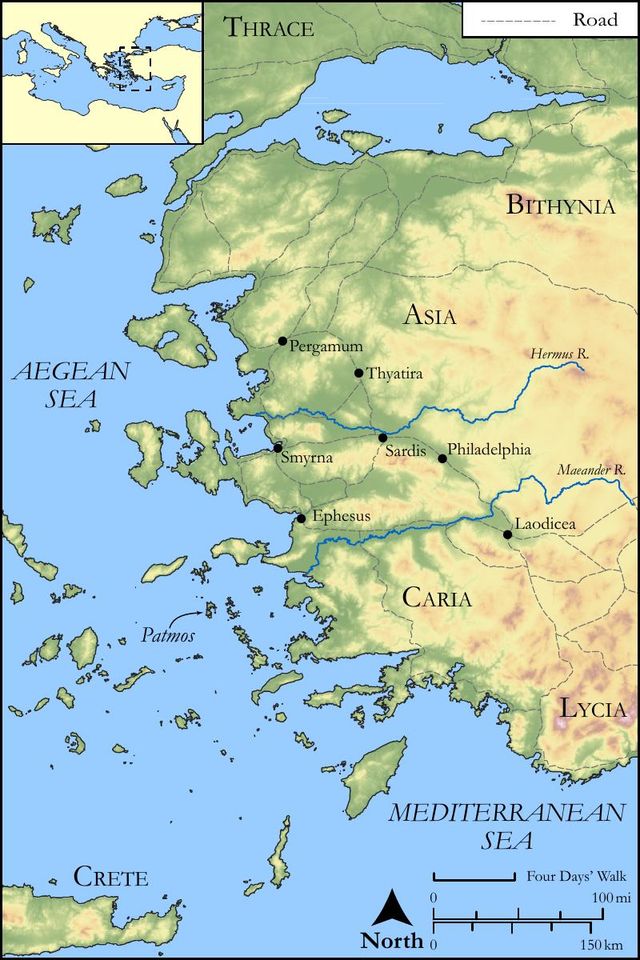

Study this verse
Public-domain commentary
Matthew Henry
From his Commentary on the Whole Bible. Henry comments on passages, not single verses — this entry covers Revelation 7:1–12. His four-level outline is real structure in the source text, so it is rendered as structure.
Here we have, I. An account of the restraint laid upon the winds. By these winds we suppose are meant those errors and corruptions in religion which would occasion a great deal of trouble and mischief to the church of God. Sometimes the Holy Spirit is compared to the wind: here the spirits of error are compared to the four winds, contrary one to another, but doing much hurt to the church, the garden and vineyard of God, breaking the branches and blasting the fruits of his plantation. The devil is called the prince of the power of the air; he, by a great wind, overthrew the house of Job's eldest son. Errors are as wind, by which those who are unstable are shaken, and carried to and fro, Eph 4:14. Observe, 1. These are called the winds of the earth, because they blow only in these lower regions near the earth; heaven is always clear and free from them. 2. They are restrained by the ministry of angels, standing on the four corners of the earth, intimating that the spirit of error cannot go forth till God permits it, and that the angels minister to the good of the church by restraining its enemies. 3. Their restraint was only for a season, and that was till the servants of God were sealed in their foreheads. God has a particular care and concern for his own servants in times of temptation and corruption, and he has a way to secure them from the common infection; he first establishes them, and then he tries them; he has the timing of their trials in his own hand.
II.An account of the sealing of the servants of God, where observe,
1.To whom this work was committed - to an angel, another angel. While some of the angels were employed to restrain Satan and his agents, another angel was employed to mark out and distinguish the faithful servants of God.
2.How they were distinguished - the seal of God was set upon their foreheads, a seal known to him, and as plain as if it appeared in their foreheads; by this mark they were set apart for mercy and safety in the worst of times.
3.The number of those that were sealed, where observe,
(1.)A particular account of those that were sealed of the twelve tribes of Israel - twelve thousand out of every tribe, the whole sum amounting to a hundred and forty-four thousand. In this list the tribe of Dan is omitted, perhaps because they were greatly addicted to idolatry; and the order of the tribes is altered, perhaps according as they had been more or less faithful to God. Some take these to be a select number of the Jews who were reserved for mercy at the destruction of Jerusalem; others think that time was past, and therefore it is to be more generally applied to God's chosen remnant in the world; but, if the destruction of Jerusalem was not yet over (and I think it is hard to prove that it was), it seems more proper to understand this of the remnant of that people which God had reserved according to the election of grace, only here we have a definite number for an indefinite.
(2.)A general account of those who were saved out of other nations (Rev 7:9): A great multitude, which no man could number, of all nations, and kindreds, and people, and tongues. Though these are not said to be sealed, yet they were selected by God out of all nations, and brought into his church, and there stood before the throne. Observe,
[1.]God will have a greater harvest of souls among the Gentiles than he had among the Jews. More are the children of the desolate than of the married woman.
[2.]The Lord knows who are his, and he will keep them safe in times of dangerous temptation.
[3.]Though the church of God is but a little flock, in comparison of the wicked world, yet it is no contemptible society, but really large and to be still more enlarged.
III.We have the songs of saints and angels on this occasion, Rev 7:9-12, where observe,
1.The praises offered up by the saints (and, as it seems to me, by the Gentile believers) for the care of God in reserving so large a remnant of the Jews, and saving them from infidelity and destruction. The Jewish church prayed for the Gentiles before their conversion, and the Gentile churches have reason to bless God for his distinguishing mercy to so many of the Jews, when the rest were cut off. Here observe,
(1.)The posture of these praising saints: they stood before the throne, and before the Lamb, before the Creator and the Mediator. In acts of religious worship we come nigh to God, and are to conceive ourselves as in his special presence; and we must come to God by Christ. The throne of God would be inaccessible to sinners were it not for a Mediator.
(2.)Their habit: they were clothed with white robes, and had palms in their hands; they were invested with the robes of justification, holiness, and victory, and had palms in their hands, as conquerors used to appear in their triumphs: such a glorious appearance will the faithful servants of God make at last, when they have fought the good fight of faith and finished their course.
(3.)Their employment: they cried with a loud voice, saying, Salvation to our God who sitteth upon the throne, and to the Lamb. This may be understood either as a hosannah, wishing well to the interest of God and Christ in the church and in the world, or as a hallelujah, giving to God and the Lamb the praise of the great salvation; both the Father and the Son are joined together in these praises; the Father contrived this salvation, the Son purchased it, and those who enjoy it must and will bless the Lord and the Lamb, and they will do it publicly, and with becoming fervour.
2.Here is the song of the angels (Rev 7:11, Rev 7:12), where observe,
(1.)Their station - before the throne of God, attending on him, and about the saints, ready to serve them.
(2.)Their posture, which is very humble, and expressive of the greatest reverence: They fell before the throne on their faces, and worshipped God. Behold the most excellent of all the creatures, who never sinned, who are before him continually, not only covering their faces, but falling down on their faces before the Lord! What humility then, and what profound reverence, become us vile frail creatures, when we come into the presence of God! We should fall down before him; there should be both a reverential frame of spirit and a humble behaviour in all our addresses to God (3.) Their praises. They consented to the praises of the saints, said their Amen thereto; there is in heaven a perfect harmony between the angels and saints; and then they added more of their own, saying, Blessing, and glory, and wisdom, and thanksgiving, and honour, and power, and might, be unto our God for ever and ever. Amen. Here,
[1.]They acknowledge the glorious attributes of God - his wisdom, his power, and his might.
[2.]They declare that for these his divine perfections he ought to be blessed, and praised, and glorified, to all eternity; and they confirm it by their Amen. We see what is the work of heaven, and we ought to begin it now, to get our hearts tuned for it, to be much in it, and to long for that world where our praises, as well as happiness, will be perfected.
Historical interpretation
Four Centuries of Reception
5 surviving comments on this verse. Each one is dated, so this reads as a timeline rather than a list.
Select a marker to jump to its quote. Markers stagger vertically where authors wrote within a few decades of each other.
Although these things are thought by some to have occurred long ago to the Jews at the hands of the Romans … how much more will these things occur at the coming of the antichrist, and not only partially in the land of the Jews but over the whole world at whose four corners the angels stand fulfilling a service assigned to them by God, but unknown to us. The holding back of the winds reveals clearly the dissolution of the good order of creation and the inevitability of evil. For by means of wind the plants of the earth are nourished and ships sail the sea.
Holding the four winds of the earth, etc. By their own power, they, in a way, suffocate everything, allowing no one to breathe freely under their jurisdiction. The diversity of provinces on land, the islands in the sea, and the various qualities and conditions of men in the trees are signified. Alternatively, the four angels are to be understood as the same as the four winds, according to the prophecy of Daniel saying: Behold, the four winds of heaven were stirring up the great sea, and four great beasts came up from the sea (Dan. 7).
After this, I saw four angels standing at the four corners of the earth. That is, the four principal kingdoms, namely, those of the Assyrians, Persians, Greeks, and Romans. For just as in the previous seals, after witnessing the manifold conflicts of the Church, he saw the joys of the triumphant souls; so also now, he is about to prove with examples what victory follows the kingdom of the Antichrist, succeeding the preceding kingdoms of the world, which have already yielded to the rule of Christ's Church. For great causes must be confirmed by greater arguments.
And after these things, I saw four angels standing on the four corners of the earth, holding the four winds of the earth, that the wind should not blow upon the earth, nor upon the sea, nor on any tree. It should be noted that he seems to have kept the order all the way from the first to the sixth seal, but, omitting the seventh, he comes back to the beginning of Christ's incarnation and briefly recapitulates with different allegorical symbols the things he had already related, and then he concludes these same two narrations with the seventh seal. Recapitulation is not always done in this way, but in various ways. So what do we understand to be symbolized by the four angels but the body of the old enemy? It is because of the four principal kingdoms of the world, namely that of the Assyrians, that of the Medes, that of the Persians or Macedonians, and that of the Romans, in which the Devil reigned through the cult of idolatry, that four angels are put into the reprobate category. This is why Nebuchadnezzar saw a statue whose head was of gold, but the breast and the arms of silver, and the belly and the thighs of brass, and the legs of iron; [Dan. 2:32-33] for the kingdom of the Assyrians is symbolized by gold, that of the Medes by silver, that of the Persians or Macedonians by brass, and that of the Romans by iron. It is not surprising that bad people are symbolized by angels, since it was said about Judas, One of you is a devil. [John 6:71] One should also know that the four angels are the same as the four winds, according to the prophecy of Daniel, who says, Behold the four winds strove upon the great sea, and four beasts, different one from another, came down out of the sea. [Variant of Dan. 7:2-3] Indeed he indicates that the winds and the beasts are the same, that is the four aforesaid kingdoms. Therefore when the angels hold the winds, they necessarily hold themselves; and since all people of this kind are the Devil's body, he himself is also understood in them. So what does it mean that the four angels held the four winds of the earth that they should not blow, if not that the hidden enemy and his whole body united and bound themselves together, and blocked the mouth of everyone in such a way that no one dared to breathe out the word of truth against the cult of idolatry? By the earth is represented the diversity of provinces, and by the sea the numerousness of islands. The trees as well, since he has mentioned no genus, because of their diversity, symbolize the various offices of people. Now since they were being choked by the Devil, they were saved by the coming of their Lord. Whence it soon follows:
From here, the events that occurred to the Jews in the war against the Romans are clearly shown to the evangelist, which became a cause for them regarding the cross and the mockery against the Lord.
For the four angels who hold the four corners of the land of the Jews guarded so that none of the Jews worthy of death might escape, perhaps casting into them cowardice of flight or some difficulty or a longing for a foreign land and for their wives and loved ones, which is figuratively indicated by the holding of the four corners of Judea.
As for the control of the four winds, which means that neither on the earth nor at sea nor upon any tree should they blow, it signifies that no relief or interval could be found for them in war, nor any easing of their hardships, neither for those fighting on land nor for those engaged in naval battles. For many naval battles were fought during the time of Josephus, nor did those attending to agriculture and the care of plants escape this fate. For all were utterly overtaken by calamities: cities set on fire, land ravaged, and crops destroyed. Josephus thoroughly details all these events in his account of the siege of Jerusalem.
Continue studying Revelation 7:1 across the web’s major study libraries — every link below opens this exact verse, chapter, or book on the destination site.
Read & Compare
 BibleGatewayThis verse in more than 200 translations and 70 languages.
 Bible.comThe YouVersion reader — hundreds of translations, reading plans, and highlights.
 ESV.orgCrossway's official English Standard Version reader.
 NET BibleThe NET translation with 60,000+ translators' notes on every rendering decision.
 STEP BibleTyndale House's free study tool — original text, vocabulary, and scholarly resources.
 BibliaLogos Bible Software's free web reader.
 USCCBThe New American Bible (Revised Edition) with the U.S. bishops' study notes.
Commentaries
 BibleHub CommentariesDozens of classic commentaries on this verse, gathered on one page.
 StudyLightMore than 100 commentary sets — the largest collection on the web.
 BibleRefPlain-English commentary on what this verse means, verse by verse.
 Enduring WordDavid Guzik's free commentary on this chapter, widely used by Bible teachers.
 Bible Study ToolsVerse commentary alongside Greek and Hebrew study aids.
Original Language & Research
- BibleHub InterlinearThe verse word by word — original language, transliteration, and English.
- BibleHub LexiconEvery word's original-language definition and Strong's entry.
 Blue Letter BibleDeep-study tools — Strong's numbers, concordance, and word studies.
 CNTR CollationThe earliest Greek manuscripts of this verse, collated letter by letter.
Sermons, Hymns & Audio


TrulyRandomVerse is not affiliated with these sites and doesn’t control their content. They’re linked because they’re genuinely useful.
Summary
Revelation 7:1 introduces a pivotal interlude in John's apocalyptic vision, immediately following the cataclysmic events of the sixth seal. This verse depicts four angels positioned at the earth's extremities, divinely commissioned to restrain the "four winds"—symbolic of destructive forces or judgments—from impacting the earth, sea, and vegetation. This temporary cessation of impending devastation sets the stage for a crucial act of divine protection and sealing of God's servants before the full outpouring of God's wrath.
Context
ShowHideLiterary Context
Revelation 7:1 serves as a profound pause in the unfolding sequence of God's judgments, specifically after the terrifying disturbances in the heavens and the plea for hiding from divine wrath described in Revelation 6:12-17. The chapter opens with this scene of restraint, creating a dramatic interlude before the seventh seal is opened. This delay is purposeful, immediately followed by the sealing of the 144,000 from the tribes of Israel in Revelation 7:2-8 and the subsequent vision of the great multitude from every nation, tribe, people, and language standing before the throne in Revelation 7:9-17. Thus, Revelation 7 functions as a crucial moment of divine grace and protection, ensuring God's people are secured before further judgments are unleashed.
Historical & Cultural Context
John's vision, written during his exile on Patmos, likely under the persecution of the Roman Empire (possibly under Domitian), would have resonated deeply with early Christians facing tribulation. The imagery of "four corners of the earth" and "four winds" draws on the idiom of Scripture, as when Isaiah foretells the gathering of the dispersed "from the four corners of the earth", not as a literal flat earth, but as an idiomatic expression for the entirety of the world and its cardinal directions. Winds, in particular, often symbolized powerful, sometimes destructive, divine agents or judgments in Old Testament prophecy (e.g., Jeremiah 49:36, Daniel 7:2). The concept of angels as divine messengers and agents of God's will was also well-established in Jewish and early Christian thought. This scene would have offered a powerful message of divine control and ultimate protection amidst a world perceived as hostile and chaotic.
Key Themes
ShowHideThe most prominent theme in Revelation 7:1 is Divine Sovereignty and Control. Even the most destructive forces are not unleashed haphazardly but are held back by God's direct command through His angelic agents. This underscores God's absolute authority over creation and judgment, providing reassurance that chaos is always subject to His will. Closely related is the theme of Delay of Judgment, which is not arbitrary but purposeful, allowing for a crucial act of identification and protection of God's servants. This delay highlights God's patience and His priority of preserving His faithful amidst tribulation, foreshadowing the Protection of God's People that becomes explicit in the subsequent verses with the sealing of the 144,000 as described in Revelation 7:3.
Exposition and Analysis
ShowHideKey Word Analysis
ShowHideMeaning "an angle." In this context, "four corners of the earth" is an ancient idiom signifying the entire globe or the four cardinal directions (North, South, East, West). It emphasizes the universal scope of the angels' position and the forces they control, affecting the whole world rather than a specific region.
Meaning "to use strength, i.e., seize or retain (literally or figuratively)." This word conveys a forceful, deliberate, and authoritative restraint. The angels are not merely standing by; they are actively exercising power to prevent the winds from blowing, highlighting the immediate and effective divine control over these destructive forces.
Meaning "wind; (plural) by implication, (the four) quarters (of the earth)." While literally referring to atmospheric currents, in biblical apocalyptic literature, "winds" often symbolize powerful, destructive forces, divine judgments, or even the chaos of war and geopolitical upheaval. Their being held signifies the suspension of these cataclysmic events.
Verse Breakdown
ShowHide"And after these things I saw four angels standing on the four corners of the earth"
This clause establishes the setting and the agents of divine action. "After these things" explicitly links this scene to the preceding judgments of the seals, indicating a chronological progression. John's vision reveals four angels, positioned at the "four corners"—an idiomatic expression for the entirety of the earth—signifying their universal authority and the global reach of the forces they control. Their "standing" implies a posture of readiness and authority, poised to execute a divine command.
"holding the four winds of the earth"
This is the central action of the verse. The "four winds" symbolize the destructive judgments or forces that are typically unleashed upon the earth. These could represent literal natural disasters (storms, earthquakes), or more broadly, the chaotic forces of war, pestilence, and divine wrath. The angels are "holding" them, actively restraining their power, indicating a deliberate and forceful suspension of these impending calamities. This action signifies God's absolute control over the timing and intensity of judgment.
"that the wind should not blow on the earth, nor on the sea, nor on any tree"
This final clause clarifies the immediate purpose of the angels' action: to prevent the destructive forces from affecting any part of creation. "Earth, sea, and any tree" collectively represent the entire terrestrial environment, emphasizing the comprehensive nature of the threatened devastation and, conversely, the comprehensive scope of the divine restraint. This temporary pause is a moment of grace, setting the stage for God's protective work.
Literary Devices
ShowHideRevelation 7:1 employs several significant Literary Devices. The most prominent is Symbolism: the "four angels" represent divine agents of God's will; the "four corners of the earth" are a common Idiom for the entire world, emphasizing global scope rather than literal geography; and the "four winds" are powerful Symbols of destructive forces, divine judgments, or even the chaos of war and natural disasters, frequently used in apocalyptic literature. The phrase "earth, sea, nor on any tree" uses Merism, a figure of speech where two or more contrasting parts are used to represent a whole, signifying all aspects of the natural world. The verse also creates a sense of Suspense and Foreshadowing, as the holding back of these forces implies their eventual release, building anticipation for what follows while simultaneously highlighting a crucial moment of divine intervention and protection.
Theological and Thematic Connections
ShowHideRevelation 7:1 profoundly underscores God's meticulous sovereignty over all creation, even over the forces of destruction and judgment. It reveals that chaos is never outside of divine control; rather, every destructive force is held in check by God's express command, released only according to His perfect timing and purpose. This interlude, following the terror of the sixth seal, highlights God's patience and His unyielding commitment to His people, demonstrating that His grace often precedes His judgment, providing a window for salvation and protection. The temporary restraint of judgment is a testament to God's redemptive heart, ensuring that His elect are sealed and secured before the full outpouring of His wrath.
Reflection and Application
ShowHideRevelation 7:1 offers immense comfort and a powerful reminder of God's unwavering control in a world that often feels chaotic and unpredictable. In an age marked by global crises, environmental concerns, and geopolitical tensions, this verse assures us that no natural disaster, political upheaval, or destructive force operates outside of God's sovereign permission and timing. It calls believers to cultivate a deep trust in God's meticulous plan, knowing that He has a purpose for every delay and a protective hand over His faithful servants, even amidst the most dire prophecies of future judgments. This divine pause reminds us that God's grace and concern for His people always precede His judgment, providing a window for His people to be secured and marked for His protection. It encourages us to live with confident hope, recognizing that our ultimate security rests not in worldly circumstances but in the unshakeable sovereignty of our God.
Questions for Reflection
ShowHideFAQ
ShowHideWhat are the "four corners of the earth" and the "four winds of the earth" in this verse?
ShowHideThe "four corners of the earth" is an ancient idiom, common in Scripture, signifying the entirety or universality of the earth (North, South, East, West), rather than a literal flat earth with corners. It emphasizes that the angels are positioned to control forces affecting the whole world. The "four winds of the earth" are symbolic of powerful, often destructive, forces or divine judgments. In biblical prophecy, winds frequently represent agents of God's wrath or instruments of chaos, as seen in passages like Jeremiah 49:36 and Daniel 7:2. Their being "held" indicates a temporary restraint on these forces of devastation—be it literal winds, natural disasters, or the spiritual forces of chaos and war—by divine decree, preventing them from blowing on the earth, sea, or any tree.
Christ-Centered Fulfillment
ShowHideRevelation 7:1, while not explicitly mentioning Christ, profoundly points to His ultimate authority and redemptive work. The scene of angels holding back destructive forces underscores the divine control that is fully vested in Christ, who is described as the Lamb who opens the seals and the one through whom all things were created and sustained (Colossians 1:16-17). The delay of judgment, orchestrated by God, serves the purpose of sealing His servants, a protective act that finds its ultimate security in Christ. It is through His atoning sacrifice that believers are marked and preserved for eternal life, becoming part of the great multitude that no one can number, standing before the throne and the Lamb (Revelation 7:9-10). Christ's intercessory work (Hebrews 7:25) and His promise to protect His own (John 10:28-29) are the ultimate realities foreshadowed by this temporary restraint of judgment. The very purpose of holding back the winds is to secure those who belong to Him, a testament to the Lamb's victory and His ongoing care for His redeemed.