


Revelation 7:2
Bible text: King James Version (1769 Blayney text) · Public domain
Bible text: King James Version with Strong's numbers · Public domain
Bible text: Berean Standard Bible · Public domain
Bible text: American Standard Version (1901) · Public domain
Bible text: World English Bible, Messianic edition · Public domain
Bible text: Geneva Bible (1599) · Public domain
Bible text: Young's Literal Translation · Public domain
- ΚαὶKaiAndG2532CONJConjunction
- εἶδονeidonI sawG1492V-2AAI-1SVerb 2nd Aorist Active Indicative 1st Singular
- ἄλλονallonanotherG243A-ASMAdjective Accusative Singular Masculine
- ἄγγελονangelonangelG32N-ASMNoun Accusative Singular Masculine
- ἀναβαίνονταanabainontais ascendingG305V-PAP-ASMVerb Present Active Participle Accusative Singular Masculine
- ἀπὸapofromG575PREPPreposition
- ἀνατολῆςanatolēs[the] risingG395N-GSFNoun Genitive Singular Feminine
- ἡλίουhēliouof [the] sunG2246N-GSMNoun Genitive Singular Masculine
- ἔχονταechontahavingG2192V-PAP-ASMVerb Present Active Participle Accusative Singular Masculine
- σφραγῖδαsphragida[the] sealG4973N-ASFNoun Accusative Singular Feminine
- θεοῦtheouof GodG2316N-GSM-TNoun Genitive Singular Masculine Title
- ζῶντοςzōntos[the] livingG2198V-PAP-GSMVerb Present Active Participle Genitive Singular Masculine
- καὶkaiAndG2532CONJConjunction
- ἔκραξενekraxenhe criedG2896V-AAI-3SVerb Aorist Active Indicative 3rd Singular
- φωνῇphōnēain a voiceG5456N-DSFNoun Dative Singular Feminine
- μεγάλῃmegalēloudG3173A-DSFAdjective Dative Singular Feminine
- τοῖςtoisto theG3588T-DPMDefinite article Dative Plural Masculine
- τέσσαρσινtessarsinfourG5064A-DPMAdjective Dative Plural Masculine
- ἀγγέλοιςangeloisangelsG32N-DPMNoun Dative Plural Masculine
- οἷςhoisto whomG3739R-DPMRelative pronoun Dative Plural Masculine
- ἐδόθηedothēit had been givenG1325V-API-3SVerb Aorist Passive Indicative 3rd Singular
- αὐτοῖςautoisto themG846P-DPMPersonal pronoun Dative Plural Masculine
- ἀδικῆσαιadikēsaito harmG91V-AANVerb Aorist Active Infinitive
- τὴνtēntheG3588T-ASFDefinite article Accusative Singular Feminine
- γῆνgēnearthG1093N-ASFNoun Accusative Singular Feminine
- καὶkaiandG2532CONJConjunction
- τὴνtēntheG3588T-ASFDefinite article Accusative Singular Feminine
- θάλασσανthalassanseaG2281N-ASFNoun Accusative Singular Feminine
English is a literal word-by-word gloss of the Greek, not the KJV's wording. Why?
This is the original text the KJV's translators worked from — each Greek word with its own literal English meaning in this verse, prepared by scholars at Tyndale House, Cambridge. The KJV translates whole sentences, not word by word, so its wording differs: one Greek word can become several English words, and the KJV may choose “charity” where the gloss reads “love”. Both are faithful — they answer different questions. For the KJV's own rendering, switch to the KJV text.
Details
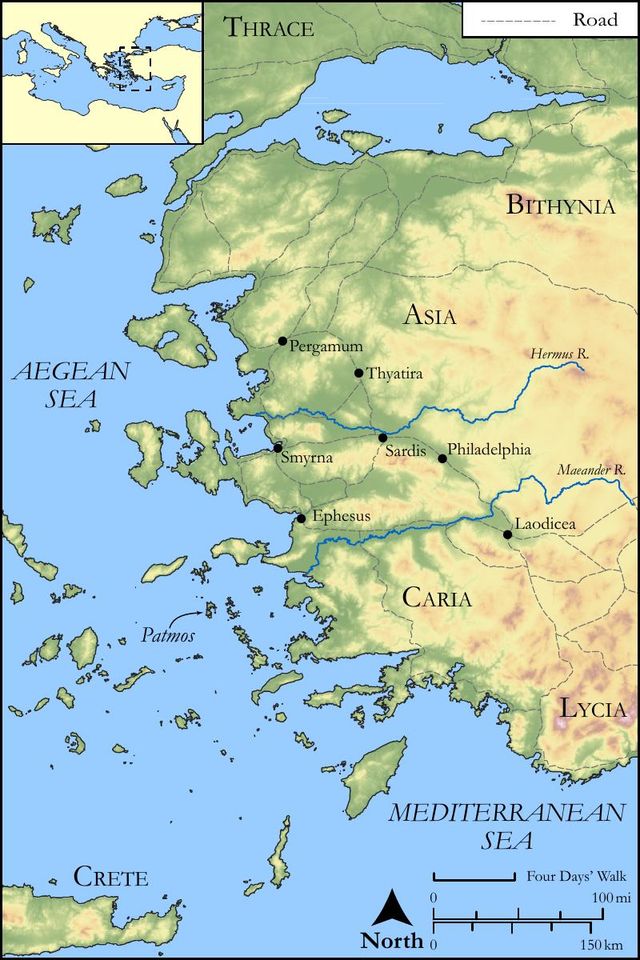
See on the biblical-era maps

Study this verse
Public-domain commentary
Matthew Henry
From his Commentary on the Whole Bible. Henry comments on passages, not single verses — this entry covers Revelation 7:1–12. His four-level outline is real structure in the source text, so it is rendered as structure.
Here we have, I. An account of the restraint laid upon the winds. By these winds we suppose are meant those errors and corruptions in religion which would occasion a great deal of trouble and mischief to the church of God. Sometimes the Holy Spirit is compared to the wind: here the spirits of error are compared to the four winds, contrary one to another, but doing much hurt to the church, the garden and vineyard of God, breaking the branches and blasting the fruits of his plantation. The devil is called the prince of the power of the air; he, by a great wind, overthrew the house of Job's eldest son. Errors are as wind, by which those who are unstable are shaken, and carried to and fro, Eph 4:14. Observe, 1. These are called the winds of the earth, because they blow only in these lower regions near the earth; heaven is always clear and free from them. 2. They are restrained by the ministry of angels, standing on the four corners of the earth, intimating that the spirit of error cannot go forth till God permits it, and that the angels minister to the good of the church by restraining its enemies. 3. Their restraint was only for a season, and that was till the servants of God were sealed in their foreheads. God has a particular care and concern for his own servants in times of temptation and corruption, and he has a way to secure them from the common infection; he first establishes them, and then he tries them; he has the timing of their trials in his own hand.
II.An account of the sealing of the servants of God, where observe,
1.To whom this work was committed - to an angel, another angel. While some of the angels were employed to restrain Satan and his agents, another angel was employed to mark out and distinguish the faithful servants of God.
2.How they were distinguished - the seal of God was set upon their foreheads, a seal known to him, and as plain as if it appeared in their foreheads; by this mark they were set apart for mercy and safety in the worst of times.
3.The number of those that were sealed, where observe,
(1.)A particular account of those that were sealed of the twelve tribes of Israel - twelve thousand out of every tribe, the whole sum amounting to a hundred and forty-four thousand. In this list the tribe of Dan is omitted, perhaps because they were greatly addicted to idolatry; and the order of the tribes is altered, perhaps according as they had been more or less faithful to God. Some take these to be a select number of the Jews who were reserved for mercy at the destruction of Jerusalem; others think that time was past, and therefore it is to be more generally applied to God's chosen remnant in the world; but, if the destruction of Jerusalem was not yet over (and I think it is hard to prove that it was), it seems more proper to understand this of the remnant of that people which God had reserved according to the election of grace, only here we have a definite number for an indefinite.
(2.)A general account of those who were saved out of other nations (Rev 7:9): A great multitude, which no man could number, of all nations, and kindreds, and people, and tongues. Though these are not said to be sealed, yet they were selected by God out of all nations, and brought into his church, and there stood before the throne. Observe,
[1.]God will have a greater harvest of souls among the Gentiles than he had among the Jews. More are the children of the desolate than of the married woman.
[2.]The Lord knows who are his, and he will keep them safe in times of dangerous temptation.
[3.]Though the church of God is but a little flock, in comparison of the wicked world, yet it is no contemptible society, but really large and to be still more enlarged.
III.We have the songs of saints and angels on this occasion, Rev 7:9-12, where observe,
1.The praises offered up by the saints (and, as it seems to me, by the Gentile believers) for the care of God in reserving so large a remnant of the Jews, and saving them from infidelity and destruction. The Jewish church prayed for the Gentiles before their conversion, and the Gentile churches have reason to bless God for his distinguishing mercy to so many of the Jews, when the rest were cut off. Here observe,
(1.)The posture of these praising saints: they stood before the throne, and before the Lamb, before the Creator and the Mediator. In acts of religious worship we come nigh to God, and are to conceive ourselves as in his special presence; and we must come to God by Christ. The throne of God would be inaccessible to sinners were it not for a Mediator.
(2.)Their habit: they were clothed with white robes, and had palms in their hands; they were invested with the robes of justification, holiness, and victory, and had palms in their hands, as conquerors used to appear in their triumphs: such a glorious appearance will the faithful servants of God make at last, when they have fought the good fight of faith and finished their course.
(3.)Their employment: they cried with a loud voice, saying, Salvation to our God who sitteth upon the throne, and to the Lamb. This may be understood either as a hosannah, wishing well to the interest of God and Christ in the church and in the world, or as a hallelujah, giving to God and the Lamb the praise of the great salvation; both the Father and the Son are joined together in these praises; the Father contrived this salvation, the Son purchased it, and those who enjoy it must and will bless the Lord and the Lamb, and they will do it publicly, and with becoming fervour.
2.Here is the song of the angels (Rev 7:11, Rev 7:12), where observe,
(1.)Their station - before the throne of God, attending on him, and about the saints, ready to serve them.
(2.)Their posture, which is very humble, and expressive of the greatest reverence: They fell before the throne on their faces, and worshipped God. Behold the most excellent of all the creatures, who never sinned, who are before him continually, not only covering their faces, but falling down on their faces before the Lord! What humility then, and what profound reverence, become us vile frail creatures, when we come into the presence of God! We should fall down before him; there should be both a reverential frame of spirit and a humble behaviour in all our addresses to God (3.) Their praises. They consented to the praises of the saints, said their Amen thereto; there is in heaven a perfect harmony between the angels and saints; and then they added more of their own, saying, Blessing, and glory, and wisdom, and thanksgiving, and honour, and power, and might, be unto our God for ever and ever. Amen. Here,
[1.]They acknowledge the glorious attributes of God - his wisdom, his power, and his might.
[2.]They declare that for these his divine perfections he ought to be blessed, and praised, and glorified, to all eternity; and they confirm it by their Amen. We see what is the work of heaven, and we ought to begin it now, to get our hearts tuned for it, to be much in it, and to long for that world where our praises, as well as happiness, will be perfected.
Historical interpretation
Seven Centuries of Reception
6 surviving comments on this verse. Each one is dated, so this reads as a timeline rather than a list.
Select a marker to jump to its quote. Markers stagger vertically where authors wrote within a few decades of each other.
"And I saw another angel ascending from the east, having the seal of the living God" He speaks of Elias the prophet, who is the precursor of the times of Antichrist, for the restoration and establishment of the churches from the great and intolerable persecution. We read that these things are predicted in the opening of the Old and New Testament; for He says by Malachi: "Lo, I will send to you Elias the Tishbite, to turn the hearts of the fathers to the children, according to the time of calling, to recall the Jews to the faith of the people that succeed them." And to that end He shows, as we have said, that the number of those that shall believe, of the Jews and of the nations, is a great multitude which no man was able to number. Moreover, we read in the Gospel that the prayers of the Church are sent from heaven by an angel, and that they are received against wrath, and that the kingdom of Antichrist is cast out and extinguished by holy angels; for He says: "Pray that ye enter not into temptation: for there shall be a great affliction, such as has not been from the beginning of the world; and except the Lord had shortened those days, no flesh should be saved." Therefore He shall send these seven great archangels to smite the kingdom of Antichrist; for He Himself also thus said: "Then the Son of man shall send His messengers; and they shall gather together His elect from the four corners of the wind, from the one end of heaven even to the other end thereof." For, moreover, He previously says by the prophet: "Then shall there be peace for our land, when there shall arise in it seven shepherds and eight attacks of men; and they shall encircle Assur," that is, Antichrist, "in the trench of Nimrod," that is, in the nation of the devil, by the spirit of the Church. Similarly when the keepers of the house shall be moved. Moreover, the Lord Himself, in the parable to the apostles, when the labourers had come to Him and said, "Lord, did not we sow good seed in Thy field? whence, then, hath it tares? answered them, An enemy hath done this. And they said to Him, Lord, wilt Thou, then, that we go and root them up? And He said, Nay, but let both grow together until the harvest; and in the time of the harvest I will say to the reapers, that they gather the tares and make bundles of them, and burn them with fire everlasting, but that they gather the wheat into my barns." The Apocalypse here shows, therefore, that these reapers, and shepherds, and labourers, are the angels. And the trumpet is the word of power. And although the same thing recurs in the phials, still it is not said as if it occurred twice, but because what is decreed by the Lord to happen shall be once for all; for this cause it is said twice. What, therefore, He said too little in the trumpets, is here found in the phials. We must not regard the order of what is said, because frequently the Holy Spirit, when He has traversed even to the end of the last times, returns again to the same times, and fills up what He had before failed to say. Nor must we look for order in the Apocalypse; but we must follow the meaning of those things which are prophesied. Therefore in the trumpets and phials is signified either the desolation of the plagues that are sent upon the earth, or the madness of Antichrist himself, or the cutting off of the peoples, or the diversity of the plagues, or the hope in the kingdom of the saints, or the ruin of states, or the great overthrow of Babylon, that is, the Roman state.
This was revealed long ago to Ezekiel concerning him who was clothed in a fine linen robe and who sealed the foreheads of those who mourned so that the righteous would not be destroyed along with the wicked, since the virtue of the saints is hidden and is unknown even to the angels. This is shown also here to the blessed [John], that a preeminent holy power encourages the avenging holy angels to do nothing until they might recognize the servants of the truth by virtue of their having been sealed. Although this has happened partially long ago when those who believed in Christ fled from the siege of Jerusalem by the Romans into very many destinations, the great James having showed to blessed Paul their great number, then, as has been said, this will especially occur at the coming of the antichrist when the seal of the life-giving cross will separate from the faithless the faithful who bear without shame and with boldness the sign of Christ before the impious. Therefore, the angel says, “Do not harm the earth of the sea or the trees, until we have sealed the servants of our God upon their foreheads.” Just as the creation, created for our sakes, shares in the torments with us who are being chastised, so too it will be made clean with the saints who are being glorified. Through these words we learn that the virtuous will require the power of angelic assistance before the arrival of the trials which come because of the seal of the Spirit which is given to us. [We learn further] that this seal will reveal its power to that extent that we add our own work to it, for everything remains without aid which by its own will wills not to be aided.
And I saw another angel ascending from the east, etc. The Lord born in the flesh, who is the angel of great counsel, the messenger of the Father's will, visited us as the rising sun from on high (Luke 1), bringing the banner of the cross to mark the foreheads of His own.
And he cried out with a loud voice to the four angels. The great voice of the Lord is the sublime preaching: Repent, for the kingdom of heaven is at hand.
And I saw another angel ascending from the rising of the sun, having the sign of the living God; and he cried with a loud voice to the four angels, to whom it was given to hurt the earth and the sea, saying: Hurt not the earth, nor the sea, nor the trees, till we sign the servants of our God in their foreheads. Christ is an angel because we know he announced the joys of the new life to the world, he about whom it is said, angel of great counsel. [Is. 9:6 acc. to LXX, where the verse is number 5.] The ascent from the rising of the sun meant here is the one by which, starting from the Resurrection itself, which sprang up like a new sun, he grew and filled up the whole world, and illuminated it with the evangelical teaching. With that voice he also prevented the noxious power of the four angels from doing harm, and destroyed it in both initiators and subordinates at the same time; whence Nebuchadnezzar also saw a stone cut out of a mountain without hands strike the aforesaid statue on its iron feet and break it in pieces. [Dan. 2:34] By this stone is represented the Lord Jesus Christ, begotten of Jewish stock without conjugal act, who struck the statue on the feet and made it fall, because he reached the extremity of the kingdom of the Romans with the preaching of the Word, and converted the aforesaid kingdoms of the world to rebuild them wholesomely. This same Mediator is said to have the sign of the living God, that is the mystery of the cross. By the fact that he says not “till I sign” but till we sign, he shows that there are in him many people through whom that mystery is being fulfilled. When he says in their foreheads, he indicates the inner forehead, for we smear both side posts with the blood of the Lamb, [Ref. to Ex. 12:5 et seq.] and it is no use for anyone to wear it on the outside if they do not also receive it on the inside, because faith without works is idle. [James 2:20 acc. to the Greek version.]
"Then I saw another angel ascending from the east, having the seal of the living God, and he cried out with a loud voice to the four angels to whom it was granted to harm the earth and the sea, saying, 'Do not harm the earth or the sea or the trees until the servants of our God have been sealed.'" The divine angel is said to come from the east, where the sun rises, but not from the west or the evening, symbolizing announcing of the Gospel and promises of blessings.
Continue studying Revelation 7:2 across the web’s major study libraries — every link below opens this exact verse, chapter, or book on the destination site.
Read & Compare
 BibleGatewayThis verse in more than 200 translations and 70 languages.
 Bible.comThe YouVersion reader — hundreds of translations, reading plans, and highlights.
 ESV.orgCrossway's official English Standard Version reader.
 NET BibleThe NET translation with 60,000+ translators' notes on every rendering decision.
 STEP BibleTyndale House's free study tool — original text, vocabulary, and scholarly resources.
 BibliaLogos Bible Software's free web reader.
 USCCBThe New American Bible (Revised Edition) with the U.S. bishops' study notes.
Commentaries
 BibleHub CommentariesDozens of classic commentaries on this verse, gathered on one page.
 StudyLightMore than 100 commentary sets — the largest collection on the web.
 BibleRefPlain-English commentary on what this verse means, verse by verse.
 Enduring WordDavid Guzik's free commentary on this chapter, widely used by Bible teachers.
 Bible Study ToolsVerse commentary alongside Greek and Hebrew study aids.
Original Language & Research
- BibleHub InterlinearThe verse word by word — original language, transliteration, and English.
- BibleHub LexiconEvery word's original-language definition and Strong's entry.
 Blue Letter BibleDeep-study tools — Strong's numbers, concordance, and word studies.
 CNTR CollationThe earliest Greek manuscripts of this verse, collated letter by letter.
Sermons, Hymns & Audio


TrulyRandomVerse is not affiliated with these sites and doesn’t control their content. They’re linked because they’re genuinely useful.
Summary
Revelation 7:2 introduces a pivotal interlude in John's apocalyptic vision, revealing a powerful angel ascending from the east, bearing the divine seal of the living God. This angel, acting with supreme authority, issues a commanding cry to the four angels previously tasked with unleashing destructive judgments upon the earth and sea, temporarily halting their impending actions. This verse underscores God's meticulous control over the unfolding end-time events, emphasizing His sovereign prerogative to pause even His judgments for a specific, protective purpose.
Context
ShowHideLiterary Context
This verse serves as a crucial pause in the dramatic sequence of judgments initiated by the opening of the seals. Immediately preceding it, Revelation 6 describes the cataclysmic events accompanying the breaking of the first six seals, culminating in disturbances in the heavens, widespread fear, and humanity's desperate attempt to hide from the wrath of God and the Lamb. Chapter 7, therefore, functions as an interlude between the sixth and seventh seals, shifting focus from judgment to divine preservation. Specifically, Revelation 7:1 introduces the four angels holding back the four winds of judgment, setting the stage for the arrival of the angel in verse 2 who commands them to wait. This strategic pause highlights God's deliberate and purposeful action before the final, devastating judgments are unleashed.
Historical & Cultural Context
In that day, seals were commonplace, serving multiple functions: to authenticate documents (like a will or decree), to signify ownership (marking property or livestock), to ensure security (sealing a tomb or scroll), and to denote authority or protection. Kings and officials used signet rings to impress their unique mark, which carried the weight of their power. The concept of God "sealing" His people resonates with Old Testament themes of divine election and covenant, where God set apart a people for Himself. The "east" (ἀνατολή, anatolē) held significant symbolic weight in Jewish thought, often associated with the rising sun, new beginnings, the direction of the Temple's entrance, and the anticipated return of God's glory or the Messiah (e.g., Ezekiel 43:2). This direction thus implies a divine, glorious, and authoritative origin for the angel's mission.
Key Themes
ShowHideRevelation 7:2 contributes significantly to several overarching themes within the book of Revelation and biblical theology. Firstly, it powerfully illustrates Divine Sovereignty and Control, demonstrating that even destructive forces are under God's absolute command, unleashed or restrained according to His perfect timing and purpose. Secondly, the presence of the "seal of the living God" introduces the theme of Divine Preservation and Protection, indicating God's unwavering commitment to safeguard His chosen ones amidst global tribulation. This protection is not necessarily from all suffering, but from the spiritual and ultimate destructive wrath of God. Thirdly, the verse emphasizes God's Justice and Mercy, showing that while judgment is inevitable, God's mercy precedes it, allowing for the sealing of His servants. This interlude, before the full unleashing of wrath, highlights God's meticulous care for His people, a theme echoed in passages like Psalm 91 and Romans 8:28-39.
Exposition and Analysis
ShowHideKey Word Analysis
ShowHideFrom the verb meaning "to bring tidings," this word refers to a messenger, specifically a divine messenger. In this context, it denotes a celestial being commissioned by God to carry out His will. The angel's ascending from the east and having the seal signifies a divine commission and authority far beyond that of the four angels holding the winds.
This term refers to a signet or stamp, signifying ownership, authenticity, security, and protection. The "seal of the living God" is not merely a mark but a divine guarantee of belonging and preservation, distinguishing God's people from those destined for judgment. It implies a divine act of marking and securing.
Meaning "to live," "be alive," or "be quick," this word emphasizes God's active, dynamic, and life-giving nature. When applied to God, "the living God" distinguishes Him from lifeless idols and underscores His inherent power, vitality, and ability to act in history, to save, and to protect.
This verb means "to be unjust," "to do wrong," or "to injure." In this verse, it specifically refers to the destructive power given to the four angels, indicating their capacity to inflict harm and devastation upon the earth and sea as part of God's judgment. The angel's command to "hurt" implies a temporary cessation of this destructive capability.
Verse Breakdown
ShowHide"And I saw another angel ascending from the east,"
John's vision continues, introducing a new, distinct angelic figure. The phrase "ascending from the east" carries profound symbolic weight, suggesting a divine origin and a glorious, perhaps even messianic, association, as the east was often linked with the rising sun, new beginnings, and the advent of God's glory or the Messiah. This angel is distinct from the four angels mentioned in Revelation 7:1.
"having the seal of the living God:"
This is the central identifying feature of this angel. The "seal" signifies divine authority, ownership, and protection, indicating that this angel carries a mandate directly from God. "The living God" emphasizes God's active, dynamic, and vital nature, distinguishing Him from any false deity and affirming His power to preserve and save. This seal is the instrument by which God's people will be marked for protection.
"and he cried with a loud voice to the four angels,"
The angel's "loud voice" conveys urgency, authority, and the undeniable nature of his command. He addresses the very angels introduced in the preceding verse, who were poised to unleash judgment. This demonstrates a clear hierarchy and God's precise control over His agents of judgment.
"to whom it was given to hurt the earth and the sea,"
This clause clarifies the destructive power and mandate of the four angels. They have been divinely authorized ("it was given") to inflict harm upon the terrestrial and aquatic realms, representing the entire created order. The angel's cry is a direct command to these angels to pause their destructive work, highlighting God's sovereign ability to halt judgment for His purposes.
Literary Devices
ShowHideRevelation 7:2 employs several potent Symbolism elements. The "angel" itself is a symbol of divine agency and communication. His "ascending from the east" is rich with symbolic meaning, traditionally associated with divine revelation, the rising sun, and the coming of God's glory or Messiah, suggesting a source of light and salvation. The "seal of the living God" is a crucial symbol representing divine ownership, authenticity, and protection, contrasting sharply with the mark of the beast later in Revelation. The "earth and the sea" are symbolic of the whole world, indicating the global scope of the impending judgments. The angel's "loud voice" is a form of Hyperbole or Emphasis, underscoring the urgency and absolute authority of his command. The entire verse functions as an Interlude or Parenthesis within the narrative of the seals, providing a deliberate pause in the unfolding judgments to highlight God's protective plan, thereby creating narrative tension and emphasizing divine control.
Theological and Thematic Connections
ShowHideRevelation 7:2 profoundly connects to the biblical themes of divine election, preservation, and the ultimate sovereignty of God over all creation and judgment. The "seal of the living God" echoes Old Testament concepts of God setting apart a people for Himself, such as the mark on those who sigh and groan in Ezekiel 9:4. This sealing signifies not only ownership but also a divine guarantee of protection from the wrath to come, ensuring that God's chosen ones are preserved for His purposes, even if they experience tribulation. It anticipates the ultimate security found in Christ, where believers are sealed with the Holy Spirit as a down payment of their inheritance. This divine intervention demonstrates that God's judgments are not chaotic but meticulously controlled, paused and directed according to His perfect will, prioritizing the safeguarding of His people before the full outpouring of wrath.
Reflection and Application
ShowHideRevelation 7:2 offers a profound message of comfort and assurance to believers facing times of tribulation, whether personal or global. It reminds us that even when the world seems to be unraveling, and destructive forces are at play, God remains absolutely sovereign. He does not merely react to chaos; He orchestrates and controls every detail, even pausing the very agents of His judgment for the sake of His people. The "seal of the living God" is a powerful image of divine identification and protection. For believers today, this seal is primarily spiritual, representing the indwelling Holy Spirit, who marks us as God's own, guarantees our inheritance, and preserves us for eternity (Ephesians 4:30). This does not promise immunity from all suffering, but it assures us of ultimate spiritual security and God's unwavering commitment to His covenant people. Our trust is not in our own strength or ability to endure, but in the living God who holds all things in His hands, protecting His own through every storm and ensuring their ultimate salvation.
Questions for Reflection
ShowHideFAQ
ShowHideWhat is the significance of the angel "ascending from the east"?
ShowHideThe "east" (ἀνατολή, anatolē) holds deep symbolic significance in biblical tradition. It is often associated with the rising sun, new beginnings, and the direction from which God's glory or salvation appears. For example, the glory of the Lord entered the temple from the east in Ezekiel 43:2, and Jesus' second coming is likened to lightning flashing from the east to the west in Matthew 24:27. Therefore, the angel's ascent from the east signifies a divine, glorious, and authoritative origin for his mission, emphasizing that his command comes directly from God.
What does "the seal of the living God" mean, and who receives it?
ShowHideThe "seal of the living God" is a mark of divine ownership, authenticity, and protection. In ancient times, a seal was used to authenticate documents, secure property, and identify ownership. Here, it signifies that God marks out and preserves His faithful servants amidst the global judgments. In the immediate context of Revelation 7, this seal is applied to the 144,000 from the tribes of Israel (Revelation 7:3-8). Theologically, for all believers, this concept is often understood as the sealing of the Holy Spirit, who is given as a guarantee of our inheritance and a mark of our belonging to God (Ephesians 1:13-14). This seal ensures spiritual preservation and ultimate salvation, even if physical suffering occurs.
Christ-Centered Fulfillment
ShowHideRevelation 7:2, though focused on an angel, points powerfully to Christ in its deeper fulfillment. The angel's ascent from the east, a direction often associated with the rising sun and the advent of divine glory, foreshadows the ultimate "Sun of Righteousness" who arises with healing in His wings (Malachi 4:2). This angel carries "the seal of the living God," a mark of divine ownership and protection. In the New Testament, believers are sealed not by an angel, but by the Holy Spirit, who is given through Christ's redemptive work, serving as a down payment of our inheritance until we acquire possession of it (Ephesians 1:13-14). The "living God" who gives this seal is perfectly revealed in Jesus Christ, who declared Himself to be "the way, the truth, and the life" (John 14:6), and who has "life in himself" (John 5:26). Furthermore, the angel's supreme authority to command the forces of judgment ultimately derives from Christ, to whom "all authority in heaven and on earth has been given" (Matthew 28:18). Thus, this interlude of divine protection in Revelation 7:2 is a testament to Christ's sovereign power over judgment and His unfailing commitment to preserve those whom He has redeemed by His blood (Revelation 5:9).