


Revelation 7:11
Bible text: King James Version (1769 Blayney text) · Public domain
Bible text: King James Version with Strong's numbers · Public domain
Bible text: Berean Standard Bible · Public domain
Bible text: American Standard Version (1901) · Public domain
Bible text: World English Bible, Messianic edition · Public domain
Bible text: Geneva Bible (1599) · Public domain
Bible text: Young's Literal Translation · Public domain
- καὶkaiAndG2532CONJConjunction
- πάντεςpantesallG3956A-NPMAdjective Nominative Plural Masculine
- οἱhoitheG3588T-NPMDefinite article Nominative Plural Masculine
- ἄγγελοιangeloiangelsG32N-NPMNoun Nominative Plural Masculine
- εἱστήκεισανheistēkeisanhad stoodG2476V-LAI-3PVerb Pluperfect Active Indicative 3rd Plural
- κύκλῳkuklōaroundG2945ADVAdverb
- τοῦtoutheG3588T-GSMDefinite article Genitive Singular Masculine
- θρόνουthronouthroneG2362N-GSMNoun Genitive Singular Masculine
- καὶkaiandG2532CONJConjunction
- τῶνtōntheG3588T-GPMDefinite article Genitive Plural Masculine
- πρεσβυτέρωνpresbuterōneldersG4245N-GPMNoun Genitive Plural Masculine
- καὶkaiandG2532CONJConjunction
- τῶνtōntheG3588T-GPNDefinite article Genitive Plural Neuter
- τεσσάρωνtessarōnfourG5064A-GPNAdjective Genitive Plural Neuter
- ζῴωνzōōnliving creaturesG2226N-GPNNoun Genitive Plural Neuter
- καὶkaiandG2532CONJConjunction
- ἔπεσανepesanthey fellG4098V-2AAI-3PVerb 2nd Aorist Active Indicative 3rd Plural
- ἐνώπιονenōpionbeforeG1799PREPPreposition
- τοῦtoutheG3588T-GSMDefinite article Genitive Singular Masculine
- θρόνουthronouthroneG2362N-GSMNoun Genitive Singular Masculine
- ἐπὶepiuponG1909PREPPreposition
- τὰtatheG3588T-APNDefinite article Accusative Plural Neuter
- πρόσωπαprosōpafacesG4383N-APNNoun Accusative Plural Neuter
- αὐτῶνautōnof themG846P-GPMPersonal pronoun Genitive Plural Masculine
- καὶkaiandG2532CONJConjunction
- προσεκύνησανprosekunēsanworshipedG4352V-AAI-3PVerb Aorist Active Indicative 3rd Plural
- τῷtō<the>G3588T-DSMDefinite article Dative Singular Masculine
- θεῷtheōGodG2316N-DSM-TNoun Dative Singular Masculine Title
English is a literal word-by-word gloss of the Greek, not the KJV's wording. Why?
This is the original text the KJV's translators worked from — each Greek word with its own literal English meaning in this verse, prepared by scholars at Tyndale House, Cambridge. The KJV translates whole sentences, not word by word, so its wording differs: one Greek word can become several English words, and the KJV may choose “charity” where the gloss reads “love”. Both are faithful — they answer different questions. For the KJV's own rendering, switch to the KJV text.
Details
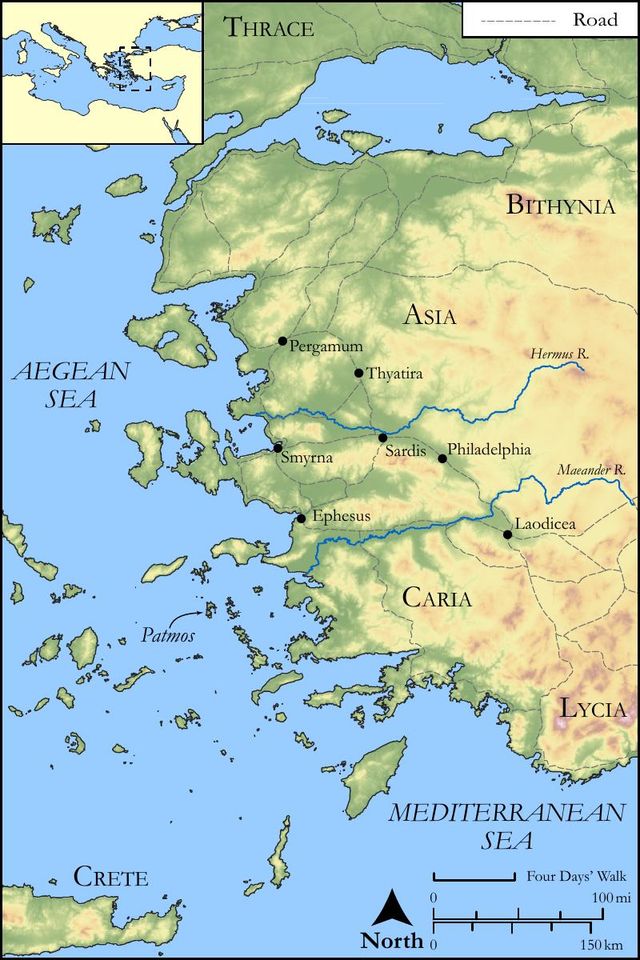
See on the biblical-era maps

Study this verse
Public-domain commentary
Matthew Henry
From his Commentary on the Whole Bible. Henry comments on passages, not single verses — this entry covers Revelation 7:1–12. His four-level outline is real structure in the source text, so it is rendered as structure.
Here we have, I. An account of the restraint laid upon the winds. By these winds we suppose are meant those errors and corruptions in religion which would occasion a great deal of trouble and mischief to the church of God. Sometimes the Holy Spirit is compared to the wind: here the spirits of error are compared to the four winds, contrary one to another, but doing much hurt to the church, the garden and vineyard of God, breaking the branches and blasting the fruits of his plantation. The devil is called the prince of the power of the air; he, by a great wind, overthrew the house of Job's eldest son. Errors are as wind, by which those who are unstable are shaken, and carried to and fro, Eph 4:14. Observe, 1. These are called the winds of the earth, because they blow only in these lower regions near the earth; heaven is always clear and free from them. 2. They are restrained by the ministry of angels, standing on the four corners of the earth, intimating that the spirit of error cannot go forth till God permits it, and that the angels minister to the good of the church by restraining its enemies. 3. Their restraint was only for a season, and that was till the servants of God were sealed in their foreheads. God has a particular care and concern for his own servants in times of temptation and corruption, and he has a way to secure them from the common infection; he first establishes them, and then he tries them; he has the timing of their trials in his own hand.
II.An account of the sealing of the servants of God, where observe,
1.To whom this work was committed - to an angel, another angel. While some of the angels were employed to restrain Satan and his agents, another angel was employed to mark out and distinguish the faithful servants of God.
2.How they were distinguished - the seal of God was set upon their foreheads, a seal known to him, and as plain as if it appeared in their foreheads; by this mark they were set apart for mercy and safety in the worst of times.
3.The number of those that were sealed, where observe,
(1.)A particular account of those that were sealed of the twelve tribes of Israel - twelve thousand out of every tribe, the whole sum amounting to a hundred and forty-four thousand. In this list the tribe of Dan is omitted, perhaps because they were greatly addicted to idolatry; and the order of the tribes is altered, perhaps according as they had been more or less faithful to God. Some take these to be a select number of the Jews who were reserved for mercy at the destruction of Jerusalem; others think that time was past, and therefore it is to be more generally applied to God's chosen remnant in the world; but, if the destruction of Jerusalem was not yet over (and I think it is hard to prove that it was), it seems more proper to understand this of the remnant of that people which God had reserved according to the election of grace, only here we have a definite number for an indefinite.
(2.)A general account of those who were saved out of other nations (Rev 7:9): A great multitude, which no man could number, of all nations, and kindreds, and people, and tongues. Though these are not said to be sealed, yet they were selected by God out of all nations, and brought into his church, and there stood before the throne. Observe,
[1.]God will have a greater harvest of souls among the Gentiles than he had among the Jews. More are the children of the desolate than of the married woman.
[2.]The Lord knows who are his, and he will keep them safe in times of dangerous temptation.
[3.]Though the church of God is but a little flock, in comparison of the wicked world, yet it is no contemptible society, but really large and to be still more enlarged.
III.We have the songs of saints and angels on this occasion, Rev 7:9-12, where observe,
1.The praises offered up by the saints (and, as it seems to me, by the Gentile believers) for the care of God in reserving so large a remnant of the Jews, and saving them from infidelity and destruction. The Jewish church prayed for the Gentiles before their conversion, and the Gentile churches have reason to bless God for his distinguishing mercy to so many of the Jews, when the rest were cut off. Here observe,
(1.)The posture of these praising saints: they stood before the throne, and before the Lamb, before the Creator and the Mediator. In acts of religious worship we come nigh to God, and are to conceive ourselves as in his special presence; and we must come to God by Christ. The throne of God would be inaccessible to sinners were it not for a Mediator.
(2.)Their habit: they were clothed with white robes, and had palms in their hands; they were invested with the robes of justification, holiness, and victory, and had palms in their hands, as conquerors used to appear in their triumphs: such a glorious appearance will the faithful servants of God make at last, when they have fought the good fight of faith and finished their course.
(3.)Their employment: they cried with a loud voice, saying, Salvation to our God who sitteth upon the throne, and to the Lamb. This may be understood either as a hosannah, wishing well to the interest of God and Christ in the church and in the world, or as a hallelujah, giving to God and the Lamb the praise of the great salvation; both the Father and the Son are joined together in these praises; the Father contrived this salvation, the Son purchased it, and those who enjoy it must and will bless the Lord and the Lamb, and they will do it publicly, and with becoming fervour.
2.Here is the song of the angels (Rev 7:11, Rev 7:12), where observe,
(1.)Their station - before the throne of God, attending on him, and about the saints, ready to serve them.
(2.)Their posture, which is very humble, and expressive of the greatest reverence: They fell before the throne on their faces, and worshipped God. Behold the most excellent of all the creatures, who never sinned, who are before him continually, not only covering their faces, but falling down on their faces before the Lord! What humility then, and what profound reverence, become us vile frail creatures, when we come into the presence of God! We should fall down before him; there should be both a reverential frame of spirit and a humble behaviour in all our addresses to God (3.) Their praises. They consented to the praises of the saints, said their Amen thereto; there is in heaven a perfect harmony between the angels and saints; and then they added more of their own, saying, Blessing, and glory, and wisdom, and thanksgiving, and honour, and power, and might, be unto our God for ever and ever. Amen. Here,
[1.]They acknowledge the glorious attributes of God - his wisdom, his power, and his might.
[2.]They declare that for these his divine perfections he ought to be blessed, and praised, and glorified, to all eternity; and they confirm it by their Amen. We see what is the work of heaven, and we ought to begin it now, to get our hearts tuned for it, to be much in it, and to long for that world where our praises, as well as happiness, will be perfected.
Historical interpretation
Four Centuries of Reception
7 surviving comments on this verse. Each one is dated, so this reads as a timeline rather than a list.
Select a marker to jump to its quote. Markers stagger vertically where authors wrote within a few decades of each other.
They were confessing with a “loud voice,” that is, with a deep devotion and unceasing praise. “Upon the throne,” that is, the Father and the Son reign in the Church, with the Holy Spirit ruling equally with them. There is here such an order to the words, “To our God and to the Lamb who sits upon the throne belongs salvation.” We find a similar manner of speaking in the Gospel, “That they might know you, the only true God, and Jesus Christ whom you have sent.” This is as though he said, “That they might know you and Jesus Christ whom you have sent, the one true God.” In the one throne is indicated the power of one nature. However, in the name of the Lamb the personal character of the Father and the Son is designated, just as when the Holy Spirit is alone named, the Father and the Son are there also to be understood. For we read in the Acts of the Apostles, “Take heed to all the flock in which the Holy Spirit has made you overseers,” and it immediately adds, “to rule the church of God which he obtained by his own blood.” Now, we know that no one has poured out their blood for us except the person of Christ. And so it is sufficiently clear that whenever one alone is named, the entire Trinity is to be understood.
Whatever this multitude might be, by expressing these names he indicates the universal church.… Through the naming of these seven virtues, we are exhorted to inquire after the reason why he named those things here in which God desires his church to participate. It is for this reason, that when these [virtues] are given to God in praise, they might confess that they have received each of them from him. For we ought not consider that God alone is capable of the [virtues] named here, but that he has found them worthy also to give to the faithful. We rejoice that the church of Christ is allowed to participate in all of these good things: blessing, glory, wisdom, thanksgiving, honor, power and might. It does not mention omnipotence or majesty or eternity, for God alone always rightly possesses these things. But in these seven we recognize all those virtues that could be granted to the faithful from him who gave them power to become sons of God. And so, if we have acquired any of these good things, we shall know with certainly that we have them by the generosity of God.
With a loud voice [the martyrs] sing of salvation from God, since they recall with great thanksgiving that they have triumphed, not by their own virtue but by his help, in the struggle with the tribulations assailing them.
And all the angels stood around the throne and the elders and the living creatures. In all the angels he showed the persons of the great multitude worshipping the Lord. He says, All who are around him shall offer gifts (Psalm LXXV).
And they fell before the throne on their faces, etc. Neither the multitude, nor the living creatures, nor the elders are mentioned in this place as worshipping, but only the angels. For they are the multitude, they are the living creatures and the elders. Although it can also be understood of those angelic spirits, of whom it is said, rejoicing in the salvation of the Gentiles: Rejoice, you Gentiles, with his people, and let all the angels of God worship him (Romans XV).
And all the angels stood round about the throne, and the ancients, and the four living creatures; and they fell down before the throne upon their faces. The angels as well as the throne and the ancients, and also the living creatures, symbolize the Church. Therefore he symbolizes one and the same thing in various ways: for since Christ alone reigns and judges in the Church, it is right for all the saints to be symbolized by one throne; since the Church itself also examines the acts of others, it is appropriate for it to be symbolized by ancients; and since it is sticking to the green pastures of the paradise, still only by faith in some of its members, and already enjoys them by sight in some other members, it is right for it to be symbolized by animals. Then, since it announces all things to come in its preaching, it is fitting for it to be symbolized by angels; and since it is brought together from various nations, it is right for it to be symbolized by a multitude. So they fell down upon their faces before the throne, that is, in the secret of their minds, where the inner judge sits. And adored, saying: Amen. Benediction, and glory, and wisdom, and thanksgiving, and honour, and power, and strength to our God for ever and ever. All these things correspond well to the Trinity.
When the thanksgiving had been made, the liturgical orders in heaven, together with the elders, responded with "Amen," applying their own consent to the things that had been said.
Continue studying Revelation 7:11 across the web’s major study libraries — every link below opens this exact verse, chapter, or book on the destination site.
Read & Compare
 BibleGatewayThis verse in more than 200 translations and 70 languages.
 Bible.comThe YouVersion reader — hundreds of translations, reading plans, and highlights.
 ESV.orgCrossway's official English Standard Version reader.
 NET BibleThe NET translation with 60,000+ translators' notes on every rendering decision.
 STEP BibleTyndale House's free study tool — original text, vocabulary, and scholarly resources.
 BibliaLogos Bible Software's free web reader.
 USCCBThe New American Bible (Revised Edition) with the U.S. bishops' study notes.
Commentaries
 BibleHub CommentariesDozens of classic commentaries on this verse, gathered on one page.
 StudyLightMore than 100 commentary sets — the largest collection on the web.
 BibleRefPlain-English commentary on what this verse means, verse by verse.
 Enduring WordDavid Guzik's free commentary on this chapter, widely used by Bible teachers.
 Bible Study ToolsVerse commentary alongside Greek and Hebrew study aids.
Original Language & Research
- BibleHub InterlinearThe verse word by word — original language, transliteration, and English.
- BibleHub LexiconEvery word's original-language definition and Strong's entry.
 Blue Letter BibleDeep-study tools — Strong's numbers, concordance, and word studies.
 CNTR CollationThe earliest Greek manuscripts of this verse, collated letter by letter.
Sermons, Hymns & Audio


TrulyRandomVerse is not affiliated with these sites and doesn’t control their content. They’re linked because they’re genuinely useful.
Summary
Revelation 7:11 presents a breathtaking tableau of heavenly worship, depicting the immediate and profound adoration offered to God by the entire angelic host, the twenty-four elders, and the four living creatures. This scene unfolds directly after the great multitude from every nation has cried out in praise, underscoring the universal and continuous nature of worship in the divine presence and affirming God's supreme worthiness to receive all glory and honor.
Context
ShowHideLiterary Context
This verse is a pivotal moment in an interlude within the unfolding judgments of the seven seals. Following the terrifying disturbances in the heavens of the sixth seal in Revelation 6:12-17, chapter 7 provides a pause before the seventh seal is opened in Revelation 8:1. This interlude introduces two distinct groups: the 144,000 sealed from the tribes of Israel, protected from the coming judgments, and then a countless multitude from every nation, tribe, people, and language, standing before the throne and the Lamb. The preceding verse, Revelation 7:10, describes this great multitude crying out with a loud voice, "Salvation belongs to our God who sits on the throne, and to the Lamb!" Verse 11 is the immediate, responsive worship from the heavenly court to this declaration of salvation.
Historical & Cultural Context
The Book of Revelation was written by John during his exile on Patmos, likely in the late first century AD, a period marked by increasing Roman persecution of Christians under emperors like Domitian. The audience, facing immense pressure to conform to imperial cult worship, would find profound encouragement in this vision of God's ultimate sovereignty and the universal worship directed solely to Him and the Lamb. The imagery of a throne room, elders, and living creatures draws heavily from Old Testament prophetic visions, particularly those of Ezekiel (Ezekiel 1) and Daniel (Daniel 7:9-10), providing a continuity of divine revelation and a familiar framework for understanding God's majestic presence and heavenly court.
Key Themes
ShowHideRevelation 7:11 powerfully reinforces several key themes prevalent throughout the book. The theme of Universal Heavenly Worship is paramount, demonstrating that not only redeemed humanity but also all of creation's highest beings—angels, elders, and living creatures—are united in ceaseless adoration of God. This scene underscores the Divine Sovereignty and Authority of God, whose throne is the undisputed center of all power and the object of ultimate reverence. The act of prostration highlights the theme of Humility in Adoration, emphasizing that even the most exalted heavenly beings assume a posture of utter lowliness and submission in the presence of the Almighty, serving as a model for all creation's response to God's glory.
Exposition and Analysis
ShowHideKey Word Analysis
ShowHideMeaning "a messenger; especially an 'angel'." In this context, it refers to the celestial beings who serve as God's messengers and attendants. Their presence around the throne signifies the full heavenly host participating in this act of worship, emphasizing the comprehensive nature of divine adoration.
Meaning "to stand (transitively or intransitively), used in various applications." While they "stood round about," their subsequent action of falling indicates a dynamic posture of readiness and then profound reverence. This initial standing suggests their attentive and prepared posture in the divine presence, ready to respond to God's glory.
Meaning "to fawn or crouch to, i.e. (literally or figuratively) prostrate oneself in homage (do reverence to, adore)." This term describes the deepest form of reverence and submission, often involving physical prostration. It signifies complete surrender and homage, acknowledging God's absolute supremacy and worthiness of all adoration.
Verse Breakdown
ShowHide"And all the angels stood round about the throne"
This clause introduces the primary subjects of the verse—the entire angelic host—and their initial position. They are positioned "round about the throne," indicating their proximity to God's presence and their readiness to participate in the heavenly liturgy. Their collective presence signifies the complete and unified nature of heavenly adoration.
"and [about] the elders and the four beasts"
This expands the circle of worshipers to include the twenty-four elders (representing the redeemed church or heavenly council) and the four living creatures (representing all creation or aspects of God's character). Their inclusion emphasizes that worship in heaven is not limited to one group but is a universal chorus involving all who are privileged to be in God's immediate presence.
"and fell before the throne on their faces"
This describes the posture of profound humility and reverence adopted by the heavenly beings. To fall "on their faces" is the ultimate sign of submission, awe, and adoration, acknowledging God's absolute sovereignty and majesty. It signifies a complete prostration of self before the divine.
"and worshipped God"
This final clause states the ultimate purpose of their actions. Their prostration is an act of "worship," a term that encompasses adoration, homage, and recognition of God's supreme worth. This is the culmination of the scene, a direct and unequivocal act of glorifying the Almighty.
Literary Devices
ShowHideRevelation 7:11 employs several powerful literary devices to convey its message. Symbolism is prominent, with the "throne" representing God's ultimate authority and sovereignty, and the "angels," "elders," and "four beasts" symbolizing various aspects of heavenly and created beings participating in worship. The act of "falling on their faces" is a vivid metaphor for profound humility, submission, and adoration, a gesture of reverence from the days of Abram, who "fell on his face" before God. The cumulative listing of the worshipers ("angels," "elders," "four beasts") creates a sense of universality and completeness, emphasizing that all of creation is united in glorifying God. The entire scene functions as an apocalyptic vision, providing a glimpse into the spiritual realities of heaven and God's ultimate triumph, designed to encourage and instruct the earthly audience.
Theological and Thematic Connections
ShowHideRevelation 7:11 profoundly reinforces the biblical truth of God's absolute worthiness of worship from all creation. It portrays a heavenly reality where the divine presence elicits an immediate and total response of adoration from the highest celestial beings. This scene is not merely a description of future events but a timeless declaration of God's inherent glory and sovereignty, emphasizing that worship is the natural and inevitable response to encountering His majesty. The unity of angels, elders, and living creatures in prostrate worship underscores the harmonious order of God's creation, all directed towards His praise.
Reflection and Application
ShowHideThe scene in Revelation 7:11 offers a profound blueprint for our own worship and spiritual posture. If the most exalted beings in heaven—angels, elders, and living creatures—fall on their faces in humble adoration before God's throne, how much more should we, as redeemed humanity, approach Him with such reverence and awe? This verse calls us to cultivate a posture of humility, recognizing God's supreme majesty and our place before Him. It reminds us that true worship is not merely an outward expression but an inward surrender of our entire being to the One who is worthy of all praise. This heavenly vision encourages us to anticipate the day when we will join this glorious chorus, aligning our earthly worship with the eternal liturgy of heaven, focusing our hearts and minds on God's sovereignty and His saving power.
Questions for Reflection
ShowHideFAQ
ShowHideWho are the "four beasts" mentioned in this verse, and what do they represent?
ShowHideThe "four beasts" (Greek: zōon, G2226, meaning "living creatures") are first introduced in Revelation 4:6-8. They are described as having six wings and being full of eyes, with faces like a lion, an ox, a man, and an eagle. These creatures are often interpreted as symbolic representations of all creation, particularly the highest forms of created life, ceaselessly praising God around His throne. They embody the majesty, power, and wisdom of God's creation, offering continuous worship and serving as guardians of God's holiness. Their presence alongside the elders and angels signifies that all of creation, in its diverse forms, participates in the adoration of the Creator.
Christ-Centered Fulfillment
ShowHideWhile Revelation 7:11 focuses on the worship of God the Father, the broader context of Revelation consistently links this worship to the Lamb, Jesus Christ. The great multitude's cry in Revelation 7:10 explicitly attributes salvation to "our God who sits on the throne, and to the Lamb." This establishes a profound unity in the object of worship. The angels, elders, and living creatures, by worshipping God, are implicitly acknowledging the divine nature and redemptive work of the Lamb, through whom access to the Father's throne is granted. Just as angels worshipped Christ at His birth (Luke 2:13-14), and will worship Him at His return (Hebrews 1:6), their prostration before the throne encompasses the glory of the Son, who is "worthy to receive power and wealth and wisdom and strength and honor and glory and praise!" as declared in Revelation 5:12. The ultimate Christ-centered fulfillment is that all creation, heavenly and earthly, will one day bow before the Lordship of Jesus, acknowledging His supreme authority and participating in the eternal worship of the triune God, as envisioned in Philippians 2:10-11.