


Revelation 4:4
Bible text: King James Version (1769 Blayney text) · Public domain
Bible text: King James Version with Strong's numbers · Public domain
Bible text: Berean Standard Bible · Public domain
Bible text: American Standard Version (1901) · Public domain
Bible text: World English Bible, Messianic edition · Public domain
Bible text: Geneva Bible (1599) · Public domain
Bible text: Young's Literal Translation · Public domain
- καὶkaiAndG2532CONJConjunction
- κυκλόθενkuklothenaroundG2943PREPPreposition
- τοῦtoutheG3588T-GSMDefinite article Genitive Singular Masculine
- θρόνουthronouthroneG2362N-GSMNoun Genitive Singular Masculine
- θρόνουςthronousthronesG2362N-APMNoun Accusative Plural Masculine
- εἴκοσιeikosi[were] twentyG1501A-NUIAdjective
- καὶkaiandG2532CONJConjunction
- τέσσαρεςtessaresfourG5064A-NPMAdjective Nominative Plural Masculine
- καὶkaiandG2532CONJConjunction
- ἐπὶepionG1909PREPPreposition
- τοὺςtoustheG3588T-APMDefinite article Accusative Plural Masculine
- θρόνουςthronousthronesG2362N-APMNoun Accusative Plural Masculine
- εἴδονeidonI sawG1492V-2AAI-1SVerb 2nd Aorist Active Indicative 1st Singular
- τοὺςtous<the>G3588T-APMDefinite article Accusative Plural Masculine
- εἴκοσιeikositwentyG1501A-NUIAdjective
- καὶkaiandG2532CONJConjunction
- τέσσαραςtessarasfourG5064A-APMAdjective Accusative Plural Masculine
- πρεσβυτέρουςpresbuterouseldersG4245N-APMNoun Accusative Plural Masculine
- καθημένουςkathēmenoussittingG2521V-PNP-APMVerb Present Middle Or Passive Deponent Participle Accusative Plural Masculine
- περιβεβλημένουςperibeblēmenoushaving clothed themselvesG4016V-RMP-APMVerb Perfect Middle Participle Accusative Plural Masculine
- ἐνeninG1722PREPPreposition
- ἱματίοιςhimatioisgarmentsG2440N-DPNNoun Dative Plural Neuter
- λευκοῖςleukoiswhiteG3022A-DPNAdjective Dative Plural Neuter
- καὶkaiandG2532CONJConjunction
- ἔσχονeschonhadG2192V-2AAI-3PVerb 2nd Aorist Active Indicative 3rd Plural
- ἐπὶepionG1909PREPPreposition
- τὰςtastheG3588T-APFDefinite article Accusative Plural Feminine
- κεφαλὰςkephalasheadsG2776N-APFNoun Accusative Plural Feminine
- αὐτῶνautōnof themG846P-GPMPersonal pronoun Genitive Plural Masculine
- στεφάνουςstephanouscrownsG4735N-APMNoun Accusative Plural Masculine
- χρυσοῦςchrusousgoldenG5552A-APMAdjective Accusative Plural Masculine
English is a literal word-by-word gloss of the Greek, not the KJV's wording. Why?
This is the original text the KJV's translators worked from — each Greek word with its own literal English meaning in this verse, prepared by scholars at Tyndale House, Cambridge. The KJV translates whole sentences, not word by word, so its wording differs: one Greek word can become several English words, and the KJV may choose “charity” where the gloss reads “love”. Both are faithful — they answer different questions. For the KJV's own rendering, switch to the KJV text.
Details
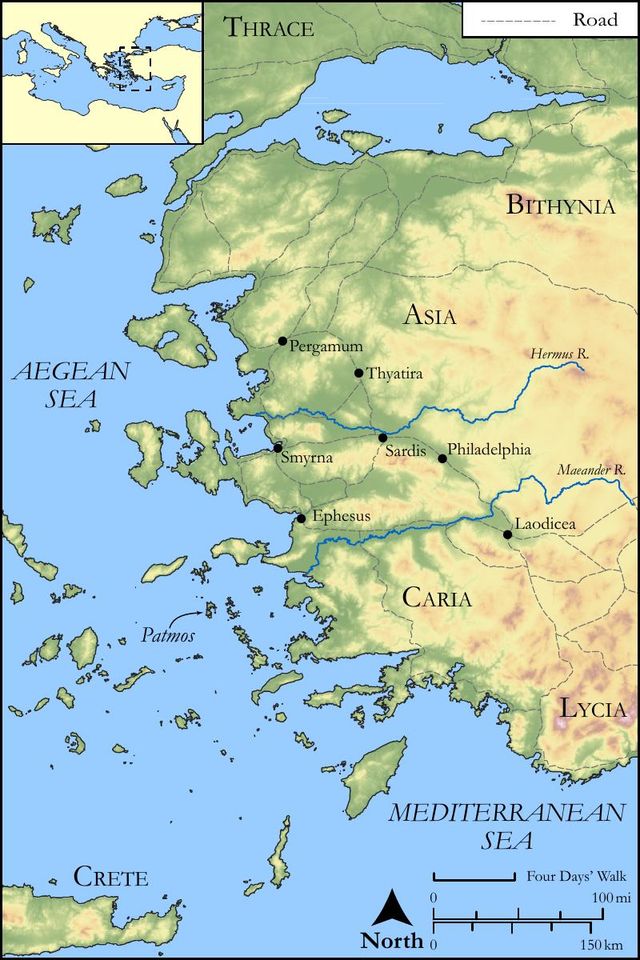
See on the biblical-era maps

Study this verse
Public-domain commentary
Matthew Henry
From his Commentary on the Whole Bible. Henry comments on passages, not single verses — this entry covers Revelation 4:1–7. His three-level outline is real structure in the source text, so it is rendered as structure.
We have here an account of a second vision with which the apostle John was favoured: After this, that is, not only "after I had seen the vision of Christ walking in the midst of the golden candlesticks," but "after I had taken his messages from his mouth, and written and sent them to the several churches, according to his command, after this I had another vision." Those who well improve the discoveries they have had of God already are prepared thereby for more, and may expect them. Observe,
I.The preparation made for the apostle's having this vision.
1.A door was opened in heaven. Hence we learn,
(1.)Whatever is transacted on earth is first designed and settled in heaven; there is the model of all the works of God; all of them are therefore before his eye, and he lets the inhabitants of heaven see as much of them as is fit for them.
(2.)We can know nothing of future events but what God is pleased to discover to us; they are within the veil, till God opens the door. But,
(3.)So far as God reveals his designs to us we may and ought to receive them, and not pretend to be wise above what is revealed.
2.To prepare John for the vision, a trumpet was sounded, and he was called up into heaven, to have a sight there of the things which were to be hereafter. He was called into the third heavens.
(1.)There is a way opened into the holiest of all, into which the sons of God may enter by faith and holy affections now, in their spirits when they die, and in their whole persons at the last day.
(2.)We must not intrude into the secret of God's presence, but stay till we are called up to it.
3.To prepare for this vision, the apostle was in the Spirit. He was in a rapture, as before (Rev 1:10), whether in the body or out of the body we cannot tell; perhaps he himself could not; however all bodily actions and sensations were for a time suspended, and his spirit was possessed with the spirit of prophecy, and wholly under a divine influence. The more we abstract ourselves from all corporeal things the more fit we are for communion with God; the body is a veil, a cloud, and clog to the mind in its transactions with God. We should as it were forget it when we go in before the Lord in duty, and be willing to drop it, that we may go up to him in heaven. This was the apparatus to the vision. Now observe,
II.The vision itself.
It begins with the strange sights that the apostle saw, and they were such as these: - 1. He saw a throne set in heaven, the seat of honour, and authority, and judgment. Heaven is the throne of God; there he resides in glory, and thence he gives laws to the church and to the whole world, and all earthly thrones are under the jurisdiction of this throne that is set in heaven. 2. He saw a glorious one upon the throne. This throne was not empty; there was one in it who filled it, and that was God, who is here described by those things that are most pleasant and precious in our world: His countenance was like a jasper and a sardine-stone; he is not described by any human features, so as to be represented by an image, but only by his transcendent brightness. This jasper is a transparent stone, which yet offers to the eye a variety of the most vivid colours, signifying the glorious perfections of God; the sardine-stone is red, signifying the justice of God, that essential attribute of which he never divests himself in favour of any, but gloriously exerts it in the government of the world, and especially of the church, through our Lord Jesus Christ. This attribute is displayed in pardoning as well as in punishing, in saving as well as in destroying sinners. 3. He saw a rainbow about the throne, like unto an emerald, Rev 4:3. The rainbow was the seal and token of the covenant of the providence that God made with Noah and his posterity with him, and is a fit emblem of that covenant of promise that God has made with Christ as the head of the church, and all his people in him, which covenant is as the waters of Noah unto God, an everlasting covenant, ordered in all things and sure. This rainbow looked like the emerald; the most prevailing colour was a pleasant green, to show the reviving and refreshing nature of the new covenant. 4. He saw four-and-twenty seats round about the throne, not empty, but filled with four-and-twenty elders, presbyters, representing, very probably, the whole church of God, both in the Old Testament and in the New Testament state; not the ministers of the church, but rather the representatives of the people. Their sitting denotes their honour, rest, and satisfaction; their sitting about the throne signifies their relation to God, their nearness to him, the sight and enjoyment they have of him. They are clothed in white raiment, the righteousness of the saints, both imputed and inherent; they had on their heads crowns of gold, signifying the honour and authority given them of God, and the glory they have with him. All these may in a lower sense be applied to the gospel church on earth, in its worshipping assemblies; and, in the higher sense, to the church triumphant in heaven. 5. He perceived lightnings and voices proceeding out of the throne; that is, the awful declarations that God makes to his church of his sovereign will and pleasure. Thus he gave forth the law on mount Sinai; and the gospel has not less glory and authority than the law, though it be of a more spiritual nature. 6. He saw seven lamps of fire burning before the throne, which are explained to be the seven Spirits of God (Rev 4:5), the various gifts, graces, and operations of the Spirit of God in the churches of Christ; these are all dispensed according to the will and pleasure of him who sits upon the throne. 7. He saw before the throne a sea of glass, like unto crystal. As in the temple there was a great vessel of brass filled with water, in which the priests were to wash when they went to minister before the Lord (and this was called a sea), so in the gospel church the sea or laver for purification is the blood of the Lord Jesus Christ, who cleanses from all sin, even from sanctuary-sins. In this all those must be washed that are admitted into the gracious presence of God on earth or his glorious presence in heaven. 8. He saw four animals, living creatures, between the throne and the circle of elders (as seems most probable), standing between God and the people; these seem to signify the ministers of the gospel, not only because of this their situation nearer to God, and between him and the elders or representatives of the Christian people, and because fewer in number than the people, but as they are here described, (1.) By their many eyes, denoting sagacity, vigilance, and circumspection. (2.) By their lion-like courage, their great labour and diligence (in which they resemble the ox), their prudence and discretion becoming men, and their sublime affections and speculations, by which they mount up with wings like eagles towards heaven (Rev 4:7), and these wings full of eyes within, to show that in all their meditations and ministrations they are to act with knowledge, and especially should be well acquainted with themselves and the state of their own souls, and see their own concern in the great doctrines and duties of religion, watching over their own souls as well as the souls of the people. (3.) By their continual employment, and that is, praising God, and not ceasing to do so night and day. The elders sit and are ministered unto; these stand and minister: they rest not night nor day. This now leads to the other part of the representation.
Historical interpretation
Eight Centuries of Reception
10 surviving comments on this verse. Each one is dated, so this reads as a timeline rather than a list.
Select a marker to jump to its quote. Markers stagger vertically where authors wrote within a few decades of each other.
Such an one is in reality a presbyter of the Church, and a true minister (deacon) of the will of God, if he do and teach what is the Lord's; not as being ordained by men, nor regarded righteous because a presbyter, but enrolled in the presbyterate because righteous. And although here upon earth he be not honoured with the chief seat, he will sit down on the four-and-twenty thrones, judging the people, as John says in the Apocalypse.
If she ought not to appear with her head uncovered on account of the angels, much more with a crown on it will she offend those (elders) who perhaps are then wearing crowns above. For what is a crown on the head of a woman, but beauty made seductive, but mark of utter wantonness,-a notable casting away of modesty, a setting temptation on fire? Therefore a woman, taking counsel from the apostles' foresight, will not too elaborately adorn herself, that she may not either be crowned with any exquisite arrangement of her hair.
The day, as I have above related, is divided into two parts by the number twelve-by the twelve hours of day and night; and by these hours too, months, and years, and seasons, and ages are computed. Therefore, doubtless, there are appointed also twelve angels of the day and twelve angels of the night, in accordance, to wit, with the number of hours. For these are the twenty-four witnesses of the days and nights which sit before the throne of God, having golden crowns on their heads, whom the Apocalypse of John the apostle and evangelist calls elders, for the reason that they are older both than the other angels and than men.
The elders represent the whole church, as we learn through Isaiah, “The Lord has reigned in Zion and in Jerusalem, and he will be glorified in the presence of his elders.” However, the twenty-four includes at the same time both leaders and people, as though duplicating the twelve tribes of Israel on account of the two Testaments. For the very same church is established in both the old and in the new, since he shows the church in the twelve apostles, namely, the entire body of leaders. And so we discover Jerusalem in the description of the city descending from heaven. The twenty-four thrones, considered by way of a distribution of offices, are twelve, since also the leaders of the twelve tribes will be advanced. And the twelve thrones, considered by way of a mystical number, is one throne, where from comes the church. For the Lord Christ is alone the one who will sit in judgment. However, the church also will sit and does sit judging the twelve tribes, but she will do this in Christ in whom is the whole [church]. Therefore, the members will sit and judge, but in one head and through one head.
[Daniel 7:9] "I beheld until thrones were set up, and the Ancient of days took His seat. His garment was as white as snow, and the hair of His head was like pure wool. His throne was composed of fiery flames and its wheels were set on fire. From before His presence there issued forth a rushing, fiery stream." We read something similar in John's Apocalypse: "After these things I was immediately in the Spirit, and lo, a throne was set up in heaven, and one was seated upon the throne; and He who sat upon it had the likeness of jasper and sardine stone, and there was a rainbow round about the throne like the appearance of emerald. Around the throne there were twenty-four other thrones, and upon the twenty-four thrones there sat twenty-four elders, clothed in shining garments; upon their heads was a golden crown, and lightning flashes issued from the throne, and voices and thunder. And in front of the throne there were seven torches of burning fire, which were the seven spirits of God. And in front of the throne lay a glassy sea like unto crystal." (Revelation 4:2-6) And so the many thrones which Daniel saw seem to me to be what John called the twenty-four thrones. And the Ancient of days is the One who, according to John sits alone upon His throne. Likewise the Son of man, who came unto the Ancient of days, is the same as He who, according to John, is called the Lion of the tribe of Judah, the Root of David, and the titles of that sort (Revelation 5:5). I imagine that these thrones are the ones of which the Apostle Paul says, "Whether thrones or dominions..." (Colossians 1:16). And in the Gospel we read, "Ye yourselves shall sit upon twelve thrones, judging the twelve tribes of Israel" (Matthew 19:28). And God is called the One who sits and who is the Ancient of days, in order that His character as eternal Judge might be indicated. His garment is shining white like the snow, and the hair of His head is like pure wool. The Savior also, when He was transfigured on the mount and assumed the glory of His divine majesty, appeared in shining white garments (Matthew 17:2). And as for the fact that His hair is compared to perfectly pure wool, the even-handedness and uprightness of His judgment is shown forth, a judgment which shows no partiality in its exercise. Moreover He is described as an elderly man, in order that the ripeness of His judgment may be established. His throne consists of fiery flames, in order that sinners may tremble before the severity of the torments, and also that the just may be saved, but so as by fire. The wheels of the throne are set aflame, or else it is the wheels of His chariot which are aflame. In Ezekiel also God is ushered on the scene seated in a four-horse chariot (Ezekiel 1:4-28), and everything pertaining to God is of a fiery consistency. In another place also a statement is made on this subject: "God is a consuming fire" (Deuteronomy 4:24), that we might know that wood, hay and stubble are going to burn up in the day of judgment. And in the Psalms we read: "Fire goeth before Him, and He shall set aflame all His enemies round about Him" (Psalm 97:3). A rushing, fiery stream proceeded from before Him in order that it might carry sinners to hell (Gehenna).
Most evidently John has described the chorus of the patriarchs and of the apostles, who sit upon the chair of holy doctrine. These he calls “elders,” that is, “fathers,” and they are clothed in white garments, that is, they are clothed in works of righteousness and in purity. They carry upon their heads golden crowns, for they have been made victors in present struggles, since that evil enemy, the devil, has been thrown down, and they have received their crowns from the Lord. Concerning this crown, the vessel of election says: “I have finished the race, I have kept the faith. Henceforth there is laid up for me the crown of righteousness, which the Lord, the righteous judge, will award to me on the day, and not only to me but also to those who love his appearing.”
Clothed in white garments, and on their heads were golden crowns. That is, clothed in good works, seeking heavenly joys with the perpetual memory of the mind. For often the mind is understood by the name of the head.
And around the throne were twenty-four thrones, etc. He sees the same Church, which he had seen as one seat because of the fellowship of faith, generated from the patriarchs and apostles through the double testament, in twenty-four thrones, sitting because of its judicial dignity in Christ. For all members will sit and judge, but in one and through one head. For how can the saints sit in judgment, standing at the right hand of the Judge? The twenty-four elders can also be understood as those who complete the perfection of work, which is commended by the number six, with the clear preaching of the Gospel. For four times six makes twenty-four.
And round about the throne were four and twenty seats; and upon the seats, four and twenty ancients sitting. As in the Gospel the Lord mentions twelve thrones, [Matt. 19:28] what does it mean that John says there are twenty-four, if not that, because of the two testaments, the number of the twelve tribes is also doubled? Therefore, regarding the distinction between both testaments, there are twenty-four thrones, and as many ancients; but regarding the unity and harmony between those same testaments, there are only twelve. We should not however understand things only carnally and think that the one throne is one thing and the twenty-four seats another; for because it is specifically and chiefly the Lord who will judge the whole Church, the ancients and the seats are for this reason said to be one throne; but because the holy preachers of both testaments will examine with him the people below them, consequently twenty-four ancients sit on twenty-four seats round about the throne. As for what is said after that concerning the ancients, clothed in white garments, and on their heads were crowns of gold, it refers to the whole Church, which clothes in white garments, that is in the inviolate sacraments of baptism. It has crowns of gold on its head because it truly triumphs over the author of death. Alternatively, this number may symbolize the holy Church because of the perfection of the number six, completed by the four books of the Gospel; or if not, then surely because the Church uses the twenty-four books of the Old Testament.
The twenty-four elders seated on the thrones would be known only by God, the knower of hidden things; and to whom He Himself reveals it. As far as my speculation goes, they were Abel, Enoch, and Noah; Abraham, Isaac, and Jacob; Melchizedek and Job; Moses and Aaron; Joshua son of Nun and Samuel; David, Elijah, and Elisha; the twelve minor prophets represented as one figure; Isaiah and Jeremiah; Ezekiel and Daniel; Zechariah and John; James son of Joseph, and Stephen, the witnesses of the new covenant. It could be said that Peter, Paul, and James, the brother of John, whom Herod killed by the sword (Acts 12:2), along with the rest of the holy apostles, if they did not have a promise from the Lord, would not now, but rather in the Renewal of All Things [παλιγγενεσίᾳ], sit upon twelve thrones, distinct from those already mentioned. For this is what the Lord said to them in the Gospel according to Matthew: "Truly I tell you, you who have followed me will, at the Renewal of All Things [παλιγγενεσίᾳ], when the Son of Man sits on his glorious throne, also sit on twelve thrones, judging the twelve tribes of Israel." (Matt. 19:28)
The white garments serve as a symbol of their purity throughout life.
The crowns, in turn, represent victory over passions and spiritual enemies.
Continue studying Revelation 4:4 across the web’s major study libraries — every link below opens this exact verse, chapter, or book on the destination site.
Read & Compare
 BibleGatewayThis verse in more than 200 translations and 70 languages.
 Bible.comThe YouVersion reader — hundreds of translations, reading plans, and highlights.
 ESV.orgCrossway's official English Standard Version reader.
 NET BibleThe NET translation with 60,000+ translators' notes on every rendering decision.
 STEP BibleTyndale House's free study tool — original text, vocabulary, and scholarly resources.
 BibliaLogos Bible Software's free web reader.
 USCCBThe New American Bible (Revised Edition) with the U.S. bishops' study notes.
Commentaries
 BibleHub CommentariesDozens of classic commentaries on this verse, gathered on one page.
 StudyLightMore than 100 commentary sets — the largest collection on the web.
 BibleRefPlain-English commentary on what this verse means, verse by verse.
 Enduring WordDavid Guzik's free commentary on this chapter, widely used by Bible teachers.
 Bible Study ToolsVerse commentary alongside Greek and Hebrew study aids.
Original Language & Research
- BibleHub InterlinearThe verse word by word — original language, transliteration, and English.
- BibleHub LexiconEvery word's original-language definition and Strong's entry.
 Blue Letter BibleDeep-study tools — Strong's numbers, concordance, and word studies.
 CNTR CollationThe earliest Greek manuscripts of this verse, collated letter by letter.
Sermons, Hymns & Audio


TrulyRandomVerse is not affiliated with these sites and doesn’t control their content. They’re linked because they’re genuinely useful.
Summary
Revelation 4:4 vividly portrays the immediate surroundings of God's majestic throne, introducing twenty-four elders seated on their own thrones, arrayed in pristine white garments, and adorned with golden crowns. This scene establishes a crucial aspect of the divine court, revealing figures of significant authority, purity, and honor who participate in the heavenly governance and worship, setting the stage for the unfolding drama of God's redemptive plan and ultimate triumph.
Context
ShowHideLiterary Context
This verse is an integral part of John's profound vision of heaven, which commences in Revelation 4:1. Having concluded his prophetic letters to the seven churches on earth, detailed in Revelation 2 and Revelation 3, John is invited "up hither" to witness "things which must be hereafter." The preceding verses, Revelation 4:2 and Revelation 4:3, establish the awe-inspiring presence of God on His central throne, surrounded by a brilliant rainbow. Revelation 4:4 then immediately expands upon this scene, introducing the specific entourage of twenty-four elders, thereby detailing the immediate heavenly court and setting the stage for the dramatic unfolding of God's plan.
Historical & Cultural Context
The Book of Revelation was written during a period of intense persecution for Christians in Asia Minor, likely under the Roman Emperor Domitian, who demanded worship as "Lord and God." Against this backdrop of imperial cult and earthly power, John's vision of God's heavenly throne room provides a powerful counter-narrative, asserting God's ultimate sovereignty. The imagery draws from Jewish apocalyptic traditions, which often feature heavenly councils and throne room scenes (e.g., Daniel 7:9-10). The concept of "elders" would have resonated with both Jewish and early Christian communities, signifying respected, mature leaders. White garments were symbols of purity, victory, and celebration in both Jewish and Roman cultures (e.g., triumphal processions). The "crowns" (stephanos) were distinct from royal diadems, often awarded to victors in athletic games or as symbols of honor, a concept familiar to the Greeks and Romans.
Key Themes
ShowHideRevelation 4:4 contributes significantly to several major themes within the book. Firstly, it underscores Divine Authority and Sovereignty, as God's throne remains the absolute center, with the elders' thrones positioned "round about" it, signifying their honored but subordinate role in the divine government. Secondly, the presence of the "four and twenty elders" introduces the theme of Representational Priesthood and Royalty, as they are widely understood to symbolize the totality of God's redeemed people—the twelve tribes of Israel and the twelve apostles—representing the complete Church, participating in Christ's reign. Thirdly, their being "clothed in white raiment" powerfully conveys the theme of Purity and Righteousness, a recurring motif in Revelation for those cleansed by the Lamb's blood and granted divine approval, as seen in Revelation 3:5 and Revelation 7:9. Finally, the "crowns of gold" signify Reward and Victory, indicating that these elders have completed their earthly faithfulness and are now receiving the victor's crown, a concept echoed in Revelation 2:10.
Exposition and Analysis
ShowHideKey Word Analysis
ShowHideDerived from a word meaning "to sit," this term refers to a stately seat, implying power and authority, or concretely, a potentate. In Revelation 4:4, the use of "thrones" (plural of thrónos) for both God and the twenty-four elders emphasizes their significant, albeit derived, authority and dignity in the heavenly court, underscoring that they are not merely seated but enthroned.
This word, meaning "older" or "senior," refers to mature, respected leaders. In biblical contexts, it often designates spiritual leaders, such as the Sanhedrists in Israel or presbyters in early Christian communities. Their presence as "elders" in the heavenly council suggests a role of wisdom, experience, and representation, indicating their status as honored members of God's divine assembly.
This term denotes a chaplet, a wreath, or a crown, primarily as a badge of royalty, a prize in public games, or a symbol of honor. Crucially, it differs from diadēma, which is a royal diadem. The stéphanos signifies a victor's wreath or a crown of achievement, indicating that these elders have triumphed through faithfulness and perseverance, receiving a reward for their completed service rather than an inherent kingly status.
Verse Breakdown
ShowHide"And round about the throne [were] four and twenty seats:"
This phrase immediately establishes the spatial arrangement of the heavenly court, with God's central throne being the focal point. The "seats" are, more accurately, "thrones" (thronoi in Greek), indicating positions of dignity and authority for those who occupy them, positioned in close proximity to the divine majesty.
"and upon the seats I saw four and twenty elders sitting,"
Here, John identifies the occupants of these thrones as "four and twenty elders." Their "sitting" denotes a settled, established position of authority and rest, suggesting that their work is complete and they are now in a place of honor and participation in the heavenly administration. The number "four and twenty" is highly symbolic, often interpreted as representing the twelve tribes of Israel and the twelve apostles, thus symbolizing the complete assembly of God's redeemed people from all ages.
"clothed in white raiment;"
This descriptive detail highlights the elders' attire. "White raiment" is a consistent biblical symbol of purity, righteousness, and victory throughout Revelation. It signifies that these individuals have been cleansed, justified, and are now in a state of holiness, reflecting their redemption and divine approval.
"and they had on their heads crowns of gold."
The final detail describes the elders' headwear. These "crowns of gold" are stéphanoi, not royal diadems, signifying a victor's wreath or a prize of honor. This indicates that their presence and exalted position are a reward for faithfulness, perseverance, and triumph over the challenges of their earthly lives, underscoring the theme of divine recompense for those who overcome.
Literary Devices
ShowHideRevelation 4:4 is rich in Symbolism, employing several key images to convey theological truths. The "white raiment" symbolizes purity, righteousness, and victory, often associated with those redeemed and made holy through Christ. The "crowns of gold" (specifically stephanos) symbolize reward, honor, and the triumph of faithfulness, distinct from inherent royalty. The number "four and twenty" itself is symbolic, widely interpreted as representing the completeness of God's people, combining the twelve tribes of Israel and the twelve apostles. The overall Imagery is vivid and majestic, painting a powerful visual of the heavenly throne room that evokes awe and reverence. The Repetition of "four and twenty" emphasizes the specific, significant number of these elders, drawing attention to their collective identity and representative role.
Theological and Thematic Connections
ShowHideRevelation 4:4 offers a profound theological statement about the nature of God's heavenly court and the destiny of His redeemed people. The presence of the twenty-four elders, seated on thrones "round about" God's central throne, signifies a divinely ordained council or assembly that participates in the administration of God's purposes. Their identity as "elders" suggests maturity, wisdom, and a representative function, leading many to understand them as symbolizing the Church, the totality of God's people from both the Old and New Covenants. This vision powerfully communicates that God's ultimate plan includes not only His supreme reign but also the exaltation and co-regency of His faithful followers, who are brought into intimate proximity with His glory, clothed in righteousness, and crowned with the rewards of their perseverance. It underscores God's commitment to His covenant people and their future participation in His eternal kingdom.
Reflection and Application
ShowHideThe vision of the twenty-four elders in Revelation 4:4 provides immense comfort and profound inspiration for believers. It first reinforces the absolute sovereignty of God, who is firmly seated on His throne, orchestrating all events, both earthly and heavenly. This truth offers peace amidst life's chaos and uncertainties, reminding us that a benevolent and powerful God is in control. Furthermore, the presence of the elders, widely understood to represent redeemed humanity, signifies the honored and secure place God's people have in His eternal plan. It reassures us that our faithfulness, purity, and perseverance in Christ are not in vain, but will be rewarded with an eternal position of honor, proximity to God, and participation in His glorious reign. This vision calls us to live with an eternal perspective, pursuing holiness ("white raiment") and steadfastness ("crowns of gold"), knowing that our ultimate destiny is to be with God, worshipping Him and sharing in His glory. It encourages us to live lives worthy of the high calling we have in Christ, anticipating the day when we too may stand in His presence, fully redeemed and rewarded.
Questions for Reflection
ShowHideFAQ
ShowHideWho are the "four and twenty elders" in Revelation 4:4?
ShowHideWhile their exact identity has been a subject of theological discussion, the most widely accepted and compelling interpretation is that the "four and twenty elders" represent the totality of God's redeemed people from both the Old and New Covenants. The number 24 is often seen as symbolic, combining the 12 tribes of Israel (representing the Old Covenant saints) and the 12 apostles (representing the foundation of the New Covenant Church). This suggests that they embody the complete, unified body of believers who have been redeemed by God throughout history. Their role in the heavenly throne room, particularly their participation in worship and their reception of crowns, strongly points to them being glorified humans, not angels, as indicated by their song in Revelation 5:9-10, where they sing of being redeemed "out of every tribe and language and people and nation."
What do their "crowns of gold" signify?
ShowHideThe "crowns of gold" worn by the elders signify honor, reward, and victory. The Greek word used here for "crown" is stéphanos (G4735), which refers to a victor's wreath, a prize awarded in athletic contests, or a symbol of honor and achievement. This is distinct from a diadēma, which denotes a royal diadem or kingly crown. Therefore, the stéphanos on the elders' heads symbolizes that they have successfully completed their earthly journey, demonstrating faithfulness, perseverance, and triumph over the challenges of the world. It represents the divine commendation and reward for their steadfastness in Christ, echoing promises of a "crown of righteousness" for those who have loved His appearing (2 Timothy 4:8) and a "crown of life" for those who endure testing (James 1:12).
Christ-Centered Fulfillment
ShowHideThe vision of the twenty-four elders in Revelation 4:4 finds its ultimate Christ-centered fulfillment in the redemptive work of Jesus. These elders, representing God's redeemed people, are seated on thrones, clothed in white raiment, and crowned with gold, not by their own merit, but solely through the finished work of Christ. Their pristine "white raiment" symbolizes the righteousness imputed to them through faith in the Lamb of God, who takes away the sin of the world, having been "washed their robes and made them white in the blood of the Lamb" (Revelation 7:14). Their "crowns of gold" are the victor's wreaths awarded because Christ Himself is the ultimate Victor, having triumphed over sin, death, and the grave through His crucifixion and resurrection (Colossians 2:15). Their very presence on thrones "round about" God's throne signifies the fulfillment of God's promise that believers would reign with Christ (2 Timothy 2:12), a privilege made possible by Jesus, who has "made us to be a kingdom and priests to serve our God, and we will reign on the earth" (Revelation 5:10). Thus, the elders' exalted position is a testament to Christ's all-sufficient sacrifice and His power to bring His people into intimate fellowship and co-regency with the Father.