


Revelation 4:2
Bible text: King James Version (1769 Blayney text) · Public domain
Bible text: Berean Standard Bible · Public domain
Bible text: American Standard Version (1901) · Public domain
Bible text: World English Bible, Messianic edition · Public domain
Bible text: Geneva Bible (1599) · Public domain
Bible text: Young's Literal Translation · Public domain
- καὶkaiandG2532CONJConjunction
- εὐθέωςeutheōsimmediatelyG2112ADVAdverb
- ἐγενόμηνegenomēnI wasG1096V-2ADI-1SVerb 2nd Aorist Middle Deponent Indicative 1st Singular
- ἐνeninG1722PREPPreposition
- πνεύματιpneumati[the] SpiritG4151N-DSNNoun Dative Singular Neuter
- καὶkaiandG2532CONJConjunction
- ἰδοὺidoubeholdG2400INJInterjection
- θρόνοςthronosa throneG2362N-NSMNoun Nominative Singular Masculine
- ἔκειτοekeitowas setG2749V-INI-3SVerb Imperfect Middle Or Passive Deponent Indicative 3rd Singular
- ἐνeninG1722PREPPreposition
- τῷtō<the>G3588T-DSMDefinite article Dative Singular Masculine
- οὐρανῷouranōheavenG3772N-DSMNoun Dative Singular Masculine
- καὶkaiandG2532CONJConjunction
- ἐπὶepiuponG1909PREPPreposition
- τὸνtontheG3588T-ASMDefinite article Accusative Singular Masculine
- θρόνονthrononthroneG2362N-ASMNoun Accusative Singular Masculine
- καθήμενοςkathēmenos[One] sittingG2521V-PNP-NSMVerb Present Middle Or Passive Deponent Participle Nominative Singular Masculine
English is a literal word-by-word gloss of the Greek, not the KJV's wording. Why?
This is the original text the KJV's translators worked from — each Greek word with its own literal English meaning in this verse, prepared by scholars at Tyndale House, Cambridge. The KJV translates whole sentences, not word by word, so its wording differs: one Greek word can become several English words, and the KJV may choose “charity” where the gloss reads “love”. Both are faithful — they answer different questions. For the KJV's own rendering, switch to the KJV text.
Details
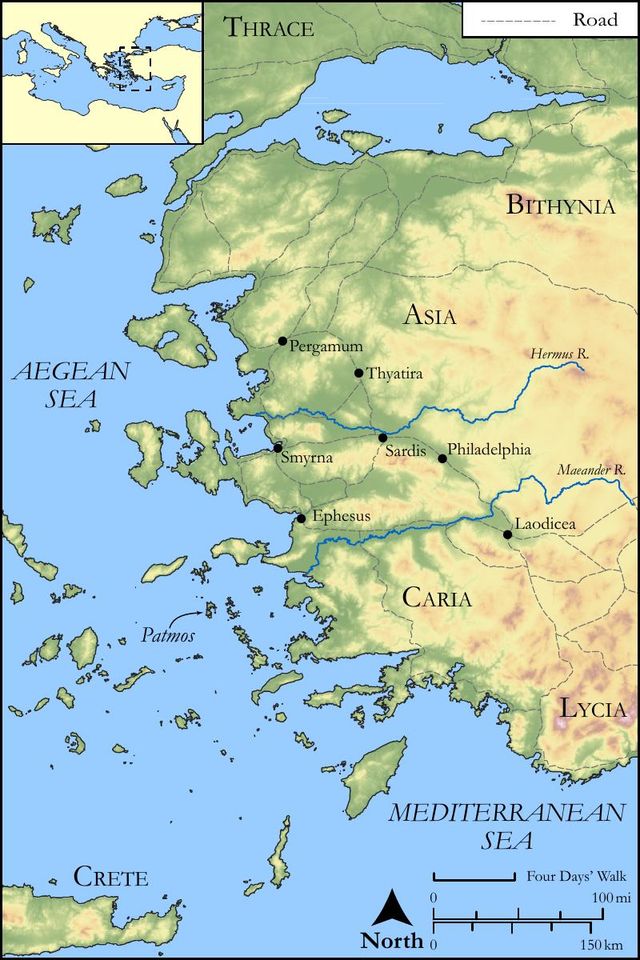
See on the biblical-era maps

Study this verse
Public-domain commentary
Matthew Henry
From his Commentary on the Whole Bible. Henry comments on passages, not single verses — this entry covers Revelation 4:1–7. His three-level outline is real structure in the source text, so it is rendered as structure.
We have here an account of a second vision with which the apostle John was favoured: After this, that is, not only "after I had seen the vision of Christ walking in the midst of the golden candlesticks," but "after I had taken his messages from his mouth, and written and sent them to the several churches, according to his command, after this I had another vision." Those who well improve the discoveries they have had of God already are prepared thereby for more, and may expect them. Observe,
I.The preparation made for the apostle's having this vision.
1.A door was opened in heaven. Hence we learn,
(1.)Whatever is transacted on earth is first designed and settled in heaven; there is the model of all the works of God; all of them are therefore before his eye, and he lets the inhabitants of heaven see as much of them as is fit for them.
(2.)We can know nothing of future events but what God is pleased to discover to us; they are within the veil, till God opens the door. But,
(3.)So far as God reveals his designs to us we may and ought to receive them, and not pretend to be wise above what is revealed.
2.To prepare John for the vision, a trumpet was sounded, and he was called up into heaven, to have a sight there of the things which were to be hereafter. He was called into the third heavens.
(1.)There is a way opened into the holiest of all, into which the sons of God may enter by faith and holy affections now, in their spirits when they die, and in their whole persons at the last day.
(2.)We must not intrude into the secret of God's presence, but stay till we are called up to it.
3.To prepare for this vision, the apostle was in the Spirit. He was in a rapture, as before (Rev 1:10), whether in the body or out of the body we cannot tell; perhaps he himself could not; however all bodily actions and sensations were for a time suspended, and his spirit was possessed with the spirit of prophecy, and wholly under a divine influence. The more we abstract ourselves from all corporeal things the more fit we are for communion with God; the body is a veil, a cloud, and clog to the mind in its transactions with God. We should as it were forget it when we go in before the Lord in duty, and be willing to drop it, that we may go up to him in heaven. This was the apparatus to the vision. Now observe,
II.The vision itself.
It begins with the strange sights that the apostle saw, and they were such as these: - 1. He saw a throne set in heaven, the seat of honour, and authority, and judgment. Heaven is the throne of God; there he resides in glory, and thence he gives laws to the church and to the whole world, and all earthly thrones are under the jurisdiction of this throne that is set in heaven. 2. He saw a glorious one upon the throne. This throne was not empty; there was one in it who filled it, and that was God, who is here described by those things that are most pleasant and precious in our world: His countenance was like a jasper and a sardine-stone; he is not described by any human features, so as to be represented by an image, but only by his transcendent brightness. This jasper is a transparent stone, which yet offers to the eye a variety of the most vivid colours, signifying the glorious perfections of God; the sardine-stone is red, signifying the justice of God, that essential attribute of which he never divests himself in favour of any, but gloriously exerts it in the government of the world, and especially of the church, through our Lord Jesus Christ. This attribute is displayed in pardoning as well as in punishing, in saving as well as in destroying sinners. 3. He saw a rainbow about the throne, like unto an emerald, Rev 4:3. The rainbow was the seal and token of the covenant of the providence that God made with Noah and his posterity with him, and is a fit emblem of that covenant of promise that God has made with Christ as the head of the church, and all his people in him, which covenant is as the waters of Noah unto God, an everlasting covenant, ordered in all things and sure. This rainbow looked like the emerald; the most prevailing colour was a pleasant green, to show the reviving and refreshing nature of the new covenant. 4. He saw four-and-twenty seats round about the throne, not empty, but filled with four-and-twenty elders, presbyters, representing, very probably, the whole church of God, both in the Old Testament and in the New Testament state; not the ministers of the church, but rather the representatives of the people. Their sitting denotes their honour, rest, and satisfaction; their sitting about the throne signifies their relation to God, their nearness to him, the sight and enjoyment they have of him. They are clothed in white raiment, the righteousness of the saints, both imputed and inherent; they had on their heads crowns of gold, signifying the honour and authority given them of God, and the glory they have with him. All these may in a lower sense be applied to the gospel church on earth, in its worshipping assemblies; and, in the higher sense, to the church triumphant in heaven. 5. He perceived lightnings and voices proceeding out of the throne; that is, the awful declarations that God makes to his church of his sovereign will and pleasure. Thus he gave forth the law on mount Sinai; and the gospel has not less glory and authority than the law, though it be of a more spiritual nature. 6. He saw seven lamps of fire burning before the throne, which are explained to be the seven Spirits of God (Rev 4:5), the various gifts, graces, and operations of the Spirit of God in the churches of Christ; these are all dispensed according to the will and pleasure of him who sits upon the throne. 7. He saw before the throne a sea of glass, like unto crystal. As in the temple there was a great vessel of brass filled with water, in which the priests were to wash when they went to minister before the Lord (and this was called a sea), so in the gospel church the sea or laver for purification is the blood of the Lord Jesus Christ, who cleanses from all sin, even from sanctuary-sins. In this all those must be washed that are admitted into the gracious presence of God on earth or his glorious presence in heaven. 8. He saw four animals, living creatures, between the throne and the circle of elders (as seems most probable), standing between God and the people; these seem to signify the ministers of the gospel, not only because of this their situation nearer to God, and between him and the elders or representatives of the Christian people, and because fewer in number than the people, but as they are here described, (1.) By their many eyes, denoting sagacity, vigilance, and circumspection. (2.) By their lion-like courage, their great labour and diligence (in which they resemble the ox), their prudence and discretion becoming men, and their sublime affections and speculations, by which they mount up with wings like eagles towards heaven (Rev 4:7), and these wings full of eyes within, to show that in all their meditations and ministrations they are to act with knowledge, and especially should be well acquainted with themselves and the state of their own souls, and see their own concern in the great doctrines and duties of religion, watching over their own souls as well as the souls of the people. (3.) By their continual employment, and that is, praising God, and not ceasing to do so night and day. The elders sit and are ministered unto; these stand and minister: they rest not night nor day. This now leads to the other part of the representation.
Historical interpretation
Seven Centuries of Reception
8 surviving comments on this verse. Each one is dated, so this reads as a timeline rather than a list.
Select a marker to jump to its quote. Markers stagger vertically where authors wrote within a few decades of each other.
"Immediately I was in the Spirit." And since the mind of the faithful is opened by the Holy Spirit, and that is manifested to them which was also foretold to the fathers, he distinctly says:-
"And, behold, a throne was set in heaven." The throne set: what is it but the throne of judgment and of the King?
[Daniel 7:9] "I beheld until thrones were set up, and the Ancient of days took His seat. His garment was as white as snow, and the hair of His head was like pure wool. His throne was composed of fiery flames and its wheels were set on fire. From before His presence there issued forth a rushing, fiery stream." We read something similar in John's Apocalypse: "After these things I was immediately in the Spirit, and lo, a throne was set up in heaven, and one was seated upon the throne; and He who sat upon it had the likeness of jasper and sardine stone, and there was a rainbow round about the throne like the appearance of emerald. Around the throne there were twenty-four other thrones, and upon the twenty-four thrones there sat twenty-four elders, clothed in shining garments; upon their heads was a golden crown, and lightning flashes issued from the throne, and voices and thunder. And in front of the throne there were seven torches of burning fire, which were the seven spirits of God. And in front of the throne lay a glassy sea like unto crystal." (Revelation 4:2-6) And so the many thrones which Daniel saw seem to me to be what John called the twenty-four thrones. And the Ancient of days is the One who, according to John sits alone upon His throne. Likewise the Son of man, who came unto the Ancient of days, is the same as He who, according to John, is called the Lion of the tribe of Judah, the Root of David, and the titles of that sort (Revelation 5:5). I imagine that these thrones are the ones of which the Apostle Paul says, "Whether thrones or dominions..." (Colossians 1:16). And in the Gospel we read, "Ye yourselves shall sit upon twelve thrones, judging the twelve tribes of Israel" (Matthew 19:28). And God is called the One who sits and who is the Ancient of days, in order that His character as eternal Judge might be indicated. His garment is shining white like the snow, and the hair of His head is like pure wool. The Savior also, when He was transfigured on the mount and assumed the glory of His divine majesty, appeared in shining white garments (Matthew 17:2). And as for the fact that His hair is compared to perfectly pure wool, the even-handedness and uprightness of His judgment is shown forth, a judgment which shows no partiality in its exercise. Moreover He is described as an elderly man, in order that the ripeness of His judgment may be established. His throne consists of fiery flames, in order that sinners may tremble before the severity of the torments, and also that the just may be saved, but so as by fire. The wheels of the throne are set aflame, or else it is the wheels of His chariot which are aflame. In Ezekiel also God is ushered on the scene seated in a four-horse chariot (Ezekiel 1:4-28), and everything pertaining to God is of a fiery consistency. In another place also a statement is made on this subject: "God is a consuming fire" (Deuteronomy 4:24), that we might know that wood, hay and stubble are going to burn up in the day of judgment. And in the Psalms we read: "Fire goeth before Him, and He shall set aflame all His enemies round about Him" (Psalm 97:3). A rushing, fiery stream proceeded from before Him in order that it might carry sinners to hell (Gehenna).
Who would think that he speaks anything fleshly who reports that he had entered in the spirit? A man so thoroughly tested by his God receives nothing fleshly, nothing earthly. But he was in the spirit so that he might see the Lord of majesty, whom he perceives in the spirit, but does not behold in the flesh. He thereby fulfilled what the apostle said: “Even though we knew Christ according to the flesh, we know him thus no longer.”
The jasper stone shines with a green and radiant brightness, so that he might know that the flesh of the assumed man, taken up without a hint of sin, shines with the vigor of everlasting sincerity and glows through the indwelling of the divine power. However, the carnelian stone is red and glimmers with a certain darkness, so that you might recognize the integrity of the undefiled flesh assumed from the modest and humble Virgin.
And immediately I was in the Spirit. And the first voice which I heard. Certainly similar to the previous voice, which had said: What you see, write in a book (Rev. 1).
And behold, a throne was set in heaven, and one sitting on the throne. The Lord inhabits the church placed in heavenly conversation. Pope Gregory interprets the throne of God in the vision of Micah as angelic powers. Presiding higher in their minds, He disposes all things below.
And immediately I was in the spirit. If this is taken as referring to John, it means that he was taken into ecstasy; if it is taken as referring to the Church, these words show its spiritual conversion. And behold there was a throne set in heaven, and upon the throne one sitting. Both heaven and the throne represent the Church, for genus is joined to genus in such a way that not two things are understood, but one. So the throne is set in heaven when heaven itself, that is the Church, deserves to be presided over by the Lord. As for the one sitting on the throne, he is nothing else but the Son of man appearing in the midst of the golden candlesticks: the only difference is that there he is walking, that is bestowing gifts, and here he is sitting, that is making judgment between everyone by administering justice according to the gifts they have been offered. Indeed the fact that the one sitting in this passage represents the Son is disclosed when it is said after that:
And rising in the Spirit, since the ascent was neither physical nor perceptible by the senses.
I see, it says, a throne, and God upon it.
Continue studying Revelation 4:2 across the web’s major study libraries — every link below opens this exact verse, chapter, or book on the destination site.
Read & Compare
 BibleGatewayThis verse in more than 200 translations and 70 languages.
 Bible.comThe YouVersion reader — hundreds of translations, reading plans, and highlights.
 ESV.orgCrossway's official English Standard Version reader.
 NET BibleThe NET translation with 60,000+ translators' notes on every rendering decision.
 STEP BibleTyndale House's free study tool — original text, vocabulary, and scholarly resources.
 BibliaLogos Bible Software's free web reader.
 USCCBThe New American Bible (Revised Edition) with the U.S. bishops' study notes.
Commentaries
 BibleHub CommentariesDozens of classic commentaries on this verse, gathered on one page.
 StudyLightMore than 100 commentary sets — the largest collection on the web.
 BibleRefPlain-English commentary on what this verse means, verse by verse.
 Enduring WordDavid Guzik's free commentary on this chapter, widely used by Bible teachers.
 Bible Study ToolsVerse commentary alongside Greek and Hebrew study aids.
Original Language & Research
- BibleHub InterlinearThe verse word by word — original language, transliteration, and English.
- BibleHub LexiconEvery word's original-language definition and Strong's entry.
 Blue Letter BibleDeep-study tools — Strong's numbers, concordance, and word studies.
 CNTR CollationThe earliest Greek manuscripts of this verse, collated letter by letter.
Sermons, Hymns & Audio


TrulyRandomVerse is not affiliated with these sites and doesn’t control their content. They’re linked because they’re genuinely useful.
Summary
Revelation 4:2 marks a profound shift in John's apocalyptic vision, transporting him from earthly concerns to a direct encounter with the divine throne room in heaven. This pivotal verse immediately establishes the supreme authority and unchallengeable sovereignty of God, introducing the central figure of the One seated on the throne and setting the stage for the unfolding judgments, worship, and redemptive narrative that define the remainder of the book of Revelation.
Context
ShowHideLiterary Context
This verse serves as the immediate follow-up to the dramatic invitation in Revelation 4:1, where a trumpet-like voice calls John to "Come up hither, and I will shew thee things which must be hereafter." This signifies a clear transition from the specific messages to the seven churches in Asia Minor (chapters 2-3), which dealt with their spiritual states and challenges, to a broader, universal, and eschatological vision. John's declaration, "And immediately I was in the spirit," echoes his earlier prophetic experience on Patmos in Revelation 1:10, indicating a divinely initiated state of spiritual transport essential for receiving and comprehending the subsequent heavenly revelations. The immediate vision of the throne and its Occupant firmly establishes the divine perspective from which all subsequent events are revealed.
Historical & Cultural Context
In the first century Roman Empire, the concept of a "throne" was intrinsically linked to imperial power, absolute authority, and the worship of the emperor. Emperors like Domitian demanded to be addressed as "Lord and God," and their thrones symbolized their ultimate dominion over the known world. John's vision directly challenges this earthly paradigm by presenting a heavenly throne, far superior to any earthly seat of power, occupied by the one true God. This vision would have been a profound counter-cultural statement to believers facing persecution for refusing to worship Caesar. It affirmed that despite the apparent might of Rome, the ultimate authority resided not in human hands but in heaven, providing immense encouragement and a call to steadfast allegiance to the divine King. The imagery draws upon the prophetic visions of God's throne (e.g., Isaiah 6:1-5 and Ezekiel 1:26-28), but elevates them to a new, climactic revelation.
Key Themes
ShowHideRevelation 4:2 powerfully introduces several foundational themes that permeate the entire book. The most prominent is Divine Sovereignty, unequivocally declared by the presence of "a throne set in heaven, and one sat on the throne." This image asserts God's absolute and unchallenged rule over all creation, history, and destiny, providing a theological anchor in the midst of the chaotic events to follow. Another key theme is Heavenly Reality, as the verse pulls back the veil to reveal the true locus of power and worship—not on earth, but in the celestial realm. This emphasizes that ultimate reality transcends the visible world and that God's dominion is visibly established in heaven. Finally, the verse highlights God's Transcendence and Immanence. While God is transcendent, dwelling in unapproachable glory on His heavenly throne, He is also immanent, accessible to John "in the spirit" and actively initiating this profound revelation, demonstrating His engagement with humanity and His purposes for the world, as seen throughout the prophetic tradition, from Amos 3:7 to the New Testament's emphasis on the Spirit's work in John 16:13.
Exposition and Analysis
ShowHideKey Word Analysis
ShowHideThis adverb signifies a swift, direct, and instantaneous transition. It emphasizes the immediacy of John's spiritual transport, indicating that the vision was not a gradual ascent or a prolonged process, but a sudden, divinely orchestrated event. This highlights the supernatural nature of the experience and the urgency of the revelation.
In this context, "spirit" refers to the Holy Spirit, signifying a state of divine inspiration, prophetic ecstasy, or spiritual transport. John is not merely in a heightened emotional state but is supernaturally empowered and enabled by God's Spirit to perceive and comprehend realities beyond the natural realm. This is a common phrase in prophetic literature, denoting the means by which divine revelation is imparted, as seen in Revelation 1:10.
Derived from a word meaning "to sit," this noun denotes a stately seat, specifically one associated with royalty, power, and authority. In Revelation, "throne" is used over 40 times, consistently emphasizing God's sovereign rule, kingly dominion, and judicial authority. Its prominent placement at the beginning of this heavenly vision immediately establishes the central theme of divine sovereignty and sets the tone for the entire book, indicating that all events unfold under the gaze and command of the One seated upon it.
Verse Breakdown
ShowHide"And immediately I was in the spirit:"
This clause describes John's instantaneous spiritual state, a divinely induced prophetic trance or ecstasy. The Holy Spirit supernaturally enables John to transcend his physical limitations and perceive heavenly realities. This is not a self-willed act but a direct, immediate impartation from God, preparing him for the profound vision that follows.
"and, behold, a throne was set in heaven,"
The conjunction "and" introduces the object of John's immediate spiritual perception. "Behold" (Greek: idoú) is an interjection used to draw attention to something remarkable or unexpected, signaling the profound significance of what is about to be revealed. The central image is "a throne," a symbol of ultimate authority and sovereignty. The phrase "was set" (Greek: keîmai) implies a fixed, established, and permanent fixture, not something temporary or movable. Its location "in heaven" unequivocally declares that the ultimate seat of power and governance is not on earth but in the celestial realm, asserting God's transcendent rule over all creation.
"and [one] sat on the throne."
This final clause identifies the Occupant of the throne, though initially unnamed. The presence of "one" (implied in the Greek verb káthēmai, "to sit") immediately confirms that this throne is not empty or merely symbolic, but actively occupied by a living, reigning being. This figure is understood to be God the Father, the ultimate source of all authority and power, whose presence validates the throne's significance and underscores the absolute nature of divine sovereignty.
Literary Devices
ShowHideRevelation 4:2 is rich with Vivid Imagery, immediately plunging the reader into a sensory experience of the divine realm. The phrase "I was in the spirit" conveys a sense of spiritual transport and heightened perception, while the subsequent vision of "a throne set in heaven" creates a powerful mental picture of stability, authority, and majesty. The interjection "behold" acts as a Literary Spotlight, drawing the reader's attention to the central and most significant element of the vision—the throne itself. This throne functions as potent Symbolism, representing God's absolute sovereignty, ultimate power, and unchallengeable rule over all creation. Its fixed position "in heaven" further emphasizes its permanence and transcendence, contrasting sharply with the fleeting and often chaotic nature of earthly powers. The entire verse serves as a Theological Foundation, establishing the divine authority from which all subsequent revelations in the book of Revelation derive their meaning and legitimacy.
Theological and Thematic Connections
ShowHideRevelation 4:2 serves as the theological bedrock for the entire book, establishing God's absolute sovereignty as the foundational truth. The vision of a throne in heaven, occupied by "one," immediately shifts the focus from earthly struggles to the ultimate divine authority that governs all things. This underscores that despite the chaos, persecution, and war in heaven depicted later in Revelation, God remains firmly in control, reigning supreme over history, humanity, and all spiritual forces. This truth provides immense comfort and assurance to believers, reminding them that their ultimate hope rests not in human institutions or earthly powers, but in the unshakeable dominion of the Almighty. The heavenly throne room becomes the command center from which all divine judgments, redemptive acts, and ultimate victory proceed, inviting humanity to align with the divine will and participate in the worship of heaven.
Reflection and Application
ShowHideRevelation 4:2 offers a profound anchor for faith in a turbulent world. In an age often characterized by uncertainty, fear, and the apparent triumph of unrighteousness, this verse powerfully reminds us that there is a sovereign God on the throne. His rule is not challenged, diminished, or surprised by earthly circumstances, political upheavals, or personal trials. This truth calls believers to lift their gaze beyond immediate troubles and to fix their hope on the ultimate, reigning power in the universe. It encourages a heavenly perspective, recognizing that true authority and lasting peace reside not in human endeavors or institutions, but with the One who sits on the throne. Understanding God's absolute sovereignty should cultivate deep trust, inspire unwavering worship, and empower courageous living, knowing that His purposes will ultimately prevail. It challenges us to live in light of eternity, aligning our lives with His divine will and participating in His eternal plan, rather than being consumed by the fleeting concerns of this world.
Questions for Reflection
ShowHideFAQ
ShowHideWhat does it mean for John to be "in the spirit"?
ShowHideFor John to be "in the spirit" (Greek: en pneumati) signifies a state of divine inspiration or spiritual transport, supernaturally enabled by the Holy Spirit. It's not merely a heightened emotional state or a dream, but a prophetic experience where John's human senses are transcended, allowing him to perceive and comprehend divine realities and revelations that are otherwise inaccessible. This state prepares him to be a recipient and recorder of God's unfolding plan, much like other prophets in the Old Testament who were moved by the Spirit (e.g., Ezekiel 3:12). It underscores that the visions recorded in Revelation are not human fabrications but divinely given insights.
Why is the "throne" so significant in Revelation?
ShowHideThe "throne" (Greek: thrónos) is arguably the most central symbol in the book of Revelation, appearing over 40 times. Its significance lies in its unequivocal representation of God's absolute sovereignty, supreme authority, and unchallengeable dominion. In a world where Roman emperors demanded worship and claimed ultimate power, the heavenly throne in Revelation asserts that the true, ultimate power resides with God alone. It is from this throne that judgments are issued, worship ascends, and the Lamb (Christ) receives power and glory. The throne signifies stability, control, and the ultimate triumph of God's righteous rule over all creation, providing a theological anchor for the entire apocalyptic narrative, as seen in the repeated emphasis on the throne in chapters like Revelation 5.
Christ-Centered Fulfillment
ShowHideWhile Revelation 4:2 primarily depicts God the Father on the throne, it lays the essential groundwork for understanding Christ's ultimate authority and shared reign. The vision of a supreme, occupied throne establishes the divine sovereignty into which Jesus, the Lamb, will later enter and share. The One who sits on the throne is the Father, but the New Testament consistently reveals that all authority in heaven and on earth has been given to Jesus Christ (e.g., Matthew 28:18). He is the Lamb worthy to open the scroll (Revelation 5:5-7), and He is explicitly depicted as sharing the Father's throne (e.g., Revelation 22:1). Thus, Revelation 4:2, by establishing the reality of God's heavenly throne, foreshadows Christ's ultimate exaltation to the right hand of the Father (Hebrews 1:3) and His co-reign as the King of Kings and Lord of Lords, the one through whom all divine purposes are executed and ultimately fulfilled.