


Revelation 4:1
Bible text: King James Version (1769 Blayney text) · Public domain
Bible text: King James Version with Strong's numbers · Public domain
Bible text: Berean Standard Bible · Public domain
Bible text: American Standard Version (1901) · Public domain
Bible text: World English Bible, Messianic edition · Public domain
Bible text: Geneva Bible (1599) · Public domain
Bible text: Young's Literal Translation · Public domain
- ΜετὰMetaAfterG3326PREPPreposition
- ταῦταtautathese thingsG3778D-APNDemonstrative pronoun Accusative Plural Neuter
- εἶδονeidonI lookedG1492V-2AAI-1SVerb 2nd Aorist Active Indicative 1st Singular
- καὶkaiandG2532CONJConjunction
- ἰδοὺidoubeholdG2400INJInterjection
- θύραthuraa doorG2374N-NSFNoun Nominative Singular Feminine
- ἠνεῳγμένηēneōgmenēopenedG455V-RPP-NSFVerb Perfect Passive Participle Nominative Singular Feminine
- ἐνeninG1722PREPPreposition
- τῷtō<the>G3588T-DSMDefinite article Dative Singular Masculine
- οὐρανῷouranōheavenG3772N-DSMNoun Dative Singular Masculine
- καὶkaiandG2532CONJConjunction
- ἡhētheG3588T-NSFDefinite article Nominative Singular Feminine
- φωνὴphōnēvoiceG5456N-NSFNoun Nominative Singular Feminine
- ἡhē<the>G3588T-NSFDefinite article Nominative Singular Feminine
- πρώτηprōtēfirstG4413A-NSFAdjective Nominative Singular Feminine
- ἣνhēnthatG3739R-ASFRelative pronoun Accusative Singular Feminine
- ἤκουσαēkousaI heardG191V-AAI-1SVerb Aorist Active Indicative 1st Singular
- ὡςhōslikeG5613PRTParticle or Disjunctive
- σάλπιγγοςsalpingosa trumpetG4536N-GSFNoun Genitive Singular Feminine
- λαλούσηςlalousēswas speakingG2980V-PAP-GSFVerb Present Active Participle Genitive Singular Feminine
- μετ᾽met᾽withG3326PREPPreposition
- ἐμοῦemoumeG1473S-1SGSNPossessive pronoun Genitive 1st Person Singular Neuter
- λέγων·legōnsayingG3004V-PAP-NSMVerb Present Active Participle Nominative Singular Masculine
- ἀνάβαanabado come upG305V-2AAM-2SVerb 2nd Aorist Active Imperative 2nd Singular
- ὧδεhōdehereG5602ADVAdverb
- καὶkaiandG2532CONJConjunction
- δείξωdeixōI will showG1166V-FAI-1SVerb Future Active Indicative 1st Singular
- σοιsoito youG4771P-2DSPersonal pronoun Dative 2nd Singular
- ἃhawhatG3739R-APNRelative pronoun Accusative Plural Neuter
- δεῖdeiit behoovesG1163V-PAI-3SVerb Present Active Indicative 3rd Singular
- γενέσθαιgenesthaito take placeG1096V-2ADNVerb 2nd Aorist Middle Deponent Infinitive
- μετὰmetaafterG3326PREPPreposition
- ταῦταtautathese thingsG3778D-APNDemonstrative pronoun Accusative Plural Neuter
English is a literal word-by-word gloss of the Greek, not the KJV's wording. Why?
This is the original text the KJV's translators worked from — each Greek word with its own literal English meaning in this verse, prepared by scholars at Tyndale House, Cambridge. The KJV translates whole sentences, not word by word, so its wording differs: one Greek word can become several English words, and the KJV may choose “charity” where the gloss reads “love”. Both are faithful — they answer different questions. For the KJV's own rendering, switch to the KJV text.
Details
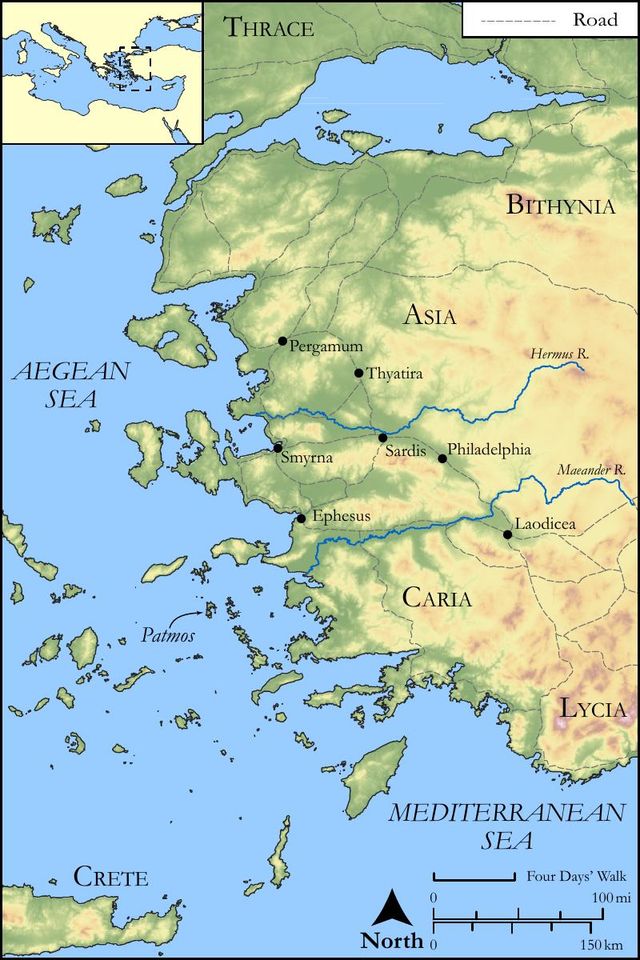
See on the biblical-era maps

Study this verse
Public-domain commentary
Matthew Henry
From his Commentary on the Whole Bible. Henry comments on passages, not single verses — this entry covers Revelation 4:1–7. His three-level outline is real structure in the source text, so it is rendered as structure.
We have here an account of a second vision with which the apostle John was favoured: After this, that is, not only "after I had seen the vision of Christ walking in the midst of the golden candlesticks," but "after I had taken his messages from his mouth, and written and sent them to the several churches, according to his command, after this I had another vision." Those who well improve the discoveries they have had of God already are prepared thereby for more, and may expect them. Observe,
I.The preparation made for the apostle's having this vision.
1.A door was opened in heaven. Hence we learn,
(1.)Whatever is transacted on earth is first designed and settled in heaven; there is the model of all the works of God; all of them are therefore before his eye, and he lets the inhabitants of heaven see as much of them as is fit for them.
(2.)We can know nothing of future events but what God is pleased to discover to us; they are within the veil, till God opens the door. But,
(3.)So far as God reveals his designs to us we may and ought to receive them, and not pretend to be wise above what is revealed.
2.To prepare John for the vision, a trumpet was sounded, and he was called up into heaven, to have a sight there of the things which were to be hereafter. He was called into the third heavens.
(1.)There is a way opened into the holiest of all, into which the sons of God may enter by faith and holy affections now, in their spirits when they die, and in their whole persons at the last day.
(2.)We must not intrude into the secret of God's presence, but stay till we are called up to it.
3.To prepare for this vision, the apostle was in the Spirit. He was in a rapture, as before (Rev 1:10), whether in the body or out of the body we cannot tell; perhaps he himself could not; however all bodily actions and sensations were for a time suspended, and his spirit was possessed with the spirit of prophecy, and wholly under a divine influence. The more we abstract ourselves from all corporeal things the more fit we are for communion with God; the body is a veil, a cloud, and clog to the mind in its transactions with God. We should as it were forget it when we go in before the Lord in duty, and be willing to drop it, that we may go up to him in heaven. This was the apparatus to the vision. Now observe,
II.The vision itself.
It begins with the strange sights that the apostle saw, and they were such as these: - 1. He saw a throne set in heaven, the seat of honour, and authority, and judgment. Heaven is the throne of God; there he resides in glory, and thence he gives laws to the church and to the whole world, and all earthly thrones are under the jurisdiction of this throne that is set in heaven. 2. He saw a glorious one upon the throne. This throne was not empty; there was one in it who filled it, and that was God, who is here described by those things that are most pleasant and precious in our world: His countenance was like a jasper and a sardine-stone; he is not described by any human features, so as to be represented by an image, but only by his transcendent brightness. This jasper is a transparent stone, which yet offers to the eye a variety of the most vivid colours, signifying the glorious perfections of God; the sardine-stone is red, signifying the justice of God, that essential attribute of which he never divests himself in favour of any, but gloriously exerts it in the government of the world, and especially of the church, through our Lord Jesus Christ. This attribute is displayed in pardoning as well as in punishing, in saving as well as in destroying sinners. 3. He saw a rainbow about the throne, like unto an emerald, Rev 4:3. The rainbow was the seal and token of the covenant of the providence that God made with Noah and his posterity with him, and is a fit emblem of that covenant of promise that God has made with Christ as the head of the church, and all his people in him, which covenant is as the waters of Noah unto God, an everlasting covenant, ordered in all things and sure. This rainbow looked like the emerald; the most prevailing colour was a pleasant green, to show the reviving and refreshing nature of the new covenant. 4. He saw four-and-twenty seats round about the throne, not empty, but filled with four-and-twenty elders, presbyters, representing, very probably, the whole church of God, both in the Old Testament and in the New Testament state; not the ministers of the church, but rather the representatives of the people. Their sitting denotes their honour, rest, and satisfaction; their sitting about the throne signifies their relation to God, their nearness to him, the sight and enjoyment they have of him. They are clothed in white raiment, the righteousness of the saints, both imputed and inherent; they had on their heads crowns of gold, signifying the honour and authority given them of God, and the glory they have with him. All these may in a lower sense be applied to the gospel church on earth, in its worshipping assemblies; and, in the higher sense, to the church triumphant in heaven. 5. He perceived lightnings and voices proceeding out of the throne; that is, the awful declarations that God makes to his church of his sovereign will and pleasure. Thus he gave forth the law on mount Sinai; and the gospel has not less glory and authority than the law, though it be of a more spiritual nature. 6. He saw seven lamps of fire burning before the throne, which are explained to be the seven Spirits of God (Rev 4:5), the various gifts, graces, and operations of the Spirit of God in the churches of Christ; these are all dispensed according to the will and pleasure of him who sits upon the throne. 7. He saw before the throne a sea of glass, like unto crystal. As in the temple there was a great vessel of brass filled with water, in which the priests were to wash when they went to minister before the Lord (and this was called a sea), so in the gospel church the sea or laver for purification is the blood of the Lord Jesus Christ, who cleanses from all sin, even from sanctuary-sins. In this all those must be washed that are admitted into the gracious presence of God on earth or his glorious presence in heaven. 8. He saw four animals, living creatures, between the throne and the circle of elders (as seems most probable), standing between God and the people; these seem to signify the ministers of the gospel, not only because of this their situation nearer to God, and between him and the elders or representatives of the Christian people, and because fewer in number than the people, but as they are here described, (1.) By their many eyes, denoting sagacity, vigilance, and circumspection. (2.) By their lion-like courage, their great labour and diligence (in which they resemble the ox), their prudence and discretion becoming men, and their sublime affections and speculations, by which they mount up with wings like eagles towards heaven (Rev 4:7), and these wings full of eyes within, to show that in all their meditations and ministrations they are to act with knowledge, and especially should be well acquainted with themselves and the state of their own souls, and see their own concern in the great doctrines and duties of religion, watching over their own souls as well as the souls of the people. (3.) By their continual employment, and that is, praising God, and not ceasing to do so night and day. The elders sit and are ministered unto; these stand and minister: they rest not night nor day. This now leads to the other part of the representation.
Historical interpretation
Seven Centuries of Reception
7 surviving comments on this verse. Each one is dated, so this reads as a timeline rather than a list.
Select a marker to jump to its quote. Markers stagger vertically where authors wrote within a few decades of each other.
"After this, I beheld, and, lo, a door was opened in heaven." The new testament is announced as an open door in heaven.
"And the first voice which I heard was, as it were, of a trumpet talking with me, saying, Come up hither." Since the door is shown to be opened, it is manifest that previously it had been closed to men. And it was sufficiently and fully laid open when Christ ascended with His body to the Father into heaven. Moreover, the first voice which he had heard when he says that it spoke with him, without contradiction condemns those who say that one spoke in the prophets, another in the Gospel; since it is rather He Himself who comes, that is the same who spoke in the prophets. For John was of the circumcision, and all that people which had heard the announcement of the Old Testament was edified with his word.
"That very same voice," said he, "that I had heard, that said unto me, Come up hither." That is the Spirit, whom a little before he confesses that he had seen walking as the Son of man in the midst of the golden candlesticks. And he now gathers from Him what had been foretold in similitudes by the law, and associates with this scripture all the former prophets, and opens up the Scriptures. And because our Lord invited in His own name all believers into heaven, He forthwith poured out the Holy Spirit, who should bring them to heaven.
“Afterwards,” John said, “I saw.” After seeing the vision, he remembered that he had seen another. The interval in time belongs not to the events but to the visions. If one were to describe a single event in different ways, it would be the descriptions that differ in time, not what took place at one time. In this way, he retraces the whole span of the church using various figures to describe it. “Behold,” he says, “an open door in heaven.” The open door represents Christ, who was born, suffered and was raised. Christ is the gateway, as he himself said, “I am the door.” Heaven represents the church because it is the habitation of God where the celestial realities are effected. This is why we pray that the will of God be done on earth even as it is in heaven. Sometimes, however, the church is represented by both heaven and earth, since the earth comes into agreement with heaven, either when the unfaithful are won by the righteous proclamation of the faithful, or when the flesh is subdued by the Spirit, or when the things of the earth are reconciled and united to the things of heaven.
This is, therefore, the voice of prophecy of which it is said, “Lift up your voice like a trumpet.” One has gone up and ascended who, having despised the world, is either compelled to come to the church or obtains admission to her. He ascends from the valley of tears to the height of that dignity of which we read, “Come, let us go up to the mountain of the Lord and to the house of the God of Jacob, and he will teach us his ways.” However, the faithful are also invited to ascend to heaven when they are commanded to seek and to taste what is in heaven and not what is upon the earth. For when a neophyte in the church is taught that Christ suffered, was raised and has ascended to the Father, and then beyond these things is taught and instructed spiritually to contemplate him in the Father according to the form of God, he is rightly said to ascend, since he will see the secrets of the mysteries in which he has believed. Therefore, the Lord said, “Do not touch me, for I have not yet ascended to the Father,” wishing this touching to be understood as belief.
The opening of the door signifies the revelation of the hidden mysteries of the Spirit. The trumpet represents the sonorous voice of the Revealer. “Come up here” indicates that the mind of the hearer is to turn away completely from the things of the earth and be turned toward heaven.
After this, I looked, and behold, a door open in heaven. After describing the works of the Church, what it was and what it would be like, he recapitulates from the birth of Christ, intending to say the same things differently. For he repeats the entire time of the Church in various figures in this book. Behold, he says, a door open in heaven. Fittingly, he sees a heavenly door about to ascend, to whom high mysteries are promised to be revealed. Or because Christ is the door, he who believes in Him born and suffered ascends to heaven, that is, to the height of the Church, and sees future spiritual events as he says.
After these things I looked, and behold a door was opened in heaven. The Redeemer's Nativity is recapitulated, and these things had already been said with various other symbols; as when one relates one event in different ways, the narrations will each have a different time, but not the event itself, which happened in one time. We should however ask the question of why John does not disclose the time of his prophecy, while other prophets used to disclose by the kings the length of the interval between one vision and another. It is because he is informing us that the whole time of the Church should be related to that continuous day of resurrection about which it is said, Blessed is he that hath part in the first resurrection; [Rev. 20:6] for the first resurrection, that is the one by which souls rise again from the death of sin to the life of justice, is now going on all the time. Now with what eyes did John see this door? As far as the figurative vision is concerned, he did not of course see it with the eyes of the flesh, but with those of the mind; but for what concerns the truth of the thing itself, truth which had already been manifested when the Lord had appeared in the flesh, not only did he see it with the eyes of the flesh, but he even touched it with his hands. The open door represents Christ, who has already been manifested to all the faithful by being born, dying, and rising again. It is appropriate for this door to be seen in heaven, that is in the Church, because it is in the Church that people proclaim and believe that our Redeemer was born, suffered, was resurrected, and went up to heaven. And the first voice which I heard, was, as it were, of a trumpet speaking with me, saying: Come up hither. Whither, but to the door and heaven, that is Christ and the Church? And with what steps, but those of faith? It is right for John to be invited to this by the first voice, because every one of the elect, in order that they may reach the mysteries of the true faith through the Gospel without the foot of belief striking against any obstacle, is strengthened by the teaching of the Old Testament, which preceded the new teaching. It is also right for this voice to be compared to a trumpet, because it is calling us to a spiritual war; whence this: Lift up thy voice like a trumpet. [Is. 58:1] In what is said after that, I will shew thee the things which must be done hereafter, he does not deny that the Church already has high honors, but he shows that they will last until the end of the world.
It is not that there is literally a door in heaven that opens and closes at times, but it was shown to the evangelist in this way so that he might see the things above the heavens.
For with every door opened, what lies within must inevitably be seen. And I heard a voice, which sounded like a trumpet, saying these words to me: Come up here so that you may see what is to come.
Continue studying Revelation 4:1 across the web’s major study libraries — every link below opens this exact verse, chapter, or book on the destination site.
Read & Compare
 BibleGatewayThis verse in more than 200 translations and 70 languages.
 Bible.comThe YouVersion reader — hundreds of translations, reading plans, and highlights.
 ESV.orgCrossway's official English Standard Version reader.
 NET BibleThe NET translation with 60,000+ translators' notes on every rendering decision.
 STEP BibleTyndale House's free study tool — original text, vocabulary, and scholarly resources.
 BibliaLogos Bible Software's free web reader.
 USCCBThe New American Bible (Revised Edition) with the U.S. bishops' study notes.
Commentaries
 BibleHub CommentariesDozens of classic commentaries on this verse, gathered on one page.
 StudyLightMore than 100 commentary sets — the largest collection on the web.
 BibleRefPlain-English commentary on what this verse means, verse by verse.
 Enduring WordDavid Guzik's free commentary on this chapter, widely used by Bible teachers.
 Bible Study ToolsVerse commentary alongside Greek and Hebrew study aids.
Original Language & Research
- BibleHub InterlinearThe verse word by word — original language, transliteration, and English.
- BibleHub LexiconEvery word's original-language definition and Strong's entry.
 Blue Letter BibleDeep-study tools — Strong's numbers, concordance, and word studies.
 CNTR CollationThe earliest Greek manuscripts of this verse, collated letter by letter.
Sermons, Hymns & Audio


TrulyRandomVerse is not affiliated with these sites and doesn’t control their content. They’re linked because they’re genuinely useful.
Summary
Revelation 4:1 marks a profound transition in John's apocalyptic vision, shifting the narrative from the earthly churches to the celestial throne room of God. This verse serves as a divine invitation and summons, opening a revelatory portal into the heavenly realm where John is granted a privileged perspective to witness and record the unfolding of future events, thereby setting the stage for the drama of judgment and redemption that comprises the remainder of the book.
Context
ShowHideLiterary Context
This verse immediately follows the seven letters to the churches in Asia Minor (Revelation 2-3), which conclude the first major section of the book. The phrase "After this" (μετὰ ταῦτα, meta tauta) signals a significant shift in focus from the present state and challenges of the earthly church to the future, divinely ordained events. It transitions from Christ's direct address to His people on earth to a panoramic vision of God's sovereignty over all history, beginning with a profound glimpse into the heavenly court. This literary demarcation is crucial, as it moves from the immanent concerns of the church age to the transcendent realities of God's ultimate plan.
Historical & Cultural Context
John, exiled on the island of Patmos, is receiving these visions during a period of intense persecution for early Christians under the Roman Empire, likely during the reign of Emperor Domitian. The imagery of an "opened door in heaven" would have resonated with Jewish apocalyptic traditions, where prophets were often granted visions of God's heavenly court (e.g., Isaiah 6 or Ezekiel 1). The "voice... as it were of a trumpet" would evoke the solemn, authoritative pronouncements of God, reminiscent of the trumpet blast at Mount Sinai accompanying God's revelation of the Law (Exodus 19:16). This context underscores the divine authority and urgency of the revelation John is about to receive, offering hope and understanding to a persecuted church.
Key Themes
ShowHideRevelation 4:1 introduces several foundational themes that will permeate the rest of the book. Firstly, it establishes the sovereignty of God, as John is immediately transported to the heavenly throne room, the ultimate seat of power and authority. Secondly, it emphasizes divine revelation and prophecy, as the explicit purpose of the invitation is to "shew thee things which must be hereafter," underscoring the book's eschatological focus. This highlights that God is not merely reacting to history but is actively orchestrating it towards His predetermined end. Finally, the "opened door" symbolizes access to God's presence and His divine perspective, a privilege granted to John to unveil the future to the church, providing assurance that God remains in control despite earthly turmoil, a theme consistently reinforced throughout the subsequent visions of judgment and redemption, such as the Lamb opening the scrolls in Revelation 5.
Exposition and Analysis
ShowHideKey Word Analysis
ShowHideThis verb signifies not merely a casual glance but an intentional and perceptive act of seeing, often implying understanding or knowing. In this context, John's "looking" is an active engagement with the divine vision, leading to a profound spiritual comprehension of the heavenly realm and the subsequent revelations. It suggests a divinely enabled perception beyond ordinary human sight.
This word denotes the act of unsealing, unlocking, or making accessible. The "opened door" is not a natural occurrence but a deliberate divine act, signifying that access to heaven's mysteries is granted by God's will alone. It underscores the supernatural nature of the vision and the exclusive privilege bestowed upon John to peer into the divine plan.
This verb means to point out, exhibit, or demonstrate, either literally or figuratively. Here, it indicates the purpose of John's heavenly ascent: to be shown, or instructed in, the future events. It emphasizes that the subsequent visions are not John's interpretations but direct, divine disclosures of "things which must be hereafter," highlighting the prophetic and authoritative nature of the revelation.
Verse Breakdown
ShowHide"¶ After this I looked, and, behold, a door [was] opened in heaven:"
The phrase "After this" (Greek: μετὰ ταῦτα, meta tauta) serves as a crucial chronological and thematic marker, indicating a new phase in John's vision, distinct from the messages to the seven churches. John's act of "looking" is met with a divine manifestation: a "door opened in heaven." This is not a physical door but a visionary portal, signifying direct, supernatural access to the celestial realm, where God's throne resides. The "behold" (ἰδού, idoú) emphasizes the suddenness and wonder of this divine unveiling.
"and the first voice which I heard [was] as it were of a trumpet talking with me;"
Immediately following the opened door, John perceives a "first voice." The description "as it were of a trumpet" (ὡς σάλπιγγος, hos salpingos) conveys the voice's profound authority, clarity, and penetrating power. Trumpets in biblical contexts often herald divine presence, significant announcements, or calls to attention (e.g., Exodus 19:16). This voice is not merely a sound but is "talking with me" (λαλοῦσα μετ' ἐμοῦ, lalōsa met' emou), indicating direct, personal communication with John.
"which said, Come up hither, and I will shew thee things which must be hereafter."
The authoritative voice issues a direct command: "Come up hither" (Ἀνάβα ὧδε, Anaba hōde). This is an invitation to ascend, both physically within the vision and spiritually to a higher perspective. The purpose of this ascent is explicitly stated: "and I will shew thee things which must be hereafter" (καὶ δείξω σοι ἃ δεῖ γενέσθαι μετὰ ταῦτα, kai deixō soi ha dei genesthai meta tauta). This phrase defines the primary focus of the remainder of the Book of Revelation – the unveiling of future events (ἃ δεῖ γενέσθαι, ha dei genesthai, "things which must come to pass"), emphasizing their divine necessity and certainty.
Literary Devices
ShowHideRevelation 4:1 employs several powerful literary devices. The most prominent is Symbolism, with the "opened door in heaven" serving as a potent symbol of divine access and revelation. It represents a breach in the veil between the earthly and heavenly realms, allowing John (and through him, the readers) to witness God's transcendent reality. The "voice... as it were of a trumpet" is a Simile, comparing the sound to a trumpet to convey its loud, clear, and authoritative nature, often associated with divine pronouncements (e.g., Revelation 1:10). This auditory imagery immediately establishes the gravity and divine origin of the message. Furthermore, the phrase "After this" functions as a Transitional Marker, signaling a dramatic shift in the narrative's focus and scope, moving from the immediate concerns of the churches to the grand panorama of future history. The entire verse also functions as a Proleptic Invitation, inviting John into the future events that will unfold in the subsequent chapters.
Theological and Thematic Connections
ShowHideRevelation 4:1 serves as the crucial theological hinge of the entire book, shifting the focus from the historical realities of the seven churches to the eternal, sovereign reality of God's throne. It underscores the foundational truth that all of history, past, present, and future, is under the absolute control of a reigning God. The "opened door" signifies not just a vision for John, but a profound theological statement: access to divine truth and the understanding of God's ultimate plan is granted by His initiative alone. This passage reassures believers that despite earthly tribulations, the ultimate power resides not with human empires or persecutors, but with the God who sits on the throne, orchestrating all things to their appointed end. This heavenly perspective frames all subsequent judgments and redemptions, rooting them in divine purpose and authority.
Reflection and Application
ShowHideRevelation 4:1 offers profound comfort and challenge to believers. In a world often characterized by chaos, uncertainty, and perceived injustice, this verse reminds us that there is a divine order and a sovereign God who is actively engaged in history. The transition from the earthly churches to the heavenly throne room encourages us to lift our gaze from our immediate circumstances and fix our eyes on the eternal perspective. Just as John was called to "Come up hither," we are invited to rise above the temporal anxieties and gain a heavenly understanding of God's overarching plan. This perspective fosters trust, resilience, and hope, knowing that all things "must be hereafter" according to God's perfect will. It challenges us to live with an eschatological awareness, understanding that our present actions are part of a larger divine narrative culminating in God's ultimate triumph.
Questions for Reflection
ShowHideFAQ
ShowHideWhat is the significance of the "opened door in heaven"?
ShowHideThe "opened door in heaven" is highly significant as it symbolizes a direct, supernatural portal or access point to the divine realm. It signifies that God is initiating a new phase of revelation to John, allowing him to witness the heavenly court and the unfolding of future events. It represents God's sovereign act of unveiling His plans and purposes, making the unseen visible and the future known. This imagery is a profound affirmation of God's control and His desire to communicate His truth to humanity.
Why is the voice described "as it were of a trumpet"?
ShowHideThe description of the voice "as it were of a trumpet" emphasizes its loud, clear, authoritative, and attention-grabbing nature. In biblical contexts, trumpet sounds often accompany divine pronouncements, significant events, or calls to assembly. For instance, God's voice at Mount Sinai was accompanied by a trumpet sound (Exodus 19:16). This imagery underscores the solemnity and divine origin of the command to John, signaling that what he is about to hear and see is of utmost importance and carries divine authority. It is a sound that demands immediate and complete attention.
Christ-Centered Fulfillment
ShowHideWhile Revelation 4:1 primarily focuses on God the Father on His throne, it lays the foundational heavenly context for the revelation of Christ's ultimate authority and redemptive work. The "opened door" and the divine summons prepare the way for the central figure of the entire apocalyptic vision: the Lamb who was slain. It is Christ, the Lamb standing as though it had been slain, who is found worthy to open the scroll and reveal the future events, demonstrating that all of God's sovereign plan, revealed from the throne, is executed through Him. The voice from the throne, though not explicitly identified as Christ in this verse, sets the stage for the Son to take His rightful place in the unfolding drama of redemption and judgment. This vision of God's throne room in Revelation 4 serves as the ultimate backdrop against which the Lamb's victory, His judgment of evil, and His establishment of the new heavens and new earth (as seen in Revelation 21-22) are understood as the fulfillment of God's eternal purposes, all centered on the redemptive work accomplished by Jesus Christ. The invitation to "Come up hither" is ultimately an invitation into the divine perspective that culminates in the triumph of Christ and His kingdom, a truth foreshadowed in Christ's own ascension to sit at the right hand of God (Acts 1:9-11 and Hebrews 1:3).