


Revelation 1:1
Bible text: King James Version (1769 Blayney text) · Public domain
Bible text: King James Version with Strong's numbers · Public domain
Bible text: Berean Standard Bible · Public domain
Bible text: American Standard Version (1901) · Public domain
Bible text: World English Bible, Messianic edition · Public domain
Bible text: Geneva Bible (1599) · Public domain
Bible text: Young's Literal Translation · Public domain
- ἈποκάλυψιςApokalupsis[The] revelationG602N-NSFNoun Nominative Singular Feminine
- ἸησοῦIēsouof JesusG2424N-GSM-PNoun Genitive Singular Masculine Individual
- ΧριστοῦChristouChristG5547N-GSM-TNoun Genitive Singular Masculine Title
- ἣνhēnwhichG3739R-ASFRelative pronoun Accusative Singular Feminine
- ἔδωκενedōkengaveG1325V-AAI-3SVerb Aorist Active Indicative 3rd Singular
- αὐτῷautōto himG846P-DSMPersonal pronoun Dative Singular Masculine
- ὁho<the>G3588T-NSMDefinite article Nominative Singular Masculine
- θεὸςtheosGodG2316N-NSM-TNoun Nominative Singular Masculine Title
- δεῖξαιdeixaito showG1166V-AANVerb Aorist Active Infinitive
- τοῖςtoisto theG3588T-DPMDefinite article Dative Plural Masculine
- δούλοιςdouloisbond-servantsG1401N-DPMNoun Dative Plural Masculine
- αὐτοῦautouof HimG846P-GSMPersonal pronoun Genitive Singular Masculine
- ἃhawhat thingsG3739R-APNRelative pronoun Accusative Plural Neuter
- δεῖdeiit behoovesG1163V-PAI-3SVerb Present Active Indicative 3rd Singular
- γενέσθαιgenesthaito take placeG1096V-2ADNVerb 2nd Aorist Middle Deponent Infinitive
- ἐνenwithG1722PREPPreposition
- τάχειtacheispeedG5034N-DSNNoun Dative Singular Neuter
- καὶkaiAndG2532CONJConjunction
- ἐσήμανενesēmanenHe signified [it]G4591V-AAI-3SVerb Aorist Active Indicative 3rd Singular
- ἀποστείλαςaposteilashaving sentG649V-AAP-NSMVerb Aorist Active Participle Nominative Singular Masculine
- διὰdiathroughG1223PREPPreposition
- τοῦtoutheG3588T-GSMDefinite article Genitive Singular Masculine
- ἀγγέλουangelouangelG32N-GSMNoun Genitive Singular Masculine
- αὐτοῦautouof HimG846P-GSMPersonal pronoun Genitive Singular Masculine
- τῷtōto theG3588T-DSMDefinite article Dative Singular Masculine
- δούλῳdoulōservantG1401N-DSMNoun Dative Singular Masculine
- αὐτοῦautouof HimG846P-GSMPersonal pronoun Genitive Singular Masculine
- ἸωάννῃIōannēJohnG2491N-DSM-PNoun Dative Singular Masculine Individual
English is a literal word-by-word gloss of the Greek, not the KJV's wording. Why?
This is the original text the KJV's translators worked from — each Greek word with its own literal English meaning in this verse, prepared by scholars at Tyndale House, Cambridge. The KJV translates whole sentences, not word by word, so its wording differs: one Greek word can become several English words, and the KJV may choose “charity” where the gloss reads “love”. Both are faithful — they answer different questions. For the KJV's own rendering, switch to the KJV text.
Details
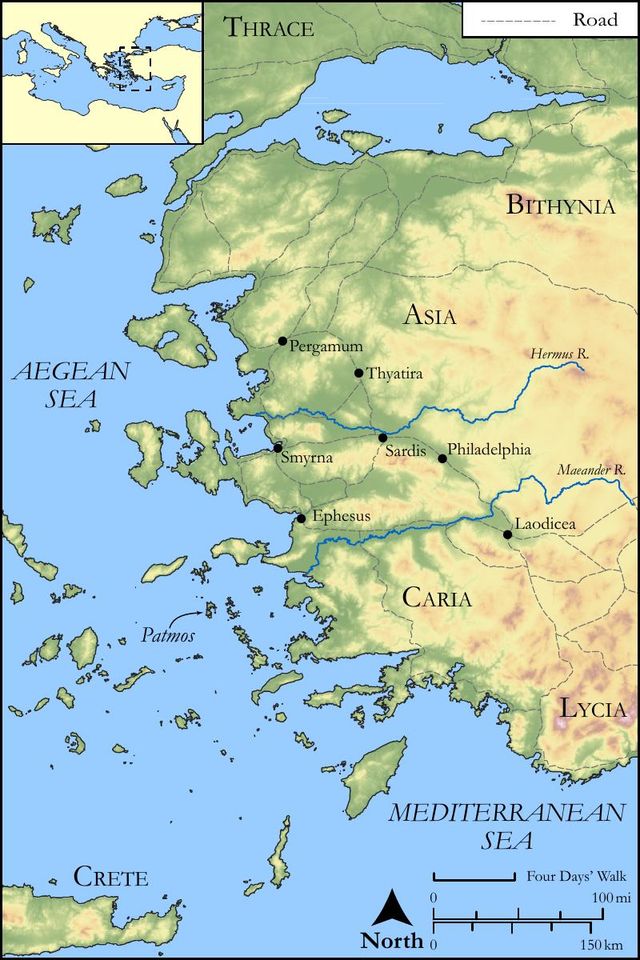
See on the biblical-era maps

Study this verse
Public-domain commentary
Matthew Henry
From his Commentary on the Whole Bible. Henry comments on passages, not single verses — this entry covers Revelation 1:1–2. His two-level outline is real structure in the source text, so it is rendered as structure.
Here we have,
I.What we may call the pedigree of this book.
1.It is the revelation of Jesus Christ. The whole Bible is so; for all revelation comes through Christ and all centres in him; and especially in these last days God has spoken to us by his Son, and concerning his Son. Christ, as the king of his church, has been pleased thus far to let his church know by what rules and methods he will proceed in his government; and, as the prophet of the church, he has made known to us the things that shall be hereafter.
2.It is a revelation which God gave unto Christ. Though Christ is himself God, and as such has light and life in himself, yet, as he sustains the office of Mediator between God and man, he receives his instructions from the Father. The human nature of Christ, though endowed with the greatest sagacity, judgment, and penetration, could not, in a way of reason, discover these great events, which not being produced by natural causes, but wholly depending upon the will of God, could be the object only of divine prescience, and must come to a created mind only by revelation. Our Lord Jesus is the great trustee of divine revelation; it is to him that we owe the knowledge we have of what we are to expect from God and what he expects from us.
3.This revelation Christ sent and signified by his angel. Observe here the admirable order of divine revelation. God gave it to Christ, and Christ employed an angel to communicate it to the churches. The angels are God's messengers; they are ministering spirits to the heirs of salvation. They are Christ's servants: principalities and powers are subject to him; all the angels of God are obliged to worship him.
4.The angels signified it to the apostle John. As the angels are the messengers of Christ, the ministers are the messengers of the churches; what they receive from heaven, they are to communicate to the churches. John was the apostle chosen for this service. Some think he was the only one surviving, the rest having sealed their testimony with their blood. This was to be the last book of divine revelation; and therefore notified to the church by the last of the apostles. John was the beloved disciple. He was, under the New Testament, as the prophet Daniel under the Old, a man greatly beloved. He was the servant of Christ; he was an apostle, an evangelist, and a prophet; he served Christ in all the three extraordinary offices of the church. James was an apostle, but not a prophet, nor an evangelist; Matthew was an apostle and evangelist, but not a prophet; Luke was an evangelist, but neither a prophet nor an apostle; but John was all three; and so Christ calls him in an eminent sense his servant John.
5.John was to deliver this revelation to the church, to all his servants. For the revelation was not designed for the use of Christ's extraordinary servants the ministers only, but for all his servants, the members of the church; they have all a right to the oracles of God, and all have their concern in them.
II.Here we have the subject-matter of this revelation, namely, the things that must shortly come to pass.
The evangelists give us an account of the things that are past; prophecy gives us an account of things to come. These future events are shown, not in the clearest light in which God could have set them, but in such a light as he saw most proper, and which would best answer his wise and holy purposes. Had they been as clearly foretold in all their circumstances as God could have revealed them, the prediction might have prevented the accomplishment; but they are foretold more darkly, to beget in us a veneration for the scripture, and to engage our attention and excite our enquiry. We have in this revelation a general idea of the methods of divine providence and government in and about the church, and many good lessons may be learned hereby. These events (it is said) were such as should come to pass not only surely, but shortly; that is, they would begin to come to pass very shortly, and the whole would be accomplished in a short time. For now the last ages of the world had come.
III.Here is an attestation of the prophecy, Rev 1:2.
It was signified to John, who bore record of the word of God, and of the testimony of Jesus Christ, and of all things that he saw. It is observable that the historical books of the Old Testament have not always the name of the historian prefixed to them, as in the books of Judges, Kings, Chronicles; but in the prophetical books the name is always prefixed, as Isaiah, Jeremiah, etc. So in the New Testament, though John did not prefix his name to his first epistle, yet he does to this prophecy, as ready to vouch and answer for the truth of it; and he gives us not only his name, but his office. He was one who bore record of the word of God in general, and of the testimony of Jesus in particular, and of all things that he saw; he was an eye-witness, and he concealed nothing that he saw. Nothing recorded in this revelation was his own invention or imagination; but all was the record of God and the testimony of Jesus; and, as he added nothing to it, so he kept back no part of the counsels of God.
Historical interpretation
Twelve Centuries of Reception
20 surviving comments on this verse. Each one is dated, so this reads as a timeline rather than a list.
Select a marker to jump to its quote. Markers stagger vertically where authors wrote within a few decades of each other.
And further, there was a certain man with us, whose name was John, one of the apostles of Christ, who prophesied, by a revelation that was made to him, that those who believed in our Christ would dwell a thousand years in Jerusalem; and that thereafter the general, and, in short, the eternal resurrection and judgment of all men would likewise take place.
What John this is, however, is uncertain. John the Apostle, But whether this is the one who wrote the Revelation, I could not say.
John, moreover, nowhere gives us the name, whether as of himself directly (in the first person), or as of another (in the third person). But the writer of the Revelation puts himself forward at once in the very beginning, for he says: "The Revelation of Jesus Christ, which He gave to him to show to His servants quickly; and He sent and signified it by His angel to His servant John, who bare record of the Word of God, and of his testimony, and of all things that he saw." And then he writes also an epistle, in which he says: "John to the seven churches which are in Asia, grace be unto you, and peace." The evangelist, on the other hand, has not prefixed his name even to the catholic epistle; but without any circumlocution, he has commenced at once with the mystery of the divine revelation itself in these terms: "That which was from the beginning, which we have heard, which we have seen with our eyes."
"The Revelation of Jesus Christ, which God gave to Him, and showed unto His servants things which must shortly come to pass, and signified it. Blessed are they who read and hear the words of this prophecy, and keep the things which are written." The beginning of the book promises blessing to him that reads and hears and keeps, that he who takes pains about the reading may thence learn to do works, and may keep the precepts.
We read in the Apocalypse of John (a book which, although rejected in these regions, we ought nevertheless to know, because it is accepted and held as canonical throughout the west, and in other Phoenician provinces, and in Egypt, for the ancient churchmen, including Irenaeus, Polycarp, Dionysius, and other Roman expounders of Sacred Scripture, among whom is holy Cyprian, accept and interpret it)...
John, the apostle whom Jesus most loved, the son of Zebedee and brother of James... In the fourteenth year then after Nero Domitian having raised a second persecution he was banished to the island of Patmos, and wrote the Apocalypse, on which Justin Martyr and Irenæus afterwards wrote commentaries. But Domitian having been put to death and his acts, on account of his excessive cruelty, having been annulled by the senate, he returned to Ephesus under Pertinax and continuing there until the time of the Emperor Trajan, founded and built churches throughout all Asia, and, worn out by old age, died in the sixty-eighth year after our Lord's passion and was buried near the same city.
which God gave unto him. But what is it, which the Son has heard from the Father? Has He heard the word of the Father? Yes, but He is the Word of the Father. When you conceive a word, wherewith to name a thing, the very, conception of that thing in the mind is a word. Just then as you have in your mind and with you your spoken word; even so God uttered the Word, i.e. begat the Son. Since then the Son is the Word of God, and the Son has spoken the Word of God to us, He has spoken to us the Father's word. What John said is therefore true.
From this we learn that this [book] is called an Apocalypse, that is, “revelation,” which manifests those secrets which are hidden and unknown to the senses, and that unless [Christ] himself reveals them, he who perceives [the revelation] will not have the strength to understand what he sees.
Revelation is the revealing of hidden mysteries when the intellect is enlightened by either divine dreams or by visions from divine enlightenment while awake.
things which must shortly come to pass. this means that some of the prophecies about them are to happen then, and the things concerning the end are not to come until later on, because to God a thousand years is like a prior day, which is like having already happened. Ps. 89:4
To his servant John. That through John, who, by the singular privilege of chastity, deserved to see these things before others, he might make the same known to all his servants.
Sending by his angel. For the angel used the figure of Christ to John, as will be more clearly apparent in the following.
Which must shortly come to pass. That is, what is about to happen to the Church in the present time.
And he signified it. He intertwined the same Apocalypse with mystical words, lest it be despised by being manifest to all.
The Revelation of Jesus Christ, which God gave him, etc. The Church, founded by the apostles, by what course it was to be spread and by what end it was to be completed, had to be revealed to strengthen the preachers of the faith against the adversities of the world. John, as is his custom, referring the glory of the Son to the Father, testifies that Jesus Christ received the revelation of the mystery from God.
QUESTION: What does it mean that he says, The Apocalypse of Jesus Christ, which God gave unto him, since the Son is equal to the Father? ANSWER: It needed to be revealed by what development the Church founded by the apostles would be enlarged and how it would be made perfect in the end, so as to strengthen the preachers of the faith against the adversity of the world. John attributes the glory of the Son to the Father in the manner usual to him, and thus declares that Jesus Christ received the revelation of this mystery from God. QUESTION: What is meant by the things which must shortly come to pass? ANSWER: It means the things that will happen to the Church in the present time. QUESTION: What is meant by and signified or, as some books have it, “sealed?” ANSWER: He interwove this same Apocalypse with mystical words so that it should not lose its worth if it was obvious to everyone.
The Apocalypse of Jesus Christ. First, it is to be noted that the meaning would be expressed more fully if he said “this is the Apocalypse;” but it is a habit of the Scriptures to leave those little words implied for brevity's sake. This is why Solomon did not say “these are the parables of Solomon” [Cf. Prov. 1:1] or “these are the words of Ecclesiastes.” [Cf. Eccles. 1:1] Apocalypse, as already said, comes from the Greek for “revelation.” Jesus in Hebrew translates to soter in Greek and salutaris in Latin. Christ comes from the Greek for “anointed”; for chrisma means “unction”. It is told in the book of Exodus [Ex. 30:22-25] that Moses was the first to prepare chrisma at the Lord's bidding, with which kings and priests used to be anointed, prefiguring Christ invisibly anointed by the Father. Which God gave unto him, to make known to his servants the things which must shortly come to pass. Here also it is to be noted that “‘by’ which God gave unto him” would be a more usual way of saying it; but it is a habit of the sacred Scripture frequently to put the accusative instead of the ablative without preposition. Whence this in a psalm: Hear, O Lord, my voice, which I have cried to thee, [Variant of Psalm 26:7] and Paul: I have fought a good fight [2 Tim. 4:7]. Indeed what is shown by these words is that this revelation is that of Jesus Christ, and that he received from God the task to make known to his servants by his revelation the things which must shortly come to pass. This is why it is necessary to mark it thus: the Apocalypse of Jesus Christ, and then to introduce, which God gave unto him, to make known to his servants, etc., the former referring to his divinity, according to which he reveals all the mysteries with the Father; the latter referring to his humanity, according to which he received not only from the Father and the Holy Spirit, but also from himself, the task to manifest to his servants by his revelation the things which must shortly come to pass. Whence it is not said, “which God ‘the Father’ gave unto him,” but, indeterminately, which God, that is the Trinity, gave unto him. Note also that in saying to his servants, he also shows the Son in the form of a servant, but not a servant, as his humanity is proclaimed master of the servants. He says his, which means “subject to divine grace”, according to this: I confess to thee, O Father, Lord of heaven and earth, because thou hast hidden these things from the wise and prudent, and hast revealed them to little ones. [Lk. 10:21] In what is said afterwards, the things which must shortly come to pass, although one could understand countless things by it, his particular intention was nonetheless to speak of the Church's temporal afflictions and everlasting joys to come, and of the wicked's present happiness and future eternal torments. These things all come to pass shortly, because this present time is forced to fly by until the end without a moment's interruption; whence the same John says elsewhere, little children, it is the last hour. [1 John 2:18] And signified, sending by his angel to his servant John. Signified. That is “sealed.” For signum means “seal,” whence it is also said to Daniel, clausi sunt signatique sermones, [Dan. 12:9] and to Isaiah, signavi visionem in discipulis meis. [Apparently a variant of Is. 8:16] But what does it mean that this vision is said to be sealed, while it is said later, seal not the words of the prophecy of this book, [Rev. 22:10] if not that these words are opened for the good, and closed with a seal for the wicked? For it is not because of faithful servants, but because of thieves that riches are sealed. Whence it is said to Daniel, the wicked shall deal wickedly, but the learned understand. [Slight variant of Dan. 12:10] Moreover, by saying signified, he showed that it should not be taken literally, but by the word signification he made us intent on examining the mysteries more deeply. So this vision was sent through an angel; but the unbounded Spirit that sent it was there both in the one through whom he sent it and in the one to whom he sent it. The same angel who appeared wore the figure of the Word incarnate alone and of his body, which is the Church. John himself as well, whom he appeared to, presented the symbol of the Church. However, one should not believe that the angel and John prefigured two churches; but when the angel possesses the symbol of the Head, John possesses that of the preachers, and when the angel possesses that of the preachers, John possesses that of the listeners; and when by the angel are represented the members that lead the way, by John are represented those that follow; or in the angel we understand the Church glorified after the resurrection, and in John the present Church needing to be instructed by Christ. Furthermore, one should know that the Lord appears after his Ascension in the same way as he appeared to the fathers before his Incarnation, namely through an angelic creature. By this fact he clearly shows that he must not now be sought physically for teaching, as he is present everywhere in majesty; for we should not think that his humanity taken from the Virgin was present in the angel, but that the angel expressed its figure. It is not at all surprising either that he is called like to the Son of man, [Rev. 1:13] when the prophet Daniel is said to have called the angel Gabriel a man. [Dan. 9:21] Moreover, it is said by this angel, I am the First and the Last, [Rev. 1:17] etc., just as, before the Incarnation, God said in the person of an angel he had assumed, I am the God of Abraham, [Ex. 3:6] etc. Indeed, just as Moses calls the one who appeared to him in the bush sometimes “angel,” sometimes “God,” so does John say that this revelation was sent to him through an angel, and affirm that it was the Lord Jesus Christ himself in the mystery and figure. Therefore it was also through an angel that the Lord appeared to Paul on the road, [Acts 9:1-19] because if he had been to appear in the substance of his own flesh, he would appear thus to John, whom he particularly loved. It is also to be noted that John speaks of himself as if of someone else, as others do. Indeed Moses says, Moses was a man exceeding meek, [Num. 12:3] and Job, there was a man in the land of Hus, whose name was Job [Job 1:1] etc.; for they were not speaking by themselves, but it was the Holy Spirit speaking through them.
John. This book was written not by another John but by the one who wrote the Gospel, he who at the marriage feast at Cana reclined on the breast of the Lord in which all treasures of wisdom and knowledge are concealed.
There exist others that say it was composed not by him but by another.
In the opening words, it is fitting to point out that in all his writings, the divine John, having dwelt upon the God-inspired words of our Savior Jesus Christ, in the present work dwells rather on his human aspects, so that he might not only be recognized from the more divine qualities, but also from the human ones.
For it is a sample of pure theology, just as to believe that the divine Word is from God and the Father, begotten before all ages and times, uncreated and consubstantial with the Father and the Spirit, and coexistent with the ages, and of all creation both spiritual and perceptible, according to what is said by the wisest Paul in the Epistle to the Colossians, that "in Him all things in heaven and on earth were created, the invisible and the visible, whether thrones, dominions, principalities, or authorities; all things were created through Him and for Him, and He is the head of the body and the church." (Co. 1:18) "Who is the beginning, the firstborn from the dead, so that He might be first in all things," (Co. 1:16,18) therefore we must believe in Him for the last things and for our salvation.
And having become man, not by a change of divinity, but by the assumption of human flesh, endowed with a rational soul, so that Emmanuel is understood as united from two natures, both divinity and humanity, each fully possessing according to its own nature and proper quality and distinction, neither confused in the union into one, nor divided after the indescribable and invisible union. For both Nestorius and Eutyches are equally detestable; their positions are opposed and totally evil.
Therefore, in order that the teaching of our Savior might be precise and true to Him, having engaged in the other divine matters, as the Lord has said, here John employed words and thoughts suited to human beings; yet neither in those divine matters did he separate the divine from the human, nor here did he separate the human from the divine. Moreover, he used the writings to a greater or lesser extent.
From this point on, the revelation is given to him to speak; it is given from the Father to the Son, and it is given from the Son to us, his servants. Calling the saints the servants of Christ, He preserved for Him what is fitting for God. For whose servants would humans be, except for the Maker and Creator of humans? And who is the Creator of humans and all creation? No one except the only-begotten Word and Son of God. For he who is present as the author says in the Gospels, "all things were made through him." (Jn. 1:3)
What, then, does John wish to add what must soon take place? And yet, of the things that are to come, not yet accomplished, already a considerable amount of time has already passed since these things were spoken, more than five hundred years. That all ages are regarded as nothing in the eyes of the eternal and everlasting God; "for a thousand years," the prophet says, "are in Your sight, O Lord, as the day that has just passed, or as a watch in the night." (Ps. 89:4) Therefore, the swift passage of time is not measured by the completion of the years that have come to be, but rather by the power and eternity of God. For in truth, every extension of time, even if it is the greatest and longest, is considered small compared to the infinite.
Jesus Christ therefore made it known to me what must take place. Jesus did not appear Himself and speak, but through His angel He initiated me into the mysteries. You see the reverent love of this divine one, who confessed that it was revealed to him through an angel and that he did not hear it from the Lord's own mouth.
John says that he testifies to the word of God and to the testimony of Jesus Christ, even to all that he saw. In this form, he also used it in the Gospels, preserving for himself the credibility of his teaching. He said, "This is the one who testifies about these things," (Jn. 21:24) and having written these things; and we know that his testimony is true. And now he says he is a witness of the divine Word that was revealed to him. John speaks of the present Revelation and the testimony given by Christ; that is, through testimony, I am both a witness and an author.
By Christ, he says, and not simply by God. But if through Jesus Christ God had this knowledge revealed, it is clear that it was through the Spirit, that is, because through Christ the grace of the activity of the Spirit descends to us.
which must shortly come to pass That is, the trials of the Church which must come to pass quickly, because this proceeds from the divine command which is not able to be altered. This is for the testing of the faithful and to expand of their glory. sending by His angel Jesus appearing in this way.
Continue studying Revelation 1:1 across the web’s major study libraries — every link below opens this exact verse, chapter, or book on the destination site.
Read & Compare
 BibleGatewayThis verse in more than 200 translations and 70 languages.
 Bible.comThe YouVersion reader — hundreds of translations, reading plans, and highlights.
 ESV.orgCrossway's official English Standard Version reader.
 NET BibleThe NET translation with 60,000+ translators' notes on every rendering decision.
 STEP BibleTyndale House's free study tool — original text, vocabulary, and scholarly resources.
 BibliaLogos Bible Software's free web reader.
 USCCBThe New American Bible (Revised Edition) with the U.S. bishops' study notes.
Commentaries
 BibleHub CommentariesDozens of classic commentaries on this verse, gathered on one page.
 StudyLightMore than 100 commentary sets — the largest collection on the web.
 BibleRefPlain-English commentary on what this verse means, verse by verse.
 Enduring WordDavid Guzik's free commentary on this chapter, widely used by Bible teachers.
 Bible Study ToolsVerse commentary alongside Greek and Hebrew study aids.
Original Language & Research
- BibleHub InterlinearThe verse word by word — original language, transliteration, and English.
- BibleHub LexiconEvery word's original-language definition and Strong's entry.
 Blue Letter BibleDeep-study tools — Strong's numbers, concordance, and word studies.
 CNTR CollationThe earliest Greek manuscripts of this verse, collated letter by letter.
Sermons, Hymns & Audio


TrulyRandomVerse is not affiliated with these sites and doesn’t control their content. They’re linked because they’re genuinely useful.
Summary
Revelation 1:1 serves as the foundational prologue to the final book of the biblical canon, immediately establishing its divine origin, Christ-centered focus, and urgent purpose. It unveils the authoritative chain of communication, revealing that this "apocalypse" is not a human invention but a direct disclosure from God the Father, given to Jesus Christ, conveyed through an angel, and finally entrusted to His servant John, all designed to reveal future events that are soon to occur for the benefit and preparation of God's people.
Context
ShowHideLiterary Context
Revelation 1:1 functions as a programmatic statement for the entire book, setting the stage for the visions, prophecies, and theological declarations that follow. It immediately identifies the nature of the writing ("The Revelation") and its ultimate source (God the Father) and subject (Jesus Christ). The subsequent verses in chapter 1 elaborate on the identity of the revealer (Jesus Christ in His glorified state, Revelation 1:12-18), the recipients (the seven churches in Asia Minor, Revelation 1:4), and the blessing pronounced upon those who read, hear, and heed its words (Revelation 1:3). This opening verse thus provides the hermeneutical key for understanding the entire apocalyptic narrative, emphasizing its divine authority and Christological focus.
Historical & Cultural Context
The Book of Revelation was written by the Apostle John, traditionally believed to be while he was exiled on the island of Patmos, a small, rocky island in the Aegean Sea, likely during the reign of Emperor Domitian (c. AD 95-96). This period was marked by escalating Roman persecution of Christians, who refused to participate in emperor worship and other pagan cults. The cultural milieu was one where imperial power was increasingly asserted as divine, creating immense pressure and suffering for early believers. John's audience, the seven churches in Asia Minor, were facing various challenges, including doctrinal error, spiritual apathy, and external persecution. The book, therefore, served not only as a prophetic unveiling of future events but also as a pastoral letter, offering comfort, exhortation, and hope to a beleaguered church, assuring them of God's ultimate sovereignty and Christ's final triumph over all oppressive powers.
Key Themes
ShowHideThis opening verse introduces several overarching themes that permeate the entire Book of Revelation. Firstly, the theme of Divine Sovereignty is paramount, as the revelation originates from God and is given to Christ, underscoring that all history, including future events, is under God's ultimate control. Secondly, the Centrality of Jesus Christ is immediately established; though often perceived as a book about the end times, Revelation is fundamentally "The Revelation of Jesus Christ," focusing on His glory, His victory, and His coming reign (Revelation 19:11-16). Thirdly, the theme of Prophetic Disclosure is highlighted by the phrase "to shew unto his servants things which must shortly come to pass," emphasizing God's intention to reveal His plans to His faithful followers, providing both warning and assurance. Lastly, the theme of Imminence and Urgency is conveyed by "must shortly come to pass," indicating that these events are not distant or irrelevant but are set in motion and will unfold according to God's appointed time, calling believers to watchful expectation and faithful endurance (Revelation 22:7).
Exposition and Analysis
ShowHideKey Word Analysis
ShowHideFrom apokalyptō, meaning "to uncover," "unveil," or "disclose." This term signifies that the book is not a hidden mystery but a divine unveiling of truths previously unknown or dimly perceived. It implies a purposeful act of God to make known His plans and purposes, particularly concerning Jesus Christ and the consummation of His kingdom. It contrasts with human speculation, asserting that the following content is a direct divine disclosure.
This word denotes a slave or bond-servant, emphasizing a position of complete submission and obedience, whether voluntary or involuntary. In the New Testament, it often refers to believers who willingly submit to Christ's lordship, serving Him faithfully. Here, it highlights the intended audience of the revelation – those who are devoted to God and Christ, for whom this unveiling is both a privilege and a call to faithful action. John himself is identified as a "servant," placing him in solidarity with the recipients of the message.
This verb means "to indicate," "to show by signs," or "to make known." It suggests that the revelation was conveyed not through plain, propositional statements alone, but through symbolic language, visions, and enigmatic imagery. This term prepares the reader for the rich tapestry of symbols, metaphors, and allegories that characterize the Book of Revelation, indicating that its truths are often communicated through visual and symbolic means that require spiritual discernment to interpret.
Verse Breakdown
ShowHide"The Revelation of Jesus Christ"
This phrase immediately identifies the book's nature and its central subject. It is an "unveiling" (apokalypsis) that belongs to Jesus Christ, meaning it is either a revelation from Him, about Him, or both. Given the context, it is primarily a revelation from Him, as the one who receives it from God the Father, and also about Him, as He is the central figure of the entire prophetic narrative, revealing His glory, power, and ultimate triumph.
"which God gave unto him"
This clarifies the ultimate source of the revelation. It originates with God the Father, who then entrusts it to His Son, Jesus Christ. This establishes the divine authority and truthfulness of the message, emphasizing that it is part of God's sovereign plan for history. It also highlights the unique relationship between the Father and the Son in the divine economy of revelation.
"to shew unto his servants things which must shortly come to pass"
This clause states the primary purpose and content of the revelation. It is given to "shew" (deiknýō, to make visible or known) to God's faithful "servants" (doûlos) events that are divinely decreed ("must," deî) and are imminent ("shortly," tákhos, in haste or quickly). This indicates that the prophecies are not merely for intellectual curiosity but for the practical guidance and preparation of believers, providing insight into God's unfolding plan.
"and he sent and signified [it] by his angel unto his servant John"
This completes the chain of communication, detailing the precise method of transmission. Jesus Christ, having received the revelation from the Father, then "sent" (apostéllō, dispatched on a mission) and "signified" (sēmaínō, conveyed by signs/symbols) the message. The intermediary is "his angel" (ángelos, messenger), who delivers the symbolic visions to "his servant John," the human author on Patmos. This hierarchical and precise transmission underscores the authenticity and divine authority of the entire book.
Literary Devices
ShowHideRevelation 1:1 employs several significant Literary Devices that set the tone for the entire book. The very title, "The Revelation," is a form of Apocalypse, a genre characterized by symbolic visions, angelic mediation, and an eschatological focus on God's ultimate triumph over evil. This verse also establishes a clear Chain of Revelation, functioning as a literary framework: God the Father -> Jesus Christ -> Angel -> John -> Servants. This hierarchical structure not only authenticates the message but also highlights the orderly and purposeful nature of divine communication. Furthermore, the phrase "signified [it] by his angel" is an instance of Metonymy or Symbolism, indicating that the message will be conveyed through signs and symbols rather than literal, straightforward prose. This immediately signals to the reader that the book's content will require interpretation and that its truths are often veiled in rich, evocative imagery. The emphasis on "things which must shortly come to pass" also introduces the literary device of Imminence, creating a sense of urgency and expectation that permeates the prophetic narrative.
Theological and Thematic Connections
ShowHideRevelation 1:1 is deeply rooted in the biblical tradition of divine revelation, echoing Old Testament prophetic patterns where God communicates His will and future plans through chosen intermediaries. It establishes the ultimate authority of the Book of Revelation as a divine word, not a human invention, ensuring its reliability and significance for believers across all generations. The emphasis on Jesus Christ as both the subject and the mediator of this revelation firmly anchors the book within a Christocentric worldview, affirming His preeminence in God's redemptive plan and His active role in directing history towards its appointed end. This verse underscores God's commitment to His "servants," demonstrating His desire to prepare and equip His people by disclosing what is to come, offering both comfort in tribulation and a call to faithful endurance and readiness.
Reflection and Application
ShowHideRevelation 1:1 invites believers into a posture of humble reception and eager anticipation. Understanding that this book is "The Revelation of Jesus Christ, which God gave unto him" should instill profound confidence in its truthfulness and divine authority. It reminds us that God is actively involved in human history, orchestrating events towards a glorious culmination centered on His Son. For us today, this means we are not left in the dark about the future; God, in His grace, has chosen to unveil His purposes to His servants. This calls us to diligent study and prayerful discernment, recognizing that the symbolic language requires careful interpretation guided by the Holy Spirit and the broader biblical narrative. Ultimately, this verse encourages us to live with a sense of urgency and hope, knowing that Christ's victory is assured and that He is coming soon. It compels us to live as faithful servants, prepared for His return and committed to His mission until that day.
Questions for Reflection
ShowHideFAQ
ShowHideWhat does "The Revelation of Jesus Christ" mean?
ShowHideThis phrase, The Revelation of Jesus Christ, primarily means the revelation from Jesus Christ, which He received from God the Father. It signifies that Jesus is the active agent in disclosing these truths. Secondarily, it is also a revelation about Jesus Christ, unveiling His glory, His victory over evil, and His ultimate reign as King of kings and Lord of lords, as seen throughout the book, particularly in passages like Revelation 19:11-16.
Why does it say "things which must shortly come to pass" if some events seem to be in the distant future?
ShowHideThe phrase must shortly come to pass (Greek: en táchei) conveys a sense of divine urgency and imminence from God's perspective. It does not necessarily mean "immediately" in human chronological terms, but rather that these events are decreed by God (must) and will unfold swiftly and certainly according to His sovereign timetable, without delay from His standpoint. This perspective is reiterated in Revelation 22:6 and Revelation 22:12, urging believers to live in watchful expectation and readiness.
Christ-Centered Fulfillment
ShowHideRevelation 1:1, by declaring itself "The Revelation of Jesus Christ," immediately establishes the entire book as a Christ-centered unveiling, not merely of future events, but of the glorified Son of God Himself. This echoes the Old Testament prophetic tradition where prophets spoke of a coming Messiah, but now, in the New Testament, Jesus is revealed as the ultimate fulfillment of those prophecies. He is the one through whom God the Father chooses to disclose His final plans, underscoring His unique mediatorial role (1 Timothy 2:5). The "things which must shortly come to pass" are not random occurrences but are intricately tied to Christ's ongoing work of redemption and His ultimate triumph over sin, death, and all opposing powers. This prologue sets the stage for the book's profound portrayal of Jesus as the Lamb who was slain yet is alive forevermore, the faithful witness, the firstborn from the dead, and the ruler of the kings of the earth. Every vision and prophecy within Revelation ultimately points to the consummation of Christ's kingdom and His glorious return, fulfilling the promises of Matthew 24:30 and Philippians 2:9-11.