


Revelation 1:2
Bible text: King James Version (1769 Blayney text) · Public domain
Bible text: Berean Standard Bible · Public domain
Bible text: American Standard Version (1901) · Public domain
Bible text: World English Bible, Messianic edition · Public domain
Bible text: Geneva Bible (1599) · Public domain
Bible text: Young's Literal Translation · Public domain
- ὃςhoswhoG3739R-NSMRelative pronoun Nominative Singular Masculine
- ἐμαρτύρησενemarturēsentestifiedG3140V-AAI-3SVerb Aorist Active Indicative 3rd Singular
- τὸνtonto theG3588T-ASMDefinite article Accusative Singular Masculine
- λόγονlogonwordG3056N-ASMNoun Accusative Singular Masculine
- τοῦtou<the>G3588T-GSMDefinite article Genitive Singular Masculine
- θεοῦtheouof GodG2316N-GSM-TNoun Genitive Singular Masculine Title
- καὶkaiandG2532CONJConjunction
- τὴνtēnto theG3588T-ASFDefinite article Accusative Singular Feminine
- μαρτυρίανmarturiantestimonyG3141N-ASFNoun Accusative Singular Feminine
- ἸησοῦIēsouof JesusG2424N-GSM-PNoun Genitive Singular Masculine Individual
- ΧριστοῦChristouChristG5547N-GSM-TNoun Genitive Singular Masculine Title
- ὅσαhosaas much asG3745K-APNCorrelative pronoun Accusative Plural Neuter
- τεtethenG5037CONJConjunction
- εἶδενeidenhe sawG1492V-2AAI-3SVerb 2nd Aorist Active Indicative 3rd Singular
English is a literal word-by-word gloss of the Greek, not the KJV's wording. Why?
This is the original text the KJV's translators worked from — each Greek word with its own literal English meaning in this verse, prepared by scholars at Tyndale House, Cambridge. The KJV translates whole sentences, not word by word, so its wording differs: one Greek word can become several English words, and the KJV may choose “charity” where the gloss reads “love”. Both are faithful — they answer different questions. For the KJV's own rendering, switch to the KJV text.
Details
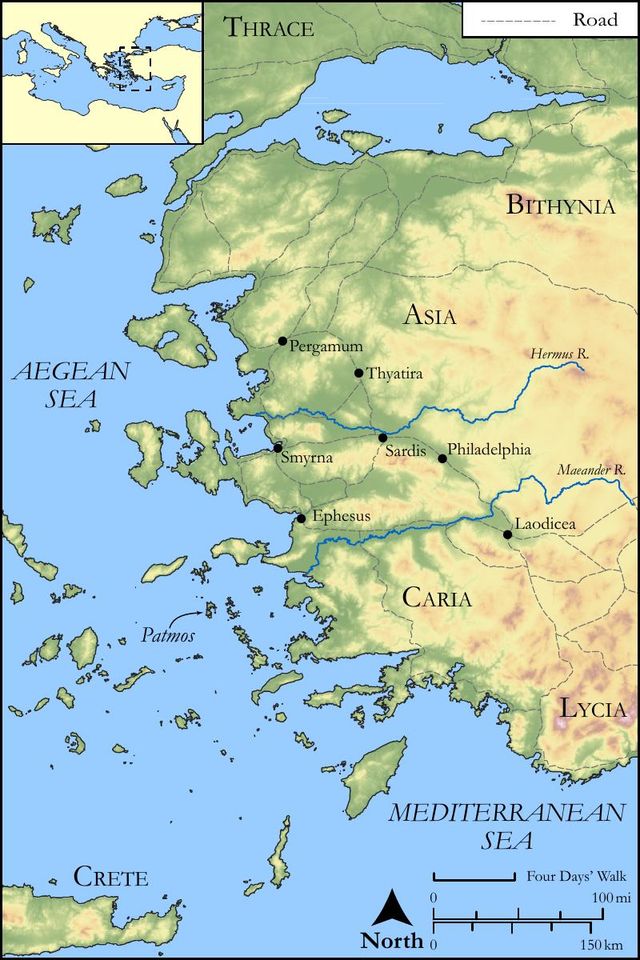
See on the biblical-era maps

Study this verse
Public-domain commentary
Matthew Henry
From his Commentary on the Whole Bible. Henry comments on passages, not single verses — this entry covers Revelation 1:1–2. His two-level outline is real structure in the source text, so it is rendered as structure.
Here we have,
I.What we may call the pedigree of this book.
1.It is the revelation of Jesus Christ. The whole Bible is so; for all revelation comes through Christ and all centres in him; and especially in these last days God has spoken to us by his Son, and concerning his Son. Christ, as the king of his church, has been pleased thus far to let his church know by what rules and methods he will proceed in his government; and, as the prophet of the church, he has made known to us the things that shall be hereafter.
2.It is a revelation which God gave unto Christ. Though Christ is himself God, and as such has light and life in himself, yet, as he sustains the office of Mediator between God and man, he receives his instructions from the Father. The human nature of Christ, though endowed with the greatest sagacity, judgment, and penetration, could not, in a way of reason, discover these great events, which not being produced by natural causes, but wholly depending upon the will of God, could be the object only of divine prescience, and must come to a created mind only by revelation. Our Lord Jesus is the great trustee of divine revelation; it is to him that we owe the knowledge we have of what we are to expect from God and what he expects from us.
3.This revelation Christ sent and signified by his angel. Observe here the admirable order of divine revelation. God gave it to Christ, and Christ employed an angel to communicate it to the churches. The angels are God's messengers; they are ministering spirits to the heirs of salvation. They are Christ's servants: principalities and powers are subject to him; all the angels of God are obliged to worship him.
4.The angels signified it to the apostle John. As the angels are the messengers of Christ, the ministers are the messengers of the churches; what they receive from heaven, they are to communicate to the churches. John was the apostle chosen for this service. Some think he was the only one surviving, the rest having sealed their testimony with their blood. This was to be the last book of divine revelation; and therefore notified to the church by the last of the apostles. John was the beloved disciple. He was, under the New Testament, as the prophet Daniel under the Old, a man greatly beloved. He was the servant of Christ; he was an apostle, an evangelist, and a prophet; he served Christ in all the three extraordinary offices of the church. James was an apostle, but not a prophet, nor an evangelist; Matthew was an apostle and evangelist, but not a prophet; Luke was an evangelist, but neither a prophet nor an apostle; but John was all three; and so Christ calls him in an eminent sense his servant John.
5.John was to deliver this revelation to the church, to all his servants. For the revelation was not designed for the use of Christ's extraordinary servants the ministers only, but for all his servants, the members of the church; they have all a right to the oracles of God, and all have their concern in them.
II.Here we have the subject-matter of this revelation, namely, the things that must shortly come to pass.
The evangelists give us an account of the things that are past; prophecy gives us an account of things to come. These future events are shown, not in the clearest light in which God could have set them, but in such a light as he saw most proper, and which would best answer his wise and holy purposes. Had they been as clearly foretold in all their circumstances as God could have revealed them, the prediction might have prevented the accomplishment; but they are foretold more darkly, to beget in us a veneration for the scripture, and to engage our attention and excite our enquiry. We have in this revelation a general idea of the methods of divine providence and government in and about the church, and many good lessons may be learned hereby. These events (it is said) were such as should come to pass not only surely, but shortly; that is, they would begin to come to pass very shortly, and the whole would be accomplished in a short time. For now the last ages of the world had come.
III.Here is an attestation of the prophecy, Rev 1:2.
It was signified to John, who bore record of the word of God, and of the testimony of Jesus Christ, and of all things that he saw. It is observable that the historical books of the Old Testament have not always the name of the historian prefixed to them, as in the books of Judges, Kings, Chronicles; but in the prophetical books the name is always prefixed, as Isaiah, Jeremiah, etc. So in the New Testament, though John did not prefix his name to his first epistle, yet he does to this prophecy, as ready to vouch and answer for the truth of it; and he gives us not only his name, but his office. He was one who bore record of the word of God in general, and of the testimony of Jesus in particular, and of all things that he saw; he was an eye-witness, and he concealed nothing that he saw. Nothing recorded in this revelation was his own invention or imagination; but all was the record of God and the testimony of Jesus; and, as he added nothing to it, so he kept back no part of the counsels of God.
Historical interpretation
Ten Centuries of Reception
5 surviving comments on this verse. Each one is dated, so this reads as a timeline rather than a list.
Select a marker to jump to its quote. Markers stagger vertically where authors wrote within a few decades of each other.
"The Revelation of Jesus Christ, which God gave to Him, and showed unto His servants things which must shortly come to pass, and signified it. Blessed are they who read and hear the words of this prophecy, and keep the things which are written." The beginning of the book promises blessing to him that reads and hears and keeps, that he who takes pains about the reading may thence learn to do works, and may keep the precepts.
Who bore witness to the word of God, and the testimony of Jesus, etc. Lest you doubt the person of John, it is he who bore witness to the eternal Word of God and the same incarnate, as he saw, saying: We have seen his glory, the glory as of the Only Begotten from the Father (John 1).
Who hath given testimony to the word of God, and the testimony of Jesus Christ, what things soever he hath seen. John gave testimony then, and now the Church does, whose symbol he was bearing when he saw this Apocalypse. He makes a distinction between the Word and Jesus Christ because of the two substances of Christ — he who gave testimony to both, saying, in the beginning was the Word, [John 1:1] as well as the Word was made flesh. [Ibid. 14] Saw refers to both: for he saw the Word with his spiritual eyes, and with his physical eyes he saw everything that is told about his humanity.
In the opening words, it is fitting to point out that in all his writings, the divine John, having dwelt upon the God-inspired words of our Savior Jesus Christ, in the present work dwells rather on his human aspects, so that he might not only be recognized from the more divine qualities, but also from the human ones.
For it is a sample of pure theology, just as to believe that the divine Word is from God and the Father, begotten before all ages and times, uncreated and consubstantial with the Father and the Spirit, and coexistent with the ages, and of all creation both spiritual and perceptible, according to what is said by the wisest Paul in the Epistle to the Colossians, that "in Him all things in heaven and on earth were created, the invisible and the visible, whether thrones, dominions, principalities, or authorities; all things were created through Him and for Him, and He is the head of the body and the church." (Co. 1:18) "Who is the beginning, the firstborn from the dead, so that He might be first in all things," (Co. 1:16,18) therefore we must believe in Him for the last things and for our salvation.
And having become man, not by a change of divinity, but by the assumption of human flesh, endowed with a rational soul, so that Emmanuel is understood as united from two natures, both divinity and humanity, each fully possessing according to its own nature and proper quality and distinction, neither confused in the union into one, nor divided after the indescribable and invisible union. For both Nestorius and Eutyches are equally detestable; their positions are opposed and totally evil.
Therefore, in order that the teaching of our Savior might be precise and true to Him, having engaged in the other divine matters, as the Lord has said, here John employed words and thoughts suited to human beings; yet neither in those divine matters did he separate the divine from the human, nor here did he separate the human from the divine. Moreover, he used the writings to a greater or lesser extent.
From this point on, the revelation is given to him to speak; it is given from the Father to the Son, and it is given from the Son to us, his servants. Calling the saints the servants of Christ, He preserved for Him what is fitting for God. For whose servants would humans be, except for the Maker and Creator of humans? And who is the Creator of humans and all creation? No one except the only-begotten Word and Son of God. For he who is present as the author says in the Gospels, "all things were made through him." (Jn. 1:3)
What, then, does John wish to add what must soon take place? And yet, of the things that are to come, not yet accomplished, already a considerable amount of time has already passed since these things were spoken, more than five hundred years. That all ages are regarded as nothing in the eyes of the eternal and everlasting God; "for a thousand years," the prophet says, "are in Your sight, O Lord, as the day that has just passed, or as a watch in the night." (Ps. 89:4) Therefore, the swift passage of time is not measured by the completion of the years that have come to be, but rather by the power and eternity of God. For in truth, every extension of time, even if it is the greatest and longest, is considered small compared to the infinite.
Jesus Christ therefore made it known to me what must take place. Jesus did not appear Himself and speak, but through His angel He initiated me into the mysteries. You see the reverent love of this divine one, who confessed that it was revealed to him through an angel and that he did not hear it from the Lord's own mouth.
John says that he testifies to the word of God and to the testimony of Jesus Christ, even to all that he saw. In this form, he also used it in the Gospels, preserving for himself the credibility of his teaching. He said, "This is the one who testifies about these things," (Jn. 21:24) and having written these things; and we know that his testimony is true. And now he says he is a witness of the divine Word that was revealed to him. John speaks of the present Revelation and the testimony given by Christ; that is, through testimony, I am both a witness and an author.
Who has given testimony to the word of God In the beginning of his gospel about his eternal Godhead saying, “In the beginning was the Word and the Word was with God and the Word was God (Jn. 1:1)”; that is about to his incarnation, saying, “And the Word was made flesh, etc.(Jn. 1:14)” Therefore, he adds: And the testimony of Jesus Christ, That is, concerning Jesus Christ. he has seen In His way of life, in His miracles, in His death and resurrection, as he clearly shows in the words his Gospel.
Continue studying Revelation 1:2 across the web’s major study libraries — every link below opens this exact verse, chapter, or book on the destination site.
Read & Compare
 BibleGatewayThis verse in more than 200 translations and 70 languages.
 Bible.comThe YouVersion reader — hundreds of translations, reading plans, and highlights.
 ESV.orgCrossway's official English Standard Version reader.
 NET BibleThe NET translation with 60,000+ translators' notes on every rendering decision.
 STEP BibleTyndale House's free study tool — original text, vocabulary, and scholarly resources.
 BibliaLogos Bible Software's free web reader.
 USCCBThe New American Bible (Revised Edition) with the U.S. bishops' study notes.
Commentaries
 BibleHub CommentariesDozens of classic commentaries on this verse, gathered on one page.
 StudyLightMore than 100 commentary sets — the largest collection on the web.
 BibleRefPlain-English commentary on what this verse means, verse by verse.
 Enduring WordDavid Guzik's free commentary on this chapter, widely used by Bible teachers.
 Bible Study ToolsVerse commentary alongside Greek and Hebrew study aids.
Original Language & Research
- BibleHub InterlinearThe verse word by word — original language, transliteration, and English.
- BibleHub LexiconEvery word's original-language definition and Strong's entry.
 Blue Letter BibleDeep-study tools — Strong's numbers, concordance, and word studies.
 CNTR CollationThe earliest Greek manuscripts of this verse, collated letter by letter.
Sermons, Hymns & Audio


TrulyRandomVerse is not affiliated with these sites and doesn’t control their content. They’re linked because they’re genuinely useful.
Summary
Revelation 1:2 succinctly establishes the authoritative foundation and eyewitness credibility of the apocalyptic visions recorded by John. It declares that John faithfully bore witness to the divine message, specifically identifying its dual source as "the word of God" and "the testimony of Jesus Christ," encompassing all the profound realities he visually perceived. This verse thus validates the book's content as a divinely inspired and accurately transmitted revelation, not a human invention.
Context
ShowHideLiterary Context
This verse immediately follows Revelation 1:1, which introduces the book as "The Revelation of Jesus Christ, which God gave unto him, to shew unto his servants things which must shortly come to pass; and he sent and signified it by his angel unto his servant John." Verse 1:2 clarifies how John, the servant mentioned in the preceding verse, received and transmitted this revelation. The "Who" (G3739) at the beginning of verse 2 directly refers back to "his servant John" from verse 1, identifying him as the faithful recorder. Thus, the opening verses establish a clear chain of revelation: God to Jesus, Jesus to an angel, the angel to John, and John to the churches. Verse 1:2 focuses on John's crucial role in this chain, emphasizing his fidelity in documenting what he received and saw, thereby authenticating the entire prophetic message that follows.
Historical & Cultural Context
John, the presumed author, was likely exiled to the island of Patmos (mentioned in Revelation 1:9) during a period of intense Roman persecution, most probably under Emperor Domitian in the late first century AD. In this hostile environment, the concept of "bearing record" or "testifying" (from the Greek martyreō) carried significant weight, often implying suffering or even death for one's witness—the very root of the English word "martyr." For the early Christian communities facing similar pressures, John's faithful eyewitness account served as a vital source of encouragement, warning, and hope, assuring them that God was sovereign and that Christ would ultimately triumph. The book's apocalyptic genre also resonated with Jewish prophetic traditions, where divine messages were often conveyed through visions and symbolic language.
Key Themes
ShowHideThis verse contributes significantly to several overarching themes within Revelation and biblical theology. Firstly, it underscores the Divine Authority and Origin of Revelation, asserting that the book's content is not John's human imagination but directly from God ("the word of God") and specifically through Jesus Christ ("the testimony of Jesus Christ"). This ensures the book's absolute truthfulness and binding authority for believers. Secondly, it highlights the theme of Eyewitness Testimony, as John explicitly states he recorded "all things that he saw." This personal, verifiable experience lends immense authenticity and weight to the extraordinary visions and prophecies contained within the book, crucial for a message dealing with future events and unseen realities. Lastly, the verse illuminates the Nature of Prophecy, particularly through the phrase "the testimony of Jesus Christ." As Revelation 19:10 famously declares, "the testimony of Jesus is the spirit of prophecy," indicating that Christ Himself is both the source and the subject of genuine prophecy, revealing God's will and future plans.
Exposition and Analysis
ShowHideKey Word Analysis
ShowHideThis verb signifies "to be a witness," "to testify," or "to give evidence." In this context, it emphasizes John's active and faithful role as the human agent through whom God's revelation is transmitted. It implies not merely passive reception but an authoritative declaration of what has been seen and heard, much like a witness in a legal proceeding. John is not inventing but attesting to the truth of the divine message.
This term refers to "something said," "a message," or "a divine utterance." Here, "the word of God" points to the ultimate, authoritative source of the revelation—God Himself. It encompasses the divine communication, the content of God's mind and will, which is being revealed to humanity. In a broader theological sense, logos also refers to Christ as the Divine Expression, as seen in John 1:1.
Derived from the same root as "bare record," this noun means "evidence given," "witness," or "record." "The testimony of Jesus Christ" can be understood in two primary ways: the testimony about Jesus (what John witnessed concerning Christ) and the testimony from Jesus (the revelation that Jesus Himself delivers). In the context of Revelation, the latter is predominant, signifying the prophetic message that emanates directly from Christ, making Him the active revealer of God's plan.
Verse Breakdown
ShowHide"Who bare record"
This clause identifies John as the one who received and faithfully documented the revelation. His role is not that of an originator but a reliable conveyor of divine truth, emphasizing his credibility and the authenticity of the message. The Greek verb martyréō (to bear witness) highlights the authoritative and truthful nature of his account.
"of the word of God"
This specifies the ultimate, divine origin of the revelation. The content of the book of Revelation is not human speculation or John's personal insights, but God's own authoritative message, communicated to humanity. It underscores the divine inspiration and infallibility of the prophetic message.
"and of the testimony of Jesus Christ"
This phrase further defines the nature and source of the revelation. It points to Jesus Christ as the specific mediator and content of the divine message. This "testimony" is understood primarily as the revelation from Jesus, the prophetic witness He Himself bears concerning God's plan and future events, as confirmed by Revelation 19:10.
"and of all things that he saw"
This final clause emphasizes the comprehensive scope and eyewitness nature of John's account. It assures the reader that what is recorded is not merely a verbal message but a direct, visual experience of profound spiritual realities and future events. This personal perception validates the truthfulness and vividness of the apocalyptic visions that comprise the book.
Literary Devices
ShowHideRevelation 1:2 employs several key literary devices to establish the authority and authenticity of its message. The use of Repetition and Emphasis is evident in the dual description of the revelation's source: "the word of God" and "the testimony of Jesus Christ." While distinct, these phrases work in tandem to underscore the divine and Christ-centered nature of the message, reinforcing its ultimate authority. The verse also functions as an Eyewitness Account, with John explicitly stating "all things that he saw." This device lends immense credibility to the extraordinary visions that follow, positioning John as a reliable reporter of perceived realities rather than a mere storyteller. Furthermore, the language evokes a Legal or Forensic Setting through terms like "bare record" (martyréō) and "testimony" (martyría). This legalistic framing implies a verifiable truth, as if John is presenting evidence in a divine courtroom, thereby strengthening the reader's trust in the veracity of the prophecy. Finally, the phrase "all things that he saw" can be seen as a form of Synecdoche or Merism, where a part (what was seen) stands for the whole (the entire revelation, including what was heard or understood), suggesting the complete and comprehensive nature of John's recorded experience.
Theological and Thematic Connections
ShowHideRevelation 1:2 lays a crucial theological groundwork for the entire book, affirming its divine origin and the reliability of its human author. It underscores the biblical principle that God communicates His truth to humanity, often through chosen vessels who faithfully transmit His message. John's role as a "witness" (martyr) connects to the broader biblical theme of testimony, where believers are called to bear witness to God's truth, even in the face of opposition. The dual emphasis on "the word of God" and "the testimony of Jesus Christ" highlights the inseparable connection between the Father's ultimate plan and the Son's active role in revealing and executing it. This verse assures readers that the profound and often challenging content of Revelation is not a human fabrication but a divinely authoritative and trustworthy revelation for the church.
Reflection and Application
ShowHideRevelation 1:2 serves as a powerful reminder of the profound privilege and solemn responsibility inherent in receiving and transmitting God's truth. Just as John was called to faithfully record the divine revelations he received, believers today are entrusted with the gospel message and the entirety of God's inspired Word. This verse encourages us to approach the Bible, and especially the book of Revelation, not as a collection of human ideas, but as a divinely authenticated record of ultimate truth. It calls us to cultivate a deep trust in God's faithfulness to reveal His plans and purposes, even when they seem mysterious or overwhelming. Furthermore, John's role as a "witness" (martyr) challenges us to consider our own calling to "bear record" of Jesus Christ in a world that often rejects His truth. This may involve speaking boldly, living consistently, or persevering faithfully through trials, knowing that our testimony, like John's, is rooted in the unshakeable word of God and the living testimony of Jesus Christ.
Questions for Reflection
ShowHideFAQ
ShowHideWhat is the difference between "the word of God" and "the testimony of Jesus Christ" in this verse?
ShowHideWhile closely related and ultimately from the same divine source, these phrases highlight distinct aspects of the revelation. "The word of God" refers to the ultimate, overarching divine message and communication that originates from God the Father, encompassing all of His revealed truth. "The testimony of Jesus Christ," on the other hand, specifically refers to the prophetic revelation that Jesus Himself delivers. In Revelation, Jesus is not just the subject of the prophecy but also the active revealer of it, as Revelation 1:1 states that God gave the revelation to Him to show His servants. Thus, the "testimony of Jesus" is the specific content and medium of the prophecy that emanates from Christ, as Revelation 19:10 famously declares, "the testimony of Jesus is the spirit of prophecy." It emphasizes Christ's active role as the one who unveils God's future plans.
Why is it important that John "saw" these things?
ShowHideJohn's explicit statement that he recorded "all things that he saw" is crucial for establishing the credibility and authenticity of the book of Revelation. In a genre characterized by symbolic language and extraordinary visions, the emphasis on direct visual perception validates the reality and truthfulness of the events and figures described. It assures the reader that John is not merely relaying abstract concepts or secondhand information, but is presenting an eyewitness account of profound spiritual realities. This personal experience lends immense weight to his record, much like the apostles' emphasis on having "seen" and "heard" the resurrected Christ (1 John 1:1). It underscores that the visions are not figments of imagination but divinely granted perceptions of genuine truth, making the prophecies reliable and trustworthy for the church.
Christ-Centered Fulfillment
ShowHideRevelation 1:2, in its declaration of John bearing record of "the word of God" and "the testimony of Jesus Christ," profoundly points to Christ as the very essence and fulfillment of divine revelation. Jesus Himself is the ultimate "Word of God," the eternal Logos through whom God speaks and acts, as illuminated in John 1:1 and John 1:14. He is the one who perfectly reveals the Father, for "no one has ever seen God; the only God, who is at the Father's side, he has made him known" (John 1:18). Furthermore, Jesus is the "faithful witness" (Revelation 1:5), not only bearing witness about God but actively being God's testimony to humanity, particularly through His life, death, resurrection, and the revelation He imparts. The "testimony of Jesus Christ" is therefore the very Spirit of Prophecy (Revelation 19:10), meaning that all true prophetic insight emanates from Him and ultimately points to His sovereign reign and redemptive work. The entire book of Revelation, recorded by John, is ultimately Jesus' unveiling of Himself and His triumph, ensuring that every vision and prophecy finds its ultimate meaning and fulfillment in Him.