


Revelation 1:3
Bible text: King James Version (1769 Blayney text) · Public domain
Bible text: King James Version with Strong's numbers · Public domain
Bible text: Berean Standard Bible · Public domain
Bible text: American Standard Version (1901) · Public domain
Bible text: World English Bible, Messianic edition · Public domain
Bible text: Geneva Bible (1599) · Public domain
Bible text: Young's Literal Translation · Public domain
- μακάριοςmakariosblessed [is]G3107A-NSMAdjective Nominative Singular Masculine
- ὁhothe [one]G3588T-NSMDefinite article Nominative Singular Masculine
- ἀναγινώσκωνanaginōskōnreadingG314V-PAP-NSMVerb Present Active Participle Nominative Singular Masculine
- καὶkaiandG2532CONJConjunction
- οἱhoithoseG3588T-NPMDefinite article Nominative Plural Masculine
- ἀκούοντεςakouonteshearingG191V-PAP-NPMVerb Present Active Participle Nominative Plural Masculine
- τοὺςtoustheG3588T-APMDefinite article Accusative Plural Masculine
- λόγουςlogouswordsG3056N-APMNoun Accusative Plural Masculine
- τῆςtēsof theG3588T-GSFDefinite article Genitive Singular Feminine
- προφητείαςprophēteiasprophecyG4394N-GSFNoun Genitive Singular Feminine
- καὶkaiandG2532CONJConjunction
- τηροῦντεςtērounteskeepingG5083V-PAP-NPMVerb Present Active Participle Nominative Plural Masculine
- τὰtathe [things]G3588T-APNDefinite article Accusative Plural Neuter
- ἐνeninG1722PREPPreposition
- αὐτῇautēaitG846P-DSFPersonal pronoun Dative Singular Feminine
- γεγραμμένα·gegrammenawrittenG1125V-RPP-APNVerb Perfect Passive Participle Accusative Plural Neuter
- ὁho<the>G3588T-NSMDefinite article Nominative Singular Masculine
- γὰρgarforG1063CONJConjunction
- καιρὸςkairosthe time [is]G2540N-NSMNoun Nominative Singular Masculine
- ἐγγύςengusnearG1451PREPPreposition
English is a literal word-by-word gloss of the Greek, not the KJV's wording. Why?
This is the original text the KJV's translators worked from — each Greek word with its own literal English meaning in this verse, prepared by scholars at Tyndale House, Cambridge. The KJV translates whole sentences, not word by word, so its wording differs: one Greek word can become several English words, and the KJV may choose “charity” where the gloss reads “love”. Both are faithful — they answer different questions. For the KJV's own rendering, switch to the KJV text.
Details
See on the biblical-era maps

Study this verse
Public-domain commentary
Matthew Henry
From his Commentary on the Whole Bible. Henry comments on passages, not single verses — this entry covers Revelation 1:3–8. His four-level outline is real structure in the source text, so it is rendered as structure.
We have here an apostolic benediction on those who should give a due regard to this divine revelation; and this benediction is given more generally and more especially.
I.More generally, to all who either read or hear the words of the prophecy.
This blessing seems to be pronounced with a design to encourage us to study this book, and not be weary of looking into it upon account of the obscurity of many things in it; it will repay the labour of the careful and attentive reader. Observe,
1.It is a blessed privilege to enjoy the oracles of God. This was one of the principal advantages the Jews had above the Gentiles.
2.It is a blessed thing to study the scriptures; those are well employed who search the scriptures.
3.It is a privilege not only to read the scriptures ourselves, but to hear them read by others, who are qualified to give us the sense of what they read and to lead us into an understanding of them.
4.It is not sufficient to our blessedness that we read and hear the scriptures, but we must keep the things that are written; we must keep them in our memories, in our minds, in our affections, and in practice, and we shall be blessed in the deed.
5.The nearer we come to the accomplishment of the scriptures, the greater regard we shall give to them. The time is at hand, and we should be so much the more attentive as we see the day approaching.
II.The apostolic benediction is pronounced more especially and particularly to the seven Asian churches, Rev 1:4.
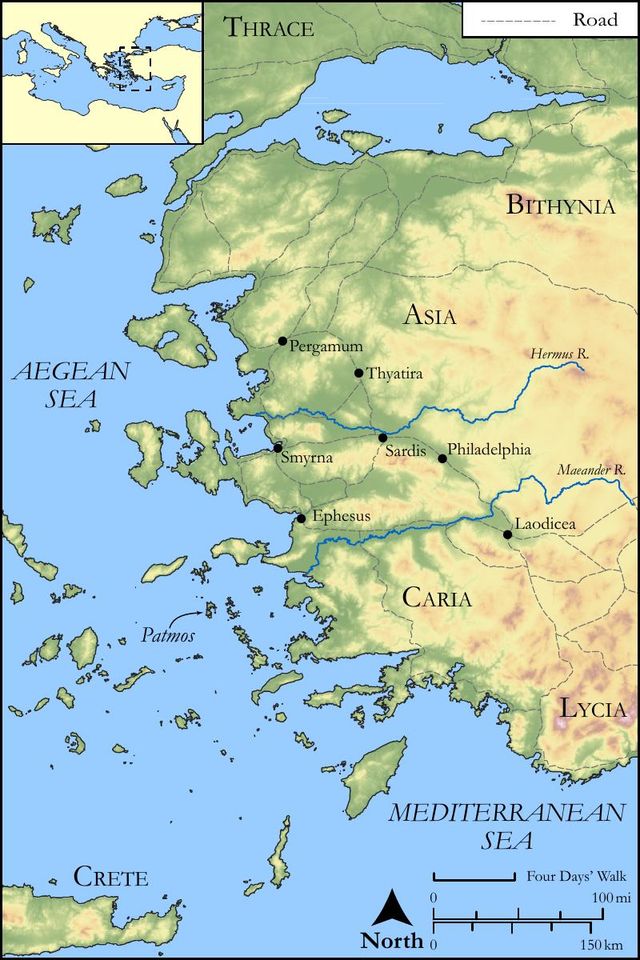
These seven churches are named in Rev 1:11, and distinct messages sent to each of them respectively in the chapters following. The apostolic blessing is more expressly directed to these because they were nearest to him, who was now in the isle of Patmos, and perhaps he had the peculiar care of them, and superintendency over them, not excluding any of the rest of the apostles, if any of them were now living. Here observe,
1.What the blessing is which he pronounces on all the faithful in these churches: Grace and peace, holiness and comfort. Grace, that is, the good-will of God towards us and his good work in us; and peace, that is, the sweet evidence and assurance of this grace. There can be no true peace where there is not true grace; and, where grace goes before, peace will follow.
2.Whence this blessing is to come. In whose name does the apostle bless the churches? In the name of God, of the whole Trinity; for this is an act of adoration, and God only is the proper object of it; his ministers must bless the people in no name but his alone. And here,
(1.)The Father is first named: God the Father, which may be taken either essentially, for God as God, or personally, for the first person in the ever-blessed Trinity, the God and Father of our Lord Jesus Christ; and he is described as the Jehovah who is, and who was, and who is to come, eternal, unchangeable, the same to the Old Testament church which was, and to the New Testament church which is, and who will be the same to the church triumphant which is to come.
(2.)The Holy Spirit, called the seven spirits, not seven in number, nor in nature, but the infinite perfect Spirit of God, in whom there is a diversity of gifts and operations. He is before the throne; for, as God made, so he governs, all things by his Spirit.
(3.)The Lord Jesus Christ. He mentions him after the Spirit, because he intended to enlarge more upon the person of Christ, as God manifested in the flesh, whom he had seen dwelling on earth before, and now saw again in a glorious form. Observe the particular account we have here of Christ, Rev 1:5.
[1.]He is the faithful witness; he was from eternity a witness to all the counsels of God (Joh 1:18), and he was in time a faithful witness to the revealed will of God, who has now spoken to us by his Son; upon his testimony we may safely depend, for he is a faithful witness, cannot be deceived and cannot deceive us.
[2.]He is the first-begotten or first-born from the dead, or the first parent and head of the resurrection, the only one who raised himself by his own power, and who will by the same power raise up his people from their graves to everlasting honour; for he has begotten them again to a lively hope by his resurrection from the dead.
[3.]He is the prince of the kings of the earth; from him they have their authority; by him their power is limited and their wrath restrained; by him their counsels are over-ruled, and to him they are accountable. This is good news to the church, and it is good evidence of the Godhead of Christ, who is King of kings and Lord of lords.
[4.]He is the great friend of his church and people, one who has done great things for them, and this out of pure disinterested affection. He has loved them, and, in pursuance of that everlasting love, he has, First, Washed them from their sins in his own blood. Sins leave a stain upon the soul, a stain of guilt and of pollution. Nothing can fetch out this stain but the blood of Christ; and, rather than it should not be washed out, Christ was willing to shed his own blood, to purchase pardon and purity for them. Secondly, He has made them kings and priests to God and his Father. Having justified and sanctified them, he makes them kings to his Father; that is, in his Father's account, with his approbation, and for his glory. As kings, they govern their own spirits, conquer Satan, have power and prevalency with God in prayer, and shall judge the world. He hath made them priests, given them access to God, enabled them to enter into the holiest and to offer spiritual and acceptable sacrifices, and has given them an unction suitable to this character; and for these high honours and favours they are bound to ascribe to him dominion and glory for ever.
[5.]He will be the Judge of the world: Behold, he cometh, and every eye shall see him, Rev 1:7. This book, the Revelation, begins and ends with a prediction of the second coming of the Lord Jesus Christ. We should set ourselves to meditate frequently upon the second coming of Christ, and keep it in the eye of our faith and expectation. John speaks as if he saw that day: "Behold, he cometh, as sure as if you beheld him with your eyes. He cometh with clouds, which are his chariot and pavilion. He will come publicly: Every eye shall see him, the eye of his people, the eye of his enemies, every eye, yours and mine." He shall come, to the terror of those who have pierced him and have not repented and of all who have wounded and crucified him afresh by their apostasy from him, and to the astonishment of the pagan world. For he comes to take vengeance on those who know not God, as well as on those that obey not the gospel of Christ.
[6.]This account of Christ is ratified and confirmed by himself, Rev 1:8. Here our Lord Jesus justly challenges the same honour and power that is ascribed to the Father, Rev 1:4. He is the beginning and the end; all things are from him and for him; he is the Almighty; he is the same eternal and unchangeable one. And surely whoever presumes to blot out one character of this name of Christ deserves to have his name blotted out of the book of life. Those that honour him he will honour; but those who despise him shall be lightly esteemed.
Historical interpretation
Ten Centuries of Reception
8 surviving comments on this verse. Each one is dated, so this reads as a timeline rather than a list.
Select a marker to jump to its quote. Markers stagger vertically where authors wrote within a few decades of each other.
"The Revelation of Jesus Christ, which God gave to Him, and showed unto His servants things which must shortly come to pass, and signified it. Blessed are they who read and hear the words of this prophecy, and keep the things which are written." The beginning of the book promises blessing to him that reads and hears and keeps, that he who takes pains about the reading may thence learn to do works, and may keep the precepts.
He wishes to make clear that the reading does not accomplish the obedience of the commandments, nor does the hearing display the completion of an accomplished deed. Rather, that alone is perfection, when you perform with understanding what you read and what you hear. “The time is short.” For those who accomplish these things, he does not prolong the time of recompense, but he says that the giving of the divine reward is near.
for the time is at hand. the time of the giving out rewards, because the brief moment of life is small in comparison to the future.
Blessed is he who reads, etc. Therefore, teachers and hearers are blessed, because the short time of labor is followed by eternal joys for those who keep the word of God.
Blessed is he that readeth and they that hear the words of the prophecy of this book, and keep those things which are written in it; for the time is at hand. Here it is made clear how great this book's authority is, since it is the only one among all prophecies to promise blessedness in return with a promise that is in some way specific. In saying he that readeth and they that hear, he indicated the persons of the teachers and of the listeners. What is said after that, and keep those things, pertains to both, because not the hearers of the law are just before God, but the doers of the law shall be justified. [Rom. 2:13] Then, in order to stimulate the minds of both to observe those things, he added, for the time is at hand; namely the time either for the just to be rewarded after their observance of the commandments or for the unjust to be punished after their negligence of them.
QUESTION: What is meant by Blessed is he that reads and they that hear the words of this prophecy, etc.? ANSWER: The teacher and his listeners are blessed because, for those who keep the words of God, the short time of hardship is followed by eternal joys. As the Truth replied to the woman who said to him that the womb of the mother of such great son was blessed as well as her paps, even more blessed are they who hear the word of God, and keep it. [Luke 11:27-28] For he may doubtless call singularly blessed whoever is quick to understand it correctly and to put it into practice once they understand it, and, finally, as he stipulates in this same book: And he that heareth, let him say: Come, [Rev. 22:17] that is, let whoever perceives the inner light of faith and glory in their mind, also call others to it; or, as it is said concerning the same Truth, the things which Jesus began to do and to teach. [Acts 1:1]
He did not say only those who read are blessed, for many would be so blessed, since most read, but also those who hear and become obedient to the exhortations contained in it, and those who preserve and guard what is spoken as divine laws.
"for the time is near." For to everyone who keeps the commandments of God, the time of blessedness is near. It either means that, or "near," he says, is the period of the time of departure. The term "near" has been interpreted in previous contexts.
Blessed He tells the hearers to listen to the power of the book; that is, how to get blessedness, saying: Blessed is he that reads Referring to the doctors of the Church, who hear Referring to pious students, The words of this prophesy, By keeping in mind. and keeps those things that are written in it; By enduring the future trials, and the reason is added: For the time is at hand, already passing, as if to say, the suffering is brief and the reward of blessedness is forever.
Continue studying Revelation 1:3 across the web’s major study libraries — every link below opens this exact verse, chapter, or book on the destination site.
Read & Compare
 BibleGatewayThis verse in more than 200 translations and 70 languages.
 Bible.comThe YouVersion reader — hundreds of translations, reading plans, and highlights.
 ESV.orgCrossway's official English Standard Version reader.
 NET BibleThe NET translation with 60,000+ translators' notes on every rendering decision.
 STEP BibleTyndale House's free study tool — original text, vocabulary, and scholarly resources.
 BibliaLogos Bible Software's free web reader.
 USCCBThe New American Bible (Revised Edition) with the U.S. bishops' study notes.
Commentaries
 BibleHub CommentariesDozens of classic commentaries on this verse, gathered on one page.
 StudyLightMore than 100 commentary sets — the largest collection on the web.
 BibleRefPlain-English commentary on what this verse means, verse by verse.
 Enduring WordDavid Guzik's free commentary on this chapter, widely used by Bible teachers.
 Bible Study ToolsVerse commentary alongside Greek and Hebrew study aids.
Original Language & Research
- BibleHub InterlinearThe verse word by word — original language, transliteration, and English.
- BibleHub LexiconEvery word's original-language definition and Strong's entry.
 Blue Letter BibleDeep-study tools — Strong's numbers, concordance, and word studies.
 CNTR CollationThe earliest Greek manuscripts of this verse, collated letter by letter.
Sermons, Hymns & Audio


TrulyRandomVerse is not affiliated with these sites and doesn’t control their content. They’re linked because they’re genuinely useful.
Summary
Revelation 1:3 pronounces a unique beatitude upon those who actively engage with its prophetic message. This blessing is extended not only to the one who publicly reads the words of this prophecy and those who hear them, but critically, to those who diligently obey and keep the truths contained within. The verse concludes with a powerful declaration of urgency, affirming that the opportune time for these events and their implications is imminently present, calling all believers to a posture of readiness and faithful living.
Context
ShowHideLiterary Context
Revelation 1:3 serves as a foundational declaration at the very outset of the Apocalypse, immediately following the introductory verses that identify the book's divine origin and its purpose as "the revelation of Jesus Christ" (Revelation 1:1). It establishes the intended interaction between the text and its audience, moving beyond mere intellectual comprehension to active obedience. This beatitude is the first of seven blessings found throughout the book, strategically placed to encourage engagement with what follows, distinguishing the book not merely as a cryptic prophecy but as a source of divine blessing for those who respond faithfully. It sets the tone for the entire book, emphasizing its practical and transformative intent.
Historical & Cultural Context
Written by the Apostle John, likely during his exile on the island of Patmos (circa AD 95), Revelation was addressed to seven churches in Asia Minor (Revelation 1:4). These churches were facing various challenges, including persecution from the Roman Empire, internal heresies, and spiritual apathy. In that day, public reading of texts was common, especially in the synagogues and other religious assemblies. The act of "reading" (likely by a designated reader) and "hearing" (by the congregation) reflects the standard mode of scripture dissemination and communal worship in the early church. The call to "keep" the words underscores the Jewish and early Christian emphasis on covenant obedience, where hearing God's word inherently demanded a response of faithfulness, particularly crucial for believers enduring trials and temptations.
Key Themes
ShowHideThis verse introduces several pivotal themes that permeate the book of Revelation and the broader New Testament. Foremost is the theme of blessing through obedience, echoing the Old Testament promises to those who heed God's commands (e.g., Deuteronomy 28:1-14). It highlights that divine revelation is not merely for information but for transformation, a concept reinforced by Jesus's own words regarding those who hear and obey His word (Luke 11:28). Another key theme is the imminence of God's plan, conveyed by the phrase "the time is at hand." This speaks not necessarily to immediate chronological fulfillment of all events, but to the urgent, opportune nature of the prophetic season, demanding present readiness and vigilance from believers, a theme also found in passages like Romans 13:11-12. Finally, the verse subtly introduces the theme of prophecy's practical implications, asserting that understanding God's future designs should directly impact present conduct and spiritual preparedness.
Exposition and Analysis
ShowHideKey Word Analysis
ShowHideThis word signifies a state of profound spiritual well-being, happiness, or divine favor that is independent of outward circumstances. It describes a blessedness that originates from God and characterizes those who are in a right relationship with Him, often used in the Beatitudes to describe those who possess true spiritual prosperity (e.g., Matthew 5:3).
This term refers to a prediction, whether scriptural or otherwise. In this context, it denotes the divinely inspired message of Revelation itself, which unveils future events and divine truths. It emphasizes that the book is not merely a human composition but a revelation from God concerning His plans.
This verb means to guard from loss or injury, to note (a prophecy), or figuratively, to fulfill a command. It implies more than mere intellectual assent; it denotes active preservation, diligent observance, and obedient adherence to the principles and commands contained within the prophecy. It's about living out the implications of what is read and heard.
Derived from a root meaning "near," this word indicates proximity, whether literally or figuratively, in terms of place or time. In this context, it conveys urgency and imminence, suggesting that the "time" (kairós, opportune time) for the unfolding of these prophetic events, and the call to readiness they entail, is already present and pressing.
Verse Breakdown
ShowHide"Blessed [is] he that readeth,"
This clause refers to the individual who publicly reads the words of the prophecy, likely in a communal worship setting. The blessing is pronounced upon this act, indicating the divine favor on the proclamation of God's word.
"and they that hear the words of this prophecy,"
This extends the blessing to the congregation or audience who listens to the public reading. It underscores the importance of attentive listening to divine revelation, recognizing its sacred and life-giving nature.
"and keep those things which are written therein:"
This is the crucial condition for the full experience of the blessing. It moves beyond passive reception to active obedience. To "keep" implies not just intellectual understanding or memorization, but a diligent adherence to the commands, warnings, and principles found within the prophecy, integrating them into one's life.
"for the time [is] at hand."
This final clause provides the compelling reason and urgent motivation for the preceding call to read, hear, and keep. "The time" (kairós) refers to the divinely appointed, opportune season for the fulfillment of these prophecies and the resultant call to readiness. "At hand" emphasizes its nearness and immediate relevance, demanding a present and vigilant response from believers.
Literary Devices
ShowHideRevelation 1:3 employs several significant literary devices. Beatitude is the most prominent, as the verse opens with "Blessed is he," echoing the form of blessings found throughout Scripture, particularly the Beatitudes of Jesus (e.g., Matthew 5:3-12). This immediately elevates the significance of engaging with the book, promising divine favor rather than merely intellectual understanding. The verse also utilizes tricolon, presenting three distinct groups who receive the blessing: "he that readeth," "they that hear," and "they that keep." This rhetorical device emphasizes the comprehensive nature of the call to engagement, from proclamation to reception to obedience. Furthermore, the concluding phrase, "for the time is at hand," functions as a motive clause, providing a compelling reason for the preceding commands and injecting a sense of urgency into the entire message. This sense of imminence serves to underscore the immediate relevance and practical implications of the prophecy for the lives of its readers and hearers.
Theological and Thematic Connections
ShowHideRevelation 1:3 establishes a profound theological principle: divine revelation is given not merely for intellectual curiosity or future prediction, but for present transformation and obedient living. The blessing is contingent upon active engagement and faithful adherence, underscoring that true blessedness flows from a life aligned with God's revealed will. This emphasis on hearing and keeping echoes the covenantal relationship God desires with His people, where knowledge of His word leads to a responsive walk of faith. The urgency conveyed by "the time is at hand" highlights the eschatological tension of the Christian life, where the future reality of Christ's kingdom impinges upon and shapes present conduct.
Reflection and Application
ShowHideRevelation 1:3 serves as a timeless invitation and a potent challenge for every believer. It calls us to approach God's Word, and especially the often-intimidating book of Revelation, not with trepidation or mere academic interest, but with an eager expectation of divine blessing. The verse reminds us that the true benefit of engaging with Scripture comes not from simply reading or hearing, but from actively integrating its truths into the fabric of our daily lives. In a world saturated with information, this verse cuts through the noise, urging us to be doers of the Word, allowing its prophetic insights to shape our character, inform our decisions, and ignite our passion for God's kingdom. The declaration that "the time is at hand" should instill a holy urgency within us, compelling us to live with intentionality, vigilance, and unwavering faithfulness, knowing that God's ultimate plan is unfolding and our response matters in the present moment.
Questions for Reflection
ShowHideFAQ
ShowHideWhat does "the time is at hand" mean in Revelation 1:3?
ShowHideThe phrase "the time is at hand" (Greek: ho kairos engys) signifies a sense of imminent urgency and opportune readiness, rather than a precise chronological prediction of immediate fulfillment. The Greek word kairos refers to a specific, appointed, or critical season, a divinely determined moment, as opposed to chronos, which denotes linear, chronological time. Engys means "near" or "at hand." Therefore, it indicates that the season for the unfolding of God's prophetic plan, and the call to preparedness it demands, has already begun and is pressing. It serves as a powerful motivator for believers to live faithfully and vigilantly in the present, recognizing that the events described in Revelation are not distant historical or future curiosities, but have immediate implications for their lives and the life of the church. This concept resonates with other New Testament passages that speak of the nearness of the Lord's return and the need for readiness, such as Romans 13:11-12 and 1 Peter 4:7.
Christ-Centered Fulfillment
ShowHideRevelation 1:3, while pronouncing a blessing on those who engage with prophecy, finds its ultimate Christ-centered fulfillment in the person and work of Jesus Himself. The "prophecy" of this book is explicitly "the revelation of Jesus Christ" (Revelation 1:1), meaning that to read, hear, and keep its words is ultimately to encounter and obey Christ. Jesus is the living Word (John 1:1), the one who perfectly read, heard, and kept the Father's will, even to the point of death on the cross (Philippians 2:8). The blessedness promised in this verse is a participation in the blessedness of Christ, who perfectly embodies the obedient life. Furthermore, the urgency of "the time is at hand" points to Christ as the one who inaugurated the "last days" through His first coming (Hebrews 1:1-2) and whose imminent return marks the consummation of all things (Revelation 22:20). Thus, to "keep those things which are written therein" is to live a life conformed to the image of Christ, eagerly awaiting His glorious appearing and participating in His ongoing redemptive work until He returns.