


Revelation 22:7
Bible text: King James Version (1769 Blayney text) · Public domain
Bible text: Berean Standard Bible · Public domain
Bible text: American Standard Version (1901) · Public domain
Bible text: World English Bible, Messianic edition · Public domain
Bible text: Geneva Bible (1599) · Public domain
Bible text: Young's Literal Translation · Public domain
- ἰδοὺidoubeholdG2400INJInterjection
- ἔρχομαιerchomaiI am comingG2064V-PNI-1SVerb Present Middle Or Passive Deponent Indicative 1st Singular
- ταχύtachuquicklyG5035ADVAdverb
- μακάριοςmakariosBlessed [is]G3107A-NSMAdjective Nominative Singular Masculine
- ὁhothe [one]G3588T-NSMDefinite article Nominative Singular Masculine
- τηρῶνtērōnkeepingG5083V-PAP-NSMVerb Present Active Participle Nominative Singular Masculine
- τοὺςtoustheG3588T-APMDefinite article Accusative Plural Masculine
- λόγουςlogouswordsG3056N-APMNoun Accusative Plural Masculine
- τῆςtēsof theG3588T-GSFDefinite article Genitive Singular Feminine
- προφητείαςprophēteiasprophecyG4394N-GSFNoun Genitive Singular Feminine
- τοῦtouof theG3588T-GSNDefinite article Genitive Singular Neuter
- βιβλίουbiblioubookG975N-GSNNoun Genitive Singular Neuter
- τούτουtoutouthisG3778D-GSNDemonstrative pronoun Genitive Singular Neuter
English is a literal word-by-word gloss of the Greek, not the KJV's wording. Why?
This is the original text the KJV's translators worked from — each Greek word with its own literal English meaning in this verse, prepared by scholars at Tyndale House, Cambridge. The KJV translates whole sentences, not word by word, so its wording differs: one Greek word can become several English words, and the KJV may choose “charity” where the gloss reads “love”. Both are faithful — they answer different questions. For the KJV's own rendering, switch to the KJV text.
Details
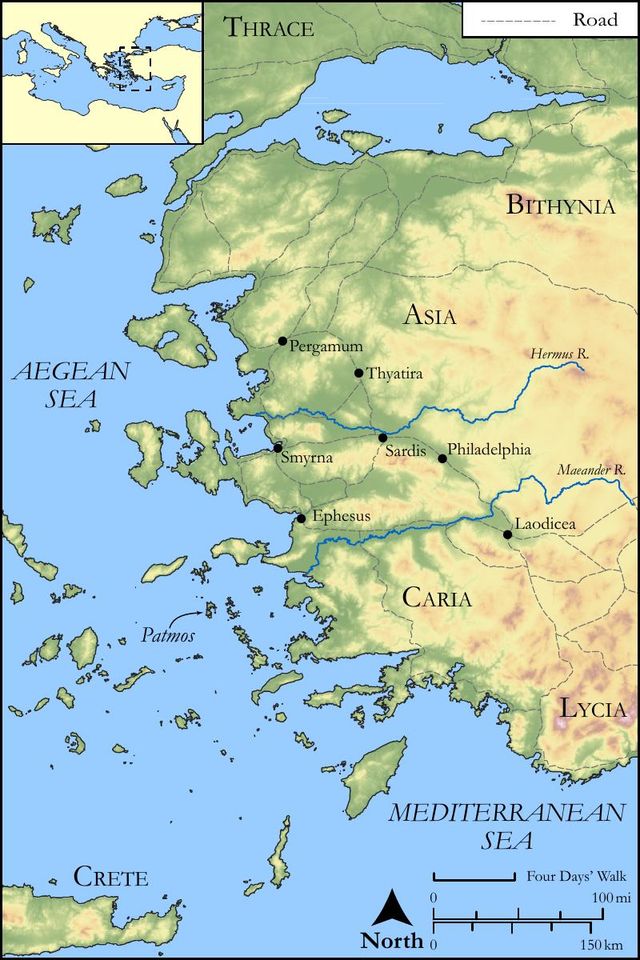
See on the biblical-era maps

Study this verse
Public-domain commentary
Matthew Henry
From his Commentary on the Whole Bible. Henry comments on passages, not single verses — this entry covers Revelation 22:6–19.
We have here a solemn ratification of the contents of this book, and particularly of this last vision (though some think it may not only refer to the whole book, but to the whole New Testament, yea, to the whole Bible, completing and confirming the canon of scripture); and here, 1. This is confirmed by the name and nature of that God who gave out these discoveries: he is the Lord God, faithful and true, and so are all his sayings. 2. By the messengers he chose, to reveal these things to the world; the holy angels showed them to holy men of God; and God would not employ his saints and angels in deceiving the world. 3. They will soon be confirmed by their accomplishment: they are things that must shortly be done; Christ will make haste, he will come quickly, and put all things out of doubt; and then those will prove the wise and happy men who have believed and kept his words. 4. By the integrity of that angel who had been the apostle's guide and interpreter in these visions; this integrity was such that he not only refused to accept religious adoration from John, but once and again reproved him for it. He who was so tender of the honour of God, and so displeased with what was a wrong to God, would never come in his name to lead the people of God into mere dreams and delusions; and it is a still further confirmation of the sincerity of this apostle that he confesses his own sin and folly, into which he had now again relapsed, and he leaves this his failing on perpetual record: this shows he was a faithful and an impartial writer. 5. By the order given to leave the book of the prophecy open, to be perused by all, that they might labour to understand it, that they might make their objections against it, and compare the prophecy with the events. God here deals freely and openly with all; he does not speak in secret, but calls every one to witness to the declarations here made, Rev 22:10. 6. By the effect this book, thus kept open, will have upon men; those that are filthy and unjust will take occasion thence to be more so, but it will confirm, strengthen, and further sanctify those that are upright with God; it will be a savour of life to some and of death to others, and so will appear to be from God, Rev 22:12. 7. It will be Christ's rule of judgment at the great day; he will dispense rewards and punishments to men according as their works agree or disagree with the word of God; and therefore that word itself must needs be faithful and true. 8. It is the word of him who is the author, finisher, and rewarder of the faith and holiness of his people, Rev 22:13, Rev 22:14. He is the first and the last, and the same from first to last, and so is his word too; and he will by this word give to his people, who conform themselves to it, a right to the tree of life, and an entrance into heaven; and this will be a full confirmation of the truth and authority of his word, since it contains the title and evidence of that confirmed state of holiness and happiness that remains for his people in heaven. 9. It is a book that condemns and excludes from heaven all wicked, unrighteous persons, and particularly those that love and make lies (Rev 22:15), and therefore can never be itself a lie. 10. It is confirmed by the testimony of Jesus, which is the Spirit of prophecy. And this Jesus, as God, is the root of David, though, as man, his offspring - a person in whom all uncreated and created excellencies meet, too great and too good to deceive his churches and the world. He is the fountain of all light, the bright and the morning star, and as such has given to his churches this morning light of prophecy, to assure them of the light of that perfect day which is approaching. 11. It is confirmed by an open and general invitation to all to come and partake of the promises and privileges of the gospel, those streams of the water of life; these are tendered to all who feel in their souls a thirst which nothing in this world can quench. 12. It is confirmed by the joint testimony of the Spirit of God, and that gracious Spirit that is in all the true members of the church of God; the Spirit and the bride join in testifying the truth and excellency of the gospel. 13. It is confirmed by a most solemn sanction, condemning and cursing all who should dare to corrupt or change the word of God, either by adding to it or taking from it, Rev 22:18, Rev 22:19. He that adds to the word of God draws down upon himself all the plagues written in this book; and he who takes any thing away from it cuts himself off from all the promises and privileges of it. This sanction is like a flaming sword, to guard the canon of the scripture from profane hands. Such a fence as this God set about the law (Deu 4:2), and the whole Old Testament (Mal 4:4), and now in the most solemn manner about the whole Bible, assuring us that it is a book of the most sacred nature, divine authority, and of the last importance, and therefore the peculiar care of the great God.
Historical interpretation
Seven Centuries of Reception
6 surviving comments on this verse. Each one is dated, so this reads as a timeline rather than a list.
Select a marker to jump to its quote. Markers stagger vertically where authors wrote within a few decades of each other.
When the prophet now has completed, so to speak, the whole prophecy, he pronounces those blessed who should observe it, and names himself, too, in the number of the same: "For blessed," says he, "is he that keepeth the words of the prophecy of this book; and I John who saw and heard these things." That this person was called John, therefore, and that this was the writing of a John, I do not deny. And I admit further, that it was also the work of some holy and inspired man. But I could not so easily admit that this was the apostle, the son of Zebedee, the brother of James, and the same person with him who wrote the Gospel which bears the title according to John, and the catholic epistle. But from the character of both, and the forms of expression, and the whole disposition and execution of the book, I draw the conclusion that the authorship is not his. For the evangelist nowhere else subjoins his name, and he never proclaims himself either in the Gospel or in the epistle.
“To keep” means to believe in a reverent manner and to maintain one’s resolve and intention to live a more pure life.
By the messenger of truth the Lord himself reveals directly “to his servants what must soon take place.” And unless anyone be in doubt about the expectation of the end, he indicates that what is to happen will happen quickly and that he is blessed who keeps the words of the prophets.
It is often customary for the prophets to speak divine words as though it were from their own person. The words “I am coming soon” indicate either the shortness of the present time in comparison with the future age or the sudden swiftness of the death of each person. For the departure from here is the end of every person. Therefore, since “we do not know at what hour the thief will come,” we are commanded “to watch and to gird ourselves and to keep our lamps burning,” letting our godly behavior shine even for our neighbor. Therefore, let us not cease to beseech God with a contrite heart to “save us from all our pursuers,” lest our souls, having been defeated by them, be snatched away unprepared “with no one to rescue or to save.” [Let us also pray God] lest any soul, bound by the chains of earthly affairs and not able to free itself from them, should vainly turn again to them and then, when constrained to leave them by the authority of the angels and the command of God, will lament in vain for the lost opportunities of a life now passed. Rather, singing without ceasing the song of David, “I prepared myself and was not fearful to keep your commandments,” let us receive as a reward for keeping [his commandments] the praise of God, who will say, “Well done, good and faithful servant; you have been faithful over a little, I will set you over much; enter into the joy of your master.” Together with him glory, honor and power are fittingly given to the Father and also to the Holy Spirit now and always and forever and ever. Amen.
Blessed is he who keeps the words of the prophecy of this book, etc. It is understood, blessed am I. Thus, the blessed Dionysius, bishop of Alexandria, connects these verses, while refuting some heresies that arose on the occasion of this little book and refuting their error, and transferring the meaning of the same prophecy, purified from all clouds of carnal understanding, to the eternal and heavenly promises.
For this reason he also brought it on: "Behold, I come quickly." Blessed are those who keep these things of this prophecy. For those who keep them take pains not to fall under the punishments foretold in it through a God-beloved life.
Continue studying Revelation 22:7 across the web’s major study libraries — every link below opens this exact verse, chapter, or book on the destination site.
Read & Compare
 BibleGatewayThis verse in more than 200 translations and 70 languages.
 Bible.comThe YouVersion reader — hundreds of translations, reading plans, and highlights.
 ESV.orgCrossway's official English Standard Version reader.
 NET BibleThe NET translation with 60,000+ translators' notes on every rendering decision.
 STEP BibleTyndale House's free study tool — original text, vocabulary, and scholarly resources.
 BibliaLogos Bible Software's free web reader.
 USCCBThe New American Bible (Revised Edition) with the U.S. bishops' study notes.
Commentaries
 BibleHub CommentariesDozens of classic commentaries on this verse, gathered on one page.
 StudyLightMore than 100 commentary sets — the largest collection on the web.
 BibleRefPlain-English commentary on what this verse means, verse by verse.
 Enduring WordDavid Guzik's free commentary on this chapter, widely used by Bible teachers.
 Bible Study ToolsVerse commentary alongside Greek and Hebrew study aids.
Original Language & Research
- BibleHub InterlinearThe verse word by word — original language, transliteration, and English.
- BibleHub LexiconEvery word's original-language definition and Strong's entry.
 Blue Letter BibleDeep-study tools — Strong's numbers, concordance, and word studies.
 CNTR CollationThe earliest Greek manuscripts of this verse, collated letter by letter.
Sermons, Hymns & Audio


TrulyRandomVerse is not affiliated with these sites and doesn’t control their content. They’re linked because they’re genuinely useful.
Summary
Revelation 22:7 delivers a profound and urgent declaration from Jesus Christ, positioned near the culmination of the prophetic book. It serves as a final, solemn admonition and a blessed promise, encapsulating the core message and ultimate purpose of the entire Revelation. The verse underscores the certainty and imminence of Christ's return, while simultaneously pronouncing divine favor upon those who diligently guard, obey, and live out the truths revealed within this sacred prophecy.
CONTEXT
ShowHideExposition and Analysis
ShowHideKey Word Analysis
ShowHideG2400 - This is a second person singular imperative, functioning as an interjection meaning "lo!" or "see!" It is used here to draw immediate and emphatic attention to the declaration that follows, signaling a crucial and urgent statement from the speaker, Jesus Christ. It demands the reader's full focus on the truth being presented.
G5035 - Derived from the neuter singular of the adjective tachýs (swift), used adverbially, this term signifies "shortly," "without delay," "soon," or "suddenly." In the context of Christ's return, it conveys the idea of an unexpected or swift arrival, emphasizing the certainty and readiness required of believers, rather than a specific, immediate timeframe on a human calendar. It implies that when He comes, it will be decisive and rapid.
G5083 - This verb means "to guard (from loss or injury, properly, by keeping the eye upon)," "to note (a prophecy)," or "to fulfill a command." It implies a diligent and active adherence. In this context, "keeping" the sayings of the prophecy involves not just intellectual understanding or passive reception, but a conscious, ongoing effort to preserve, observe, obey, and put into practice the warnings, commands, and truths revealed in the Book of Revelation. It is a comprehensive commitment to living by its light.
Verse Breakdown
ShowHide"Behold, I come quickly:"
This is a direct, emphatic declaration from Jesus Christ Himself. The "Behold" (G2400 idoú) calls for immediate attention to the profound truth that follows. The phrase "I come quickly" (G2064 érchomai G5035 tachý) underscores the certainty and imminence of His return. It's not merely a prediction but a divine promise from the One who has the authority to fulfill it, signaling that His arrival will be swift and decisive when it occurs, demanding a state of constant readiness from His followers.
"blessed is he that keepeth"
This clause introduces a beatitude, a declaration of divine favor and spiritual well-being. The term "blessed" (G3107 makários) signifies a state of supreme happiness, fortunate, or well-off, indicating God's approval and the spiritual prosperity that comes from a right relationship with Him. The blessing is specifically for those who "keepeth" (G5083 tēréō), implying active obedience, diligent preservation, and practical application of the truths revealed. This is not a passive reception but an engaged, transformative response.
"the sayings of the prophecy of this book."
This specifies the object of the "keeping." "The sayings" (G3056 lógos) refers to the words, messages, and teachings contained within the book. "The prophecy" (G4394 prophēteía) identifies the nature of these sayings as divinely inspired predictions and revelations. "Of this book" (G5127 toútou G975 biblíon) explicitly refers to the entire Book of Revelation, emphasizing that its entire message, not just select parts, is to be guarded, understood, and obeyed. The blessing is for comprehensive faithfulness to God's final revelation.
Literary Devices
ShowHideRevelation 22:7 masterfully employs several literary devices to convey its urgent and profound message. The most prominent is Direct Address, as Jesus Christ Himself speaks, lending ultimate authority and personal urgency to the declaration "Behold, I come quickly." This personal utterance makes the promise and the command deeply intimate and compelling. The verse also features a Beatitude, a common biblical form (e.g., in the Sermon on the Mount) that declares a state of blessedness or happiness upon those who exhibit certain characteristics or actions. Here, the formula "blessed is he that..." confers divine favor upon the obedient. The use of the imperative "Behold" (G2400 idoú) functions as an Exclamatory Interjection, immediately seizing the reader's attention and underscoring the critical importance of the message that follows. Finally, the entire statement serves as a Prophetic Declaration, not just foretelling an event but also carrying divine authority and a call to action, characteristic of apocalyptic literature.
Theological and Thematic Connections
ShowHideRevelation 22:7 stands as a powerful capstone to the biblical narrative, weaving together themes of divine sovereignty, the authority of God's Word, and the nature of true blessedness. It affirms that history is moving towards a definitive climax orchestrated by God, with Christ's return as the central event. The call to "keep" the sayings of the prophecy highlights the active and transformative nature of faith; it's not merely intellectual assent but a life lived in accordance with God's revealed will. This obedience is the pathway to genuine blessedness, a spiritual well-being that transcends earthly circumstances and is rooted in God's favor. The verse thus serves as a timeless reminder that living in light of eternity, with vigilance and faithful adherence to Christ's teachings, is the path to enduring joy and divine commendation.
Reflection and Application
ShowHideRevelation 22:7 serves as a timeless call to vigilance, faithful living, and a deep reverence for God's revealed will. The certain and imminent return of Christ should not be a cause for fear for believers, but rather a powerful motivator for living with intentionality and purpose. To "keep the sayings of the prophecy of this book" means allowing the truths of Revelation—its warnings against compromise, its promises of ultimate victory, and its vision of the New Creation—to shape our daily choices, priorities, and character. It calls us to live in a state of readiness, actively pursuing holiness, engaging in mission, and persevering through trials, knowing that our labor is not in vain. The blessing promised is not for passive knowledge, but for active obedience that transforms our lives and aligns them with God's eternal purposes, fostering a deep and abiding spiritual peace even amidst a turbulent world.
Questions for Reflection
ShowHideFAQ
ShowHideWhat does "I come quickly" mean in Revelation 22:7?
ShowHideThe phrase "I come quickly" (Greek: G5035 tachý) does not necessarily mean "immediately" in human temporal terms, but rather emphasizes the suddenness, swiftness, and certainty of Christ's return. It conveys that when He does come, His arrival will be decisive and without delay, much like a thief in the night (Matthew 24:42-44). The emphasis is on the need for readiness and vigilance on the part of believers, rather than predicting a specific date. This declaration is repeated multiple times in Revelation (Revelation 3:11, Revelation 22:12, Revelation 22:20), consistently urging believers to live in expectant anticipation of His glorious return.
What does it mean to "keep the sayings of the prophecy of this book"?
ShowHideTo "keep" (Greek: G5083 tēréō) the sayings of the prophecy means much more than simply reading or intellectually understanding them. It implies actively guarding, preserving, observing, and putting into practice the truths, warnings, and commands revealed throughout the Book of Revelation. This involves diligent study, faithful obedience to its ethical and theological implications, and perseverance in the face of tribulation, trusting in God's ultimate victory and justice. It is a call to live a life transformed by the prophetic vision, aligning one's actions and attitudes with God's revealed will, as exemplified by the call to be "doers of the word, and not hearers only" (James 1:22).
Christ-Centered Fulfillment
ShowHideRevelation 22:7 finds its ultimate Christ-centered fulfillment in the person and work of Jesus Christ, who is both the speaker of this profound declaration and the very subject of the prophecy. As the One who declares, "Behold, I come quickly," Jesus asserts His divine authority and sovereignty over all of history, including its culmination. He is the Alpha and the Omega, the beginning and the end, the first and the last (Revelation 22:13), whose return will bring about the full realization of God's redemptive plan. The "sayings of the prophecy of this book" ultimately point to Him—His triumph over sin and death, His establishment of the New Jerusalem, and His eternal reign with His redeemed people (Revelation 21:1-7). The "blessedness" promised to those who "keep" these sayings is a blessedness found exclusively in union with Christ, who is the Living Word (John 1:1) and the source of all life. Our ability to "keep" His commands and prophecies is empowered by His Spirit, made possible by His atoning sacrifice, and motivated by the hope of His glorious return, when He will make all things new and dwell perfectly with His people (Revelation 21:3).