


Revelation 22:8
- κἀγὼkagōAnd I myselfG2532P-1NS + G2532=CONJ
- ἸωάννηςIōannēsJohnG2491N-NSM-PNoun Nominative Singular Masculine Individual
- ὁhowhoG3588T-NSMDefinite article Nominative Singular Masculine
- ἀκούωνakouōnis hearingG191V-PAP-NSMVerb Present Active Participle Nominative Singular Masculine
- καὶkaiandG2532CONJConjunction
- βλέπωνblepōnis seeingG991V-PAP-NSMVerb Present Active Participle Nominative Singular Masculine
- ταῦτα·tautathese thingsG3778D-APNDemonstrative pronoun Accusative Plural Neuter
- καὶkaiAndG2532CONJConjunction
- ὅτεhotewhenG3753CONJConjunction
- ἤκουσαēkousaI heardG191V-AAI-1SVerb Aorist Active Indicative 1st Singular
- καὶkaiandG2532CONJConjunction
- ἔβλεψαeblepsasawG991V-AAI-1SVerb Aorist Active Indicative 1st Singular
- ἔπεσαepesaI fell downG4098V-2AAI-1SVerb 2nd Aorist Active Indicative 1st Singular
- προσκυνῆσαιproskunēsaito worshipG4352V-AANVerb Aorist Active Infinitive
- ἔμπροσθενemprosthenbeforeG1715PREPPreposition
- τῶνtōntheG3588T-GPMDefinite article Genitive Plural Masculine
- ποδῶνpodōnfeetG4228N-GPMNoun Genitive Plural Masculine
- τοῦtouof theG3588T-GSMDefinite article Genitive Singular Masculine
- ἀγγέλουangelouangelG32N-GSMNoun Genitive Singular Masculine
- τοῦtouwhoG3588T-GSMDefinite article Genitive Singular Masculine
- δεικνύοντόςdeiknuontosis showingG1166V-PAP-GSMVerb Present Active Participle Genitive Singular Masculine
- μοιmoimeG3165P-1DSPersonal pronoun Dative 1st Singular
- ταῦταtautathese thingsG3778D-APNDemonstrative pronoun Accusative Plural Neuter
English is a literal word-by-word gloss of the Greek, not the KJV's wording. Why?
This is the original text the KJV's translators worked from — each Greek word with its own literal English meaning in this verse, prepared by scholars at Tyndale House, Cambridge. The KJV translates whole sentences, not word by word, so its wording differs: one Greek word can become several English words, and the KJV may choose “charity” where the gloss reads “love”. Both are faithful — they answer different questions. For the KJV's own rendering, switch to the KJV text.
Details
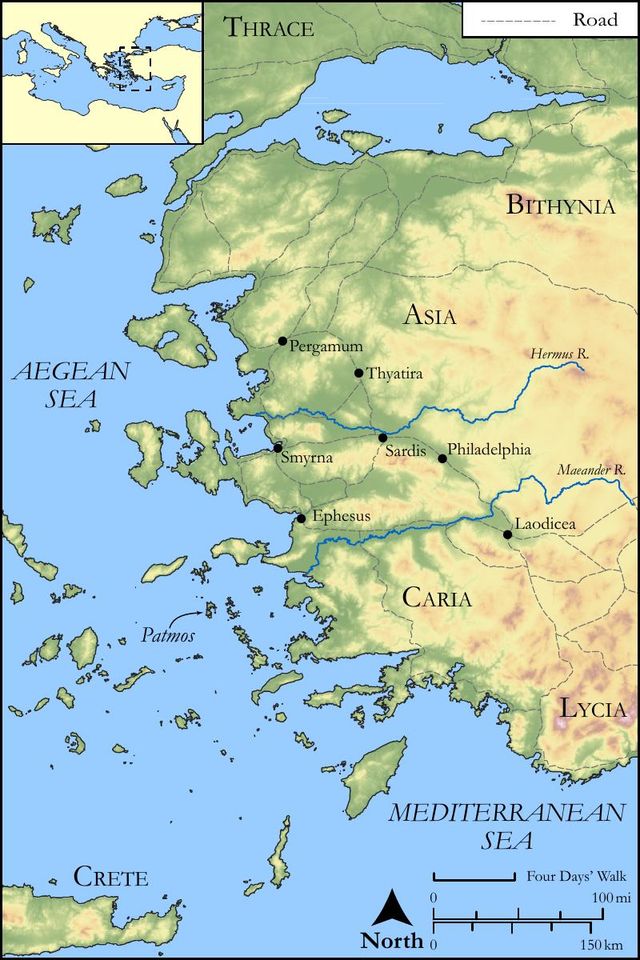
See on the biblical-era map

Study this verse
Public-domain commentary
Matthew Henry
From his Commentary on the Whole Bible. Henry comments on passages, not single verses — this entry covers Revelation 22:6–19.
We have here a solemn ratification of the contents of this book, and particularly of this last vision (though some think it may not only refer to the whole book, but to the whole New Testament, yea, to the whole Bible, completing and confirming the canon of scripture); and here, 1. This is confirmed by the name and nature of that God who gave out these discoveries: he is the Lord God, faithful and true, and so are all his sayings. 2. By the messengers he chose, to reveal these things to the world; the holy angels showed them to holy men of God; and God would not employ his saints and angels in deceiving the world. 3. They will soon be confirmed by their accomplishment: they are things that must shortly be done; Christ will make haste, he will come quickly, and put all things out of doubt; and then those will prove the wise and happy men who have believed and kept his words. 4. By the integrity of that angel who had been the apostle's guide and interpreter in these visions; this integrity was such that he not only refused to accept religious adoration from John, but once and again reproved him for it. He who was so tender of the honour of God, and so displeased with what was a wrong to God, would never come in his name to lead the people of God into mere dreams and delusions; and it is a still further confirmation of the sincerity of this apostle that he confesses his own sin and folly, into which he had now again relapsed, and he leaves this his failing on perpetual record: this shows he was a faithful and an impartial writer. 5. By the order given to leave the book of the prophecy open, to be perused by all, that they might labour to understand it, that they might make their objections against it, and compare the prophecy with the events. God here deals freely and openly with all; he does not speak in secret, but calls every one to witness to the declarations here made, Rev 22:10. 6. By the effect this book, thus kept open, will have upon men; those that are filthy and unjust will take occasion thence to be more so, but it will confirm, strengthen, and further sanctify those that are upright with God; it will be a savour of life to some and of death to others, and so will appear to be from God, Rev 22:12. 7. It will be Christ's rule of judgment at the great day; he will dispense rewards and punishments to men according as their works agree or disagree with the word of God; and therefore that word itself must needs be faithful and true. 8. It is the word of him who is the author, finisher, and rewarder of the faith and holiness of his people, Rev 22:13, Rev 22:14. He is the first and the last, and the same from first to last, and so is his word too; and he will by this word give to his people, who conform themselves to it, a right to the tree of life, and an entrance into heaven; and this will be a full confirmation of the truth and authority of his word, since it contains the title and evidence of that confirmed state of holiness and happiness that remains for his people in heaven. 9. It is a book that condemns and excludes from heaven all wicked, unrighteous persons, and particularly those that love and make lies (Rev 22:15), and therefore can never be itself a lie. 10. It is confirmed by the testimony of Jesus, which is the Spirit of prophecy. And this Jesus, as God, is the root of David, though, as man, his offspring - a person in whom all uncreated and created excellencies meet, too great and too good to deceive his churches and the world. He is the fountain of all light, the bright and the morning star, and as such has given to his churches this morning light of prophecy, to assure them of the light of that perfect day which is approaching. 11. It is confirmed by an open and general invitation to all to come and partake of the promises and privileges of the gospel, those streams of the water of life; these are tendered to all who feel in their souls a thirst which nothing in this world can quench. 12. It is confirmed by the joint testimony of the Spirit of God, and that gracious Spirit that is in all the true members of the church of God; the Spirit and the bride join in testifying the truth and excellency of the gospel. 13. It is confirmed by a most solemn sanction, condemning and cursing all who should dare to corrupt or change the word of God, either by adding to it or taking from it, Rev 22:18, Rev 22:19. He that adds to the word of God draws down upon himself all the plagues written in this book; and he who takes any thing away from it cuts himself off from all the promises and privileges of it. This sanction is like a flaming sword, to guard the canon of the scripture from profane hands. Such a fence as this God set about the law (Deu 4:2), and the whole Old Testament (Mal 4:4), and now in the most solemn manner about the whole Bible, assuring us that it is a book of the most sacred nature, divine authority, and of the last importance, and therefore the peculiar care of the great God.
Historical interpretation
Seven Centuries of Reception
5 surviving comments on this verse. Each one is dated, so this reads as a timeline rather than a list.
Select a marker to jump to its quote. Markers stagger vertically where authors wrote within a few decades of each other.
When the prophet now has completed, so to speak, the whole prophecy, he pronounces those blessed who should observe it, and names himself, too, in the number of the same: "For blessed," says he, "is he that keepeth the words of the prophecy of this book; and I John who saw and heard these things." That this person was called John, therefore, and that this was the writing of a John, I do not deny. And I admit further, that it was also the work of some holy and inspired man. But I could not so easily admit that this was the apostle, the son of Zebedee, the brother of James, and the same person with him who wrote the Gospel which bears the title according to John, and the catholic epistle. But from the character of both, and the forms of expression, and the whole disposition and execution of the book, I draw the conclusion that the authorship is not his. For the evangelist nowhere else subjoins his name, and he never proclaims himself either in the Gospel or in the epistle.
John, the most blessed of the apostles, says that when he heard [these words] he was overcome with fright by the power of the words and the magnitude of the vision and fell to the ground because of this. And he says that he was prostrate that he might adore the angel of truth “who showed these things to me.”
[To witness by eye and ear] is characteristic of one who is an apostle. Just as he said in the Gospel, “He who has seen bears witness, and his testimony is true,” so also in this passage [John] confesses that he is an eyewitness and earwitness of what has been foretold and so makes himself to be a guarantee of what has been seen.
I fell down to worship at the feet of the angel, etc. Either he repeated what he had once done, not daring to attempt it again after being restrained, or, struck by the great amazement of the visions, he confesses he wanted to worship again.
And when he says I heard and saw, I fell down to worship before the feet of the angel. These things are interpreted in those that have arrived, when we also have demonstrated that the doctrines of the atheistic Greeks about their national leaders have nothing in common with the purest doctrines of the church.
Continue studying Revelation 22:8 across the web’s major study libraries — every link below opens this exact verse, chapter, or book on the destination site.
Read & Compare
 BibleGatewayThis verse in more than 200 translations and 70 languages.
 Bible.comThe YouVersion reader — hundreds of translations, reading plans, and highlights.
 ESV.orgCrossway's official English Standard Version reader.
 NET BibleThe NET translation with 60,000+ translators' notes on every rendering decision.
 STEP BibleTyndale House's free study tool — original text, vocabulary, and scholarly resources.
 BibliaLogos Bible Software's free web reader.
 USCCBThe New American Bible (Revised Edition) with the U.S. bishops' study notes.
Commentaries
 BibleHub CommentariesDozens of classic commentaries on this verse, gathered on one page.
 StudyLightMore than 100 commentary sets — the largest collection on the web.
 BibleRefPlain-English commentary on what this verse means, verse by verse.
 Enduring WordDavid Guzik's free commentary on this chapter, widely used by Bible teachers.
 Bible Study ToolsVerse commentary alongside Greek and Hebrew study aids.
Original Language & Research
- BibleHub InterlinearThe verse word by word — original language, transliteration, and English.
- BibleHub LexiconEvery word's original-language definition and Strong's entry.
 Blue Letter BibleDeep-study tools — Strong's numbers, concordance, and word studies.
 CNTR CollationThe earliest Greek manuscripts of this verse, collated letter by letter.
Sermons, Hymns & Audio


TrulyRandomVerse is not affiliated with these sites and doesn’t control their content. They’re linked because they’re genuinely useful.
Summary
Revelation 22:8 captures a pivotal moment at the climax of John's apocalyptic visions, where the apostle, overwhelmed by the grandeur of the divine revelation, instinctively prostrates himself to worship the guiding angel. This impulsive act, though born of awe, immediately sets the stage for a crucial theological correction, emphasizing that worship is reserved exclusively for God alone, a foundational truth underscored throughout the biblical narrative.
Context
ShowHideLiterary Context
This verse is situated at the very conclusion of the Book of Revelation, following the breathtaking descriptions of the New Heaven and New Earth, the New Jerusalem, and the River of the Water of Life. John has been granted an unparalleled glimpse into the eternal state, the consummation of God's redemptive plan. The immediate preceding verses detail the accessibility of the tree of life and the blessedness of those who obey God's commands, setting a tone of ultimate divine presence and glory. John's reaction in this verse serves as a final, powerful reminder of the proper response to such overwhelming revelation, just before the book concludes with final warnings and blessings.
Historical & Cultural Context
In the Greco-Roman world of John's time, prostration (proskynesis) was a common gesture of profound respect, honor, or supplication, often directed towards emperors, deities, or powerful figures. However, for Jews and early Christians, this act of worship was strictly reserved for God alone. The Old Testament consistently condemns the worship of idols, angels, or any created being, emphasizing God's unique sovereignty. This cultural backdrop highlights the significance of the angel's immediate correction: it was not merely a social faux pas but a profound theological error that challenged the very core of monotheistic worship. The incident in Revelation 22:8, mirroring a previous one in Revelation 19:10, underscores the persistent human tendency to misdirect adoration and the divine imperative to correct it.
Key Themes
ShowHideThis verse powerfully reinforces several overarching themes of Revelation and the broader biblical canon. Foremost is the exclusivity of worship to God alone. John's error and the angel's swift correction serve as a final, emphatic declaration that no created being, however glorious or instrumental in divine revelation, is worthy of adoration. This theme is central to the book's portrayal of God's sovereignty and the dangers of idolatry. Another key theme is the subordinate role of angels as messengers and servants of God, not objects of worship. They are fellow servants, sharing in the testimony of Jesus, and their glory is derived from God, not inherent. Finally, the incident highlights human fallibility and the need for humility, even for a seasoned apostle like John. It demonstrates that even those closest to divine revelation can momentarily err, underscoring the constant need for discernment and adherence to God's explicit commands regarding worship.
Exposition and Analysis
ShowHideKey Word Analysis
ShowHideThis primary verb means "to look at," "perceive," or "behold" (G991). In this context, it signifies John's direct visual experience of the "things" (taûta) revealed to him, encompassing the entirety of the prophetic visions of the new creation and the New Jerusalem. His seeing is not merely physical sight but a profound spiritual apprehension of divine realities.
This primary verb means "to hear" in various senses, including "to give audience," "to understand," or "to be reported" (G191). John's experience is multimodal; he not only saw the visions but also heard the accompanying explanations, pronouncements, and divine declarations. The combination of seeing and hearing signifies a complete and authoritative reception of the revelation.
Derived from "pros" (towards) and a root meaning "to kiss like a dog licking its master's hand," this verb means "to fawn or crouch to," "prostrate oneself in homage," or "to adore" (G4352). It denotes an act of profound reverence, submission, and adoration. The angel's immediate rejection of this worship underscores its exclusive reservation for God, prohibiting its application to any created being, regardless of their spiritual stature or role.
Verse Breakdown
ShowHide"And I John saw these things, and heard them."
This clause establishes John's personal testimony and direct involvement in receiving the revelation. The use of "I John" (G1473, G2491) emphasizes his identity as the eyewitness and recorder of these final, momentous visions. The "things" (G5023) refer to the entirety of the apocalyptic revelation he has just witnessed, particularly the glorious descriptions of the new heaven, new earth, and New Jerusalem, as well as the accompanying divine declarations. His seeing (G991) and hearing (G191) confirm the comprehensive and authentic nature of his prophetic experience.
"And when I had heard and seen, I fell down to worship before the feet of the angel which shewed me these things."
This second clause describes John's immediate and overwhelming reaction to the profound revelation. The phrase "when I had heard and seen" highlights the cumulative impact of the visions. John's act of "falling down to worship" (G4098, G4352) signifies an instinctive, profound gesture of reverence and awe. However, the object of his worship—"the angel" (G32) who had "shewed" (G1166) him the visions—is critically misguided. This act, though seemingly pious, represents a misdirection of the ultimate homage due only to God, setting the stage for the angel's crucial correction in the subsequent verse.
Literary Devices
ShowHideThe passage employs several significant literary devices. Repetition is evident in John's act of falling down to worship the angel, mirroring his identical mistake in Revelation 19:10. This serves to underscore the absolute importance of the angel's correction and the theological principle it conveys. The scene also utilizes Contrast between the overwhelming glory of the divine revelation and the inherent fallibility of even a Spirit-filled prophet like John. This highlights the stark distinction between the Creator and creation, and the exclusive nature of true worship. Furthermore, the angel functions as a Symbol of faithful servanthood, embodying humility and pointing all glory back to God. Its immediate refusal of worship is not merely a verbal correction but a symbolic act reinforcing the proper object of adoration.
Theological and Thematic Connections
ShowHideRevelation 22:8 serves as a powerful theological anchor, reaffirming the biblical mandate that worship is an act reserved exclusively for the Triune God. John's instinctive, yet mistaken, prostration before the angel highlights a crucial distinction between revering God's messengers and worshipping God Himself. This principle is foundational to monotheistic faith, safeguarding against idolatry and ensuring that all ultimate praise and adoration are directed to the Creator alone. The angel's swift correction underscores the absolute necessity of discerning the proper object of worship, a truth consistently upheld throughout Scripture as vital for a pure relationship with God.
Reflection and Application
ShowHideRevelation 22:8 offers profound insights for contemporary believers, serving as a powerful reminder of where our ultimate devotion must lie. In a world saturated with distractions and potential idols—be they spiritual experiences, charismatic leaders, or even the blessings of God—this verse calls us to a rigorous discernment. It compels us to examine our hearts and ensure that our worship, our adoration, and our ultimate allegiance are directed solely to the Living God. We are to appreciate and learn from God's messengers, but never to elevate them to a position of deity. This passage fosters a spirit of humility, reminding us that even the most spiritually mature among us can err, and that constant vigilance is required to maintain a pure and undivided devotion to the One who truly deserves all glory, honor, and praise.
Questions for Reflection
ShowHideFAQ
ShowHideWhy did John fall down to worship the angel again, after being corrected once before in Revelation 19:10?
ShowHideJohn's repeated action in Revelation 22:8 underscores the overwhelming nature of the visions he received and the profound human tendency to misdirect worship in moments of intense awe. It's not necessarily a sign of spiritual dullness, but rather an instinctive, perhaps even involuntary, reaction to the sheer majesty of the divine revelation being mediated through the angel. The angel, as a direct conduit of God's truth and a participant in the glory of the New Jerusalem, might have appeared so radiant and authoritative that John momentarily forgot the strict prohibition against worshipping created beings. This repetition serves a crucial pedagogical purpose within the text, emphasizing with even greater force the absolute exclusivity of worship to God alone. It highlights that even the most spiritually mature can be susceptible to this error, making the angel's consistent correction a vital theological lesson for all believers.
Christ-Centered Fulfillment
ShowHideRevelation 22:8, with its emphatic correction of John's misguided worship, powerfully points to the unique and exclusive deity of Jesus Christ, the ultimate object of all true worship. The angel's refusal of adoration ("Worship God!") foreshadows the New Testament's consistent portrayal of Jesus as the one who rightly receives worship, a stark contrast to any created being. Unlike the angel, Jesus accepts worship throughout the Gospels, from the wise men to His disciples after the resurrection. This is because Jesus is not merely a messenger, but the very Word of God made flesh, the radiance of God's glory and the exact imprint of His nature. He is the Lamb who was slain and is worthy of the same praise, honor, glory, and power as God the Father. Thus, John's error and the angel's correction ultimately serve to magnify Christ's unparalleled status as the God-man, the only one in all creation who is worthy of ultimate adoration, for He is God with us, the Alpha and the Omega, the beginning and the end.