


Matthew 28:9
Bible text: King James Version (1769 Blayney text) · Public domain
Bible text: King James Version with Strong's numbers · Public domain
Bible text: Berean Standard Bible · Public domain
Bible text: American Standard Version (1901) · Public domain
Bible text: World English Bible, Messianic edition · Public domain
Bible text: Geneva Bible (1599) · Public domain
Bible text: Young's Literal Translation · Public domain
- ὩςHōsaboutG5613PRTParticle or Disjunctive
- δὲdenowG1161CONJConjunction
- ἐπορεύοντοeporeuontowere goingG4198V-INI-3PVerb Imperfect Middle Or Passive Deponent Indicative 3rd Plural
- ἀπαγγεῖλαιapangeilaito reportG518V-AANVerb Aorist Active Infinitive
- τοῖςtoisto theG3588T-DPMDefinite article Dative Plural Masculine
- μαθηταῖςmathētaisdisciplesG3101N-DPMNoun Dative Plural Masculine
- αὐτοῦautouof himG846P-GSMPersonal pronoun Genitive Singular Masculine
- καὶkaiAndG2532CONJConjunction
- ἰδοὺidoubeholdG2400INJInterjection
- ὁho<the>G3588T-NSMDefinite article Nominative Singular Masculine
- ἸησοῦςIēsousJesusG2424N-NSM-PNoun Nominative Singular Masculine Individual
- ὑπήντησενhupēntēsenmet withG5221V-AAI-3SVerb Aorist Active Indicative 3rd Singular
- αὐταῖςautaisthemG846P-DPFPersonal pronoun Dative Plural Feminine
- λέγων·legōnsayingG3004V-PAP-NSMVerb Present Active Participle Nominative Singular Masculine
- χαίρετεchaireteGreetings!G5463V-PAM-2PVerb Present Active Imperative 2nd Plural
- αἱhai<the>G3588T-NPFDefinite article Nominative Plural Feminine
- δὲdeAndG1161CONJConjunction
- προσελθοῦσαιproselthousaihaving come to [Him]G4334V-2AAP-NPFVerb 2nd Aorist Active Participle Nominative Plural Feminine
- ἐκράτησανekratēsanthey took hold ofG2902V-AAI-3PVerb Aorist Active Indicative 3rd Plural
- αὐτοῦautouHisG846P-GSMPersonal pronoun Genitive Singular Masculine
- τοὺςtous<the>G3588T-APMDefinite article Accusative Plural Masculine
- πόδαςpodasfeetG4228N-APMNoun Accusative Plural Masculine
- καὶkaiandG2532CONJConjunction
- προσεκύνησανprosekunēsanworshipedG4352V-AAI-3PVerb Aorist Active Indicative 3rd Plural
- αὐτῷautōHimG846P-DSMPersonal pronoun Dative Singular Masculine
English is a literal word-by-word gloss of the Greek, not the KJV's wording. Why?
This is the original text the KJV's translators worked from — each Greek word with its own literal English meaning in this verse, prepared by scholars at Tyndale House, Cambridge. The KJV translates whole sentences, not word by word, so its wording differs: one Greek word can become several English words, and the KJV may choose “charity” where the gloss reads “love”. Both are faithful — they answer different questions. For the KJV's own rendering, switch to the KJV text.
Details
See on the biblical-era maps
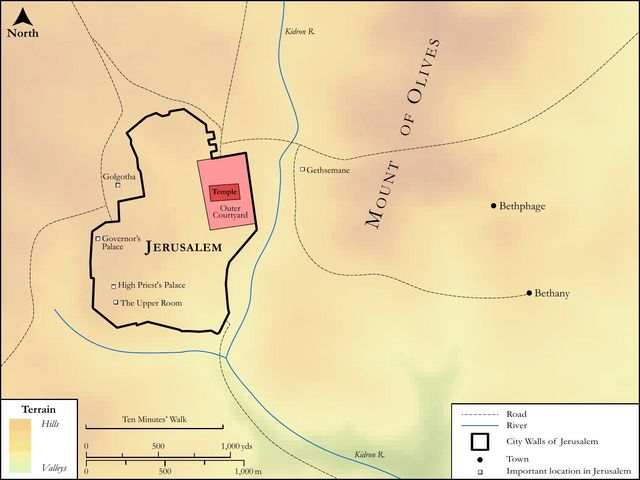
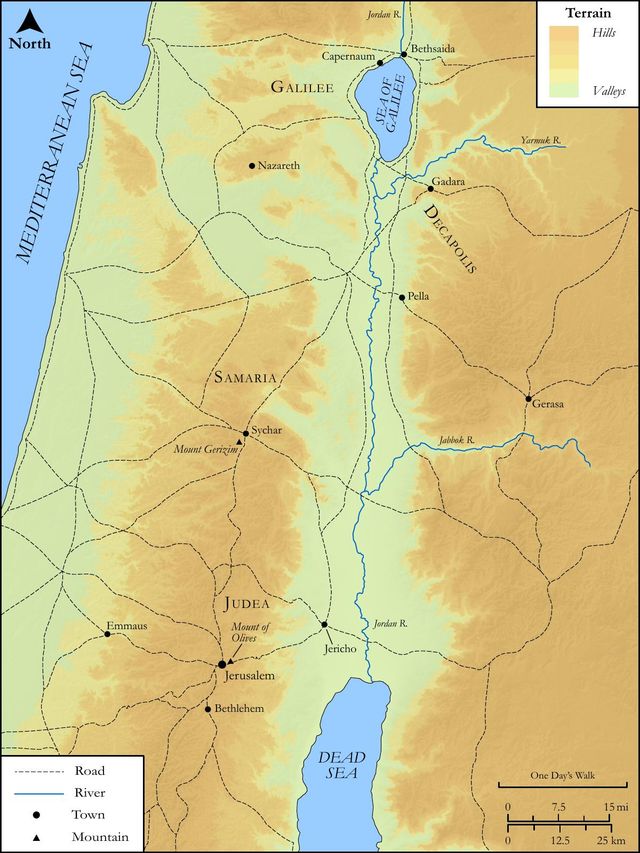
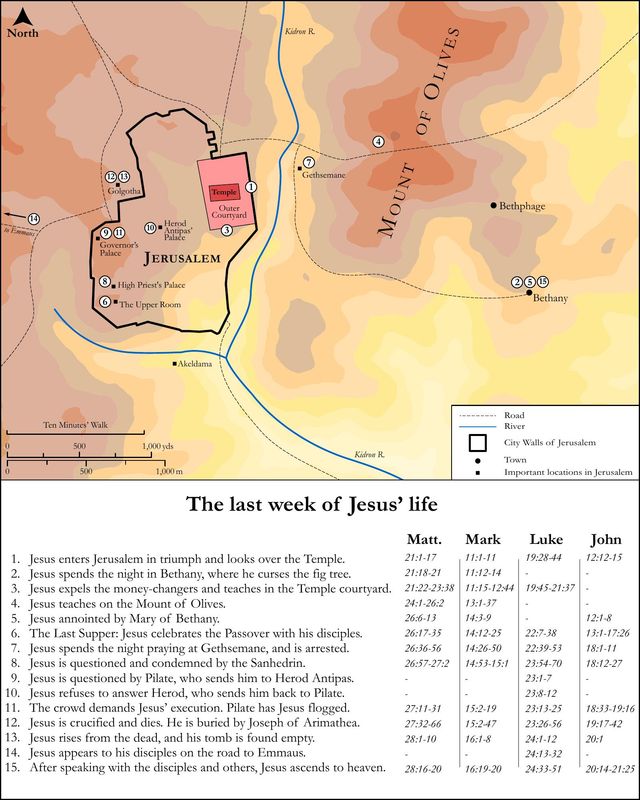
Study this verse
Historical interpretation
Five Centuries of Reception
12 surviving comments on this verse. Each one is dated, so this reads as a timeline rather than a list.
Select a marker to jump to its quote. Markers stagger vertically where authors wrote within a few decades of each other.
The women having been comforted by the Angel, are straightway met by the Lord, that when they should proclaim His resurrection to the disciples, they should speak rather from Christ's own mouth than from an Angel's.
The same order as of old now followed in the reversal of our woe, that whereas death began from the female sex, the same should now first see the glory of the Resurrection, and be made the messenger thereof. Whence the Lord adds, Go tell my brethren that they go into Galilee, there shall they see me.
The events during which the small band of women first saw the Lord, were greeted by him, fell to their knees and were commanded to announce the good news to the apostles reverse the order present at the beginning of the world. The gender through which death entered the world would also be the first to receive the glory, vision, fruit and news of the resurrection. The guards, who had seen everything, spurned the glory of the resurrection when they accepted a bribe to lie about the theft of Christ’s body. They sold their silence regarding the resurrection in exchange for the honor and pleasure of this world, for its honor is in money.
Therefore after then they had departed with fear and joy, "Behold, Jesus met them, saying, All hail." But "they held Him by the feet," and with exceeding joy and gladness ran unto Him, and received by the touch also, an infallible proof, and full assurance of the resurrection. "And they worshipped Him." What then saith He? "Be not afraid." Again, He Himself casts out their fear, making way for faith, "But go, tell my brethren, that they go into Galilee, and there shall they see me." Mark how He Himself sends good tidings to His disciples by these women, bringing to honor, as I have often said, that sex, which was most dishonored, and to good hopes; and healing that which was diseased.
Perchance some one of you would wish to be like them, to hold the feet of Jesus; ye can even now, and not His feet and His hands only, but even lay hold on that sacred head, receiving the awful mysteries with a pure conscience. But not here only, but also in that day ye shall see Him, coming with that unspeakable glory, and the multitude of the angels, if ye are disposed to be humane; and ye shall hear not these words only, "All hail!" but also those others, "Come ye blessed of my Father, inherit the kingdom prepared for you before the foundation of the world."
(Verse 9.) And behold, Jesus met them, saying: Greetings. Those who were searching, those who were running in this manner, deserved to meet the risen Lord, and first to hear, Greetings: so that the curse of the woman Eve would be overturned in women.
But they drew near and held his feet, and adored him. These came near and held his feet, because they adored him. But she, who sought the living among the dead, and still did not know that the Son of God had risen, rightly hears: Do not touch me, for I have not yet ascended to my Father (John 20:17).
Two different feelings occupied the minds of the women: fear and joy. Fear came from the magnitude of the miracle they had witnessed and joy from their desire for the resurrection. Nevertheless both feelings impelled their steps. They continued on to the apostles so that through them the seed of faith would be scattered.“And behold, Jesus met them, saying ‘Hail!’ ” They who sought him out and ran to him deserved to be the first to meet the risen Lord and to hear him say, “Hail.” Thus it happened that Eve’s curse was undone by these women.
A twofold feeling possessed the minds of the women, fear and joy; fear, at the greatness of the miracle; joy, in their desire of Him that was risen; but both added speed to their women's steps, as it follows, And did run to bring his disciples word. They went to the Apostles, that through them might be spread abroad the seed of the faith. They who thus desired, and who thus ran, merited to have their rising Lord come to meet them; whence it follows, And, behold, Jesus met them, saying, All hail.
The women ought first to hear this Hail, that the curse of the woman Eve may be removed in these women.
This may be always observed, both in the Old and New Testament, that when there is an appearance of any majestic person, the first thing done is to banish fear, that the mind being tranquillized may receive the things that are said.
(ubi sup.) We conclude that they had speech of Angels twice at the sepulchre; when they saw one Angel, of whom Matthew and Mark speak; and again when they saw two Angels, as Luke and John relate. And twice in like manner of the Lord; once at that time when Mary supposed Him to be the gardener, (John 20:15.) and now again when He met them in the way to confirm them by repetition, and to restore them from their faintness.
(de Cons. Ev. iii. ult.) That the Lord, both by His own mouth, and by the Angel, directs them to seek for Him, not in that place in which He was to show Himself first, but in Galilee, makes every believer anxious to understand in what mystery it is spoken. Galilee is interpreted 'transmigration,' or 'revelationa'. And according to the first interpretation what meaning offers itself, save this, that the grace of Christ was to pass from the people of Israel to the Gentiles, who would not believe when the Apostles should preach the Gospel to them, unless the Lord Himself should first make ready their way in the hearts of men. This is the signification of that, He shall go before you into Galilee. There shall ye see him, means, there shall ye find His members, there shall ye perceive His living Body in such as shall receive you. According to the other interpretation, 'revelation,' it is to be understood, ye shall see him no longer in the form of a servant, but in that in which He is equal with the Father. That revelation will be the true Galilee, when we shall be like him, and shall see him as he is. (1 John 3:2.) That will be the blessed passing from this world to that eternity.
While they were going, the Lord “met them” and said, “Hail!” When he meets them, he does not frighten them with his power but comes before them with the ardor of his love. He does not startle them with his authority but greets them warmly. He binds them by the covenant of the bridegroom, not by the right of the ruler. He honors them with the love of a brother. He greets them with a gracious salutation. At one time he had said to his disciples, “Salute no one on the road.” So why is it that here along the way this visitor is so quick to salute them? He does not wait to be recognized. He does not demand to be understood. He does not allow himself to be questioned. Rather, he extends this greeting immediately, enthusiastically. He did this because the force of his love overcomes and surpasses all. Furthermore, by doing so Christ himself greets the church. He makes its very heart to be his own and thus receives its body into his own, as the apostle says, “And he is the head of the body, the church.” This greeting itself evidently shows that the full figure of the church abides in these women. They are contrasted with those disciples whom Christ scolds who were wavering over the resurrection. He quells their fears by showing his side and the deep holes from the nails. By taking food, he now restores their faith.
(Serm. 76.) That in these women is contained a full figure of the Church is shown hereby, that Christ convinces His disciples when in doubt concerning the Resurrection, and confirms them when in fear; and when He meets them He does not terrify them by His power, but prevents them with the ardour of love. And Christ in His Church salutes Himself, for He has taken it into His own Body.
(ubi sup.) Then Mary was not suffered to touch Him; now she has permission not only to touch, but to hold Him altogether; they came and held him by the feet, and worshipped him.
(ubi sup.) They hold Christ's feet, who in the Church present the type of Evangelic preaching, and merit this privilege by their running to Him; and by faith so detain their Saviour's footsteps, that they may come to the honour of His perfect Godhead. She is deservedly bid to touch me not, who mourns her Lord upon earth, and so seeks Him dead in the tomb, as not to know that He reigns in heaven with the Father. This, that the same Mary, one while exalted to the summit of faith, touches Christ, and holds Him with entire and holy affection; and again, cast down in weakness of flesh, and womanly infirmity, doubts, undeserving to touch her Lord, causes us no difficulty. For that is of mystery, this of her sex; that is of divine grace, this of human nature. And so also we, when we have knowledge of divine things, live unto God; when we are wise in human things, we are blinded by our own selves.
(Serm. 80.) They held His feet to show that the head of Christ is the man, but that the woman is in Christ's feet, and that it was given to them through Christ, not to go before, but to follow the man. Christ also repeats what the Angel had said, that what an Angel had made sure, Christ might make yet more sure. It follows, Then saith Jesus unto them, Fear not.
(ubi sup.) He calls them brethren whom He has made akin to His own body; brethren whom the generous Heir has made His co-heirs; brethren, whom He has adopted to be sons of His own Father.
But the teacher says to her: "Do not touch me." Not because the Lord after the resurrection refused the touch of women, since of the two coming to his tomb it is written: "They approached, and held his feet."
But the reason why she should not touch him is also added when he continues: "For I have not yet ascended to my Father." For in our heart Jesus ascends to the Father when he is believed to be equal to the Father.
(Hom. ubi sup.) The Lord is rightly seen by His disciples in Galilee, forasmuch as He had already passed from death to life, from corruption to incorruption; for such is the interpretation of Galilee, 'Transmigration.' Happy women! who merited to announce to the world the triumph of the Resurrection! More happy souls, who in the day of judgment, when the reprobate are smitten with terror, shall have merited to enter the joy of the blessed resurrection!
Hereby He showed that He will meet with His help all those who begin the ways of virtue, and enable them to attain to everlasting salvation.
It was told above how He rose when the sepulchre was closed, to show that that body which had been shut up therein dead, was now become immortal. He now offers His feet to be held by the women, to show that He had real flesh, which can be touched by mortal creatures.
Continue studying Matthew 28:9 across the web’s major study libraries — every link below opens this exact verse, chapter, or book on the destination site.
Read & Compare
 BibleGatewayThis verse in more than 200 translations and 70 languages.
 Bible.comThe YouVersion reader — hundreds of translations, reading plans, and highlights.
 ESV.orgCrossway's official English Standard Version reader.
 NET BibleThe NET translation with 60,000+ translators' notes on every rendering decision.
 STEP BibleTyndale House's free study tool — original text, vocabulary, and scholarly resources.
 BibliaLogos Bible Software's free web reader.
 USCCBThe New American Bible (Revised Edition) with the U.S. bishops' study notes.
Commentaries
 BibleHub CommentariesDozens of classic commentaries on this verse, gathered on one page.
 StudyLightMore than 100 commentary sets — the largest collection on the web.
 BibleRefPlain-English commentary on what this verse means, verse by verse.
 Enduring WordDavid Guzik's free commentary on this chapter, widely used by Bible teachers.
 Bible Study ToolsVerse commentary alongside Greek and Hebrew study aids.
Original Language & Research
- BibleHub InterlinearThe verse word by word — original language, transliteration, and English.
- BibleHub LexiconEvery word's original-language definition and Strong's entry.
 Blue Letter BibleDeep-study tools — Strong's numbers, concordance, and word studies.
 CNTR CollationThe earliest Greek manuscripts of this verse, collated letter by letter.
Sermons, Hymns & Audio


TrulyRandomVerse is not affiliated with these sites and doesn’t control their content. They’re linked because they’re genuinely useful.
Summary
Matthew 28:9 records the first post-resurrection appearance of Jesus to His faithful followers, specifically Mary Magdalene and the "other Mary," as they were hurrying to inform the disciples of the empty tomb and the angel's message. This pivotal encounter validates the reality of Jesus' physical resurrection, elicits immediate worship from the women, and serves as a profound confirmation of His triumph over death, setting the stage for the broader proclamation of the Gospel.
Context
ShowHideLiterary Context
This verse immediately follows the dramatic events at Jesus' tomb on the first Easter morning. In Matthew 28:1-4, Mary Magdalene and the "other Mary" arrive at the tomb to find a great earthquake, an angel descending from heaven, and the Roman guards paralyzed with fear. The angel then declares Jesus' resurrection, stating, "He is not here: for he is risen, as he said. Come, see the place where the Lord lay" (Matthew 28:6). The angel further instructs them to go quickly and tell His disciples that He has risen and will meet them in Galilee (Matthew 28:7). As the women depart from the tomb "with fear and great joy" (Matthew 28:8), eager to obey the angelic command, Jesus Himself intercepts them, providing the direct, personal confirmation recorded in this verse. This encounter bridges the angelic announcement with the disciples' future commissioning.
Historical & Cultural Context
The setting is Jerusalem, specifically the path leading away from the tomb, likely early on Sunday morning. In Jewish culture, women were often not considered reliable legal witnesses, yet Matthew, like the other Gospel writers, highlights their crucial role as the first eyewitnesses to the resurrection and the first to be commissioned to share the news. The act of "holding him by the feet" was a profound gesture of reverence, submission, and recognition in Israel, as when the Shunammite woman caught Elisha by the feet, signifying a deep acknowledgment of authority and a desire to cling to the one being honored. It also served as undeniable proof of Jesus' physical, tangible presence, countering any notion of a mere spiritual apparition. The greeting "All hail" (Greek: chairete) was a common salutation, but in this context, it carries a deeper theological weight, inviting the women to share in the profound joy of the resurrection, echoing the prophetic promises of a Messiah who would bring glad tidings.
Key Themes
ShowHideMatthew 28:9 contributes significantly to several overarching themes within the Gospel of Matthew and broader biblical theology. Firstly, it powerfully affirms the physical reality of Jesus' resurrection. The tangibility of His body, allowing the women to hold His feet, is a foundational truth, emphasizing that His victory over death was complete, not merely spiritual. This aligns with the emphasis on Jesus' bodily resurrection found throughout the New Testament, as seen in Luke 24:39. Secondly, the women's immediate response of worship highlights the theme of Jesus' divine authority and worthiness of adoration. Their prostration and worship signify their recognition of Him as the resurrected Lord, a theme that culminates in the Great Commission where Jesus declares "All power is given unto me in heaven and in earth" (Matthew 28:18). Lastly, the verse underscores the theme of joy and commissioning. Jesus' greeting of "All hail" (rejoice!) transforms their fear into profound gladness, and their encounter prepares them to be the first human messengers of the resurrection, foreshadowing the global mission to "go ye therefore, and teach all nations" (Matthew 28:19).
Exposition and Analysis
ShowHideKey Word Analysis
ShowHideThis interjection serves as an emphatic particle, drawing immediate attention to what follows. It signals a sudden, unexpected, and significant event, often indicating a divine revelation or a moment of profound importance. Here, it underscores the astonishing reality of Jesus' sudden appearance to the women.
While the KJV translates it as "All hail," the underlying Greek verb is chaírō, meaning "to be cheerful, calmly happy or well-off." In its imperative plural form (chairete), it functions as a greeting, but more profoundly, it means "rejoice!" or "be glad!" In the context of the resurrection, it is a declaration of victory and an invitation to share in the overwhelming joy of Christ's triumph over sin and death, transforming the women's fear into profound gladness.
This word literally means "to fawn or crouch to," often like a dog licking its master's hand, implying prostration. It signifies an act of profound homage, reverence, and adoration, typically directed towards a deity or a figure of supreme authority. The women's immediate act of proskynéō confirms their recognition of Jesus' divine identity and authority as the resurrected Lord.
Verse Breakdown
ShowHide"And as they went to tell his disciples"
This phrase establishes the immediate context, highlighting the women's obedience to the angel's command to share the news of the resurrection with the disciples. Their journey is one of urgency and purpose, driven by both fear and great joy, as described in Matthew 28:8.
"behold, Jesus met them, saying, 'All hail.'"
This is the dramatic climax of the verse. The sudden appearance of Jesus ("behold") is an unexpected divine intervention, confirming the angel's message personally. His greeting, "All hail" (rejoice!), is more than a mere salutation; it is a proclamation of victory and an invitation to share in the profound joy of His resurrection, dispelling any lingering doubts or fears.
"And they came and held him by the feet, and worshipped him."
This describes the women's immediate and profound response. "Held him by the feet" signifies both a desperate clinging to the tangible reality of His resurrected body and a gesture of deep reverence and submission. Their subsequent act of "worshipped him" unequivocally demonstrates their recognition of Jesus' divine nature and authority, acknowledging Him as their resurrected Lord worthy of ultimate adoration.
Literary Devices
ShowHideMatthew 28:9 employs several powerful literary devices. The use of Direct Encounter or Epiphany is central, as Jesus suddenly "met them," confirming His presence in a personal and immediate way. This unexpected appearance heightens the drama and significance of the moment. The verse also utilizes Symbolism through the women's action of "held him by the feet." This physical act is symbolic of their desire to cling to the reality of His resurrection, to ground their experience in His tangible presence, and to express profound reverence and submission. Furthermore, their act of Worship immediately following the encounter underscores Jesus' divine authority and the appropriate human response to His resurrected glory. Finally, Jesus' greeting, "All hail," functions as a Proclamation of joy and victory, transforming the women's initial "fear" (Matthew 28:8) into profound gladness, setting the emotional tone for the dawn of the new covenant.
Theological and Thematic Connections
ShowHideMatthew 28:9 is a cornerstone for understanding the Christian faith, as it provides direct, eyewitness testimony to the physical resurrection of Jesus Christ. This tangibility is crucial, distinguishing the Christian message from mere spiritual experiences or abstract ideas. The women's ability to hold Jesus' feet affirms that His victory over death was not a spiritual escape, but a bodily triumph, ensuring the hope of future bodily resurrection for believers. Their immediate response of worship underscores Jesus' divine nature and His absolute worthiness of adoration, establishing Him as the resurrected Lord to whom all authority belongs. This encounter transforms their fear into joy and commissions them as the first human witnesses, setting a precedent for all believers to share the good news of Christ's victory.
Reflection and Application
ShowHideThis profound encounter in Matthew 28:9 offers timeless lessons for believers today. Just as Jesus met the women in their journey of obedience, He continues to meet us in our daily lives, often in unexpected moments, confirming His presence and truth. Their response—clinging to His feet and worshipping Him—provides a powerful model for our own faith. It calls us to a humble, tangible, and deeply reverent relationship with the resurrected Christ. We are invited not just to believe about Him, but to encounter Him personally, to hold fast to the reality of His victory over death, and to offer Him our complete adoration. This verse reminds us that our faith is grounded in a living, accessible Savior who transforms fear into joy and commissions us to share His life-changing news. It challenges us to move beyond mere intellectual assent to a vibrant, worshipping relationship, allowing His resurrection power to infuse every aspect of our lives and empower us to be His witnesses in the world.
Questions for Reflection
ShowHideFAQ
ShowHideWhy did the women hold Jesus by the feet?
ShowHideThe act of holding Jesus by the feet was a profound gesture with multiple layers of meaning. Culturally, it signified deep reverence, submission, and adoration towards a figure of great authority. The women were prostrating themselves in homage. Theologically, it also served as undeniable proof of Jesus' physical, tangible resurrection. By allowing them to touch Him, Jesus confirmed that He was not a ghost or a spirit, but truly resurrected in body, a crucial detail for validating the resurrection event and countering any future claims of a mere spiritual appearance. This act of touch provided concrete evidence to the first human witnesses.
What is the significance of Jesus saying "All hail"?
ShowHideThe King James Version's "All hail" translates the Greek word chairete (χαίρετε), which is the plural imperative of chairō (χαίρω), meaning "to rejoice" or "be glad." While it functioned as a common greeting, in this context, it carries profound theological weight. It is not merely a polite salutation but a declaration of victory and an invitation to share in the overwhelming joy of His resurrection. Jesus, having conquered sin and death, invites the women to participate in the triumph, transforming their fear and awe into profound gladness. It sets the tone for the new reality of the resurrection, a reality of joy and hope for all who believe.
Christ-Centered Fulfillment
ShowHideMatthew 28:9 stands as a glorious testament to the Christ-centered fulfillment of God's redemptive plan. Jesus, the promised Messiah, here reveals Himself as the Resurrected Lord, conquering death and the grave, as foretold in prophecies like Psalm 16:10. His physical appearance and the women's ability to hold His feet confirm the reality of His bodily resurrection, the very cornerstone of the Gospel message proclaimed by Paul in 1 Corinthians 15:3-4. This encounter is a direct fulfillment of Jesus' own predictions that He would rise again on the third day, a theme reiterated throughout the Gospels (e.g., Matthew 16:21). Furthermore, the women's immediate worship of Jesus foreshadows the universal adoration that will be given to Him as the exalted Christ, the Lamb who was slain and is worthy to receive power, riches, wisdom, strength, honor, glory, and blessing, as envisioned in Revelation 5:12-14. His greeting of "All hail" (rejoice!) encapsulates the new covenant joy found in His triumph, a joy that the world cannot take away (John 16:22). Ultimately, this verse reveals Christ as the living Head of the Church, commissioning His first witnesses to proclaim His victory, setting the stage for the Great Commission and the spread of His kingdom to the ends of the earth (Acts 1:8).