


Matthew 28:10
Bible text: King James Version (1769 Blayney text) · Public domain
Bible text: King James Version with Strong's numbers · Public domain
Bible text: Berean Standard Bible · Public domain
Bible text: American Standard Version (1901) · Public domain
Bible text: World English Bible, Messianic edition · Public domain
Bible text: Geneva Bible (1599) · Public domain
Bible text: Young's Literal Translation · Public domain
- ΤότεToteThenG5119ADVAdverb
- λέγειlegeisaysG3004V-PAI-3SVerb Present Active Indicative 3rd Singular
- αὐταῖςautaisto themG846P-DPFPersonal pronoun Dative Plural Feminine
- ὁho<the>G3588T-NSMDefinite article Nominative Singular Masculine
- Ἰησοῦς·IēsousJesusG2424N-NSM-PNoun Nominative Singular Masculine Individual
- μὴmēNotG3361PRT-NNegative Particle Negative
- φοβεῖσθε·phobeisthedo fearG5399V-PNM-2PVerb Present Middle Or Passive Deponent Imperative 2nd Plural
- ὑπάγετεhupagetedo goG5217V-PAM-2PVerb Present Active Imperative 2nd Plural
- ἀπαγγείλατεapangeilatedo tellG518V-AAM-2PVerb Aorist Active Imperative 2nd Plural
- τοῖςtoisto theG3588T-DPMDefinite article Dative Plural Masculine
- ἀδελφοῖςadelphoisbrothersG80N-DPMNoun Dative Plural Masculine
- μουmouof MineG3165P-1GSPersonal pronoun Genitive 1st Singular
- ἵναinaso thatG2443CONJConjunction
- ἀπέλθωσινapelthōsinthey may goG565V-2AAS-3PVerb 2nd Aorist Active Subjunctive 3rd Plural
- εἰςeisintoG1519PREPPreposition
- τὴνtēn<the>G3588T-ASFDefinite article Accusative Singular Feminine
- ΓαλιλαίανGalilaianGalileeG1056N-ASF-LNoun Accusative Singular Feminine Location
- κἀκεῖkakeiand thereG1563CONJ + G1563=ADV
- μεmeMeG3165P-1ASPersonal pronoun Accusative 1st Singular
- ὄψονταιopsontaiwill they beholdG3700V-FDI-3PVerb Future Middle Deponent Indicative 3rd Plural
English is a literal word-by-word gloss of the Greek, not the KJV's wording. Why?
This is the original text the KJV's translators worked from — each Greek word with its own literal English meaning in this verse, prepared by scholars at Tyndale House, Cambridge. The KJV translates whole sentences, not word by word, so its wording differs: one Greek word can become several English words, and the KJV may choose “charity” where the gloss reads “love”. Both are faithful — they answer different questions. For the KJV's own rendering, switch to the KJV text.
Details
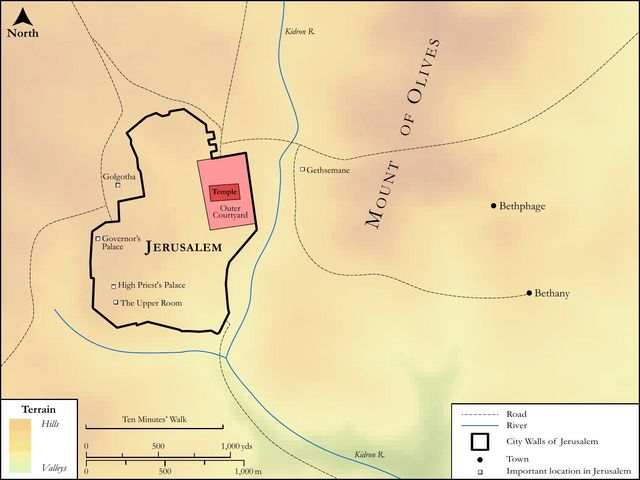
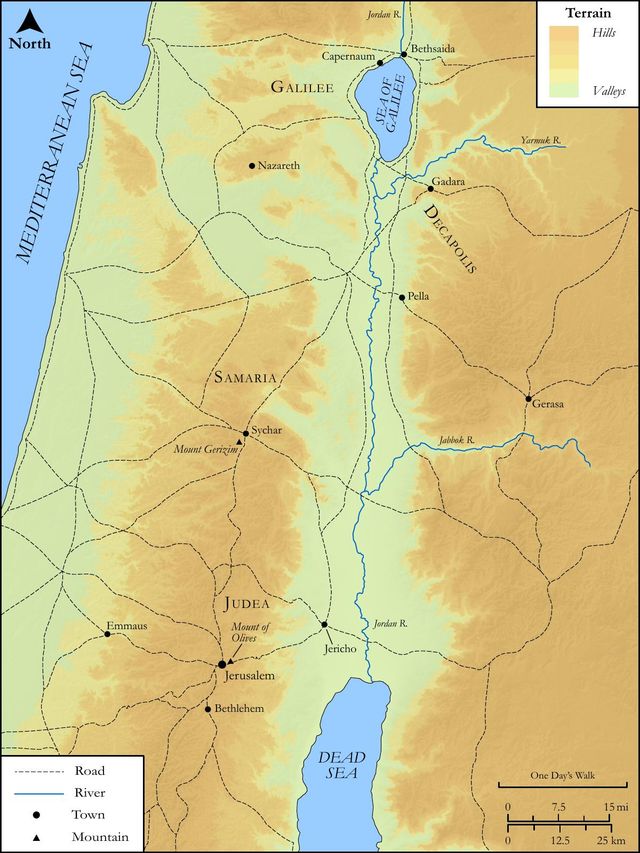
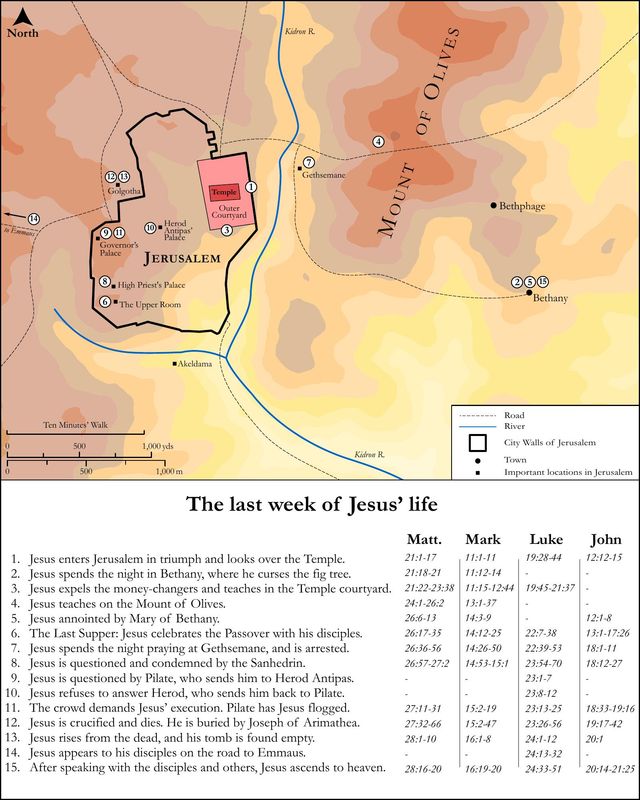
See on the biblical-era maps
Study this verse
Historical interpretation
Seven Centuries of Reception
12 surviving comments on this verse. Each one is dated, so this reads as a timeline rather than a list.
Select a marker to jump to its quote. Markers stagger vertically where authors wrote within a few decades of each other.
The women having been comforted by the Angel, are straightway met by the Lord, that when they should proclaim His resurrection to the disciples, they should speak rather from Christ's own mouth than from an Angel's.
The same order as of old now followed in the reversal of our woe, that whereas death began from the female sex, the same should now first see the glory of the Resurrection, and be made the messenger thereof. Whence the Lord adds, Go tell my brethren that they go into Galilee, there shall they see me.
The events during which the small band of women first saw the Lord, were greeted by him, fell to their knees and were commanded to announce the good news to the apostles reverse the order present at the beginning of the world. The gender through which death entered the world would also be the first to receive the glory, vision, fruit and news of the resurrection. The guards, who had seen everything, spurned the glory of the resurrection when they accepted a bribe to lie about the theft of Christ’s body. They sold their silence regarding the resurrection in exchange for the honor and pleasure of this world, for its honor is in money.
Therefore after then they had departed with fear and joy, "Behold, Jesus met them, saying, All hail." But "they held Him by the feet," and with exceeding joy and gladness ran unto Him, and received by the touch also, an infallible proof, and full assurance of the resurrection. "And they worshipped Him." What then saith He? "Be not afraid." Again, He Himself casts out their fear, making way for faith, "But go, tell my brethren, that they go into Galilee, and there shall they see me." Mark how He Himself sends good tidings to His disciples by these women, bringing to honor, as I have often said, that sex, which was most dishonored, and to good hopes; and healing that which was diseased.
Perchance some one of you would wish to be like them, to hold the feet of Jesus; ye can even now, and not His feet and His hands only, but even lay hold on that sacred head, receiving the awful mysteries with a pure conscience. But not here only, but also in that day ye shall see Him, coming with that unspeakable glory, and the multitude of the angels, if ye are disposed to be humane; and ye shall hear not these words only, "All hail!" but also those others, "Come ye blessed of my Father, inherit the kingdom prepared for you before the foundation of the world."
Two different feelings occupied the minds of the women: fear and joy. Fear came from the magnitude of the miracle they had witnessed and joy from their desire for the resurrection. Nevertheless both feelings impelled their steps. They continued on to the apostles so that through them the seed of faith would be scattered.“And behold, Jesus met them, saying ‘Hail!’ ” They who sought him out and ran to him deserved to be the first to meet the risen Lord and to hear him say, “Hail.” Thus it happened that Eve’s curse was undone by these women.
(Verse 10.) Then Jesus said to them, 'Do not be afraid. And in the old and new Testament, this must always be observed: that when a more august (or narrower) vision appears, fear is first dispelled so that, with the mind calmed, the things that are said can be heard.'
Go, tell my brothers to go to Galilee, there they will see me. And when they had gone, behold, some of the guards came into the city and reported to the chief priests all that had happened. These brothers, of whom he spoke elsewhere: I will announce your name to my brothers (Ps. XXI, 23): who do not see the Savior in Judea, but in the multitude of the Gentiles.
A twofold feeling possessed the minds of the women, fear and joy; fear, at the greatness of the miracle; joy, in their desire of Him that was risen; but both added speed to their women's steps, as it follows, And did run to bring his disciples word. They went to the Apostles, that through them might be spread abroad the seed of the faith. They who thus desired, and who thus ran, merited to have their rising Lord come to meet them; whence it follows, And, behold, Jesus met them, saying, All hail.
The women ought first to hear this Hail, that the curse of the woman Eve may be removed in these women.
This may be always observed, both in the Old and New Testament, that when there is an appearance of any majestic person, the first thing done is to banish fear, that the mind being tranquillized may receive the things that are said.
(ubi sup.) We conclude that they had speech of Angels twice at the sepulchre; when they saw one Angel, of whom Matthew and Mark speak; and again when they saw two Angels, as Luke and John relate. And twice in like manner of the Lord; once at that time when Mary supposed Him to be the gardener, (John 20:15.) and now again when He met them in the way to confirm them by repetition, and to restore them from their faintness.
(de Cons. Ev. iii. ult.) That the Lord, both by His own mouth, and by the Angel, directs them to seek for Him, not in that place in which He was to show Himself first, but in Galilee, makes every believer anxious to understand in what mystery it is spoken. Galilee is interpreted 'transmigration,' or 'revelationa'. And according to the first interpretation what meaning offers itself, save this, that the grace of Christ was to pass from the people of Israel to the Gentiles, who would not believe when the Apostles should preach the Gospel to them, unless the Lord Himself should first make ready their way in the hearts of men. This is the signification of that, He shall go before you into Galilee. There shall ye see him, means, there shall ye find His members, there shall ye perceive His living Body in such as shall receive you. According to the other interpretation, 'revelation,' it is to be understood, ye shall see him no longer in the form of a servant, but in that in which He is equal with the Father. That revelation will be the true Galilee, when we shall be like him, and shall see him as he is. (1 John 3:2.) That will be the blessed passing from this world to that eternity.
While they were going, the Lord “met them” and said, “Hail!” When he meets them, he does not frighten them with his power but comes before them with the ardor of his love. He does not startle them with his authority but greets them warmly. He binds them by the covenant of the bridegroom, not by the right of the ruler. He honors them with the love of a brother. He greets them with a gracious salutation. At one time he had said to his disciples, “Salute no one on the road.” So why is it that here along the way this visitor is so quick to salute them? He does not wait to be recognized. He does not demand to be understood. He does not allow himself to be questioned. Rather, he extends this greeting immediately, enthusiastically. He did this because the force of his love overcomes and surpasses all. Furthermore, by doing so Christ himself greets the church. He makes its very heart to be his own and thus receives its body into his own, as the apostle says, “And he is the head of the body, the church.” This greeting itself evidently shows that the full figure of the church abides in these women. They are contrasted with those disciples whom Christ scolds who were wavering over the resurrection. He quells their fears by showing his side and the deep holes from the nails. By taking food, he now restores their faith.
(Serm. 76.) That in these women is contained a full figure of the Church is shown hereby, that Christ convinces His disciples when in doubt concerning the Resurrection, and confirms them when in fear; and when He meets them He does not terrify them by His power, but prevents them with the ardour of love. And Christ in His Church salutes Himself, for He has taken it into His own Body.
(ubi sup.) Then Mary was not suffered to touch Him; now she has permission not only to touch, but to hold Him altogether; they came and held him by the feet, and worshipped him.
(ubi sup.) They hold Christ's feet, who in the Church present the type of Evangelic preaching, and merit this privilege by their running to Him; and by faith so detain their Saviour's footsteps, that they may come to the honour of His perfect Godhead. She is deservedly bid to touch me not, who mourns her Lord upon earth, and so seeks Him dead in the tomb, as not to know that He reigns in heaven with the Father. This, that the same Mary, one while exalted to the summit of faith, touches Christ, and holds Him with entire and holy affection; and again, cast down in weakness of flesh, and womanly infirmity, doubts, undeserving to touch her Lord, causes us no difficulty. For that is of mystery, this of her sex; that is of divine grace, this of human nature. And so also we, when we have knowledge of divine things, live unto God; when we are wise in human things, we are blinded by our own selves.
(Serm. 80.) They held His feet to show that the head of Christ is the man, but that the woman is in Christ's feet, and that it was given to them through Christ, not to go before, but to follow the man. Christ also repeats what the Angel had said, that what an Angel had made sure, Christ might make yet more sure. It follows, Then saith Jesus unto them, Fear not.
(ubi sup.) He calls them brethren whom He has made akin to His own body; brethren whom the generous Heir has made His co-heirs; brethren, whom He has adopted to be sons of His own Father.
(Hom. ubi sup.) The Lord is rightly seen by His disciples in Galilee, forasmuch as He had already passed from death to life, from corruption to incorruption; for such is the interpretation of Galilee, 'Transmigration.' Happy women! who merited to announce to the world the triumph of the Resurrection! More happy souls, who in the day of judgment, when the reprobate are smitten with terror, shall have merited to enter the joy of the blessed resurrection!
Hereby He showed that He will meet with His help all those who begin the ways of virtue, and enable them to attain to everlasting salvation.
It was told above how He rose when the sepulchre was closed, to show that that body which had been shut up therein dead, was now become immortal. He now offers His feet to be held by the women, to show that He had real flesh, which can be touched by mortal creatures.
. Jesus says to the women, "Rejoice!" As womankind had been sentenced to sorrow, so the Lord procured joy for womankind by His Resurrection, and blessed them. With extreme reverence and honor for Him they grasped His feet, in their piety not daring to touch any other part of His Body. Some say that they grasped His feet purposely to ascertain if He had truly risen, and was not only an apparition or a spirit. For they suspected that He was a spirit. These two Mary’s, therefore, touched His feet; but according to John, Mary Magdalene attempted to touch Him but was not permitted to do so, because she wanted to continue to be with Him as she had before (Jn. 20:17). Or perhaps she was not permitted to touch Jesus, in John’s account, because she was being too curious. For since she had already touched His feet, as Matthew says, what need was there for her to touch Him again? So He kept her at arm’s length.
Continue studying Matthew 28:10 across the web’s major study libraries — every link below opens this exact verse, chapter, or book on the destination site.
Read & Compare
 BibleGatewayThis verse in more than 200 translations and 70 languages.
 Bible.comThe YouVersion reader — hundreds of translations, reading plans, and highlights.
 ESV.orgCrossway's official English Standard Version reader.
 NET BibleThe NET translation with 60,000+ translators' notes on every rendering decision.
 STEP BibleTyndale House's free study tool — original text, vocabulary, and scholarly resources.
 BibliaLogos Bible Software's free web reader.
 USCCBThe New American Bible (Revised Edition) with the U.S. bishops' study notes.
Commentaries
 BibleHub CommentariesDozens of classic commentaries on this verse, gathered on one page.
 StudyLightMore than 100 commentary sets — the largest collection on the web.
 BibleRefPlain-English commentary on what this verse means, verse by verse.
 Enduring WordDavid Guzik's free commentary on this chapter, widely used by Bible teachers.
 Bible Study ToolsVerse commentary alongside Greek and Hebrew study aids.
Original Language & Research
- BibleHub InterlinearThe verse word by word — original language, transliteration, and English.
- BibleHub LexiconEvery word's original-language definition and Strong's entry.
 Blue Letter BibleDeep-study tools — Strong's numbers, concordance, and word studies.
 CNTR CollationThe earliest Greek manuscripts of this verse, collated letter by letter.
Sermons, Hymns & Audio


TrulyRandomVerse is not affiliated with these sites and doesn’t control their content. They’re linked because they’re genuinely useful.
Summary
Matthew 28:10 captures a pivotal post-resurrection encounter where Jesus directly addresses the women who first came to His tomb, offering them profound reassurance and a clear, urgent command. He instructs them to dispel their fear and immediately go tell His disciples, whom He now intimately calls "my brethren," to proceed to Galilee, where He promises to meet them. This verse is a foundational moment, confirming the reality of the resurrection and initiating the gathering that would precede the Great Commission.
Context
ShowHideLiterary Context
This verse immediately follows the miraculous discovery of the empty tomb by Mary Magdalene and the "other Mary" (Matthew 28:1). An angel had already appeared to them, declaring Jesus' resurrection and instructing them to tell the disciples to go to Galilee, where they would see Him (Matthew 28:5-7). As the women hurried away with "fear and great joy," Jesus Himself met them, reiterating and personally confirming the angel's message (Matthew 28:8-9). Thus, Matthew 28:10 serves as Jesus' direct, personal affirmation of the angel's commission, adding His own comforting presence and authority to the command. It sets the stage for the disciples' journey to Galilee and the subsequent climactic encounter where Jesus delivers the Great Commission.
Historical & Cultural Context
The events unfold in Jerusalem shortly after the Passover festival, a time of heightened religious and political tension. Jesus had just been crucified by Roman authorities at the instigation of Jewish religious leaders. For the disciples, this was a period of immense grief, confusion, and fear, as they were followers of a condemned man and potentially targets themselves. In Jewish society, the testimony of women was generally not accepted in legal proceedings, making their role as the first witnesses to the resurrection and messengers to the male disciples particularly striking and counter-cultural. Galilee, in contrast to Jerusalem, was Jesus' primary region of ministry, a place of familiarity and relative safety away from the hostile authorities in the capital. The instruction to meet there signifies a return to the roots of their discipleship and a strategic move to a less volatile environment for this crucial post-resurrection gathering.
Key Themes
ShowHideThis verse powerfully reinforces several key themes central to the Gospel of Matthew and the broader New Testament. Firstly, it undeniably establishes the reality of Jesus' bodily resurrection, as He is alive, speaking, and issuing commands. Secondly, Jesus' words, "Be not afraid," echo a recurring divine motif throughout Scripture, offering divine reassurance in the face of overwhelming, fear-inducing encounters with God's power. Thirdly, His reference to the disciples as "my brethren" signifies a profound shift in their relationship, underscoring the establishment of a new covenant family bond forged through His atoning work and resurrection. Finally, the command to gather in Galilee highlights the theme of divine appointment and mission, as this location becomes the designated site for Jesus to impart final instructions and empower His disciples for their global mission, culminating in the Great Commission.
Exposition and Analysis
ShowHideKey Word Analysis
ShowHideThis word, often translated "fear," signifies to be frightened, alarmed, or to be in awe of. In this context, it addresses the natural human response to the supernatural and the traumatic events the women had just experienced. Jesus' command "Be not afraid" is a common divine utterance throughout the Bible, consistently serving to calm human apprehension in the presence of God's power or a divine messenger, inviting trust rather than terror.
Derived from Greek words meaning "a" (connective particle) and "womb," literally "from the same womb." While often referring to biological brothers, here Jesus uses it figuratively to denote a deep, familial spiritual bond. This intimate term, used by Jesus post-resurrection, signifies a profound transformation in His relationship with His disciples, elevating them to the status of a new, spiritual family, united by His redemptive work.
This verb describes a specific kind of seeing—to gaze with wide-open eyes, as at something remarkable. It implies a vision that is more than mere casual observation; it suggests an appearance or manifestation that is significant and impactful. The promise that "there shall they see me" implies a purposeful, undeniable encounter with the resurrected Christ, designed to confirm His reality and commission His followers.
Verse Breakdown
ShowHide"Then said Jesus unto them"
This phrase establishes Jesus' direct, personal involvement and authority. It highlights that the message is not merely from an angel, but from the resurrected Christ Himself, giving it ultimate weight and credibility.
"Be not afraid"
This is Jesus' immediate pastoral response to the women's "fear and great joy" (Matthew 28:8). It is a divine reassurance, calming their natural human trepidation in the face of the miraculous and the divine presence, inviting them to move from terror to faith.
"go tell my brethren"
This is a clear, urgent command to action. The women, despite their social standing, are commissioned as the first evangelists of the resurrection. The term "my brethren" is profoundly significant, indicating a new, intimate relationship between Jesus and His disciples, forged through His death and resurrection, transcending their previous master-disciple dynamic.
"that they go into Galilee"
This specifies the destination for the crucial post-resurrection gathering. Galilee was the primary region of Jesus' public ministry, a familiar and perhaps safer place away from the hostile authorities in Jerusalem. It signifies a return to the roots of their discipleship and a strategic location for the next phase of His plan.
"and there shall they see me"
This is a promise and a purpose for their journey. The disciples are not merely to hear about the resurrection, but to experience a personal, undeniable encounter with the risen Lord. This meeting in Galilee will be foundational for their understanding, their faith, and their subsequent commission.
Literary Devices
ShowHideMatthew 28:10 employs several potent literary devices. The most prominent is Direct Discourse, as Jesus' exact words are quoted, lending immediate authority and intimacy to the message. There is also a powerful sense of Reassurance conveyed through Jesus' opening command, "Be not afraid," a common motif in biblical encounters with the divine that serves to calm human fear and prepare for revelation. The instruction to "go tell my brethren" functions as a Commissioning, highlighting the women's pivotal role as the first evangelists of the resurrection. Furthermore, the mention of Galilee serves as a Symbolic Setting, representing a return to the familiar, a place of new beginnings away from the dangers of Jerusalem, where the disciples would be re-gathered and re-commissioned. This verse also contains a subtle Irony, as women, whose testimony was often dismissed in that culture, are chosen by Christ to deliver the most significant news in human history to the male disciples.
Theological and Thematic Connections
ShowHideMatthew 28:10 stands as a profound theological statement, affirming the absolute reality of Christ's bodily resurrection and His ongoing, active lordship. Jesus' appearance and direct command underscore His authority over life and death, demonstrating that His triumph over the grave is not merely a spiritual event but a tangible, historical fact. The intimate address "my brethren" signifies the inauguration of a new spiritual family, the church, where believers are united with Christ and with one another through His redemptive work. This verse also highlights the divine pattern of commissioning witnesses to spread the good news, beginning with the most unexpected messengers—the women—and setting the stage for the global mission that would soon follow. It emphasizes that the resurrected Christ is not distant but actively engaged in guiding His church, calling His followers to gather for further instruction and empowerment.
Reflection and Application
ShowHideMatthew 28:10 offers timeless encouragement and clear direction for believers today. Just as Jesus met the women in their fear and joy, He continues to meet us in our own anxieties and triumphs, offering His comforting presence and peace. His command to "Be not afraid" reminds us that even in the face of overwhelming circumstances or divine encounters, we are called to trust in His sovereignty and goodness. The women's immediate obedience to "go tell" serves as a powerful model for our own call to evangelism; our personal encounter with the risen Christ should compel us to share the transformative news of His resurrection with others. Furthermore, the instruction for the disciples to gather in Galilee underscores the vital importance of Christian community and fellowship. It is within the context of gathering that we receive further instruction, encouragement, and empowerment for our collective mission. Our faithful obedience to Christ's commands, even when they seem daunting or counter-intuitive, always leads to deeper encounters with Him and a clearer understanding of our purpose in His kingdom.
Questions for Reflection
ShowHideFAQ
ShowHideWhy did Jesus tell them to go to Galilee specifically?
ShowHideGalilee was Jesus' primary region of public ministry, a familiar and perhaps safer environment compared to Jerusalem, which was the center of religious and political opposition. By directing them to Galilee, Jesus was calling His disciples back to the place where their journey with Him largely began, a place away from the immediate dangers and scrutiny of the Jerusalem authorities. It served as a designated, strategic location for a crucial post-resurrection gathering where He would give them final instructions and commission them for their global mission, as recorded in Matthew 28:16-20.
Why were women the first to be told about the resurrection and commissioned to tell the disciples?
ShowHideIn Jewish society of that time, the testimony of women was often not considered legally valid. Therefore, Jesus' choice to appear first to women and commission them as the primary messengers of His resurrection is highly significant. It demonstrates His universal reach, valuing and empowering those often overlooked by society. It also highlights the divine nature of the event; God chose to use the "weak" and "foolish" things of the world to shame the wise, ensuring that the truth of the resurrection rested on divine power, not human credibility alone. This choice also paved the way for women's integral role in the early church and in the spread of the Gospel.
What is the significance of Jesus calling His disciples "my brethren"?
ShowHideThe term "my brethren" (Greek: adelphoi) signifies a profound shift in the relationship between Jesus and His followers after His resurrection. Prior to this, they were His disciples or servants. Now, through His atoning death and resurrection, they are brought into a new, intimate family relationship with Him, sharing in His divine sonship by adoption. This term underscores the new covenant reality where believers are united with Christ, becoming co-heirs with Him. It reflects the truth that Jesus is not ashamed to call them "brothers" (as seen in Hebrews 2:11-12), signifying their new status as members of God's household.
Christ-Centered Fulfillment
ShowHideMatthew 28:10, though brief, is profoundly Christ-centered, revealing the resurrected Lord as the active, sovereign initiator of His new covenant community and global mission. Jesus' appearance to the women and His command to "go tell my brethren" foreshadows His ongoing role as the Head of the Church, who continually calls and sends His followers. His intimate address, "my brethren," fulfills the deeper spiritual reality that through His sacrifice, He has brought many sons and daughters to glory, making them co-heirs with Him (as seen in Romans 8:17). This verse speaks to Christ's victory over sin and death, establishing Him as the firstborn from the dead (Colossians 1:18), whose resurrection guarantees the resurrection life for all who believe in Him. The command to meet in Galilee, a place of new beginnings, points to Christ as the one who continually gathers His scattered sheep, transforming their fear into faith and their confusion into clarity. Ultimately, this verse sets the stage for the Great Commission, where the resurrected Christ, having all authority in heaven and on earth (Matthew 28:18), empowers His "brethren" to make disciples of all nations, thereby fulfilling His redemptive purpose for humanity and establishing His kingdom to the ends of the earth. His promise, "there shall they see me," is a divine assurance of His abiding presence with His church, a promise that extends through the ages, culminating in His glorious return (Revelation 1:7).