


John 20:17
Bible text: King James Version (1769 Blayney text) · Public domain
Bible text: King James Version with Strong's numbers · Public domain
Bible text: Berean Standard Bible · Public domain
Bible text: American Standard Version (1901) · Public domain
Bible text: World English Bible, Messianic edition · Public domain
Bible text: Geneva Bible (1599) · Public domain
Bible text: Young's Literal Translation · Public domain
- λέγειlegeiSaysG3004V-PAI-3SVerb Present Active Indicative 3rd Singular
- αὐτῇautēato herG846P-DSFPersonal pronoun Dative Singular Feminine
- ὁho<the>G3588T-NSMDefinite article Nominative Singular Masculine
- Ἰησοῦς·IēsousJesusG2424N-NSM-PNoun Nominative Singular Masculine Individual
- μήmēNotG3361PRT-NNegative Particle Negative
- μουmouMeG3165P-1GSPersonal pronoun Genitive 1st Singular
- ἅπτου·haptoudo yourself touchG681V-PMM-2SVerb Present Middle Imperative 2nd Singular
- οὔπωoupōnot yetG3768ADV-NAdverb or adverb and particle combined Negative
- γὰρgarforG1063CONJConjunction
- ἀναβέβηκαanabebēkahave I ascendedG305V-RAI-1SVerb Perfect Active Indicative 1st Singular
- πρὸςprostoG4314PREPPreposition
- τὸνtontheG3588T-ASMDefinite article Accusative Singular Masculine
- πατέραpateraFatherG3962N-ASM-TNoun Accusative Singular Masculine Title
- μουmouof mineG3165P-1GSPersonal pronoun Genitive 1st Singular
- πορεύουporeuoudo goG4198V-PNM-2SVerb Present Middle Or Passive Deponent Imperative 2nd Singular
- δὲdehoweverG1161CONJConjunction
- πρὸςprostoG4314PREPPreposition
- τοὺςtoustheG3588T-APMDefinite article Accusative Plural Masculine
- ἀδελφούςadelphousbrothersG80N-APMNoun Accusative Plural Masculine
- μουmouof MineG3165P-1GSPersonal pronoun Genitive 1st Singular
- καὶkaiandG2532CONJConjunction
- εἰπὲeipedo sayG2036V-2AAM-2SVerb 2nd Aorist Active Imperative 2nd Singular
- αὐτοῖς·autoisto themG846P-DPMPersonal pronoun Dative Plural Masculine
- ἀναβαίνωanabainōI am ascendingG305V-PAI-1SVerb Present Active Indicative 1st Singular
- πρὸςprostoG4314PREPPreposition
- τὸνtontheG3588T-ASMDefinite article Accusative Singular Masculine
- πατέραpateraFatherG3962N-ASM-TNoun Accusative Singular Masculine Title
- μουmouof MineG3165P-1GSPersonal pronoun Genitive 1st Singular
- καὶkaiandG2532CONJConjunction
- πατέραpateraFatherG3962N-ASM-TNoun Accusative Singular Masculine Title
- ὑμῶνhumōnof youG4771P-2GPPersonal pronoun Genitive 2nd Plural
- καὶkaiand [to]G2532CONJConjunction
- θεόνtheonGodG2316N-ASM-TNoun Accusative Singular Masculine Title
- μουmouof MineG3165P-1GSPersonal pronoun Genitive 1st Singular
- καὶkaiandG2532CONJConjunction
- θεὸνtheonGodG2316N-ASM-TNoun Accusative Singular Masculine Title
- ὑμῶνhumōnof youG4771P-2GPPersonal pronoun Genitive 2nd Plural
English is a literal word-by-word gloss of the Greek, not the KJV's wording. Why?
This is the original text the KJV's translators worked from — each Greek word with its own literal English meaning in this verse, prepared by scholars at Tyndale House, Cambridge. The KJV translates whole sentences, not word by word, so its wording differs: one Greek word can become several English words, and the KJV may choose “charity” where the gloss reads “love”. Both are faithful — they answer different questions. For the KJV's own rendering, switch to the KJV text.
Details
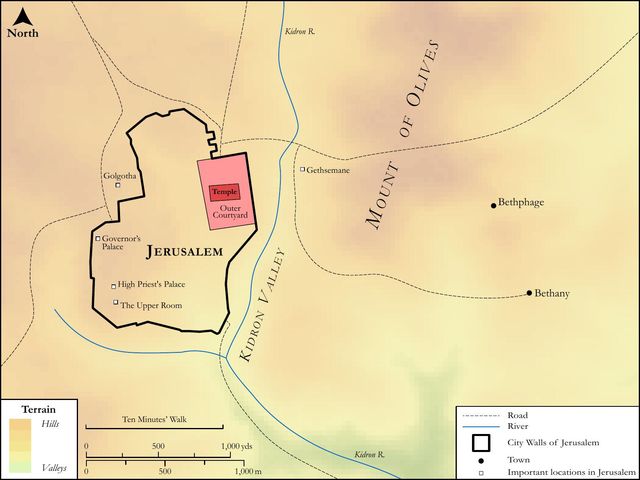
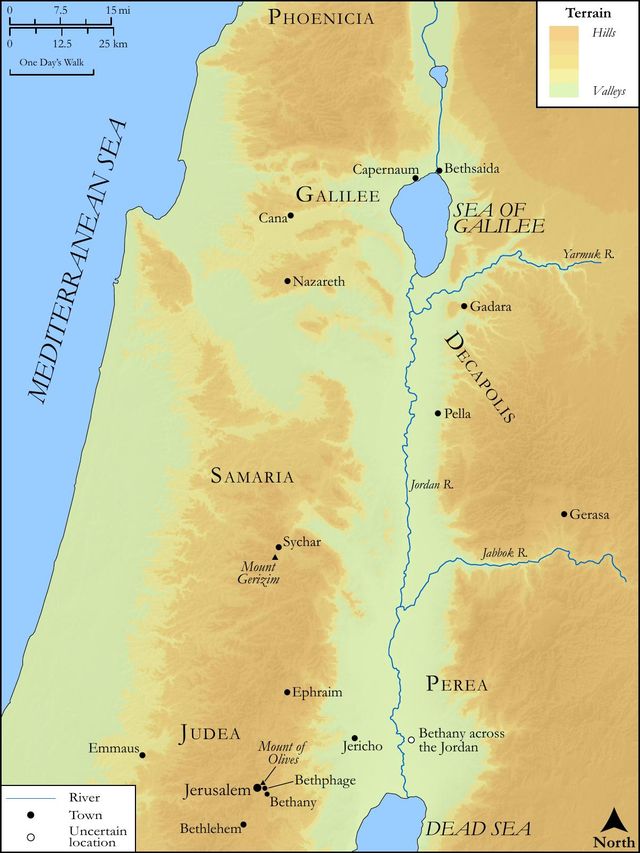
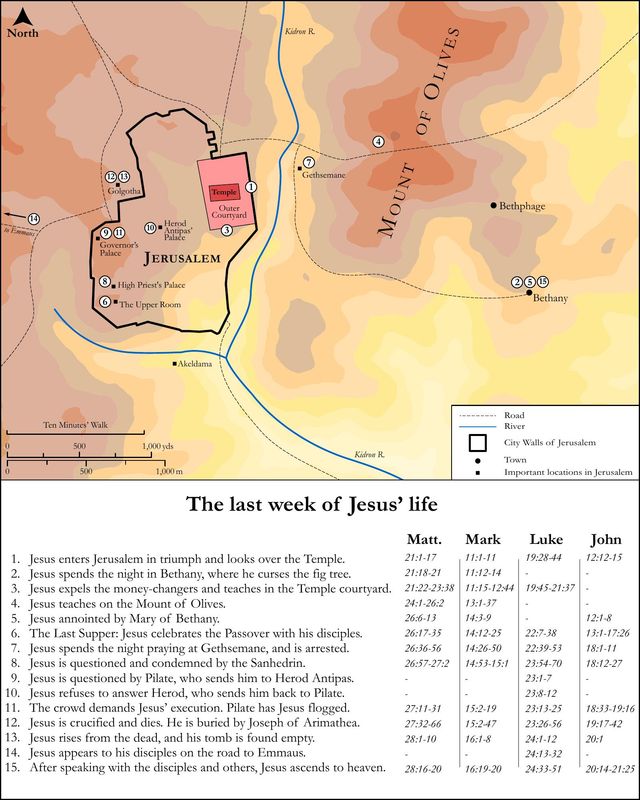
See on the biblical-era maps
Study this verse
Public-domain commentary
Matthew Henry
From his Commentary on the Whole Bible. Henry comments on passages, not single verses — this entry covers John 20:11–18. His four-level outline is real structure in the source text, so it is rendered as structure.
St. Mark tells us that Christ appeared first to Mary Magdalene (Mar 16:9); that appearance is here largely related; and we may observe,
I.The constancy and fervency of Mary Magdalene's affection to the Lord Jesus, Joh 20:11.
1.She staid at the sepulchre, when Peter and John were gone, because there her Master had lain, and there she was likeliest to hear some tidings of him. Note,
(1.)Where there is a true love to Christ there will be a constant adherence to him, and a resolution with purpose of heart to cleave to him. This good woman, though she has lost him, yet, rather than seem to desert him, will abide by his grave for his sake, and continue in his love even when she wants the comfort of it.
(2.)Where there is a true desire of acquaintance with Christ there will be a constant attendance on the means of knowledge. See Hos 6:2, Hos 6:3, The third day he will raise us up; and then shall we know the meaning of that resurrection, if we follow on to know, as Mary here.
2.She staid there weeping, and these tears loudly bespoke her affection to her Master. Those that have lost Christ have cause to weep; she wept at the remembrance of his bitter sufferings; wept for his death, and the loss which she and her friends and the country sustained by it; wept to think of returning home without him; wept because she did not now find his body. Those that seek Christ must seek him sorrowing (Luk 2:48), must weep, not for him, but for themselves.
3.As she wept, she looked into the sepulchre, that her eye might affect her heart. When we are in search of something that we have lost we look again and again in the place where we last left it, and expected to have found it. She will look yet seven times, not knowing but that at length she may see some encouragement. Note,
(1.)Weeping must not hinder seeking. Though she wept, she stooped down and looked in.
(2.)Those are likely to seek and find that seek with affection, that seek in tears.
II.The vision she had of two angels in the sepulchre, Joh 20:12. Observe here,
1.The description of the persons she saw. They were two angels in white, sitting (probably on some benches or ledges hewn out in the rock) one at the head, and the other at the feet, of the grave. Here we have,
(1.)Their nature. They were angels, messengers from heaven, sent on purpose, on this great occasion,
[1.]To honour the Son and to grace the solemnity of his resurrection. Now that the Son of God was again to be brought into the world, the angels have a charge to attend him, as they did at his birth, Heb 1:6.
[2.]To comfort the saints; to speak good words to those that were in sorrow, and, by giving them notice that the Lord was risen, to prepare them for the sight of him.
(2.)Their number: two, not a multitude of the heavenly host, to sing praise, only two, to bear witness; for out of the mouth of two witnesses this word would be established.
(3.)Their array: They were in white, denoting,
[1.]Their purity and holiness. The best of men standing before the angels, and compared with them, are clothed in filthy garments (Zac 3:3), but angels are spotless; and glorified saints, when they come to be as the angels, shall walk with Christ in white.
[2.]Their glory, and glorying, upon this occasion. The white in which they appeared represented the brightness of that state into which Christ was now risen.
(4.)Their posture and place: They sat, as it were, reposing themselves in Christ's grave; for angels, though they needed not a restoration, were obliged to Christ for their establishment. These angels went into the grave, to teach us not to be afraid of it, nor to think that our resting in it awhile will be any prejudice to our immortality; no, matters are so ordered that the grave is not much out of our way to heaven. It intimates likewise that angels are to be employed about the saints, not only at their death, to carry their souls into Abraham's bosom, but at the great day, to raise their bodies, Mat 24:31. These angelic guards (and angels are called watchers Dan 4:23), keeping possession of the sepulchre, when they had frightened away the guards which the enemies had set, represents Christ's victory over the powers of darkness, routing and defeating them. Thus Michael and his angels are more than conquerors. Their sitting to face one another, one at his bed's head, the other at his bed's feet, denotes their care of the entire body of Christ, his mystical as well as his natural body, from head to foot; it may also remind us of the two cherubim, placed one at either end of the mercy-seat, looking one at another, Exo 25:18. Christ crucified was the great propitiatory, at the head and feet of which were these two cherubim, not with flaming swords, to keep us fRom. but welcome messengers, to direct us to, the way of life.
2.Their compassionate enquiry into the cause of Mary Magdalene's grief (Joh 20:13): Woman, why weepest thou? This question was,
(1.)A rebuke to her weeping: "Why weepest thou, when thou has cause to rejoice?" Many of the floods of our tears would dry away before such a search as this into the fountain of them. Why are thou cast down?
(2.)It was designed to show how much angels are concerned at the griefs of the saints, having a charge to minister to them for their comfort. Christians should thus sympathize with one another.
(3.)It was only to make an occasion of informing her of that which would turn her mourning into rejoicing, would put off her sackcloth, and gird her with gladness.
3.The melancholy account she gives them of her present distress: Because they have taken away the blessed body I came to embalm, and I know not where they have laid it. The same story she had told, Joh 20:2. In it we may see,
(1.)The weakness of her faith. If she had had faith as a grain of mustard-seed, this mountain would have been removed; but we often perplex ourselves needlessly with imaginary difficulties, which faith would discover to us as real advantages. Many good people complain of the clouds and darkness they are under, which are the necessary methods of grace for the humbling of their souls, the mortifying of their sins, and the endearing of Christ to them.
(2.)The strength of her love. Those that have a true affection for Christ cannot but be in great affliction when they have lost either the comfortable tokens of his love in their souls or the comfortable opportunities of conversing with him, and doing him honour, in his ordinances. Mary Magdalene is not diverted from her enquiries by the surprise of the vision, nor satisfied with the honour of it; but still she harps upon the same string: They have taken away my Lord. A sight of angels and their smiles will not suffice without a sight of Christ and God's smiles in him. Nay, the sight of angels is but an opportunity of pursuing her enquiries after Christ. All creatures, the most excellent, the most dear, should be used as means, and but as means, to bring us into acquaintance with God in Christ. The angels asked her, Why weepest thou? I have cause enough to weep, says she, for they have taken away my Lord, and, like Micah, What have I more? Do you ask, Why I weep? My beloved has withdrawn himself, and is gone. Note, None know, but those who have experienced it, the sorrow of a deserted soul, that has had comfortable evidences of the love of God in Christ, and hopes of heaven, but has now lost them, and walks in darkness; such a wounded spirit who can bear?
III.Christ's appearing to her while she was talking with the angels, and telling them her case.
Before they had given her any answer, Christ himself steps in, to satisfy her enquiries, for God now speaketh to us by his Son; none but he himself can direct us to himself. Mary would fain know where her Lord is, and behold he is at her right hand. Note, 1. Those that will be content with nothing short of a sight of Christ shall be put off with nothing less. He never said to the soul that sought him, Seek in vain. "Is it Christ that thou wouldest have? Christ thou shalt have." 2. Christ, in manifesting himself to those that seek him, often outdoes their expectations. Mary longs to see the dead body of Christ, and complains of the loss of that, and behold she sees him alive. Thus he does for his praying people more than they are able to ask or think. In this appearance of Christ to Mary observe,
(1.)How he did at first conceal himself from her.
[1.]He stood as a common person, and she looked upon him accordingly, Joh 20:14. She stood expecting an answer to her complaint from the angels; and either seeing the shadow, or hearing the tread, of some person behind her, she turned herself back from talking with the angels, and sees Jesus himself standing, the very person she was looking for, and yet she knew not that it was Jesus. Note, First, The Lord is nigh unto them that are of a broken heart (Psa 34:18), nearer than they are aware. Those that seek Christ, though they do not see him, may yet be sure he is not far from them. Secondly, Those that diligently seek the Lord will turn every way in their enquiry after him. Mary turned herself back, in hopes of some discoveries. Several of the ancients suggest that Mary was directed to look behind her by the angels' rising up, and doing their obeisance to the Lord Jesus, whom they saw before Mary did; and that she looked back to see to whom it was they paid such a profound reverence. But, if so, it is not likely that she would have taken him for the gardener; rather, therefore, it was her earnest desire in seeking that made her turn every way. Thirdly, Christ is often near his people, and they are not aware of him. She knew not that it was Jesus; not that he appeared in any other likeness, but either it was a careless transient look she cast upon him, and, her eyes being full of care, she could not so well distinguish, or they were holden, that she should not know him, as those of the two disciples, Luk 24:16.
[2.]He asked her a common question, and she answered him accordingly, Joh 20:15.
First, The question he asked her was natural enough, and what any one would have asked her: "Woman, why weepest thou? Whom seekest thou? What business hast thou here in the garden so early? And what is all this noise and ado for?" Perhaps it was spoken with some roughness, as Joseph spoke to his brethren when he made himself strange, before he made himself known to them. It should seem, this was the first word Christ spoke after his resurrection: "Why weepest thou? I am risen." The resurrection of Christ has enough in it to ally all our sorrows, to check the streams, and dry up the fountains, of our tears. Observe here, Christ takes cognizance, 1. Of his people's griefs, and enquires, Why weep you? He bottles their tears, and records them in his book. 2. Of his people's cares and enquires, Whom seek you, and what would you have? When he knows they are seeking him, yet he will know it from them; they must tell him whom they seek.
Secondly, The reply she made him is natural enough; she does not give him a direct answer, but, as if she should say, "Why do you banter me, and upbraid me with my tears? You know why I weep, and whom I seek;" and therefore, supposing him to be the gardener, the person employed by Joseph to dress and keep his garden, who, she thought, was come thither thus early to his work, she said, Sir, if thou hast carried him hence, pray tell me where thou hast laid him, and I will take him away. See here, 1. The error of her understanding. She supposed our Lord Jesus to be the gardener, perhaps because he asked what authority she had to be there. Note, Troubled spirits, in a cloudy and dark day, are apt to misrepresent Christ to themselves, and to put wrong constructions upon the methods of his providence and grace. 2. The truth of her affection. See how her heart was set upon finding Christ. She puts the question to every one she meets, like the careful spouse, Saw you him whom my soul loveth? She speaks respectfully to a gardener, and calls him Sir, in hopes to gain some intelligence from him concerning her beloved. When she speaks of Christ, she does not name him; but, If thou have borne him hence, taking it for granted that this gardener was full of thoughts concerning this Jesus as well as she, and therefore could not but know whom she meant. Another evidence of the strength of her affection was that, wherever he was laid, she would undertake to remove him. Such a body, with such a weight of spices about it, was much more than she could pretend to carry; but true love thinks it can do more than it can, and makes nothing of difficulties. She supposed this gardener grudged that the body of one that was ignominiously crucified should have the honour to be laid in his master's new tomb, and that therefore he had removed it to some sorry place, which he thought fitter for it. Yet Mary does not threaten to tell his master, and get him turned out of his place for it; but undertakes to find out some other sepulchre, to which he might be welcome. Christ needs not to stay where he is thought a burden.
(2.)How Christ at length made himself known to her, and, by a pleasing surprise, gave her infallible assurances of his resurrection. Joseph at length said to his brethren, I am Joseph. So Christ here to Mary Magdalene, now that he is entered upon his exalted state. Observe,
[1.]How Christ discovered himself to this good woman that was seeking him in tears (Joh 20:16): Jesus saith unto her, Mary. It was said with an emphasis, and the air of kindness and freedom with which he was wont to speak to her. Now he changed his voice, and spoke like himself, not like the gardener. Christ's way of making himself known to his people is by his word, his word applied to their souls, speaking to them in particular. When those whom God knew by name in the counsels of his love (Exo 33:12) are called by name in the efficacy of his grace, then he reveals his Son in them as in Paul (Gal 1:16), when Christ called to him by name, Saul, Saul. Christ's sheep know his voice, Joh 10:4. This one word, Mary, was like that to the disciples in the storm, It is I. Then the word of Christ does us good when we put our names into the precepts and promises. "In this Christ calls to me, and speaks to me."
[2.]How readily she received this discovery. When Christ said, "Mary, dost thou not know me? are you and I grown such strangers?" she was presently aware who it was, as the spouse (Sol 2:8), It is the voice of my beloved. She turned herself, and said, Rabboni, My Master. It might properly be read with an interrogation, "Rabboni? Is it my master? Nay, but is it indeed?" Observe, First, The title of respect she gives Him: My Master; didaskale - a teaching master. The Jews called their doctors Rabbies, great men. Their critics tell us that Rabbon was with them a more honourable title than Rabbi; and therefore Mary chooses that, and adds a note of appropriation, My great Master. Note, Notwithstanding the freedom of communion which Christ is pleased to admit us to with himself, we must remember that he is our Master, and to be approached with a godly fear. Secondly, With what liveliness of affection she gives this title to Christ. She turned from the angels, whom she had in her eye, to look unto Jesus. We must take off our regards from all creatures, even the brightest and best, to fix them upon Christ, from whom nothing must divert us, and with whom nothing must interfere. When she thought it had been the gardener, she looked another way while speaking to him; but now that she knew the voice of Christ she turned herself. The soul that hears Christ's voice, and is turned to him, calls him, with joy and triumph, My Master. See with what pleasure those who love Christ speak of his authority over them. My Master, my great Master.
[3.]The further instructions that Christ gave her (Joh 10:17): "Touch me not, but go and carry the news to the disciples."
First, He diverts her from the expectation of familiar society and conversation with him at this time: Touch me not, for I am not yet ascended. Mary was so transported with the sight of her dear Master that she forgot herself, and that state of glory into which he was now entering, and was ready to express her joy by affectionate embraces of him, which Christ here forbids at this time. 1. Touch me not thus at all, for I am to ascend to heaven. He bade the disciples touch him, for the confirmation of their faith; he allowed the women to take hold of his feet, and worship him (Mat 28:9); but Mary, supposing that he was risen, as Lazarus was, to live among them constantly, and converse with them freely as he had done, upon that presumption was about to take hold of his hand with her usual freedom. This mistake Christ rectified; she must believe him, and adore him, as exalted, but must not expect to be familiar with him as formerly. See Co2 5:16. He forbids her to dote upon his bodily presence, to set her heart on this, or expect its continuance, and leads her to the spiritual converse and communion which she should have with him after he was ascended to his Father; for the greatest joy of his resurrection was that it was a step towards his ascension. Mary thought, now that her Master was risen, he would presently set up a temporal kingdom, such as they had long promised themselves. "No," says Christ, "touch me not, with any such thought; think not to lay hold on me, so as to detain me here; for, though I am not yet ascended, go to my brethren, and tell them, I am to ascend." As before his death, so now after his resurrection, he still harps upon this, that he was going away, was no more in the world; and therefore they must look higher than his bodily presence, and look further than the present state of things. 2. "Touch me not, do not stay to touch me now, stay not now to make any further enquiries, or give any further expressions of joy, for I am not yet ascended, I shall not depart immediately, it may as well be done another time; the best service thou canst do now is to carry the tidings to the disciples; lose no time therefore, but go away with all speed." Note, Public service ought to be preferred before private satisfaction. It is more blessed to give than to receive. Jacob must let an angel go, when the day breaks, and it is time for him to look after his family. Mary must not stay to talk with her Master, but must carry his message; for it is a day of good tidings, which she must not engross the comfort of, but hand it to others. See that story, Kg2 7:9.
Secondly, He directs her what message to carry to his disciples: But go to my brethren, and tell them, not only that I am risen (she could have told them that of herself, for she had seen him), but that I ascend. Observe,
a.To whom this message is sent: Go to my brethren with it; for he is not ashamed to call them so. (1.) He was now entering upon his glory, and was declared to be the Son of God with greater power than ever, yet he owns his disciples as his brethren, and expresses himself with more tender affection to them than before; he had called them friends, but never brethren till now. Though Christ be high, yet he is not haughty. Notwithstanding his elevation, he disdains not to own his poor relations. (b.) His disciples had lately carried themselves very disingenuously towards him; he had never seen them together since they all forsook him and fled, when he was apprehended; justly might he now have sent them an angry message: "Go to yonder treacherous deserters, and tell them, I will never trust them any more, or have any thing more to do with them." No, he forgives, he forgets, and does not upbraid.
b.By whom it is sent: by Mary Magdalene, out of whom had been cast seven devils, yet now thus favoured. This was her reward for her constancy in adhering to Christ, and enquiring after him; and a tacit rebuke to the apostles, who had not been so close as she was in attending on the dying Jesus, nor so early as she was in meeting the rising Jesus; she becomes an apostle to the apostles.
c.What the message itself is: I ascend to my Father. Two full breasts of consolation are here in these words: -
(a.)Our joint-relation to God, resulting from our union with Christ, is an unspeakable comfort. Speaking of that inexhaustible spring of light, life, and bliss, he says, He is my Father, and our Father; my God, and your God. This is very expressive of the near relation that subsists between Christ and believers: he that sanctifieth, and those that are sanctified, are both one; for they agree in one, Heb 2:11. Here we have such an advancement of Christians, and such a condescension of Christ, as bring them very near together, so admirably well is the matter contrived, in order to their union. [a.] It is the great dignity of believers that the Father of our Lord Jesus Christ is, in him, their Father. A vast difference indeed there is between the respective foundations of the relation; he is Christ's Father by eternal generation, ours by a gracious adoption; yet even this warrants us to call him, as Christ did, Abba, Father. This gives a reason why Christ called them brethren, because his Father was their Father. Christ was now ascending to appear as an advocate with the Father - with his Father, and therefore we may hope he will prevail for any thing - with our Father, and therefore we may hope he will prevail for us. [b.] It is the great condescension of Christ that he is pleased to own the believer's God for his God: My God, and your God; mine, that he may be yours; the God of the Redeemer, to support him (Psa 89:26), that he might be the God of the redeemed, to save them. The summary of the new covenant is that God will be to us a God; and therefore Christ being the surety and head of the covenant, who is primarily dealt with, and believers only through him as his spiritual seed, this covenant-relation fastens first upon him, God becomes his God, and so ours; we partaking of a divine nature, Christ's Father is our Father; and, he partaking of the human nature, our God is his God.
(b.)Christ's ascension into heaven, in further prosecution of his undertaking for us, is likewise an unspeakable comfort: "Tell them I must shortly ascend; that is the next step I am to take." Now this was intended to be, [a.] A word of caution to these disciples, not to expect the continuance of his bodily presence on earth, nor the setting up of his temporal kingdom among men, which they dreamed of. "No, tell them, I am risen, not to stay with them, but to go on their errand to heaven." Thus those who are raised to a spiritual life, in conformity to Christ's resurrection, must reckon that they rise to ascend; they are quickened with Christ that they may sit with him in heavenly places, Eph 2:5, Eph 2:6. Let them not think that this earth is to be their home and rest; no, being born from heaven, they are bound for heaven; their eye and aim must be upon another world, and this must be ever upon their hearts, I ascend, therefore must I seek things above. [b.] A word of comfort to them, and to all that shall believe in him through their word; he was then ascending, he is now ascended to his Father, and our Father. This was his advancement; he ascended to receive those honours and powers which were to be the recompence of his humiliation; he says it with triumph, that those who love him may rejoice. This is our advantage; for he ascended as a conqueror, leading captivity captive for us (Psa 68:18), he ascended as our forerunner, to prepare a place for us, and to be ready to receive us. This message was like that which Joseph's brethren brought to Jacob concerning him (Gen 45:26), Joseph is yet alive, and not only so, vivit imo, et in senatum venit - he lives, and comes into the senate too; he is governor over all the land of Egypt; all power is his.
Some make those words, I ascend to my God and your God, to include a promise of our resurrection, in the virtue of Christ's resurrection; for Christ had proved the resurrection of the dead from these words, I am the God of Abraham, Mat 22:32. So that Christ here insinuates, "As he is my God, and hath therefore raised me, so he is your God, and will therefore raise you, and be your God, Rev 21:3. Because I live, you shall live also. I now ascend, to honour my God, and you shall ascend to him as your God.
IV.Here is Mary Magdalene's faithful report of what she had seen and heard to the disciples (Joh 20:18):
She came and told the disciples, whom she found together, that she had seen the Lord. Peter and John had left her seeking him carefully with tears, and would not stay to seek him with her; and now she comes to tell them that she had found him, and to rectify the mistake she had led them into by enquiring after the dead body, for now she found it was a living body and a glorified one; so that she found what she sought, and, what was infinitely better, she had joy in her sight of the Master herself, and was willing to communicate of her joy, for she knew it would be good news to them. When God comforts us, it is with this design, that we may comfort others. And as she told them what she had seen, so also what she had heard; she had seen the Lord alive, of which this was a token (and a good token it was) that he had spoken these things unto her as a message to be delivered to them, and she delivered it faithfully. Those that are acquainted with the word of Christ themselves should communicate their knowledge for the good of others, and not grudge that others should know as much as they do.
Historical interpretation
Six Centuries of Reception
28 surviving comments on this verse. Each one is dated, so this reads as a timeline rather than a list.
Select a marker to jump to its quote. Markers stagger vertically where authors wrote within a few decades of each other.
And that He Himself is not God over all, and the Father, but His Son, He [shows when He] says, "I ascend unto my Father and your Father, and to my God and your God." And again, "When all things shall be subdued unto Him, then shall He also Himself be subject unto Him that put all things under Him, that God may be all in all." Wherefore it is one [Person] who put all things under, and who is all in all, and another [Person] to whom they were subdued, who also Himself, along with all other things, becomes subject [to the former].
For they do not choose to understand, that if these things are as they say, the Lord Himself, in whom they profess to believe, did not rise again upon the third day; but immediately upon His expiring on the cross, undoubtedly departed on high, leaving His body to the earth. But the case was, that for three days He dwelt in the place where the dead were, as the prophet says concerning Him: "And the Lord remembered His dead saints who slept formerly in the land of sepulture; and He descended to them, to rescue and save them." And the Lord Himself says, "As Jonas remained three days and three nights in the whale's belly, so shall the Son of man be in the heart of the earth." [Matthew 12:40] Then also the apostle says, "But when He ascended, what is it but that He also descended into the lower parts of the earth?" [Ephesians 4:9] This, too, David says when prophesying of Him, "And you have delivered my soul from the nethermost hell;" [Psalms 86:13] and on His rising again the third day, He said to Mary, who was the first to see and to worship Him, "Touch Me not, for I have not yet ascended to the Father; but go to the disciples, and say unto them, I ascend unto My Father, and unto your Father." [John 20:17]
If, then, the Lord observed the law of the dead, that He might become the first-begotten from the dead, and tarried until the third day "in the lower parts of the earth;" [Ephesians 4:9] then afterwards rising in the flesh, so that He even showed the print of the nails to His disciples, He thus ascended to the Father;— [if all these things occurred, I say], how must these men not be put to confusion, who allege that "the lower parts" refer to this world of ours, but that their inner man, leaving the body here, ascends into the super-celestial place? For as the Lord "went away in the midst of the shadow of death," where the souls of the dead were, yet afterwards arose in the body, and after the resurrection was taken up [into heaven], it is manifest that the souls of His disciples also, upon whose account the Lord underwent these things, shall go away into the invisible place allotted to them by God, and there remain until the resurrection, awaiting that event; then receiving their bodies, and rising in their entirety, that is bodily, just as the Lord arose, they shall come thus into the presence of God. "For no disciple is above the Master, but every one that is perfect shall be as his Master." [Luke 6:40] As our Master, therefore, did not at once depart, taking flight [to heaven], but awaited the time of His resurrection prescribed by the Father, which had been also shown forth through Jonas, and rising again after three days was taken up [to heaven]; so ought we also to await the time of our resurrection prescribed by God and foretold by the prophets, and so, rising, be taken up, as many as the Lord shall account worthy of this [privilege].
But not so; Jesus saith unto her, "Touch me not, for I am not yet ascended to my Father; but go to my brethren" (and even in this He proves Himself to be the Son; for if He had been the Father, He would have called them His children, (instead of His brethren), "and say unto them, I ascend unto my Father and your Father, and to my God and your God." Now, does this mean, I ascend as the Father to the Father, and as God to God? Or as the Son to the Father, and as the Word to God? Wherefore also does this Gospel, at its very termination, intimate that these things were ever written, if it be not, to use its own words, "that ye might believe that Jesus Christ is the Son of God? " Whenever, therefore, you take any of the statements of this Gospel, and apply them to demonstrate the identity of the Father and the Son, supposing that they serve your views therein, you are contending against the definite purpose of the Gospel.
How blind, to be sure, is the man who fails to perceive that by the name of Christ some other God is implied, if he ascribes to the Father this name of Christ! For if Christ is God the Father, when He says, "I ascend unto my Father and your Father, and to my God and your God," He of course shows plainly enough that there is above Himself another Father and another God.
But after he had destroyed his enemies through his passion, the Lord, who is mighty in battle and strong, required a purification that could be given to him by his Father alone. And this is why he forbids Mary to touch him.
It belongs to the resurrection that one should be on the first day in the paradise of God, and it belongs to the resurrection when Jesus appears and says, “Do not touch me. For I am not yet ascended to my Father,” but the perfection of the resurrection was when he came to the Father.
(de Trin.) Heretics, among their other impieties, misinterpret these words of our Lord's, and say, that if His Father is their Father, His God their God, He cannot be God Himself. But though He remained in the form of God, He took upon Him the form of a servant; and Christ says this in the form of a servant to men. And we cannot doubt that in so far as He is man, the Father is His Father in the same sense in which He is of other men, and God His God in like manner. Indeed He begins with saying, Go to My brethren. But God can only have brethren according to the flesh; the Only-Begotten God, being Only-Begotten, is without brethren.
He said, “Do not touch me,” first of all, because this body was [like] a first-flowering fruit from Sheol that our Lord, as priest, was preserving carefully from contact with any [human] hand, so as to offer it to the [only] hand capable of receiving such a gift and capable of paying the price for an offering such as this. Second, [he did not want anyone to touch him] in order to show that this body was [already] glorified and magnified. Thus he showed them that, while he had been a servant, everyone had power over him, since even tax collectors and sinners used to come and touch him. But when he was made Lord, fear of him was over everyone like [the fear of] God. Even kings and nobles convince us [of this], for those who see [them] are afraid to touch them.
But in case anyone, from simplicity or perverse ingenuity, should suppose that Christ is but equal in honor to righteous people … it is well to make this distinction beforehand, that the name of the Father is one, but the power of his operation is many. And Christ himself, knowing this, has spoken unerringly, “I am ascending to my Father and your Father.” He does not say, “to our Father,” but distinguishing and saying first what was proper to himself, “to My Father,” which was by nature. Then he adds, “and your Father,” which was by adoption. For however high the privilege we have received of saying in our prayers, “Our Father,” who art in heaven, yet this gift is one of loving-kindness. For we call him Father, not as having been by nature begotten of our Father who is in heaven but having been transferred from servitude to sonship by the grace of the Father, through the Son and Holy Spirit. We are permitted to speak this way because of the ineffable loving-kindness [of our Father].
The Father, having begotten the Son, remained the Father and is not changed. He begat Wisdom yet did not lose wisdom himself. He begat power yet did not become weak. He begat God but did not lose his own Godhead. Neither did he lose anything himself by diminution or change. He who was begotten does not lack anything either. Perfect is he who begat, perfect is that which was begotten: God was he who begat, God is he who was begotten; God of all himself, yet giving the Father the title as his own God. For he is not ashamed to say, “I ascend to my Father and your Father, and to my God and your God.” But in case you might think that he is a Father of the Son in the same way that he is Father of creation, Christ drew a distinction in what follows. For he did not say, “I ascend to our Father,” lest the creatures should be made fellows of the Only Begotten. Instead, he said, “My Father and your Father.” He is in one way mine, by nature. He is, in another way, yours, by adoption. And again, “to my God and your God,” in one way mine, as his true and only-begotten Son, and in another way yours, as his workmanship. The Son of God then is very God, ineffably begotten before all ages.
To give you the explanation in one sentence: You are to apply the loftier expressions to the Godhead and to that nature in him that is superior to sufferings and bodily experiences. But all that is lowly should be applied to the composite condition of him who for your sakes made himself of no reputation and was incarnate.
He becomes the firstborn of the new creation of men and women in Christ by the twofold regeneration, reborn by holy baptism and by that birth that is the consequence of the resurrection from the dead. In both alike he becomes for us the Prince of life, the firstfruits and the firstborn. This firstborn, then, also has brothers. This is who he is referring to when he says to Mary, “Go and tell my brothers, I go to my Father and your Father, and to my God and your God.” In these words he sums up the whole aim of his dispensation as man. For humanity rebelled against God and “served those that by nature were no gods.” And even though they were the children of God, they became attached to an evil father falsely so called. Therefore, the mediator between God and man, having assumed the firstfruits of all human nature, sends to his brothers the announcement of himself not in his divine character but in that which he shares with us. He says, “I am departing in order to make that true Father, from whom you were separated, to be your Father; and to make that true God from whom you had rebelled to be your God. And I am doing this in my own person. For by those firstfruits that I have assumed, I am in myself presenting all humanity to its God and Father.”Since, then, the firstfruits made the true God to be its God and the good Father to be its Father, the blessing is secured for human nature as a whole, and by means of the firstfruits the true God and Father becomes Father and God of all men and women. Now “if the firstfruits are holy, the lump also is holy.” But where the firstfruits, Christ, is—and the firstfruits is none other than Christ—there also are those who are Christ’s, as the apostle says.
Now that the words addressed to Mary are not applicable to the Godhead of the Only Begotten, one may learn from the intention with which they were uttered. For he who humbled himself to a level with human littleness is the one who spoke these words. … He from whom we were formerly alienated by our revolt has become our Father and our God. Accordingly in the passage cited above the Lord brings the good news of this benefit. And the words are not a proof of the degradation of the Son but the good news of our reconciliation to God. For that which has taken place in Christ’s humanity is a common boon bestowed on humankind generally. For as when we see in him the weight of the body that naturally gravitates to earth ascending through the air into the heavens, we believe according to the words of the apostle that we also “shall be caught up in the clouds to meet the Lord in the air.” Even so, when we hear that the true God and Father has become the God and Father of our Firstfruits, we no longer doubt that the same God has become our God and Father too, inasmuch as we have learned that we shall come to the same place where Christ has entered for us as our forerunner.
For Christ’s purpose in the incarnation was to pave for us the road to heaven. Mark how he says, “I go up to my Father and your Father, to my God and your God.”
Also, when our Lord Jesus Christ Himself was talking with the woman of Samaria by the well alone, "His disciples came" and found Him talking with her, "and wondered that Jesus was standing and talking with a woman." [John 4:27] Is He not a rule, such as may not be set aside, an example, and a pattern to all the tribes of men? And not only so; but also, when our Lord was risen from the place of the dead, and Mary came to the place of sepulture, she ran and fell at the feet of our Lord and worshipped Him, and would have taken hold of Him. But He said to her: "Touch Me not; for I am not yet ascended to My Father." [John 20:17] Is it not, then, matter for astonishment, that, while our Lord did not allow Mary, the blessed woman, to touch His feet, yet you live with them, and are waited on by women and maidens, and sleep where they sleep, and women wash your feet for you, and anoint you!
Some assert, that she asked for spiritual grace, because she had heard Him when with the disciples say, "If I go to the Father, I will ask Him, and He shall give you another Comforter." But how could she who was not present with the disciples have heard this? Besides, such an imagination is far from the meaning here. And how should she ask, when He had not yet gone to the Father? What then is the sense? Methinks that she wished still to converse with Him as before, and that in her joy she perceived nothing great in Him, although He had become far more excellent in the Flesh. To lead her therefore from this idea, and that she might speak to Him with much awe, (for neither with the disciples doth He henceforth appear so familiar as before,) He raiseth her thoughts, that she should give more reverent heed to Him. To have said, "Approach Me not as ye did before, for matters are not in the same state, nor shall I henceforth be with you in the same way," would have been harsh and high-sounding; but the saying, "I am not yet ascended to the Father," though not painful to hear, was the saying of One declaring the same thing. For by saying, "I am not yet ascended," He showeth that He hasteth and presseth thither; and that it was not meet that One about to depart thither, and no longer to converse with men, should be looked on with the same feelings as before.
(Hom. lxxxvi. 2) Mary wished to be as familiar with Christ now, as she was before His Passion; forgetting, in her joy, that His body was made much more holy by its resurrection. So, Touch Me not, He says, to remind her of this, and make her feel awe in talking with Him. For which reason too He no longer keeps company with His disciples, viz. that they might look upon Him with the greater awe. Again, by saying I have not yet ascended, He shows that He is hastening there. And He who was going to depart and live no more with men, ought not to be regarded with the same feeling that He was before: But go to My brethren, and say unto them, I ascend unto My Father, and your Father; and to My God, and your God.
"Go and say unto the brethren, that I go unto My Father, and your Father, unto My God and your God." Yet He was not about to do so immediately, but after forty days. How then saith He this? With a desire to raise their minds, and to persuade them that He departeth into the heavens. But the, "To My Father and your Father, to My God, and your God," belongs to the Dispensation, since the "ascending" also belongs to His Flesh. For He speaketh these words to one who had no high thoughts. "Is then the Father His in one way, and ours in another?" Assuredly then He is. For if He is God of the righteous in a manner different from that in which He is God of other men, much more in the case of the Son and us. For because He had said, "Say to the brethren," in order that they might not imagine any equality from this, He showed the difference. He was about to sit on His Father's throne, but they to stand by. So that albeit in His Subsistence according to the Flesh He became our Brother, yet in Honor He greatly differed from us, it cannot even be told how much.
It is the custom of our Lord that, while his providence is preparing something, he seems to do something else according to the sense of his words. For instance, this is how he acted with the woman who suffered from hemorrhages. He asked, “Who touched me?” He certainly knew the answer. However he seemed to ask as if he did not know, so that the woman who had touched him might be afraid and manifest the miracle and show her faith though which, since it was adequate, she had received her healing.… And it is the same here as well. He first showed himself to the woman after his resurrection and was about to ascend into heaven, and by now he wanted to teach the disciples that they did not only have to believe in resurrection, because their sight testified to the reality of the facts, but also so that they might know he was not going to remain on earth after his resurrection but would also ascend into heaven to receive greater glory with his Father. Since this is so, it seems he says these things to the woman and forbids her to touch him as if she was not supposed to come into contact with his body in the same way anymore, since he was now provided with a different and much more powerful body. But this is the real meaning: Through what he said he wanted both to teach his disciples about his resurrection and his ascension. And this is evident from the fact that he showed himself again to the disciples who were in doubt, and he ordered them to touch the wounds on his body in the spots of the nails. So this is not the reason he kept the woman from coming into contact with him. And we cannot say that she was prevented because she was a woman; indeed, he allowed her to touch his feet many times. If she could not touch him because she was a woman, he would have forbidden her to do so even before. If he had forbidden the woman because his body had been transformed into a better state, he would have not allowed the disciples to confirm with their touch their faith in his resurrection. And then, if she also, by any chance, had doubted, like them, wouldn’t he have allowed her to confirm her faith through the contact with him? If someone says that he did not care about the faith of this woman or her unbelief, this is quite foolish. But since he had allowed her to come to him then, is it possible that the reward that he gave her for her faith was the privation of contact with him? And does this not look hateful, especially to educated people? Therefore, with his words he revealed two things: first, that his body after the resurrection was in a stronger and more excellent condition than before and therefore was not to be exposed to any human contact; second, that he would be assumed into heaven, to be connected forever with the Father in honor.
What is “Touch me as I ascended to the Father”?
Touch me as equal to the Father.
What is “Touch me as equal to the Father”?
Touch me as God, that is believe in me as God.
Jesus saith to her, Touch Me not; for I am not yet ascended unto My Father.
The meaning of this saying is not easily understood by the vulgar, for a mystery underlies it; but we must probe it for our advantage. For the Lord will vouchsafe unto us the knowledge of His own Words. For He repulses the woman as she was running up to Him, and though she longed to embrace His Feet, He suffered her not; and, in explanation of His reason for so doing, said: For I am not yet ascended unto My Father. We must inquire into the meaning of this saying. For what if He were not yet ascended to His Father? How could this reason suffice to render it improper for those that loved Him to touch His holy Body? Would it not be blameworthy for any one to imagine that the Lord shrank from the pollution of the touch, and thus spake that He might be pure when He ascended to the Father in heaven? Would not such a man stand convicted of great folly and madness? For the Nature of God can never be polluted. For just as the light of the sun's ray, when it strikes upon a dunghill or any other earthly impurities, suffers no stain----for it remains as it is, that is, undefiled, and partakes in no degree of the ill odour of the objects that it encounters----even so the all-holy Nature of God can never admit of the blemish of defilement. What, then, is the reason why Mary was prevented from touching Him, when she drew near and yearned so to do? What can the Lord mean when He says: For I am not yet ascended unto My Father? We must investigate this according to the best of our ability. We say, therefore, that the reasons for our Saviour's sojourn amongst us were manifold and diverse, but this one the principal of all, which is indicated in His own words: For I came not to call the righteous, but sinners to repentance.
Therefore, before the saving Cross and the Resurrection from the dead, while as yet His providential scheme had not received its appropriate fulfilment, He mingled both with the just and the unjust, and ate with publicans and sinners, and allowed any that so willed to come to Him and touch His holy Body, that He might sanctify all men and call them to a knowledge of the truth, and might bring back to health those who were diseased and enfeebled by the constant practice of sin. Therefore also, in another place, He said unto them: They that are whole have no need of a physician; but they that are sick. Therefore, before His Resurrection from the dead, He had intercourse indiscriminately with the righteous and with sinners, and never frightened away any that came unto Him. Moreover, when He was once reclining at the house of a Pharisee, a woman came in unto Him weeping, who was a sinner in the city, as is written, and let down her wanton locks, scarcely released from the service of her past sins, and wiped His Feet therewith; and we see that He did not stop her. Again, when He was on His way to bring back to life the daughter of the leader of the Synagogue, once more a woman came near unto Him, who had an issue of blood, and touched the border of His garment; and we find that He was in nowise offended, but rather vouchsafed unto her the comforting assurance: Daughter, thy faith hath made thee whole; go in peace. But at that time, by His Providence, men who were still unclean, and who were polluted both in mind and body, were suffered without let or hindrance to touch the holy Flesh Itself of our Saviour Christ, and to gain every blessing thereby; but when, after having completed the scheme of our redemption, He had both suffered the Cross itself, and death thereon, and had risen again to life, and shown that His Nature was superior to death, henceforward, instead of granting them a ready permission, He hinders those who come to Him from touching the very Flesh of His holy Body; thereby giving us a type of the holy Churches, and the mystery concerning Himself, just as also the Law given by the all-wise Moses itself did, when it represented the slaughter of the lamb as a figure of Christ; for no uncircumcised person, said the Law, shall eat thereof, meaning by uncircumcised impure----and humanity may justly be deemed impure in its own nature. For what is the nature of man, as compared with God's inherent purity? We may not, therefore, while we remain uncircumcised, that is, impure, touch the holy Body, but only when we have been made pure by the true circumcision of the Spirit. For circumcision is that of the heart, in the Spirit, as Paul saith. And we cannot be spiritually circumcised if the Holy Spirit hath not taken up His abode in us by faith and Holy Baptism. Surely, therefore, it was meet that Mary should for a while be restrained from touching His sacred Body, as she had not yet received the Spirit. For even though Christ was risen from the dead, still the Spirit had not yet been given to humanity by the Father through Him. For when He ascended to God the Father, He sent the Spirit down to us; wherefore also He said: It is expedient for you that I go away: for if I go not away, the Comforter cannot come unto you; but if I depart, I will send Him unto you. As, therefore, the Holy Spirit had not yet been sent down unto us, for He had not yet ascended to the Father, He repulses Mary as not yet having received the Spirit, saying: Touch Me not, for I am not yet ascended unto the Father; that is to say, I have not yet sent down unto you the Holy Spirit. Hence the type is applicable to the Churches. Therefore, also, we drive away from the Holy Table those who are indeed convinced of the Godhead of Christ, and have already made profession of faith, that is, those who are already catechumens, when they have not as yet been enriched with the Holy Spirit. For He does not dwell in those who have not received Baptism. But when they have been made partakers of the Holy Spirit, then indeed there is nothing to hinder them from touching Our Saviour Christ. Therefore, also, to those who wish to partake of the blessed Eucharist, the ministers of Divine mysteries say, "Holy things to the holy," teaching that participation in holy things is the due reward of those who are sanctified in the Spirit.
But go unto My brethren, and say to them, I ascend unto My Father and your Father, and My God and your God.
CHAPTER I. That the Son is by Nature God, even though we find Him calling the Father His God.
For reasons which we have given, Christ suffers not Mary to touch Him, though, in her love of God, she greatly yearned for this boon; but still rewards her for her watchful care, and doubly requites her for her passionate faith and love for Him, showing that those who are diligent in His service meet with a recompence. And, what was even yet more glorious, she achieved the deliverance of woman from the frailties of old; for in her first----I mean in Mary----all womankind, so to speak, are crowned with a double honour. For though at first she thus lamented, and made Christ an occasion for weeping, she turned her mourning into joy when she was told to forbear from tears by Him, Who, by His own sentence of old, had made woman easy to be overcome by the attacks of sorrow. For God had said to the woman: In sorrow shalt thou bring forth children; but just as He once made her subject unto sorrow in Paradise, when she hearkened to the voice of the serpent, and ministered to the devil's wiles, so now again in a garden He bids her refrain from weeping. Releasing her from that curse which bound her unto sorrow, He bids her be the first messenger of tidings of great joy, and proclaim |662 to the disciples His journey heavenward; that as the first woman, the mother of all mankind, was condemned for listening to the devil's voice, and through her the whole race of women, so also this woman, in that she had hearkened to our Saviour's words, and announced tidings fraught with life eternal, might deliver the entire race of women from the charge of old. The Lord, therefore, grants unto Mary that, besides being delivered from tears, and from a heart ever prone to sorrow, her feet also should be beautiful. For, as the Prophet exclaims: How beautiful are the feet of them that bring glad tidings of good things! while the feet of that woman of old time were not beautiful, for no good tidings did she bring when she enticed our forefather to transgress the Divine command. That Mary is worthy our admiration we may infer, from the fact that she was deemed worthy of mention in prophecy. For what said the Prophet concerning her, and the women with her, who announced unto the holy disciples the Resurrection of the Saviour? Ye women, who come from the sight, come hither; for it is a people that hath not understanding. For this Divine prophecy bids these women, true lovers of Christ, come, as it were, with quickened steps, that they may tell what they themselves have seen, and condemns the insensibility of the Jews in that they laughed to scorn the words of our Saviour Christ Himself concerning the Resurrection.
And though there were also other women there (for this the other Evangelists are pleased to record), and the wise John made mention only of Mary, we shall yet find no discrepancy in the accounts of these holy men. For it is probable that John made mention only of Mary Magdalene, because her love for Christ was more impassioned, and she outran the others, so that she first saw the tomb, and was in the garden, and visited every place that was nigh unto the sepulchre, to search for the Body; for she thought, in fact, that the Lord had been taken away. For results are always ascribed to those who take the lead in counsel and action, though there may be others who co-operate in both.
Therefore, to her honour and glory and perpetual renown, the Saviour vouchsafed unto Mary the duty of proclaiming to the brethren the tidings contained in His words: I ascend unto My Father and your Father, and My God and your God; and do thou for thy part accept this great and profound mystery, not suffering thine heart to vault over the measure of the truth of the Divine doctrines. Observe how the Only-begotten Word of God came among us, that we also might be even as He is, so far as is possible for our nature to attain thereto, and so far as relates unto our new creation by grace. For He humbled Himself that He might exalt that which was by nature lowly to His own high station; and wore the form of a servant, though He was by Nature Lord and Son of God, that He might uplift that which was by nature enslaved to the dignity of Sonship, in conformity with His own Likeness, and in His Image. How, and in what sense, then, He, becoming one of us as Man, in order that we also might be like Him, that is, Gods and Sons, receives our attributes into Himself, and gives back unto us His own, you may well be anxious to inquire. I will explain, then, as far as I am able: In the first place, then, though we are servants by rank and nature (for creatures are subject to their Creator), He calls us His brethren, and designates God the common Father of Himself and us; and, making humanity His own, by taking our likeness upon Him, He calls our God His God, though He is His Son by Nature; that, as we mount up to His exceeding great dignity of station by likeness to Him (for it is not because we are by nature sons of God that we are so called, for He cries in our hearts by His own Spirit, Abba, Father), so also He, since He took our form----for He became Man, according to the Scriptures----might have God for His God, though He was truly God by Nature, and proceeded from Him. Be not, therefore, offended, though you hear Him calling God His God, but rather contemplate His words in a teachable spirit, and attentively consider their true meaning. For He says that God is both His Father and our God; and both sayings are true. For, in very truth, the God of the universe is Christ's Father, but not ours by nature; but rather our God as our Creator and Sovereign Lord. But the Son, as it were, blending Himself with us, vouchsafes to our nature the dignity that is in a special and peculiar sense His own, calling Him That begat Him the common Father of us all; while, on the other hand, He receives into Himself, by taking upon Him our likeness, that which belonged to our nature. For He calls His Father His God, being unwilling, through His inherent love and mercy toward mankind, to dishonour our likeness that He had taken upon Himself. If, then, you choose in ignorance to cavil at this saying, and it seem intolerable to you that the Lord should say that God the Father was His God, you will then, in your perversity, be bringing a charge against the scheme for your own redemption; and when you ought to be offering up thanksgiving you will be dishonouring your Benefactor, and be foolishly objecting to the manner in which He manifested His love towards you. For if He humbled Himself, despising shame, and became a Man for your sake, on your head is the charge of humiliation, and to Him Who chose to undergo this for your sake, exceeding great is the honour due. And I am amazed that you have ears merely for the eclipse of glory (for He humbled Himself for our sake), and consider not its restoration, and, regarding only the degradation, reflect not upon the exaltation. For how was He humiliated, if you do not regard Him as perfect, as being God? And in what sense was He degraded, if you do not take into account the lofty attributes of His ineffable Nature? Therefore, when He was perfect and all-sufficient as God, He humbled Himself for your sake, transforming Himself to your likeness; and though He was high exalted as the Son of God, and of the very Essence of the Father, He degraded Himself, being mulcted of the attributes of Divine glory, so far as His Nature admitted. As therefore, now, He is at the same time God and Man, being high exalted because of His parentage (for He is God of God and truly Begotten of His Father), and also made lowly for our sake (for He became Man for us); be of a tranquil mind when you hear Him saying: I ascend unto My Father and your Father, and My God and your God. For it was very meet and right that, as being by Nature God and Son of God, He should call Him That begat Him His Father; and that, as being Man, even as we are men. He should call God His God.
For the human being who died rises up on the third day. But when Mary strives with longing to touch his holy limbs, he objected and says to her, “Do not touch me, for I have not yet ascended to my Father; go to my brothers and tell them, ‘I am ascending to my Father and your Father, my God and your God.’ ” God the Word, who comes from heaven and lives in the bosom of the Father, did not utter the phrase “I have not yet ascended to my Father.” The Wisdom that embraces all things that exists did not say it either. This was spoken by the very human being who was formed out of all kinds of limbs, who had been raised from the dead and who after death had not yet ascended to his Father but reserved for himself the firstfruit of his passage.
The Son of man and Son of God, therefore, dearly beloved, then attained a more excellent and holier fame when he returned to the glory of the Father’s majesty. In an incomprehensible way, he began to be nearer to the Father in respect of his Godhead after having become distanced in respect of his manhood. A better instructed faith then began to draw closer to a conception of the Son’s equality with the Father without the necessity of handling the corporeal substance in Christ. As a result of this [substance], he is less than the Father, since, while the nature of the glorified body still remained, the faith of believers was called on to touch not with the hand of flesh but with the spiritual understanding the Only Begotten, who was equal with the Father. And this is why the Lord said to Mary Magdalene (who represents the church), when she hurriedly approached and touched him, “Do not touch me, for I have not yet ascended to my Father,” that is, I would not have you come to me as to a human body or recognize me by fleshly perceptions. I want you to wait for higher things. I prepare greater things for you. When I have ascended to my Father, then you shall handle me more perfectly and truly, for you shall grasp what you cannot touch and believe what you cannot see.
Carried away by the warmth of her affection and by her fervent love,
The maiden hurried, wanting to take hold of him,
Who is not containable, who fills all creation.
But the Creator did not fault her eagerness;
Instead, he elevated her to the divine, saying,
“Do not touch me; or do you consider me merely mortal?
I am God, do not touch me.
O holy woman, lift up your eyes and consider the heavens;
Seek me there,
For I am ascending to my Father,
Whom I have not left.
For I exist simultaneously with him
And share the same throne and honor with him, I
Who offer resurrection to the fallen.”
(Hom. xxv.) The Evangelist does not add what she did upon recognising Him, but we know from what our Lord said to her: Jesus saith unto her, Touch Me not. Mary then had tried to embrace His feet, but was not allowed. Why not? The reason follows: For I am not yet ascended to My Father.
Now indeed what the woman did is not added by the evangelist, but it is indicated by what she heard. To whom it is said: "Do not touch me; for I have not yet ascended to my Father." For in these words it is shown that Mary wished to embrace the feet of him whom she recognized. But the teacher says to her: "Do not touch me." Not because the Lord after the resurrection refused the touch of women, since of the two coming to his tomb it is written: "They approached, and held his feet."
But the reason why she should not touch him is also added when he continues: "For I have not yet ascended to my Father." For in our heart Jesus ascends to the Father when he is believed to be equal to the Father. For whoever does not believe him equal to the Father, in his breast the Lord has not yet ascended to the Father. Therefore that person truly touches Jesus who believes the Son to be coeternal with the Father. For in the heart of Paul, Jesus had already ascended to the Father when the same Paul was saying: "Who, being in the form of God, did not consider it robbery to be equal to God." Hence John also touched our Redeemer with the hand of faith, who says: "In the beginning was the Word, and the Word was with God, and the Word was God. He was in the beginning with God. All things were made through him." Therefore that person touches the Lord who believes him equal to the Father in eternity of substance.
But perhaps someone is troubled by the silent question of how the Son can be equal to the Father. In this matter, what human nature cannot grasp by wondering, it remains that it should know this to be credible from another wonder. For it has something by which it may briefly answer itself on these matters. For it is established that he himself created the mother in whose virgin womb he was to be created from humanity. What wonder then if he is equal to the Father, who is prior to his mother? With Paul also attesting, we have learned that Christ is the power of God and the wisdom of God. Therefore whoever thinks the Son is lesser detracts particularly from the Father, whose wisdom he confesses to be unequal to him. For what powerful man would calmly bear it if someone said to him: "You are indeed great, but nevertheless your wisdom is less than you"? The Lord himself also says: "I and the Father are one." And again he says: "The Father is greater than I." Of whom it is also written that he was subject to his parents. What wonder then if from his humanity he asserts himself less than the Father in heaven, from which he was also subject to his parents on earth?
From which humanity it is now said to Mary: "Go to my brothers and tell them: I ascend to my Father and your Father, my God and your God." Since he says "my" and "your," why does he not say "our" in common? But speaking distinctly he indicates that he has the same Father and God differently than we do. "I ascend to my Father," namely by nature; "and your Father," by grace. "To my God," because I descended; "to your God," because you will ascend. For because I too am man, God is mine; because you are freed from error, God is yours. Therefore distinctly is he my Father and God, because he whom he begot as God before the ages, he created as man with me at the end of the ages.
Of those passages which refer to the period after the resurrection, there are several which pertain to his human nature.… Other passages speak of Christ’s dual nature, such as, “I ascend unto my Father and your Father, and my God and your God.” “My God and your God,” is to be understood more in an abstract way, as though he were ranking himself with us. Those passages, in general, that are sublime must be assigned to the divine nature, which is superior to passion and body. And those passages that are humble must be ascribed to the human nature. And those passages that are common must be attributed to the compound being, that is, the one Christ, who is God and man. And it should be understood that both [the human and divine] belong to one and the same Jesus Christ, our Lord. For if we know what is proper to each, and perceive that both are performed by one and the same, we shall have the true faith and shall not go astray.
Continue studying John 20:17 across the web’s major study libraries — every link below opens this exact verse, chapter, or book on the destination site.
Read & Compare
 BibleGatewayThis verse in more than 200 translations and 70 languages.
 Bible.comThe YouVersion reader — hundreds of translations, reading plans, and highlights.
 ESV.orgCrossway's official English Standard Version reader.
 NET BibleThe NET translation with 60,000+ translators' notes on every rendering decision.
 STEP BibleTyndale House's free study tool — original text, vocabulary, and scholarly resources.
 BibliaLogos Bible Software's free web reader.
 USCCBThe New American Bible (Revised Edition) with the U.S. bishops' study notes.
Commentaries
 BibleHub CommentariesDozens of classic commentaries on this verse, gathered on one page.
 StudyLightMore than 100 commentary sets — the largest collection on the web.
 BibleRefPlain-English commentary on what this verse means, verse by verse.
 Enduring WordDavid Guzik's free commentary on this chapter, widely used by Bible teachers.
 Bible Study ToolsVerse commentary alongside Greek and Hebrew study aids.
Original Language & Research
- BibleHub InterlinearThe verse word by word — original language, transliteration, and English.
- BibleHub LexiconEvery word's original-language definition and Strong's entry.
 Blue Letter BibleDeep-study tools — Strong's numbers, concordance, and word studies.
 CNTR CollationThe earliest Greek manuscripts of this verse, collated letter by letter.
Sermons, Hymns & Audio


TrulyRandomVerse is not affiliated with these sites and doesn’t control their content. They’re linked because they’re genuinely useful.
Summary
John 20:17 records a pivotal post-resurrection encounter between the risen Jesus and Mary Magdalene, where Jesus issues a unique instruction, "Touch me not," followed by a profound commission and theological declaration. This verse marks a transition in the disciples' relationship with Jesus and God the Father, signaling the impending ascension of Christ and the establishment of a new, intimate familial bond between God and believers through Jesus' finished work. It transforms Mary from a grieving follower into the first herald of the resurrection, carrying a message of new spiritual kinship to the disciples.
Context
ShowHideLiterary Context
This verse is situated immediately after Mary Magdalene's discovery of the empty tomb and her initial, tearful encounter with the risen Jesus. Having previously mistaken Him for the gardener, her recognition comes only when Jesus calls her by name John 20:15-16. Her response, likely an attempt to embrace or cling to Him in overwhelming joy and relief, prompts Jesus' surprising command. This interaction sets the stage for Jesus' subsequent appearances to the disciples, culminating in His commissioning of them and eventual ascension. The entire chapter of John 20 emphasizes the reality of the resurrection and the new spiritual order it inaugurates.
Historical & Cultural Context
In ancient Jewish culture, physical contact could convey various meanings, including reverence, healing, or a desire to retain presence. After His resurrection, Jesus' body was glorified yet still tangible, as evidenced by His later invitation to Thomas to touch His wounds John 20:27. Therefore, Jesus' instruction to Mary is not a general prohibition against all touch. Rather, it likely addresses a specific cultural or theological implication of Mary's action. Perhaps her desire to cling to Him reflected an earthly understanding of His presence, akin to holding onto a physical body, which was incompatible with His imminent ascension and the new spiritual reality of His presence through the Holy Spirit. The context also highlights the significant role of women as primary witnesses to the resurrection.
Key Themes
ShowHideJohn 20:17 contributes significantly to several key themes within John's Gospel and broader New Testament theology. It underscores the reality and nature of the resurrected body, which is glorified and not bound by earthly limitations, anticipating the Ascension of Christ as the completion of His redemptive work Acts 1:9-11. Crucially, it introduces the theme of a new covenant relationship with God, where believers, through Christ, are granted intimate access to God as "Father" and "God," sharing in Jesus' filial relationship Romans 8:15. Finally, Jesus' designation of His disciples as "my brethren" establishes the theme of the brotherhood of believers, united in a new spiritual family through their shared relationship with the Father through Christ Hebrews 2:11-12.
Exposition and Analysis
ShowHideKey Word Analysis
ShowHideThis verb means "to attach oneself to," "to cling to," or "to lay hold of." The Greek imperative mḗ háptou is a present imperative, which often carries the nuance of "stop doing something already in progress" or "do not continue to do something." Thus, Jesus' command is not merely "do not touch me" but more accurately "stop clinging to me" or "do not hold on to me." This suggests Mary was either already embracing Him or was about to do so with a strong, possessive grip, reflecting her desire to retain His physical presence.
Meaning "to go up," "to arise," or "to climb up." Jesus' use of this word here refers to His imminent return to the Father in heaven, signifying the completion of His earthly mission and His exaltation to the right hand of God. This ascension is not merely a physical departure but a theological necessity, marking the transition from His post-resurrection appearances to His heavenly enthronement and the subsequent sending of the Holy Spirit.
A primary word for "father," literally or figuratively, near or remote. Jesus consistently referred to God as "my Father," emphasizing His unique Sonship. However, in this verse, He expands this intimate relationship to include His disciples, declaring, "my Father, and your Father." This signifies a radical shift in humanity's relationship with God, made possible by Jesus' atoning work, resurrection, and impending ascension, granting believers adoption into God's family.
Verse Breakdown
ShowHide"Jesus saith unto her, Touch me not;"
Jesus' initial instruction to Mary Magdalene, likely a gentle redirection from an attempt to cling to Him. This command is not a prohibition against all physical contact (as He later allows Thomas to touch His wounds), but rather a theological statement about the nature of His resurrected body and the new phase of His relationship with humanity. Mary's clinging reflects an earthly desire to retain His physical presence, which is incompatible with His imminent heavenly glorification.
"for I am not yet ascended to my Father:"
This clause provides the reason for Jesus' command. His work on earth, though culminating in the resurrection, is not fully complete until His ascension to the Father. His post-resurrection appearances are a temporary, transitional phase. The verb "ascended" (perfect tense in Greek) implies an action that is about to happen and will have lasting results, signifying His return to His divine glory and authority.
"but go to my brethren, and say unto them,"
Jesus commissions Mary, transforming her from a recipient of comfort into the first evangelist of the resurrection. The term "my brethren" is significant; it is the first time Jesus refers to His disciples in this intimate familial way after His resurrection, highlighting the new spiritual bond established through His redemptive work. Mary is entrusted with a vital message for the disciples, who were likely still hiding in fear and disbelief.
"I ascend unto my Father, and your Father;"
This is the core of the message Mary is to deliver. Jesus reiterates His own impending ascension and, crucially, declares that His Father is now also their Father. This signifies the profound theological truth that through Jesus, believers are brought into an adopted sonship, sharing in His intimate relationship with God. This is a new, unprecedented level of access and intimacy with the Creator.
"and to my God, and your God."
This parallel phrase reinforces the previous declaration, emphasizing the comprehensive nature of this new relationship. Not only is God now their Father, but also their God in a unique, personal covenantal way, mirroring Jesus' own relationship with the Father as God. This highlights the full reconciliation and communion made possible by Christ's work, establishing a new spiritual reality for all who believe.
Literary Devices
ShowHideJohn 20:17 employs several significant literary devices. The most prominent is Commissioning, as Jesus immediately transforms Mary Magdalene from a grieving follower into the first bearer of the resurrection news to His disciples, effectively making her an apostle to the apostles. There is also profound Symbolism in Jesus' instruction "Touch me not." Mary's desire to cling to Jesus represents an earthly, temporal understanding of His presence, which is now being superseded by a spiritual, eternal reality. Jesus redirects her from a physical attachment to a spiritual mission, symbolizing the shift from His physical presence to His spiritual indwelling through the Holy Spirit. Furthermore, the concluding phrase, "my Father, and your Father; and to my God, and your God," exhibits a beautiful Parallelism and a subtle Chiasm (A-B-A'-B' structure where "my Father" corresponds to "my God" and "your Father" to "your God"), emphasizing the shared, yet distinct, nature of Jesus' relationship with God and the newly granted relationship for believers. This rhetorical device underscores the profound theological truth of spiritual adoption.
Theological and Thematic Connections
ShowHideJohn 20:17 serves as a theological bridge, connecting Jesus' resurrection to His ascension and the subsequent outpouring of the Holy Spirit, which empowers believers to live in a new covenant reality. The declaration "my Father, and your Father; and to my God, and your God" is a pivotal statement in the New Testament, signifying the profound shift in humanity's relationship with God. Through Jesus' redemptive work, the barrier of sin is removed, and believers are no longer merely servants or creatures, but are adopted as children into the very family of God. This grants them unprecedented access and intimacy with the Almighty, enabling them to approach God with the confidence and affection of a child to a loving parent, a privilege previously reserved for Jesus alone. This new status is the fulfillment of God's redemptive plan, establishing a spiritual kinship that transcends all earthly boundaries and empowers believers for mission.
Reflection and Application
ShowHideJohn 20:17 calls us to a deeper understanding of our relationship with the risen Christ and with God the Father. Like Mary, we may sometimes be tempted to cling to a limited, earthly understanding of Jesus, perhaps seeking a tangible presence or a return to past experiences. However, Jesus' words redirect us to the spiritual reality of His ascended glory and His ongoing work through the Holy Spirit. This verse challenges us to move beyond a desire for physical retention and to embrace the profound spiritual intimacy and mission that are now ours. We are commissioned, just as Mary was, to share the good news of the resurrected Christ and the new, intimate access we have to God as our Father. This truth should fill us with immense gratitude, confidence, and a sense of belonging, empowering us to live as true children of God, walking in the authority and love bestowed upon us through Christ. Our faith is not in a Jesus who can be physically held, but in a living, ascended Lord who empowers us by His Spirit to participate in His ongoing mission, knowing that our God is truly our Father and our God.
Questions for Reflection
ShowHideFAQ
ShowHideWhy did Jesus tell Mary, "Touch me not," when He later allowed Thomas to touch Him?
ShowHideThe Greek phrase mḗ háptou (G3361 mḗ, G680 háptomai) is best translated as "Stop clinging to me" or "Do not hold on to me," rather than a simple prohibition against any touch. Mary, in her overwhelming joy and reverence, was likely attempting to embrace or cling to Jesus, perhaps out of a desire to prevent Him from leaving again or to hold onto His physical presence. Jesus' command was not a general ban on physical contact (as He later invited Thomas to touch His wounds in John 20:27), but a redirection. His explanation, "for I am not yet ascended to my Father," clarifies that His post-resurrection appearances were a temporary, transitional phase. He was not to be held onto in an earthly manner, as His ultimate destination was the Father's right hand, from where He would send the Holy Spirit to indwell believers. His interaction with Thomas, on the other hand, was to provide concrete proof of His bodily resurrection, addressing Thomas's specific doubt. The contexts and purposes of the two interactions were different.
What is the significance of Jesus saying, "I ascend unto my Father, and your Father; and to my God, and your God"?
ShowHideThis declaration is profoundly significant. Before His death and resurrection, Jesus consistently referred to God as "my Father," emphasizing His unique Sonship. Here, for the first time after His resurrection, He extends this intimate relationship to His disciples, declaring that His Father is now also their Father, and His God, their God. This signifies the establishment of a new covenant relationship. Through Jesus' atoning sacrifice and resurrection, believers are reconciled to God and adopted into His family Romans 8:15. This means they now share in Jesus' filial relationship with God, gaining unprecedented access, intimacy, and privilege as children of God. It transforms their status from servants to sons and daughters, co-heirs with Christ Galatians 4:4-7. This new spiritual kinship is a central truth of the Christian faith, made possible by Jesus' completed work.
Christ-Centered Fulfillment
ShowHideJohn 20:17 stands as a powerful testament to the Christ-centered fulfillment of God's redemptive plan. Jesus' resurrection and impending ascension are not merely historical events but the very means by which humanity is brought into a new, intimate relationship with God. When Jesus declares, "I ascend unto my Father, and your Father; and to my God, and your God," He is announcing the culmination of His work, which secures for believers the privilege of adoption into God's family. This is the fulfillment of Old Testament promises of a new covenant where God would be truly "their God" and they "His people" Jeremiah 31:33. Through Christ, the barrier of sin is removed, and believers are no longer alienated but are welcomed into the divine household, sharing in the Son's own relationship with the Father. This new access is not based on human merit but solely on the finished work of Christ, who, by His death and resurrection, became the firstborn among many brethren Romans 8:29. His ascension, in turn, paves the way for the sending of the Holy Spirit John 16:7, who indwells believers, empowering them to cry out "Abba, Father!" Galatians 4:6. Thus, John 20:17 profoundly reveals how Jesus' redemptive journey transforms our identity and destiny, making us co-heirs with Him and beloved children of the Most High God.