


John 16:28
- ἐξῆλθονexēlthonI came forthG1831V-2AAI-1SVerb 2nd Aorist Active Indicative 1st Singular
- παρὰparafrom withG3844PREPPreposition
- τοῦtoutheG3588T-GSMDefinite article Genitive Singular Masculine
- πατρὸςpatrosFatherG3962N-GSM-TNoun Genitive Singular Masculine Title
- καὶkaiandG2532CONJConjunction
- ἐλήλυθαelēluthahave comeG2064V-2RAI-1SVerb 2nd Perfect Active Indicative 1st Singular
- εἰςeisintoG1519PREPPreposition
- τὸνtontheG3588T-ASMDefinite article Accusative Singular Masculine
- κόσμον·kosmonworldG2889N-ASMNoun Accusative Singular Masculine
- πάλινpalinagainG3825ADVAdverb
- ἀφίημιaphiēmiI leaveG863V-PAI-1SVerb Present Active Indicative 1st Singular
- τὸνtontheG3588T-ASMDefinite article Accusative Singular Masculine
- κόσμονkosmonworldG2889N-ASMNoun Accusative Singular Masculine
- καὶkaiandG2532CONJConjunction
- πορεύομαιporeuomaigoG4198V-PNI-1SVerb Present Middle Or Passive Deponent Indicative 1st Singular
- πρὸςprostoG4314PREPPreposition
- τὸνtontheG3588T-ASMDefinite article Accusative Singular Masculine
- πατέραpateraFatherG3962N-ASM-TNoun Accusative Singular Masculine Title
English is a literal word-by-word gloss of the Greek, not the KJV's wording. Why?
This is the original text the KJV's translators worked from — each Greek word with its own literal English meaning in this verse, prepared by scholars at Tyndale House, Cambridge. The KJV translates whole sentences, not word by word, so its wording differs: one Greek word can become several English words, and the KJV may choose “charity” where the gloss reads “love”. Both are faithful — they answer different questions. For the KJV's own rendering, switch to the KJV text.
Details
See on the biblical-era map
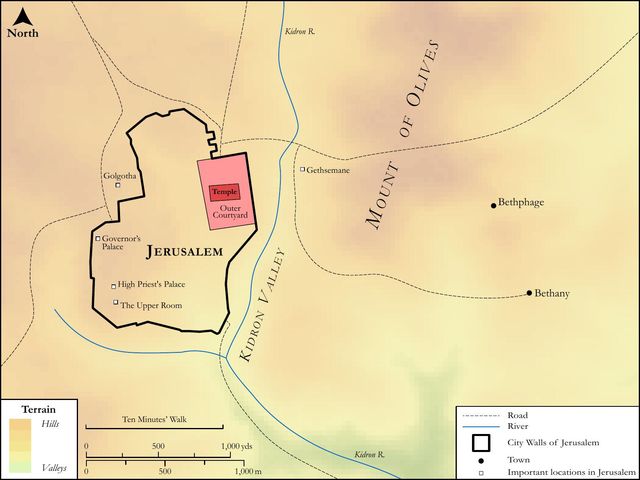
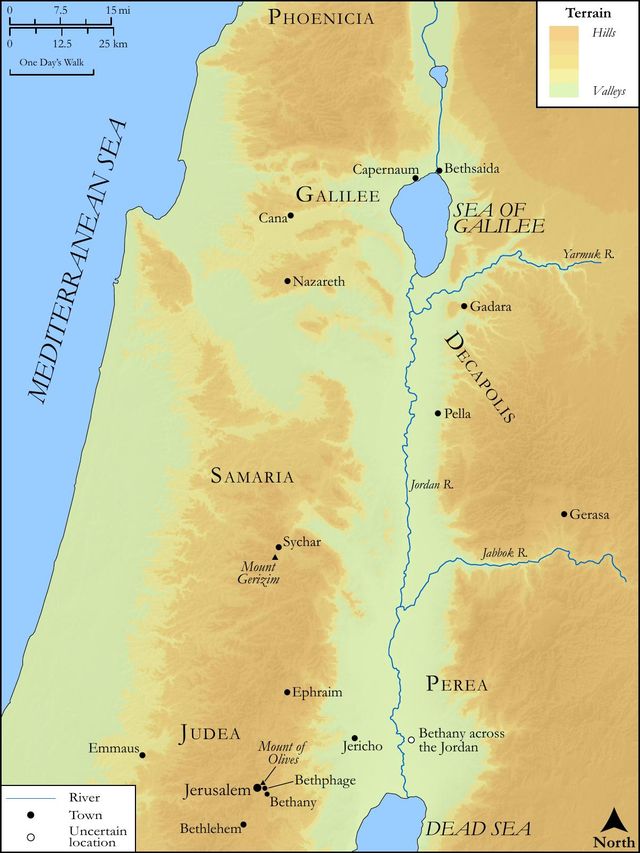
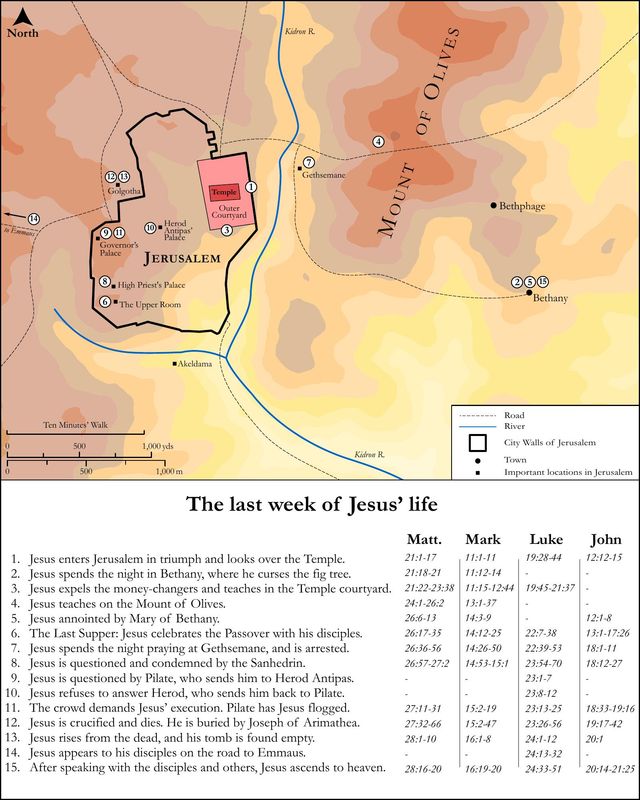
Study this verse
Public-domain commentary
Matthew Henry
From his Commentary on the Whole Bible. Henry comments on passages, not single verses — this entry covers John 16:28–33. His four-level outline is real structure in the source text, so it is rendered as structure.
Two things Christ here comforts his disciples with: -
I.With an assurance that, though he was leaving the world, he was returning to his Father, from whom he came forth Joh 16:28-32, where we have,
1.A plain declaration of Christ's mission from the Father, and his return to him (Joh 16:28): I came forth from the Father, and am come, as you see, into the world. Again, I leave the world, as you will see shortly, and go to the Father. This is the conclusion of the whole matter. There was nothing he had more inculcated upon them than these two things - whence he came, and whither he went, the Alpha and Omega of the mystery of godliness (Ti1 3:16), that the Redeemer, in his entrance, was God manifest in the flesh, and in his exit was received up into glory.
(1.)These two great truths are here,
[1.]Contracted, and put into a few words. Brief summaries of Christian doctrine are of great use to young beginners. The principles of the oracles of God brought into a little compass in creeds and catechisms have, like the beams of the sun contracted in a burning glass, conveyed divine light and heat with a wonderful power. Such we have, Job 28:28; Ecc 12:13; Ti1 1:15; Tit 2:11, Tit 2:12; Jo1 5:11; much in a little.
[2.]Compared, and set the one over against the other. There is an admirable harmony in divine truths; they both corroborate and illustrate one another; Christ's coming and his going do so. Christ had commended his disciples for believing that he came forth from God (Joh 16:27), and thence infers the necessity and equity of his returning to God again, which therefore should not seem to them either strange or sad. Note, The due improvement of what we know and own would help us into the understanding of that which seems difficult and doubtful.
(2.)If we ask concerning the Redeemer whence he came, and whither he went, we are told, [1.] That he came from the Father, who sanctified and sealed him; and he came into this world, this lower world, this world of mankind, among whom by his incarnation he was pleased to incorporate himself. Here his business lay, and hither he came to attend it. He left his home for this strange country; his palace for this cottage; wonderful condescension! [2. That, when he had done his work on earth, he left the world, and went back to his Father at his ascension. He was not forced away, but made it his own act and deed to leave the world, to return to it no more till he comes to put an end to it; yet still he is spiritually present with his church, and will be to the end.
2.The disciples' satisfaction in this declaration (Joh 16:29, Joh 16:30): Lo, now speakest though plainly. It should seem, this one word of Christ did them more good than all the rest, though he had said many things likely enough to fasten upon them. The Spirit, as the wind, blows when and where, and by what word he pleases; perhaps a word that has been spoken once, yea twice, and not perceived, yet, being often repeated, takes hold at last. Two things they improved in by this saying: -
(1.)In knowledge: Lo, now speakest thou plainly. When they were in the dark concerning what he said, they did not say, Lo, now speakest thou obscurely, as blaming him; but now that they apprehend his meaning they give him glory for condescending to their capacity: Lo, now speakest thou plainly. Divine truths are most likely to do good when they are spoken plainly, Co1 2:4. Observe how they triumphed, as the mathematician did with his heurēka, heurēka, when he had hit upon a demonstration he had long been in quest of: I have found it, I have found it. Note, When Christ is pleased to speak plainly to our souls, and to bring us with open face to behold his glory, we have reason to rejoice in it.
(2.)In faith: Now are we sure. Observe,
[1.]What was the matter of their faith: We believe that thou camest forth from God. He had said (Joh 16:27) that they did believe this; "Lord" (say they) "we do believe it, and we have cause to believe it, and we know that we believe it, and have the comfort of it."
[2.]What was the motive of their faith - his omniscience. This proved him a teacher come from God, and more than a prophet, that he knew all things, which they were convinced of by this that he resolved those doubts which were hid in their hearts, and answered the scruples they had not confessed. Note, Those know Christ best that know him by experience, that can say of his power, It works in me; of his love, He loved me. And this proves Christ not only to have a divine mission, but to be a divine person, that he is a discerner of the thoughts and intents of the heart, therefore the essential, eternal Word, Heb 4:12, Heb 4:13. He has made all the churches to know that he searches the reins and the heart, Rev 2:23. This confirmed the faith of the disciples here, as it made the first impression upon the woman of Samaria that Christ told her all the things that ever she did (Joh 4:29), and upon Nathanael that Christ saw him under the fig-tree, Joh 1:48, Joh 1:49.
These words, and needest not that any man should ask thee, may bespeak either, First, Christ's aptness to teach. He prevents us with his instructions, and is communicative of the treasures of wisdom and knowledge that are hid in him, and needs not to be importuned. Or, Secondly, His ability to teach: "Thou needest not, as other teachers, to have the learners' doubts told thee, for thou knowest, without being told, what they stumble at." The best of teachers can only answer what is spoken, but Christ can answer what is thought, what we are afraid to ask, as the disciples were, Mar 9:32. Thus he can have compassion, Heb 5:2.
3.The gentle rebuke Christ gave the disciples for their confidence that they now understood him, Joh 16:31, Joh 16:32. Observing how they triumphed in their attainments, he said, "Do you now believe? Do you now look upon yourselves as advanced and confirmed disciples? Do you now think you shall make no more blunders? Alas! you know not your own weakness; you will very shortly be scattered every man to his own," etc. Here we have,
(1.)A question, designed to put them upon consideration: Do you now believe? [1.] "If now, why not sooner? Have you not heard the same things many a time before?" Those who after many instructions and invitations are at last persuaded to believe have reason to be ashamed that they stood it out so long. [2.] "If now, why not ever? When an hour of temptation comes, where will your faith be then?" As far as there is inconstancy in our faith there is cause to question the sincerity of it, and to ask, "Do we indeed believe?"
(2.)A prediction of their fall, that, how confident soever they were now of their own stability, in a little time they would all desert him, which was fulfilled that very night, when, upon his being seized by a party of the guards, all his disciples forsook him and fled, Mat 26:56. They were scattered,
[1.]From one another; they shifted every one for his own safety, without any care or concern for each other. Troublous times are times of scattering to Christian societies; in the cloudy and dark day the flock of Christ is dispersed, Eze 34:12. So Christ, as a society, is not visible.
[2.]Scattered for him: You shall leave me alone. They should have been witnesses for him upon his trial, should have ministered to him in his sufferings; if they could have given him no comfort they might have done him some credit; but they were ashamed of his chain, and afraid of sharing with him in his sufferings, and left him alone. Note, Many a good cause, when it is distressed by its enemies, is deserted by its friends. The disciples had continued with Christ in his other temptations and yet turned their back upon him now; those that are tried, do not always prove trusty. If we at any time find our friends unkind to us, let us remember that Christ's were so to him. When they left him alone, they were scattered every man to his own; not to their own possessions or habitations, these were in Galilee; but to their own friends and acquaintance in Jerusalem; every one went his own way, where he fancied he should be most safe. Every man to secure his own; himself and his own life. Note, Those will not dare to suffer for their religion that seek their own things more than the things of Christ, and that look upon the things of this world as their ta idia - their own property, and in which their happiness is bound up. Now observe here, First, Christ knew before that his disciples would thus desert him in the critical moment, and yet he was still tender of them, and in nothing unkind. We are ready to say of some, "If we could have foreseen their ingratitude, we would not have been so prodigal of our favours to them;" Christ did foresee theirs, and yet was kind to them. Secondly, He told them of it, to be a rebuke to their exultation in their present attainments: "Do you now believe? Be not high-minded, but fear; for you will find your faith so sorely shaken as to make it questionable whether it be sincere or no, in a little time." Note, even when we are taking the comfort of our graces, it is good to be reminded of our dangers from our corruptions. When our faith is strong, our love flaming, and our evidences are clear, yet we cannot infer thence that tomorrow shall be as this day. Even when we have most reason to think we stand, yet we have reason enough to take heed lest we fall. Thirdly, He spoke of it as a thing very near. The hour was already come, in a manner, when they would be as shy of him as ever they had been fond of him. Note, A little time may produce great changes, both concerning us and in us.
(3.)An assurance of his own comfort notwithstanding: Yet I am not alone. He would not be thought to complain of their deserting him, as if it were any real damage to him; for in their absence he should be sure of his Father's presence, which was instar omnium - every thing: The Father is with me. We may consider this,
[1.]As a privilege peculiar to the Lord Jesus; the Father was so with him in his sufferings as he never was with any, for still he was in the bosom of the Father. The divine nature did not desert the human nature, but supported it, and put an invincible comfort and an inestimable value into his sufferings. The Father had engaged to be with him in his whole undertaking (Psa 89:21 etc.), and to preserve him (Isa 49:8); this emboldened him, Isa 50:7. Even when he complained of his Father's forsaking him, yet he called him My God, and presently after was so well assured of his favourable presence with him as to commit his Spirit into his hand. This he had comforted himself with all along (Joh 8:29), He that sent me is with me, the Father hath not left me alone, and especially now at last. This assists our faith in the acceptableness of Christ's satisfaction; no doubt, the Father was well pleased in him, for he went along with him in his undertaking from first to last.
[2.]As a privilege common to all believers, by virtue of their union with Christ; when they are alone, they are not alone, but the Father is with them. First, When solitude is their choice, when they are alone, as Isaac in the field, Nathanael under the fig-tree, Peter upon the house-top, meditating and praying, the Father is with them. Those that converse with God in solitude are never less alone than when alone. A good God and a good heart are good company at any time. Secondly, When solitude is their affliction, their enemies lay them alone, and their friends leave them so, their company, like Job's, is made desolate; yet they are not so much alone as they are thought to be, the Father is with them, as he was with Joseph in his bonds and with John in his banishment. In their greatest troubles they are as one whom his father pities, as one whom his mother comforts. And, while we have God's favourable presence with us, we are happy, and ought to be easy, though all the world forsake us. Non deo tribuimus justum honorem nisi solus ipse nobis sufficiat - We do not render due honour to God, unless we deem him alone all-sufficient. - Calvin.
II.He comforts them with a promise of peace in him, by virtue of his victory over the world, whatever troubles they might meet with in it (Joh 16:33): "These things have I spoken, that in me you might have peace; and if you have it not in me you will not have it at all, for in the world you shall have tribulation; you must expect no other, and yet may cheer up yourselves, for I have overcome the world." Observe,
1.The end Christ aimed at in preaching this farewell sermon to his disciples: That in him they might have peace. He did not hereby intend to give them a full view of that doctrine which they were shortly to be made masters of by the pouring out of the Spirit, but only to satisfy them for the present that his departure from them was really for the best. Or, we may take it more generally: Christ had said all this to them that by enjoying him they might have the best enjoyment of themselves. Note,
(1.)It is the will of Christ that his disciples should have peace within, whatever their troubles may be without.
(2.)Peace in Christ is the only true peace, and in him alone believers have it, for this man shall be the peace, Mic 5:5. Through him we have peace with God, and so in him we have peace in our own minds.
(3.)The word of Christ aims at this, that in him we may have peace. Peace is the fruit of the lips, and of his lips, Isa 57:19.
2.The entertainment they were likely to meet with in the world: "You shall not have outward peace, never expect it." Though they were sent to proclaim peace on earth, and good-will towards men, they must expect trouble on earth, and ill-will from men. Note, It has been the lot of Christ's disciples to have more or less tribulation in this world. Men persecute them because they are so good, and God corrects them because they are no better. Men design to cut them off from the earth, and God designs by affliction to make them meet for heaven; and so between both they shall have tribulation.
3.The encouragement Christ gives them with reference hereto: But be of good cheer, tharseite. "Not only be of good comfort, but be of good courage; have a good heart on it, all shall be well." Note, In the midst of the tribulations of this world it is the duty and interest of Christ's disciples to be of good cheer, to keep up their delight in God whatever is pressing, and their hope in God whatever is threatening; as sorrowful indeed, in compliance with the temper of the climate, and yet always rejoicing, always cheerful (Co2 6:10), even in tribulation, Rom 5:3.
4.The ground of that encouragement: I have overcome the world. Christ's victory is a Christian triumph. Christ overcame the prince of this world, disarmed him, and cast him out; and still treads Satan under our feet. He overcame the children of this world, by the conversion of many to the faith and obedience of his gospel, making them the children of his kingdom. When he sends his disciples to preach the gospel to all the world, "Be of good cheer," says he, "I have overcome the world as far as I have gone, and so shall you; though you have tribulation in the world, yet you shall gain your point, and captivate the world," Rev 6:2. He overcame the wicked of the world, for many a time he put his enemies to silence, to shame; "And be you of good cheer, for the Spirit will enable you to do so too." He overcame the evil things of the world by submitting to them; he endured the cross, despising it and the shame of it; and he overcame the good things of it by being wholly dead to them; its honours had no beauty in his eye, its pleasures no charms. Never was there such a conqueror of the world as Christ was, and we ought to be encouraged by it,
(1.)Because Christ has overcome the world before us; so that we may look upon it as a conquered enemy, that has many a time been baffled. Nay,
(2.)He has conquered it for us, as the captain of our salvation. We are interested in his victory; by his cross the world is crucified to us, which bespeaks it completely conquered and put into our possession; all is yours, even the world. Christ having overcome the world, believers have nothing to do but to pursue their victory, and divide the spoil; and this we do by faith, Jo1 5:4. We are more than conquerors through him that loved us.
Historical interpretation
Five Centuries of Reception
13 surviving comments on this verse. Each one is dated, so this reads as a timeline rather than a list.
Select a marker to jump to its quote. Markers stagger vertically where authors wrote within a few decades of each other.
This, then, being the case, it was not the Father whom, after His lengthened intercourse with them, they were ignorant of, but it was the Son; and accordingly the Lord, while upbraiding Philip for not knowing Himself who was the object of their ignorance, wished Himself to be acknowledged indeed as that Being whom He had reproached them for being ignorant of after so long a time-in a word, as the Son. And now it may be seen in what sense it was said, "He that hath seen me hath seen the Father," -even in the same in which it was said in a previous passage, "I and my Father are one." Wherefore? Because "I came forth from the Father, and am come into the world" and, "I am the way: no man cometh unto the Father, but by me; " and, "No man can come to me, except the Father draw him; " and, "All things are delivered unto me by the Father; " and, "As the Father quickeneth (the dead), so also doth the Son; " and again, "If ye had known me, ye would have known the Father also."
And these indeed are testimonies bearing on the incarnation of the Word; and there are also very many others. But let us also look at the subject in hand,-namely, the question, brethren, that in reality the Father's power, which is the Word, came down from heaven, and not the Father Himself. For thus He speaks: "I came forth from the Father, and am come." Now what subject is meant in this sentence, "I came forth from the Father," but just the Word? And what is it that is begotten of Him, but just the Spirit, that is to say, the Word? But you will say to me, How is He begotten? In your own case you can give no explanation of the way in which you were begotten, although you see every day the cause according to man; neither can you tell with accuracy the economy in His case. For you have it not in your power to acquaint yourself with the practised and indescribable art (method) of the Maker, but only to see, and understand, and believe that man is God's work. Moreover, you are asking an account of the generation of the Word, whom God the Father in His good pleasure begat as He willed. Is it not enough for you to learn that God made the world, but do you also venture to ask whence He made it? Is it not enough for you to learn that the Son of God has been manifested to you for salvation if you believe, but do you also inquire curiously how He was begotten after the Spirit? No more than two, in sooth, have been put in trust to give the account of His generation after the flesh; and are you then so bold as to seek the account (of His generation) after the Spirit, which the Father keeps with Himself, intending to reveal it then to the holy ones and those worthy of seeing His face? Rest satisfied with the word spoken by Christ, viz., "That which is born of the Spirit is spirit," just as, speaking by the prophet of the generation of the Word, He shows the fact that He is begotten, but reserves the question of the manner and means, to reveal it only in the time determined by Himself. For He speaks thus: "From the womb, before the morning star, I have begotten Thee."
How great is the advantage of going out of the world, Christ Himself, the Teacher of our salvation and of our good works, shows to us, who, when His disciples were saddened that He said that He was soon to depart, spoke to them, and said, "If ye loved me, ye would surely rejoice because I go to the Father; " teaching thereby, and manifesting that when the dear ones whom we love depart from the world, we should rather rejoice than grieve. Remembering which truth, the blessed Apostle Paul in his epistle lays it down, saying, "To me to live is Christ, and to die is gain; " counting it the greatest gain no longer to be held by the snares of this world, no longer to be liable to the sins and vices of the flesh, but taken away from smarting troubles, and freed from the envenomed fangs of the devil, to go at the call of Christ to the joy of eternal salvation.
I came forth from God, and am come into the world,
(vi. de. Trin. c. 31) Perfect faith in the Son, which believes and loves what has come forth from God, and deserveth to be heard and loved for its own sake, this faith confessing the Son of God, born from Him, and sent by Him, needeth not an intercessor with the Father: wherefore it follows, And have believed that I came forth from God. His nativity and advent are signified by, I came forth from the Father, and am come into the world. The one is dispensation, the other nature. To have come from the Father, and to have come forth from God, have not the same meaning; because it is one thing to have come forth from God in the relation of Sonship, another thing to have come from the Father into this world to accomplish the mystery of our salvation. Since to come forth from God is to subsist as His Son, what else can He be but God.
A perfect faith in the Son, which believes and loves the fact that he has come forth from God, has access to the Father without any need of his intervention. The confession that the Son was born and sent from God entitles such a person to a direct audience with God and to love from him. And so the narrative of Jesus’ birth and coming must be taken in the strictest and most literal sense. He says, “I went forth from God,” conveying the fact that his nature is exactly what was given to him by his birth. For what being other than God could go forth from God, that is, could enter upon existence by being born from him? And then he continues, “And I have come from the Father into this world.” In order that he might assure us that this going forth from God means his birth from the Father, he tells us that he came from the Father into the world, referring here to his incarnation. When he said prior to this that he “went forth from God,” however, there he was referring to his [birth by] nature. Since he put on record first the fact of his going forth from God, and then his coming from the Father, we cannot say that the going and the coming are the same thing. Coming from the Father and going forth from God are not synonymous. Perhaps we might paraphrase them instead as “birth” and “presence,” knowing that they are as different in meaning as these two words. It is one thing to have gone forth from God, entering into a substantial existence [with him] by birth. It is quite another, however, to have come from the Father into this world [by birth] in order to accomplish the mysteries of our salvation.
(Hom. lxxix) As it was consolatory to them to hear of His resurrection, and how He came from God, and went to God, He dwells again and again on these subjects: Again I leave the world, and go to the Father. The one was a proof that their faith in Him was not vain: the other that they would still be under His protection.
(Tr. ci. 4) The word ask here means not only to seek for, but to ask a question: the Greek word from which it is translated has both meanings.
(Tr. cii) But does He love us because we love Him; or rather do not we love Him, because He loved us? This is what the Evangelist says, Let us love God, because God first loved us. (1 John 4:19) The Father then loves us, because we love the Son, (Diligamus Deum, Vulg.) it being from the Father and the Son, that we receive the love from the Father and the Son. He loves what He has made; but He would not make in us what He loved, except He loved us in the first place.
(Tr. cii) He came forth from the Father, because He is of the Father; He came into the world, because He showed Himself in the body to the world. He left the world by His departure in the body, and went to the Father by the ascension of His humanity, nor yet in respect of the government of His presence, left the world; just as when He went forth from the Father and came into the world, He did so in such wise as not to leave the Father. But our Lord Jesus Christ, we read, was asked questions, and petitioned after His resurrection: for when about to ascend to Heaven He was asked by His disciples when He would restore the kingdom to Israel; when in Heaven He was asked by Stephen, to receive his spirit. And who would dare to say that as mortal He might be asked, as immortal He might not? I think then that when He says, In that day ye shall ask Me nothing, He refers not to the time of His resurrection, but to that time when we shall see Him as He is: which vision is not of this present life, but of the life everlasting, when we shall ask for nothing, ask no questions, because there will remain nothing to be desired, nothing to be learnt.
(Tr. cii) The word whatsoever, must not be understood to mean any thing, but something which with reference to obtaining the life of blessedness is not nothing. That is not sought in the Saviour's name, which is sought to the hindering of our salvation; for by, in My name, must be understood not the mere sound of the letters or syllables, but that which is rightly and truly signified by that sound. He who holds any notion concerning Christ, which should not be held of the only Son of God, does not ask in His name. But he who thinks rightly of Him, asks in His name, and receives what he asks, if it be not against his eternal salvation: he receives when it is right he should receive; for some things are only denied at present in order to be granted at a more suitable time. Again, the words, He will give it you, only comprehend those benefits which properly appertain to the persons who ask. All saints are heard for themselves, but not for all; for it is not, will give, simply, but, will give you; what follows: Hitherto have ye asked nothing in My name, may be understood in two ways: either that they had not asked in His name, because they had not known it as it ought to be known; or, Ye have asked nothing, because with reference to obtaining the thing ye ought to ask for, what ye have asked for is to be counted nothing. That therefore they may ask in His name not for what is nothing, but for the fulness of joy, He adds, Ask and ye shall receive, that your joy may be full. This full joy is not carnal, but spiritual joy; and it will be full, when it is so great that nothing can be added to it.
(1. de Trin. c. 8) And this is that full joy, than which nothing can be greater, viz. to enjoy God, the Trinity, in the image of Whom we are made.
(Tr. cii) Whatsoever then is asked, which appertained to the getting this joy, this must be asked in the name of Christ. For His saints that persevere in asking for it, He will never in His divine mercy disappoint. But whatever is asked beside this is nothing, i. e. not absolutely nothing, but nothing in comparison (computatione) with so great a thing as this. It follows: These things have I spoken unto you in proverbs: but the time cometh, when I shall no more speak unto you in proverbs, but I shall show you plainly of the Father. The hour of which He speaks may be understood of the future life, when we shall see Him, as the Apostle saith, face to face, (1 Cor. 13:12) and, These things have I spoken to you in proverbs, of that which the Apostle saith, Now we see as in a glass darkly. But I will show you that the Father shall be seen through the Son; For no man knoweth the Father save the Son, and he to whom the Son shall reveal Him. (Mat. 11:17)
(Tr. cii. c. 3) But this sense seems to be interfered with by what follows: At that day ye shall ask in My name. What shall we have to ask for in a future life, when all our desires shall be satisfied? Asking implies the want of something. It remains then that we understand the words of Jesus going to make His disciples spiritual, from being carnal and natural beings. The natural man so understands whatever he hears of God in a bodily sense, as being unable to conceive any other. Wherefore whatever Wisdom saith of the incorporeal, immutable substance are proverbs to him, not that he accounts them proverbs, but understands them as if they were proverbs. But when, become spiritual, he hath begun to discern all things, though in this life he see but in a glass and in part, ye doth he perceive, not by bodily sense, not by idea of the imagination, but by most sure intelligence of the mind, perceive and hold that God is not body, but spirit: the Son showeth so plainly of the Father, that He who showeth is seen to be of the same nature with Him who is shewn. Then they who ask, ask in His name, because by the sound of that name they understand nothing but the thing itself which is expressed by that name. These are able to think that our Lord Jesus Christ, in so far as He is man, intercedes with the Father for us, in so far as He is God, hears us together with the Father: which I think is His meaning when He says, And I say not unto you that I will pray the Father for you. To understand this, viz. how that the Son does not ask the Father, but Father and Son together hear those who ask, is beyond the reach of any but the spiritual vision.
"And ye have believed," He adds, "that I came out from God. I came forth from the Father, and am come into the world: again I leave the world, and go to the Father." Clearly we have believed. For surely it ought not to be accounted a thing incredible because of this, that in coming to the world He came forth in such a sense from the Father that He did not leave the Father behind; and that, on leaving the world, He goes to the Father in such a sense that He does not actually forsake the world. For He came forth from the Father because He is of the Father; and He came into the world, in showing to the world His bodily form, which He had received of the Virgin. He left the world by a bodily withdrawal, He proceeded to the Father by His ascension as man, but He forsook not the world in the ruling activity of His presence.
When Jesus says that he came into this world and again left the world and went to the Father, he does not mean that he either abandoned the Father when he became man or that he abandoned the human race when, in the flesh, he went to the Father. For he is truly God and with his ineffable power fills all things and is not far from anything that exists.
Herein, then, in the fact that our Lord went back to the Father and returned with power to the place from which He knew that He had gone forth, is proof clear and incontrovertible, that He was not one of the false prophets, and that He did not come to utter to us the promptings of man's private judgment, or to teach us doctrines contrary to the Father's Will, as the demented Jews ignorantly imagined. Granting then, (so a man might speak, wishing to combat the perverse opinions of the Jews) that He was not the true Christ, as you say. O Jews, and that without the approval of God the Father He introduced the teaching of the life according to the Gospel, showing that the commandment of the Law was now barren, and so profitless for the attainment of perfection in piety; (for you accuse Him as a Sabbath-breaker, and, when He did any wonderful works among you, you impiously said that He used to do them by Beelzebub the prince of the devils); how then was it that He ascended into heaven itself? How was it that the Father gave a share of His throne, and the angels threw open wide the gates of heaven, to Him Who combated His decrees as you say, and propounded doctrines contrary to the Will of the Sovereign of the Universe? Was His Ascension unobserved? Of a truth, great was the crowd of witnesses to whom the Divine and heavenly messenger spake the words: Ye men of Galilee, why stand ye looking into heaven? this Jesus, Which was received up from you into heaven, shall so come in like manner as ye beheld Him going into heaven. What hast thou, O Jews, to say in reply? Wilt thou not honour with obedience even the voice of an angel? Wilt thou not accept the testimony of the witnesses, though those who gazed upon the scene were many in number? And yet the Law says clearly, In the mouth of two or three witnesses shall every word be established. How then any longer can the reproach of being a false prophet be brought with any justice against Him, Who of His own power returns to the Father in heaven? And will it not rather follow, by the convincing logic of facts, that we should entertain the firm conviction that He came from God, that is from the Father, and is in fact no other than He Whom the Law and the prophets foretold unto us?
And when He says that He came into this world and again left the world and went to the Father, He does not mean that He either abandoned the Father when He became Man, nor that He abandoned the race of man when in His flesh He went to the Father; for He is truly God, and with His ineffable power filleth all things, and is not far from anything that exists.
He came forth from the Father and came into the world because he made himself visible to the world in his humanity, who in his divinity was invisible along with the Father. He came forth from the Father, because he appeared not in that form in which he is equal to the Father but in the lesser one of a created being that he took on himself. And he came into the world because, in the form of a servant that he accepted, he offered himself to be seen even by those who love this world. Again, he left the world behind and returned to the Father because he removed from the sight of those who love the world what they had seen, and he taught to those who love him that he should be believed to be equal to the Father. He left the world behind and returned to the Father because by his ascension he brought the humanity that he had put on to the place of invisible realities.
Some of the things said concerning Christ make known the fact of his origin from the Father as cause.… For from him he derives both his being and all that he has. His being was by generative and not by creative means, as, “I came forth, and I have come,” and “I live because of the Father.” But all that he has is not by free gift or by teaching, but in a causal sense, as “the Son is not able to do anything of himself, unless he sees the Father doing anything.” For if the Father does not exist, neither does the Son. For the Son is of the Father and in the Father and with the Father, and not after the Father. In a similar way also what he does is of him and with him. For there is one and the same—not similar but the same—will and energy and power in the Father, Son and Holy Spirit.
Continue studying John 16:28 across the web’s major study libraries — every link below opens this exact verse, chapter, or book on the destination site.
Read & Compare
 BibleGatewayThis verse in more than 200 translations and 70 languages.
 Bible.comThe YouVersion reader — hundreds of translations, reading plans, and highlights.
 ESV.orgCrossway's official English Standard Version reader.
 NET BibleThe NET translation with 60,000+ translators' notes on every rendering decision.
 STEP BibleTyndale House's free study tool — original text, vocabulary, and scholarly resources.
 BibliaLogos Bible Software's free web reader.
 USCCBThe New American Bible (Revised Edition) with the U.S. bishops' study notes.
Commentaries
 BibleHub CommentariesDozens of classic commentaries on this verse, gathered on one page.
 StudyLightMore than 100 commentary sets — the largest collection on the web.
 BibleRefPlain-English commentary on what this verse means, verse by verse.
 Enduring WordDavid Guzik's free commentary on this chapter, widely used by Bible teachers.
 Bible Study ToolsVerse commentary alongside Greek and Hebrew study aids.
Original Language & Research
- BibleHub InterlinearThe verse word by word — original language, transliteration, and English.
- BibleHub LexiconEvery word's original-language definition and Strong's entry.
 Blue Letter BibleDeep-study tools — Strong's numbers, concordance, and word studies.
 CNTR CollationThe earliest Greek manuscripts of this verse, collated letter by letter.
Sermons, Hymns & Audio


TrulyRandomVerse is not affiliated with these sites and doesn’t control their content. They’re linked because they’re genuinely useful.
Summary
John 16:28 serves as a profound, concise declaration by Jesus, encapsulating the entirety of His redemptive mission: His divine origin from the Father, His incarnation into the world, His impending departure from the world through death and resurrection, and His glorious return to the Father. This statement, delivered during His Farewell Discourse, provides His disciples with a foundational understanding of His identity and the cosmic scope of His saving work, offering both clarification and comfort in the face of His imminent physical absence.
Context
ShowHideLiterary Context
This verse is a pivotal summary within Jesus' Farewell Discourse (John 13-17), delivered to His disciples in the upper room on the night before His crucifixion. Throughout this discourse, Jesus has been preparing His disciples for His departure, speaking of the coming of the Holy Spirit, the world's hatred, and the sorrow that will turn into joy. The disciples have been struggling to fully grasp His veiled references to "going away" and "a little while." Just prior to this verse, Jesus has explicitly stated that He would speak no more in parables but plainly (John 16:25). This verse, John 16:28, is His direct, unambiguous statement that finally clarifies His origin and destination, prompting the disciples' affirmation of understanding in John 16:29-30. It acts as a theological anchor, confirming the truth of His mission before He faces the cross.
Historical & Cultural Context
The setting is Jerusalem during Passover week, a time of immense religious and nationalistic fervor. The disciples, being devout Jews, would have been steeped in Old Testament prophecies concerning the Messiah, often expecting a political deliverer who would establish an earthly kingdom. Jesus' repeated references to His "departure" and "going to the Father" would have been deeply unsettling and confusing for them, as it contradicted their earthly expectations of a conquering king. Culturally, the concept of a divine messenger coming from God and returning to God was not entirely alien in some philosophical circles, but Jesus' unique claim of being the Son who literally "came forth from the Father" and would "go to the Father" transcended typical human understanding, asserting a pre-existent, divine nature that was profoundly counter-cultural to strict monotheistic interpretations without the Trinitarian revelation.
Key Themes
ShowHideJohn 16:28 powerfully articulates several core themes central to John's Gospel and Christian theology. Firstly, it underscores the Divine Origin and Pre-existence of Christ, echoing the prologue's declaration that the Word was with God and was God. Jesus' coming "from the Father" establishes His unique, eternal relationship with God. Secondly, it highlights the Incarnation, the astonishing truth that the eternal Son "came into the world" by taking on human flesh, as vividly proclaimed in John 1:14. Thirdly, the verse foreshadows Jesus' Atoning Work and Ascension, signifying that His "leaving the world" is not an abandonment but the completion of His redemptive mission through His death, resurrection, and subsequent return to glory. This departure is the means by which He accomplishes salvation. Finally, it emphasizes Jesus' Return to the Father's Presence and Exaltation, affirming that His mission culminates in His glorious re-enthronement at God's right hand, as seen in Acts 1:9-11.
Exposition and Analysis
ShowHideKey Word Analysis
ShowHideMeaning "to issue (literally or figuratively):--come (forth, out), depart (out of), escape, get out, go (abroad, away, forth, out, thence), proceed (forth), spread abroad." This word emphasizes Jesus' divine origin and initiative. He did not merely appear, but actively "issued forth" from the Father, underscoring His pre-existence and purposeful mission. It suggests a deliberate movement from one sphere of existence (the divine, eternal realm) into another (the temporal, earthly realm).
Meaning "orderly arrangement, i.e. decoration; by implication, the world (in a wide or narrow sense, including its inhabitants, literally or figuratively (morally)):--adorning, world." In John's Gospel, "world" often carries a dual meaning: the created order and humanity, often in its fallen, alienated state from God. Here, it signifies the sphere of human existence and sin into which Jesus entered for redemptive purposes, highlighting the vast chasm He bridged.
Meaning "a 'father' (literally or figuratively, near or more remote):--father, parent." This term is central to John's theology, emphasizing the unique, intimate, and eternal relationship between Jesus and God. Jesus is not merely a prophet or a servant, but the Son who shares the very essence and being of the Father, from whom He originates and to whom He returns. This relationship is the source of His authority and mission.
Meaning "to send forth, in various applications (as follow):--cry, forgive, forsake, lay aside, leave, let (alone, be, go, have), omit, put (send) away, remit, suffer, yield up." In this context, "leave" signifies Jesus' departure from the earthly realm, encompassing His death, resurrection, and ascension. It is not an abandonment but a purposeful completion of His mission, allowing for the sending of the Holy Spirit and His return to glory.
Verse Breakdown
ShowHide"I came forth from the Father,"
This clause asserts Jesus' divine origin and pre-existence. It speaks to His eternal relationship with God the Father, indicating that He did not begin His existence at His human birth but proceeded from the very being of God. This is a profound statement of His divinity, establishing His authority and unique identity as the Son of God.
"and am come into the world:"
This signifies the Incarnation, the moment when the eternal Son took on human flesh and entered the created order. It highlights the condescension of God, who, out of love, entered the realm of humanity, with all its brokenness and sin, to accomplish salvation. This "coming" is a deliberate, purposeful act of divine intervention.
"again, I leave the world,"
This points to Jesus' impending departure from His earthly ministry, which would involve His crucifixion, death, resurrection, and ultimately, His ascension. The word "again" (pálin) emphasizes the cyclical nature of His journey—a return movement. His "leaving" is not a defeat but the necessary fulfillment of His redemptive work, making way for the next phase of God's plan.
"and go to the Father."
This final clause describes Jesus' glorious return to His rightful place at the Father's side. It speaks of His ascension and exaltation, signifying the successful completion of His earthly mission and His re-entry into the full glory of the Godhead. This return ensures His ongoing intercession for believers and His sovereign rule from heaven.
Literary Devices
ShowHideJohn 16:28 masterfully employs Chiasm (an A-B-B'-A' structure) to underscore Jesus' complete redemptive journey. The pattern is "Came forth from the Father (A) – came into the world (B) – leave the world (B') – go to the Father (A')." This chiastic structure visually and conceptually emphasizes the cyclical nature of His mission, beginning and ending with the Father, with His earthly sojourn as the central, pivotal event. Furthermore, the verse utilizes Antithesis or Contrast by juxtaposing "from the Father" with "into the world" and "leave the world" with "go to the Father." This highlights the two distinct realms Jesus traversed – the divine and the earthly – and the profound distance He bridged for humanity's salvation. The concise, declarative nature of the statement also lends it a powerful Authoritative Tone, reinforcing Jesus' unique self-awareness and divine identity.
Theological and Thematic Connections
ShowHideJohn 16:28 is a theological cornerstone, succinctly articulating the pre-existence, incarnation, atoning work, and ascension of Jesus Christ. It reveals the Trinitarian nature of God, with the Son originating from and returning to the Father, all within the divine plan for humanity's salvation. This verse underscores the purposeful nature of Christ's entire earthly sojourn, not as an accidental event but as a divinely orchestrated mission from eternity to eternity. It assures believers that Jesus' departure was not an abandonment but a necessary step for the full realization of God's redemptive purposes, including the sending of the Holy Spirit and His ongoing intercession for His people.
Reflection and Application
ShowHideJohn 16:28 offers profound comfort and clarity for believers today. It grounds our faith in the absolute truth of Jesus' divine identity and the purposeful nature of His mission. Understanding that Jesus "came forth from the Father" assures us of His authority and the divine backing of His words and works. His "coming into the world" reminds us of God's immense love and willingness to enter our broken reality to redeem us. His "leaving the world" and "going to the Father" signifies the completion of His redemptive work on the cross and His glorious exaltation, ensuring our salvation and His ongoing intercession for us. This complete journey provides an unshakable foundation for our hope and trust, knowing that our Savior is not merely a historical figure but the eternally existent Son who accomplished all that was necessary for our reconciliation with God. It calls us to live with confidence in His finished work and with anticipation of His promised return.
Questions for Reflection
ShowHideFAQ
ShowHideWhat is the significance of Jesus saying "I came forth from the Father"?
ShowHideThis statement is profoundly significant because it asserts Jesus' divine origin and pre-existence. It means Jesus did not begin His existence at His birth in Bethlehem but eternally existed with the Father. It highlights His unique relationship as the Son who proceeds from the very essence of God, establishing His divinity and authority. This is a core tenet of Christian theology, affirming that Jesus is God incarnate, not merely a prophet or a created being. It echoes the opening of John's Gospel, where the Word was with God and the Word was God.
How does this verse relate to the Incarnation and the Ascension?
ShowHideJohn 16:28 directly speaks to both the Incarnation and the Ascension. "I came forth from the Father, and am come into the world" refers to the Incarnation, where the eternal Son of God took on human flesh and dwelt among humanity (John 1:14). This was God's direct intervention into human history. "Again, I leave the world, and go to the Father" refers to Jesus' departure from the earthly realm through His death, resurrection, and ultimately, His Ascension. The Ascension is His glorious return to His rightful place at the Father's side, signifying the completion of His earthly redemptive work and His exaltation (Acts 1:9).
Why did Jesus need to "leave the world" and "go to the Father"?
ShowHideJesus' departure was essential for several reasons. Firstly, it marked the completion of His atoning work on the cross, His victory over sin and death through the resurrection, and His glorification. Secondly, His physical departure was necessary for the coming of the Holy Spirit, the "Comforter" or "Advocate," who would empower the disciples, guide them into all truth, and indwell believers (John 16:7). Thirdly, His return to the Father signifies His ongoing role as our High Priest and Advocate, interceding for us in heaven (Hebrews 7:25). His ascension also foreshadows His promised return to earth (John 14:3).
Christ-Centered Fulfillment
ShowHideJohn 16:28 is a quintessential Christ-centered statement, encapsulating the entire arc of the Son's redemptive mission. It speaks to Jesus' eternal pre-existence with the Father, a truth echoed in Colossians 1:15-17 where He is described as the "image of the invisible God, the firstborn over all creation." His "coming into the world" is the Incarnation, the miraculous moment when the divine Word became flesh, taking on human nature without ceasing to be God, as beautifully articulated in Philippians 2:6-8. This act of divine condescension was solely for the purpose of salvation, to reconcile a fallen humanity to a holy God. His statement "I leave the world" foreshadows His sacrificial death on the cross, the ultimate act of atonement by which He bore the sins of humanity, fulfilling the prophecies of the suffering servant found in Isaiah 53:5-6. Finally, His declaration "and go to the Father" points to His glorious resurrection and ascension, where He was exalted to God's right hand, reigning as King and High Priest (Hebrews 4:14-16). Thus, John 16:28 is not merely a historical summary but a profound theological truth that reveals the very heart of the Gospel: God's eternal Son, in perfect obedience to the Father, fully accomplished salvation from beginning to end, bridging the chasm between God and humanity and securing eternal life for all who believe in Him.